Compliance Just Got Easier: Stay ahead of regulatory changes with instant notifications on updates that matter.
['Toxic Substances Control Act - EPA']
['Toxic Substances - EPA', 'Toxic Subtances Control Act - EPA']
2021-05-12T05:00:00Z
JOIN TODAY TO CONTINUE READING THIS ARTICLE & OTHER INDUSTRY NEWS!
You'll also get exclusive access to:
A database of easy-to-understand regulationsAsk unlimited questions to our expertsPre-led discussions forumsAnd more
TRY IT FREE TODAY
Already have an account? Log in now.

Copyright 2026 J. J. Keller & Associate, Inc. For re-use options please contact copyright@jjkeller.com or call 800-558-5011.
NewsIndustry NewsIndustry NewsToxic Substances Control Act - EPAToxic Subtances Control Act - EPATSCA ComplianceToxic Substances - EPAEnvironmentalEnglishFocus AreaUSA
EPA releases updated PFBS toxicity assessments
2021-05-12T05:00:00Z
Continuing to build its library of information on per- and polyfluoroalkyl substances (PFAS), EPA issued two final assessments on the toxicity of perfluorobutane sulfonic acid (PFBS), a member of the larger group of PFAS. The toxicity assessments, for PFBS and K PFBS (the potassium salt of PFBS) provide one piece of information used in determining when there is a risk to public health.
In the assessment, chronic and subchronic oral reference doses (RfDs) for PFBS have been established. These values represent the amount of a chemical a person can ingest daily over a lifetime (chronic RfD) or less (subchronic RfD) that is unlikely to lead to adverse health effects. For PFBS the assessment established a subchronic RfD of 0.001mg/kg-day and a chronic RfD of 0.0003 mg/kg-day, greater than those of PFOA and PFOS, suggesting PFBS is less toxic to humans. Next steps for this data, include connecting these toxicity values to exposure, and other risk factors, to determine if, and when, it is appropriate to address PFBS.
PFBS is a replacement chemical for PFOS, a chemical that was voluntarily phased out in 2002. PFBS has been identified in the environment and consumer products, including surface water, wastewater, drinking water, dust, carpeting and carpet cleaners, and floor wax. Animal studies have shown health effects from PFBS, a number of organs with the thyroid appearing to be particularly sensitive to oral PFBS exposure.

NewsIndustry NewsIndustry NewsToxic Substances Control Act - EPAToxic Subtances Control Act - EPATSCA ComplianceToxic Substances - EPAEnvironmentalEnglishFocus AreaUSA
EPA releases updated PFBS toxicity assessments
2021-05-12T05:00:00Z
Continuing to build its library of information on per- and polyfluoroalkyl substances (PFAS), EPA issued two final assessments on the toxicity of perfluorobutane sulfonic acid (PFBS), a member of the larger group of PFAS. The toxicity assessments, for PFBS and K PFBS (the potassium salt of PFBS) provide one piece of information used in determining when there is a risk to public health.
In the assessment, chronic and subchronic oral reference doses (RfDs) for PFBS have been established. These values represent the amount of a chemical a person can ingest daily over a lifetime (chronic RfD) or less (subchronic RfD) that is unlikely to lead to adverse health effects. For PFBS the assessment established a subchronic RfD of 0.001mg/kg-day and a chronic RfD of 0.0003 mg/kg-day, greater than those of PFOA and PFOS, suggesting PFBS is less toxic to humans. Next steps for this data, include connecting these toxicity values to exposure, and other risk factors, to determine if, and when, it is appropriate to address PFBS.
PFBS is a replacement chemical for PFOS, a chemical that was voluntarily phased out in 2002. PFBS has been identified in the environment and consumer products, including surface water, wastewater, drinking water, dust, carpeting and carpet cleaners, and floor wax. Animal studies have shown health effects from PFBS, a number of organs with the thyroid appearing to be particularly sensitive to oral PFBS exposure.


See More
RELATED NEWS



Specialized Industries
Go beyond the regulations! Visit the Institute for in-depth guidance on a wide range of compliance subjects in safety and health, transportation, environment, and human resources.
J. J. Keller® COMPLIANCE NETWORK is a premier online safety and compliance community, offering members exclusive access to timely regulatory content in workplace safety (OSHA), transportation (DOT), environment (EPA), and human resources (DOL).

Interact With Our Compliance Experts
Puzzled by a regulatory question or issue? Let our renowned experts provide the answers and get your business on track to full compliance!

Upcoming Events
Reference the Compliance Network Safety Calendar to keep track of upcoming safety and compliance events. Browse by industry or search by keyword to see relevant dates and observances, including national safety months, compliance deadlines, and more.

SAFETY & COMPLIANCE NEWS
Keep up with the latest regulatory developments from OSHA, DOT, EPA, DOL, and more.



REGSENSE® REGULATORY REFERENCE
Explore a comprehensive database of word-for-word regulations on a wide range of compliance topics, with simplified explanations and best practices advice from our experts.

THE J. J. KELLER INSTITUTE
The Institute is your destination for in-depth content on 120+ compliance subjects. Discover articles, videos, and interactive exercises that will strengthen your understanding of regulatory concepts relevant to your business.



ADD HAZMAT, ENVIRONMENTAL, & HR RESOURCES
Unlock exclusive content offering expert insights into hazmat, environmental, and human resources compliance with a COMPLIANCE NETWORK EDGE membership.

DIRECT ACCESS TO COMPLIANCE EXPERTS
Struggling with a compliance challenge? Get the solution from our in-house team of experts! You can submit a question to our experts by email, set up a phone or video call, or request a detailed research report.



EVENTS
Register to attend live online events hosted by our experts. These webcasts and virtual conferences feature engaging discussions on important compliance topics in a casual, knowledge-sharing environment.
Most Recent Highlights In Environmental

NewsEnforcement and Audits - OSHACERCLA, SARA, EPCRAToxics Release Inventory ReportingVideoMonthly Roundup VideoCAA ComplianceInjury and Illness RecordkeepingEnglishOSHA Violations and PenaltiesAir ProgramsIndustry NewsSafety & HealthGeneral Industry Safety300-A Annual SummaryEnvironmentalFocus AreaAir ProgramsUSA
EHS Monthly Round Up - January 2023
In this monthly roundup video, we’ll review the most impactful environmental, safety, and health news.
Hi everyone! Welcome to the monthly roundup video, where we’ll review the most impactful environmental, safety, and health news. First, let’s take a look at what’s happening in safety and health.
If you haven’t already done so, now is the time to post your OSHA 300A Summary. Employers are required to post the Summary in a conspicuous place from February 1st through April 30th.
As required by law, OSHA increased its penalties for inflation in mid-January. Penalties went up 7.7 percent, effective January 17th.
Also in January, OSHA released its long-awaited Fall 2022 regulatory agenda. Along with numerous proposed rules in the works, three major final rules are slated for 2023 – COVID-19 in healthcare, Injury and Illness tracking, and an update to the hazard communication standard.
OSHA recently released two new letters of interpretation, which address exit signs and lockout/tagout. Specifically, OSHA states that the International Standards Organization emergency exit symbol can be located beside the mandatory EXIT text on an existing sign.
The second letter addresses the applicability of lockout/tagout and the maintenance and operations of cathodic protection rectifiers when working on pipelines.
New York’s Warehouse Worker Protection Act was signed into law in December and takes effect in late February. It protects warehouse distribution workers from undisclosed or unlawful work speed quotas and includes protections for workers who fail to meet these quotas.
In 2021, a worker died every 101 minutes from a work-related injury, according to the Bureau of Labor Statistics. A total of 5,190 fatal work injuries was recorded in the U.S. in 2021, an 8.9 percent increase over 2020.
Turning to environmental news, EPA automatically added nine per- and polyfluoroalkyl substances, or PFAS, to the Toxics Release Inventory, or TRI, list. Four PFAS were added since they are no longer claimed as confidential business information.
EPA released its Fall 2022 regulatory agenda in early January. Included are major regulations impacting the National Ambient Air Quality Standards, waters of the United States, and modifications to the Risk Management Program under the Clean Air Act.
There are also a number of rules related to the National Emission Standards for Hazardous Air Pollutants in various rule stages.
And finally, beginning with model year 2027, heavy-duty trucks will be required to meet clean air standards that are 80 percent more stringent than current requirements.
EPA says this final rule is aimed at reducing smog- and soot-forming emissions, increasing the life of governed vehicles by up to 250 percent, and increasing emissions warranty periods up to 450 percent.
Thanks for tuning in to the monthly news roundup!
NewsIndustry NewsWater AnalysisToxic Water PollutantsWater ProgramsIn-Depth ArticleEnvironmentalWater MonitoringWater ProgramsUSAEnglishFocus AreaCWA Compliance
2026-10-23T05:00:00Z
Looking beyond PFAS: Emerging contaminants draw EPA's attention
For years, conversations about emerging contaminants have focused on per- and polyfluoroalkyl substances (PFAS). While PFAS remain a major regulatory and public concern, they represent only one part of a much larger picture. Regulators and researchers are increasingly evaluating a broader range of chemicals that may be present in drinking water and the environment.
A recent EPA research initiative highlights this shift. In September 2026, EPA announced a scientific study that will use non-targeted analysis (NTA) to improve the agency's understanding of emerging contaminants in drinking water. Unlike traditional analytical methods that look for a limited list of chemicals, NTA allows researchers to screen for thousands of potential contaminants and identify previously unknown substances.
Emerging contaminants continue to evolve
There is no single regulatory definition of "emerging contaminant." Generally, the term refers to chemicals that have been detected in the environment and may present risks to human health or ecosystems but are not yet fully understood, routinely monitored, or regulated.
Many emerging contaminants are not new chemicals. In many cases, they have been used for decades. What has changed is the ability to detect them at very low concentrations and to better understand where they occur, how they move through the environment, and what impacts they may have.
PFAS are a prime example. Once largely unknown outside technical circles, they are now the subject of drinking water standards, reporting requirements, cleanup efforts, and litigation. Other contaminant groups may follow a similar path as research continues.
EPA is expanding its view beyond PFAS
As part of its study, EPA developed a screening library containing more than 1,400 emerging contaminants. According to EPA, the library includes more than 1,000 pesticides and pesticide metabolites, more than 250 pharmaceuticals and personal care products, more than 70 PFAS, and other emerging contaminants.
While PFAS remain the most recognized emerging contaminant family, EPA's screening efforts extend far beyond fluorinated chemicals. The pharmaceutical and personal care product category includes compounds such as antibiotics, hormones, and other medicinal ingredients that can enter the environment through wastewater systems and other pathways. The pesticide category encompasses herbicide, insecticide, fungicide, and pesticide degradation products that may persist in soil, groundwater, or surface water.
EPA states that the study will help identify contaminants that may warrant additional investigation in the future.
Why this matters now
Most facilities are not currently required to monitor for hundreds or thousands of emerging contaminants. However, today's research efforts often become tomorrow's regulatory priorities.
Historically, contaminants often attract scientific attention long before regulatory requirements follow. As occurrence data grows and analytical methods improve, regulators gain a better understanding of where contaminants are found and whether additional action is needed.
Facilities that manufacture, process, use, discharge, or dispose of chemicals should understand which substances are present in their operations and waste streams. This includes evaluating raw materials, wastewater discharges, byproducts, and residual wastes. Facilities may also want to monitor supplier communications and regulatory developments related to chemicals used in their operations.
Organizations with strong chemical inventory management and environmental review processes are often better positioned to adapt when new contaminants attract regulatory attention.
Preparing for what comes next
Organizations do not need to become experts on every emerging contaminant. However, focusing solely on PFAS could cause them to overlook broader trends developing across the environmental landscape.
EPA's latest drinking water study demonstrates that regulators are increasingly using advanced analytical tools to evaluate a much wider universe of chemicals. Whether the next major concern involves pharmaceuticals, pesticide metabolites, or another group of contaminants, facilities that stay informed about emerging issues will be better positioned to anticipate and respond to future compliance challenges.
Key to remember: PFAS may be the most visible emerging contaminant today, but they are unlikely to be the last. EPA's recent drinking water study shows that regulators are evaluating a much broader range of contaminants, making it important for facilities to stay informed about emerging chemical concerns before they become regulatory requirements.
NewsEnglishWasteHawaiiChange NoticesChange NoticeWasteSpecial WasteWaste ManagementEnvironmentalSolid WasteWaste/HazWasteFocus Area
2026-10-20T05:00:00Z
Hawaii overhauls solid waste landfill regulations
Effective date: September 25, 2026
This applies to: Facilities that manage solid waste
Description of change: The State of Hawaii Department of Health made the first major update to the solid waste management control regulations in decades. The amended regulations:
- Increase flexibility for small municipal solid waste landfills (MSWLFs),
- Revise siting restrictions for MSWLFs,
- Add requirements for construction and demolition landfills and special waste landfills,
- Add leachate control and closure requirements for all solid waste management facilities,
- Require auto processing and salvaging on an impervious surface, and
- Update the solid waste permitting program.
Examples of significant changes include:
- Adding requirements for facilities that manage solid waste (except landfills), such as leachate control for all facilities and use of impervious working surfaces for solid waste salvage facilities;
- Updating MSWLF requirements (such as requiring compliance with the federal maximum contaminant level or state level (whichever is lower) for groundwater contaminants); and
- Adding new requirements for construction and demolition landfills.
Related state info: Non-hazardous solid waste and recycling state comparison
NewsChange NoticesChange NoticeWater ProgramsWater QualityEnvironmentalWater ProgramsEnglishNorth DakotaFocus AreaCWA Compliance
2026-10-20T05:00:00Z
North Dakota adopts permanent septic system rules
Effective date: October 1, 2026
This applies to: The licensing, permitting, and installation of on-site wastewater treatment systems (septic systems)
Description of change: The North Dakota Department of Environmental Quality (DEQ) finalized permanent rules for on-site wastewater treatment systems (septic systems). The final rule establishes statewide licensing requirements, a common technical code, and a process for variances from the code.
Senate Bill 2267 shifted responsibility for regulating septic systems to the DEQ. The department issued an emergency rule in 2025 to continue existing licenses. This rulemaking finalizes:
- Licensing requirements for septic system installers,
- Training requirements for licensed septic system installers,
- Permit requirements (permits will continue to be issued by the local permitting authority), and
- Technical requirements (which closely align with the existing voluntary common code previously developed).
NewsEnglishChange NoticesChange NoticeOhioWasteEnvironmentalSolid WasteLand Disposal RestrictionsWaste/HazWasteFocus Area
2026-10-20T05:00:00Z
Ohio establishes CCR regulations
Effective date: October 1, 2026
This applies to: Owners and operators of coal combustion residuals (CCR) landfills and surface impoundments
Description of change: The Ohio Environmental Protection Agency (EPA) adopted regulations for CCR generated by electric utilities and disposed of in dedicated landfills and surface impoundments. The new rules partially implement the federal CCR regulations (40 CFR Part 257 Subpart D). They also contain state-specific provisions (OAC Chapter 3745-525) for requirements related to CCR permits to install and financial assurance for landfills previously regulated by OAC Chapter 3745-30.
The Ohio EPA plans to apply for partial approval to implement the CCR program in place of EPA.
Most Recent Highlights In Transportation
NewsEnglishWasteRecyclingChange NoticesChange NoticeWasteTexasSustainabilityEnvironmentalSolid WasteWaste/HazWasteSustainabilityFocus Area
2026-10-20T05:00:00Z
Texas adopts financial assurance rules for recycling facilities
Effective date: October 1, 2026
This applies to: Recycling facilities that accept, process, and repurpose renewable energy components
Description of change: The Texas Commission on Environmental Quality (TCEQ)’s final rule adds 30 TAC Chapter 376 (and amends Chapter 328 accordingly) to establish new requirements for recycling facilities that accept, process, and repurpose renewable energy components for recovering valuable materials from:
- Wind turbine generators,
- Solar energy devices, and
- Battery energy storage systems.
The new rule adds reporting, financial assurance, and penalty requirements. For example, the regulation requires recycling facilities to submit annual reports by January 15 that include:
- An inventory of unrecycled renewable energy components,
- An estimated timeline to recycle them,
- A cost estimate for recycling or disposing of the materials prepared by a third-party Texas-licensed professional engineer, and
- Evidence of financial assurance for the cost estimate.
Related state info: Non-hazardous solid waste and recycling state comparison
NewsAir QualityAir EmissionsChange NoticesChange NoticeCaliforniaMobile Emission SourcesCAA ComplianceEnvironmentalFocus AreaEnglishAir ProgramsAir Programs
2026-10-20T05:00:00Z
California amends vehicle regulations
Effective date: September 10, 2026
This applies to: Public agency utilities, high-priority fleets, and drayer trucks subject to the Advanced Clean Fleets (ACF) regulation and hydrogen refueling stations subject to the Low Carbon Fuel Standard (LCFS) regulation
Description of change: The California Air Resources Board (CARB) amended the ACF’s state and local government requirements. CARB’s final rule:
- Extends the 50 percent zero-emission vehicle (ZEV) purchase requirement to January 1, 2030;
- Modifies the Daily Usage Exemption and the ZEV Purchase Exemption to allow all vehicles of all model years to be eligible for consideration;
- Adds an exemption under the ZEV Milestones Option for captive waste and wastewater fleets that produce biomethane on-site;
- Expands the ZEV Purchase Exemption availability criteria to ensure minimum ZEV warranty requirements and manufacturer experience or reliability and streamlines the exemption process;
- Modifies the Fleet Resiliency Exemption by lowering the ZEV penetration threshold from 25 to 5 percent of the fleet where it stays and expands eligibility to all vehicle types; and
- Repeals sections of the ACF regulation for high-priority fleets and drayer trucks (these regulations were never implemented because CARB didn’t have a federal preemption waiver to enforce them).
CARB also amended the LCFS regulation, modifying the derating factors for light- and medium-duty hydrogen refueling infrastructure (LMD-HRI) crediting. CARB reduced the derating factor so that LMD-HRI stations may receive HRI credits for the full nameplate capacity for public stations and 50 percent of the nameplate capacity for private stations.

NewsAir QualityIndustry NewsIndustry NewsEnvironmental Protection Agency (EPA)Renewable and Alternative EnergyBiofuelCAA ComplianceEnvironmentalRenewable and Alternative EnergyFocus AreaEnglishAir ProgramsAir ProgramsUSA
2026-10-20T05:00:00Z
EPA proposes reallocating excess 2025 SREs to 2026, 2027
On October 16, 2026, EPA published a rule proposing to revise the Small Refinery Exemption (SRE) reallocation volumes for compliance years 2026 and 2027 under the Renewable Fuel Standard (RFS) program.
Who’s impacted?
The RFS program applies to obligated parties, including:
- Refiners of gasoline or diesel fuel (i.e., transportation fuel); and
- Importers of transportation fuel.
EPA sets annual renewable fuel volume and percentage standards for each compliance year. Obligated parties must calculate their individual renewable volume obligations (RVOs), measured in Renewable Identification Numbers (RINs), and obtain and retire enough RINs to meet their RVOs for each compliance year.
What’s the issue?
In April 2026, EPA established the annual volume and percentage standards for the 2026 and 2027 compliance years (Set 2 Rule), including reallocating part of the SREs granted and expected to be granted for the 2023–2025 compliance years.
However, EPA granted a higher volume of SREs for the 2025 compliance year than expected, exempting 770 million more RINs than the Set 2 Rule projected for the 2026 and 2027 compliance years. The agency plans to revise the Set 2 Rule to account for the additional SRE reallocation volume.
What’s the proposed solution?
EPA proposes reallocating 100 percent of the additional 770 million RINs by reallocating the additional 2025 exempted RVO either:
- Equally between the 2026 and 2027 compliance years, or
- Fully to the 2027 compliance year.
The proposed rule would adjust the renewable volume and percentage standards for biomass-based diesel, advanced biofuel, and total renewable fuel. The Set 2 Rule didn’t establish SRE reallocation volumes for cellulosic biofuel.
Additionally, the proposed rule may extend the current 2026 compliance reporting deadline of March 31, 2027.
EPA will host a virtual public hearing for the proposed rule on November 4, 2026. Public comments on the rule are due by December 4, 2026 (Docket ID No. EPA-HQ-OAR-2024-0505).
Key to remember: EPA proposes to reallocate the excess 2025 small refinery exemption volumes to the 2026 and 2027 compliance years.

NewsIndustry NewsEnglishEnvironmental Management SystemsEMS PlanningIn-Depth ArticleCAA ComplianceEnvironmentalEnvironmental Management SystemsCWA ComplianceWaste/HazWasteSARA ComplianceFocus AreaUSA
2026-10-16T05:00:00Z
When one activity triggers multiple environmental obligations
Environmental compliance programs are often managed separately. Air permitting, hazardous waste, stormwater, emergency planning, and chemical reporting frequently involve different personnel, regulations, and procedures.
The challenge is that facilities don't operate that way. They operate processes, and those processes rarely fit neatly within a single regulatory category.
A company rarely decides to implement an "air program change" or a "hazardous waste change." Instead, it purchases a new solvent, installs a fuel tank, modifies a manufacturing process, or adds new equipment. A single operational decision can affect multiple environmental compliance programs at the same time. When organizations evaluate changes through only one regulatory lens, they risk overlooking obligations that arise elsewhere.
The following examples illustrate how one product, process, or activity can trigger requirements across several environmental programs.
Switching to a new paint or solvent
A facility may decide to replace an existing paint, coating, or solvent to improve product quality, address supply chain challenges, or reduce costs. Before making the switch, environmental professionals should consider how the change could affect multiple compliance obligations.
A new paint or solvent may contain a different concentration of volatile organic compounds (VOCs), affecting air emission calculations, permit applicability, or recordkeeping requirements. Spent materials, contaminated wipes, absorbents, and cleanup residues may require a new hazardous waste determination. Depending on the chemical composition and quantities involved, the material could also affect Tier II inventory reporting or Toxics Release Inventory (TRI) reporting obligations.
What appears to be a straightforward purchasing decision can ultimately affect air compliance, waste management, and chemical reporting programs.
Installing a diesel fuel storage tank
Organizations often add fuel storage to support emergency generators, fleet operations, or business continuity initiatives. While the project may be viewed primarily as an operational improvement, it can create environmental obligations in several areas.
The tank may count toward Spill Prevention, Control, and Countermeasure (SPCC) applicability thresholds. Fuel storage can also increase stormwater pollution risks, requiring updates to inspection procedures, pollution prevention controls, or employee training. Secondary containment requirements, spill response procedures, and release reporting obligations may also need review.
A project initially viewed as a facilities improvement may affect spill prevention, stormwater management, and emergency preparedness responsibilities.
Managing aerosol cans
Aerosol cans are commonly used throughout facilities for maintenance, cleaning, lubrication, painting, and other routine activities. Their widespread use can cause organizations to overlook their broader compliance implications.
Depending on how they're managed, discarded aerosol cans may qualify for the federal universal waste regulations. If cans are punctured and processed for recycling, facilities must also consider hazardous waste management requirements, employee training, and potential air emission concerns associated with puncturing operations. Likewise, storage practices, container management, and recordkeeping procedures should be evaluated.
Because aerosol cans intersect with waste management, recycling, and air concerns, they demonstrate how a routine maintenance activity can involve multiple regulatory programs.
Adding a refrigeration process
Expanding refrigerated storage capacity or installing a new industrial refrigeration process may seem like a project driven by production needs. However, depending on the refrigerant used and the quantity stored on-site, the environmental and safety implications can extend well beyond equipment installation.
Certain refrigerants may be subject to leak management and repair, servicing, recovery, and recordkeeping requirements. Depending on the substance and quantity stored on-site, facilities may also trigger Tier II or TRI reporting obligations.
For facilities using substances such as anhydrous ammonia, increasing refrigerant inventories may have even broader consequences. Exceeding regulatory thresholds could trigger EPA's Risk Management Program (RMP) requirements and OSHA's Process Safety Management (PSM) obligations, adding responsibilities related to process hazard analyses, operating procedures, employee training, emergency planning, mechanical integrity, and management of change.
The project may also require updates to emergency response procedures, hazard communication programs, and chemical inventory management processes. As a result, a decision driven by production or storage needs may affect environmental reporting, accident prevention, emergency preparedness, and process safety requirements across the facility.
Looking beyond program boundaries
Environmental regulations are often organized by media, program, or statute. Facilities, however, operate through products, equipment, and processes. Because of this difference in perspective, a single operational change can have consequences that reach far beyond its original purpose.
Organizations that routinely evaluate projects through multiple compliance lenses are often better positioned to identify environmental obligations before they become compliance issues. Asking how a new product, process, equipment installation, or operational change might affect air, waste, water, chemical reporting, spill prevention, emergency planning, or process safety requirements can help reduce surprises and support more effective compliance management.
Key to remember: Environmental compliance obligations rarely exist in isolation. Before implementing a new product, process, or operational change, consider how it may affect multiple environmental programs, not just the one most directly associated with the project.
NewsIndustry NewsToxic Substances Control Act - EPAToxic Subtances Control Act - EPATSCA ComplianceToxic Substances - EPAEnvironmental Protection Agency (EPA)EnvironmentalIn-Depth ArticleEnglishFocus AreaUSA
2026-10-16T05:00:00Z
Court vacates EPA’s methylene chloride rule: How should facilities respond?
When a court overturns an environmental regulation, it can be tempting to adopt an “all bets are off” approach and stop efforts to comply with the rule. However, facilities that continue to operate as if the rule still applies are better prepared to meet any future rulemaking that’s likely to occur. On September 15, 2026, the U.S. Court of Appeals for the Fifth Circuit vacated EPA’s methylene chloride risk management rule established under the Toxic Substances Control Act (TSCA) and remanded it back to the federal agency for further proceedings. EPA must restart the rulemaking process for methylene chloride.
Here’s what you need to know about the ruling and how your facility can respond to “hedge its bets” against future environmental regulations of methylene chloride.
What regulations and facilities are impacted?
The court’s decision in East Fork Enterprises, Inc. v. EPA (Case No. 24-60227) impacts EPA’s methylene chloride risk management rule finalized in May 2024 (2024 final rule). The rule applied to entities that manufacture (including import), process, distribute in commerce, use, or dispose of methylene chloride or methylene chloride-containing products.
Reasons for overturning the methylene chloride rule
The court listed a range of reasons for vacating the 2024 final rule, including the following significant findings.
Whole-chemical approach
EPA used a “whole chemical” approach in its revised 2022 risk determination for methylene chloride (on which the 2024 final rule is based) instead of making individual risk determinations for each condition of use (COU). As a result, EPA recharacterized six COUs (previously found not to present unreasonable risk) as posing unreasonable risk.
Court’s conclusion: TSCA doesn’t permit EPA to issue a whole-chemical risk determination; it requires EPA to evaluate and issue risk determinations for each COU.
Personal protective equipment (PPE) assumption
In its 2022 risk determination, EPA didn’t assume that exposed employees use PPE. However, TSCA requires the agency to account for PPE use if evidence suggests that it’s commonly used.
Court’s conclusion: There was sufficient evidence for EPA to assume PPE use, especially given that OSHA’s methylene chloride standard generally requires the use of PPE when employee exposure warrants it.
Risk analysis methods
EPA’s approach to “unreasonable risk” went beyond the statutory limits, appearing to attempt to eliminate nearly all risks. Further, EPA’s risk analysis didn’t comply with TSCA’s “best available science” standard (producing exposure limits unsupported by substantial evidence), and the agency overlooked relevant evidence.
Court’s conclusion: TSCA requires EPA to identify only unreasonable risk, which allows for some risk; the act isn’t designed to eliminate all risk. Also, TSCA mandates the agency to base its risk evaluations on all acceptable scientific information, including data contrary to its presuppositions.
Regulating to the extent necessary
EPA exceeded its authority by imposing regulations beyond “the extent necessary.” The court ruled that EPA’s basis for requiring a near-complete ban on methylene chloride use was unauthorized because it was based on the agency’s uncertainty as to whether a risk deemed reasonable will stay reasonable.
Court’s conclusion: TSCA permits EPA to eliminate actual, identified unreasonable risk. The agency can’t ban chemicals based on a reasonable risk that may become unreasonable in the future.
What’s next?
The court vacated with remand EPA’s methylene chloride rule and associated risk determination. As a result, EPA’s risk determination for methylene chloride is invalid, and the methylene chloride risk management rule is no longer in effect. Additionally, EPA must develop a new risk management rule that resolves the issues identified in the court’s opinion.
How should regulated entities respond?
EPA’s methylene chloride risk management rule is legally unenforceable, including its bans on uses and the regulatory requirements (such as the Workplace Chemical Protection Program). However, due to the uncertainty of EPA’s response and future rulemaking, companies should respond thoughtfully. Consider these tips:
- Watch closely for EPA’s response to this litigation.
- Consider maintaining protective measures and compliance programs that were implemented in response to the 2024 final rule, where possible. Continuing these efforts may ease compliance burdens if EPA issues a revised rule in the future. For example:
- Continue conducting exposure monitoring and recording the results,
- Keep searching for possible substitutes, and
- Maintain workplace protections that are already implemented.
- Ensure compliance with existing methylene chloride regulations, including:
- EPA’s March 2019 final rule banning methylene chloride for consumer paint and coating removal, and
- OSHA’s occupational exposure control requirements for methylene chloride (29 CFR 1910.1052).
Key to remember: A U.S. court vacated EPA’s 2024 methylene chloride risk management rule, but facilities that maintain protections and compliance programs developed under the rule may be better prepared for any future regulations of the chemical.
Most Recent Highlights In Safety & Health

NewsIndustry NewsIndustry NewsToxic Substances Control Act - EPAToxic Subtances Control Act - EPATSCA ComplianceToxic Substances - EPAEnvironmental Protection Agency (EPA)EnvironmentalEnglishFocus AreaUSA
2026-10-14T05:00:00Z
EPA proposes additional TCE compliance delays
On October 14, 2026, EPA published a proposed rule to extend additional compliance dates for the trichloroethylene (TCE) risk management rule finalized in 2024 (2024 TCE final rule) under the Toxic Substances Control Act (TSCA). If finalized, the rule would delay compliance deadlines for certain chemical processors and refrigerant manufacturers.
Who’s impacted?
The 2024 TCE final rule applies to entities that manufacture (including import), process, distribute in commerce, use, or dispose of TCE or TCE-containing products.
The proposed rule specifically affects:
- Chemical processors;
- Manufacturers, processors, and distributors subject to downstream notification requirements; and
- Refrigerant manufacturers that process TCE to make HFC-134a.
What are the proposed changes?
For chemical processors, EPA proposes to move the prohibition compliance dates from December 18, 2026, to December 31, 2027, for:
- Processing TCE as a reactant/intermediate;
- Processing TCE for the industrial and commercial use of TCE as a processing aid in as well as the industrial and commercial use of TCE as a processing aid in:
- Process solvent used in battery manufacturing;
- Process solvent used in polymer fiber spinning, fluoroelastomer manufacturing, and Alcantara manufacturing;
- Extraction solvent used in caprolactam manufacturing; and
- Precipitant used in beta-cyclodextrin manufacturing.
- Disposing of TCE through wastewater from such processing and uses to industrial pretreatment, industrial treatment, or publicly owned treatment works.
For manufacturers, processors, and distributors in commerce, the proposed rule amends the compliance date for downstream notifications and the text required to be in the Safety Data Sheets (SDSs) to reflect the new prohibition compliance dates. EPA would require affected manufacturers, processors, and distributors to update the SDSs with the new text 30 days after the publication date of a final rule.
For refrigerant manufacturers, EPA proposes extending the first phaseout reduction of processing TCE as an intermediate to manufacture HFC-134a. The 2024 TCE final rule requires manufacturers to reduce the annual amount of TCE feedstock they use to no greater than 75 percent of their baseline by June 7, 2027. This proposed rule would push the compliance date to December 31, 2027.
Key to remember: EPA proposes extending the TCE prohibition compliance deadline for certain chemical processors and the TCE feedstock phasedown date for specific refrigerant manufacturers.

NewsGreenhouse GasesIndustry NewsIndustry NewsStationary Emission SourcesAir EmissionsEnvironmental Protection Agency (EPA)CAA ComplianceEnvironmentalFocus AreaEnglishAir ProgramsAir ProgramsUSA
2026-10-14T05:00:00Z
EPA further delays 2025 GHGRP submissions
EPA published an interim final rule on October 14, 2026, further extending the submission deadline for the reporting year (RY) 2025 annual greenhouse gas (GHG) report from October 30, 2026, to March 10, 2027.
Who’s impacted?
The final rule applies to facilities subject to the GHG Reporting Program (GHGRP) at 40 CFR Part 98. Generally, three types of entities must report:
- Large industrial sources of GHG emissions that directly emit 25,000 or more metric tons of carbon dioxide equivalent (CO2e) per year;
- Fuel and industrial gas suppliers whose products would result in 25,000 or more metric tons of CO2e of GHG emissions per year if combusted, released, or oxidized; and
- CO2 injection facilities that inject any amount of CO2 into the subsurface.
What’s the new deadline?
The interim final rule pushes the submission deadline for the RY 2025 GHG report from October 30, 2026, to March 10, 2027. The delay only applies to the RY 2025 GHG report.
Rule refresher
The GHGRP requirements are based on source categories in the subparts of Part 98. Facilities must report GHG emissions from the previous calendar year for all applicable source categories.
Reporters must use specific methods to calculate GHG emissions, which are detailed in the regulations. Facilities submit the annual GHG report to EPA using the electronic Greenhouse Gas Reporting Tool (e-GGRT).
Key to remember: EPA's interim final rule extends the submission deadline for the 2025 annual GHG report to March 10, 2027.

NewsIndustry NewsIndustry NewsWater ProgramsWater QualityEnvironmental Protection Agency (EPA)EnvironmentalUSAWater ProgramsEnglishFocus AreaCWA Compliance
2026-10-13T05:00:00Z
EPA delays CWA hazardous substances FRPs by 3 years
EPA issued a final rule on October 13, 2026, extending the compliance date to submit Facility Response Plans (FRPs) for worst-case discharges of Clean Water Act (CWA) hazardous substances by 3 years.
Effective December 14, 2026, the final rule also removes provisions related to climate change and environmental justice.
Who’s impacted?
The extension affects facilities subject to the FRP requirements of 40 CFR Part 118. These include onshore non-transportation-related facilities that:
- Could be reasonably expected to cause substantial harm to the environment by discharging a CWA hazardous substance (117.3) into or on the navigable waters, adjoining shorelines, or exclusive economic zone; and
- Meet the applicability criteria listed at 118.3.
What are the changes?
The agency moved the deadline from June 1, 2027, to June 1, 2030, providing regulated facilities additional time to prepare and submit their CWA hazardous substances FRPs to EPA. Covered entities must also submit a Substantial Harm Certification Form (Appendix A to Part 118) with the FRP.
| Type of facility | FRP submission deadline |
|---|---|
| Existing facility (in operation by November 30, 2029) | June 1, 2030 |
| Newly regulated facility (meets applicability criteria after November 30, 2029) | Within 6 months of meeting applicability criteria |
| Newly constructed facility* (starts operations after June 1, 2030) | Before starting operations |
| Facility with planned event/change* (occurs after June 1, 2030) | Before changed part of facility starts operations |
| Facility with unplanned event/change (occurs after June 1, 2030) | Within 6 months of event/change |
* If changes occur during startup, facilities must submit adjustments to the FRP after a 60-day operational trial period.
EPA also removed the following factors considered during the substantial harm determination:
- Enhancing resilience to climate change as a passive mitigation measure or system,
- Possible vulnerability to adverse weather conditions caused by climate change, and
- Potential adverse impacts to communities with environmental justice concerns.
Further, the agency removed requirements to include the impacts of climate change and the impacts on communities with environmental justice concerns in the hazard evaluation.
Key to remember: EPA extended the compliance deadline to June 1, 2030, for entities to submit Facility Response Plans for worst-case discharges of CWA hazardous substances.

NewsGreenhouse GasesAir QualityEnforcement and Audits - OSHAAir EmissionsMonthly Roundup VideoCAA ComplianceUSAHazard CommunicationEnglishOSHA Violations and PenaltiesIndustry NewsOSHA InspectionsSafety & HealthConstruction SafetyGeneral Industry SafetyEnvironmentalFocus AreaHazard CommunicationAir ProgramsVideo
EHS Monthly Round Up - September 2026
In this September 2026 roundup video, we'll review the most impactful environmental, health, and safety news.
Hi everyone! Welcome to the monthly news roundup video, where we’ll review the most impactful environmental health and safety news. Let’s take a look at what happened over the past month.
For the 16th consecutive year, fall protection for construction topped OSHA’s list of most frequently cited standards. Preliminary inspection data for fiscal year 2026 show that OSHA recorded just over 4,000 fall protection construction violations, down from nearly 6,000 in FY 2025. The standards rounding out the Top 10 list remain unchanged from previous years, though some rankings have shifted.
The next HazCom compliance deadline is coming up on November 20. Employers who purchase substances that are aerosols, desensitized explosives, and flammable gases will receive – or may already have received – revised safety data sheets and see updated labels with their shipments. In addition, all employers must, as necessary, update any alternative workplace labeling, update their HazCom training program, and provide additional employee training for any newly identified hazards. Employers also must retain any new SDSs they receive.
California's Occupational Safety and Health Standards Board released a revised discussion draft of its proposed workplace violence prevention rule for general industry. The draft better defines employer responsibilities under the state’s workplace violence prevention law.
Turning to environmental news, EPA repealed the majority of the greenhouse gas emission standards established by the 2024 Carbon Pollution Standards for fossil fuel-fired power plants. The agency also proposes to remove the remaining GHG emission requirements for these plants.
And finally, EPA extended the Renewable Fuel Standard compliance deadline from September 1 to October 1. The extension gave parties more time to assess the impact of EPA’s small refinery exemption decisions and adjust their strategies before completing their 2025 reporting obligations.
Thanks for tuning in to the monthly news roundup. We’ll see you next month!

NewsEnforcement and Audits - OSHAToxic Substances Control Act - EPASafety and Health Programs and TrainingTSCA ComplianceErgonomicsMonthly Roundup VideoSafety and Health Programs and TrainingChemical Data ReportingHazard CommunicationUSAEnglishErgonomicsEmergency Planning - OSHAIndustry NewsOSHA InspectionsSafety & HealthEmergency PreparednessGeneral Industry SafetyDisaster RecoveryEnvironmentalHazard CommunicationMine SafetyFocus AreaVideo
EHS Monthly Round Up - October 2024
In this October 2024 roundup video, we'll review the most impactful environmental, health, and safety news.
Hi everyone! Welcome to the monthly news roundup video, where we’ll review the most impactful environmental, health, and safety news. Please view the content links in the transcript for more information about the topics I’ll be covering today. Let’s get started!
A Government Accountability Office report says OSHA can do more to protect warehouse and delivery workers from ergonomic injuries. The report recommends several steps for OSHA to consider, including ensuring compliance officers can easily obtain data on when musculoskeletal disorders occurred.
OSHA updated its inspection guidance for animal slaughtering and processing industries. Inspections will focus on several hazards, including sanitation, ergonomics, and machine guarding. Among other changes, compliance officers will conduct inspections during off-shift times and identify workplace activities that impact employees most at risk such as temporary employees.
OSHA urges workers involved in hurricane cleanup and recovery efforts to be mindful of hazards, especially those associated with restoring electricity, removing debris, and trimming trees. Proper training, experience, and familiarity with related equipment helps ensure worker safety.
And finally, turning to environmental news, EPA extended the 2024 Chemical Data Reporting deadline to November 22 due to technical difficulties with its electronic reporting tool. The 2024 report covers activities that occurred between calendar years 2020 and 2023.
Thanks for tuning in to the monthly news roundup. We’ll see you next month!
Most Recent Highlights In Human Resources

NewsEnforcement and Audits - OSHAAir EmissionsFall ProtectionMonthly Roundup VideoFall ProtectionFalling Object ProtectionCAA ComplianceUSAEnglishOSHA Violations and PenaltiesOSHA Emphasis ProgramsIndustry NewsEnforcement and Audits - OSHASafety & HealthConstruction SafetyGeneral Industry SafetyEnvironmentalFocus AreaAir ProgramsVideo
EHS Monthly Round Up - May 2023
In this monthly roundup video, we'll review the most impactful environmental, safety, and health news.
Hi everyone! Welcome to the monthly news roundup video, where we’ll review the most impactful environmental, health, and safety news. Please view the content links in the transcript to take a deeper dive into the topics I’ll be covering today. With that said, let’s get started!
First, let’s take a look at what’s happening in safety and health. The week of May 1 marked the 10th annual Stand-Down to Prevent Falls in Construction. Employers were encouraged to have safety talks or demonstrations on the use of fall protection.
A new National Emphasis Program on fall prevention covers all industries, with a focus on construction and specific general industry activities. It took effect May 1; however, programmed inspections will begin after a 90-day outreach period.
With the start of lawn-care season, a recent OSHA case highlights some of the risks involved. The Agency found a lawn service contractor operating in Kentucky ignored safety requirements to save time.
A forklift operator suffered fatal injuries after falling into a recycling baler while trying to remove a jam. Investigators found a lack of training and communication were contributing factors.
In response to larger, more frequent wildfires, the state of Washington has proposed permanent wildfire smoke rules. They include year-round requirements for employers that will be in effect whenever there’s a risk that workers will be exposed to wildfire smoke.
And finally, turning to environmental news, EPA finalized changes to the new source performance standards for Automobile and Light Duty Truck Surface Coating Operations. The rule adds more emissions requirements for such operations.
Thanks for tuning in to the monthly news roundup. We’ll see you next month!

NewsIndustry NewsEnforcement and Audits - OSHASafety & HealthConstruction SafetyGeneral Industry SafetyMonthly Roundup VideoWaste/HazWasteEnvironmentalFocus AreaUSAEnglishOSHA Violations and PenaltiesOSHA Emphasis ProgramsVideo
EHS Monthly Round Up - January 2024
In this monthly video, we'll review the most impactful environmental, health, and safety news.
Hi everyone! Welcome to the monthly news roundup video, where we’ll go over the most impactful environmental, health, and safety news. Please view the content links in the transcript for more information about the topics I’ll be covering today. Let’s get started!
Effective January 15, OSHA penalties increased 3.2 percent for inflation. Most penalties increased to $16,131. Willful and serious violations, however, increased to $161,323.
Construction workers aged 45 and older suffer more severe injuries and higher associated costs than other age groups. Most injuries are due to slips, trips, and falls.
Washington State updated its process safety management rules to better protect workers in petroleum refineries from the hazards of volatile chemicals. The rules take effect December 27, 2024.
Bloodborne pathogens topped the list of OSHA violations for the healthcare industry in 2023. Hazard Communication was the second most cited standard, followed by respiratory protection.
OSHA Region 2 launched a regional emphasis program that targets tree trimming, tree removal, and land clearing operations. Region 2 includes New York, New Jersey, Puerto Rico, and the U.S. Virgin Islands.
EPA continues to strengthen its regulation of per- and polyfluoroalkyl — or PFAS — substances. A new rule prevents facilities from using any of the 300+ inactive PFAS before EPA conducts a risk determination and, if necessary, regulates the activity.
Thanks for tuning in to the monthly news roundup. We’ll see you next month!

NewsToxic Substances Control Act - EPAToxic Subtances Control Act - EPATSCA ComplianceFall ProtectionMonthly Roundup VideoFall Protection for ConstructionMiningUSAHazard CommunicationEnglishHeat StressIndustry NewsHeat and Cold ExposureSafety & HealthConstruction SafetyGeneral Industry SafetySpecialized IndustriesEnvironmentalHazard CommunicationMine SafetyFocus AreaVideo
EHS Monthly Round Up - May 2025
In this May 2025 roundup video, we'll review the most impactful environmental health and safety news.
Hi everyone! Welcome to the monthly news roundup video, where we’ll review the most impactful environmental health and safety news. Let's take a look at what happened over the last month!
OSHA will host an informal public hearing on its proposed Heat Injury and Illness Prevention rule on June 16. Information about the proposed rule and instructions on how to watch the hearing can be found on OSHA’s website.
OSHA’s National Safety Stand-Down to Prevent Falls in Construction event, held the week of May 5, raised awareness of fall hazards in an effort to help prevent injuries and fatalities. Slips, trips, and falls were the leading cause of death in the construction industry in 2023, accounting for 421 fatalities.
After concluding its investigation of a California chemical facility fire, the Chemical Safety and Hazard Investigation Board is calling for improved heater safeguards to prevent similar incidents. The fire was caused by an overheated refinery furnace. The Board also made several safety recommendations for chemical facilities.
Following a number of recent fall incidents, the Mine Safety and Health Administration issued a safety alert advising miners to use fall protection. The most recent incident occurred when a miner fell from the deck of a bulldozer.
Turning to environmental news, EPA further delayed the PFAS manufacturing report submission period. The date was moved from July 11, 2025, to April 13, 2026. This is a one-time reporting requirement for manufacturers of per- and polyfluoroalkyl, or PFAS, substances.
Thanks for tuning in to the monthly news roundup. We’ll see you next month!

NewsCERCLA, SARA, EPCRA CERCLA, SARA, EPCRASafety and Health Programs and TrainingPersonal Protective EquipmentElectrical SafetyTSCA ComplianceMonthly Roundup VideoSafety and Health Programs and TrainingCAA ComplianceUSAEnglishHeat StressAir ProgramsPersonal Protective EquipmentIndustry NewsHeat and Cold ExposureSafety & HealthConstruction SafetyGeneral Industry SafetyElectrical SafetyEnvironmentalFocus AreaAir ProgramsVideo
EHS Monthly Round Up - December 2024
In this December 2024 roundup video, we’ll review the most impactful environmental, health, and safety news.
Hi everyone! Welcome to the monthly news roundup video, where we’ll review the most impactful environmental, health, and safety news. Please view the content links in the transcript for more information about the topics I’ll be covering today. Let’s get started!
OSHA’s personal protective equipment in construction final rule takes effect January 13. Employers must ensure PPE is of safe design and construction for the work to be performed and properly fits employees.
OSHA extended the comment deadline to January 14 for its proposed heat illness prevention rule. This gives stakeholders two more weeks to review the proposal and comment on it. An informal public hearing on the rule is scheduled for June 16.
OSHA released its Fall 2024 regulatory agenda on December 13. Many final and proposed rulemakings have been pushed into the first half of 2025, and a few have been bumped into the third quarter of the year.
OSHA updated its arc flash guidance for employees working on energized electrical equipment. Arc flash incidents can ignite clothing, cause structural fires, and cause severe or fatal burns. The guidance covers protecting employees from arc flash hazards, common electrical work myths, establishing boundaries around arc flash hazards, and being aware of arc flash hazards.
Warehouse, delivery, and retail workers are at increased risk for injuries and illnesses during the holidays due to higher volumes of work to meet consumer demand. OSHA reminds employers to protect workers by ensuring they’re trained to recognize and prevent hazards.
And finally, turning to environmental news, EPA released its Fall 2024 regulatory agenda on December 13. It includes projected publication dates for several final and proposed rules that may impact industry compliance with air, land, and water regulations.
Thanks for tuning in to the monthly news roundup. We’ll see you next month!

NewsHazardous WasteWaste ManifestsSafety and Health Programs and TrainingPesticidesPesticide Registration and LabelingMonthly Roundup VideoFocus Four HazardsUSAInjury and Illness RecordkeepingWaste/HazWasteEnglishIndustry NewsWaste HandlersSafety & HealthInjury and Illness RecordkeepingConstruction SafetyGeneral Industry SafetyWaste300-A Annual SummaryEnvironmentalMine SafetyFocus AreaPesticidesVideo
EHS Monthly Round Up - April 2025
In this April 2025 roundup video, we'll review the most impactful environmental health and safety news.
Hi everyone! Welcome to the monthly news roundup video, where we’ll review the most impactful environmental health and safety news. Let’s take a look at what’s happened over the last month!
On April 17, OSHA released 2024 injury and illness data. This includes information from more than 370,000 establishments that submitted Form 300A, as well as partial data from more than 732,000 Form 300 and Form 301 records. OSHA provides public access to the data in an effort to identify unsafe conditions and workplace hazards that may lead to occupational injuries and illnesses.
This year’s National Stand-Down to Prevent Struck-by Incidents took place the week of April 21. Struck-by incidents are the second leading cause of death among construction workers and the leading cause of nonfatal injuries in the construction industry. The stand-down emphasized the importance of training and prevention on worksites.
A safety alert from the Mine Safety and Health Administration urges the mining community to implement effective safety and health programs, with a focus on identifying and eliminating health and safety hazards. The alert was issued due to a high number of mining fatalities in the first quarter of 2025.
The Mine Safety and Health Administration temporarily paused its silica enforcement for coal mine operators until August 18, four months from its original compliance date of April 14. Under the agency’s silica rule, mine operators must update their respiratory protection programs. This may require them to obtain additional respirators and sampling devices. The agency says this four-month pause provides time for operators to come into compliance.
And finally, turning to environmental news, EPA updated the process for making data corrections to hazardous waste manifests. Waste handlers must correct errors on the manifest within 30 days of a request from EPA or a state agency. They also must submit corrections electronically.
And finally, EPA streamlined its pesticide registration process. The agency updated its MyPest app and made policy changes regarding how to submit two of its registration forms.
Thanks for tuning in to the monthly news roundup. We’ll see you next month!
New Network Poll


No active poll
Please come back soon!
Most Popular Highlights In Environmental

NewsIndustry NewsIndustry NewsToxic Substances Control Act - EPAToxic Subtances Control Act - EPATSCA ComplianceToxic Substances - EPAEnvironmental Protection Agency (EPA)EnvironmentalEnglishFocus AreaUSA
2026-04-13T05:00:00Z
EPA delays TSCA Section 8(a)(7) PFAS reporting timeline again
On April 13, 2026, the Environmental Protection Agency (EPA) published a final rule that further delays the submission period for the one-time report required of manufacturers on per- and polyfluoroalkyl substances (PFAS) by the PFAS Reporting and Recordkeeping Rule (PFAS Reporting Rule).
This final rule pushes the starting submission period to either 60 days after the effective date of a future final rule updating the PFAS Reporting Rule or January 31, 2027, whichever is earlier.
Who’s impacted?
Established under Toxic Substances Control Act (TSCA) Section 8(a)(7), the PFAS Reporting Rule (40 CFR Part 705) requires any business that manufactured (including imported) any PFAS or PFAS-containing article between 2011 and 2022 to report. Covered manufacturers and importers must submit information on:
- Chemical identity, uses, and volumes made and processed;
- Byproducts;
- Environmental and health effects;
- Worker exposure; and
- Disposal.
What’s the new timeline?
The opening submission period was moved from April 13, 2026, to either 60 days after the effective date of a future final PFAS Reporting Rule or January 31, 2027, whichever is earlier.
Most manufacturers have 6 months to submit the report. Small manufacturers reporting only as importers of PFAS-containing articles have 1 year.
| TSCA Section 8(a)(7) PFAS Reporting Rule submission period | ||
|---|---|---|
| Start date | End date | |
| Most manufacturers | 60 days from effective date of final PFAS Reporting Rule or January 31, 2027 (whichever is earlier) | 6 months from start date or July 31, 2027 (whichever is earlier) |
| Small manufacturers reporting solely as PFAS article importers | 60 days from effective date of final PFAS Reporting Rule or January 31, 2027 (whichever is earlier) | 1 year from start date or January 31, 2028 (whichever is earlier) |
Why the delay?
In November 2025, the agency proposed updates to the PFAS Reporting Rule. EPA has delayed the reporting period to give the agency time to issue a final rule (expected later this year).
Key to remember: EPA has delayed the starting submission deadline for the TSCA Section 8(a)(7) PFAS Reporting Rule from April 2026 to no later than January 2027.

NewsIndustry NewsTSCA ComplianceCAA ComplianceSustainabilityIn-Depth ArticleCWA ComplianceEnvironmentalEnglishSustainabilityESG (Environmental, Social, and Governance)Focus AreaUSA
2025-12-05T06:00:00Z
EPA’s 2026 regulatory shift: How environmental managers can stay ahead
The clock is ticking for environmental teams. By 2026, several new EPA regulations will reshape compliance obligations for U.S. companies. Organizations that act now will avoid costly penalties and operational disruptions.
What’s changing and why it matters
Although EPA has been deregulating or loosening some requirements, there are still some standards being tightened across multiple fronts in the coming year:
- Renewable fuel standards (RFS): The EPA proposed higher volume requirements for 2026, including 24.02 billion renewable identification numbers (RINs), up nearly 8% from 2025. This increase pushes stricter expectations on fuel producers and organizations purchasing renewable fuels.
- Stormwater multi-sector general permit (MSGP): A new MSGP set to take effect by February 2026 will require quarterly PFAS indicator monitoring, expanded benchmark sampling, and resiliency measures in stormwater control designs.
- PFAS Reporting under the Toxic Substances Control Act (TSCA): TSCA Section 8(a)(7) mandates PFAS manufacturing and import data collection beginning in April 2026, through October 2026, with extended deadlines for certain small manufacturers.
Failure to prepare could lead to fines, reputational damage, supply chain disruptions, and permit delays. Companies that weave compliance planning into their 2026 strategy will be positioned not just to meet legal deadlines but to sustain operations smoothly.
Key areas of impact
- Renewable fuel standards (RFS) and air emissions The proposed increase in 2026 Renewable Identification Numbers (RIN) volumes, from 24.02 billion to 24.46 billion for 2027, signals tightening air and fuels policy that affects fuel use and emissions accounting.
- Stormwater management The upcoming 2026 MSGP requires expanded quarterly PFAS monitoring, new benchmark triggers, corrective action plans, and integration of climate resilience in design standards.
- PFAS disclosure (TSCA Section 8(a)(7)) Manufacturers and importers of PFAS must submit electronic reporting of usage, volumes, disposal, and exposure data between April and October 2026, with extensions available for smaller operations.
Steps to take now
- Audit compliance programs: Cross-check operations against RIN inventory, stormwater permits, and TSCA reporting duties.
- Upgrade monitoring and recordkeeping: Implement robust electronic systems to track PFAS, stormwater quality, fuel volumes, and emissions.
- Staff training: Educate teams on PFAS obligations, new stormwater protocols, and RFS structures.
- Engage regulators early: Comment on proposed rules, consult during permit drafting, and flag issues during the notice-and-comment period.
Looking ahead
The EPA’s 2026 updates reflect a trend toward increased transparency and environmental accountability. Companies that treat compliance as strategic will not only avoid enforcement but also gain resilience and stakeholder trust.
Key to remember: Start planning now. Early action on EPA rule changes will save time, money, and headaches when enforcement begins.
NewsEnforcement and Audits - OSHACERCLA, SARA, EPCRAToxics Release Inventory ReportingVideoMonthly Roundup VideoCAA ComplianceInjury and Illness RecordkeepingEnglishOSHA Violations and PenaltiesAir ProgramsIndustry NewsSafety & HealthGeneral Industry Safety300-A Annual SummaryEnvironmentalFocus AreaAir ProgramsUSA
EHS Monthly Round Up - January 2023
In this monthly roundup video, we’ll review the most impactful environmental, safety, and health news.
Hi everyone! Welcome to the monthly roundup video, where we’ll review the most impactful environmental, safety, and health news. First, let’s take a look at what’s happening in safety and health.
If you haven’t already done so, now is the time to post your OSHA 300A Summary. Employers are required to post the Summary in a conspicuous place from February 1st through April 30th.
As required by law, OSHA increased its penalties for inflation in mid-January. Penalties went up 7.7 percent, effective January 17th.
Also in January, OSHA released its long-awaited Fall 2022 regulatory agenda. Along with numerous proposed rules in the works, three major final rules are slated for 2023 – COVID-19 in healthcare, Injury and Illness tracking, and an update to the hazard communication standard.
OSHA recently released two new letters of interpretation, which address exit signs and lockout/tagout. Specifically, OSHA states that the International Standards Organization emergency exit symbol can be located beside the mandatory EXIT text on an existing sign.
The second letter addresses the applicability of lockout/tagout and the maintenance and operations of cathodic protection rectifiers when working on pipelines.
New York’s Warehouse Worker Protection Act was signed into law in December and takes effect in late February. It protects warehouse distribution workers from undisclosed or unlawful work speed quotas and includes protections for workers who fail to meet these quotas.
In 2021, a worker died every 101 minutes from a work-related injury, according to the Bureau of Labor Statistics. A total of 5,190 fatal work injuries was recorded in the U.S. in 2021, an 8.9 percent increase over 2020.
Turning to environmental news, EPA automatically added nine per- and polyfluoroalkyl substances, or PFAS, to the Toxics Release Inventory, or TRI, list. Four PFAS were added since they are no longer claimed as confidential business information.
EPA released its Fall 2022 regulatory agenda in early January. Included are major regulations impacting the National Ambient Air Quality Standards, waters of the United States, and modifications to the Risk Management Program under the Clean Air Act.
There are also a number of rules related to the National Emission Standards for Hazardous Air Pollutants in various rule stages.
And finally, beginning with model year 2027, heavy-duty trucks will be required to meet clean air standards that are 80 percent more stringent than current requirements.
EPA says this final rule is aimed at reducing smog- and soot-forming emissions, increasing the life of governed vehicles by up to 250 percent, and increasing emissions warranty periods up to 450 percent.
Thanks for tuning in to the monthly news roundup!
NewsGreenhouse GasesAir QualityEnforcement and Audits - OSHAAir EmissionsMonthly Roundup VideoCAA ComplianceUSAHazard CommunicationEnglishOSHA Violations and PenaltiesIndustry NewsOSHA InspectionsSafety & HealthConstruction SafetyGeneral Industry SafetyEnvironmentalFocus AreaHazard CommunicationAir ProgramsVideo
EHS Monthly Round Up - September 2026
In this September 2026 roundup video, we'll review the most impactful environmental, health, and safety news.
Hi everyone! Welcome to the monthly news roundup video, where we’ll review the most impactful environmental health and safety news. Let’s take a look at what happened over the past month.
For the 16th consecutive year, fall protection for construction topped OSHA’s list of most frequently cited standards. Preliminary inspection data for fiscal year 2026 show that OSHA recorded just over 4,000 fall protection construction violations, down from nearly 6,000 in FY 2025. The standards rounding out the Top 10 list remain unchanged from previous years, though some rankings have shifted.
The next HazCom compliance deadline is coming up on November 20. Employers who purchase substances that are aerosols, desensitized explosives, and flammable gases will receive – or may already have received – revised safety data sheets and see updated labels with their shipments. In addition, all employers must, as necessary, update any alternative workplace labeling, update their HazCom training program, and provide additional employee training for any newly identified hazards. Employers also must retain any new SDSs they receive.
California's Occupational Safety and Health Standards Board released a revised discussion draft of its proposed workplace violence prevention rule for general industry. The draft better defines employer responsibilities under the state’s workplace violence prevention law.
Turning to environmental news, EPA repealed the majority of the greenhouse gas emission standards established by the 2024 Carbon Pollution Standards for fossil fuel-fired power plants. The agency also proposes to remove the remaining GHG emission requirements for these plants.
And finally, EPA extended the Renewable Fuel Standard compliance deadline from September 1 to October 1. The extension gave parties more time to assess the impact of EPA’s small refinery exemption decisions and adjust their strategies before completing their 2025 reporting obligations.
Thanks for tuning in to the monthly news roundup. We’ll see you next month!
NewsMunicipal WastewaterChange NoticesChange NoticeWater ProgramsEnvironmentalCWA ComplianceEnglishFocus AreaNorth Carolina
2026-06-24T05:00:00Z
North Carolina approved revisions to wastewater discharge rules
Effective date: May 1, 2026
This applies to: Facilities with domestic wastewater discharges up to 2 million gallons per day
Description of change: The North Carolina Department of Environmental Quality (DEQ) adopted a rule that adds a permitting option to the National Pollutant Discharge Elimination System (NPDES) program for facilities with domestic wastewater discharges of up to 2 million gallons per day.
DEQ removed the ban on new or expanded discharges of oxygen-consuming waste when the 7Q10 and 30Q2 flows are both 0 for these facilities. In other words, it allows systems to discharge domestic wastewater to zero-flow receiving streams, provided the system:
- Meets qualifying criteria,
- Complies with specific effluent limits, and
- Uses low-energy methods before discharging wastewater to the receiving stream.
It’ll likely benefit areas where the cost of piping to a higher-flowing stream farther away is prohibitive.
NewsEnglishUniversal WasteChange NoticesChange NoticeWasteEnvironmentalWaste/HazWasteLouisianaFocus Area
2025-12-02T06:00:00Z
Louisiana adds aerosol cans to universal waste program
Effective date: November 20, 2025
This applies to: Owners and operators of all facilities that generate, transport, treat, store, or dispose of hazardous waste
Description of change: The Louisiana Department of Environmental Quality added hazardous waste aerosol cans to the universal waste program. The program streamlines hazardous waste management requirements and is identical to the federal universal waste requirements for aerosol cans.
View related state info: Universal waste — Louisiana
Most Popular Highlights In Transportation

NewsIndustry NewsFleet SafetyHours of ServiceHours of ServiceFocus AreaIn-Depth ArticleEnglishTransportationUSA
2023-05-09T05:00:00Z
What is a false log and when will one result in an out-of-service order?
Recently, the Commercial Vehicle Safety Alliance (CVSA) changed the out-of-service criteria related to false logs. However, the change did not affect what constitutes a false log and when a violation for a false log will be written.
What is ‘false’
A false log is a driver’s record of duty status (log), either paper or electronic, that does not truthfully reflect the driver’s activities. Common examples of false logs include:
- An electronic logging device (ELD) log that shows the driver as being logged out while the vehicle is moving,
- A paper log or ELD log that shows the driver using personal conveyance when the reason for the movement is company-related,
- A paper log or ELD log that has duty time logged on the wrong duty line (as in on-duty time logged as off-duty time, sleeper time logged as off-duty time or vice-versa), and
- A paper or ELD log that shows a ghost driver as a co-driver.
In all such cases, the driver will be given a violation for operating with a false log. The next step for the officer will be deciding if the driver is to be placed out of service due to the violation.
The out-of-service decision
To determine if the driver will be placed out of service, the officer will review the requirements in the North American Standard Out-of-Service Criteria, published by CVSA. To place the driver out of service, the officer will need to determine the falsification was an attempt to “hide” on-duty hours, and:
- The falsification has taken place since the drivers last 8-hour or 10-hour break (8 hour for passenger-carrying driver, 10 hours for passenger carrying driver), and/or
- The driver is currently over hours once the hidden hours are added into the driver’s on-duty totals.
Therefore, in the case of the driver that logged off-duty rather than sleeper, the driver will not be placed out of service. This is because there was no attempt to hide on-duty hours and when the driver’s hours are recalculated, it will not result in the driver being over an hours limit.
On the other hand, if the driver used personal conveyance after the last 10-hour break, the driver would be placed out of service. This is due to the falsification taking place since the driver’s last 10-hour break.
Finally, if a driver falsified off-duty time three days ago (the time was recorded as off-duty rather than on-duty time) and when the time is changed from off-duty to on-duty the driver is over the 60- or 70-hour limit, the driver will be placed out of service. This would include a driver that incorrectly logged an on-duty activity as off-duty time (such as fueling or loading/unloading) or a driver that incorrectly logged driving time as personal conveyance.
Key to remember: While all incidents of false logs will be cited during a roadside inspection, the decision on placing the driver out of service will be based on the specific situation.
NewsIndustry NewsHazmat SafetyHazmatIn-Depth ArticleFocus AreaUSAEnglishTransportationHazmat Rulemaking procedures
2023-12-22T06:00:00Z
Navigating change: Key updates to 2024 IATA DGR take effect
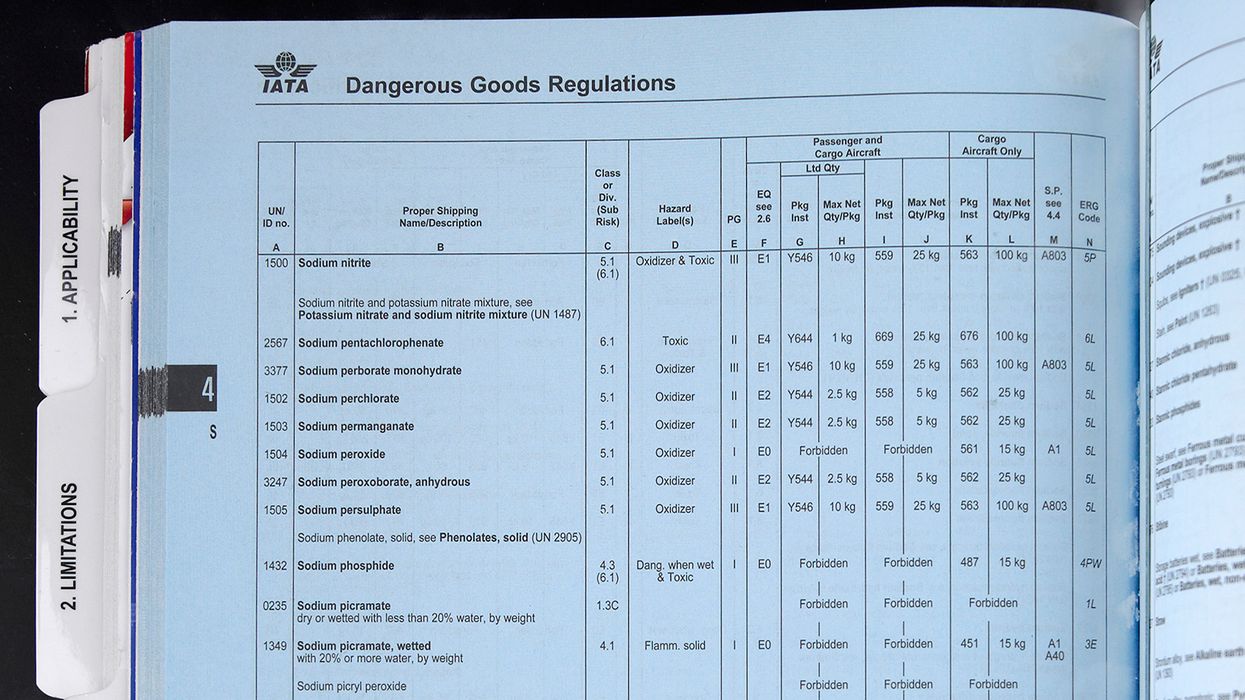
Every year the International Air Transport Association (IATA) updates its Dangerous Goods Regulations (DGR) to ensure the safe and secure handling of dangerous goods that are shipped or transported by air. While changes to the 2024 IATA DGR (65th edition) are not as plentiful as they were in previous years, they are no less important.
Mandatory compliance with the 2024 IATA DGR begins on January 1, 2024, and will be valid until the 2025 IATA DGR comes into effect. Let’s look at the key updates, listed by Section, for the 65th edition of the IATA DGR:
Need additional information for IATA? Check out this ezExplanation.
Limitations
- Dangerous Goods Carried by Passengers or Crew (2.3)— Provisions for battery-powered mobility aids have been revised to include reference to the guidance on the end-to-end processes associated with the carriage of mobility aids.
Packing
The following packing instructions have been updated:
- 5.2.0.9 - Added a water capacity limit for non-refillable cylinders containing a flammable gas, limited to a water capacity not exceeding 1.25 L.
- PI 952 - Revised to include reference to "equipment."
- PI 954 - Clarified the rules for marking overpacks containing dry ice. The total net quantity of dry ice in the overpack must be marked on the outside of the overpack.
Packaging specifications and performance tests
- 6.0.3 - Clarified the requirements and formatting for UN specification marks on packages.
Documentation
- 8.1.6.9.2, Step 6 – Added a note to "reinforce that there is no requirement for the type, number and net quantity in inner packagings within the outer packaging of a combination packaging to be shown" on the shipping papers (Shippers Declaration for Dangerous Goods).
Radioactive materials
- 10.8.3.9.1—Added an additional example of the description for the first sequence of information on the Shipper's Declaration to address where a radioactive material has a subsidiary hazard, and the proper shipping name must be supplemented by the technical or chemical name.
- 10.8.6—Added two examples to show how radioactive materials with a subsidiary hazard should be described and how packages in an overpack should be shown.
Appendices
IATA has added a new appendix to the list of appendices in the DGR. Appendix H includes a list of changes IATA will make to the 2025 IATA DGR. IATA added Appendix H so that shippers and carriers have time to prepare for the substantial updates that are coming for 2025. Some of the changes include:
- Adding an exception for data loggers and cargo trackers with installed lithium batteries.
- Modifying the exception for COVID-19 vaccines to now apply to all pharmaceutical products.
- Adding a new classification for sodium ion batteries.
- Updating the list of dangerous goods and special provisions.
- Amending and adding several packing instructions.
- Revising the "lithium battery mark", which will be known as the "battery mark" in the future.
Making sure you are keeping up with these regulatory changes and preparing for future updates is extremely important if you want to avoid costly delays, fines, and lost revenue. Keep your hazmat employees up to speed and inform them of any changes they need to be aware of.
Key to Remember: IATA updates their DGR every year and changes to the 2024 IATA DGR become effective on January 1, 2024.
NewsIndustry NewsIndustry NewsCMV InspectionsSpeed limitsAnnual inspections - Motor CarrierTransportationCMV drivingFleet OperationsEnglishFocus AreaUSA
2026-10-15T05:00:00Z
Safe driving habits are on cruise control: Tickets issued to over half of drivers tested
Of the 8,083 commercial motor vehicle and passenger vehicle drivers tested across North American roadways, 3,968 warnings and 2,604 tickets were issued for unsafe driving behaviors.
Speeding, distracted driving, and aggressive driving were among the leading causes of roadway crashes cited, according to the Commercial Vehicle Safety Alliance’s (CVSA’s) 2026 North America safety event findings.
The top unsafe behaviors of 2026 include:
- Reckless, careless, and dangerous driving, which was the focus of this year’s Operation Safe Driver Week: 83 warnings and 33 citations were issued. Broken down by driver type, 50 warnings and 22 citations were issued to commercial motor vehicle drivers, and 33 warnings and 11 citations were issued to passenger vehicle drivers.
- Speeding, which was the most cited behavior: 1,003 warnings and 691 citations were issued. Broken down by driver type, 50 warnings and 22 citations were issued to commercial motor vehicle drivers, and 33 warnings and 11 citations were issued to passenger vehicle drivers.
- Failure to wear a seat belt: 292 warnings and 311 citations were issued. Broken down by driver type, 267 warnings and 270 citations were issued to commercial motor vehicle drivers, and 25 warnings and 41 citations were issued to passenger vehicle drivers.
- Possession, use or impairment of drugs or alcohol: 17 warnings and 26 citations were issued. Broken down by type, 12 warnings and 22 citations were issued to commercial motor vehicle drivers, and 5 warnings and 4 citations were issued to passenger vehicle drivers.
| Other Top Warnings, Citations, and Tickets Issued to CMV Drivers | ||
| Offense | Total # Warnings | Total # Citations |
| Failure to obey traffic control device | 652 | 319 |
| Improper lane change | 76 | 23 |
| Following too closely | 48 | 23 |
| Improper passing | 29 | 10 |
| Improper turn | 12 | 3 |

NewsIndustry NewsIn-Depth ArticlePrivate carrier authorityExempt Carrier AuthorityMotorcoach operating authorityPassenger carrier authorityOperating AuthorityFleet OperationsFocus AreaEnglishUSAFor-Hire Carrier AuthorityTransportationHousehold Goods Carrier authority
2026-10-14T05:00:00Z
One Texas-to-Texas load could change your registration requirements
Many carriers believe that once they’ve obtained their interstate authority, they’re authorized to make any type of move in any state — but that’s not always the case. Texas is a great example of this, as having interstate operating authority doesn’t always give a motor carrier everything it needs to conduct transportation within the state of Texas.
This is why it’s essential that carriers look closely at any movements that both begin and end in Texas. Even a carrier that primarily operates in interstate commerce needs Texas intrastate authority if it performs a point-to-point Texas trip.
Interstate authority vs. Texas intrastate authority
Understanding the difference between interstate authority and Texas intrastate authority is integral to understanding what a carrier needs before operating in Texas. The USDOT number and the Texas Department of Motor Vehicles (TxDMV) number serve different purposes:
- USDOT numbers are the carrier’s federal safety identifier and are used to track information such as inspections, crashes, and compliance history; and
- TxDMV numbers and the related Texas registration certificate demonstrate that the carrier is registered with the state to make intrastate movements.
Because the two credentials aren’t interchangeable, a carrier with a USDOT number and federal operating authority may still need to register with the TxDMV. The key question is: Does the carrier perform any regulated movements that both originate and terminate within Texas?
When do you need to register with the TxDMV?
Texas generally requires the following intrastate vehicles and operations to have and display a USDOT number and to register with TxDMV for intrastate authority:
- Private and for-hire vehicles, or combinations of vehicles, with a gross weight or gross weight rating exceeding 26,000 pounds when used to transport cargo in furtherance of a commercial enterprise;
- For-hire vehicles used to transport household goods, regardless of gross weight rating;
- Vehicles, including buses, designed or used to transport more than 15 passengers, including the driver;
- Commercial school buses;
- Vehicles used to transport hazardous materials in a quantity requiring placarding; Vehicles operated by a foreign carrier;
- Foreign-domiciled buses; and/or
- Vehicles owned or controlled by a person who isn’t a U.S. citizen or doesn’t reside in the United States.
Applying for Texas intrastate authority
Application for authority can be completed online. Call (800) 299-1700 to begin the registration process over the phone and obtain a Unique Identifier Number (UIN). Once a UIN has been assigned, use the online Motor Carrier Credentialing System (MCCS) at https://apps.txdmv.gov/apps/mccs/motorcarrier/.
Registration isn’t a one-time administrative task
Once a carrier receives its certificate of registration, it must maintain that status by doing the following:
- Review its principal business address, mailing address, and email address in the department’s online system every 6 months;
- Maintain required insurance filings;
- Keep its vehicle listing current; and
- Retain the insurance cab card at its principal place of business, and make sure the correct copy is carried in each covered vehicle.
Just like at the federal level, changes in vehicle size, passenger capacity, cargo, routes, ownership, or operating status could trigger a fresh review of the carrier’s registration obligations.
Key to remember: Federal authority alone may not be enough when a regulated trip both begins and ends in Texas, even if the carrier performs those trips infrequently. A careful review of a carrier’s operations — and confirmation of TxDMV registration requirements — can help prevent credentialing issues, roadside delays, and avoidable compliance fees.

NewsIndustry NewsFleet SafetyIn-Depth ArticleCMV Parts and MaintenanceParts and Accessories - Motor CarrierFocus AreaMaintenance and periodic inspectionsEnglishVehicle maintenanceTransportationUSA
2026-10-19T05:00:00Z
Stay ahead of repairs: Building a systematic maintenance program
A compliant vehicle maintenance program and keeping vehicles safe involves more than completing an annual inspection and relying on driver inspections. Federal regulations require carriers to have an ongoing process for identifying maintenance needs, correcting defects, and keeping vehicles in safe operating condition throughout the year. That is the purpose of a systematic inspection, repair, and maintenance program.
Under 49 CFR 396.3, motor carriers must “systematically inspect, repair, and maintain” vehicles under their control. Parts and accessories must also be kept in safe and proper operating condition at all times.
What does “systematic” mean?
Federal Motor Carrier Safety Administration (FMCSA) provides carriers with a lot of flexibility to design their maintenance program. Because vehicle use varies from fleet to fleet or even individual vehicles in a fleet, maintenance intervals can vary. For this reason, FMCSA does not establish a universal maintenance interval. Instead, they provide carriers with guidance stating “systematic” generally means a regular or scheduled program designed to keep vehicles in a safe operating condition.
Vehicles used in long haul, interstate transit will need a different schedule than a local delivery truck making frequent stops and starts. The important thing is that the carrier establishes a regular schedule and follows it.
How does FMCSA verify compliance?
One of the primary ways compliance is demonstrated is through a carrier's maintenance records. Any vehicle controlled by a motor carrier for 30 consecutive days must have maintenance records identifying the vehicle, make, serial number, and year.
The records must show the nature and due date of inspections and maintenance operations to be performed. They must also document the actual date and type of inspection, repair, or maintenance that was actually performed.
In short, a carrier should be able to demonstrate:
- What maintenance is required,
- When it is due, and
- When it was completed.
Producing a folder with invoices and receipts may show that a vehicle was repaired, but a well-documented program demonstrates that maintenance is being proactively managed.
Recordkeeping requirements
These maintenance records generally must be retained where a vehicle is housed or maintained for a period of one year and then for six months after the vehicle leaves the carrier's control.
Systematic maintenance isn't about creating more paperwork. It’s about developing a repeatable process that keeps vehicles safe, identifies problems before they become more serious, and documents the work performed.
This information can also help carriers evaluate whether their current preventive maintenance intervals are appropriate for the equipment and how it is being used.
Systematic maintenance can save money
A good preventive maintenance program isn't just about satisfying a regulation. Identifying worn brakes, tire problems, fluid leaks, or other problems before they result in a failure is critical to reducing roadside breakdowns, emergency repairs, towing expenses, service disruption, and even unplanned downtime.
Preventive maintenance also gives carriers control over when repairs occur. A defect discovered during scheduled shop time can be addressed more efficiently, and at a lower cost than the same problem discovered on the side of the road.
This information can help carriers evaluate whether their current maintenance intervals are appropriate for the equipment and how the equipment is being used.
Key to remember: FMCSA requires you to keep records. Good records can help you run a better, less expensive maintenance program.
NewsIndustry NewsHazmat SafetyHazmat: HighwayFocus AreaIn-Depth ArticleHazmat EnforcementEnglishTransportationUSA
2022-12-27T06:00:00Z
Placarding responsibility – Whose is it?
Many shippers are unaware of their responsibility to provide placards to drivers, but the responsibility shifts as soon as the driver hits the road.
Check the regulations
According to Section 172.506 of the Hazardous Materials Regulations (HMR), a shipper offering a hazardous material for transportation by highway must provide the motor carrier with the required placards for the material being offered. The shipper must offer the placards to the carrier prior to, or at the same time as, the material is offered for transportation — unless the vehicle is already placarded for the hazmat.
Section 172.506 also states that no motor carrier may transport a hazardous material in a motor vehicle unless the required placards for the hazmat are affixed to the vehicle. Before transport, the driver is responsible for displaying the required placards for all the hazmat that is on the vehicle.
Avoid issues with shippers
Many trailers are equipped with flip placards that represent most classes of hazardous materials but without adequate training, shippers may not understand their responsibility to provide the driver with the required placards. If a driver arrives and the shipper fails to provide placards, the driver should contact dispatch for additional instructions or drive to a truck stop to secure the necessary placards. The driver becomes responsible for placards as soon as the trailer enters a public highway, so train your drivers to temporarily refuse the shipment until the proper placards can be obtained. If necessary, the driver must bobtail or leave empty before driving to pick up placards.
Another common placarding question with shippers involves combination loads. If a driver arrives at a shipper’s location and is already transporting a hazardous material below the placarding threshold, is the shipper required to provide placards for the combination load on the trailer? In this scenario, the driver already has 600 pounds of a Class 8 corrosive material on the trailer, and the shipper is offering an additional 500 pounds of the same commodity. The regulations state that the shipper is only required to provide placards for the commodity that is being offered, not for the aggregate weight of both shipments. In this scenario, the driver is responsible for providing placards since it involves a combination load.
The Hazardous Materials Regulations are complex, especially for newer employees. Drivers that can speak “hazmat” to shippers often secure additional business, so be sure to train your drivers and give them the confidence to have impactful conversations with shippers.
Key to remember: Carry extra placards in case a shipper is unable to supply the required placards or a combination of hazmat on the vehicle requires different placards.
Most Popular Highlights In Human Resources

NewsIndustry NewsIndustry NewsAssociate Benefits & CompensationAssociate RelationsHR GeneralistFamily and Medical Leave Act (FMLA)Family and Medical Leave Act (FMLA)HR ManagementEnglishFocus AreaHuman ResourcesUSA
2026-10-14T05:00:00Z
HR manager didn’t follow company policy for his own FMLA leave, and got terminated for it
In early 2023, Frank, an HR manager, suffered from severe right shoulder arthritis. Starting on February 21, he decided to take leave under the federal Family and Medical Leave Act (FMLA) to manage his health issues, eventually opting for surgery.
The employer’s policy indicated that requests for FMLA leave be made through the HR Department on the forms provided. The forms required employees to provide a medical certification to support the absence.
When Frank first asked for leave, he didn’t submit a medical certification. He argued that delayed submission of such paperwork was, nonetheless, consistent with the employer’s customary practice. During his tenure as HR manager, he would also retroactively approve FMLA leave for employees who began their leave before filling out the required paperwork.
On March 9, Debra, a company director, sent Frank a letter reminding him to submit the medical certification by March 17. When Frank failed to do so, Debra sent him a second, third, and fourth reminder, extending the deadline each time. In the last two letters, she warned Frank that failure to comply with the company leave policies could result in his termination.
Frank didn’t submit a certification until May 4. It excused his absence beginning May 2, but didn’t address his absences from February 21 to May 1. He never provided documentation covering the prior absences or a reason for them.
On July 7, before he could return to work, the employer informed Frank that his employment was terminated. The termination letter cited his “failure to provide the healthcare certifications required” by company policies, which resulted in his incurring “multiple unexcused absences in violation of the” company’s personnel code.
Frank sued, but the court sided with the employer, despite the suspicious timing of the termination. It first noted that when an employee takes leave without complying with the employer’s internal leave policies, they haven’t “engaged in any activity protected by the FMLA.” Also, since Frank failed to provide a certification supporting his leave from February 21 to May 1, the FMLA didn’t cover his time off, and he didn’t engage in FMLA-protected activity.
Bergman v. St. Clair County, Southern District of Illinois, No. 3:24-CV-02374, September 23, 2026.
Key to remember: If an employee fails to provide a requested FMLA certification without justification, employers may deny FMLA protections.
Court decisions are based on the specific facts presented and each court’s interpretation of the law. Because courts may reach different conclusions, similar situations can lead to different outcomes. Employers should avoid relying on a single case as definitive guidance and instead assess each situation carefully, considering applicable laws, and seeking advice when needed.

NewsIndustry NewsIndustry NewsHR GeneralistFamily and Medical Leave Act (FMLA)Family and Medical Leave Act (FMLA)USAHR ManagementEnglishFocus AreaHuman Resources
2023-09-06T05:00:00Z
Appellate court sided with employee's (almost) 3-year-delayed FMLA claim
Back in October 2018, Laffon had a medical emergency and needed some time off under the federal Family and Medical Leave Act (FMLA).
Her leave lasted until November 15. Ten days after she returned to work, on November 26, her employer terminated her.
She sued, arguing that the employer retaliated against her because of her FMLA leave.
The catch? She didn't bring the suit until almost three years later.
No link between leave and termination
In court, the employer argued that there was no causal link between Laffon taking FMLA leave and her termination. Although the court documents aren't robust, they do reveal that the employer indicated that Laffon's allegations didn't show that her taking FMLA leave was a factor in the decision to terminate her. The documents showed only that the termination chronologically followed her leave.
The court agreed with the employer. It also agreed that Laffon failed to allege a willful violation of the FMLA, which would allow her to benefit from the FMLA's three-year statute of limitations.
Laffon appealed the case to the Ninth Circuit.
Statute of limitations
Under the FMLA, employees have two years from the date of the last event constituting the alleged violation for which they can bring a claim.
Those two years are extended to three years if the employer's actions were "willful." This means that an employee must show that the employer either knew or showed reckless disregard for whether its conduct violated the FMLA.
Ruling overturned
Fast forward to August 2023, when the Ninth Circuit reversed the lower court's decision. It indicated that, based on Laffon's amended complaint and liberally construing the law, her allegations establish that her leave was causally connected to her termination and that the employer's action (her termination) was willful.
Glymph v. CT Corporation Systems, No. 22-35735, Ninth Circuit Court of Appeals, August 22, 2023.
Key to remember: Terminating an employee soon after returning from FMLA leave is risky, unless there is a clear, well-documented, non-leave-related reason. Case documents did not show such a clear reason, which can also increase the risk of a willful finding. Employees have time to file claims, even years.

NewsIndustry NewsHuman ResourcesHR GeneralistFamily and Medical Leave Act (FMLA)Focus AreaIn-Depth ArticleFamily and Medical Leave Act (FMLA)Associate RelationsEnglishUSAHR ManagementDisabilities and ADADisabilities and ADAReasonable Accommodations
2026-10-13T05:00:00Z
Is providing an accommodation instead of FMLA leave okay? The law says, “No.”
Eligible employees may take leave for qualifying reasons under the federal Family and Medical Leave Act (FMLA). But may an employer require an employee to accept a workplace accommodation instead of taking FMLA leave? What if the absence creates a hardship for the employer?
The answer is likely no.
Under FMLA regulations at 825.702(d), if an employee is entitled to FMLA leave, the employer may not require the employee to take a job with a reasonable accommodation in place of that leave.
In other words, an employer generally may not deny FMLA leave and require the employee to keep working in a modified job, even if the employer offers similar pay and benefits or adjusts the job so the employee can perform its essential functions.
Is there an exception?
There’s a limited exception for certain intermittent or reduced schedule leaves. If the need for leave is foreseeable because of planned medical treatment, or if the employer agrees to intermittent or reduced schedule leave for bonding with a healthy child, the employer may temporarily transfer the employee to an available alternative position. The employee must be qualified for the position, however, and the position must better accommodate the recurring leave than the employee’s regular job.
This exception doesn’t apply when the leave is unforeseeable, such as during episodic flare-ups related to a chronic condition.
When the employee requests a different arrangement
The FMLA doesn’t prohibit employers from agreeing to an employee’s request for a different shift, schedule, or position when the employee returns from leave. However, employers may not pressure or require the employee to accept a different position against the employee’s wishes.
Applies to any accommodation
This rule applies to any workplace accommodation. For example, in lieu of leave, an employer may not require an employee to:
- Work from home,
- Use modified equipment, or
- Accept changes to a workstation.
No undue hardship defense under the FMLA
Unlike the federal Americans with Disabilities Act, the FMLA doesn’t include an undue hardship defense. This means that employers may not deny FMLA leave because the employee’s absence creates staffing challenges, affects productivity, or burdens a department.
Key to remember: If an employee is entitled to FMLA leave, the employer may not require the employee to accept an accommodation instead of taking that leave.
NewsWage and HourChange NoticesChange NoticeWage and HourAssociate Benefits & CompensationHR GeneralistMinimum WageFocus AreaHR ManagementEnglishSouth DakotaAssociate RelationsHuman Resources
2026-10-19T05:00:00Z
South Dakota minimum wage to increase
Effective date: January 1, 2027
This applies to: Employers with employees in South Dakota
Description of change: Effective January 1, 2027, the South Dakota minimum wage will increase from $11.85 to $12.30 per hour. The minimum wage for tipped employees will increase from $5.95 to $6.15 per hour on that date, as well.
View related state info: Minimum wage – South Dakota

NewsIndustry NewsIndustry NewsWage and HourWage and HourAssociate Benefits & CompensationAssociate RelationsHR GeneralistFair Labor Standards Act (FLSA)OvertimeHR ManagementEnglishFocus AreaHuman ResourcesUSA
2026-05-21T05:00:00Z
Federal overtime threshold rule gone, for now
On May 15, members of Congress introduced a bill that would gradually increase the overtime salary threshold for determining whether employees may be classified as exempt under the federal Fair Labor Standards Act (FLSA).
This news came on the heels of the U.S. Department of Labor's official rescission of the 2024 rule that increased the threshold. That rule was challenged in federal court, and employers didn’t have to comply with it since it was vacated in November 2024.
Employers may now comfortably continue to follow the 2019 rule, where the minimum salary threshold is $684 per week ($35,568 per year) for executive, administrative, and professional employees, and $107,432 for highly compensated employees.
Potential future increases
The bill, The Restoring Overtime Pay Act of 2026 (HR 8868), would increase the federal minimum salary level as follows:
- 2026 — $45,000
- 2027 — $55,000
- 2028 — $65,000
- 2029 — $75,000
- 2030 — 55th percentile of full-time salaried workers nationally*, updated annually
*The current 55th percentile of full-time salaried workers nationally is $89,440 and could increase to $98,000 by 2030.
The measure would allow the Secretary of Labor to establish a higher salary threshold through notice and comment rulemaking, as long as it can be updated annually.
The bill would also require the following:
- The Secretary of Labor would need to provide annual, automatic updates to the overtime threshold of at least the 55th percentile of weekly earnings of full-time salaried workers.
- If the Secretary doesn’t establish an increased salary threshold, the 55th percentile of weekly earnings of full-time salaried workers nationally would take effect, based on the Bureau of Labor Statistics (BLS) from the second quarter of the preceding calendar year.
- The Secretary would need to publish a notice announcing the revised salary threshold no later than 60 days before the revised threshold takes effect.
- The BLS would need to publicly publish data on its website for each week of each quarter and data on weekly earnings by census region.
The bill is in the first stage of the legislative process. It was referred to the House Committee on Education and Workforce. While it has a small chance of being enacted at this time, it does show that some members of Congress are interested in this topic.
Key to remember: Congress members introduced a bill increasing the federal salary threshold level. But for now, employers can use the 2019 federal salary threshold to determine whether they may classify an employee as exempt.

NewsIndustry NewsHR GeneralistFamily and Medical Leave Act (FMLA)In-Depth ArticleFamily and Medical Leave Act (FMLA)HR ManagementEnglishUSAFocus AreaHuman Resources
2024-05-07T05:00:00Z
May employees take FMLA leave to care for family members outside the U.S.?
Yes, employees may take leave under the federal Family and Medical Leave Act (FMLA) to care for family members who are outside U.S. borders.
If the employee meets the eligibility criteria of the FMLA, the family member has an FMLA serious health condition, and the employee is needed to care for the family member, the employee’s time off would be protected. It doesn’t really matter where the family member is.
To figure out whether the family member’s condition meets the criteria under the FMLA, employers may require that the employee provide a certification supporting the leave.
Certifications in other languages
If an employee or a family member is visiting in another country, or a family member lives in another country, and a serious health condition develops, employers must accept a medical certification from a health care provider who practices in that country. This rule applies to an original certification, a recertification, and when requesting a second or third opinion from a provider.
If a certification by a health care provider from another country is in a language other than English, employers may require that the employee provide a written translation of the certification.
Traveling to care for family member
If family members are outside the U.S., employees will need to spend some time traveling. The employee’s travel time would likely be seen as part of the FMLA leave if:
- The travel is so intertwined with the care, or
- If it is needed to obtain the care.
Handling intermittent leave
Employees may also take intermittent FMLA leave to care for far-away family members. Employers would manage such leave the same way they do for intermittent leave inside the U.S. Employers should:
- Give the employee an eligibility/rights & responsibilities notice within five days of being put on notice,
- Ask for a certification if desired (including a translation),
- Give the employee a designation notice within five days of getting enough information, and
- Track the employee’s leave time.
Whenever employees are away from the physical worksite, tracking how much intermittent FMLA leave they are taking has its own challenges. Employers may use a simple honor system of self-reporting or technology to keep track of when the employee is taking FMLA leave and when the employee is working.
Key to remember: Eligible employees may take FMLA leave to care for family members who are outside the U.S.
Most Popular Highlights In Safety & Health
NewsHazard ClassificationsIn-Depth ArticleHazard CommunicationHazCom Written ProgramHazcom LabelingEnglishHazCom Information and TrainingIndustry NewsSafety & HealthConstruction SafetyGeneral Industry SafetyHazard CommunicationFocus AreaUSA
2026-10-21T05:00:00Z
November 20 Is Coming: Is Your HazCom Program Ready?
Every October, OSHA hands employers its cheat sheet. The preliminary fiscal year 2026 numbers came out this month, and Hazard Communication (29 CFR 1910.1200) ranked second overall and first in general industry, with 1,961 citations.
That's down 23% from the year before, and it would probably be pretty easy to just assume the sharp decline as progress. However, it's more likely a lull. For all of FY2026, employers were operating inside a transition window that allowed compliance with the 2012 standard, the 2024 standard, or both. That window closes for employers on November 20, 2026. Every HazCom citation written in FY2027 will be measured against the new rule.
How we got to this point
OSHA published its updated HazCom final rule on May 20, 2024 (89 FR 44144), aligning the standard with Revision 7 of the UN's Globally Harmonized System plus selected Revision 8 elements. In January 2026, with the first deadline days away and its own guidance documents unfinished, OSHA pushed every compliance date back four months (91 FR 1695). The schedule under 1910.1200(j) now reads:
- May 19, 2026: Manufacturers, importers and distributors: substances (passed)
- November 20, 2026: Employers: substances
- November 19, 2027: Manufacturers, importers and distributors: mixtures
- May 19, 2028: Employers: mixtures
The upcoming November date requires employers to update alternative workplace labeling, revise their written hazard communication programs, and train workers on newly identified hazards for substances whose classifications changed.
The manufacturer deadline for substances passed in May, which means reclassified safety data sheets have been arriving. Some products picked up new hazard classes, such as the new Category 3 for non-flammable aerosols or the subdivided flammable gas categories. Others shifted or changed hazard statements or precautionary language.
Each of those revised SDSs will need to be studied by employers because they could contain triggers. Under 1910.1200(h)(1), employers must train workers whenever a new chemical hazard is introduced into the work area. That includes a reclassified product. If your workplace labels, inventory and training still reflect the old SDS, you are out of step with the first document an inspector will ask for.
The cost of falling behind
Federal OSHA's maximum penalty is $16,550 per serious violation and $165,514 per willful or repeat violation. Those figures didn't rise this year and OSHA skipped the 2026 inflation adjustment because the fall 2025 government shutdown delayed the CPI data it relies on. Expect an adjustment in 2027.
Individual HazCom citations rarely make headlines. The real exposure is cumulative. HazCom violations often pop up alongside respiratory protection and PPE citations, and a HazCom citation today becomes the possibility for a repeat classification tomorrow, at ten times the price.
A 30-day action plan
With about a month left to prepare, focus on what an inspector will actually ask for.
- Audit your SDS library: Request current SDSs from every supplier and compare Section 2 against the versions on file. Flag every changed classification.
- True up the chemical inventory: The list required by 1910.1200(e)(1)(i) must use product identifiers that match the current SDS.
- Audit workplace labels: Secondary containers and alternative systems such as HMIS or NFPA must convey hazard information consistent with the updated SDS. Reclassified products need relabeling.
- Revise the written program: Document how you receive, review and distribute updated SDSs, and reference the 2024 standard. Inspectors usually start here.
- Retrain, and document it: Target training to the products that changed rather than running a generic refresher. Record dates, attendees and content.
- Prepare for 2028: The mixtures deadline is a pretty big wave, because most workplace chemicals are mixtures. The SDS review process you build this month is the one you'll lean on through May 2028.
Keys to remember: November 20, 2026, is the employer HazCom deadline for substances. Employers must be ready to address updated hazard classifications flowing downstream from manufacturers and importers.

NewsExcavation Hazard IdentificationIndustry NewsExcavationsSafety & HealthConstruction SafetyExcavationsExpert InsightsEnglishFocus AreaUSA
2026-10-15T05:00:00Z
Expert Insights: Trench Safety by the Numbers
When I started working in construction safety, my colleague and I loved to challenge each other with safety questions to keep on top of our game amidst a dynamic construction world. Remembering safety rules is critical, but can be overwhelming, when it comes to excavation and trenches for example. Things such as when a protection system is required, when an egress method is necessary, or at what point a professional engineer needs to get involved come to mind. So, we came up with a little quiz called Excavation Safety by the Numbers to help refresh the what, where, and when of excavations. Here are some common numbers by the foot: 2, 4, 5, 6, 20, and 25.
2 Feet
There are two circumstances where the number 2 comes into play.
- Spoil piles must be at least 2 feet from the edge of an excavation or trench provided the surface is able to support such a load.
- If using a trench box or other engineered protection system, the bottom of the protection system cannot be more than 2 feet above the bottom of the trench or excavation.
4 Feet with 25 feet
Four feet is the trench or excavation depth that triggers the requirement to have a means of egress such as a ladder. Depending on the length of the trench/excavation, the maximum travel distance to or between egress points is 25 feet.
5 Feet
A protective system is required for trenches and excavations 5 feet deep or deeper unless a competent person determines the excavation is entirely in stable rock.
6 Feet
If employees are working near the edge of a trench/excavation with a depth of 6 feet or more, then fall protection/prevention is required.
20 Feet
If the depth of a trench/excavation is greater than 20 feet, then the protective system must be designed and approved by a professional engineer. While this number quiz does not encompass every aspect of trench/excavation safety, it may help reinforce key concepts before the first scoop of soil is moved. Remember to follow specific jobsite requirements for each trench and excavation.

NewsIndustry NewsSafety and Health Programs and TrainingSafety & HealthBehavior Based SafetyConstruction SafetyGeneral Industry SafetyIn-Depth ArticleEnglishFocus AreaUSA
2026-10-22T05:00:00Z
When human error isn't the whole story
When an incident happens, one of the first questions many people ask is, "Who made the mistake?" Human & Organizational Performance (HOP) encourages us to ask a different question. "What contributed to the mistake?"
HOP is based on the idea that the work environment influences how people perform their jobs. By better understanding the factors surrounding the work, organizations can identify ways to strengthen safeguards, make work more reliable, and improve safety culture.
The five principles behind HOP
HOP is built around five core principles. The wording may vary, but the underlying ideas remain the same.
1. Error is normal
People make mistakes. That's part of being human. No amount of training, experience, or motivation will completely eliminate human error. Employees will occasionally forget a step, misread information, become distracted, or make a decision that doesn't work out as intended.
Instead of expecting perfect performance, HOP encourages employers to ask:
- What happens if someone makes a mistake?
- Will the error be detected?
- Is there a safeguard in place?
- Could the mistake lead directly to an injury or serious event?
Employers shouldn't rely on employees getting it right every single time. Processes and safeguards help catch mistakes before they lead to an injury or serious event.
2. Blame fixes nothing
Blame may identify who was involved, but it rarely explains why the event happened.
When an investigation stops at "employee error," valuable learning opportunities are often missed. Maybe the procedure wasn't practical or outdated. Maybe production demands influenced the decision. Maybe communication, training, staffing, equipment, or supervision played a role.
Accountability is important, but effective investigations dive deeper to examine the pressures, workplace factors, and system weaknesses that contributed to the event.
3. Context drives behavior
People generally do what makes sense to them at the time. That's why understanding the work environment matters. Factors that can influence decisions include:
- Production pressure,
- Staffing levels,
- Fatigue,
- Time constraints,
- Equipment design,
- Resource availability,
- Workload, and
- Conflicting priorities.
Looking back after an incident, it can be easy to wonder why someone made a particular decision. In the moment, however, the employee was responding to the circumstances in front of them from their perspective. Understanding those circumstances often helps explain why the decision seemed reasonable at the time and where improvements may be needed.
4. Leader response matters
How leaders respond after an incident can have a lasting impact. If employees expect blame and punishment, they're less likely to report concerns, admit mistakes, or speak up when something isn't right.
When leaders focus on understanding what happened and learning from it, employees are more likely to share information that can help prevent future incidents.
Employees are generally more willing to report concerns, share lessons learned, and discuss mistakes when they believe the goal is to improve the workplace rather than assign blame.
5. Learning is vital
Every near miss, hazard report, equipment problem, employee concern, and incident creates an opportunity to learn.
Organizations don't have to wait for someone to get hurt before making improvements. Most warning signs show up long before an injury occurs.
Paying attention to those warning signs can help employers address problems before they contribute to an injury or serious incident.
Why the system matters
One of the biggest lessons from HOP is that workplace outcomes are rarely driven by one person alone. Procedures, equipment, staffing, schedules, training, maintenance practices, production expectations, and leadership decisions all influence how work gets done.
Looking beyond the employees’ actions often reveals controllable risks that contributed to the event. By identifying and controlling what shapes the decision-making environment, organizations can move beyond blame and toward effective and lasting incident prevention.
Putting HOP into practice
Organizations don't need to create a new safety program to begin using HOP principles. In many cases, it starts by changing how incidents, near misses, and operational problems are discussed and investigated.
The next time an incident, near miss, equipment problem, or operational issue occurs, consider asking:
- What made this action seem reasonable at the time?
- What factors influenced the decision?
- What pressures or obstacles were present?
- What safeguards were missing, weak, or ineffective?
- What can we improve so the next person doesn't face the same situation?
Open conversations like this often identify issues that wouldn't have been found by simply concluding that the employee made a mistake.
Key to remember: Human error may explain what happened, but it rarely explains why it happened. Looking at the factors surrounding the work often provides a clearer picture of what contributed to the event and what can be done to help prevent it from happening again.

NewsEmergency Planning - OSHAIndustry NewsSafety & HealthConstruction SafetyEmergency PreparednessGeneral Industry SafetyIn-Depth ArticleEnglishFocus AreaUSA
2026-10-09T05:00:00Z
How well do first responders know your facility?
Organizations spend a lot of time and resources preparing for emergencies. Local fire departments, EMS providers, and hazmat teams do too. But here’s a question that isn’t asked very often: How much preparation have they done together?
When a serious incident occurs, organizations often rely on outside responders to help protect employees, property, and the surrounding community. These responders bring valuable expertise and resources, but they may not know the facility, its hazards, or its operations as well as the people who work there every day.
That's why emergency preparedness should be viewed as a partnership, not a handoff. The strongest emergency responses occur when organizations and first responders build relationships, share information, and understand each other's expectations long before an incident occurs.
Build the relationship before it's needed
The best time for organizations to meet with local responders isn’t during an emergency. Facility tours, pre-incident planning meetings, and joint exercises allow both sides to learn from one another. Responders can become familiar with facility layouts, hazards, and access procedures. Facility personnel can better understand responder capabilities, equipment, and response expectations.
These conversations also help identify potential issues before they become problems. Questions about after-hours access, communication protocols, command structure, specialized hazards, or monitoring capabilities are much easier to answer during a planning meeting than during an active emergency.
Perhaps most importantly, these interactions build trust and familiarity, both of which can improve communication when pressure is high.
Why familiarity matters
When responders arrive, they often need information quickly to make critical decisions. The more they know beforehand, the more effectively they can respond. During an emergency, responders don't have time to learn the facility from scratch.
Consider some of the questions they may need answered:
- Are there gates, badge-controlled doors, or other security measures?
- Are there any areas with restricted access?
- What hazardous materials are onsite, and where are they located?
- Which utilities, fire department connections (FDCs), or processes may need to be shut down?
- Who has authority to make decisions during the incident?
- Which employees have specialized knowledge of equipment, chemicals, or operations?
- How can responders access the facility after normal business hours?
Without those answers, valuable time can be spent gathering information instead of managing the emergency.
The relationship goes both ways
Organizations sometimes assume responders have every resource they might need. In reality, responder capabilities can vary by jurisdiction, equipment availability, and specialized training.
For example, a local department may have standard atmospheric monitoring equipment but may not carry instruments designed to detect every chemical present at a facility. Certain incidents may require additional resources, technical expertise, or support from a regional hazmat team.
Understanding those capabilities and limitations before an emergency occurs helps both organizations and responders establish realistic expectations, identify resource gaps, and avoid surprises when an incident occurs.
Don't rely on paperwork alone
Many organizations already share hazard information through regulatory programs. Facilities subject to EPCRA requirements may provide chemical inventory information that helps emergency planners understand potential community hazards, but that information doesn't replace direct conversations and site familiarity.
Responders also benefit from information such as facility maps, building access points, utility shutoff locations, hazardous material storage areas, emergency contacts, and site-specific response considerations.
Responders don't need every document an organization has ever produced. What helps most is having key information organized, accessible, and available before an emergency occurs.
Strengthen the partnership
To strengthen relationships with local emergency responders:
- Arrange facility tours to familiarize responders with the site;
- Review emergency plans, major hazards, and available resources together;
- Confirm after-hours access procedures;
- Identify primary and backup emergency contacts;
- Provide updates when processes, layouts, or chemical inventories change; and
- Conduct joint drills or exercises.
Key to remember: First responders shouldn't be learning about a facility during an emergency. The best emergency responses are built on relationships, communication, and shared understanding long before 911 is called.
NewsIndustry NewsSafety & HealthElectrical SafetyConstruction SafetyGeneral Industry SafetyElectrical SafetyOccupational Safety and Health Administration (OSHA), DOLIn-Depth ArticleEnglishFocus AreaUSA
2026-10-15T05:00:00Z
Arc flash labels provide valuable information worth your time and life
Walk through an industrial facility, hospital, or factory, and you will see warning labels on electrical equipment. To an untrained person, some of the information may be difficult to understand. To a qualified electrical worker, however, the label provides critical information about arc flash and shock hazards that help workers assess the risk and select the proper protective measures.
Why this matters
Electrical equipment labels provide vital information when a worker must inspect or service energized equipment. This information helps workers choose the proper personal protective equipment (PPE) the worker needs to wear when performing work on that piece of equipment.
Of course, the safest plan is to work on the system in a deenergized state. However, qualified workers may still need to wear appropriate PPE to verify that no electrical current is flowing in the system and to take voltage, amperage, or other electrical measurements during initial energization of circuits and equipment.
Information on the label comes from an Incident Energy Analysis Method which is typically performed by an electrical engineer using calculations found in NFPA 70E Annex D. The label provides information workers need to stay safe.
Required label information
NFPA 70E 130.5(H) requires arc flash labels to include information that helps workers understand the electrical hazards and choose the proper PPE for the task. This information includes:
- Nominal System Voltage (such as120/240 volts, 480/277 volts, or 600 volts);
- Arc flash boundary, which identifies the distance at which incident energy reaches 1.2 cal/cm² (5 J/cm²). This is when serious burn injuries can happen; and
- At least one of the following:
- Available incident energy and the corresponding working distance,
- Minimum arc rating of clothing to be worn as PPE, or
- Site-specific level of PPE.
Other valuable information on a label
While NFPA 70E requires certain minimum information on an arc flash label, employers may choose to include additional details that help workers identify electrical hazards. Two examples are the Limited Approach Boundary and Restricted Approach Boundary.
These boundaries address shock hazards, which NFPA 70E defines as the risk of injury from electric current passing through the body. Depending on the amount of current, the path it takes through the body, and the duration of exposure, an electric shock can result in anything from a mild sensation to significant injury or even death.
- Limited Approach Boundary: Marks the distance where a shock hazard exists. Unqualified workers must remain outside this boundary unless escorted by a qualified person and properly advised of the hazards.
- Restricted Approach Boundary: Establishes the shock protection boundary for qualified workers. Crossing this boundary requires additional protective measures to prevent contact with exposed energized parts.
Always read the fine print on the label.
Key to remember: Arc flash labels provide critical information to workers before they perform tasks on electrical equipment. Understanding this information is an essential part of assessing risk, determining proper protective measures, and most importantly ensuring the safety of the workers.

NewsIndustry NewsEnforcement and Audits - OSHAOSHA InspectionsSafety & HealthGeneral Industry SafetyIn-Depth ArticleEnglishFocus AreaUSA
2026-10-12T05:00:00Z
DOL report spotlights OSHA small employer, low-hazard industry inspections
A new report brings attention to OSHA inspections of small employers in low-hazard industries. In a September 24 alert memorandum to OSHA assistant secretary David Keeling, the Department of Labor (DOL) Office of Inspector General (OIG) states its “urgent concern” that OSHA may have conducted impermissible inspections of small employers in low-risk industries and therefore may not have complied with the agency’s authorized appropriations acts.
The memo explains that an OIG investigation identified 481 inspections that the Inspector General says warrant further review by OSHA.
Hotline complaint leads to investigation, report
The OIG’s investigation stemmed from a September 2025 hotline complaint alleging OSHA had performed a planned program inspection on the complainant earlier that year even though the complainant’s business was allegedly exempted by OSHA’s appropriations rider. A recurring congressional appropriations rider generally prohibits OSHA from using appropriated funds for enforcement activities involving employers that have 10 or fewer employees and operate in designated low-hazard industries. However, the agency can still inspect an otherwise-exempt employer in certain circumstances, including:
- Health hazards;
- Fatalities, or hospitalizations of two or more employees;
- Imminent danger; and
- Complaints from current employees.
In response to the complaint, the Inspector General reviewed OSHA Information System (OIS) inspection data from November 8, 2024, through January 21, 2026. (The review did not include supporting case files.) The analysis found OSHA initiated and closed 621 inspections that met the exemption criteria. Of those, the report says 140 clearly involved a permissible exception, while:
- 201 had insufficient OIS data demonstrating an exception applied, and
- 280 had no permissible exceptions supported by OIS data.
These issues, the OIG states, may have stemmed from control weaknesses in OSHA guidance and issues with data reliability: “Therefore, OSHA may have conducted 481 impermissible inspections that did not comply with its appropriations acts.”
Following a preliminary review of 27 case files, OSHA found four that did not meet any exceptions allowed under its appropriations acts. The agency also found coding errors with the other 23 inspections. OSHA officials indicated the overall issue was likely due to coding errors rather than impermissible inspections and stated it would need to perform an in-depth review of case files to confirm. The Inspector General noted that this raises concerns about overall data reliability and that both issues (i.e., coding errors, impermissible inspections) warrant immediate attention from agency management.
OSHA pushes back on findings
In response to a draft of the September 24 memo, OSHA officials disagreed with the findings, citing the Inspector General’s lack of familiarity with the OIS and its data fields and its limited review of the inspection information for each inspector or investigation as the reason for its “unsupported conclusions.” The agency also argued that the OIG did not adequately account for OSHA’s procedures, management reviews, or the fact that inspectors sometimes need to begin an investigation to determine whether the exemption or an exception applies.
OIG recommendations to OSHA and DOL
The Inspector General stated that, ultimately, OSHA’s response did not change the OIG’s conclusion, and four recommendations were made to OSHA:
- Review all 481 identified inspections to determine whether they complied with the appropriations acts and take appropriate action based on the results.
- Establish adequate controls to prevent impermissible inspections and to document permissible exceptions in both the OIS and case files.
- Update guidance to specify which employee-related field to use when determining if enforcement exemptions and limitations apply under OSHA’s appropriations acts.
- Improve OIS data accuracy through data-entry controls and validation against case-file documentation.
The Inspector General also recommended that the Secretary of Labor conduct an investigation to determine whether OSHA failed to comply with the Antideficiency Act. The OIG noted that if the DOL ultimately determines that a violation occurred, federal law requires reporting to the President and Congress, with a copy provided to the Comptroller General.
OSHA’s consideration of the recommendations is ongoing, and the OIG says it looks forward to continuing its work with OSHA “to ensure planned corrective actions meet the intent of our proposed recommendations.” It should be noted that the Inspector General did not audit supporting case file documentation and therefore drew no conclusions on whether OSHA complied with its appropriations acts.
Key to remember: A DOL OIG investigation found that OSHA may have conducted certain small employer inspections that did not comply with its appropriations acts. OSHA disputes the findings, and its review of the cases and the OIG’s recommendations is ongoing. For employers, the Inspector General’s report is a reminder that some small employers in low-hazard industries may be subject to special limits on OSHA enforcement.
Saved to my EVENT CALENDAR!
View your saved links by clicking the arrow next to your profile picture located in the header. Then, click “My Activity” to view the Event Calendar on your Activity page.
OK
J. J. Keller is the trusted source for DOT / Transportation, OSHA / Workplace Safety, Human Resources, Construction Safety and Hazmat / Hazardous Materials regulation compliance products and services. J. J. Keller helps you increase safety awareness, reduce risk, follow best practices, improve safety training, and stay current with changing regulations.
Copyright 2026 J. J. Keller & Associate, Inc. For re-use options please contact copyright@jjkeller.com or call 800-558-5011.