Compliance Just Got Easier: Stay ahead of regulatory changes with instant notifications on updates that matter.
['Toxic and Hazardous Substances - OSHA']
['Toxic and Hazardous Substances - OSHA']
2025-12-15T06:00:00Z
JOIN TODAY TO CONTINUE READING THIS ARTICLE & OTHER INDUSTRY NEWS!
You'll also get exclusive access to:
A database of easy-to-understand regulationsAsk unlimited questions to our expertsPre-led discussions forumsAnd more
TRY IT FREE TODAY
Already have an account? Log in now.

Copyright 2026 J. J. Keller & Associate, Inc. For re-use options please contact copyright@jjkeller.com or call 800-558-5011.
NewsIndustry NewsSafety & HealthConstruction SafetyGeneral Industry SafetyToxic and Hazardous Substances - OSHAIn-Depth ArticleEnglishFocus AreaToxic and Hazardous Substances - OSHAUSA
Medical screening or surveillance — Which is best for illness prevention?
2025-12-15T06:00:00Z
Without understanding the difference between medical screening and medical surveillance, employers can’t fully protect workers from exposure or potential illness. Both are fundamental for optimizing employee health; however, they are separate and distinct concepts. Medical screening is, in essence, only one component of a comprehensive medical surveillance program.
The difference in a nutshell
The fundamental purpose of medical screening is early diagnosis and treatment of an individual; thus, it has a clinical focus. It may be a single case or repeated event that is aimed at detecting health issues before symptoms appear, such as through physical exams or biological testing.
On the other hand, the fundamental purpose of medical surveillance is to detect and eliminate the underlying causes (i.e., hazards/exposures) of any discovered trends and, therefore, focuses on prevention. It takes a broader, proactive approach, analyzing health data across groups of workers to identify and eliminate underlying workplace hazards or exposures.
When are screening and surveillance needed?
Medical screening is typically required in the following situations:
- Pre-employment for jobs involving exposure to hazardous substances (e.g., lead, asbestos, benzene);
- Periodically for employees working in environments with regulated toxins, excessive noise, or respiratory risks;
- Post-exposure following incidents involving bloodborne pathogens or chemical spills; and
- Job-specific risk assessments, such as for healthcare personnel, where screening helps identify infectious disease risks and immunity status.
Medical surveillance is necessary when workers are exposed to specific health hazards where ongoing monitoring can help detect early signs of occupational illness, ensure regulatory compliance, and guide protective interventions. Specific hazardous materials for which medical surveillance protocols would be triggered include:
- Acrylonitrile
- Arsenic, Inorganic
- Asbestos
- Benzene
- Bloodborne Pathogens
- 1,3-Butadiene
- Cadmium
- 13 Carcinogens
- Coke Oven Emissions
- Compressed Air Environments
- Cotton Dust
- 1,2-Dibromo, 3-Chloropropane (DBCP)
- Ethylene Oxide (EtO)
- Formaldehyde
- Hazardous waste and emergency operations (HAZWOPER)
- Hazardous Chemicals in Laboratories
- Hexavalent Chromium (Chrom VI)
- Lead
- 4,4’ Methylenedianiline (MDA)
- Methylene Chloride (MC)
- Noise
- Silica, Crystalline
- Tuberculosis
- Vinyl Chloride (chloroethene)
What does an effective medical surveillance program entail?
Key elements of a successful medical surveillance program include:
- Exposure assessment identifies and evaluates workplace hazards including chemicals, noise, or biological agents to determine which employees are at risk and what type of monitoring is needed.
- Baseline and periodic health examinations establish a health benchmark before exposure tracks changes over time, including physical exams, lab tests, and functional assessments tailored to specific job risks.
- Biological monitoring tests biological samples, such as blood, urine, etc., to detect the presence of hazardous substances and provides insight into internal exposure levels.
- Data collection and trend analysis helps identify patterns, emerging risks, and the effectiveness of control measures.
- Medical removal procedures are steps used to temporarily reassign or remove workers from exposure to prevent further harm. Medical removal is typically triggered by specific findings during biological monitoring that show threshold limits have been exceeded.
- Employee training and communication ensures workers understand the purpose of surveillance, their rights, and the results of their health assessments. Frequent, consistent, and transparent communication builds trust and encourages participation in the program.
- Regulatory compliance requires medical surveillance programs to align with OSHA and other relevant standards.
- Documentation and recordkeeping ensures records of exposures, medical evaluations, and follow-up actions are accurate for compliance, long-term health assessments, business continuity, and legal protection.
- Program evaluation and continuous improvement is essential to ensure the program remains effective, adapts to new risks, and incorporates the latest best practices and technologies.
Key to remember: By distinguishing between medical surveillance and medical screening, employers can better align their safety efforts with regulatory requirements and proactively reduce risks, ultimately fostering a healthier, more resilient workforce.

NewsIndustry NewsSafety & HealthConstruction SafetyGeneral Industry SafetyToxic and Hazardous Substances - OSHAIn-Depth ArticleEnglishFocus AreaToxic and Hazardous Substances - OSHAUSA
Medical screening or surveillance — Which is best for illness prevention?
2025-12-15T06:00:00Z
Written by
cind_pauley
Compliance Expert - EHS
cind_pauley
COSS; COHC; CPR/FA/AED Certified; Six Sigma Yellow Belt; MI Safety Conference Board of Directors
M.A., Central Michigan University; B.A.A., Central Michigan University
Compliance Expert at J. J. Keller & Associates specializing in hearing conservation, emergency planning and more. Cindy develops content and provides regulatory insight for customers and partners.
Without understanding the difference between medical screening and medical surveillance, employers can’t fully protect workers from exposure or potential illness. Both are fundamental for optimizing employee health; however, they are separate and distinct concepts. Medical screening is, in essence, only one component of a comprehensive medical surveillance program.
The difference in a nutshell
The fundamental purpose of medical screening is early diagnosis and treatment of an individual; thus, it has a clinical focus. It may be a single case or repeated event that is aimed at detecting health issues before symptoms appear, such as through physical exams or biological testing.
On the other hand, the fundamental purpose of medical surveillance is to detect and eliminate the underlying causes (i.e., hazards/exposures) of any discovered trends and, therefore, focuses on prevention. It takes a broader, proactive approach, analyzing health data across groups of workers to identify and eliminate underlying workplace hazards or exposures.
When are screening and surveillance needed?
Medical screening is typically required in the following situations:
- Pre-employment for jobs involving exposure to hazardous substances (e.g., lead, asbestos, benzene);
- Periodically for employees working in environments with regulated toxins, excessive noise, or respiratory risks;
- Post-exposure following incidents involving bloodborne pathogens or chemical spills; and
- Job-specific risk assessments, such as for healthcare personnel, where screening helps identify infectious disease risks and immunity status.
Medical surveillance is necessary when workers are exposed to specific health hazards where ongoing monitoring can help detect early signs of occupational illness, ensure regulatory compliance, and guide protective interventions. Specific hazardous materials for which medical surveillance protocols would be triggered include:
- Acrylonitrile
- Arsenic, Inorganic
- Asbestos
- Benzene
- Bloodborne Pathogens
- 1,3-Butadiene
- Cadmium
- 13 Carcinogens
- Coke Oven Emissions
- Compressed Air Environments
- Cotton Dust
- 1,2-Dibromo, 3-Chloropropane (DBCP)
- Ethylene Oxide (EtO)
- Formaldehyde
- Hazardous waste and emergency operations (HAZWOPER)
- Hazardous Chemicals in Laboratories
- Hexavalent Chromium (Chrom VI)
- Lead
- 4,4’ Methylenedianiline (MDA)
- Methylene Chloride (MC)
- Noise
- Silica, Crystalline
- Tuberculosis
- Vinyl Chloride (chloroethene)
What does an effective medical surveillance program entail?
Key elements of a successful medical surveillance program include:
- Exposure assessment identifies and evaluates workplace hazards including chemicals, noise, or biological agents to determine which employees are at risk and what type of monitoring is needed.
- Baseline and periodic health examinations establish a health benchmark before exposure tracks changes over time, including physical exams, lab tests, and functional assessments tailored to specific job risks.
- Biological monitoring tests biological samples, such as blood, urine, etc., to detect the presence of hazardous substances and provides insight into internal exposure levels.
- Data collection and trend analysis helps identify patterns, emerging risks, and the effectiveness of control measures.
- Medical removal procedures are steps used to temporarily reassign or remove workers from exposure to prevent further harm. Medical removal is typically triggered by specific findings during biological monitoring that show threshold limits have been exceeded.
- Employee training and communication ensures workers understand the purpose of surveillance, their rights, and the results of their health assessments. Frequent, consistent, and transparent communication builds trust and encourages participation in the program.
- Regulatory compliance requires medical surveillance programs to align with OSHA and other relevant standards.
- Documentation and recordkeeping ensures records of exposures, medical evaluations, and follow-up actions are accurate for compliance, long-term health assessments, business continuity, and legal protection.
- Program evaluation and continuous improvement is essential to ensure the program remains effective, adapts to new risks, and incorporates the latest best practices and technologies.
Key to remember: By distinguishing between medical surveillance and medical screening, employers can better align their safety efforts with regulatory requirements and proactively reduce risks, ultimately fostering a healthier, more resilient workforce.


See More
RELATED NEWS


Specialized Industries
Go beyond the regulations! Visit the Institute for in-depth guidance on a wide range of compliance subjects in safety and health, transportation, environment, and human resources.
J. J. Keller® COMPLIANCE NETWORK is a premier online safety and compliance community, offering members exclusive access to timely regulatory content in workplace safety (OSHA), transportation (DOT), environment (EPA), and human resources (DOL).

Interact With Our Compliance Experts
Puzzled by a regulatory question or issue? Let our renowned experts provide the answers and get your business on track to full compliance!

Upcoming Events
Reference the Compliance Network Safety Calendar to keep track of upcoming safety and compliance events. Browse by industry or search by keyword to see relevant dates and observances, including national safety months, compliance deadlines, and more.

SAFETY & COMPLIANCE NEWS
Keep up with the latest regulatory developments from OSHA, DOT, EPA, DOL, and more.



REGSENSE® REGULATORY REFERENCE
Explore a comprehensive database of word-for-word regulations on a wide range of compliance topics, with simplified explanations and best practices advice from our experts.

THE J. J. KELLER INSTITUTE
The Institute is your destination for in-depth content on 120+ compliance subjects. Discover articles, videos, and interactive exercises that will strengthen your understanding of regulatory concepts relevant to your business.



ADD HAZMAT, ENVIRONMENTAL, & HR RESOURCES
Unlock exclusive content offering expert insights into hazmat, environmental, and human resources compliance with a COMPLIANCE NETWORK EDGE membership.

DIRECT ACCESS TO COMPLIANCE EXPERTS
Struggling with a compliance challenge? Get the solution from our in-house team of experts! You can submit a question to our experts by email, set up a phone or video call, or request a detailed research report.



EVENTS
Register to attend live online events hosted by our experts. These webcasts and virtual conferences feature engaging discussions on important compliance topics in a casual, knowledge-sharing environment.
Most Recent Highlights In Environmental

NewsHazardous WasteSARA ComplianceCommunity Right to KnowPesticidesMine SafetyPesticide Registration and LabelingTSCA ComplianceWater ProgramsBenzeneWater QualitySafety Data Sheet ReportingMiningWaste/HazWasteTier II Inventory ReportingEnforcement and Audits - OSHASafety & HealthToxic and Hazardous Substances - OSHAEnvironmentalAir ProgramsToxic and Hazardous Substances - OSHAVideoAir QualityEnforcement and Audits - OSHACERCLA, SARA, EPCRAToxic Substances Control Act - EPAAir EmissionsMonthly Roundup VideoCAA ComplianceCWA ComplianceEnglishIndustry News
EHS Monthly Round Up - July 2026
In this July 2026 monthly roundup video, we'll review the most impactful environmental health and safety news.
Hi everyone! Welcome to the monthly news roundup video, where we’ll review the most impactful environmental health and safety news. Let’s take a look at what happened over the past month.
OSHA published its 2026 regulatory agenda on July 3. Of note, the agency projects an April 2027 date for the Emergency Response final rule, and the Heat Illness proposal is slated to be finalized in October 2027. In November 2026, OSHA also expects to publish a final rule addressing the use of subpoenas during investigations.
OSHA reopened the comment period for 14 chemical-specific proposals. This allows the public 30 days to comment on recommendations made by OSHA’s Advisory Committee on Construction Safety and Health.
OSHA updated its Voluntary Protection Programs, which recognize workplaces with strong safety and health programs and low injury rates. The changes align with the seven core elements in the agency’s Recommended Practices for Safety and Health Programs.
The Mine Safety and Health Administration withdrew 4 regulations that it says address outdated effective dates and requirements for various industry equipment and procedures. These relate to conveyor belts, blacksmith shops, diesel emission limits, and permissible flame safety lamps.
Turning to environmental news, EPA released detailed instructions and deadlines for pesticide registrants to begin compliance with the bilingual labeling requirements in the My PeST application. The first compliance deadline was July 31.
EPA aligned regulations under EPCRA Sections 311 and 312 with OSHA’s Hazard Communication amendments for hazardous chemical reporting requirements. Facilities must use OSHA’s hazard classes with their categories for safety data sheet submissions and hazardous chemical inventory reports required under EPCRA Sections 311 and 312.
And finally, EPA published its 2026 regulatory agenda on July 3. Many of the proposed and final rules support the agency’s continued deregulatory efforts and may impact regulatory compliance with air, land, and water rules.
Thanks for tuning in to the monthly news roundup. We’ll see you next month!

NewsGreenhouse GasesEnforcement and Audits - OSHAMonthly Roundup VideoWalking Working SurfacesCAA ComplianceUSAInjury and Illness RecordkeepingLaddersEnglishIndustry NewsEnforcement and Audits - OSHAOSHA InspectionsSafety & HealthInjury and Illness Recording CriteriaGeneral Industry SafetyEnvironmentalFocus AreaAir ProgramsVideo
EHS Monthly Round Up - February 2026
In this Februrary 2026 roundup video, we'll discuss the most impactful environmental health and safety news.
Hi everyone! Welcome to the monthly news roundup video, where we’ll review the most impactful environmental health and safety news. Let’s take a look at what happened over the past month.
Fatal work injuries fell 4 percent in 2024, largely due to a decline in workplace drug- and alcohol-related overdoses. According to the Bureau of Labor Statistics, overdose fatalities fell from 512 in 2023 to 410 in 2024. Across all types of workplace incidents, there were 5,070 fatal work injuries in 2024, compared to 5,283 in 2023. Transportation incidents continue to be the most frequent type of fatal event, accounting for over 38 percent of all occupational fatalities in 2024.
OSHA is fast-tracking a proposal to remove the 2036 obligation to upgrade fall protection systems on fixed ladders that extend over 24 feet. This follows an industry petition from major chemical and petroleum industry groups, which argue the provision is unjustified, costly, and not supported by the rulemaking record. OSHA frames the upcoming proposed action as deregulatory, allowing employers to update fixed ladders at the end of their service lives. We’ll provide updates as more information becomes available.
As OSHA leans into “deregulatory” actions, lawmakers are moving to pressure the agency to issue “regulatory” rulemaking to protect American workers. The latest legislative wave of bills aims to fill regulatory gaps, tackle emerging hazards, expand OSHA authority, and raise penalties. Topics addressed by these bills include musculoskeletal disorders, heat stress, infectious diseases, wildfire smoke, and workplace violence.
In a recently issued letter of interpretation, OSHA states that a burn injury caused by a personal lithium-ion battery fire is work related if it occurs in the workplace during assigned working hours. The letter details an incident where an employee was burned when their rechargeable lithium-ion batteries for e-cigarettes sparked a fire after coming into contact with a key used for work.
A new report from the Department of Labor Office of Inspector General concludes that OSHA struggles to meet its mission, particularly in high-risk industries like healthcare, construction, and manufacturing. Several pages point to OSHA’s difficulties in effectively enforcing annual injury and illness reporting requirements, reaching the nation’s high-risk worksites for inspection, and addressing workplace violence by regulatory or other action.
Turning to environmental news, EPA extended the deadlines for Facility Evaluation Reports and related requirements for coal combustion residuals facilities. In most instances, the deadlines have been moved one or two years out.
And finally, EPA announced a final rule eliminating the 2009 Endangerment Finding and related greenhouse gas emission requirements for on-highway vehicles and vehicle engines. When the final rule takes effect, manufacturers and importers of new motor vehicles and motor vehicle engines will no longer have to measure, report, certify, or comply with federal greenhouse gas emission standards.
Thanks for tuning in to the monthly news roundup. We’ll see you next month!
NewsGreenhouse GasesToxic Substances Control Act - EPAToxic Subtances Control Act - EPATSCA ComplianceMonthly Roundup VideoCAA ComplianceUSAHazard CommunicationEnglishIndustry NewsSafety & HealthConstruction SafetyGeneral Industry SafetyMaritime SafetyEnvironmentalFocus AreaHazard CommunicationAir ProgramsVideo
EHS Monthly Round Up - May 2026
In this May 2026 roundup video, we’ll review the most impactful environmental health and safety news.
Hi everyone! Welcome to the monthly news roundup video, where we’ll review the most impactful environmental health and safety news. Let’s take a look at what happened over the past month.
The first compliance date for the revised HazCom standard took effect May 19. Employers who work with chemical substances that are aerosols, desensitized explosives, or flammable gases should start to see updated safety data sheets and labels. On a related note, OSHA revised its HazCom directive for inspectors. It instructs OSHA officers on how to conduct inspections and issue citations under the standard. However, it also provides chemical manufacturers, importers, distributors, and employers with insight into what officers will be assessing.
OSHA revoked a standard that prohibited open fires and fires in drums or similar containers in marine terminals. The agency stated that since this is no longer typical practice, removing the standard would lessen the compliance burden without compromising worker safety.
OSHA received the backing of an advisory committee as it advances a comprehensive Tree Care Operations proposal. During the Advisory Committee on Construction Safety and Health meeting, the group unanimously voted in favor of moving ahead. This clears the path for OSHA to publish its long-awaited proposal.
Turning to environmental news, EPA extended the submission date for the TSCA Section 8(d) Health and Safety Data Reporting Rule one-time report from May 22, 2026, to May 21, 2027.
EPA published the first round of expiring confidential business information claims for information submitted under TSCA. The list covers claims that expire from June 22 to July 31, 2026. Businesses must submit extension requests to keep the information protected.
EPA postponed the effective compliance date for trichloroethylene users with TSCA Section 6(g) exemptions until pending judicial review is concluded. The agency has yet to establish a new compliance date.
And finally, EPA revised HFC use restrictions for certain subsectors. This applies to entities that are subject to the 2023 Technology Transition Rule requirements. The agency also proposed a rule that would exempt transportation refrigeration units from leak repair requirements regardless of charge size.
Thanks for tuning in to the monthly news roundup. We’ll see you next month!

NewsWaste ManifestsEnforcement and Audits - OSHAWater ProgramsMonthly Roundup VideoCAA ComplianceUSACWA ComplianceStormwaterWaste/HazWasteEnglishAir ProgramsIndustry NewsEnforcement and Audits - OSHAMunicipal WastewaterSafety & HealthGeneral Industry SafetyWasteEnvironmentalFocus AreaAir ProgramsVideo
EHS Monthly Round Up - March 2026
In this March 2026 roundup video, we'll review the most impactful environmental health and safety news.
Hi everyone! Welcome to the monthly news roundup video, where we’ll review the most impactful environmental health and safety news. Let’s take a look at what happened over the past month.
OSHA released an updated Job Safety and Health poster. Employers can use either the revised version or the older one, but the poster must be displayed in a conspicuous place where workers can easily see it.
OSHA recently removed a link from its Data topic webpage that displayed a list of “high-penalty cases” at or over $40,000 since 2015. The agency says it discontinued and removed it in December. The data is frozen and archived elsewhere.
OSHA published two new resources as part of its newly launched Safety Champions Program. The fact sheet provides an overview of how the program works, eligibility criteria, and key benefits. The step-by-step guide helps businesses navigate the core elements of OSHA’s Recommended Practices for Safety and Health Programs.
Several forces are nudging OSHA to address a number of workplace hazards and high-hazard industries. This comes from other agencies, safety organizations, watchdogs, legislative proposals, and persistent injury/fatality data. Among the hazards are combustible dust; first aid; personal protective equipment; and workplace violence. How all this translates into new regulations, guidance, programmed inspections, or other initiatives remains to be seen.
Turning to environmental news, EPA issued a proposed rule to require waste handlers to use electronic manifests to track all RCRA hazardous waste shipments. Stakeholders have until May 4 to comment on the proposal.
On March 10, EPA finalized stronger emission limits for new and existing large municipal waste combustors and made other changes to related standards.
And finally, EPA temporarily extended coverage under the 2021 Multi-Sector General Permit for industrial stormwater discharges until the agency issues a new general permit. The permit expired February 28 and remains in effect for facilities previously covered. EPA won’t take enforcement action against new facilities for unpermitted stormwater discharges if the facilities meet specific conditions.
Thanks for tuning in to the monthly news roundup. We’ll see you next month!

NewsGreenhouse GasesToxic Substances Control Act - EPASafe Drinking WaterWater AnalysisWater ProgramsWater QualityMaximum Contaminant LevelsWalking Working SurfacesMonthly Roundup VideoCAA ComplianceSolid WasteCWA ComplianceLaddersWaste/HazWasteEnglishHeat StressUSAIndustry NewsHeat and Cold ExposureSafety & HealthGeneral Industry SafetyWasteMaritime SafetyEnvironmentalFocus AreaWater MonitoringVolatile Organic CompoundsAir ProgramsStationary Emission SourcesVideo
EHS Monthly Round Up - April 2026
In this April 2026 roundup video, we’ll review the most impactful environmental health and safety news.
Hi everyone! Welcome to the monthly news roundup video, where we’ll review the most impactful environmental health and safety news. Let’s take a look at what happened over the past month.
OSHA revised its National Emphasis Program on heat-related hazards. Going forward, the agency will prioritize inspections in 55 high-risk industries in indoor and outdoor work settings. The program remains in effect for 5 years from its April 10 effective date.
An OSHA proposed rule seeks to eliminate the November 18, 2036, deadline in the Walking-Working Surfaces standard that would require all fixed ladders extending more than 24 feet above a lower level to be equipped with personal fall arrest systems or ladder safety systems. OSHA also seeks feedback on nine specific questions related to the proposal, with comments due on June 5.
On April 17, OSHA revoked its House Falls in Marine Terminals standard at 1917.41. The agency said that because most cargo has been containerized and is moved by cranes, the standard is no longer necessary to protect employees.
Turning to environmental news, an EPA final rule further delays the submission period for the one-time PFAS report required of manufacturers. It pushes the start of the submission period to either 60 days after the effective date of a future final rule updating the PFAS Reporting Rule or January 31, 2027, whichever comes first.
An EPA final rule makes technical changes to the emission standards established in March 2024 for crude oil and natural gas facilities. The changes take effect June 8.
EPA published the draft 6th Contaminant Candidate List for the next group of contaminants to be considered for regulation under the Safe Drinking Water Act. The proposed list designates microplastics and pharmaceuticals as priority contaminant groups for the first time.
And finally, EPA plans to make significant changes to coal combustion residuals requirements. A proposed rule published April 13 would revise the regulations governing the disposal of coal combustion residuals in landfills and surface impoundments, as well as the beneficial use of coal combustion residuals.
Thanks for tuning in to the monthly news roundup. We’ll see you next month!
Most Recent Highlights In Transportation

NewsAir QualityStationary Emission SourcesEnforcement and Audits - OSHAToxic Substances Control Act - EPAAir EmissionsSafe Drinking WaterTSCA ComplianceWater ProgramsWater QualityMonthly Roundup VideoCAA ComplianceAir PermittingHazard CommunicationUSAEnglishHeat StressOSHA Violations and PenaltiesIndustry NewsHeat and Cold ExposureSafety & HealthToxic Substances - EPAGeneral Industry SafetyEnvironmentalFocus AreaWater MonitoringHazard CommunicationAir ProgramsExtreme Temperature PreparationVideo
EHS Monthly Round Up - June 2026
In this June 2026 roundup video, we'll review the most impactful environmental health and safety news.
Hi everyone! Welcome to the monthly news roundup video, where we’ll review the most impactful environmental health and safety news. Let’s take a look at what happened over the past month.
OSHA won’t increase its penalty amounts in 2026. The agency is required to annually adjust its penalties for inflation, based specifically on the October Consumer Price Index data released by the Bureau of Labor Statistics. Due to a lapse in funding, BLS did not release the October 2025 data. Because no alternative calculation is allowed, OSHA penalties will remain at the 2025 amounts.
OSHA updated its inspection guidance for the Hazard Communication standard. While the document is geared towards OSHA inspectors, it provides insights for chemical manufacturers, importers, distributors, and employers as to what the agency will look for during an inspection.
OSHA will hold a series of informal, virtual hearings on multiple proposed rules beginning August 19th. The majority relate to respiratory protection requirements for different chemical substances. All of the proposed rules were originally published in the Federal Register on July 1, 2025.
Nevada OSHA published a list of frequently asked questions related to its recently adopted heat illness rule. The state’s rule took effect April 29.
Turning to environmental news, EPA restored emergency-related affirmative defense provisions for Title V operating permits. This allows stationary sources to assert a regulatory affirmative defense for certain air emission violations caused by events beyond their control.
EPA released two proposed rules that would have major impacts on drinking water regulations for PFAS. The agency will accept comments on the proposals until July 20.
And finally, EPA now allows facilities to submit PCB annual reports electronically. Facilities can start with the upcoming report that’s due July 15.
Thanks for tuning in to the monthly news roundup. We’ll see you next month!

NewsCERCLA, SARA, EPCRA CERCLA, SARA, EPCRASafety and Health Programs and TrainingElectronic Reporting of Injury and Illness RecordsWater ProgramsMonthly Roundup VideoSafety and Health Programs and TrainingUSAWater ProgramsHazard CommunicationInjury and Illness RecordkeepingEnglishTier II Inventory ReportingIndustry NewsSafety & HealthInjury and Illness RecordkeepingWater ReportingGeneral Industry SafetyEnvironmentalHazard CommunicationSARA ComplianceFocus AreaVideo
EHS Monthly Round Up - January 2026
In this January 2026 roundup video, we'll review the most impactful environmental health and safety news.
Hi everyone! Welcome to the monthly news roundup video, where we’ll review the most impactful environmental health and safety news. Let’s take a look at what happened over the past month.
Chemical manufacturers, importers, distributors, and employers will have an extra four months to comply with the provisions of OSHA’s revised Hazard Communication standard. When the rule was revised in 2024, it contained staggered compliance dates for those who classify or use chemical substances and mixtures. The first compliance date is now May 19 rather than January 19 of 2026.
On January 8, OSHA issued further technical corrections to its Hazard Communication final rule. An initial set of corrections was published in October 2024, and OSHA continued to review the standard for errors. The agency said these corrections should reduce confusion during the chemical classification process and prevent errors on labels and safety data sheets.
In 2024, private industry employers reported 2.5 million nonfatal workplace injuries and illnesses, according to the Bureau of Labor Statistics. This is down 3.1 percent from 2023 and largely due to a decrease in respiratory illnesses. The greatest number of cases involving days away from work, job restriction, or transfer were caused by overexertion, repetitive motion, and bodily conditions, followed by contact incidents.
Registration is open for OSHA’s Safety Champions Program, which is designed to help employers develop and implement effective safety and health programs. Participants can work at their own pace through Introductory, Intermediate, and Advanced levels.
Turning to environmental news, on January 9, EPA withdrew its direct final rule on SDS/Tier II reporting tied to OSHA HazCom, before it had a chance to take effect. The direct final rule was published back on November 17, 2025, and was intended to relax the Tier II and safety data sheet reporting requirements and align with OSHA’s HazCom standard. EPA said it plans to write a new rule addressing all public comments.
And finally, EPA published a final rule that changes certain requirements for wastewater discharges from coal-fired steam electric power plants. It applies to the deadlines established by the preceding rule finalized in 2024.
Thanks for tuning in to the monthly news roundup. We’ll see you next month!

NewsIndustry NewsEnglishEnvironmental Management SystemsEMS PlanningEnvironmentalIn-Depth ArticleLifecycle AnalysisUSAEnvironmental Management SystemsFocus AreaEnvironmental Management Systems
2026-08-05T05:00:00Z
Environmental compliance during capital projects: What gets missed most often
Capital projects often focus on budgets, schedules, engineering specifications, and operational goals. Project teams, however, frequently treat environmental compliance as a secondary consideration until late in the project lifecycle. That approach can create costly delays, permit violations, unexpected expenses, and even enforcement actions.
The most commonly missed environmental compliance issue during capital projects is the failure to evaluate how seemingly routine changes affect regulatory obligations. Changes to equipment, raw materials, production capacity, fuel usage, waste generation, emissions, water discharges, or storage practices can trigger new environmental requirements. What appears to be a straightforward operational improvement may alter permit applicability, increase emissions, generate new waste streams, or require additional monitoring and recordkeeping. Organizations that wait until construction is underway to ask environmental compliance questions often discover that regulatory reviews should've occurred months earlier.
Operational changes can trigger new requirements
Many capital projects are initiated to improve efficiency, increase production, or expand capabilities. As a result, project teams often focus on engineering and operational objectives without fully evaluating how proposed changes will affect environmental compliance.
Even relatively modest modifications can create compliance obligations that weren't considered during project planning. A project that increases throughput, changes operating patterns, or introduces new materials may trigger additional permitting, monitoring, or reporting requirements. Facilities that conduct environmental reviews during the early planning stages are generally better positioned to identify and address these issues before they affect project schedules.
Air and water impacts are often underestimated
Air permitting is one area where projects frequently encounter surprises. Process changes and production increases can affect emission calculations and permit thresholds. Facilities sometimes assume that replacing equipment with newer technology automatically improves compliance. In reality, changes in throughput, operating hours, fuels, or process materials can increase potential emissions or trigger new regulatory requirements even when newer equipment is more efficient.
Water-related requirements are also frequently overlooked. Site expansions may alter drainage patterns, increase impervious surfaces, or create new industrial stormwater exposure areas. Construction activities can trigger erosion and sediment control obligations, while process changes may affect wastewater characteristics, discharge volumes, or pretreatment requirements. These issues are often easier and less expensive to address during project design than after construction begins.
Chemical and waste management challenges
Hazardous waste and chemical management considerations are also frequently overlooked during capital projects. Introducing new raw materials, products, or process chemicals may create waste streams that require different handling, storage, transportation, or disposal practices.
Additional storage capacity may require updates to spill prevention measures, emergency response procedures, or chemical inventories. In some cases, project teams don't identify these impacts until after equipment is installed and operational.
Facilities may also discover that existing waste determinations no longer apply to modified operations. Failure to evaluate new or changed waste streams can result in improper waste management practices and increased regulatory risk.
Compliance doesn't end with the permit
Permitting is only one component of environmental compliance. Capital projects often require updates to a variety of compliance-related documents and programs that support day-to-day operations.
Facilities may need to revise Stormwater Pollution Prevention Plans (SWPPPs); Spill Prevention, Control, and Countermeasure (SPCC) Plans; inspection procedures; training materials; and recordkeeping systems. These updates are sometimes overlooked when project teams focus primarily on obtaining permits or completing construction milestones.
Failing to update supporting documentation can create compliance gaps even when all necessary permits have been obtained.
Communication and change management matter
Another common challenge is communication. Environmental compliance responsibilities often extend beyond environmental staff to engineering, operations, maintenance, purchasing personnel, and contractors. When environmental requirements aren't communicated effectively, critical information may never reach those responsible for implementing controls, maintaining records, or conducting inspections.
Many of these issues can be traced to the absence of a formal management of change (MOC) process. Capital projects frequently evolve as designs are refined, equipment is substituted, or project scopes change. Without a structured review process, environmental impacts identified early in the project may no longer reflect the final design.
An effective MOC process helps ensure that environmental considerations are reevaluated throughout the life of a project rather than only during the initial planning phase.
Building compliance into the project lifecycle
Most capital project compliance problems are preventable. Organizations that involve environmental personnel early, integrate compliance reviews into project planning, maintain clear communication channels, and establish a structured change-management process are less likely to encounter regulatory surprises.
Environmental compliance should be incorporated throughout planning, design, construction, and startup activities. Doing so can help organizations identify potential issues sooner, avoid costly delays, and reduce the likelihood of noncompliance after a project becomes operational.
Key to remember: The most common compliance pitfalls in capital projects stem from failing to evaluate how operational changes affect existing environmental requirements.

NewsIndustry NewsIndustry NewsWater PermittingWater ProgramsEnvironmental Protection Agency (EPA)EnvironmentalCWA ComplianceStormwaterEnglishFocus AreaUSA
2026-08-04T05:00:00Z
EPA proposes 2027 general stormwater permit for construction
The Environmental Protection Agency (EPA) published the proposed 2027 National Pollutant Discharge Elimination System (NPDES) Construction General Permit (CGP) for public comment on August 3, 2026. The CGP covers stormwater discharges from construction activities.
Who’s impacted?
The CGP applies to construction activities in areas where EPA is the NPDES permitting authority (including Massachusetts, New Hampshire, New Mexico, and the District of Columbia). Construction site operators must obtain a stormwater discharge permit for any construction activity that:
- Disturbs 1 acre or more of land, or
- Disturbs less than 1 acre of land but is part of a larger common plan of development or sale that will disturb 1 acre or more of land.
What are the proposed changes to the CGP?
EPA’s proposed 2027 CGP contains multiple modifications to the 2022 CGP. Significant changes include:
- Replacing the broad requirement for permittees to “meet applicable water quality standards” for receiving waters (i.e., the waters that permittees discharge into) with more specific limits that indicate water quality problems in the discharge and applying these indicator conditions to all permittees;
- Requiring CGP applicants to submit with the Notice of Intent (NOI) an electronic copy of the Stormwater Pollution Prevention Plan (SWPPP), a website address where the SWPPP can be viewed, or a copy of the SWPPP site map and the signed certification;
- Requiring construction sites that install a sediment basin to implement stabilization measures before directing stormwater to the basin; and
- Streamlining specific requirements, such as:
- Clarifying that perimeter sediment controls are only required for areas that may receive stormwater from disturbed areas;
- Clarifying the stabilization deadlines for sites in arid, semi-arid, and drought-stricken areas;
- Allowing sites that experience unforeseeable winter weather conditions to temporarily suspend the requirement to stabilize exposed portions of the site for 14 days or more of inactivity while the extreme weather conditions persist;
- Eliminating the requirement to submit pre-stabilization photos with a Notice of Termination;
- Reducing the frequency of turbidity monitoring from daily to weekly for sites discharging dewatering water continuously for longer periods of time;
- Relieving some operators of turbidity benchmark monitoring reporting requirements at sites where multiple operators coordinate monitoring efforts (if the operators submit an initial quarterly report to inform EPA that they’re relying on another permitted operator on-site to monitor and report); and
- Eliminating the reporting requirement when no dewatering discharges occur during a monitoring quarter.
Who needs to apply for 2027 CGP coverage?
Operators of both new sites (construction activities begin on or after the final 2027 CGP’s effective date) and existing sites must apply for coverage under the 2027 CGP.
If an existing site obtained permit coverage under the 2022 CGP before the permit’s expiration date (February 17, 2027), the site will automatically remain covered for a limited period of time, allowing operators to submit a new Notice of Intent for coverage under the 2027 CGP.
What’s next?
Public comments are due by September 2, 2026 (Docket ID No. EPA-HQ-OW-2025-0760).
EPA will host a webinar on August 18, 2026, to review the proposed 2027 CGP and answer questions. You may register for the webinar on EPA’s “Proposed 2027 Construction General Permit (CGP) and Related Documents” webpage. If the proposed 2027 CGP is finalized, it will replace the existing 2022 CGP, which expires on February 17, 2027.
Key to remember: EPA seeks public comment on the proposed 2027 Construction General Permit for stormwater discharges.

NewsIndustry NewsEnglishWater ProgramsWasteWaste ManagementEnvironmentalIn-Depth ArticleWater ProgramsFocus AreaWaste/HazWasteUSAAir ProgramsAir ProgramsCWA Compliance
2026-07-31T05:00:00Z
Expert Insights: Environmental compliance doesn't stop at the state level
Most industrial facilities have a good understanding of federal and state environmental requirements. However, many compliance issues arise because companies overlook county and municipal requirements.
Local governments often have their own environmental ordinances, permitting programs, and enforcement authorities that apply in addition to state and federal regulations. In some cases, local requirements are more restrictive than state rules and can lead to penalties even when a facility believes it’s operating in compliance.
Local governments play an important environmental role
Environmental compliance isn’t handled solely by the Environmental Protection Agency (EPA) and state environmental agencies. Counties, municipalities, sewer authorities, and local stormwater programs often regulate activities that directly affect water quality, public infrastructure, and community health.
For example, local governments commonly regulate:
- Stormwater discharges
- Erosion and sediment control
- Industrial wastewater discharges to sewer systems
- Hazardous material storage
- Spill prevention requirements
- Fire code and emergency planning requirements
- Local environmental permits and inspections
Many municipalities adopt ordinances that supplement state regulations and give local officials authority to inspect facilities, issue notices of violation, and assess penalties.
Industrial wastewater: Local sewer authorities have enforcement power
Industrial wastewater is one of the most common areas where facilities encounter local environmental requirements. Companies that discharge wastewater to a publicly owned treatment works (POTW) are often regulated by a municipal sewer authority rather than directly through an NPDES permit.
Local sewer authorities may issue discharge permits, establish local limits, require monitoring and reporting, conduct inspections, and enforce violations through penalties or corrective actions. Facilities can face enforcement for unauthorized discharges, exceedances, or reporting failures even when no state inspection has occurred.
Stormwater compliance often includes local requirements
Stormwater compliance frequently extends beyond state permit requirements. Many counties and municipalities operate under Municipal Separate Storm Sewer System (MS4) permits and have adopted ordinances that regulate activities affecting stormwater quality.
Local rules commonly address outdoor material storage, drainage system maintenance, erosion controls, illicit discharges, stormwater infrastructure inspections, and construction activities. A facility may comply with its industrial stormwater permit but still violate local requirements if it fails to maintain drainage systems, creates unauthorized storm sewer connections, or performs regulated site work without local approval.
Hazardous waste compliance may involve local agencies
While hazardous waste requirements are primarily federal and state responsibilities, local agencies often regulate related operational activities. These requirements may include hazardous material storage permits, fire code compliance, spill prevention measures, emergency response planning, zoning approvals, and inspections by fire marshals or emergency management officials.
Local inspectors often identify storage, containment, labeling, or emergency planning deficiencies before state environmental agencies conduct inspections. Addressing these requirements helps reduce enforcement risk and improve overall compliance performance.
A multilevel compliance strategy is essential
A strong environmental compliance program considers federal, state, county, and municipal requirements. Before expanding operations, constructing facilities, modifying wastewater systems, or changing stormwater infrastructure, companies should evaluate applicable local ordinances and permit obligations.
Regular communication with sewer authorities, stormwater programs, fire departments, and planning agencies can help identify local requirements early, avoid costly project delays, and reduce the risk of enforcement actions. Ignoring local obligations can create compliance gaps even when a facility meets federal and state environmental requirements.
Most Recent Highlights In Safety & Health

NewsIndustry NewsCriteria Air PollutantsEnvironmental Protection Agency (EPA)CAA ComplianceEnvironmentalIn-Depth ArticleFocus AreaEnglishAir PermittingAir ProgramsStationary Emission SourcesUSA
2026-07-29T05:00:00Z
EPA updates preconstruction permitting guidance: What are the impacts on major sources?
Where there’s construction, there are permits, and where there are permits, there are usually delays. For major construction projects in areas with poor air quality, the delay could be due to emission credits. New federal guidance, however, may help reduce those delays.
The Environmental Protection Agency (EPA) recently released guidance clarifying that Nonattainment New Source Review (NNSR) preconstruction permits may be issued to applicants before they obtain the required offsetting emission reduction credits (ERCs) if certain conditions are met.
The new guidance for permitting authorities (usually state or local air agencies) is a change in the agency’s recommended approach, designed to help prevent preconstruction permitting delays for applicants that haven’t yet formally secured ERCs. So, what does this mean for facilities? Let’s take a look!
Which construction projects could be affected?
EPA’s new guidance impacts construction projects in nonattainment areas. These are areas where emissions exceed the National Ambient Air Quality Standards (NAAQS) for any of the six regulated criteria air pollutants.
You need an NNSR permit to build a new major stationary source or make major modifications to an existing major stationary source if:
- The new or modified source is located in a nonattainment area, and
- The new or modified source emits or has the potential to emit a regulated pollutant in amounts that meet the applicable major source or major modification thresholds.
You must obtain an NNSR permit before construction begins. NNSR permits can be issued only if the applicant meets certain conditions, one of which is meeting emission offset requirements.
What are emission offsets?
Emission offsets are reductions in emissions from existing sources that can be used to compensate for emissions from a new or modified source. The Clean Air Act requires new and modified major sources to offset emissions by obtaining sufficient ERCs from existing sources located in the same nonattainment area.
In other words, a new or modified major source must get enough credits from existing nearby sources to cover the total amount of emissions that the facility will add to the area.
How does the guidance impact permitting?
EPA’s previous guidance recommended that NNSR permits generally shouldn’t be issued until ERCs are actually secured. As a result, permitting agencies require applicants to obtain ERCs before issuing an NNSR permit to start construction on a facility, even if the facility won’t immediately begin operations.
Guidance on Clean Air Act Nonattainment New Source Review Emissions Offsets (ERC guidance), issued by EPA on July 1, 2026, changes the agency’s recommended approach. It clarifies that permitting authorities may issue NNSR permits before applicants specifically secure the required ERCs if the permit contains:
- A federally enforceable commitment by the permit applicant to obtain the needed ERCs before starting operations, and
- An express ban on starting operations until the required ERCs are obtained with appropriate permit restrictions on the sources providing the ERCs.
What’s the possible impact on facilities?
Permitting authorities that apply ERC guidance to permitting decisions can issue NNSR permits to qualifying sources before they secure ERCs. This would allow applicants to start construction on or modifications to a major source without delay, provided the enforceable permit conditions are met.
Here's an example:
A business is ready to build a manufacturing plant in a nonattainment area, but operations at the new facility won’t begin until a year after construction is complete.
Under previous guidance, the business couldn’t begin construction on the manufacturing plant until it formally secured the required ERCs upfront for operations that won’t start until a year after the facility is complete.
EPA’s ERC guidance would allow the permitting authority to issue the business an NNSR permit before it obtains the ERCs. That means the business could build the manufacturing plant right away and then secure the ERCs later, closer to the time the facility starts operating.
Keep these points in mind!
Consider the following when determining how EPA’s updated NNSR policy may impact your construction project:
- The ERC guidance is nonbinding, meaning that permitting authorities aren’t required to implement the guidance. Permitting authorities can still require applicants to secure ERCs before issuing NNSR permits.
- Facilities may be able to start construction without first securing ERCs, but facilities can’t begin operating until they secure the required ERCs.
- Most NNSR permits are issued on a state or local level. Confirm the specific requirements that apply to your major source construction project with the relevant state or local permitting authority.
Key to remember: EPA’s guidance allows permitting authorities to issue preconstruction permits for new major sources and major modifications in nonattainment areas before the sources secure emission reduction credits.

NewsIndustry NewsIndustry NewsToxic Substances Control Act - EPAToxic Subtances Control Act - EPATSCA ComplianceToxic Substances - EPAEnvironmental Protection Agency (EPA)EnvironmentalEnglishFocus AreaUSA
2026-07-28T05:00:00Z
EPA extends PCE and CTC compliance deadlines
The Environmental Protection Agency (EPA) has extended the compliance dates of certain Workplace Chemical Protection Program (WCPP) requirements for perchloroethylene (PCE) and carbon tetrachloride (CTC) established under the Toxic Substances Control Act (TSCA).
Published on July 28, 2026, EPA’s final rule changes specific compliance dates but doesn’t alter the underlying WCPP requirements or the agency’s determination that PCE and CTC present unreasonable risks.
Who’s impacted?
The revised deadlines affect facilities subject to the TSCA PCE and CTC risk management rules finalized in 2024. These include entities that manufacture (including import), process, distribute in commerce, use, or dispose of:
- PCE,
- CTC, or
- Products containing PCE or CTC.
What are the new PCE and CTC compliance dates?
EPA’s final rule extends compliance deadlines for various WCPP requirements, including:
- Conducting initial monitoring,
- Meeting the existing chemical exposure limit (ECEL),
- Establishing a regulated area,
- Providing any required respiratory personal protective equipment (PPE) and establishing a respiratory PPE program,
- Implementing a workplace information and training program, and
- Establishing and implementing an exposure control plan (ECP).
Below is a summary of the new compliance deadlines.
| WCPP requirement(s) | New compliance deadline | PCE applicability | CTC applicability |
|---|---|---|---|
| June 21, 2027 | Non-federal facilities | Non-federal facilities |
| September 20, 2027 | Non-federal facilities | Non-federal facilities |
| September 20, 2027 | Federal and non-federal facilities | Non-federal facilities |
| December 20, 2027 | Non-federal facilities | — |
* EPA maintains the CTC rule’s WCPP compliance date of December 3, 2027, for federal and non-federal facilities to establish and implement an ECP.
Key to remember: EPA has extended compliance dates for certain PCE and CTC Workplace Chemical Protection Program requirements into 2027.
NewsHazardous WasteWaste GeneratorsWaste ManifestsWasteEnglishWaste/HazWasteNew MexicoNew Mexico Environment Department (NMED)Waste HandlersChange NoticesChange NoticeWasteWaste ManagementEnvironmentalWaste PermittingFocus AreaWaste Reporting
2026-07-24T05:00:00Z
New Mexico classifies AFFF as hazardous waste
Effective date: August 1, 2026
This applies to: Entities regulated by the New Mexico hazardous waste regulations
Description of change: The New Mexico Hazardous Waste Bureau adopted amendments and a new rule to regulate aqueous film-forming foam (AFFF) containing intentionally added per- and polyfluoroalkyl substances (PFAS).
Changes include:
- Classifying AFFF with intentionally added PFAS as a hazardous waste (subject to New Mexico’s hazardous waste regulations); and
- Establishing regulations for AFFF with intentionally added PFAS, including:
- A periodic inventory of the substance,
- Restricting the use of AFFF to emergency purposes only, and
- Requiring cleanup of discarded AFFF according to the New Mexico Hazardous Waste Act regulations.
Note that the operational restrictions (20.13.3 NMAC) take effect on August 1, 2026, and the disposal and cleanup rules (20.4.1) take effect on December 1, 2026.
Related state info: Hazardous waste generators — New Mexico
NewsGreenhouse GasesAir EmissionsChange NoticesChange NoticeColoradoCAA ComplianceEnvironmentalFocus AreaEnglishAir ProgramsAir Programs
2026-07-24T05:00:00Z
Colorado revises annual emissions reporting requirements
Effective date: July 15, 2026
This applies to: Sources subject to Regulations 3 and 7 annual reporting requirements
Description of change: The Colorado Air Quality Control Commission amended Regulation Numbers 3 and 7. The revisions:
- Remove the duplicate greenhouse gas (GHG) air pollutant emission notice (APEN) reporting requirement for sources required by Regulation Number 22 to report GHG emissions annually;
- Streamline reporting requirements for annual estimated emissions reports required by Regulation Numbers 3 and 7 (for certain non-oil and gas sector sources and for upstream and midstream oil and gas sector sources, respectively) by specifying that their Emissions Reporting Notices (ERNs) will satisfy the requirements to submit revised APENs due to a change in actual emissions or solely before expiration;
- Increase existing fees for APEN submissions, annual emissions, and application processing required by Regulation Number 3; and
- Add a fee for filing ERNs required by Regulation 7 on a per-emission-point basis (with plans to require fees from all annual reporters eventually).
Streamlined reporting begins in 2027 for Regulation Number 7 annual emissions reports for calendar year 2026 emissions. The ERN filing fee for Regulation Number 7 reporters starts with the ERN filed in 2027 for calendar year 2026 emissions.
Related state info: Clean air operating permits state comparison
NewsHazardous WasteWaste HandlersChange NoticesChange NoticeWasteWaste/HazWasteWaste ManagementEnvironmentalNevadaEnglishFocus Area
2026-07-24T05:00:00Z
Nevada revises hazardous waste recycling rules
Effective date: July 1, 2026
This applies to: Facilities and mobile units that manage recyclable materials classified as hazardous waste or hazardous secondary materials
Description of change: The Nevada State Environmental Commission adopted amendments to the hazardous waste recycling program regulations. Changes include:
- Establishing one regulatory regime for facilities managing recyclable materials classified as either hazardous waste or hazardous secondary materials;
- Exempting certain facilities or mobile units from the requirement to obtain a written determination from the Department of Conservation and Natural Resources before construction and providing that such facilities must comply with certain federal requirements, local zoning requirements if applicable, reporting and notification requirements, and other regulations;
- Exempting certain facilities (if they’re subject to local zoning requirements) from prohibitions on the locations where new or expanding stationary facilities that manage hazardous waste may be built; and
- Establishing an annual $5,000 fee for:
- A written determination issued to new facilities or mobile units that the facilities or units will operate for recycling hazardous waste; and
- Existing facilities that recycle certain hazardous waste and are subject to specific federal recycling requirements.
Most Recent Highlights In Human Resources
NewsPesticidesPesticidesChange NoticesChange NoticeEnvironmentalPesticide ManagementEnglishMichiganFocus AreaPesticides
2026-07-24T05:00:00Z
Michigan updates fertilizer bulk storage requirements
Effective date: July 2, 2026
This applies to: Commercial bulk fertilizer storage facilities
Description of change: The amendments increase requirements related to physical and structural redundancy, maintenance, and recordkeeping. The rules align with the standards of the Association of American Plant Food Control Officials (AAPFCO) and the regulations established by similarly situated states. Some of the changes include:
- Requiring every storage container to have a liquid level gauging device;
- Requiring storage containers and appurtenances to be fenced, locked, or otherwise secured to protect against vandalism or unauthorized access that could result in a discharge; and
- Allowing alternative diking for large storage tanks that use double steel wall systems.
Further, the rules require the Michigan Department of Agriculture and Rural Development to preapprove the construction of new or the modification of existing containment systems and operational areas.

NewsIndustry NewsEnglishEnvironmental Management SystemsISO 14001EnvironmentalIn-Depth ArticleLifecycle AnalysisUSAEnvironmental Management SystemsFocus AreaEnvironmental Management Systems
2026-07-14T05:00:00Z
ISO 14001:2026 arrives: Key changes for environmental management systems
Environmental management has changed significantly since ISO 14001 was last revised in 2015. Climate-related risks, resource constraints, supply chain challenges, and stakeholder expectations have reshaped how organizations manage environmental issues. In response, the International Organization for Standardization (ISO) released ISO 14001:2026, the first major update to the environmental management system (EMS) standard in over a decade.
The revised standard does not change the purpose of ISO 14001. Organizations will continue to use an EMS to identify environmental aspects, meet compliance obligations, manage environmental risks, and improve environmental performance. However, the new edition clarifies requirements and places greater emphasis on measurable environmental results. ISO says the revision is intended to better align EMS programs with today's environmental challenges. Organizations certified to ISO 14001 may need to update procedures, documentation, audits, and management reviews.
Why was the standard updated?
When ISO published 14001:2015, many organizations focused primarily on regulatory compliance. While compliance remains a core component of an EMS, environmental managers today face a broader range of issues. Climate impacts, resource availability, supply chain disruptions, and stakeholder expectations can all affect environmental planning and performance. Rather than creating an entirely new framework, the 2026 version largely builds on concepts that already existed in the 2015 edition while expanding and clarifying expectations.
Environmental context receives greater attention
A major theme of the revision is a stronger focus on organizational context. Organizations are expected to look beyond day-to-day compliance activities when identifying environmental risks and opportunities.
The revised standard emphasizes consideration of environmental conditions that may affect the EMS, including climate-related concerns, biodiversity, ecosystem impacts, and natural resource availability. Organizations are expected to evaluate how external issues and stakeholder expectations may influence environmental objectives and planning.
For environmental managers, this may mean expanding annual EMS reviews to evaluate emerging environmental issues that could affect operations, compliance obligations, permit conditions, or environmental objectives.
Change management moves into the spotlight
The revised standard also introduces a more structured approach to managing change. Many organizations already evaluate environmental impacts when making operational changes, but those reviews are often informal.
ISO 14001:2026 expects organizations to plan, manage, and evaluate changes that may affect environmental performance. Examples include:
- Installing new equipment,
- Expanding production capacity,
- Changing raw materials,
- Modifying waste management practices,
- Switching suppliers, or
- Adding new products or processes.
This requirement should sound familiar to many environmental professionals. Operational changes can affect air emissions, waste generation, wastewater discharges, stormwater exposure, and permit applicability. A structured review process can help identify environmental impacts before changes are implemented.
Lifecycle thinking and supply chains gain importance
Lifecycle thinking was already part of ISO 14001:2015, but the revised standard places greater emphasis on it. Organizations are expected to consider environmental impacts throughout the lifecycle of products and services, including activities involving suppliers, contractors, and externally provided products and services.
This requirement does not mean organizations are responsible for every environmental impact within their supply chain. Rather, it encourages organizations to understand how purchasing decisions, outsourced activities, and supplier relationships may affect environmental performance.
For some organizations, this could mean greater emphasis on supplier evaluations, procurement procedures, contractor oversight, or product stewardship initiatives.
Leadership involvement becomes more visible
ISO 14001:2026 also strengthens expectations related to leadership accountability. Environmental management is no longer viewed solely as the responsibility of the environmental department.
The revised standard emphasizes visible leadership involvement and broader organizational participation. Environmental responsibilities may extend beyond EHS personnel to departments such as operations, purchasing, engineering, and management. Organizations will need to demonstrate that leadership is actively engaged in environmental planning, resource allocation, and performance evaluation activities.
What should organizations do now?
Although organizations have time to prepare for the transition, environmental managers may want to begin evaluating their programs now. Early reviews can help identify gaps and reduce the likelihood of surprises during future audits.
Questions organizations may want to consider include:
- Does the EMS adequately address climate, resources, and other emerging environmental issues?
- Is there a documented process for evaluating environmental impacts before operational changes are made?
- Are lifecycle considerations incorporated into purchasing and contractor management activities?
- Can leadership involvement be demonstrated through documented actions and decisions?
- Do environmental objectives show measurable performance improvements?
While ISO 14001:2026 is an evolution of the existing standard rather than a complete overhaul, organizations should not assume existing EMS procedures will meet the revised expectations. Environmental managers may want to review how their systems address organizational context, change management, lifecycle considerations, and leadership involvement before their next audit.
Key to remember: For environmental professionals, the revised standard provides an opportunity to strengthen that connection and demonstrate the value that effective environmental management brings to the organization.

NewsWasteTSCA ComplianceWater ProgramsEnvironmental Protection Agency (EPA)CAA ComplianceWater ProgramsCWA ComplianceWaste/HazWasteEnglishAir ProgramsIndustry NewsIndustry NewsWasteEnvironmentalFocus AreaSARA ComplianceAir ProgramsUSA
2026-07-09T05:00:00Z
EPA releases 2026 regulatory agenda
The Environmental Protection Agency (EPA) published the 2026 Agenda of Regulatory and Deregulatory Actions on July 3, 2026. The agenda outlines the agency’s upcoming regulatory actions and their status in the rulemaking process. Many of the proposed and final rules support EPA’s continued deregulatory efforts.
Significant rulemaking on EPA’s docket includes the following:
- Proposing risk management regulations under the Toxic Substances Control Act (TSCA) for various chemical substances, such as formaldehyde, diisodecyl phthalate (DIDP), and diisononyl phthalate (DINP);
- Aligning the definition of “waters of the United States” with the Supreme Court’s Sackett v. Environmental Protection Agency (2023) decision, which narrowed the definition under the Clean Water Act;
- Finalizing the part 2 risk management regulations for asbestos, including use and associated disposal requirements for legacy asbestos, asbestos-containing talc, and asbestos fibers other than chrysotile;
- Repealing the Carbon Pollution Standards (CPS) that limit greenhouse gas emissions from fossil fuel-fired plants (or repealing a narrower set of requirements under the CPS); and
- Establishing a federal permitting program under the Resource Conservation and Recovery Act (RCRA) for the disposal of coal combustion residuals (CCR).
Additionally, EPA continues to conduct rulemaking related to per- and polyfluoroalkyl substances (PFAS), such as:
- Revising existing effluent limitations guidelines and standards (ELGs) to address PFAS discharges from PFAS manufacturing facilities and chromium electroplating facilities;
- Extending the compliance deadlines for Maximum Contaminant Levels established by the National Primary Drinking Water Regulations (NPDWRs) for perfluorooctanoic acid (PFOA) and perfluorooctane sulfonic acid (PFOS); and
- Rescinding the NPDWRs for four PFAS.
This article highlights some of the major rules we’re monitoring closely. You can review the entire agenda to learn about all the rulemakings EPA plans to review, propose, and finalize. Please note that the agenda dates are tentative, indicating when the agency seeks to publish the rulemakings in the Federal Register.
| Final Rule Stage | |
| Projected publication date | Title |
| July 2026 | Reconsideration of the Greenhouse Gas Reporting Program |
| August 2026 | 1-Bromopropane (1-BP); Regulation Under the Toxic Substances Control Act (TSCA) |
| October 2026 | Revisions to Standards for the Open Burning/Open Detonation of Waste Explosives |
| October 2026 | Secondary Lead Smelting: National Emissions Standard for Hazardous Air Pollutants (NESHAP) Technology Review and Reconsideration |
| January 2027 | Listing of Specific PFAS as Hazardous Constituents |
| Proposed Rule Stage | |
| Projected publication date of notice of proposed rulemaking | |
| August 2026 | Improving Recycling and Management of Renewable Energy Wastes: Universal Waste Regulations for Solar Panels and Lithium Batteries |
| September 2026 | Effluent Limitations Guidelines and Standards for the Oil and Gas Extraction Category (40 CFR 435 Subpart E) |
| October 2026 | Effluent Limitations Guidelines and Standards for the Centralized Waste Treatment Category (40 CFR 437) |
| December 2026 | Clean Water Act Hazardous Substance Facility Response Plans; Amendment Reconsideration |
| December 2026 | National Emission Standards for Hazardous Air Pollutants: Stationary Combustion Turbines; Amendments |
| Pre-Rule Stage | |
| Projected publication date or other action | Title |
| January 2027 (final rule) | Risk Management Program, CAA Section 112(r)(7) (Section 610 Review) |
| August 2026 (begin review) | Oil and Natural Gas Sector: Emission Standards for New, Reconstructed, and Modified Sources (Section 610 Review) |

NewsIndustry NewsIndustry NewsPesticidesPesticide Registration and LabelingEnvironmental Protection Agency (EPA)EnvironmentalEnglishFocus AreaPesticidesUSA
2026-07-01T05:00:00Z
EPA sets MyPeST compliance reporting deadlines for bilingual pesticide labeling requirements
The Environmental Protection Agency (EPA) published instructions and deadlines for pesticide registrants to report compliance with bilingual labeling requirements in the MyPeST application. The first compliance reporting deadline is July 31, 2026, for pesticide products with the highest toxicity.
Who’s impacted?
Compliance reporting applies to registrants of pesticide products subject to the bilingual labeling requirements established by the Pesticide Registration Improvement Act of 2022 (PRIA 5) amendments to the Federal Insecticide, Fungicide, and Rodenticide Act (FIFRA).
PRIA 5 requires all end-use pesticide product labels to provide Spanish translations of the human health and safety sections by including the translated sections directly on the label or providing a link via scannable technology or other readily accessible electronic methods to the translated sections. EPA allows certain antimicrobial and non-agricultural pesticide products to comply by providing access to Spanish-language Safety Data Sheets instead of direct label translations.
Compliance timelines are based on the type of pesticide and its toxicity category.
What’s required?
Pesticide registrants must report compliance with the PRIA 5 bilingual labeling requirements using EPA’s MyPeST app. The agency recently published detailed reporting instructions in the MyPeST Application User Guide (accessible in the MyPeST app).
EPA also established the following deadlines for reporting compliance in MyPeST:
| Pesticide product type | Bilingual labeling deadline | Compliance reporting deadline |
|---|---|---|
| Restricted use pesticides (RUPs) | December 29, 2025 | July 31, 2026 |
| Non-RUP agricultural products | ||
| Acute Toxicity Category I | December 29, 2025 | July 31, 2026 |
| Acute Toxicity Category II | December 29, 2027 | January 28, 2028 |
| Antimicrobials and non-agricultural products | ||
| Acute Toxicity Category I | December 29, 2026 | January 28, 2027 |
| Acute Toxicity Category II | December 29, 2028 | January 28, 2029 |
| All other pesticide products | December 29, 2030 | January 28, 2031 |

NewsIndustry NewsEnvironmental Protection Agency (EPA)Oil Spill PreventionOil Spill PreventionEnvironmentalIn-Depth ArticleCWA ComplianceEnglishFocus AreaUSA
2026-06-30T05:00:00Z
Secondary containment alternative: Does your oil-filled operational equipment qualify?
Facilities that run like a well-oiled machine often rely on just that — operational equipment that stores and uses oil to function (like hydraulic systems). But wherever oil is stored, there’s always the possibility of a leak, and spilled oil can do serious harm, especially if it reaches water.
That’s where the Environmental Protection Agency’s (EPA’s) Spill Prevention, Control, and Countermeasure (SPCC) rule comes in. Usually, regulated facilities must equip oil-filled operational equipment with general secondary containment, which is designed to temporarily hold discharged oil until it can be properly cleaned up. However, some facilities may have another compliance option available.
EPA offers an alternative to secondary containment for qualified oil-filled operational equipment. Let’s take a look at the eligibility criteria and what the other method of compliance requires.
What’s oil-filled operational equipment?
EPA defines “oil-filled operational equipment” at 40 CFR 112.2. Generally, it refers to equipment that has one or more oil storage containers with oil that’s used solely to operate the equipment. Common examples are lubrication systems for pumps and compressors, machining coolant systems, circuit breakers, and electrical switches.
Does your facility have qualified equipment?
Only qualified oil-filled operational equipment is eligible for the alternative requirements to general secondary containment.
The SPCC rule considers oil-filled operational equipment to be qualified if it hasn’t had one discharge of oil exceeding 1,000 gallons or two discharges of oil exceeding 42 gallons each over the following time periods:
- If the facility has operated for at least 3 years, within any 12-month period in the 3 years before the SPCC Plan’s certification date; or
- If the facility has operated for less than 3 years, since becoming subject to the SPCC regulations.
Take note! When determining whether your facility’s oil-filled operational equipment is eligible under federal standards:
- Don’t count oil discharges caused by natural disasters, acts of war, or terrorism; and
- Don’t count the total amount of oil spilled, only the amount that reaches navigable waters or adjoining shorelines.
What about oil-filled manufacturing equipment?
The SPCC rule distinguishes between oil-filled manufacturing equipment and oil-filled operational equipment. Oil-filled manufacturing equipment stores oil only as a supporting element for conducting a mechanical or chemical operation to create or modify a product. It typically involves a flow-through process in which oil continuously moves through the equipment. Examples of this type of equipment include reaction vessels, mixing tanks, and distillation columns.
Because it’s defined independently under the SPCC rule, oil-filled manufacturing equipment isn’t eligible for the alternative compliance option available to qualified oil-filled operational equipment.
What are the alternative measures?
Instead of providing secondary containment for qualified oil-filled operational equipment, facilities may choose to comply with the alternative requirements at 112.7(k), which include:
- Establishing and documenting an inspection or a monitoring program to detect equipment failures and discharges; and
- Adding to the SPCC Plan:
- An oil spill contingency plan according to the requirements of Part 109; and
- A written commitment of the resources (manpower, equipment, and materials) needed to quickly control and remove any potentially harmful quantities of discharged oil.
Take note! If your business must submit a facility response plan (FRP) under 112.20, the oil spill contingency plan and written commitment requirements don’t apply since your FRP already contains these elements.
Why should my facility consider the alternative compliance option?
The alternative requirements to general secondary containment don’t require facilities to prepare an impracticability determination for qualified oil-filled operational equipment.
The impracticability determination provisions at 112.7(d) impose more requirements for facilities that use alternative measures to secondary containment for unqualified equipment. In addition to meeting the same requirements for qualified oil-filled operational equipment, facilities must have the oil spill contingency plan certified by a Professional Engineer (unless self-certifying as a qualified facility). They also must:
- Describe in the SPCC Plan the reasons such measures aren’t practicable, and
- Conduct periodic integrity tests of bulk storage containers and periodic integrity and leak tests of valves and piping.
Key to remember: The SPCC rule offers an alternative to general secondary containment requirements for qualified oil-filled operational equipment.
New Network Poll


No active poll
Please come back soon!
Most Popular Highlights In Environmental
NewsHazardous WasteSARA ComplianceCommunity Right to KnowPesticidesMine SafetyPesticide Registration and LabelingTSCA ComplianceWater ProgramsBenzeneWater QualitySafety Data Sheet ReportingMiningWaste/HazWasteTier II Inventory ReportingEnforcement and Audits - OSHASafety & HealthToxic and Hazardous Substances - OSHAEnvironmentalAir ProgramsToxic and Hazardous Substances - OSHAVideoAir QualityEnforcement and Audits - OSHACERCLA, SARA, EPCRAToxic Substances Control Act - EPAAir EmissionsMonthly Roundup VideoCAA ComplianceCWA ComplianceEnglishIndustry News
EHS Monthly Round Up - July 2026
In this July 2026 monthly roundup video, we'll review the most impactful environmental health and safety news.
Hi everyone! Welcome to the monthly news roundup video, where we’ll review the most impactful environmental health and safety news. Let’s take a look at what happened over the past month.
OSHA published its 2026 regulatory agenda on July 3. Of note, the agency projects an April 2027 date for the Emergency Response final rule, and the Heat Illness proposal is slated to be finalized in October 2027. In November 2026, OSHA also expects to publish a final rule addressing the use of subpoenas during investigations.
OSHA reopened the comment period for 14 chemical-specific proposals. This allows the public 30 days to comment on recommendations made by OSHA’s Advisory Committee on Construction Safety and Health.
OSHA updated its Voluntary Protection Programs, which recognize workplaces with strong safety and health programs and low injury rates. The changes align with the seven core elements in the agency’s Recommended Practices for Safety and Health Programs.
The Mine Safety and Health Administration withdrew 4 regulations that it says address outdated effective dates and requirements for various industry equipment and procedures. These relate to conveyor belts, blacksmith shops, diesel emission limits, and permissible flame safety lamps.
Turning to environmental news, EPA released detailed instructions and deadlines for pesticide registrants to begin compliance with the bilingual labeling requirements in the My PeST application. The first compliance deadline was July 31.
EPA aligned regulations under EPCRA Sections 311 and 312 with OSHA’s Hazard Communication amendments for hazardous chemical reporting requirements. Facilities must use OSHA’s hazard classes with their categories for safety data sheet submissions and hazardous chemical inventory reports required under EPCRA Sections 311 and 312.
And finally, EPA published its 2026 regulatory agenda on July 3. Many of the proposed and final rules support the agency’s continued deregulatory efforts and may impact regulatory compliance with air, land, and water rules.
Thanks for tuning in to the monthly news roundup. We’ll see you next month!
NewsIndustry NewsIndustry NewsCWA CompliancePoint SourcesWater ProgramsWater QualityEnvironmental Protection Agency (EPA)Industrial WastewaterEnvironmentalWater ProgramsEnglishFocus AreaUSA
2026-01-05T06:00:00Z
EPA extends wastewater compliance deadlines for coal-fired steam power plants
The Environmental Protection Agency (EPA) published a final rule on December 31, 2025, that changes certain requirements for wastewater discharges from coal-fired steam electric power plants. It applies to the deadlines established by the preceding rule finalized in 2024.
The 2025 final rule:
- Extends the submission deadline for the notice of planned participation (NOPP) required for the subcategory of electric generating units (EGUs) seeking to permanently stop coal combustion by December 31, 2034;
- Extends compliance deadlines for zero-discharge limitations that apply to dischargers of flue gas desulfurization (FGD) wastewater, bottom ash (BA) transport water, and combustion residual leachate (CRL);
- Establishes tiered standards for indirect discharges of FGD wastewater, BA transport water, and CRL; and
- Adds provisions that allow facilities to transfer into and out of the subcategory of regulated EGUs that will permanently cease coal combustion by 2034 until December 31, 2034.
Who’s affected?
The final rule impacts EGUs subject to the effluent limitations guidelines and standards for the steam electric power generating point source category (40 CFR Part 423).
What are the new deadlines?
The 2025 final rule delays the NOPP compliance date. It also extends the deadlines for zero-discharge limitations on FGD wastewater, BA transport water, and CRL. These apply to the best available economically achievable (BAT) limitations for direct dischargers and the pretreatment standards for existing sources (PSES) for indirect dischargers.
| Requirement(s) | Previous deadline | New deadline |
|---|---|---|
| December 31, 2025 | December 31, 2031 |
(Direct dischargers)
| No later than December 31, 2029 | No later than December 31, 2034 |
(Indirect dischargers)
| May 9, 2027 | January 1, 2029, or site-specific date for BAT |
What are the other changes?
EPA’s 2025 final rule sets tiered standards for indirect dischargers of FGD wastewater, BA transport water, and CRL:
- The first tier requires indirect dischargers to meet pre-2024 final rule standards by January 1, 2029.
- The second tier:
- Allows indirect dischargers to continue indirectly discharging up to December 31, 2024, if they certify that they’ll convert to become direct dischargers; or
- Requires indirect dischargers to meet the zero-discharge requirements by January 1, 2029, if they choose not to become direct dischargers.
The final rule also adds provisions that enable facilities to transfer into and out of the subcategory of regulated EGUs that will permanently cease coal combustion by 2034 until December 31, 2034. It allows EGUs to switch between complying with the zero-discharge limitations and the requirements that apply to the subcategory.
Key to remember: EPA has delayed certain compliance requirements for coal-fired steam electric power plants that discharge three types of wastewaters.
NewsIndustry NewsIndustry NewsToxic Substances Control Act - EPAToxic Subtances Control Act - EPATSCA ComplianceToxic Substances - EPAEnvironmental Protection Agency (EPA)EnvironmentalEnglishFocus AreaUSA
2026-07-28T05:00:00Z
EPA extends PCE and CTC compliance deadlines
The Environmental Protection Agency (EPA) has extended the compliance dates of certain Workplace Chemical Protection Program (WCPP) requirements for perchloroethylene (PCE) and carbon tetrachloride (CTC) established under the Toxic Substances Control Act (TSCA).
Published on July 28, 2026, EPA’s final rule changes specific compliance dates but doesn’t alter the underlying WCPP requirements or the agency’s determination that PCE and CTC present unreasonable risks.
Who’s impacted?
The revised deadlines affect facilities subject to the TSCA PCE and CTC risk management rules finalized in 2024. These include entities that manufacture (including import), process, distribute in commerce, use, or dispose of:
- PCE,
- CTC, or
- Products containing PCE or CTC.
What are the new PCE and CTC compliance dates?
EPA’s final rule extends compliance deadlines for various WCPP requirements, including:
- Conducting initial monitoring,
- Meeting the existing chemical exposure limit (ECEL),
- Establishing a regulated area,
- Providing any required respiratory personal protective equipment (PPE) and establishing a respiratory PPE program,
- Implementing a workplace information and training program, and
- Establishing and implementing an exposure control plan (ECP).
Below is a summary of the new compliance deadlines.
| WCPP requirement(s) | New compliance deadline | PCE applicability | CTC applicability |
|---|---|---|---|
| June 21, 2027 | Non-federal facilities | Non-federal facilities |
| September 20, 2027 | Non-federal facilities | Non-federal facilities |
| September 20, 2027 | Federal and non-federal facilities | Non-federal facilities |
| December 20, 2027 | Non-federal facilities | — |
* EPA maintains the CTC rule’s WCPP compliance date of December 3, 2027, for federal and non-federal facilities to establish and implement an ECP.
Key to remember: EPA has extended compliance dates for certain PCE and CTC Workplace Chemical Protection Program requirements into 2027.
NewsIndustry NewsEnvironmental Protection Agency (EPA)Oil Spill PreventionOil Spill PreventionEnvironmentalIn-Depth ArticleCWA ComplianceEnglishFocus AreaUSA
2026-06-30T05:00:00Z
Secondary containment alternative: Does your oil-filled operational equipment qualify?
Facilities that run like a well-oiled machine often rely on just that — operational equipment that stores and uses oil to function (like hydraulic systems). But wherever oil is stored, there’s always the possibility of a leak, and spilled oil can do serious harm, especially if it reaches water.
That’s where the Environmental Protection Agency’s (EPA’s) Spill Prevention, Control, and Countermeasure (SPCC) rule comes in. Usually, regulated facilities must equip oil-filled operational equipment with general secondary containment, which is designed to temporarily hold discharged oil until it can be properly cleaned up. However, some facilities may have another compliance option available.
EPA offers an alternative to secondary containment for qualified oil-filled operational equipment. Let’s take a look at the eligibility criteria and what the other method of compliance requires.
What’s oil-filled operational equipment?
EPA defines “oil-filled operational equipment” at 40 CFR 112.2. Generally, it refers to equipment that has one or more oil storage containers with oil that’s used solely to operate the equipment. Common examples are lubrication systems for pumps and compressors, machining coolant systems, circuit breakers, and electrical switches.
Does your facility have qualified equipment?
Only qualified oil-filled operational equipment is eligible for the alternative requirements to general secondary containment.
The SPCC rule considers oil-filled operational equipment to be qualified if it hasn’t had one discharge of oil exceeding 1,000 gallons or two discharges of oil exceeding 42 gallons each over the following time periods:
- If the facility has operated for at least 3 years, within any 12-month period in the 3 years before the SPCC Plan’s certification date; or
- If the facility has operated for less than 3 years, since becoming subject to the SPCC regulations.
Take note! When determining whether your facility’s oil-filled operational equipment is eligible under federal standards:
- Don’t count oil discharges caused by natural disasters, acts of war, or terrorism; and
- Don’t count the total amount of oil spilled, only the amount that reaches navigable waters or adjoining shorelines.
What about oil-filled manufacturing equipment?
The SPCC rule distinguishes between oil-filled manufacturing equipment and oil-filled operational equipment. Oil-filled manufacturing equipment stores oil only as a supporting element for conducting a mechanical or chemical operation to create or modify a product. It typically involves a flow-through process in which oil continuously moves through the equipment. Examples of this type of equipment include reaction vessels, mixing tanks, and distillation columns.
Because it’s defined independently under the SPCC rule, oil-filled manufacturing equipment isn’t eligible for the alternative compliance option available to qualified oil-filled operational equipment.
What are the alternative measures?
Instead of providing secondary containment for qualified oil-filled operational equipment, facilities may choose to comply with the alternative requirements at 112.7(k), which include:
- Establishing and documenting an inspection or a monitoring program to detect equipment failures and discharges; and
- Adding to the SPCC Plan:
- An oil spill contingency plan according to the requirements of Part 109; and
- A written commitment of the resources (manpower, equipment, and materials) needed to quickly control and remove any potentially harmful quantities of discharged oil.
Take note! If your business must submit a facility response plan (FRP) under 112.20, the oil spill contingency plan and written commitment requirements don’t apply since your FRP already contains these elements.
Why should my facility consider the alternative compliance option?
The alternative requirements to general secondary containment don’t require facilities to prepare an impracticability determination for qualified oil-filled operational equipment.
The impracticability determination provisions at 112.7(d) impose more requirements for facilities that use alternative measures to secondary containment for unqualified equipment. In addition to meeting the same requirements for qualified oil-filled operational equipment, facilities must have the oil spill contingency plan certified by a Professional Engineer (unless self-certifying as a qualified facility). They also must:
- Describe in the SPCC Plan the reasons such measures aren’t practicable, and
- Conduct periodic integrity tests of bulk storage containers and periodic integrity and leak tests of valves and piping.
Key to remember: The SPCC rule offers an alternative to general secondary containment requirements for qualified oil-filled operational equipment.

NewsIndustry NewsIndustry NewsStationary Emission SourcesEnvironmental Protection Agency (EPA)Hazardous Air PollutantsCAA ComplianceEnvironmentalFocus AreaEnglishAir ProgramsAir ProgramsUSA
2026-03-19T05:00:00Z
Final rule adds EtO emission limits to polyether polyol production
The Environmental Protection Agency (EPA) finalized major changes to the National Emission Standards for Hazardous Air Pollutants (NESHAP) for Polyether Polyols (PEPO) Production (PEPO NESHAP).
Who’s impacted?
The final rule applies to facilities that produce polyether polyols and are subject to the regulations at 40 CFR 63 Subpart PPP.
What are the changes?
EPA’s final rule establishes ethylene oxide (EtO) standards, updates maximum achievable control technology (MACT) requirements, and revises other provisions for the PEPO NESHAP.
EtO standards
The final rule adds EtO emission standards for:
- Equipment leaks,
- Heat exchange systems,
- Process vents,
- Storage vessels, and
- Wastewater.
The standards set emission limits and add requirements for monitoring and leak repairs.
MACT standards
Further, the final rule:
- Requires heat exchange systems to use the more sensitive Modified El Paso Method (also known as the Air Stripping Method) for quarterly monitoring and a leak definition of 6.2 parts per million by volume of total strippable hydrocarbon concentration (as methane) in the stripping gas,
- Lowers the MACT control thresholds for batch process vents and storage vessels,
- Updates the requirements for internal floating roof storage vessels,
- Lowers the threshold for equipment leaks for valves in gas/vapor service or light liquid service, and
- Requires transfer operations with loading operations that exceed a certain threshold to use a vapor balance system or reduce emissions.
Other standards
EPA’s final rule also:
- Requires 5-year performance testing for process vent control devices;
- Revises flare monitoring and operational requirements to ensure they meet the MACT standards at all times when controlling hazardous air pollutant (HAP) emissions;
- Adds new monitoring requirements for pressure vessels to verify that no detectable emissions exist;
- Clarifies that any bypass of a pollution control device for closed vent systems is a violation;
- Aligns the requirements for surge control vessels and bottoms receivers with the process vent standards;
- Adds butylene oxide to the definition of “epoxide” and the HAPs list;
- Expands “affected source” to cover specific post-reaction processes; and
- Finalizes work practice standards for maintenance vents and equipment openings, storage vessel degassing, and routine storage vessel maintenance.
However, EPA didn’t finalize the 2024 proposed rule’s addition of a fenceline monitoring program for EtO or its changes to the continuous process vent standard.
What’s the compliance timeline?
Facilities subject to the PEPO NESHAP must comply with the changes by March 18, 2029, or upon startup, whichever is later.
Key to remember: EPA’s final rule for polyether polyol emissions makes significant changes, such as establishing EtO limits and revising MACT standards.
NewsGreenhouse GasesEnforcement and Audits - OSHAMonthly Roundup VideoWalking Working SurfacesCAA ComplianceUSAInjury and Illness RecordkeepingLaddersEnglishIndustry NewsEnforcement and Audits - OSHAOSHA InspectionsSafety & HealthInjury and Illness Recording CriteriaGeneral Industry SafetyEnvironmentalFocus AreaAir ProgramsVideo
EHS Monthly Round Up - February 2026
In this Februrary 2026 roundup video, we'll discuss the most impactful environmental health and safety news.
Hi everyone! Welcome to the monthly news roundup video, where we’ll review the most impactful environmental health and safety news. Let’s take a look at what happened over the past month.
Fatal work injuries fell 4 percent in 2024, largely due to a decline in workplace drug- and alcohol-related overdoses. According to the Bureau of Labor Statistics, overdose fatalities fell from 512 in 2023 to 410 in 2024. Across all types of workplace incidents, there were 5,070 fatal work injuries in 2024, compared to 5,283 in 2023. Transportation incidents continue to be the most frequent type of fatal event, accounting for over 38 percent of all occupational fatalities in 2024.
OSHA is fast-tracking a proposal to remove the 2036 obligation to upgrade fall protection systems on fixed ladders that extend over 24 feet. This follows an industry petition from major chemical and petroleum industry groups, which argue the provision is unjustified, costly, and not supported by the rulemaking record. OSHA frames the upcoming proposed action as deregulatory, allowing employers to update fixed ladders at the end of their service lives. We’ll provide updates as more information becomes available.
As OSHA leans into “deregulatory” actions, lawmakers are moving to pressure the agency to issue “regulatory” rulemaking to protect American workers. The latest legislative wave of bills aims to fill regulatory gaps, tackle emerging hazards, expand OSHA authority, and raise penalties. Topics addressed by these bills include musculoskeletal disorders, heat stress, infectious diseases, wildfire smoke, and workplace violence.
In a recently issued letter of interpretation, OSHA states that a burn injury caused by a personal lithium-ion battery fire is work related if it occurs in the workplace during assigned working hours. The letter details an incident where an employee was burned when their rechargeable lithium-ion batteries for e-cigarettes sparked a fire after coming into contact with a key used for work.
A new report from the Department of Labor Office of Inspector General concludes that OSHA struggles to meet its mission, particularly in high-risk industries like healthcare, construction, and manufacturing. Several pages point to OSHA’s difficulties in effectively enforcing annual injury and illness reporting requirements, reaching the nation’s high-risk worksites for inspection, and addressing workplace violence by regulatory or other action.
Turning to environmental news, EPA extended the deadlines for Facility Evaluation Reports and related requirements for coal combustion residuals facilities. In most instances, the deadlines have been moved one or two years out.
And finally, EPA announced a final rule eliminating the 2009 Endangerment Finding and related greenhouse gas emission requirements for on-highway vehicles and vehicle engines. When the final rule takes effect, manufacturers and importers of new motor vehicles and motor vehicle engines will no longer have to measure, report, certify, or comply with federal greenhouse gas emission standards.
Thanks for tuning in to the monthly news roundup. We’ll see you next month!
Most Popular Highlights In Transportation

NewsIndustry NewsFleet SafetyDriver qualificationsDriver qualification and hiringFocus AreaIn-Depth ArticleEnglishTransportationUSA
2026-08-05T05:00:00Z
PSP updates aim to speed hiring, strengthen data protection
Motor carriers rely on accurate driver history information to make sound hiring decisions. Now, the Pre-employment Screening Program (PSP) has introduced two updates designed to improve both the efficiency of the hiring process and the protection of sensitive driver information.
The changes may seem minor on the surface, but they address real-world challenges that safety professionals frequently encounter.
Since 2010, motor carriers have had the option to obtain PSP reports on their driver-applicants, showing the driver’s five-year crash history and three-year roadside inspection history.
Name variations
The first enhancement adds greater transparency around first-name variations. PSP reports will now display different versions of a driver’s first name exactly as they appear in crash and roadside inspection records. According to the Federal Motor Carrier Safety Administration (FMCSA), this allows employers to better distinguish between simple data-entry errors and discrepancies that warrant additional investigation.
For motor carriers, the change could mean less time spent chasing down documentation or questioning records that differ only because of a typo, nickname, or inconsistent data entry across systems.
PII protections
The second enhancement focuses on privacy. The PSP system now allows a company’s primary PSP user to mask personally identifiable information (PII) across all the organization’s PSP reports.
When enabled, dates of birth appear as MM/DD/XXXX, and commercial driver’s license (CDL) numbers display only the last four digits. Safety and compliance information remains accessible while sensitive personal information is better protected.
Why it matters
PSP data is drawn from the FMCSA’s Motor Carrier Management Information System (MCMIS). The records often provide insights that may not be apparent through other pre-employment checks.
The new enhancements address two growing concerns:
- Hiring delays caused by inconsistent driver-identification information, and
- Data privacy and cybersecurity risks.
As fleets continue to digitize records and exchange sensitive information electronically, data accuracy and privacy protection are becoming increasingly important.
For fleets already using PSP, review whether the new PII masking option should be enabled and confirm who has access to PSP reports.
And, keep your eyes on Congress, which is considering legislation that would allow motor carriers to purchase PSP reports for current drivers, not just driver-applicants.
Key to remember: The PSP program has made two enhancements aimed at helping motor carriers obtain accurate driver-history information more efficiently and protecting sensitive driver data more effectively.
NewsLoading and unloading - Motor CarrierTransportationHazmat SafetyCargo loading and securementIn-Depth ArticlePre-trip inspectionsEnglishCMV InspectionsIndustry NewsFleet SafetySafety & HealthGeneral Industry SafetyGeneral Duty ClauseGeneral Duty ClauseFocus AreaWheel chocks - Motor CarrierUSA
2026-07-27T05:00:00Z
Investigation uncovers pitfalls in deadly truck-unloading incident
A routine truck fuel-transfer operation that ended in an explosion, fire, and worker’s death is the subject of a preliminary report from Washington state. Investigators outline the sequence of events and factors that may have contributed to the incident. The findings also discuss related requirements and highlight important lessons for employers and motor carriers responsible for these operations.
What happened?
According to the Washington state Fatality Assessment & Control Evaluation (FACE) report number 71-275-2026, a technician was assigned in September 2023 to unload a liquefied natural gas (LNG) trailer parked at a transfer station. The semi-trailer was operated by a contract carrier, whose driver had made several deliveries prior to that day.
The technician hooked up the transfer hose and began the LNG offload from the trailer. While the transfer hose was still connected and the transfer was underway, the truck driver drove ahead several feet. This pulled the hose connection apart, releasing LNG that quickly created a vapor cloud.
Realizing what happened, the driver climbed down from the truck cab and headed for the emergency shutoff located at the back of the trailer. However, the vapor reached an ignition source, resulting in an explosion and fire.
The driver escaped to a neighboring field. The technician, on the other hand, suffered severe burns but managed to reach a muster point. Another worker at the station called 911. Then, first responders took control of the scene and transported the technician and driver to a hospital. The technician later died of his injuries, while the driver survived with minor burns.
Contributing factors
According to investigators, several factors may have contributed to the fatal event:
- Wheel chocks were not used to hold the trailer in place while the offloading occurred.
- The driver received paperwork from the technician and assumed that meant the transfer was done.
- Prior to moving the truck, the driver did not perform a pre-trip inspection.
- A variety of ignition sources were present in the area.
Related requirements
The Washington state administrative code WAC 296-800-11005 (or General Duty Clause) is referenced in the FACE report. However, at the federal level, employers would instead consider Section 5(a)(1) of the Occupational Safety and Health Act. That section specifies, “Each employer … shall furnish to each of his employees employment and a place of employment which are free from recognized hazards that are causing or are likely to cause death or serious physical harm to his employees.”
The investigation further points to portions of the National Fire Protection Association (NFPA) 59A, Standard for the Production, Storage, and Handling of Liquefied Natural Gas (LNG). Specifically, the report references NFPA provisions for using parking brakes, chocking wheels, and keeping the truck engine off until the hose is disconnected and vapors are dispersed.
Further recommendations
State officials offered suggestions to prevent a repeat incident. These included:
- Verification steps — Before a transfer, verify that the parking brake is set, ignition is off, keys are removed from the ignition, and rear wheels are chocked.
- Interlock brake systems — These electronic systems keep the truck wheels locked when the doors of the trailer control cabinet are open. This prevents movement.
- Communication procedures — Workers should know when a transfer is starting, underway, or completed. Notification steps should be followed by everyone involved, including contractors, in order to prevent human error.
The report also directs employers and motor carriers to a loading/unloading guide from the DOT.
Key to remember
A Washington state FACE report warns employers and motor carriers about the dangers of truck movement during a fuel transfer. The findings also list related regulations and key recommendations.

NewsIndustry NewsOn-duty time - Motor CarrierFleet SafetyHours of ServiceRisk Management TransportationRisk Management - Motor CarrierFocus AreaIn-Depth ArticleFleet OperationsEnglishTransportationUSA
2022-12-15T06:00:00Z
6 Yard Move FAQs – Need-to-know answers for carriers and drivers
A “yard move” (YM) is an electronic logging device (ELD) special driving category, which carriers have the option to authorize. Putting an ELD in the YM status can give a yard or road driver added flexibility or another avenue for falsification.
To avoid violations and increased risk, ensure that your drivers, dispatchers, and safety personnel know the answers to these frequently asked questions (FAQs).
1. What falls under the definition of a “yard”?
The Federal Motor Carrier Safety Administration (FMCSA) does not officially define a yard. Still, it is generally accepted an area that is not open to public travel due to being restricted by signs or gates.
A carrier’s terminal, a customer’s facility, or a rail yard can be a yard if the area cannot be defined as a highway per 390.5. A driver may also cross a public road to reach another part of private property under yard-move time if traffic controls (i.e., flagger) for the public are in place.
Malls, truck stops, and parking lots the public can access, however, are all examples of places that cannot be a yard for ELD and on-duty (not driving) purposes.
2. Is a yard driver subject to federal regulations?
Commercial motor vehicles (CMVs) are federally regulated at 10,001 pounds or greater — rated or actual, alone or in combination with a trailer. State definitions of a CMV vary.
Suppose a yard truck met the definition of a CMV and operates in an area open to public travel in interstate commerce. In that case, the yard driver must be qualified under Part 391 and is subject to all other applicable federal regulations. If the yard truck and trailer meet the definition of a CDL vehicle in 383.5 as most do, the driver is also subject to drug and alcohol testing and CDL requirements.
Yard drivers might not be required by their carrier to use an ELD to create a log. They are stillsubject to the hours-of-service limits in 395.3 and the same rules for on-duty (not driving) time in a yard or on-duty driving (Line-3) on a public roadway.
A carrier may allow the use of a time record instead of an ELD to track a yard driver’s time under the 150 air-mile exception in 395.1(e). If the yard driver uses an ELD, the carrier can designate the driver as “Exempt” (exempt from grid logs only) in the ELD back-office system.
3. How is a yard move recorded on an ELD?
YM time is visible in the ELD grid as driving time with a dashed or dotted line. Before using YM time, the driver must select the “YM” special driving category and annotate the ELD record describing the reason for the activity.
According to federal hours-of-service rules, a driver cannot use “Line-3” or on-duty driving time after 14 consecutive hours from the start of on-duty time for the day. However, yard moves are recorded as “Line-4 time” or on-duty not (driving) time. Therefore, YM time doesn’t stop the 14-hour clock, but can be appropriately used beyond the 14-hour or other driving limits.
4. Does a yard move count toward the 30-minute break from eight total hours of on-duty driving?
Yes. Because a YM is on-duty (not driving), it counts toward the 30-consecutive minute break from on-duty driving required after eight total hours of on-duty driving. (see 395.3(a)(3))However, if a driver is involved in a fatigue-related crash, driving in a yard to satisfy a break from driving requirement will not look prudent to a jury.
5. What if a driver forgets to change the driving status, and the ELD remains in YM-status after they leave the yard?
The time will be incorrectly captured as Yard Move (on-duty yard time rather than on-duty driving time) and could be considered a false log. To address this, the driver should attach a comment to the log explaining the error as soon as safely possible.
The driver’s log must be manually edited to the correct driving time if the ELD system allows the off-yard time to be changed to on-duty driving time. Otherwise, an annotation must be made noting the correct on-duty (not driving) and on-duty driving time.
6. How are yard moves audited?
Verify the location at the time of the YM with the location description or the longitude and latitude data from the ELD or vehicle tracking device. If the driver was not in a yard at the time of the YM, the driver falsified the record.
A driver using a public road in YM status to get fuel or take the truck in for maintenance is considered falsification. If the driver was over the 11-hour driving limit, 14-consecutive on-duty period, or the 60- or 70-hour limit, they now have an out-of-service violation and a false log.
Carriers can define a geo-fence or virtual boundary of the yard if the system allows that feature to indicate a departure from the yard.
Keys to remember:
Carriers must train their team to understand when the Yard Move status or on-duty (not driving) can and can’t be used when operating a CMV. Audit yard moves to ensure this ELD special driving category, or duty status for drivers on time records, is not used to falsify logs.

NewsIndustry NewsHazmat SafetyHazmat: HighwayFocus AreaIn-Depth ArticleHazmat EnforcementEnglishTransportationUSA
2022-12-27T06:00:00Z
Placarding responsibility – Whose is it?
Many shippers are unaware of their responsibility to provide placards to drivers, but the responsibility shifts as soon as the driver hits the road.
Check the regulations
According to Section 172.506 of the Hazardous Materials Regulations (HMR), a shipper offering a hazardous material for transportation by highway must provide the motor carrier with the required placards for the material being offered. The shipper must offer the placards to the carrier prior to, or at the same time as, the material is offered for transportation — unless the vehicle is already placarded for the hazmat.
Section 172.506 also states that no motor carrier may transport a hazardous material in a motor vehicle unless the required placards for the hazmat are affixed to the vehicle. Before transport, the driver is responsible for displaying the required placards for all the hazmat that is on the vehicle.
Avoid issues with shippers
Many trailers are equipped with flip placards that represent most classes of hazardous materials but without adequate training, shippers may not understand their responsibility to provide the driver with the required placards. If a driver arrives and the shipper fails to provide placards, the driver should contact dispatch for additional instructions or drive to a truck stop to secure the necessary placards. The driver becomes responsible for placards as soon as the trailer enters a public highway, so train your drivers to temporarily refuse the shipment until the proper placards can be obtained. If necessary, the driver must bobtail or leave empty before driving to pick up placards.
Another common placarding question with shippers involves combination loads. If a driver arrives at a shipper’s location and is already transporting a hazardous material below the placarding threshold, is the shipper required to provide placards for the combination load on the trailer? In this scenario, the driver already has 600 pounds of a Class 8 corrosive material on the trailer, and the shipper is offering an additional 500 pounds of the same commodity. The regulations state that the shipper is only required to provide placards for the commodity that is being offered, not for the aggregate weight of both shipments. In this scenario, the driver is responsible for providing placards since it involves a combination load.
The Hazardous Materials Regulations are complex, especially for newer employees. Drivers that can speak “hazmat” to shippers often secure additional business, so be sure to train your drivers and give them the confidence to have impactful conversations with shippers.
Key to remember: Carry extra placards in case a shipper is unable to supply the required placards or a combination of hazmat on the vehicle requires different placards.

NewsIndustry NewsFleet SafetyTransportation SecurityRisk Management TransportationRisk Management - Motor CarrierFocus AreaIn-Depth ArticleEnglishTransportationUSA
2022-10-03T05:00:00Z
Delivering freight to military bases
Truck drivers deliver everything from food to hazmat commodities at military bases every day, but they always go through an inspection process prior to entry. Security tensions are high because of the Russia-Ukraine conflict, and military bases are following strict protocol. Follow along to understand how drivers gain access to military bases.
Prior to entry
When a carrier needs to access a military base for delivery, they must communicate with the base in advance to validate the request.
Base inspection officers will request:
- The driver’s name,
- Carrier information, and
- The commodity being delivered.
The officers will verify the request to ensure that the driver has a valid reason to be on the installation.
Possess the correct identification forms
Drivers checking in at the inspection station should be prepared to provide the requested identification documents. Military bases typically accept the Transportation Workers Identification Credential (TWIC), military ID cards, and Real ID commercial driver licenses. Many drivers carry company-issued employee ID cards to prevent identify theft, but military installations and government contractors require verified identification.
The identification credentials are scanned through a law enforcement system to check the driver for active and previous criminal issues. After the driver has been processed, the tractor inspection will follow.
Tractor-and-trailer inspection
Officers will thoroughly inspect the tractor and trailer for contraband. Even if drivers are permitted to possess certain items in the general public, this is not the case on military bases. Firearms, knives, and anything else identified as a weapon will be confiscated, and the driver will be refused entry. Additionally, the carrier may be denied entry for subsequent deliveries because of a single failed inspection.
Drivers should not have a reasonable expectation of privacy during the inspection process. If illegal drugs are identified, the officers will request additional resources through the military police.
Final steps
After officers have verified the driver’s identity and searched the tractor and trailer, they will identify any cameras that may be visible. Forward- and rear-facing dash cameras are prohibited, but security tape can be placed over the lens to prevent recording. Drivers will also receive specific instructions about the travel route and delivery process.
Just doing their job
Making deliveries at military bases can appear intimidating, but security officers at the front gate are tasked with preventing explosive devices, drugs, and weapons from entering the facility. If they fail to do their job, then the entire base could be in jeopardy.
Key to remember: Understanding the process and being prepared is essential for deliveries on military bases.
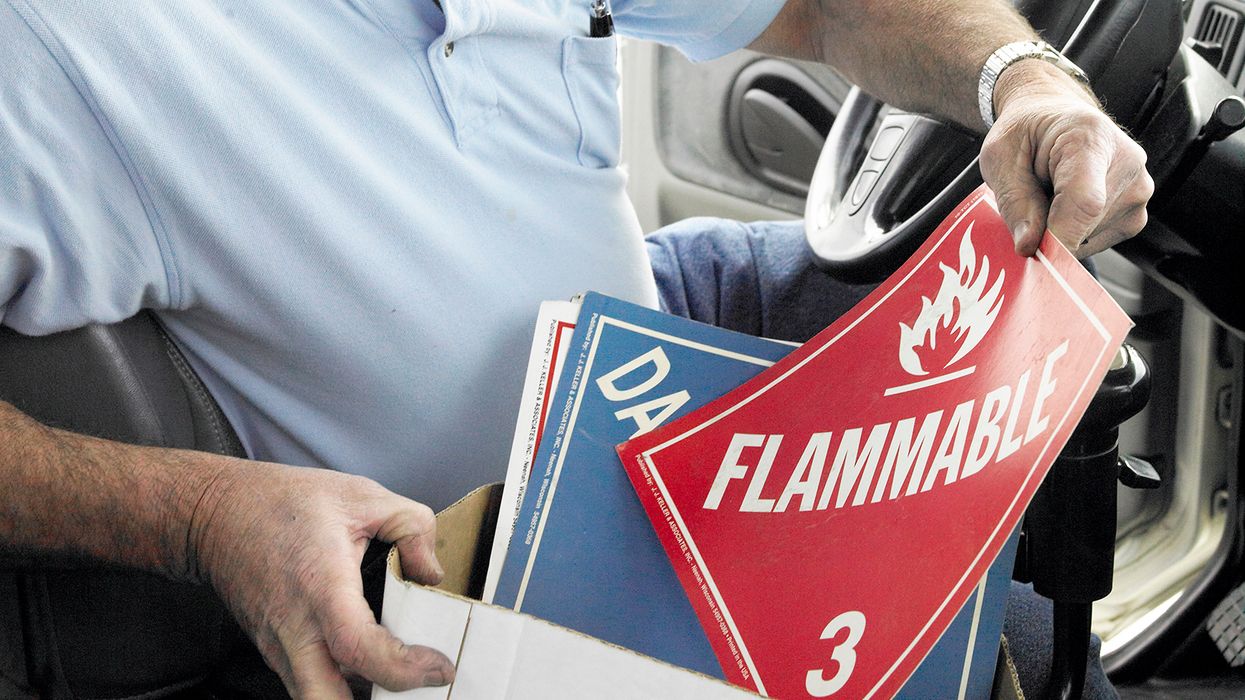
NewsIndustry NewsClassification - HazmatHazmat SafetyHazmat: HighwayHazmatIn-Depth ArticleHazmat definitionsFocus AreaEnglishTransportationUSA
2022-11-15T06:00:00Z
Fuel tanks — Is a CDL hazmat endorsement required?
Many carriers use fuel systems to power equipment mounted on a commercial motor vehicle (CMV). Do these tanks that fuel the equipment need placards? And does the driver need a hazmat endorsement on their commercial driver’s license (CDL)?
PHMSA recently clarified how the Hazardous Materials Regulations (HMR) apply to fuel systems powering equipment mounted on a motor vehicle. In this case, a company was asking about mounted fuel tanks used to operate boiler and steam units mounted on their trucks and trailers. The tanks in question were separate from the fuel tanks that powered the engine.
The bottom line? If placards are not required, no hazmat endorsement is needed to drive the vehicle.
When a tank is a fuel tank, no placards required
According to the interpretation, a fuel tank is a tank — other than a cargo tank — used to transport flammable or combustible liquid, or compressed gas, to:
- Supply fuel for propulsion of the transport vehicle to which it is attached, or
- Operate other equipment on the transport vehicle.
PHMSA noted that permanently mounted fuel tanks are not subject to the HMR with respect to their use on the vehicle, if the tanks:
- Meet the requirements of 49 CFR 393.65 and 393.67 for liquid fuel systems,
- Are used only to supply fuel to operate the motor vehicle or its auxiliary equipment, and
- Are not marked as Department of Transportation specification cargo tanks nor meet the definition of a cargo tank, as defined in 171.8.
Fuel tanks that meet these criteria are not subject to the HMR, therefore no placards are required.
When a hazmat endorsement is required
Drivers who operate any size CMV hauling hazmat in quantities that require placarding must obtain a CDL with a hazardous materials endorsement (HME). This is the same in all states and is true whether a carrier operates in intrastate or interstate commerce.
More specifically, drivers must have the HME on their CDL to drive a vehicle that transports:
- Hazardous materials that must be placarded under 49 CFR Part 172, or
- Any quantity of a select agent or toxin listed in 42 CFR Part 73.
Key to remember: If no placard is required, the CDL hazmat endorsement is not needed either.
Most Popular Highlights In Human Resources

NewsIndustry NewsIndustry NewsHR GeneralistFamily and Medical Leave Act (FMLA)Family and Medical Leave Act (FMLA)USAHR ManagementEnglishFocus AreaHuman Resources
2023-09-06T05:00:00Z
Appellate court sided with employee's (almost) 3-year-delayed FMLA claim
Back in October 2018, Laffon had a medical emergency and needed some time off under the federal Family and Medical Leave Act (FMLA).
Her leave lasted until November 15. Ten days after she returned to work, on November 26, her employer terminated her.
She sued, arguing that the employer retaliated against her because of her FMLA leave.
The catch? She didn't bring the suit until almost three years later.
No link between leave and termination
In court, the employer argued that there was no causal link between Laffon taking FMLA leave and her termination. Although the court documents aren't robust, they do reveal that the employer indicated that Laffon's allegations didn't show that her taking FMLA leave was a factor in the decision to terminate her. The documents showed only that the termination chronologically followed her leave.
The court agreed with the employer. It also agreed that Laffon failed to allege a willful violation of the FMLA, which would allow her to benefit from the FMLA's three-year statute of limitations.
Laffon appealed the case to the Ninth Circuit.
Statute of limitations
Under the FMLA, employees have two years from the date of the last event constituting the alleged violation for which they can bring a claim.
Those two years are extended to three years if the employer's actions were "willful." This means that an employee must show that the employer either knew or showed reckless disregard for whether its conduct violated the FMLA.
Ruling overturned
Fast forward to August 2023, when the Ninth Circuit reversed the lower court's decision. It indicated that, based on Laffon's amended complaint and liberally construing the law, her allegations establish that her leave was causally connected to her termination and that the employer's action (her termination) was willful.
Glymph v. CT Corporation Systems, No. 22-35735, Ninth Circuit Court of Appeals, August 22, 2023.
Key to remember: Terminating an employee soon after returning from FMLA leave is risky, unless there is a clear, well-documented, non-leave-related reason. Case documents did not show such a clear reason, which can also increase the risk of a willful finding. Employees have time to file claims, even years.

NewsIndustry NewsHR GeneralistFamily and Medical Leave Act (FMLA)In-Depth ArticleFamily and Medical Leave Act (FMLA)HR ManagementEnglishUSAFocus AreaHuman Resources
2024-05-07T05:00:00Z
May employees take FMLA leave to care for family members outside the U.S.?
Yes, employees may take leave under the federal Family and Medical Leave Act (FMLA) to care for family members who are outside U.S. borders.
If the employee meets the eligibility criteria of the FMLA, the family member has an FMLA serious health condition, and the employee is needed to care for the family member, the employee’s time off would be protected. It doesn’t really matter where the family member is.
To figure out whether the family member’s condition meets the criteria under the FMLA, employers may require that the employee provide a certification supporting the leave.
Certifications in other languages
If an employee or a family member is visiting in another country, or a family member lives in another country, and a serious health condition develops, employers must accept a medical certification from a health care provider who practices in that country. This rule applies to an original certification, a recertification, and when requesting a second or third opinion from a provider.
If a certification by a health care provider from another country is in a language other than English, employers may require that the employee provide a written translation of the certification.
Traveling to care for family member
If family members are outside the U.S., employees will need to spend some time traveling. The employee’s travel time would likely be seen as part of the FMLA leave if:
- The travel is so intertwined with the care, or
- If it is needed to obtain the care.
Handling intermittent leave
Employees may also take intermittent FMLA leave to care for far-away family members. Employers would manage such leave the same way they do for intermittent leave inside the U.S. Employers should:
- Give the employee an eligibility/rights & responsibilities notice within five days of being put on notice,
- Ask for a certification if desired (including a translation),
- Give the employee a designation notice within five days of getting enough information, and
- Track the employee’s leave time.
Whenever employees are away from the physical worksite, tracking how much intermittent FMLA leave they are taking has its own challenges. Employers may use a simple honor system of self-reporting or technology to keep track of when the employee is taking FMLA leave and when the employee is working.
Key to remember: Eligible employees may take FMLA leave to care for family members who are outside the U.S.

NewsDrug and Alcohol TestingDrug and Alcohol TestingDrug Free WorkplaceMarijuanaIn-Depth ArticleUSAHR ManagementEnglishIndustry NewsSafety & HealthGeneral Industry SafetyHR GeneralistAssociate RelationsFocus AreaHuman Resources
2026-07-28T05:00:00Z
Federal marijuana changes mean it’s time for a drug and alcohol policy review
If you haven’t looked at your drug and alcohol policy lately, it’s time to schedule a review. A change in the way the federal government views medical marijuana could mean it needs to be refreshed.
Federal medical marijuana change impacts accommodations
In April, medical marijuana was reclassified as a Schedule III drug under the Controlled Substances Act, meaning that under federal law it’s considered to have a low potential for dependence. Products containing marijuana approved by the Food and Drug Administration (FDA) and marijuana products regulated by state medical marijuana laws are now in the lower drug category.
State medical marijuana laws still need to be followed, but the reclassification gives some federal protections to individuals who legally use medical marijuana under a state law or who use a federally approved drug containing marijuana.
To avoid the risk of a discrimination claim under the federal Americans with Disabilities Act (ADA), employers in states where medical marijuana is legal should review their workplace policy to make sure it treats individuals using medical marijuana the same way it treats any individual using a prescription medication.
Employers with employees covered by federal drug and alcohol testing regulations for workers in safety-sensitive positions, such as Department of Transportation regulations, must continue to follow those federal laws and forbid marijuana use for covered employees. There are other considerations for employees who only fall under a workplace drug and alcohol policy, however.
A positive test for marijuana should not automatically lead to termination or a decision not to hire. Employers should consider additional factors before making a decision.
What does it mean to accommodate medical marijuana use?
When an employee tests positive for marijuana, an employer should check to see if the positive test is the result of legal off-duty use of medical marijuana. If that is the case, accommodation should be considered.
Accommodating medical marijuana use doesn’t mean an employee must be allowed to use it in the workplace or be impaired on work time. Instead, it means pausing to consider a workplace change because of the employee’s medical condition.
In general, this begins with a discussion with the employee about accommodations, including the legal off-duty use of medical marijuana. In states where medical marijuana isn’t legal, employers would only need to consider accommodations for use of marijuana products approved by the FDA. If an employee with a medical marijuana card asks that off-duty use be accommodated, the information-gathering phase could include documentation of the disability and the need for accommodation.
When deciding whether off-duty medical marijuana use is an appropriate accommodation, safety concerns may be considered. An employer can ask the employee to present their doctor with a list of their job duties and concerns to determine whether a genuine risk of substantial harm exists if the employee were to use cannabis while off duty.
If the off-duty use of medical marijuana presents a risk, other reasonable accommodations should be discussed. Perhaps the employee can work with their doctor to find another medication that will not present a safety risk. Other considerations could include moving the employee out of a safety-sensitive position, using alternative scheduling, or changing the way the work is done.
After the accommodation has been agreed upon, a trial period can be used to determine whether it is working.
Federal recreational marijuana changes under consideration
Additional changes to the way the federal government views marijuana could be coming soon. Recreational marijuana is still categorized as a Schedule I drug, but the federal government is considering moving it to a lower drug schedule.
The Drug Enforcement Administration held hearings on this proposal between June 29 and July 15, and those who spoke at the hearing can submit briefs through August 17. After the hearing process is completed, the federal government could issue a final rule rescheduling recreational marijuana.
More will be known about how this could influence workplace drug policies after a final rule is issued. It’s likely that state laws will continue to make an impact on how employers handle marijuana in the workplace, although rescheduling could also mean that the federal Food and Drug Administration plays a larger role in how marijuana is handled.
For now, employers should continue to follow state recreational marijuana laws and consider accommodations for medical marijuana as required.
Key to remember: Employers should review drug and alcohol policies to make sure medical marijuana is handled appropriately and watch for changes in the way the federal government classifies recreational marijuana.

NewsMonthly Roundup VideoFamily and Medical Leave Act (FMLA)LeaveFamily and Medical Leave Act (FMLA)USAHuman ResourcesLeaveHR ManagementEnglishTalent Management & RecruitingAssociate Benefits & CompensationDiscriminationGender DiscriminationDiscriminationIndustry NewsAffirmative ActionRetaliationWage and HourWage and HourPregnancy DiscriminationHR GeneralistAssociate RelationsFocus AreaVideo
HR Monthly Round Up - July 2026
In this July 2026 roundup video, we’ll review the most impactful HR news.
Welcome, everyone! In the next few minutes, we’ll review the latest HR news. Let’s get started.
On June 30th, the Equal Employment Opportunity Commission announced that it voted to rescind two documents relating to permissible affirmative action under Title VII of the 1964 Civil Rights Act. The rescission doesn’t reverse the U.S. Supreme Court’s decisions in two cases in which the Court recognized that Title VII may allow for certain voluntary affirmative action plans in limited circumstances.
In lieu of the EEOC’s actions, employers may want to assess whether any existing policies or programs could be affected by changes in the federal government’s approach to affirmative action.
One other quick EEOC update, the agency published its 2026 regulatory agenda on July 6th, indicating that it plans to publish a proposed rule in November that would change the Pregnant Workers Fairness Act regulations. The EEOC wants to revise the interpretation of the words “pregnancy, childbirth, or related medical conditions.” Stay tuned for more on this in the coming months.
Also, on July 6th, the U.S. Department of Labor’s Wage and Hour Division published its 2026 regulatory agenda. The agency noted that a proposed rule on joint employer status was slated for July 2026, and a final rule on independent contractor status is expected in October 2026. However, these dates, like the EEOC one, are estimates and subject to change.
Our last HR update for this month is all about retaliation, specifically as it pertains to the Family and Medical Leave Act. Employers are prohibited from taking adverse employment actions because employees exercise their FMLA rights. For example, giving an employee who took FMLA leave a smaller pay increase or a lower bonus could be seen as retaliating against them.
That’s what the Third Circuit Court of Appeals ruled in June against an employer that had given an employee a more than 40 percent reduction in bonus and salary increase compared to previous years. The employer ultimately fired the employee who then sued.
The court found the timing of the lower amounts was unusually suggestive, as they happened right after he took FMLA leave, which implied it was retaliatory.
That’s all the HR news we have time for today. Thanks for watching. See you next month!

NewsIndustry NewsRecordkeepingRecordkeepingHR GeneralistFamily and Medical Leave Act (FMLA)In-Depth ArticleFamily and Medical Leave Act (FMLA)HR ManagementEnglishUSAFocus AreaHuman Resources
2026-05-20T05:00:00Z
Do the FMLA notices and certifications expire in June?
The answer to that question for employers is, “No.” The answer to that question for the U.S. Government’s Office of Management and Budget (OMB), however, is, “Yes.”
Employers might notice that the following federal Family and Medical Leave Act (FMLA) documents from the U.S. Department of Labor (DOL) have an expiration date listed as “6/30/26” in the upper right-hand corner:
- WH-381: Eligibility/Rights and Responsibilities Notice
- WH-382: Designation notice
- WH-380-E: Certification of an employee’s serious health condition
- WH-380-F: Certification of a family member’s serious health condition
- WH-384: Certification of a qualifying exigency
- WH-385: Certification for military caregiver of a current military member
- WH-385-V: Certification for military caregiver of a veteran
This, however, doesn’t mean that employers aren’t allowed to use these forms after that date. They may. Employers and employees are allowed to use the current forms beyond that date because the content remains applicable under FMLA law.
The June 30, 2026, date on the FMLA notices and certification forms, doesn’t represent a deadline for FMLA leave itself. It’s the OMB’s expiration date for the forms’ collection and recordkeeping requirements, not the end of the forms’ legal validity.
What the date means
These government documents are subject to certain checks and balances, such as the following:
- OMB control number 1235‑0003 governs the collection of information from employers and employees for DOL compliance purposes.
- The June 30, 2026, date is when the latest version of the forms will be replaced by a new OMB‑approved version.
The OMB has to review the FMLA notices and certification forms every 3 years. The last time it did so, it didn’t make any material changes.
The OMB is part of the U.S. Executive Office and helps the president meet policy and budget, manage details, oversee regulatory objectives, and helps fulfill the agency’s statutory responsibilities.
Model forms optional
Employers aren’t required to use the DOL’s model forms. Many do, however, because it’s easier than creating their own forms. Using the DOL’s forms also helps ensure the notices provide enough information and the certifications don’t ask employees for information beyond what the FMLA allows.
Key to remember: The June 30, 2026, expiration date of FMLA documents is just a form‑collection deadline, not a legal cutoff for FMLA leave or certification. Employers may still use the current forms until a new version is issued.

NewsIndustry NewsAssociate Benefits & CompensationHR GeneralistFamily and Medical Leave Act (FMLA)In-Depth ArticleFamily and Medical Leave Act (FMLA)Associate RelationsEnglishHR ManagementFocus AreaHuman ResourcesUSA
2025-03-27T05:00:00Z
Who can fill out FMLA forms? The answer might surprise you
One of the most common questions involving the federal Family and Medical Leave Act (FMLA) that we see is: “Can ________ fill out the medical certification?”
This question stumps a lot of HR people and can be a little confusing.
It might be easier to start with who CAN’T fill out an FMLA certification. That includes your coworker, best friend, neighbor, or pet.
Jokes aside, often (but not always) a doctor fills out the FMLA certification, and since March 30 is “Doctors’ Day,” this is a great time to discuss this topic.
FMLA certification basics
Employers aren’t required to use certifications, but if they do, the U.S. Department of Labor (DOL) has five different certification forms to use for various FMLA leave situations.
The forms are as follows:
- Certification of Health Care Provider for Employee's Serious Health Condition,
- Certification of Health Care Provider for Family Member's Serious Health Condition,
- Certification of Qualifying Exigency for Military Family Leave,
- Certification for Serious Injury or Illness of a Current Servicemember for Military Family Leave, and
- Certification for Serious Injury or Illness of a Veteran for Military Family Leave.
Let’s focus on the first two, as these are the most common ones HR administrators use.
Who can fill out an FMLA certification?
The FMLA regulations describe the person who has the authority to fill out a certification as a “health care provider.” The good news is, the regulations include a lengthy list of medical professionals who fit this role.
Under the FMLA, a health care provider includes:
- A doctor of medicine or osteopathy,
- A podiatrist,
- A dentist,
- A clinical psychologist,
- An optometrist,
- A chiropractor (limited to manual manipulation of the spine as demonstrated by X-ray),
- A nurse practitioner,
- A nurse midwife,
- A clinical social worker,
- A physician assistant,
- A Christian Science practitioner, and
- Any health care provider from whom the employer or the employer's group health plan's benefits manager will accept a medical certification to substantiate a claim for benefits.
To be qualified to fill out FMLA forms, medical professionals must be authorized to practice in the state and perform within the scope of their practice. This means that the provider must be authorized to diagnose and treat physical or mental health conditions.
What about doctors in a foreign country?
If an employee or an employee's family member is visiting another country, or a family member resides in another country, and a serious health condition develops, the employer must accept a medical certification from a health care provider who practices in that country. This includes second and third opinions.
If a medical certification from a foreign health care provider is not in English, the employee may be required to provide a written translation of the certification.
Key to remember: The FMLA regulations spell out which medical professionals can fill out certification forms.
Most Popular Highlights In Safety & Health

NewsIndustry NewsAccident Investigation - OSHAAccident Investigation - OSHASafety & HealthConstruction SafetyGeneral Industry SafetyIn-Depth ArticleEnglishFocus AreaUSA
2026-08-06T05:00:00Z
What near misses are trying to tell you
Nobody got hurt. Nothing was damaged. It's easy to shrug and move on. A near miss is still an incident. A hazard existed, someone was exposed to it, yet the exposure didn't result in injury, illness, or damage.
That doesn't mean the hazard is gone. If it's ignored, the risk remains, and the next incident could have a very different outcome. If you see a close call, say something. If you hear about one, act on it. That's what turns a near miss from a warning sign into an opportunity for prevention.
Same hazard, different outcome
The problem with ignoring a near miss is that the hazard is often still there. Consider this common workplace situation.
A ceiling pipe had been dripping in a lobby corridor for three weeks. A repair ticket sat in the backlog, and custodial staff mopped the puddle every morning before the building filled. Since the leak wasn’t viewed as urgent, nothing changed.
A week before anyone got hurt, a worker slipped on the wet floor but caught the handrail and walked away unharmed. The near miss went unreported, the leak continued, and conditions remained exactly the same. Then another worker slipped in the same location, fell, and injured an ankle.
The hazard, exposure, and circumstances were nearly identical. One incident ended as a near miss and the other resulted in an injury. The difference was the outcome, not the hazard.
Had that first near miss been reported and investigated, important questions would’ve surfaced immediately. How long had the leak existed? Why was the area not marked? Why was the repair request still sitting in the backlog? The real issue wasn’t the worker who slipped. It was a system that failed to recognize and prioritize a safety critical repair.
Turning near misses into prevention
Most near misses go unreported for a handful of predictable reasons. Employees may fail to report incidents because they don’t view them as significant, are concerned about potential repercussions, are unsure of the reporting process, or doubt that any action will be taken. That last reason can be the most damaging because it teaches people that speaking up is pointless.
The question is not whether near misses happen in your workplace. They do. The question is whether people report them and whether anything happens when they do.
Creating a strong reporting culture starts with action, not just encouragement.
- Make reporting easy. If reporting is difficult, people will not do it. Use simple tools such as a paper form, anonymous drop box, or QR code linked to a reporting form.
- Respond every time. Not every reported incident requires a full investigation, but every report deserves acknowledgment. Silence quickly kills reporting culture.
- Investigate for causes, not blame. Focus on what allowed the hazard to exist rather than who made a mistake.
- Assign owners and deadlines. Every corrective action should have a responsible person and a due date. Simply telling employees to "be careful" isn’t a corrective action.
- Fix it now and for good. Put interim controls in place immediately, such as signage, barriers, or containment measures, while working toward a permanent solution.
- Close the loop. Verify the fix worked and share what was learned. One incident may reveal a hazard that exists elsewhere in the organization.
Prevention starts here
While OSHA doesn’t require employers to report every near miss, the agency recognizes the value of identifying and correcting hazards before they cause an injury. Near miss investigations are included in OSHA's Recommended Practices for Safety and Health Programs and are a required element of OSHA's Voluntary Protection Program (VPP).
Some OSHA approved state plans go even further and specifically require employers to investigate workplace incidents and identify underlying causes as part of their injury and illness prevention efforts. These requirements reinforce the value of investigating near misses to identify hazards and take corrective action before someone gets hurt.
Key to Remember: A near miss is an incident without an injury, but it is not an incident without value. Investigate it, identify the root cause, and fix the hazard before the next incident has a different outcome.

NewsIndustry NewsIndustry NewsEnforcement and Audits - OSHASafety & HealthGeneral Industry SafetyOccupational Safety and Health Administration (OSHA), DOLEnglishFocus AreaOSHA Emphasis ProgramsUSA
2026-07-31T05:00:00Z
OSHA revises, extends warehouse NEP
Effective July 31, OSHA revised its National Emphasis Program (NEP) on Warehousing and Distribution Center Operations (CPL 03-00-026) and extended the expiration date five years, to July 31, 2031. Inspections under the NEP will continue to focus on hazards common to warehousing and distribution centers such as powered industrial trucks, material handling/storage, walking-working surfaces, means of egress, heat, ergonomics, and fire protection.
Significant revisions include:
- Removed coverage for High Injury Rate Retail Establishments (Table 3 in 2023 NEP).
- Removed mandatory screening for ergonomic and heat hazards.
- Clarified Area Office discretion to expand inspections based upon fatalities/catastrophes, complaints, or referrals related to establishments in the NAICS codes covered under the NEP.
The revised NEP replaces the previous version, which took effect July 13, 2023.

NewsIndustry NewsEnforcement and Audits - OSHAEnforcement and Audits - OSHASafety & HealthConstruction SafetyGeneral Industry SafetyOccupational Safety and Health Administration (OSHA), DOLIn-Depth ArticleEnglishFocus AreaUSA
2026-08-10T05:00:00Z
Hot off the press: OSHA’s latest compliance publications
OSHA continues to release publications. Five new ones cover topics ranging from heat-related illnesses to hepatitis B vaccination requirements. The documents don’t create new regulations or obligations. Instead, they provide guidance and information that may help you comply.
Heat-related illness
Although OSHA doesn’t have a Heat standard, the agency expects employers to protect workers from heat hazards. In fact, OSHA can issue citations under the General Duty Clause. The agency may also cite related existing standards for illness recordkeeping, sanitation, and training. Two new publications offer solutions:
- The fact sheet, Heat-Related Illnesses and First Aid (OSHA 4506), outlines the signs and symptoms of heat-related illnesses, from heat stroke to rhabdomyolysis (muscle breakdown). A section on first aid offers several response principles, including four ways to cool a worker immediately.
- The Quick Card, Protecting You and Your Co-workers from Heat Exposure (OSHA 3154), explains how workers can protect themselves and their coworkers from heat exposure. It covers risk factors, symptoms of heat exhaustion and heat stroke, prevention and protection measures, and first aid actions.
Hepatitis B vaccination
The Bloodborne Pathogens standard requires employers to make the hepatitis B vaccine series available to workers who have occupational exposure. The term occupational exposure is defined in 29 CFR 1910.1030. The hepatitis B virus (HBV) is a pathogenic microorganism that can cause potentially life-threatening disease in humans. It’s transmitted through exposure to blood and other potentially infectious materials (OPIM).
An OSHA fact sheet, Hepatitis B Vaccination Protection (OSHA 4504), provides a high-level overview of 1910.1030 and an explanation of hepatitis B vaccine protection and employer requirements under the standard.
Anti-retaliation programs
OSHA's whistleblower protections prohibit employers from retaliating against employees who report safety concerns, workplace injuries, or potential OSHA violations. The agency also enforces whistleblower protections under more than 20 other federal laws. The fact sheet, Recommended Practices for Anti-Retaliation Programs (OSHA 4508), is intended to assist employers in creating retaliation-free workplaces.
The publication outlines five key elements to an effective anti-retaliation program: management commitment, compliance concern response system, anti-retaliation response system, anti-retaliation training, and program oversight.
Safety Champions Program
OSHA’s Safety Champions Program is a voluntary program open to private and public-sector worksites covered by OSHA. It is aimed at employers that want to improve workplace safety and health, with the goal of reducing the risk of occupational injuries, illnesses, and fatalities. A fact sheet, Safety Champions: An OSHA Cooperative Program (OSHA 4497), explains who can participate, how the program works, the benefits of participating, and how to get started.
Other publications
Earlier this year, OSHA also issued these publications related to electrical safety, OSHA inquiries, silica, the OSHA poster, hearing protection, and OSHA inspections:
- Extension Cords: 5 Things to Know (OSHA 4495);
- Roll Up! Electrical Safety in Construction (OSHA 4496);
- Responding to OSHA Inquiries on Complaints and Referrals: Best Practices for Small Employers (OSHA 4498);
- Hazard Alert: Worker Exposure to Silica during Countertop Manufacturing, Finishing, and Installation (OSHA (DTSEM) - HA-3768-2026);
- OSHA Cares That You Go Home Safe (OSHA 3165-02R 2026), the OSHA job safety and health poster;
- Hearing Protector Fit Testing: Ensuring Appropriate Noise Protection at Work (SHIB 02-17-2026); and
- Employer Rights and Responsibilities Following a Federal OSHA Inspection (OSHA 3000-01R 2026).
Key to remember: Several new OSHA publications provide guidance and information on a variety of topics, from heat safety to anti-retaliation programs.

NewsIndustry NewsAccident Investigation - OSHAAccident Root Cause DeterminationSafety & HealthConstruction SafetyGeneral Industry SafetyIn-Depth ArticleEnglishFocus AreaUSA
2026-06-22T05:00:00Z
Beyond the blame: Turbocharging incident investigations with root cause analysis
Every incident has a story, but uncovering the true cause requires digging deeper than the obvious. This is where root cause analysis (RCA) comes in. An RCA is a systematic process that dissects a near miss, incident, or failure to identify the underlying factor(s) that led to the event. RCAs are intended to go beyond the immediate or obvious causes to uncover contributing factors like system gaps, inadequate processes and procedures, and questionable equipment conditions.
Stepping into an effective RCA
Understanding how and why a problem occurs helps us discover and implement more effective, lasting corrective actions. We do this by following five basic steps:
- Gather data: Collect all relevant information about the incident so you can build an accurate picture of what happened. This information is derived from collecting physical evidence, interviewing employees and witnesses, analyzing photos, reviewing documentation such as SOPs or training records, and evaluating environmental conditions like lighting or noise.
- Identify the problem: Define what actually went wrong, focusing on the event itself without making assumptions or jumping to conclusions. This might include clarifying procedural steps, pinpointing deviations from expected outcomes, or identifying unsafe actions, conditions, or system failures.
- Analyze cause and effects: Determine why the problem occurred by examining the relationships between actions, conditions, decisions, and system factors that contributed to the event. Analysis may include the use of RCA tools like 5‑Whys, fishbone diagrams, or fault-tree analysis helps reveal deeper organizational, human-factors, or process-related causes.
- Generate possible solutions: Develop corrective and preventive actions that directly address the causes identified. Effective solutions will close system gaps, improve processes, utilize engineering controls, remove hazardous conditions, and enhance training.
- Document results: Record the date, findings, and corrective actions in a clear, complete written report. The report should summarize what happened, why it happened, how the investigative team reached their decisions, corrective actions that will be taken and who’s responsible for each, and timelines for implementation and follow-up. Thorough documentation ensures accountability, demonstrates regulatory compliance, and provides a reference for future risk assessments or audits.
Dodging investigation biases
It’s not enough to simply follow the steps of an investigation and RCA. It’s critical to act fast but do so without steering the root cause analysis in a certain direction. Research involving multiple experienced investigators found that bias during investigations occurs far more often than people realize.
Here are the most common pitfalls that can quickly undermine an otherwise solid analysis:
- Limited perspective: Viewing a situation through a narrow or incomplete lens shaped by one’s own experiences, assumptions, roles, or available information can result in an interpretation of an incident that does not reflect the full reality of what happened.
- Jumping to conclusions: When investigators arrive at a conclusion before analyzing important facts, or when they address only surface-level issues, incident causes aren’t corrected. This can lead to repeated incidents with increasing severity over time and costly fixes that don’t solve the real problem.
- Misguided focus: Human tendency is to look at human error. However, when investigators only look at what is immediately visible, such as an unsafe act or a single piece of equipment, they often miss deeper systemic factors.
- Confirmation bias: Unconsciously looking for information that confirms what investigators already believe can result in missed clues or facts, leading the investigation in the wrong direction.
- Organizational pressures: Not having the correct investigation team (people with diverse knowledge in maintenance, engineering, operations, EHS, human factors) or feeling pressured to “wrap the investigation up quickly” can easily derail an investigation. When this happens, investigators may overlook system or management weaknesses, assign blame, or withhold information, leading to corrective actions that are too narrow or unrealistic.
A disciplined root cause analysis, free from bias, can take your incident investigations from ineffective to effective ensuring a strong defense against recurring workplace incidents.
Keys to remember: Root cause analysis identifies the deeper system and process factors behind an incident so organizations can implement lasting fixes. Using a structured approach to investigations and remaining aware of common biases helps ensure findings are accurate and corrective actions will prevent incident recurrence.

NewsIndustry NewsSafety & HealthElectrical SafetyGeneral Industry SafetyElectrical SafetyIn-Depth ArticleEnglishFocus AreaUSA
2022-11-14T06:00:00Z
Don’t blast away arc flash safety
Despite the numerous safety standards and resources to protect employees from arc flash blasts, many employees continue to get seriously injured or killed by these lethal hazards. In early 2022, Congress met with OSHA and other stakeholders to discuss improvements to OSHA’s electrical personal protective equipment (PPE) requirements. During the meeting, stakeholders agree that between 500,000 and 800,000 workers regularly work without adequate PPE, including arc flash protection.
If you have two energized points which are not contacting each other solidly, the current can jump from one point to the other. This is called an electric arc or arc flash. Arc flashes occur by an electrical equipment failure (like a short circuit) or human error (such as holding a metal object too close to energized equipment).
One-second duration
Unlike a flash fire, an electric arc can begin and end in less than a second. Bystanders see a flash and hear a loud boom, and it is over.
Electric arc
A person can be severely injured or killed by this arc’s huge amount of heat. The temperature of the arc can range from 15,000 to 35,000 degrees Fahrenheit (F). (Heat above 122 degrees (F) can cause third-degree burns, which do not heal.) You can imagine what this heat can do to the human body.
Flying molten metal
The arc also immediately turns the electrical conductors into molten metal droplets that fly away from the source near the sound speed. These projectiles can travel quite a distance, starting clothing and other materials on fire.
Arc blast
Not only does the electric arc generate excessive heat, but this heat also causes an intense pressure wave that usually throws the employees working nearby away from the arc. This wave is so strong it can break eardrums and cause concussions and broken bones.
Explosions and/or fire
The heat from electric arcs can ignite combustible or flammable vapors in the air, causing an explosion. Materials stored nearby can also start on fire.
Personal protective equipment (PPE)
Whenever electrical workers have the chance of exposure to an electric arc, they must wear clothing and eye protection resistant to the flash. Make sure your employer provides you with the necessary PPE.
Cost of an electric arc accident
The monetary cost of an electric arc accident can run into hundreds of thousands of dollars. Damage to equipment and facility, lost production time, increased insurance expenses, medical bills, worker’s compensation, and legal costs can all result from one electric arc accident.
Key to remember
Electricity has long been recognized as a serious workplace hazard, exposing workers to electric shock, burns, fires, and arc-flash explosions. OSHA’s electrical standard minimizes these potential hazards by specifying safety requirements in the design and use of electrical equipment and systems.

NewsIndustry NewsConfined SpacesConfined Space HazardsSafety & HealthConstruction SafetyGeneral Industry SafetyPermit-Required Confined SpacesConfined SpacesIn-Depth ArticleEnglishFocus AreaUSA
2026-06-29T05:00:00Z
The high cost of overlooking confined space hazards
Confined space risks can escalate rapidly and without warning, and inadequate planning for entry can turn a routine task into an irreversible tragedy. This stark reality was highlighted when six lives were lost last summer at a Colorado dairy operation, and the associated $246,000 in penalties underscored the financial costs of improper planning. Both costly lessons serve as a powerful reminder that these outcomes were entirely preventable with the right preparation, training, and hazard awareness.
Rapid consequences
What started as a normal workday quickly turned fatal when two workers attempted to stop the flow in the manure transfer system. When a pipe disconnected, both workers were overcome by toxic hydrogen sulfide gas. Four coworkers rushed to their assistance and were met with the same deadly atmosphere. The catastrophe unfolded in mere minutes, presenting a serious wake-up call to the sudden and severe consequences of hazardous atmospheres within confined spaces.
Preventable failures
Findings from OSHA’s investigation revealed that several safety system gaps played a role in the incident, including:
- Inadequate planning for confined space entry and emergency response;
- Failure to maintain a written hazard communication program; and
- Insufficient training to help workers better understand, recognize, and respond to exposure risks.
Understanding these findings and taking steps to address these areas can help strengthen future safety practices and prevent similar incidents.
Proven safety strategies
When invisible hazards pose the greatest risk, keeping employees safe requires a plan that includes:
Step 1: Identifying and classifying the space to determine whether it is a confined space or a permit‑required confined space.
Step 2: Assessing the space for all potential hazards, including toxic gases, oxygen levels, engulfment or entrapment risks, and mechanical or electrical dangers.
Step 3: Establishing reliable communication channels between the Entrant and Attendant before entry and ensure communication is maintained throughout the operation.
Step 4: Preparing required equipment beforehand, including calibrated gas monitors, communication equipment, and rescue systems.
Step 5: Developing a rescue plan and set up equipment in advance. Most confined space fatalities occur when untrained coworkers attempt a rescue. All personnel, including rescuers, must be trained prior to entry on alarms, communication protocols, and exiting expectations.
Step 6: Training personnel according to assigned roles, including Attendant, Entrant, and Entry Supervisor. Training must be provided prior to an employee’s first assigned duties, any time there is a change in assigned duties; when operations change that could affect hazards, or whenever it’s believed that there are deviations from established procedures.
Step 7: Obtaining required permits and ensure all safety conditions and controls are verified and documented prior to entry and throughout the entry as necessary.
Step 8: Controlling hazardous energy sources including mechanical, electrical, and pneumatic systems, as well as valves and piping.
Step 9: Monitoring confined space atmospheres throughout the entry to ensure oxygen levels and flammable and toxic gases remain within safe limits.
Step 10: Ensuring proper air quality by ventilating the space when natural ventilation is not sufficient.
Step 11: Reviewing and refreshing your confined space and hazard communication programs at least annually to ensure confined spaces are classified properly, hazards are effectively controlled, and employees are properly trained.
Preventing deadly confined space incidents requires a disciplined process during every entry. By taking these simple but essential steps, organizations can protect workers from the life‑threatening risks posed by hazardous atmospheres in confined spaces.
Key to remember: Preventing deadly confined space incidents relies on hazards recognition, thorough preparation, and following a consistent and disciplined process every entry.
Saved to my EVENT CALENDAR!
View your saved links by clicking the arrow next to your profile picture located in the header. Then, click “My Activity” to view the Event Calendar on your Activity page.
OK
J. J. Keller is the trusted source for DOT / Transportation, OSHA / Workplace Safety, Human Resources, Construction Safety and Hazmat / Hazardous Materials regulation compliance products and services. J. J. Keller helps you increase safety awareness, reduce risk, follow best practices, improve safety training, and stay current with changing regulations.
Copyright 2026 J. J. Keller & Associate, Inc. For re-use options please contact copyright@jjkeller.com or call 800-558-5011.