Compliance Just Got Easier: Stay ahead of regulatory changes with instant notifications on updates that matter.
['Forklifts and Powered Trucks']
['PIT Inspections', 'Forklifts and Powered Trucks', 'Safe Operation of PITs']
06/16/2026

Copyright 2026 J. J. Keller & Associate, Inc. For re-use options please contact copyright@jjkeller.com or call 800-558-5011.
:
|
InstituteSafety & HealthForklifts and Powered TrucksGeneral Industry SafetyForklifts and Powered TrucksFocus AreaUSAEnglishSafe Operation of PITsAnalysisPIT InspectionsIn Depth (Level 3)
Daily inspections – External
['Forklifts and Powered Trucks']
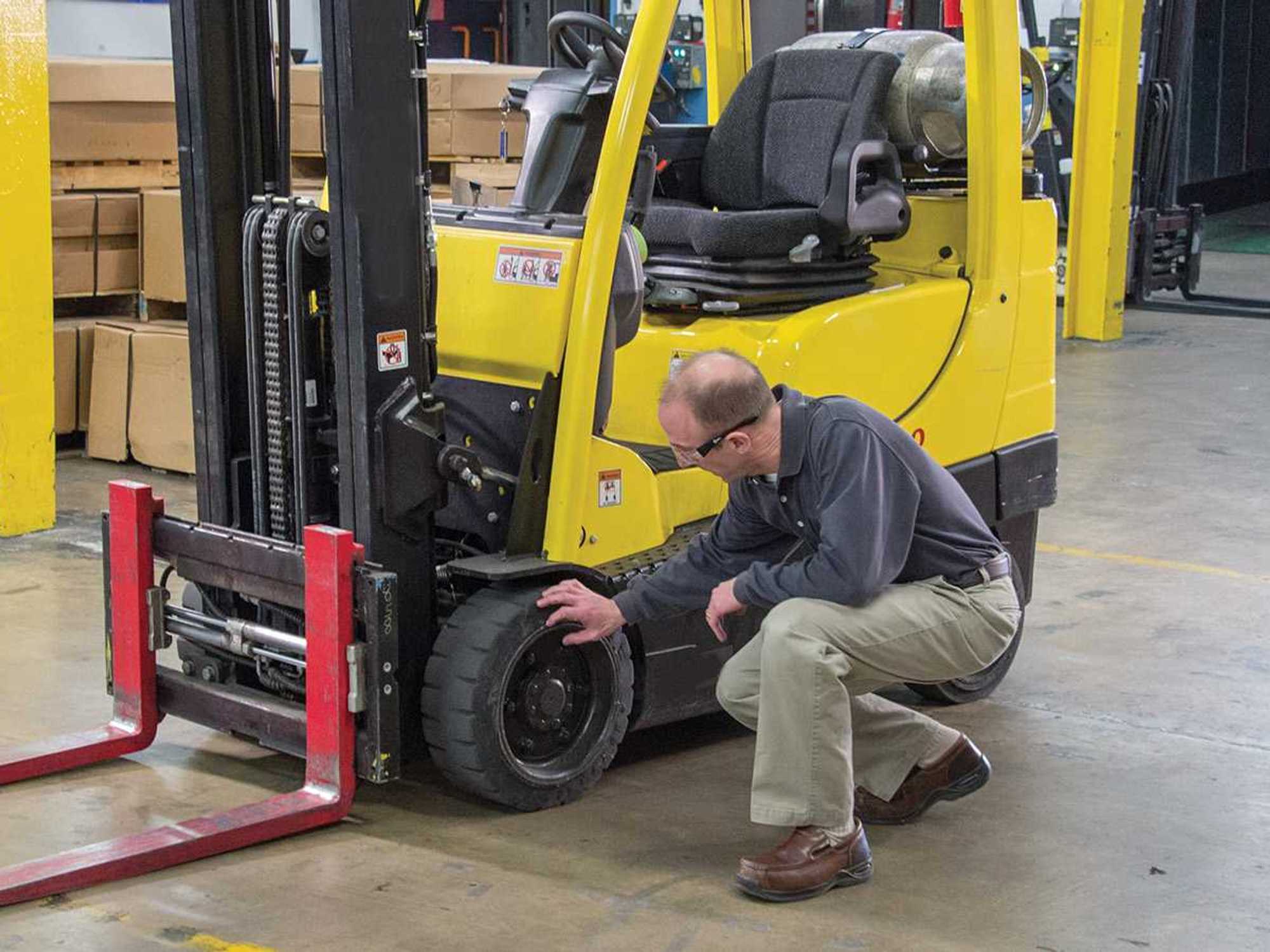
- A PIT’s tires, forks, mast and carriage, body, cab, and (for certain types) platform must be inspected daily to ensure proper operation and safety in the workplace.
The daily inspection requirements below broadly apply to several kinds of Powered Industrial Trucks (PITs): electric forklifts, gas and diesel forklifts, liquefied petroleum gas (LPG) forklifts, order pickers, powered pallet jacks, reach trucks, and stand-up tow tractors. They must be inspected for these requirements daily, with additional specific requirements for every type of PIT.
Tires
On electric forklifts, gas and diesel forklifts, LPG forklifts, powered pallet jacks, reach trucks, stand-up tow tractors, and pallet jacks, the tires must be in good repair (e.g., no cuts, separation from the rim, or excessive wear) and properly inflated. There must be lug nuts present on each tire, and the lug nuts must each be tightly secure.
Forks
On electric forklifts, gas and diesel forklifts, LPG forklifts, order pickers, powered pallet jacks, reach trucks, and pallet jacks, the forks must be properly aligned and in good repair (e.g., no cracks, bends, or excessive wear). Where present, the top clip retaining pin for each fork must be tightly secure and in good repair (e.g., no cracks). Load back rests must be securely attached and in good repair (e.g., no cracks or bends).
On reach trucks, the telescoping forks must be in good repair (e.g., no cracks, bends, or excessive wear).
Mast and carriage
On electric forklifts, gas and diesel forklifts, LPG forklifts, order pickers, and reach trucks, the mast assembly must be in good repair (e.g., no cracks or dents, missing stops, or broken welds). The hydraulic cylinders must be in good repair (e.g., no cracks or leaks). The lift chains and rollers must be in good repair (e.g., no cracks, kinks, or rust) and properly lubricated. Additionally, the tension of the lift chains must be correct.
On an order picker, the hoist lines, cables, lift chains, and rollers must be in good repair (e.g., no cracks, kinks, or rust).
Body
The body of the PIT must be in good repair (e.g., no cracks or dents) and clean (e.g., no grease or lint). The covers over the battery and other hazardous parts must be in place and secure. The overhead guard must be securely attached and in good repair (e.g., no cracks, bends, broken welds, or missing bolts). The nameplate must be present and legible. The safety decals or warning labels must also be legible. Any wiring, belts, lights, headlights, taillights, reflectors, warning lights, hoses, chains, and cables must be in good repair (e.g., no cracks, bends, frays, breaks, leaks, or kinks). Any lights or headlights must be aimed correctly. The control levers must be properly labeled.
On a powered pallet jack, the operator must ensure the hand guard is in place.
Cab
The cab should be clean, with the seatbelt working properly and in good repair (e.g., no frays or excessive wear). The seat itself must also be in good repair and adjusted properly. Control levers must be properly labeled. The mirrors must be in good repair (e.g., no cracks or breaks), clean, and adjusted properly.
Platform
Operators of order pickers, powered pallet jacks, and stand-up tow tractors must also inspect the PIT’s platform. The order picker’s work platform must be clean and in good repair (e.g., no cracks or holes). The guardrails or other limiting devices on the order picker must be in good repair (e.g., no cracks or bends) and must close properly and lock securely. The powered pallet jack and stand-up tow tractor riding platforms must be clean and in good repair (e.g., no cracks or holes).
:
forklifts-and-powered-trucks
forklifts-and-powered-trucks
FOUNDATIONAL LEARNING
Daily inspections – External
InstituteSafety & HealthForklifts and Powered TrucksGeneral Industry SafetyForklifts and Powered TrucksFocus AreaUSAEnglishSafe Operation of PITsAnalysisPIT InspectionsIn Depth (Level 3)
['Forklifts and Powered Trucks']
- A PIT’s tires, forks, mast and carriage, body, cab, and (for certain types) platform must be inspected daily to ensure proper operation and safety in the workplace.
The daily inspection requirements below broadly apply to several kinds of Powered Industrial Trucks (PITs): electric forklifts, gas and diesel forklifts, liquefied petroleum gas (LPG) forklifts, order pickers, powered pallet jacks, reach trucks, and stand-up tow tractors. They must be inspected for these requirements daily, with additional specific requirements for every type of PIT.
Tires
On electric forklifts, gas and diesel forklifts, LPG forklifts, powered pallet jacks, reach trucks, stand-up tow tractors, and pallet jacks, the tires must be in good repair (e.g., no cuts, separation from the rim, or excessive wear) and properly inflated. There must be lug nuts present on each tire, and the lug nuts must each be tightly secure.
Forks
On electric forklifts, gas and diesel forklifts, LPG forklifts, order pickers, powered pallet jacks, reach trucks, and pallet jacks, the forks must be properly aligned and in good repair (e.g., no cracks, bends, or excessive wear). Where present, the top clip retaining pin for each fork must be tightly secure and in good repair (e.g., no cracks). Load back rests must be securely attached and in good repair (e.g., no cracks or bends).
On reach trucks, the telescoping forks must be in good repair (e.g., no cracks, bends, or excessive wear).
Mast and carriage
On electric forklifts, gas and diesel forklifts, LPG forklifts, order pickers, and reach trucks, the mast assembly must be in good repair (e.g., no cracks or dents, missing stops, or broken welds). The hydraulic cylinders must be in good repair (e.g., no cracks or leaks). The lift chains and rollers must be in good repair (e.g., no cracks, kinks, or rust) and properly lubricated. Additionally, the tension of the lift chains must be correct.
On an order picker, the hoist lines, cables, lift chains, and rollers must be in good repair (e.g., no cracks, kinks, or rust).
Body
The body of the PIT must be in good repair (e.g., no cracks or dents) and clean (e.g., no grease or lint). The covers over the battery and other hazardous parts must be in place and secure. The overhead guard must be securely attached and in good repair (e.g., no cracks, bends, broken welds, or missing bolts). The nameplate must be present and legible. The safety decals or warning labels must also be legible. Any wiring, belts, lights, headlights, taillights, reflectors, warning lights, hoses, chains, and cables must be in good repair (e.g., no cracks, bends, frays, breaks, leaks, or kinks). Any lights or headlights must be aimed correctly. The control levers must be properly labeled.
On a powered pallet jack, the operator must ensure the hand guard is in place.
Cab
The cab should be clean, with the seatbelt working properly and in good repair (e.g., no frays or excessive wear). The seat itself must also be in good repair and adjusted properly. Control levers must be properly labeled. The mirrors must be in good repair (e.g., no cracks or breaks), clean, and adjusted properly.
Platform
Operators of order pickers, powered pallet jacks, and stand-up tow tractors must also inspect the PIT’s platform. The order picker’s work platform must be clean and in good repair (e.g., no cracks or holes). The guardrails or other limiting devices on the order picker must be in good repair (e.g., no cracks or bends) and must close properly and lock securely. The powered pallet jack and stand-up tow tractor riding platforms must be clean and in good repair (e.g., no cracks or holes).
2656871954
2656871951
UPGRADE TO CONTINUE READING
RELATED TOPICS
J. J. Keller is the trusted source for DOT / Transportation, OSHA / Workplace Safety, Human Resources, Construction Safety and Hazmat / Hazardous Materials regulation compliance products and services. J. J. Keller helps you increase safety awareness, reduce risk, follow best practices, improve safety training, and stay current with changing regulations.
Copyright 2026 J. J. Keller & Associate, Inc. For re-use options please contact copyright@jjkeller.com or call 800-558-5011.