Compliance Just Got Easier: Stay ahead of regulatory changes with instant notifications on updates that matter.
['Hazmat']
['Hazmat Rulemaking procedures']
2026-01-14T06:00:00Z
JOIN TODAY TO CONTINUE READING THIS ARTICLE & OTHER INDUSTRY NEWS!
You'll also get exclusive access to:
A database of easy-to-understand regulationsAsk unlimited questions to our expertsPre-led discussions forumsAnd more
TRY IT FREE TODAY
Already have an account? Log in now.

Copyright 2026 J. J. Keller & Associate, Inc. For re-use options please contact copyright@jjkeller.com or call 800-558-5011.
NewsPipeline and Hazardous Materials Safety Administration (PHMSA), DOTChange NoticesChange NoticeHazmat SafetyHazmatFocus AreaUSAEnglishTransportationHazmat Rulemaking procedures
PHMSA Final Rule: Hazardous Materials: Eliminating Unnecessary Regulatory Burdens on Fuel Transportation
2026-01-14T06:00:00Z
PHMSA is adopting several amendments to the Hazardous Materials Regulations to reduce unnecessary regulatory burdens associated with the safe transportation of hazardous materials, including energy products. These amendments will reduce costs for hazardous materials transporters and eliminate unnecessary regulatory burdens on fuel transportation while maintaining or increasing the level of safety provided in the Hazardous Materials Regulations.
DATES:
Effective Date: This rule is effective February 13, 2026.
Voluntary Compliance Date: January 14, 2026.
Published in the Federal Register January 14, 2026, page 1433.
View final rule.
| §107.502 General registration requirements. | ||
| (d) | Revised | View Text |
| §171.7 Reference material. | ||
| (l) | Revised | View Text |
| §172.303 Prohibited marking. | ||
| (b)(4) | Added | View Text |
| §172.336 Identification numbers; special provisions. | ||
| (c) Table 1 | Revised | View Text |
| §172.704 Training requirements. | ||
| (e)(1) | Revised | View Text |
| §173.315 Compressed gases in cargo tanks and portable tanks. | ||
| (i)(13) | Revised | View Text |
| §178.337-1 General Requirements. | ||
| (d) | Revised | View Text |
| §180.407 Requirements for test and inspection of specification cargo tanks. | ||
| (a)(7) | Added | View Text |
Previous Text
§107.502 General registration requirements.
* * * *
(d) Registration statements must be in English, contain all the information required by this subpart, and be submitted to: FMCSA Hazardous Materials Division—MC–SEH, West Building, 1200 New Jersey Avenue SE, Washington, DC 20590.
§171.7 Reference material.
* * * *
(l) Chlorine Institute, Inc., 1300 Wilson Boulevard, Arlington, VA 22209.
(1) Chlorine Institute Emergency Kit ‘‘A’’ for 100-lb. & 150-lb. Chlorine Cylinders, Edition 12, Revision 2, January 2014, into §173.3.
(2) Chlorine Institute Emergency Kit ‘‘B’’ for Chlorine Ton Containers, Edition 11, July 2014, into §173.3.
(3) Type 1 JQ 225, Dwg., H51970, Revision F, November 1996, into §173.315.
(4) Type 1 JQ 225, Dwg. H50155, Revision H, November 1996, into §173.315.
(5) Pamphlet 57, Emergency Shut-Off Systems for Bulk Transfer of Chlorine, Edition 6, June 2015, into §177.840.
(6) Section 3, Pamphlet 166, Angle Valve Guidelines for Chlorine Bulk Transportation, 1st Edition, October 2002, into §178.337–9.
(7) Pamphlet 168, Guidelines for Dual Valve Systems for Bulk Chlorine Transport, Edition 2, July 2015, into §178.337–9.
(8) Standard Chlorine Angle Valve Assembly, Dwg. 104–8, July 1993, into §178.337–9.
(9) Excess Flow Valve with Removable Seat, Dwg. 101–7, July 1993, into §178.337–8.
(10) Excess Flow Valve with Removable Basket, Dwg. 106–6, July 1993, into §178.337–8.
(11) Standards for Housing and Manway Covers for Steel Cargo Tanks, Dwgs. 137–1 and 137–2, September 1, 1982, into §178.337–10. Safety Admin., DOT
(12) Typical Manway Arrangement Chlorine Cargo Tank, Dwg
§172.336 Identification numbers; special provisions.
* * * *
(c)
* * * *
| Packaging: | When: | Then the alternative marking requirement is: |
|---|---|---|
| On the ends of portable tanks, cargo tanks, or tank cars. | They have more than one compartment and hazardous materials with different identification numbers are being transported therein. | The identification numbers on the sides of the tank are displayed in the same sequence as the compartments containing the materials they identify. |
| On cargo tanks. | They contain only gasoline. | The tank is marked “Gasoline” on each side and rear in letters no less than 50 mm (2 inches) high, or is placarded in accordance with §172.542(c). |
| On cargo tanks. | They contain only fuel oil. | The cargo tank is marked “Fuel Oil” on each side and rear in letters no less than 50 mm (2 inches) high, or is placarded in accordance with §172.544(c). |
| On one end of nurse tanks if that end contains valves, fittings, regulators or gauges when those appurtenances prevent the markings and placard from being properly placed and visible. | They meet the provisions of §173.315(m) of this subchapter. | N/A. |
| On cargo tanks, including compartmented cargo tanks, or tank cars. | They contain more than one petroleum distillate fuel. | The identification number for the liquid petroleum distillate fuel having the lowest flash point is displayed. If the cargo tank also contains gasoline and alcohol fuel blends consisting of more than 10% ethanol the identification number “3475” or “1987,” as appropriate, must also be displayed. |
§172.704 Training requirements.
* * * *
(e)(1) A hazmat employee who repairs, modifies, reconditions, or tests packagings, as qualified for use in the transportation of hazardous materials, and who does not perform any other function subject to the requirements of this subchapter, is not subject to the training requirement of paragraph (a)(3) of this section.
§173.315 Compressed gases in cargo tanks and portable tanks.
* * * *
(i)(13) A safety relief valve on a chlorine cargo tank must conform to one of the following standards of The Chlorine Institute, Inc.: Type 11/2 JQ225, Dwg. H51970, (IBR, see §171.7 of this subchapter); or Type 11/2 JQ225, Dwg. H50155 (IBR, see §171.7 of this subchapter).
§178.337-1 General Requirements.
* * * *
(d) Reflective design. Every uninsulated cargo tank permanently attached to a cargo tank motor vehicle shall, unless covered with a jacket made of aluminum, stainless steel, or other bright nontarnishing metal, be painted a white, aluminum or similar reflecting color on the upper two-thirds of area of the cargo tank.


NewsPipeline and Hazardous Materials Safety Administration (PHMSA), DOTChange NoticesChange NoticeHazmat SafetyHazmatFocus AreaUSAEnglishTransportationHazmat Rulemaking procedures
PHMSA Final Rule: Hazardous Materials: Eliminating Unnecessary Regulatory Burdens on Fuel Transportation
2026-01-14T06:00:00Z
PHMSA is adopting several amendments to the Hazardous Materials Regulations to reduce unnecessary regulatory burdens associated with the safe transportation of hazardous materials, including energy products. These amendments will reduce costs for hazardous materials transporters and eliminate unnecessary regulatory burdens on fuel transportation while maintaining or increasing the level of safety provided in the Hazardous Materials Regulations.
DATES:
Effective Date: This rule is effective February 13, 2026.
Voluntary Compliance Date: January 14, 2026.
Published in the Federal Register January 14, 2026, page 1433.
View final rule.
| §107.502 General registration requirements. | ||
| (d) | Revised | View Text |
| §171.7 Reference material. | ||
| (l) | Revised | View Text |
| §172.303 Prohibited marking. | ||
| (b)(4) | Added | View Text |
| §172.336 Identification numbers; special provisions. | ||
| (c) Table 1 | Revised | View Text |
| §172.704 Training requirements. | ||
| (e)(1) | Revised | View Text |
| §173.315 Compressed gases in cargo tanks and portable tanks. | ||
| (i)(13) | Revised | View Text |
| §178.337-1 General Requirements. | ||
| (d) | Revised | View Text |
| §180.407 Requirements for test and inspection of specification cargo tanks. | ||
| (a)(7) | Added | View Text |
Previous Text
§107.502 General registration requirements.
* * * *
(d) Registration statements must be in English, contain all the information required by this subpart, and be submitted to: FMCSA Hazardous Materials Division—MC–SEH, West Building, 1200 New Jersey Avenue SE, Washington, DC 20590.
§171.7 Reference material.
* * * *
(l) Chlorine Institute, Inc., 1300 Wilson Boulevard, Arlington, VA 22209.
(1) Chlorine Institute Emergency Kit ‘‘A’’ for 100-lb. & 150-lb. Chlorine Cylinders, Edition 12, Revision 2, January 2014, into §173.3.
(2) Chlorine Institute Emergency Kit ‘‘B’’ for Chlorine Ton Containers, Edition 11, July 2014, into §173.3.
(3) Type 1 JQ 225, Dwg., H51970, Revision F, November 1996, into §173.315.
(4) Type 1 JQ 225, Dwg. H50155, Revision H, November 1996, into §173.315.
(5) Pamphlet 57, Emergency Shut-Off Systems for Bulk Transfer of Chlorine, Edition 6, June 2015, into §177.840.
(6) Section 3, Pamphlet 166, Angle Valve Guidelines for Chlorine Bulk Transportation, 1st Edition, October 2002, into §178.337–9.
(7) Pamphlet 168, Guidelines for Dual Valve Systems for Bulk Chlorine Transport, Edition 2, July 2015, into §178.337–9.
(8) Standard Chlorine Angle Valve Assembly, Dwg. 104–8, July 1993, into §178.337–9.
(9) Excess Flow Valve with Removable Seat, Dwg. 101–7, July 1993, into §178.337–8.
(10) Excess Flow Valve with Removable Basket, Dwg. 106–6, July 1993, into §178.337–8.
(11) Standards for Housing and Manway Covers for Steel Cargo Tanks, Dwgs. 137–1 and 137–2, September 1, 1982, into §178.337–10. Safety Admin., DOT
(12) Typical Manway Arrangement Chlorine Cargo Tank, Dwg
§172.336 Identification numbers; special provisions.
* * * *
(c)
* * * *
| Packaging: | When: | Then the alternative marking requirement is: |
|---|---|---|
| On the ends of portable tanks, cargo tanks, or tank cars. | They have more than one compartment and hazardous materials with different identification numbers are being transported therein. | The identification numbers on the sides of the tank are displayed in the same sequence as the compartments containing the materials they identify. |
| On cargo tanks. | They contain only gasoline. | The tank is marked “Gasoline” on each side and rear in letters no less than 50 mm (2 inches) high, or is placarded in accordance with §172.542(c). |
| On cargo tanks. | They contain only fuel oil. | The cargo tank is marked “Fuel Oil” on each side and rear in letters no less than 50 mm (2 inches) high, or is placarded in accordance with §172.544(c). |
| On one end of nurse tanks if that end contains valves, fittings, regulators or gauges when those appurtenances prevent the markings and placard from being properly placed and visible. | They meet the provisions of §173.315(m) of this subchapter. | N/A. |
| On cargo tanks, including compartmented cargo tanks, or tank cars. | They contain more than one petroleum distillate fuel. | The identification number for the liquid petroleum distillate fuel having the lowest flash point is displayed. If the cargo tank also contains gasoline and alcohol fuel blends consisting of more than 10% ethanol the identification number “3475” or “1987,” as appropriate, must also be displayed. |
§172.704 Training requirements.
* * * *
(e)(1) A hazmat employee who repairs, modifies, reconditions, or tests packagings, as qualified for use in the transportation of hazardous materials, and who does not perform any other function subject to the requirements of this subchapter, is not subject to the training requirement of paragraph (a)(3) of this section.
§173.315 Compressed gases in cargo tanks and portable tanks.
* * * *
(i)(13) A safety relief valve on a chlorine cargo tank must conform to one of the following standards of The Chlorine Institute, Inc.: Type 11/2 JQ225, Dwg. H51970, (IBR, see §171.7 of this subchapter); or Type 11/2 JQ225, Dwg. H50155 (IBR, see §171.7 of this subchapter).
§178.337-1 General Requirements.
* * * *
(d) Reflective design. Every uninsulated cargo tank permanently attached to a cargo tank motor vehicle shall, unless covered with a jacket made of aluminum, stainless steel, or other bright nontarnishing metal, be painted a white, aluminum or similar reflecting color on the upper two-thirds of area of the cargo tank.


See More
RELATED NEWS

Specialized Industries
Go beyond the regulations! Visit the Institute for in-depth guidance on a wide range of compliance subjects in safety and health, transportation, environment, and human resources.
J. J. Keller® COMPLIANCE NETWORK is a premier online safety and compliance community, offering members exclusive access to timely regulatory content in workplace safety (OSHA), transportation (DOT), environment (EPA), and human resources (DOL).

Interact With Our Compliance Experts
Puzzled by a regulatory question or issue? Let our renowned experts provide the answers and get your business on track to full compliance!

Upcoming Events
Reference the Compliance Network Safety Calendar to keep track of upcoming safety and compliance events. Browse by industry or search by keyword to see relevant dates and observances, including national safety months, compliance deadlines, and more.

SAFETY & COMPLIANCE NEWS
Keep up with the latest regulatory developments from OSHA, DOT, EPA, DOL, and more.



REGSENSE® REGULATORY REFERENCE
Explore a comprehensive database of word-for-word regulations on a wide range of compliance topics, with simplified explanations and best practices advice from our experts.

THE J. J. KELLER INSTITUTE
The Institute is your destination for in-depth content on 120+ compliance subjects. Discover articles, videos, and interactive exercises that will strengthen your understanding of regulatory concepts relevant to your business.



ADD HAZMAT, ENVIRONMENTAL, & HR RESOURCES
Unlock exclusive content offering expert insights into hazmat, environmental, and human resources compliance with a COMPLIANCE NETWORK EDGE membership.

DIRECT ACCESS TO COMPLIANCE EXPERTS
Struggling with a compliance challenge? Get the solution from our in-house team of experts! You can submit a question to our experts by email, set up a phone or video call, or request a detailed research report.



EVENTS
Register to attend live online events hosted by our experts. These webcasts and virtual conferences feature engaging discussions on important compliance topics in a casual, knowledge-sharing environment.
Most Recent Highlights In Environmental

NewsIndustry NewsWater PermittingPoint SourcesWater ProgramsEnvironmental Protection Agency (EPA)Industrial WastewaterEnvironmentalIn-Depth ArticleWater ProgramsUSAEnglishFocus AreaCWA Compliance
2026-04-16T05:00:00Z
Effluent limitations: FAQs for direct dischargers of industrial wastewater
Facilities across the country conduct industrial activities that generate wastewater containing pollutants and then release it directly into nearby surface waters, such as streams, rivers, or lakes. However, before any industrial wastewater can be discharged from a site, the facility must obtain a National Pollutant Discharge Elimination System (NPDES) permit.
The Environmental Protection Agency (EPA) uses effluent limitations as the primary method to regulate direct discharges of industrial wastewater into waters of the United States. These restrictions are incorporated into NPDES permits.
Meeting effluent limitations is the key to compliance with NPDES permits. But like other environmental regulations, these standards can get complex quickly without a solid foundation of understanding. We’ve compiled common FAQs to help you become fluent in effluent limitations.
What’s effluent?
There’s no specific statutory or regulatory definition of “effluent.” Thankfully, a 1997 document from EPA entitled Terms of Environment: Glossary, Abbreviations, and Acronyms, Revised December 1997 (EPA 175-B-97-001) provides clarity, defining effluent as “wastewater — treated or untreated — that flows out of a treatment plant, sewer, or industrial outfall.”
What’s the difference between effluent guidelines and limitations?
There are subtle but important distinctions between these two terms.
Effluent guidelines (also known as effluent limitations guidelines and standards or ELGs) are the national industrial wastewater discharge standards established by EPA for all facilities in an industrial category.
The federal agency develops effluent guidelines based on the performance of the best available technology that’s economically achievable for an industry. Notably, effluent guidelines are technology-based; they’re not based on risk or impacts to receiving waters (i.e., water quality-based).
Federal effluent guidelines (40 CFR Subchapter N) for direct dischargers of industrial wastewater are implemented through the NPDES permitting program.
Effluent limitations are any restrictions imposed “on quantities, discharge rates, and concentrations of pollutants” from industrial wastewater discharges (122.2). Simply put, effluent limitations are the specific numeric and non-numeric requirements developed for facilities to comply with the effluent guidelines. Unlike effluent guidelines, effluent limitations may be both technology- and water quality-based.
Most states issue NPDES permits, except for the District of Columbia, Massachusetts, New Hampshire, and New Mexico, where EPA serves as the permitting authority. The permit writer develops effluent limitations for NPDES permits and issues them to facilities. The permit may be general (covering multiple facilities with similar operations and discharges) or individual (customized with site-specific conditions).
What’s the bottom line? Effluent guidelines aren’t directly enforceable permit conditions, whereas effluent limitations are.
What are the types of effluent limitations?
Two categories of effluent limitations may appear in NPDES permits:
- Technology-based effluent limitations (TBELs), and
- Water quality-based effluent limitations (WQBELs).
TBELs are based on available treatment technologies and require facilities to meet a minimum level of treatment of pollutants in wastewater discharges.
WQBELs apply only when TBELs aren’t enough to achieve water quality standards. States develop total maximum daily loads (TMDLs). A TMDL is the maximum amount of a pollutant that can be discharged into a waterbody while still meeting the water quality standards. Specific portions of the TMDL are then allotted to permitted facilities (called wasteload allocation). Facilities can’t release more than their allocated amounts.
Any applicable wasteload allocations are incorporated into a facility’s NPDES permit.
Do facilities have to use specific control technologies?
Although EPA’s effluent guidelines are based on the use of a specific control technology, facilities aren’t required to install the same technology system. As long as they comply with the standards, facilities may implement other treatment technologies.
Key to remember: Understanding effluent limitations is key to complying with industrial wastewater discharge permits.

NewsClosuresIndustry NewsIndustry NewsWaste/HazWasteWasteEnvironmental Protection Agency (EPA)Waste ManagementEnvironmentalSolid WasteEnglishFocus AreaUSA
2026-04-16T05:00:00Z
EPA proposes major changes to coal combustion residuals rules
The Environmental Protection Agency (EPA) published a proposed rule on April 13, 2026, to revise the existing regulations governing the disposal of coal combustion residuals (CCR) in landfills and surface impoundments as well as the beneficial use of CCR.
Who’s impacted?
The proposed rule affects coal-fired electric utilities and independent power producers subject to the CCR disposal and beneficial use regulations at 40 CFR Part 257.
What are the changes?
Significant changes the EPA proposes include:
- Adding an option for facilities to certify the closure of legacy CCR surface impoundments by CCR removal that were closed before November 8, 2024, under regulatory oversight;
- Expanding the eligibility criteria for facilities to defer CCR closure requirements until site-specific determinations are made for legacy surface impoundments that were closed before November 8, 2024, under regulatory oversight;
- Exempting CCR dewatering structures (used to dewater CCR waste for the disposal of CCR elsewhere) from federal CCR regulations (Part 257);
- Rescinding all CCR management unit (CCRMU) requirements or revising the existing CCRMU regulations;
- Allowing permit authorities to make site-specific determinations regarding certain requirements during permitting for CCR units complying with federal CCR groundwater monitoring, corrective action, and closure requirements under a federal or an approved-state CCR permit; and
- Revising the beneficial use requirements by:
- Removing the environmental demonstration requirement for non-roadway use of more than 12,400 tons of unencapsulated CCR; and
- Excluding these beneficial uses from federal CCR regulations (Part 257):
- CCR used in cement manufacturing at cement kilns,
- Flue gas desulfurization (FGD) gypsum used in agriculture, and
- FGD gypsum used in wallboard.
Key to remember: EPA plans to make significant amendments to the coal combustion residuals requirements.

NewsHazardous WasteIndustry NewsEnglishWaste ManifestsSafety & HealthGeneral Industry SafetyWasteEnvironmentalIn-Depth ArticleEnvironmental Management SystemsFocus AreaUSA
2026-04-14T05:00:00Z
What to know about EPA’s proposed manifest sunset rule
The Environmental Protection Agency (EPA) is taking another major step toward modernizing hazardous waste tracking. The agency’s proposed “manifest sunset rule” would officially phase out paper hazardous waste manifests and require the exclusive use of the e-Manifest system. For employers, especially those generating or managing hazardous waste, it’s a fundamental shift in how waste shipments are documented, tracked, and audited.
Since 2018, EPA’s e-Manifest system has been available as a digital alternative to paper manifests. Over the years, the agency has added requirements pushing the industry toward adoption, including mandatory registration and electronic data submission. But despite those efforts, many companies have continued to rely on paper manifests, either out of habit, for convenience, or because parts of their waste chain weren’t ready to go digital. EPA even states in the proposed rule that fewer than 1 percent of all e-Manifest users have completely switched to digital manifests. The proposed sunset rule is designed to close that gap. Once finalized, it would set a firm deadline (24 months) after which paper manifests would no longer be allowed.
Why EPA wants to eliminate paper manifests
EPA’s reasoning is pretty straightforward. Paper manifests are slower, easier to lose, and more prone to errors. They rely on manual handling and delayed processing, which can create gaps in tracking and compliance. A fully electronic system, on the other hand, allows for real-time visibility, standardized data entry, and faster correction of mistakes. It also gives regulators a clearer, more immediate picture of what’s happening across the entire waste life cycle.
Addressing one of the biggest digital barriers: signatures
One overlooked part of the proposed rule is how EPA is trying to solve one of the biggest barriers to going fully digital, which is signatures in the field. Anyone who has dealt with manifests knows that the weak point is often the hand-off between the generator and the transporter, especially when drivers don’t have system access or reliable connectivity.
To address that, EPA is proposing new functionality that would allow users to sign manifests using quick response (QR) codes or even short message service (SMS). In practice, this could mean a driver scans a QR code or receives a text prompt and then completes the signature process directly on the phone. So, no login or full system access is needed. EPA is also exploring the ability to use SMS and QR-based tools to make updates to manifest data without needing full system permissions. That’s a big deal operationally because it removes one of the most common bottlenecks in needing a registered user at a specific site to make even minor corrections.
Operational challenges companies should expect
With that said, moving to a fully digital system still comes with potential issues. It requires coordination across your entire operation. Generators, transporters, and disposal facilities all have to be aligned and capable of using the system effectively. If one party in that chain struggles, it can create delays or compliance issues for everyone involved. There’s also an upfront investment to consider. Companies may need to upgrade internal systems, ensure reliable connectivity, and train employees in new work processes. For organizations with multiple sites or field operations, this can take some planning. But over time, many of those burdens are expected to decrease. Electronic signatures, reusable templates, and centralized recordkeeping can significantly reduce administrative work.
One of the biggest shifts employers will notice is the level of visibility. With paper manifests, there’s often a lag between shipment and final documentation. In a digital system, that lag disappears. Information becomes available almost immediately, and regulators have access to the same data. That means errors or discrepancies are easier to find and harder to ignore.
The good news is that companies don’t have to wait for the final rule to start preparing. Taking a close look at your current manifest process is a good first step. If paper is still a major part of your workflow, that’s a clear signal that changes are coming. Making sure your e-Manifest account is fully set up and that employees understand how to use it will go a long way in avoiding future disruptions.
Keys to remember: The EPA’s proposed Paper Manifest Sunset Rule would set a firm date to phase out paper hazardous waste manifests and require that all covered shipments be tracked through the agency’s electronic e‑Manifest system, through which the Agency says will improve hazardous waste tracking and transparency while reducing administrative burden and saving regulated entities roughly $28.5 million per year.

NewsIndustry NewsCAA ComplianceEnvironmentalIn-Depth ArticleFocus AreaEnglishAir PermittingAir ProgramsUSA
2026-04-13T05:00:00Z
How incinerators are permitted: A look at the regulatory framework and EPA’s new streamlining proposal
Incinerators in the United States operate under a complex permitting framework designed to protect air quality, public health, and the environment. Under the Clean Air Act (CAA), facilities that burn waste must meet strict emission standards, maintain operating controls, and follow extensive monitoring and reporting rules. These requirements ensure that incineration, while a valuable tool for waste management, wildfire mitigation, and disaster recovery, remains safe and consistent with federal air quality objectives. Against this backdrop, the Environmental Protection Agency (EPA) recently proposed a rule to streamline permitting for specific types of incinerators used in wildfire prevention and disaster cleanup, a move that could reduce delays for state and local governments.
The regulatory basis for incinerator permitting
Most incinerators fall under Section 129 of the CAA, which mandates EPA to establish performance standards and emission guidelines for categories of solid waste combustion units. These standards govern pollutants such as particulate matter, carbon monoxide, sulfur dioxide, nitrogen oxides, lead, cadmium, mercury, hydrogen chloride, and dioxins/furans. Operators must also conduct emissions testing, maintain continuous monitoring equipment, track operational parameters, and submit regular compliance reports.
Permitting generally occurs through Title V operating permits, which consolidate all applicable air quality requirements into a single enforceable document. A Title V permit typically requires annual certifications, detailed recordkeeping, periodic emissions tests, and reporting of deviations. While the Title V program doesn't impose new standards, it ensures that incinerators comply with all existing federal and state air quality rules.
Different categories of incinerators, such as large municipal waste combustors (LMWC), small municipal waste combustors (SMWC), commercial and industrial solid waste incinerators (CISWI), and other solid waste incinerators (OSWI), have distinct requirements. These subcategories reflect variations in unit size, waste composition, and operational design, and each has its own subpart under EPA’s air quality regulations.
Air curtain incinerators: A special case
Air curtain incinerators (ACIs), which burn wood waste, yard debris, and clean lumber, occupy a niche segment of the permitting landscape. They use a mechanized “curtain” of air to increase combustion efficiency and reduce particulate emissions compared to open burning. However, their regulatory treatment has historically been inconsistent.
Because ACIs fit partly within several existing subparts, operators often face confusion about which monitoring, opacity limits, and reporting duties apply. Overlap across four regulatory categories can create delays, particularly during emergencies when ACIs are deployed to remove vegetative fuels that increase wildfire risk or to process debris after storms.
EPA’s emergent focus on streamlining
In March 2026, EPA announced a proposal to consolidate the regulatory requirements for ACIs used solely to burn wood-derived materials into a single subpart under Section 129 of the CAA. The proposal would also allow these ACIs to operate without a Title V permit unless located at a facility that otherwise requires one.
EPA stated that the change would “cut red tape” and provide clarity for state, local, and Tribal governments, allowing them to respond more effectively to natural disasters and conduct wildfire mitigation activities without unnecessary administrative delays. The agency emphasized that unprocessed debris contributes to poor air and water quality and poses safety risks, particularly in post disaster environments.
Context: Broader federal actions on disaster-related incineration
The proposal follows earlier federal steps to ease the temporary use of incinerators during emergencies. In 2025, EPA issued an interim final rule permitting CISWI units to burn nonhazardous disaster debris for up to 8 weeks without prior EPA approval, a provision intended to accelerate cleanup after hurricanes, wildfires, and floods. These units must still operate their pollution control equipment, and extensions beyond 8 weeks require EPA authorization.
Such measures reflect the increasing volume of debris associated with severe weather events and the need for rapid, environmentally sound disposal mechanisms. The current proposal for ACIs builds on these efforts by targeting the specific regulatory bottlenecks associated with vegetative and wood waste disposal.
Looking ahead
EPA’s streamlined permitting proposal doesn't alter emission standards but rather clarifies and simplifies administrative pathways. If finalized, it may make ACIs more accessible during periods of heightened wildfire risk and in the critical early stages of disaster recovery.
Key to remember: At its core, the permitting system for incinerators aims to balance environmental protection with operational flexibility. The new proposal underscores EPA’s recognition that, in emergency contexts, speed matters but so does environmental stewardship.

NewsIndustry NewsIndustry NewsToxic Substances Control Act - EPAToxic Subtances Control Act - EPATSCA ComplianceToxic Substances - EPAEnvironmental Protection Agency (EPA)EnvironmentalEnglishFocus AreaUSA
2026-04-13T05:00:00Z
EPA delays TSCA Section 8(a)(7) PFAS reporting timeline again
On April 13, 2026, the Environmental Protection Agency (EPA) published a final rule that further delays the submission period for the one-time report required of manufacturers on per- and polyfluoroalkyl substances (PFAS) by the PFAS Reporting and Recordkeeping Rule (PFAS Reporting Rule).
This final rule pushes the starting submission period to either 60 days after the effective date of a future final rule updating the PFAS Reporting Rule or January 31, 2027, whichever is earlier.
Who’s impacted?
Established under Toxic Substances Control Act (TSCA) Section 8(a)(7), the PFAS Reporting Rule (40 CFR Part 705) requires any business that manufactured (including imported) any PFAS or PFAS-containing article between 2011 and 2022 to report. Covered manufacturers and importers must submit information on:
- Chemical identity, uses, and volumes made and processed;
- Byproducts;
- Environmental and health effects;
- Worker exposure; and
- Disposal.
What’s the new timeline?
The opening submission period was moved from April 13, 2026, to either 60 days after the effective date of a future final PFAS Reporting Rule or January 31, 2027, whichever is earlier.
Most manufacturers have 6 months to submit the report. Small manufacturers reporting only as importers of PFAS-containing articles have 1 year.
| TSCA Section 8(a)(7) PFAS Reporting Rule submission period | ||
|---|---|---|
| Start date | End date | |
| Most manufacturers | 60 days from effective date of final PFAS Reporting Rule or January 31, 2027 (whichever is earlier) | 6 months from start date or July 31, 2027 (whichever is earlier) |
| Small manufacturers reporting solely as PFAS article importers | 60 days from effective date of final PFAS Reporting Rule or January 31, 2027 (whichever is earlier) | 1 year from start date or January 31, 2028 (whichever is earlier) |
Why the delay?
In November 2025, the agency proposed updates to the PFAS Reporting Rule. EPA has delayed the reporting period to give the agency time to issue a final rule (expected later this year).
Key to remember: EPA has delayed the starting submission deadline for the TSCA Section 8(a)(7) PFAS Reporting Rule from April 2026 to no later than January 2027.
Most Recent Highlights In Transportation

NewsGreenhouse GasesIndustry NewsIndustry NewsAir ProgramsEnvironmental Protection Agency (EPA)CAA ComplianceEnvironmentalFocus AreaEnglishVolatile Organic CompoundsAir ProgramsStationary Emission SourcesUSA
2026-04-10T05:00:00Z
EPA amends specific oil and gas emission standards
On April 9, 2026, the Environmental Protection Agency (EPA) published a final rule that makes technical changes to the emission standards established in March 2024 (2024 Final Rule) for crude oil and natural gas facilities. This rule (2026 Final Rule) amends the requirements for:
- Temporary flaring of associated gas, and
- Vent gas net heating value (NHV) monitoring provisions for flares and enclosed combustion devices (ECDs).
Who’s impacted?
The 2026 Final Rule affects new and existing oil and gas facilities. Specifically, it applies to the regulations for the Crude Oil and Natural Gas source category, including the:
- New Source Performance Standards at 40 CFR 60 Subpart OOOOb, and
- Emission guidelines at 60 Subpart OOOOc.
These emission standards are commonly referred to as OOOOb/c.
What are the changes?
The 2026 Final Rule implements technical changes to the temporary flaring and vent gas NHV monitoring requirements set by the 2024 Final Rule.
Temporary flaring
The rule extends the baseline time limit for temporary flaring of associated gas at well sites in certain situations (like conducting repairs or maintenance) from 24 to 72 hours. Owners and operators must stop temporary flaring as soon as the situation is resolved or the temporary flaring limit is reached (whichever happens first).
It also grants allowances beyond the 72-hour limit if exigent circumstances occur (such as severe weather that prevents safe access to a well site to address an emergency or maintenance issue) and there’s a need to extend duration for repairs, maintenance, or safety issues. Owners and operators must keep records of exigent circumstances and include the information in their annual reports.
NHV monitoring
For new and existing sources, the 2026 Final Rule exempts all flare types (unassisted and assisted) and ECDs from monitoring due to high NHV content, except when inert gases are added to the process streams or for other scenarios that decrease the NHV content of the inlet stream gas. In these cases, EPA requires NHV monitoring via continuous monitoring or the alternative performance test (sampling demonstration) option for all flares and ECDs.
Other significant changes include:
- Replacing the general exemption from NHV monitoring for associated gas for any control device used at well site affected facilities with NHV monitoring requirements,
- Granting operational pauses during weekends and holidays for the consecutive 14-day sampling demonstration requirements (limiting it to no more than 3 operating days from the previous sampling day), and
- Permitting less than 1-hour sampling times for twice daily samples where low or intermittent flow makes it infeasible (as long as owners and operators report the sampling time used and the reason for the reduced time).
The 2026 Final Rule takes effect on June 8, 2026.
Key to remember: EPA’s technical changes to the emission standards for oil and gas facilities apply to temporary flaring provisions and vent gas NHV monitoring requirements.

NewsWaste ManifestsEnforcement and Audits - OSHAWaste/HazWasteWater ProgramsMonthly Roundup VideoCAA ComplianceUSACWA ComplianceStormwaterEnglishAir ProgramsIndustry NewsEnforcement and Audits - OSHAMunicipal WastewaterSafety & HealthGeneral Industry SafetyWasteEnvironmentalFocus AreaAir ProgramsVideo
EHS Monthly Round Up - March 2026
In this March 2026 roundup video, we'll review the most impactful environmental health and safety news.
Hi everyone! Welcome to the monthly news roundup video, where we’ll review the most impactful environmental health and safety news. Let’s take a look at what happened over the past month.
OSHA released an updated Job Safety and Health poster. Employers can use either the revised version or the older one, but the poster must be displayed in a conspicuous place where workers can easily see it.
OSHA recently removed a link from its Data topic webpage that displayed a list of “high-penalty cases” at or over $40,000 since 2015. The agency says it discontinued and removed it in December. The data is frozen and archived elsewhere.
OSHA published two new resources as part of its newly launched Safety Champions Program. The fact sheet provides an overview of how the program works, eligibility criteria, and key benefits. The step-by-step guide helps businesses navigate the core elements of OSHA’s Recommended Practices for Safety and Health Programs.
Several forces are nudging OSHA to address a number of workplace hazards and high-hazard industries. This comes from other agencies, safety organizations, watchdogs, legislative proposals, and persistent injury/fatality data. Among the hazards are combustible dust; first aid; personal protective equipment; and workplace violence. How all this translates into new regulations, guidance, programmed inspections, or other initiatives remains to be seen.
Turning to environmental news, EPA issued a proposed rule to require waste handlers to use electronic manifests to track all RCRA hazardous waste shipments. Stakeholders have until May 4 to comment on the proposal.
On March 10, EPA finalized stronger emission limits for new and existing large municipal waste combustors and made other changes to related standards.
And finally, EPA temporarily extended coverage under the 2021 Multi-Sector General Permit for industrial stormwater discharges until the agency issues a new general permit. The permit expired February 28 and remains in effect for facilities previously covered. EPA won’t take enforcement action against new facilities for unpermitted stormwater discharges if the facilities meet specific conditions.
Thanks for tuning in to the monthly news roundup. We’ll see you next month!

NewsIndustry NewsIndustry NewsMunicipal WastewaterPublicly Owned Treatment WorksSafe Drinking WaterWater ProgramsEnvironmental Protection Agency (EPA)EnvironmentalUSAWater ProgramsEnglishFocus AreaCWA Compliance
2026-04-07T05:00:00Z
EPA releases draft list of drinking water contaminants for possible regulation
The Environmental Protection Agency (EPA) published the draft Sixth Contaminant Candidate List (CCL 6) for the next group of contaminants to be considered for regulation under the Safe Drinking Water Act (SDWA). The agency’s proposed list designates microplastics and pharmaceuticals as priority contaminant groups for the first time.
What’s on the list?
The proposed CCL 6 contains:
- 4 chemical groups, including:
- Microplastics,
- Pharmaceuticals,
- Per- and polyfluoroalkyl substances (PFAS), and
- Disinfection byproducts.
- 75 chemicals; and
- 9 microbes.
EPA may regulate the listed contaminants in the future.
What does the CCL do?
The drinking water CCL is the first part of the process to regulate contaminants in public water systems. The list identifies unregulated contaminants known or anticipated to be present in drinking water that pose the greatest health risk. It helps EPA prioritize which contaminants to evaluate for potential regulation.
The SDWA requires EPA to make regulatory determinations (i.e., whether to develop rules for a contaminant) for at least five contaminants listed on the CCL every 5 years. When the agency determines a contaminant needs to be regulated, it begins the rulemaking process to develop a National Primary Drinking Water Regulation (NPDWR) for the contaminant. The NPDWRs apply to public water systems.
How can I participate?
EPA will receive public comments on the CCL 6 through June 5, 2026. You can send comments to EPA via regulations.gov or by mail. Make sure your submission includes the Docket ID No. EPA-HQ-OW-2022-0946.
Key to remember: The draft list of the next round of drinking water contaminants to be considered for regulation adds priority groups for microplastics and pharmaceuticals.

NewsIndustry NewsIndustry NewsEnvironmental Protection Agency (EPA)Renewable and Alternative EnergyBiofuelCAA ComplianceEnvironmentalRenewable and Alternative EnergyFocus AreaEnglishAir ProgramsAir ProgramsUSA
2026-04-03T05:00:00Z
EPA delivers 2026–2027 renewable fuel volumes
On April 1, 2026, the Environmental Protection Agency (EPA) published the “Set 2” Rule, establishing the Renewable Fuel Standard (RFS) program’s 2026 and 2027 renewable fuel volumes and associated percentage standards for:
- Cellulosic biofuel,
- Biomass-based diesel (BBD),
- Advanced biofuel, and
- Total renewable fuel.
The final rule also implements other significant changes.
Who’s impacted?
The “Set 2” Rule affects:
- Transportation fuel (i.e., gasoline and diesel) refiners, blenders, marketers, distributors, importers, and exporters; and
- Renewable fuel producers and importers.
The volume and percentage requirements apply to obligated parties, which include transportation fuel refiners and importers.
What are the changes?
The final rule sets the renewable fuel volume requirements and associated percentage standards for 2026 and 2027. Volume requirements are measured in billion Renewable Identification Numbers (RINs). One RIN represents 1 gallon of ethanol-equivalent renewable fuel.
| Renewable fuel category | Volume requirements (in billion RINs) | Percentage standards | ||
|---|---|---|---|---|
| 2026 | 2027 | 2026 | 2027 | |
| Cellulosic biofuel | 1.36 | 1.43 | 0.79% | 0.84% |
| BBD | 9.07 | 9.20 | 5.24% | 5.37% |
| Advanced biofuel | 11.10 | 11.32 | 6.42% | 6.61% |
| Total renewable fuel | 26.81 | 27.02 | 15.50% | 15.78% |
The “Set 2” Rule also:
- Reallocates 70 percent of the exempted Renewable Volume Obligations (RVOs) for 2023–2025 to 2026 and 2027 (which are reflected in the above table’s volume requirements),
- Partially waives the 2025 cellulosic biofuel volume requirement from 1.38 billion RINs to 1.21 billion RINs and adjusts the related percentage standard from 0.81 percent to 0.71 percent, and
- Removes renewable electricity as a qualifying renewable fuel under the RFS program.
RFS program refresher
The RFS program requires transportation fuel sold in the United States to contain a minimum volume of renewable fuels. EPA sets the renewable fuel volume targets for each of the four renewable fuel categories.
To comply, obligated parties must:
- Calculate their RVOs for each renewable fuel category, and
- Obtain and retire enough RINs to meet their RVOs.
Regulations also apply to fuel blenders, marketers, and exporters.
Small refiners may petition EPA for a small refinery exemption (SRE), which allows refineries to produce gasoline and diesel without having to meet the RVOs required by the RFS program. EPA grants SREs annually, and they cover one specific compliance year.
Key to remember: EPA’s final “Set 2” rule establishes the renewable fuel volumes and percentage standards for 2026 and 2027 and drives other changes to the RFS program.

NewsAir QualityIndustry NewsIndustry NewsAir ProgramsEnvironmental Protection Agency (EPA)Hazardous Air PollutantsCAA ComplianceEnvironmentalFocus AreaEnglishAir ProgramsStationary Emission SourcesUSA
2026-04-02T05:00:00Z
EPA releases final NESHAP for chemical manufacturing area sources
The Environmental Protection Agency (EPA) published a final rule on April 1, 2026, amending the National Emission Standards for Hazardous Air Pollutants (NESHAP) for Chemical Manufacturing Area Sources (CMAS). The NESHAP controls hazardous air pollutant (HAP) emissions from facilities that manufacture a range of chemicals and products, such as inorganic chemicals, plastics, and synthetic rubber.
Who’s impacted?
The final rule applies to nine area source categories in the chemical manufacturing sector that are regulated by the CMAS NESHAP (40 CFR 63 Subpart VVVVVV).
What are the changes?
EPA’s final rule:
- Establishes leak detection and repair requirements for equipment leaks and heat exchange systems in organic HAP service,
- Adds detectable emissions monitoring standards for pressure vessels in organic HAP service and emission management practice standards for pressure relief devices (PRDs) in organic HAP service,
- Prohibits closed vent systems in organic HAP service from bypassing an air pollution control device (APCD), and
- Requires recurring performance testing of non-flare APCDs to demonstrate compliance with process vent and storage tank provisions.
The final rule also mandates electronic reporting for notifications of compliance status (NOCs), performance test reports, and periodic reports. Facilities must submit these reports through the Compliance and Emissions Data Reporting Interface (CEDRI) on EPA’s Central Data Exchange.
What didn’t change?
Significantly, the final rule doesn’t add previously proposed regulations for area sources that use ethylene oxide (EtO) to produce materials described by code 325 of the North American Industry Classification System (NAICS).
EPA states that it intends to address the regulation of EtO from area sources and major sources in one final action.
What are the compliance timelines?
Existing facilities must comply with the amendments by April 1, 2029.
New facilities (those that begin construction or reconstruction after January 22, 2025) have to comply with the changes by April 1, 2026, or upon startup, whichever is later.
Additionally, facilities must start electronically submitting:
- Performance tests by June 1, 2026;
- NOCs by August 31, 2026; and
- Periodic reports by April 1, 2029.
Key to remember: EPA’s final HAP emissions rule for chemical manufacturing area sources adds new requirements for certain processing equipment and systems.
Most Recent Highlights In Safety & Health

NewsTier II Inventory ReportingIndustry NewsCERCLA, SARA, EPCRACommunity Right to KnowEmergency Release PlanningEnvironmental Protection Agency (EPA)EnvironmentalIn-Depth ArticleEnglishSARA ComplianceFocus AreaUSA
2026-03-31T05:00:00Z
EPCRA inventory reports: A case study in federal, state, and local collaboration
Environmental regulations require many facilities to report annual inventories of the hazardous chemicals they use or store. Have you ever considered the impact that this information has beyond regulatory compliance? Reporting facilities, whether they realize it or not, serve an essential role in local emergency response planning.
The Environmental Protection Agency’s (EPA’s) Hazardous Chemical Inventory Reporting program under the Emergency Planning and Community Right-to-Know Act (EPCRA) offers a prime example of how collaboration among the federal, state, local, and facility levels supports safer communities.
What’s EPCRA's inventory reporting program?
The Occupational Safety and Health Administration (OSHA) requires facilities to keep Safety Data Sheets (SDSs) for any hazardous chemical used or stored in the workplace. Facilities that use or store the chemicals on-site at or above certain thresholds at any one time are subject to EPCRA’s Hazardous Chemical Inventory Reporting program. Regulated facilities must report information about the hazardous chemicals to the:
- State Emergency Response Commission (SERC),
- Local Emergency Planning Committee (LEPC), and
- Local fire department.
What’s reported?
EPA’s EPCRA inventory program consists of two reporting requirements under Sections 311 and 312 of EPCRA.
SDSs/lists
Section 311 of EPCRA requires facilities to submit the SDSs for or a list of the hazardous chemicals used or stored on-site at or above the reporting thresholds to the SERC, LEPC, and local fire department.
SDSs usually include comprehensive information, such as:
- The composition of ingredients,
- Physical and health hazard information, and
- First aid and firefighting measures.
If a facility opts to list the chemicals, it must group them by hazard categories and include each chemical’s name and any hazardous components as identified by the SDS. This is generally a one-time submission for each hazardous chemical. However, if a facility submits an SDS for a hazardous chemical and later discovers significant new information about it, the facility has to send an updated SDS to the SERC, LEPC, and local fire department.
Annual inventories
Under Section 312 of EPCRA, facilities must also submit an annual inventory (known as the Tier II inventory report) of the hazardous chemicals used or stored on-site at or above the reporting thresholds to the SERC, LEPC, and local fire department by March 1.
Facilities should check state regulations to confirm Tier II reporting thresholds, as they may be more stringent.
The Tier II inventory report requires information on the covered hazardous chemicals used or stored at the facility during the previous calendar year, including:
- The locations of the chemicals,
- The amounts of the chemicals, and
- The potential hazards of the chemicals.
How do inventories support emergency planning?
Inventory reports provide information that’s vital to effective emergency response planning. Specifically, the inventories tell state and local officials about where hazardous chemical releases may occur and the risks that such releases may pose. Equipped with an accurate view of these hazards, officials can build and maintain effective emergency response plans for their communities.
Each participant in the emergency planning effort plays a distinct role:
- Reporting facilities provide the SERCs, LEPCs, and local fire departments with the information they need to build effective response plans, such as the types of chemicals on-site and their quantities, locations, and possible hazards.
- SERCs designate local emergency planning districts and appoint and supervise LEPCs. They also establish the inventory reporting procedures, review local emergency response plans, and process information requests from the public.
- LEPCs use inventory reports to develop and update emergency response plans that address each community’s unique risks.
- Local fire departments use the inventory reports to understand the potential chemical-related risks they may encounter at specific facilities. By knowing where the chemicals are and the potential hazards they pose, fire departments can improve personnel training and identify the most appropriate ways to respond to chemical emergencies.
Ultimately, reporting facilities aren’t just meeting a compliance requirement; they’re also supporting safer communities.
Key point: EPCRA’s hazardous chemical inventory requirements provide an example of effective collaboration between EPA, state and local officials, and facilities to prepare communities for chemical emergencies.
NewsIndustry NewsCERCLA, SARA, EPCRAToxics Release Inventory ReportingEnvironmentalIn-Depth ArticleEnglishSARA ComplianceFocus AreaUSA
2026-03-27T05:00:00Z
Expert Insights: Four commonly overlooked categories in TRI reporting
Toxics Release Inventory (TRI) reporting can be tricky, even for seasoned EHS teams. Many facilities meet all the requirements but still miss chemicals that should be reported. Most oversights fall into four key categories. Here’s what they are and why they get missed, along with a few simple examples that show up in routine operations.
Newly added or updated TRI chemicals
The TRI list changes more often than many people realize. The Environmental Protection Agency (EPA) regularly updates it and recently added new per- and polyfluoroalkyl substances (PFAS) and even a full diisononyl phthalate (DINP) chemical category. When facilities don’t review these updates each year, they may keep using materials that now contain reportable chemicals without realizing it. For example, PFAS were expanded for Reporting Years 2024 and 2025, and the DINP category was added in 2023. These changes mean that everyday items like coatings, lubricants, and flexible plastics can suddenly trigger TRI thresholds.
“Otherwise used” chemicals
Not every reportable chemical is manufactured or processed. Many are simply “otherwise used,” including solvents, degreasers, cleaners, and maintenance chemicals. Facilities often overlook these because they aren’t part of the product mix, but they can add up fast. Even common shop chemicals, when used across a year, can exceed the 10,000-pound threshold and require reporting.
Coincidentally manufactured byproducts
Some chemicals are created unintentionally during normal operations. Ammonia may form during baking or heating steps, nitrates often appear in wastewater treatment, and metal compounds can be generated during welding, machining, or corrosion. These substances count as “manufactured” under TRI even if they weren’t intentionally manufactured. Examples like ammonia, nitrates, metal compounds, and diesel byproducts such as naphthalene and polycyclic aromatic compounds are regularly overlooked in TRI reporting because they’re easy to underestimate.
Impurities or additives in mixtures
Many reportable chemicals hide inside mixtures, oils, coatings, lubricants, and chemical blends. If a facility focuses only on the main ingredients, it may miss the smaller additive or impurity that’s actually subject to TRI reporting. These overlooked components can push a facility over a reporting threshold, even when the product is used in small amounts.
TRI oversights usually occur not because facilities ignore the rules but because chemicals show up in unexpected forms. Keeping an eye on updates, tracking cleaners and maintenance chemicals, monitoring byproducts, and checking mixtures closely can prevent the most common reporting mistakes.

NewsIndustry NewsWaste/HazWasteSustainabilityCAA ComplianceSustainabilityIn-Depth ArticleCWA ComplianceEnvironmentalEnglishSustainabilityESG (Environmental, Social, and Governance)Focus AreaUSA
2026-03-25T05:00:00Z
The essential role of local governments in environmental regulation
Counties and municipalities play a major role in protecting air, water, and land resources across the United States. Although federal and state agencies establish the overarching environmental framework, thousands of local agencies conduct the day to day permitting, inspections, and enforcement needed to make those rules work.
Local governments obtain regulatory authority largely through delegation. Federal environmental laws such as the Clean Air Act, Clean Water Act, and Resource Conservation and Recovery Act (RCRA) allow the Environmental Protection Agency (EPA) to authorize state agencies, which may then rely on local entities to administer components of these programs. In many states, local districts, counties, or municipalities operate significant environmental programs directly under state authority.
Common local level programs
A strong example of local involvement can be seen in air quality management. The National Association of Clean Air Agencies (NACAA) reports that 117 local air agencies participate in implementing federal and state clean air programs, highlighting how implementation frequently happens at the local level.
EPA’s AirNow directory lists numerous local air quality agencies across the country; Examples include air pollution control districts in California (such as the Sacramento Metropolitan Air Quality Management District, the San Francisco Bay Area Air Quality Management District, and the South Coast Air Quality Management District) as well as local air programs in Maricopa County, Arizona; Jacksonville, Florida; and Omaha, Nebraska. These districts conduct inspections, issue permits, investigate complaints, and maintain air monitoring networks, all of which support state and federal clean air requirements.
Local authority is also central to solid waste management, where many states rely heavily on counties and municipalities to manage planning, facilities, and enforcement. For instance, Washington State requires local governments to develop comprehensive solid and hazardous waste management plans that guide all waste handling and recycling programs within each county or city. These plans determine facility needs, outline reduction and recycling strategies, and shape local ordinances designed to meet state goals.
Additional examples appear across the country. Maryland’s Montgomery County, California’s Alameda County, and the District of Columbia all implement ambitious local waste diversion plans that supplement or exceed state requirements, demonstrating how counties and cities directly shape waste reduction and recycling policy. Likewise, South Carolina places most solid waste management responsibility on county governments, which must develop local plans, designate recycling coordinators, and report progress toward statewide goals.
Why is local involvement critical?
Local environmental regulatory authority matters because conditions vary widely across the nation. Counties and municipalities better understand their own industries, land uses, and growth patterns, allowing them to respond quickly to complaints, target outreach effectively, and adopt ordinances that go beyond state or federal minimums when necessary. Their proximity to communities makes local agencies essential partners in achieving environmental compliance and advancing public health protections.
As federal and state programs evolve, the role of local agencies continues to expand. Air quality districts, solid waste authorities, and local environmental health departments all demonstrate how counties and municipalities contribute directly to national environmental objectives.
Key to remember: With thousands of local agencies responsible for on the ground regulatory tasks, the strength and responsiveness of the United States’ environmental protection system depend heavily on the active engagement of local governments.

NewsIndustry NewsCERCLA, SARA, EPCRACommunity Right to KnowToxics Release Inventory ReportingEnvironmental Protection Agency (EPA)EnvironmentalIn-Depth ArticleEnglishSARA ComplianceFocus AreaUSA
2026-03-24T05:00:00Z
Toxics Release Inventory: Are you ready to report?
Every year at the beginning of July, industrial facilities across the nation can breathe a collective sigh of relief — their annual inventories of toxic chemicals are complete! To ensure that your facility can be part of that celebration (and avoid a chaotic rush to meet the deadline), now’s the perfect time to start preparing for the Toxics Release Inventory (TRI).
The Environmental Protection Agency’s (EPA’s) TRI program requires industrial facilities to report waste management data on certain toxic chemicals they manufacture, process, and use by July 1 each year. Is your facility ready to report? Here’s an overview of the TRI program to help you answer this question.
Who’s covered by TRI reporting?
Generally, TRI reporting applies if the facility:
- Is in a covered industry sector (40 CFR 372.23);
- Employs 10 or more full-time-equivalent employees; and
- Manufactures, processes, or otherwise uses a covered chemical or chemical category (372.65) in quantities above the threshold levels (372.25, .27, and .28) in a given year.
TRI tip: The TRI reporting year (RY) reflects the calendar year covered by the report, not the year in which you submit the report. For example, TRI reports for RY 2025 are due by July 1, 2026.
What’s covered by TRI reporting?
Facilities must submit the TRI Form R (or the streamlined Form A Certification Statement if eligible) for each TRI-listed chemical manufactured, processed, or used during the previous calendar year. The data covers chemical waste management activities (including releases to the environment) and any actions taken to reduce or prevent chemical waste.
Facilities usually report for each chemical:
- The quantities of releases (routine and accidental),
- Any releases caused by catastrophic or other one-time events,
- The maximum amount on-site during the year, and
- The amount contained in wastes managed on-site or transferred off-site.
What’s new for RY 2025?
The TRI reports for RY 2025 contain three differences from previous years:
- The de minimis level for anthracene was lowered from 1.0 percent to 0.1 percent. Anthracene’s Chemical Abstracts Service Registry Number (CASRN) is 120-12-7.
- More activity sub-use codes were added to the sub-use codes for “processing” and “otherwise use” activities.
- Nine per- and polyfluoroalkyl substances (PFAS) were added to the TRI chemical list:
| EPA registry name | CASRN |
|---|---|
| 6:2 fluorotelomer sulfonate acid | 27619-97-2 |
| 6:2 fluorotelomer sulfonate ammonium salt | 59587-39-2 |
| 6:2 fluorotelomer sulfonate anion | 425670-75-3 |
| 6:2 fluorotelomer sulfonate potassium salt | 59587-38-1 |
| 6:2 fluorotelomer sulfonate sodium salt | 27619-94-9 |
| Acetic acid, [(.gamma.-.omega.-perfluoro-C8-10-alkyl)thio] derivs., Bu esters | 3030471-22-5 |
| Ammonium perfluorodecanoate | 3108-42-7 |
| Perfluoro-3-methoxypropanoic acid | 377-73-1 |
| Sodium perfluorodecanoate | 3830-45-3 |
How are TRI reports submitted?
Facilities must submit TRI reports electronically to the TRI-MEweb application on EPA’s Central Data Exchange (CDX). Even if a facility uses its own software to prepare TRI forms, it must upload and submit the forms to TRI-MEweb.
TRI tip: To complete the submission process on TRI-MEweb, you need to assign one user the Preparer role and another user the Certifying Official role. Ensure both users have added TRI-MEweb to their CDX user accounts.
TRI reports must be submitted to both EPA and the state. If your facility’s state participates in the TRI Data Exchange (TDX), TRI-MEweb will automatically send your report to the state. If your facility’s state doesn’t participate, you must send a hard copy of the report to the TRI state contact.
TRI tip: Use EPA’s “TRI Data Exchange” webpage to determine whether your facility’s state participates in TDX. As of March 2026, all 50 states participate in TDX. The District of Columbia doesn’t participate.
More TRI tips
Keep these things in mind when preparing your TRI reports:
- You must submit a Form R (or Form A if eligible) for each TRI-listed chemical your facility manufactured, processed, or otherwise used above the threshold quantity.
- TRI data is publicized. If a chemical’s identity needs to be protected, you have to submit substantiation forms to claim the chemical identity as a trade secret. EPA must approve the claims. Further, for each chemical with a trade secret claim, you have to mail hard copies of the substantiation forms and the corresponding Form Rs (or Form As if eligible) to EPA and the state.
- EPA’s online GuideME platform offers comprehensive guidance for TRI reporting, including reporting forms and instructions, the TRI chemical list, and Q&As.
- Contact the state environmental agency directly to confirm the submission method. EPA’s “TRI State Contacts” webpage contains state contact information.
- Register your facility on CDX or ensure your facility’s CDX account is updated as soon as possible to avoid delays caused by technical issues.
Start preparing for TRI reporting now to give your facility plenty of time to gather data, complete the forms, and respond to unexpected issues that could arise. That way, your facility can breathe easily throughout the whole reporting season.
Key to remember: The submission deadline for TRI reporting is July 1, 2026. Make sure your facility is ready to report.

NewsIndustry NewsIndustry NewsStationary Emission SourcesEnvironmental Protection Agency (EPA)Hazardous Air PollutantsCAA ComplianceEnvironmentalFocus AreaEnglishAir ProgramsAir ProgramsUSA
2026-03-19T05:00:00Z
Final rule adds EtO emission limits to polyether polyol production
The Environmental Protection Agency (EPA) finalized major changes to the National Emission Standards for Hazardous Air Pollutants (NESHAP) for Polyether Polyols (PEPO) Production (PEPO NESHAP).
Who’s impacted?
The final rule applies to facilities that produce polyether polyols and are subject to the regulations at 40 CFR 63 Subpart PPP.
What are the changes?
EPA’s final rule establishes ethylene oxide (EtO) standards, updates maximum achievable control technology (MACT) requirements, and revises other provisions for the PEPO NESHAP.
EtO standards
The final rule adds EtO emission standards for:
- Equipment leaks,
- Heat exchange systems,
- Process vents,
- Storage vessels, and
- Wastewater.
The standards set emission limits and add requirements for monitoring and leak repairs.
MACT standards
Further, the final rule:
- Requires heat exchange systems to use the more sensitive Modified El Paso Method (also known as the Air Stripping Method) for quarterly monitoring and a leak definition of 6.2 parts per million by volume of total strippable hydrocarbon concentration (as methane) in the stripping gas,
- Lowers the MACT control thresholds for batch process vents and storage vessels,
- Updates the requirements for internal floating roof storage vessels,
- Lowers the threshold for equipment leaks for valves in gas/vapor service or light liquid service, and
- Requires transfer operations with loading operations that exceed a certain threshold to use a vapor balance system or reduce emissions.
Other standards
EPA’s final rule also:
- Requires 5-year performance testing for process vent control devices;
- Revises flare monitoring and operational requirements to ensure they meet the MACT standards at all times when controlling hazardous air pollutant (HAP) emissions;
- Adds new monitoring requirements for pressure vessels to verify that no detectable emissions exist;
- Clarifies that any bypass of a pollution control device for closed vent systems is a violation;
- Aligns the requirements for surge control vessels and bottoms receivers with the process vent standards;
- Adds butylene oxide to the definition of “epoxide” and the HAPs list;
- Expands “affected source” to cover specific post-reaction processes; and
- Finalizes work practice standards for maintenance vents and equipment openings, storage vessel degassing, and routine storage vessel maintenance.
However, EPA didn’t finalize the 2024 proposed rule’s addition of a fenceline monitoring program for EtO or its changes to the continuous process vent standard.
What’s the compliance timeline?
Facilities subject to the PEPO NESHAP must comply with the changes by March 18, 2029, or upon startup, whichever is later.
Key to remember: EPA’s final rule for polyether polyol emissions makes significant changes, such as establishing EtO limits and revising MACT standards.
Most Recent Highlights In Human Resources

NewsIndustry NewsWater PermittingWater ProgramsEnvironmentalIn-Depth ArticleCWA ComplianceStormwaterEnglishFocus AreaUSA
2026-03-16T05:00:00Z
Key questions in industrial stormwater compliance
Industrial stormwater compliance can feel complex for facilities balancing operations, employees, and shifting permit requirements. Many questions center on the federal general permit, pollution prevention plan expectations, monitoring, and what to do in everyday situations where stormwater risks arise. The following sections summarize core topics and practical concerns.
What is the current status of the federal 2021 Multi-Sector General Permit (MSGP)?
EPA issued the current MSGP in 2021, and it remains in effect beyond its February 28, 2026 expiration until EPA finalizes the proposed 2026 MSGP. Because the proposed 2026 permit is still under review, the 2021 MSGP continues to govern covered facilities.
Why has the proposed 2026 MSGP not taken effect?
EPA released the proposed 2026 MSGP in December 2024. Public comments, including an extended comment period ending May 19, 2025, must be reviewed before finalizing the permit. Since the existing MSGP remains valid until replaced, the 2021 permit stays in force while EPA completes its process.
What is a Stormwater Pollution Prevention Plan (SWPPP)?
A SWPPP outlines how a facility prevents pollutants from reaching stormwater. It identifies pollutant sources, control measures, inspection routines, monitoring steps, and staff training. A SWPPP must be written before submitting a Notice of Intent (NOI) for permit coverage and updated when operations or stormwater risks change.
What are the requirements for authorized state stormwater permits?
Most states issue their own industrial stormwater permits modeled on the federal MSGP. These permits typically require:
- Preparation and maintenance of a SWPPP;
- Inspections and monitoring (such as benchmark, effluent, or visual monitoring);
- Corrective actions when control measures fail; and
- Reporting through state online systems.
States may add requirements based on local conditions. When EPA updates the MSGP, states often revise their permits to align with new federal standards.
Who needs coverage under the MSGP?
Industrial facilities that discharge stormwater to waters of the United States generally need permit coverage unless they qualify for a no‑exposure exclusion. The federal MSGP applies in areas where EPA, not the state, holds National Pollutant Discharge Elimination System (NPDES) authority.
How does a facility obtain coverage?
To obtain coverage, a facility must:
- Prepare and implement a SWPPP;
- Put pollution controls in place, such as good housekeeping and spill prevention;
- Identify sector specific requirements based on the permit; and
- Submit a Notice of Intent through EPA’s online system.
The proposed 2026 MSGP includes updated forms and appendices, but current requirements remain based on the 2021 version until a new permit is published.
What monitoring is required?
Under the 2021 MSGP, required monitoring may include:
- Quarterly visual assessments,
- Benchmark monitoring in designated years, and
- Effluent limitations monitoring for specific regulated discharges.
The proposed 2026 MSGP would expand per- and polyfluoroalkyl substances (PFAS) sampling, increase benchmark monitoring frequency, and add requirements for impaired waters. These changes remain pending.
What happens if benchmark thresholds are exceeded?
A benchmark exceedance requires the facility to investigate causes, improve control measures, and document actions in the SWPPP. The proposed 2026 MSGP would formalize additional implementation measures and reporting steps, but these wouldn’t apply until the new permit takes effect.
What about common real world compliance scenarios?
Industrial stormwater issues often arise from everyday activities. Consider these examples:
Employees’ vehicles leaking oil in parking lots
Leaks from employee vehicles can contaminate stormwater. While the MSGP does not regulate personal vehicles directly, the facility is responsible for any pollutants that enter stormwater from its property. Good housekeeping practices include absorbent stations, spill kits, drip pans, and designated parking areas with routine inspection.
Nonroutine outdoor maintenance
Temporary outdoor activities such as conducting maintenance, unloading equipment, or staging materials, can introduce pollutants. The SWPPP should address nonroutine tasks by requiring temporary controls like tarps, containment pads, or scheduling activities during dry weather. Documentation of these activities is also part of good recordkeeping.
Outdoor waste storage or scrap piles
These materials should be covered or sheltered, kept away from storm drains, and inspected frequently. If runoff contacts industrial materials, the discharge becomes regulated and must be managed under the permit.
These scenarios reinforce the need for strong housekeeping practices, staff training, and prompt corrective actions.
What documentation must facilities keep?
Facilities must maintain monitoring records, inspection logs, SWPPP updates, and corrective action reports. EPA may request these documents at any time. Appendices in the proposed 2026 MSGP preview updated forms, but the 2021 requirements remain in place for now.
What should facilities do while waiting for the 2026 MSGP?
Facilities should continue full compliance with the 2021 MSGP, track regulatory updates, and prepare for more frequent monitoring and PFAS sampling likely included in the 2026 permit. Reviewing proposed changes now helps facilities plan needed SWPPP updates in advance.
Key to remember: Industrial facilities covered under the 2021 MSGP or a state equivalent must continue following that permit until EPA issues a new federal MSGP. Staying informed, maintaining strong housekeeping, and keeping SWPPP documentation current remain the most effective strategies for compliance.
NewsIndustry NewsCERCLA, SARA, EPCRACommunity Right to KnowToxics Release Inventory ReportingEnvironmental Protection Agency (EPA)EnvironmentalIn-Depth ArticleEnglishSARA ComplianceFocus AreaUSA
2026-03-13T05:00:00Z
Toxics Release Inventory: Are you ready to report?
Every year at the beginning of July, industrial facilities across the nation can breathe a collective sigh of relief — their annual inventories of toxic chemicals are complete! To ensure that your facility can be part of that celebration (and avoid a chaotic rush to meet the deadline), now’s the perfect time to start preparing for the Toxics Release Inventory (TRI).
The Environmental Protection Agency’s (EPA’s) TRI program requires industrial facilities to report waste management data on certain toxic chemicals they manufacture, process, and use by July 1 each year. Is your facility ready to report? Here’s an overview of the TRI program to help you answer this question.
Who’s covered by TRI reporting?
Generally, TRI reporting applies if the facility:
- Is in a covered industry sector (40 CFR 372.23);
- Employs 10 or more full-time-equivalent employees; and
- Manufactures, processes, or otherwise uses a covered chemical or chemical category (372.65) in quantities above the threshold levels (372.25, .27, and .28) in a given year.
TRI tip: The TRI reporting year (RY) reflects the calendar year covered by the report, not the year in which you submit the report. For example, TRI reports for RY 2025 are due by July 1, 2026.
What’s covered by TRI reporting?
Facilities must submit the TRI Form R (or the streamlined Form A Certification Statement if eligible) for each TRI-listed chemical manufactured, processed, or used during the previous calendar year. The data covers chemical waste management activities (including releases to the environment) and any actions taken to reduce or prevent chemical waste.
Facilities usually report for each chemical:
- The quantities of releases (routine and accidental),
- Any releases caused by catastrophic or other one-time events,
- The maximum amount on-site during the year, and
- The amount contained in wastes managed on-site or transferred off-site.
What’s new for RY 2025?
The TRI reports for RY 2025 contain three differences from previous years:
- The de minimis level for anthracene was lowered from 1.0 percent to 0.1 percent. Anthracene’s Chemical Abstracts Service Registry Number (CASRN) is 120-12-7.
- More activity sub-use codes were added to the sub-use codes for “processing” and “otherwise use” activities.
- Nine per- and polyfluoroalkyl substances (PFAS) were added to the TRI chemical list:
| EPA registry name | CASRN |
|---|---|
| 6:2 fluorotelomer sulfonate acid | 27619-97-2 |
| 6:2 fluorotelomer sulfonate ammonium salt | 59587-39-2 |
| 6:2 fluorotelomer sulfonate anion | 425670-75-3 |
| 6:2 fluorotelomer sulfonate potassium salt | 59587-38-1 |
| 6:2 fluorotelomer sulfonate sodium salt | 27619-94-9 |
| Acetic acid, [(.gamma.-.omega.-perfluoro-C8-10-alkyl)thio] derivs., Bu esters | 3030471-22-5 |
| Ammonium perfluorodecanoate | 3108-42-7 |
| Perfluoro-3-methoxypropanoic acid | 377-73-1 |
| Sodium perfluorodecanoate | 3830-45-3 |
How are TRI reports submitted?
Facilities must submit TRI reports electronically to the TRI-MEweb application on EPA’s Central Data Exchange (CDX). Even if a facility uses its own software to prepare TRI forms, it must upload and submit the forms to TRI-MEweb.
TRI tip: To complete the submission process on TRI-MEweb, you need to assign one user the Preparer role and another user the Certifying Official role. Ensure both users have added TRI-MEweb to their CDX user accounts.
TRI reports must be submitted to both EPA and the state. If your facility’s state participates in the TRI Data Exchange (TDX), TRI-MEweb will automatically send your report to the state. If your facility’s state doesn’t participate, you must send a hard copy of the report to the TRI state contact.
TRI tip: Use EPA’s “TRI Data Exchange” webpage to determine whether your facility’s state participates in TDX. As of March 2026, all 50 states participate in TDX. The District of Columbia doesn’t participate.
More TRI tips
Keep these things in mind when preparing your TRI reports:
- You must submit a Form R (or Form A if eligible) for each TRI-listed chemical your facility manufactured, processed, or otherwise used above the threshold quantity.
- TRI data is publicized. If a chemical’s identity needs to be protected, you have to submit substantiation forms to claim the chemical identity as a trade secret. EPA must approve the claims. Further, for each chemical with a trade secret claim, you have to mail hard copies of the substantiation forms and the corresponding Form R (or Form A if eligible) to EPA and the state.
- EPA’s online GuideME platform offers comprehensive guidance for TRI reporting, including reporting forms and instructions, the TRI chemical list, and Q&As.
- Contact the state environmental agency directly to confirm the submission method. EPA’s “TRI State Contacts” webpage contains state contact information.
- Register your facility on CDX or ensure your facility’s CDX account is updated as soon as possible to avoid delays caused by technical issues.
Start preparing for TRI reporting now to give your facility plenty of time to gather data, complete the forms, and respond to unexpected issues that could arise. That way, your facility can breathe easily throughout the whole reporting season.
Key to remember: The submission deadline for TRI reporting is July 1, 2026. Make sure your facility is ready to report.

NewsAir QualityIndustry NewsIndustry NewsAir ProgramsAir EmissionsEnvironmental Protection Agency (EPA)CAA ComplianceEnvironmentalFocus AreaEnglishAir ProgramsStationary Emission SourcesUSA
2026-03-12T05:00:00Z
EPA finalizes emission standards for large municipal waste combustors
On March 10, 2026, the Environmental Protection Agency (EPA) finalized emission regulations for large municipal waste combustors (LMWCs). The final rule revises nearly all emission limits for new and existing LMWCs.
Who’s impacted?
The final rule applies to LMWCs that combust more than 250 tons per day of municipal solid waste and are covered by the:
- New Source Performance Standards (NSPS) for new LMWCs, or
- Emission Guidelines (EGs) for existing LMWCs.
EPA established new subparts for the amendments at 40 CFR Part 60, including:
- Subpart VVVV for the NSPS, and
- Subpart WWWW for the EGs.
What are the changes?
Generally, stricter emission limits apply. For all LMWCs (new and existing), the rule revises the emission limits for:
- Cadmium,
- Hydrogen chloride,
- Lead,
- Mercury,
- Particulate matter,
- Polychlorinated dibenzodioxins and dibenzofurans, and
- Sulfur dioxide.
For all new LMWCs, the final rule revises the emission limits for carbon monoxide (CO) and nitrogen oxides (NOx). The final rule also amends the CO and NOx limits for all existing LMWCs, except for the CO limits for two subcategories of combustors and the NOx limits for two subcategories of combustors for new municipal solid waste incinerators.
Other major changes include:
- Removing certain exclusions and exemptions for startups, shutdowns, and malfunctions (requiring LMWCs to meet emission standards at all times);
- Removing the NOx emissions averaging compliance alternative for existing LMWCs;
- Amending recordkeeping and reporting requirements; and
- Eliminating Title V operating air permit requirements for qualifying air curtain incinerators that burn only wood waste, yard waste, and clean lumber.
What’s the compliance timeline?
When EPA updates EGs, states must revise their State Implementation Plans (SIPs) to incorporate the changes. States have to submit revised SIPs by March 10, 2027. Once EPA approves the SIP, facilities with existing LMWCs must meet the new standards either within 3 years of the SIP’s approval date or by March 10, 2031, whichever is earlier.
New LMWCs must comply with the amended NSPS by September 10, 2026, or upon startup, whichever is later.
Key to remember: EPA finalized stronger emission limits for new and existing large municipal waste combustors and made other changes to the standards.

NewsGreenhouse GasesEnforcement and Audits - OSHAMonthly Roundup VideoWalking Working SurfacesCAA ComplianceUSAInjury and Illness RecordkeepingLaddersEnglishIndustry NewsEnforcement and Audits - OSHAOSHA InspectionsSafety & HealthInjury and Illness Recording CriteriaGeneral Industry SafetyEnvironmentalFocus AreaAir ProgramsVideo
EHS Monthly Round Up - February 2026
In this Februrary 2026 roundup video, we'll discuss the most impactful environmental health and safety news.
Hi everyone! Welcome to the monthly news roundup video, where we’ll review the most impactful environmental health and safety news. Let’s take a look at what happened over the past month.
Fatal work injuries fell 4 percent in 2024, largely due to a decline in workplace drug- and alcohol-related overdoses. According to the Bureau of Labor Statistics, overdose fatalities fell from 512 in 2023 to 410 in 2024. Across all types of workplace incidents, there were 5,070 fatal work injuries in 2024, compared to 5,283 in 2023. Transportation incidents continue to be the most frequent type of fatal event, accounting for over 38 percent of all occupational fatalities in 2024.
OSHA is fast-tracking a proposal to remove the 2036 obligation to upgrade fall protection systems on fixed ladders that extend over 24 feet. This follows an industry petition from major chemical and petroleum industry groups, which argue the provision is unjustified, costly, and not supported by the rulemaking record. OSHA frames the upcoming proposed action as deregulatory, allowing employers to update fixed ladders at the end of their service lives. We’ll provide updates as more information becomes available.
As OSHA leans into “deregulatory” actions, lawmakers are moving to pressure the agency to issue “regulatory” rulemaking to protect American workers. The latest legislative wave of bills aims to fill regulatory gaps, tackle emerging hazards, expand OSHA authority, and raise penalties. Topics addressed by these bills include musculoskeletal disorders, heat stress, infectious diseases, wildfire smoke, and workplace violence.
In a recently issued letter of interpretation, OSHA states that a burn injury caused by a personal lithium-ion battery fire is work related if it occurs in the workplace during assigned working hours. The letter details an incident where an employee was burned when their rechargeable lithium-ion batteries for e-cigarettes sparked a fire after coming into contact with a key used for work.
A new report from the Department of Labor Office of Inspector General concludes that OSHA struggles to meet its mission, particularly in high-risk industries like healthcare, construction, and manufacturing. Several pages point to OSHA’s difficulties in effectively enforcing annual injury and illness reporting requirements, reaching the nation’s high-risk worksites for inspection, and addressing workplace violence by regulatory or other action.
Turning to environmental news, EPA extended the deadlines for Facility Evaluation Reports and related requirements for coal combustion residuals facilities. In most instances, the deadlines have been moved one or two years out.
And finally, EPA announced a final rule eliminating the 2009 Endangerment Finding and related greenhouse gas emission requirements for on-highway vehicles and vehicle engines. When the final rule takes effect, manufacturers and importers of new motor vehicles and motor vehicle engines will no longer have to measure, report, certify, or comply with federal greenhouse gas emission standards.
Thanks for tuning in to the monthly news roundup. We’ll see you next month!
NewsAir EmissionsChange NoticesChange NoticeColoradoCAA ComplianceEnvironmentalFocus AreaEnglishAir ProgramsAir Programs
2026-03-06T06:00:00Z
Colorado adds landfill methane emission regulation
Effective date: February 14, 2026
This applies to: Open and closed municipal solid waste landfills
Description of change: The Colorado Air Quality Control Commission added Regulation 31, which establishes new emission control and monitoring requirements for municipal solid waste landfills. Applicability is based on the landfill’s amount of waste it holds and methane emissions.
Significant changes implemented by Regulation 31 include:
- Establishing a stricter emission control threshold than federal standards so that more landfills must install gas collection and control systems,
- Mandating closed landfills with emission combustion devices to install biofilters when the devices are removed,
- Expanding the methane monitoring requirements (allowing additional monitoring tools for identifying large emission sources) and allowing alternative monitoring technologies for periodic monitoring, and
- Phasing in a ban on open flares to replace them with enclosed flares.
Related state info: Clean air operating permits state comparison
New Network Poll
State minimum wage information
Apr 23, 2026
The following chart provides the minimum wage rates for states that have state minimum wage laws. Some states have higher minimum wages than the federal, and some states have a lower rate; however, if the state’s rate is lower than the federal rate, the federal rate applies to employers who are covered by the Fair Labor Standards Act (FLSA).
A number of states increase the minimum wage each year based on changes to the Consumer Price Index (CPI). In some cases, the CPI does not change, or may even decrease. While a few states will adjust their minimum wage downward to account for this, others simply retain the same minimum wage that was in effect the previous year.
| State | Minimum wage | Tipped minimum wage |
|---|---|---|
| Alabama | No state law, federal applies | |
| Alaska | $15.00 effective July 1, 2027 $14.00 effective July 1, 2026 $13.00 effective July 1, 2025 $11.92 effective January 1, 2025 $11.73 effective January 1, 2024 $10.85 effective January 1, 2023 | No tip credit as of 10/20/22 |
| Arizona | $15.15, effective January 1, 2026 $14.70, effective January 1, 2025 $14.35, effective January 1, 2024 | $12.15, effective January 1, 2026 $11.70, effective January 1, 2025 $11.35, effective January 1, 2024 |
| Arkansas | $11.00, effective January 1, 2021 | $2.63 |
| California | $15.50, effective January 1, 2023 $16.00, effective January 1, 2024 $16.50, effective January 1, 2025 $16.90, effective January 1, 2026 | |
| Colorado | $13.65, effective January 1, 2023 $14.42, effective January 1, 2024 $14.81, effective January 1, 2025 $15,16, effective January 1, 2026 Employers have been allowed to pay tipped employees $3.02 less than the minimum wage required in the area. Effective January 1, 2026, local governments with a minimum wage higher than the state minimum wage may increase the standard tip credit of $3.02 to include the difference between the local and state standard minimum wages. | $10.63 $11.40 $11.79 $12.14 |
| Connecticut | $14.00, effective July 1, 2022 $15.00, effective June 1, 2023 $15.69, effective January 1, 2024 $16.35, effective January 1, 2025 $16.94, effective January 1, 2026 |
The tip credit for hotel/restaurant is $9.97; for bartenders is $8.12. |
| Delaware | $10.50, effective January 1, 2022 $11.75, effective January 1, 2023 $13.25, effective January 1, 2024 $15.00, effective January 1, 2025 | $2.23 |
| District of Columbia | $17.50, effective July 1, 2024 $17.95, effective July 1, 2025 $18.40, effective July 1, 2026 The minimum wage will thereafter increase annually based on the Consumer Price Index, or will be $1 higher than the federal rate, whichever is greater. Effective March 1, 2024, employers must pay minimum wage rates when a DC employee performs at least two hours of work for the same employer in the District in one work week. | $10.00, effective July 1, 2024 $10.00, effective July 1, 2025 $10.30, effective July 1, 2026 The DC tipped credit will end effective July 1, 2027, as tipped employees will earn the regular minimum wage. |
| Florida | $15.00 effective September 30, 2026 $14.00 effective September 30, 2025 $13.00 effective September 30, 2024 $12.00 effective September 30, 2023 $11.00 effective September 30, 2022 The minimum wage will increase by $1 each September 30 until it reaches $15 per hour on September 30, 2026. After that, starting September 30, 2027, the minimum wage will be adjusted annually for inflation. | $11.98 effective September 30, 2026 $10.95 effective September 30, 2025 $9.98 effective September 30, 2024 $8.98 effective September 30, 2023 $7.98 effective September 30, 2022 |
| Georgia | $5.15 (but federal rate applies) | None (federal rate applies) |
| Hawaii | $12.00, effective October 1, 2022 The minimum hourly wage will progressively increase as follows:
| $12.00 |
| Idaho | $7.25 | $3.35 |
| Illinois | $13.00, effective January 1, 2023 $14.00, effective January 1, 2024 $15.00, effective January 1, 2025 | $7.80, effective January 1, 2023 $8.40, effective January 1, 2024 $9.00, effective January 1, 2025 |
| Indiana | $7.25 | $2.13 |
| Iowa | $7.25 ($6.35 for workers who haven’t completed 90 days with the employer) | $4.35 |
| Kansas | $7.25 | $2.13 |
| Kentucky | $7.25 | $2.13 |
| Louisiana | No state law, federal applies | |
| Maine | $13.80, effective January 1, 2023 $14.15, effective January 1, 2024 $14.65, effective January 1, 2025 $15.10, effective January 1, 2026 | $6.90 $7.08 $7.33 $7.55 |
| Maryland | Employers with 15+ employees: $12.50, effective January 1, 2022 $13.25, effective January 1, 2023 $15.00, effective January 1, 2024 Employers with 14 or fewer employees: $12.20, effective January 1, 2022 $12.80, effective January 1, 2023 $15.00, effective January 1, 2024 | $3.63 |
| Massachusetts | $14.25, effective January 1, 2022 $15.00, effective January 1, 2023 | $6.15 $6.75 |
| Michigan | $10.33, effective January 1, 2024 $10.56, effective January 1, 2025 $12.48, effective February 21, 2025 $13.73, effective January 1, 2026 $15.00, effective January 1, 2027 | $3.93 effective 1/1/24 $4.01 from 1/1/25 to 2/21/25 $4.74 effective 2/21/25 $5.49 effective 1/1/26 |
| Minnesota | Until January 1, 2025, the minimum wage for Minnesota employees depends on whether the company is a “large employer” or a “small employer” (as defined below). Effective January 1, 2025, the MN minimum wage law no longer includes the reduced minimum wage standards for small employers. A lower minimum wage may be paid only to those under age 20, and only for the first 90 days of their employment. This is referred to as a training wage. Effective January 1, 2026, the minimum wage for all employers in the state is $11.41; $9.31 for training wage. Effective January 1, 2025, the minimum wage for all employers in the state is $11.13; $9.08 for training wage. Effective January 1, 2024, minimum wages are as follows:
|
|
| Mississippi | No state law, federal applies | |
| Missouri | The minimum wage rate increased 85 cents each year through 2023 for all private, nonexempt businesses.
|
|
| Montana | $10.85, effective January 1, 2026 $10.55, effective January 1, 2025 $10.30, effective January 1, 2024 $9.95, effective January 1, 2023 | No tip credit |
| Nebraska | $10.50, effective January 1, 2023 $12.00, effective January 1, 2024 $13.50, effective January 1, 2025 $15.00, effective January 1, 2026 | $2.13 |
| Nevada | July 1, 2023: $10.25 if employers provide qualified health insurance benefits; $11.25 if employers do not provide them. July 1, 2024: $12.00 with no adjustment for health insurance benefits. | Same as for non-tipped employees. |
| New Hampshire | $7.25 | $3.26 |
| New Jersey |
| $8.87 (1/1/23) $9.87 (1/1/24 and 1/1/25) |
| New Mexico | $11.50, effective January 1, 2022 $12.00, effective January 1, 2023 | $2.80 $3.00 |
| New York | $14.20, effective December 31, 2022 $15.00, effective January 1, 2024 $15.50, effective January 1, 2025 $16.00, effective January 1, 2026 Effective January 1, 2027, these wages will be annually indexed to inflation | 1/1/2024 — $10.00 Food Service Workers 1/1/2024 - $12.50 Service employees |
| New York City — Large employers (11 or more) | $15.00, effective December 31, 2019 Employers regardless of size: $16.00, effective January 1, 2024 $16.50 effective January 1, 2025 $17.00 effective January 1, 2026 | $14.15 Tipped service employees $11.35 Tipped Food Service Workers |
| New York City — Small employers (10 or fewer) | $15.00, effective December 31, 2020 Employers regardless of size: $16.00, effective January 1, 2024 $16.50 effective January 1, 2025 $17.00 effective January 1, 2026 | $14.15 Tipped service employees $11.35 Tipped Food Service Workers |
| Long Island & Westchester | $15.00, effective December 31, 2021 $16.00 effective January 1, 2024 $16.50 effective January 1, 2025 $17.00 effective January 1, 2026 | $17.00 in Long Island Westchester County: $14.15 Tipped service employees $11.35 Tipped Food Service Workers |
| North Carolina | $7.25 | $2.13 |
| North Dakota | $7.25 | $4.86 |
| Ohio | $10.10, effective January 1, 2023 $10.45, effective January 1, 2024 $10.70, effective January 1, 2025 $11.00, effective January 1, 2026 (adjusted each January 1) | $5.05 $5.25 $5.35 $5.50 |
| Oklahoma | $7.25 | $2.13 |
| Oregon | The Oregon Legislature passed a bill establishing a series of annual minimum wage increases beginning July 1, 2016 through July 1, 2022. To accommodate the different economies contained within the state, the bill divides the state into three regions, as follows: | |
| Standard |
| Same as the minimum wage |
| Portland metro |
| Same as the minimum wage |
| Non-urban counties |
| Same as the minimum wage |
| Pennsylvania | $7.25 | $2.83 |
| Rhode Island |
| $3.89 |
| South Carolina | No state law, federal applies | |
| South Dakota | $10.80, effective January 1, 2023 $11.20, effective January 1, 2024 $11.50, effective January 1, 2025 $11.85, effective January 1, 2026 (adjusted each January 1) | $5.40 $5.60 $5.75 $5.925 |
| Tennessee | No state law, federal applies | |
| Texas | $7.25 | $2.13 |
| Utah | $7.25 | $2.13 |
| Vermont | $13.18, effective January 1, 2023 $13.67, effective January 1, 2024 $14.01, effective January 1, 2025 $14.42, effective January 1, 2026 (adjusted each January 1) | $6.59 $6.84 $7.01 $7.21 |
| Virginia |
| $11.00 |
| Washington | $15.74, effective January 1, 2023 $16.28, effective January 1, 2024 $16.66, effective January 1, 2025 $17.13, effective January 1, 2026 | $15.74 $16.28 $16.66 $17.13 |
| West Virginia | $8.75 | $2.62 |
| Wisconsin | $7.25 | $2.33 |
| Wyoming | $5.15 (but federal rate applies) | $2.13 |

No active poll
Please come back soon!
Most Popular Highlights In Environmental
NewsClosuresIndustry NewsIndustry NewsWaste/HazWasteWasteEnvironmental Protection Agency (EPA)Waste ManagementEnvironmentalSolid WasteEnglishFocus AreaUSA
2026-04-16T05:00:00Z
EPA proposes major changes to coal combustion residuals rules
The Environmental Protection Agency (EPA) published a proposed rule on April 13, 2026, to revise the existing regulations governing the disposal of coal combustion residuals (CCR) in landfills and surface impoundments as well as the beneficial use of CCR.
Who’s impacted?
The proposed rule affects coal-fired electric utilities and independent power producers subject to the CCR disposal and beneficial use regulations at 40 CFR Part 257.
What are the changes?
Significant changes the EPA proposes include:
- Adding an option for facilities to certify the closure of legacy CCR surface impoundments by CCR removal that were closed before November 8, 2024, under regulatory oversight;
- Expanding the eligibility criteria for facilities to defer CCR closure requirements until site-specific determinations are made for legacy surface impoundments that were closed before November 8, 2024, under regulatory oversight;
- Exempting CCR dewatering structures (used to dewater CCR waste for the disposal of CCR elsewhere) from federal CCR regulations (Part 257);
- Rescinding all CCR management unit (CCRMU) requirements or revising the existing CCRMU regulations;
- Allowing permit authorities to make site-specific determinations regarding certain requirements during permitting for CCR units complying with federal CCR groundwater monitoring, corrective action, and closure requirements under a federal or an approved-state CCR permit; and
- Revising the beneficial use requirements by:
- Removing the environmental demonstration requirement for non-roadway use of more than 12,400 tons of unencapsulated CCR; and
- Excluding these beneficial uses from federal CCR regulations (Part 257):
- CCR used in cement manufacturing at cement kilns,
- Flue gas desulfurization (FGD) gypsum used in agriculture, and
- FGD gypsum used in wallboard.
Key to remember: EPA plans to make significant amendments to the coal combustion residuals requirements.
NewsHazardous WasteIndustry NewsEnglishWaste ManifestsSafety & HealthGeneral Industry SafetyWasteEnvironmentalIn-Depth ArticleEnvironmental Management SystemsFocus AreaUSA
2026-04-14T05:00:00Z
What to know about EPA’s proposed manifest sunset rule
The Environmental Protection Agency (EPA) is taking another major step toward modernizing hazardous waste tracking. The agency’s proposed “manifest sunset rule” would officially phase out paper hazardous waste manifests and require the exclusive use of the e-Manifest system. For employers, especially those generating or managing hazardous waste, it’s a fundamental shift in how waste shipments are documented, tracked, and audited.
Since 2018, EPA’s e-Manifest system has been available as a digital alternative to paper manifests. Over the years, the agency has added requirements pushing the industry toward adoption, including mandatory registration and electronic data submission. But despite those efforts, many companies have continued to rely on paper manifests, either out of habit, for convenience, or because parts of their waste chain weren’t ready to go digital. EPA even states in the proposed rule that fewer than 1 percent of all e-Manifest users have completely switched to digital manifests. The proposed sunset rule is designed to close that gap. Once finalized, it would set a firm deadline (24 months) after which paper manifests would no longer be allowed.
Why EPA wants to eliminate paper manifests
EPA’s reasoning is pretty straightforward. Paper manifests are slower, easier to lose, and more prone to errors. They rely on manual handling and delayed processing, which can create gaps in tracking and compliance. A fully electronic system, on the other hand, allows for real-time visibility, standardized data entry, and faster correction of mistakes. It also gives regulators a clearer, more immediate picture of what’s happening across the entire waste life cycle.
Addressing one of the biggest digital barriers: signatures
One overlooked part of the proposed rule is how EPA is trying to solve one of the biggest barriers to going fully digital, which is signatures in the field. Anyone who has dealt with manifests knows that the weak point is often the hand-off between the generator and the transporter, especially when drivers don’t have system access or reliable connectivity.
To address that, EPA is proposing new functionality that would allow users to sign manifests using quick response (QR) codes or even short message service (SMS). In practice, this could mean a driver scans a QR code or receives a text prompt and then completes the signature process directly on the phone. So, no login or full system access is needed. EPA is also exploring the ability to use SMS and QR-based tools to make updates to manifest data without needing full system permissions. That’s a big deal operationally because it removes one of the most common bottlenecks in needing a registered user at a specific site to make even minor corrections.
Operational challenges companies should expect
With that said, moving to a fully digital system still comes with potential issues. It requires coordination across your entire operation. Generators, transporters, and disposal facilities all have to be aligned and capable of using the system effectively. If one party in that chain struggles, it can create delays or compliance issues for everyone involved. There’s also an upfront investment to consider. Companies may need to upgrade internal systems, ensure reliable connectivity, and train employees in new work processes. For organizations with multiple sites or field operations, this can take some planning. But over time, many of those burdens are expected to decrease. Electronic signatures, reusable templates, and centralized recordkeeping can significantly reduce administrative work.
One of the biggest shifts employers will notice is the level of visibility. With paper manifests, there’s often a lag between shipment and final documentation. In a digital system, that lag disappears. Information becomes available almost immediately, and regulators have access to the same data. That means errors or discrepancies are easier to find and harder to ignore.
The good news is that companies don’t have to wait for the final rule to start preparing. Taking a close look at your current manifest process is a good first step. If paper is still a major part of your workflow, that’s a clear signal that changes are coming. Making sure your e-Manifest account is fully set up and that employees understand how to use it will go a long way in avoiding future disruptions.
Keys to remember: The EPA’s proposed Paper Manifest Sunset Rule would set a firm date to phase out paper hazardous waste manifests and require that all covered shipments be tracked through the agency’s electronic e‑Manifest system, through which the Agency says will improve hazardous waste tracking and transparency while reducing administrative burden and saving regulated entities roughly $28.5 million per year.
NewsGreenhouse GasesIndustry NewsIndustry NewsAir ProgramsEnvironmental Protection Agency (EPA)CAA ComplianceEnvironmentalFocus AreaEnglishVolatile Organic CompoundsAir ProgramsStationary Emission SourcesUSA
2026-04-10T05:00:00Z
EPA amends specific oil and gas emission standards
On April 9, 2026, the Environmental Protection Agency (EPA) published a final rule that makes technical changes to the emission standards established in March 2024 (2024 Final Rule) for crude oil and natural gas facilities. This rule (2026 Final Rule) amends the requirements for:
- Temporary flaring of associated gas, and
- Vent gas net heating value (NHV) monitoring provisions for flares and enclosed combustion devices (ECDs).
Who’s impacted?
The 2026 Final Rule affects new and existing oil and gas facilities. Specifically, it applies to the regulations for the Crude Oil and Natural Gas source category, including the:
- New Source Performance Standards at 40 CFR 60 Subpart OOOOb, and
- Emission guidelines at 60 Subpart OOOOc.
These emission standards are commonly referred to as OOOOb/c.
What are the changes?
The 2026 Final Rule implements technical changes to the temporary flaring and vent gas NHV monitoring requirements set by the 2024 Final Rule.
Temporary flaring
The rule extends the baseline time limit for temporary flaring of associated gas at well sites in certain situations (like conducting repairs or maintenance) from 24 to 72 hours. Owners and operators must stop temporary flaring as soon as the situation is resolved or the temporary flaring limit is reached (whichever happens first).
It also grants allowances beyond the 72-hour limit if exigent circumstances occur (such as severe weather that prevents safe access to a well site to address an emergency or maintenance issue) and there’s a need to extend duration for repairs, maintenance, or safety issues. Owners and operators must keep records of exigent circumstances and include the information in their annual reports.
NHV monitoring
For new and existing sources, the 2026 Final Rule exempts all flare types (unassisted and assisted) and ECDs from monitoring due to high NHV content, except when inert gases are added to the process streams or for other scenarios that decrease the NHV content of the inlet stream gas. In these cases, EPA requires NHV monitoring via continuous monitoring or the alternative performance test (sampling demonstration) option for all flares and ECDs.
Other significant changes include:
- Replacing the general exemption from NHV monitoring for associated gas for any control device used at well site affected facilities with NHV monitoring requirements,
- Granting operational pauses during weekends and holidays for the consecutive 14-day sampling demonstration requirements (limiting it to no more than 3 operating days from the previous sampling day), and
- Permitting less than 1-hour sampling times for twice daily samples where low or intermittent flow makes it infeasible (as long as owners and operators report the sampling time used and the reason for the reduced time).
The 2026 Final Rule takes effect on June 8, 2026.
Key to remember: EPA’s technical changes to the emission standards for oil and gas facilities apply to temporary flaring provisions and vent gas NHV monitoring requirements.
NewsAir QualityIndustry NewsIndustry NewsAir ProgramsEnvironmental Protection Agency (EPA)Hazardous Air PollutantsCAA ComplianceEnvironmentalFocus AreaEnglishAir ProgramsStationary Emission SourcesUSA
2026-04-02T05:00:00Z
EPA releases final NESHAP for chemical manufacturing area sources
The Environmental Protection Agency (EPA) published a final rule on April 1, 2026, amending the National Emission Standards for Hazardous Air Pollutants (NESHAP) for Chemical Manufacturing Area Sources (CMAS). The NESHAP controls hazardous air pollutant (HAP) emissions from facilities that manufacture a range of chemicals and products, such as inorganic chemicals, plastics, and synthetic rubber.
Who’s impacted?
The final rule applies to nine area source categories in the chemical manufacturing sector that are regulated by the CMAS NESHAP (40 CFR 63 Subpart VVVVVV).
What are the changes?
EPA’s final rule:
- Establishes leak detection and repair requirements for equipment leaks and heat exchange systems in organic HAP service,
- Adds detectable emissions monitoring standards for pressure vessels in organic HAP service and emission management practice standards for pressure relief devices (PRDs) in organic HAP service,
- Prohibits closed vent systems in organic HAP service from bypassing an air pollution control device (APCD), and
- Requires recurring performance testing of non-flare APCDs to demonstrate compliance with process vent and storage tank provisions.
The final rule also mandates electronic reporting for notifications of compliance status (NOCs), performance test reports, and periodic reports. Facilities must submit these reports through the Compliance and Emissions Data Reporting Interface (CEDRI) on EPA’s Central Data Exchange.
What didn’t change?
Significantly, the final rule doesn’t add previously proposed regulations for area sources that use ethylene oxide (EtO) to produce materials described by code 325 of the North American Industry Classification System (NAICS).
EPA states that it intends to address the regulation of EtO from area sources and major sources in one final action.
What are the compliance timelines?
Existing facilities must comply with the amendments by April 1, 2029.
New facilities (those that begin construction or reconstruction after January 22, 2025) have to comply with the changes by April 1, 2026, or upon startup, whichever is later.
Additionally, facilities must start electronically submitting:
- Performance tests by June 1, 2026;
- NOCs by August 31, 2026; and
- Periodic reports by April 1, 2029.
Key to remember: EPA’s final HAP emissions rule for chemical manufacturing area sources adds new requirements for certain processing equipment and systems.
NewsIndustry NewsIndustry NewsToxic Substances Control Act - EPAToxic Subtances Control Act - EPATSCA ComplianceToxic Substances - EPAEnvironmental Protection Agency (EPA)EnvironmentalEnglishFocus AreaUSA
2026-04-13T05:00:00Z
EPA delays TSCA Section 8(a)(7) PFAS reporting timeline again
On April 13, 2026, the Environmental Protection Agency (EPA) published a final rule that further delays the submission period for the one-time report required of manufacturers on per- and polyfluoroalkyl substances (PFAS) by the PFAS Reporting and Recordkeeping Rule (PFAS Reporting Rule).
This final rule pushes the starting submission period to either 60 days after the effective date of a future final rule updating the PFAS Reporting Rule or January 31, 2027, whichever is earlier.
Who’s impacted?
Established under Toxic Substances Control Act (TSCA) Section 8(a)(7), the PFAS Reporting Rule (40 CFR Part 705) requires any business that manufactured (including imported) any PFAS or PFAS-containing article between 2011 and 2022 to report. Covered manufacturers and importers must submit information on:
- Chemical identity, uses, and volumes made and processed;
- Byproducts;
- Environmental and health effects;
- Worker exposure; and
- Disposal.
What’s the new timeline?
The opening submission period was moved from April 13, 2026, to either 60 days after the effective date of a future final PFAS Reporting Rule or January 31, 2027, whichever is earlier.
Most manufacturers have 6 months to submit the report. Small manufacturers reporting only as importers of PFAS-containing articles have 1 year.
| TSCA Section 8(a)(7) PFAS Reporting Rule submission period | ||
|---|---|---|
| Start date | End date | |
| Most manufacturers | 60 days from effective date of final PFAS Reporting Rule or January 31, 2027 (whichever is earlier) | 6 months from start date or July 31, 2027 (whichever is earlier) |
| Small manufacturers reporting solely as PFAS article importers | 60 days from effective date of final PFAS Reporting Rule or January 31, 2027 (whichever is earlier) | 1 year from start date or January 31, 2028 (whichever is earlier) |
Why the delay?
In November 2025, the agency proposed updates to the PFAS Reporting Rule. EPA has delayed the reporting period to give the agency time to issue a final rule (expected later this year).
Key to remember: EPA has delayed the starting submission deadline for the TSCA Section 8(a)(7) PFAS Reporting Rule from April 2026 to no later than January 2027.
NewsIndustry NewsWater PermittingPoint SourcesWater ProgramsEnvironmental Protection Agency (EPA)Industrial WastewaterEnvironmentalIn-Depth ArticleWater ProgramsUSAEnglishFocus AreaCWA Compliance
2026-04-16T05:00:00Z
Effluent limitations: FAQs for direct dischargers of industrial wastewater
Facilities across the country conduct industrial activities that generate wastewater containing pollutants and then release it directly into nearby surface waters, such as streams, rivers, or lakes. However, before any industrial wastewater can be discharged from a site, the facility must obtain a National Pollutant Discharge Elimination System (NPDES) permit.
The Environmental Protection Agency (EPA) uses effluent limitations as the primary method to regulate direct discharges of industrial wastewater into waters of the United States. These restrictions are incorporated into NPDES permits.
Meeting effluent limitations is the key to compliance with NPDES permits. But like other environmental regulations, these standards can get complex quickly without a solid foundation of understanding. We’ve compiled common FAQs to help you become fluent in effluent limitations.
What’s effluent?
There’s no specific statutory or regulatory definition of “effluent.” Thankfully, a 1997 document from EPA entitled Terms of Environment: Glossary, Abbreviations, and Acronyms, Revised December 1997 (EPA 175-B-97-001) provides clarity, defining effluent as “wastewater — treated or untreated — that flows out of a treatment plant, sewer, or industrial outfall.”
What’s the difference between effluent guidelines and limitations?
There are subtle but important distinctions between these two terms.
Effluent guidelines (also known as effluent limitations guidelines and standards or ELGs) are the national industrial wastewater discharge standards established by EPA for all facilities in an industrial category.
The federal agency develops effluent guidelines based on the performance of the best available technology that’s economically achievable for an industry. Notably, effluent guidelines are technology-based; they’re not based on risk or impacts to receiving waters (i.e., water quality-based).
Federal effluent guidelines (40 CFR Subchapter N) for direct dischargers of industrial wastewater are implemented through the NPDES permitting program.
Effluent limitations are any restrictions imposed “on quantities, discharge rates, and concentrations of pollutants” from industrial wastewater discharges (122.2). Simply put, effluent limitations are the specific numeric and non-numeric requirements developed for facilities to comply with the effluent guidelines. Unlike effluent guidelines, effluent limitations may be both technology- and water quality-based.
Most states issue NPDES permits, except for the District of Columbia, Massachusetts, New Hampshire, and New Mexico, where EPA serves as the permitting authority. The permit writer develops effluent limitations for NPDES permits and issues them to facilities. The permit may be general (covering multiple facilities with similar operations and discharges) or individual (customized with site-specific conditions).
What’s the bottom line? Effluent guidelines aren’t directly enforceable permit conditions, whereas effluent limitations are.
What are the types of effluent limitations?
Two categories of effluent limitations may appear in NPDES permits:
- Technology-based effluent limitations (TBELs), and
- Water quality-based effluent limitations (WQBELs).
TBELs are based on available treatment technologies and require facilities to meet a minimum level of treatment of pollutants in wastewater discharges.
WQBELs apply only when TBELs aren’t enough to achieve water quality standards. States develop total maximum daily loads (TMDLs). A TMDL is the maximum amount of a pollutant that can be discharged into a waterbody while still meeting the water quality standards. Specific portions of the TMDL are then allotted to permitted facilities (called wasteload allocation). Facilities can’t release more than their allocated amounts.
Any applicable wasteload allocations are incorporated into a facility’s NPDES permit.
Do facilities have to use specific control technologies?
Although EPA’s effluent guidelines are based on the use of a specific control technology, facilities aren’t required to install the same technology system. As long as they comply with the standards, facilities may implement other treatment technologies.
Key to remember: Understanding effluent limitations is key to complying with industrial wastewater discharge permits.
Most Popular Highlights In Transportation

NewsIndustry NewsFleet SafetyRisk Management TransportationRisk Management - Motor CarrierFocus AreaIn-Depth ArticleEnglishTransportationUSA
2026-04-09T05:00:00Z
Are your drivers and spotters speaking the same language?
Maneuvering a commercial truck and trailer into a tight spot or through a busy area in a yard is no easy feat. A common best practice is to use spotters to help drivers safely navigate through these obstacles.
Even with this additional set of eyes and ears, drivers must remain alert and effectively communicate with the spotter.
Common, basic hand signals
To help avoid hazards, a spotter directs the commercial driver using hand signals to make a desired vehicle movement. To be effective and safe, the spotter and driver must speak the same language.
Unlike some industries such as construction, the hand signals used throughout the trucking industry are not standardized. Drivers and yard employees should be trained on common, basic hand signals.
When at a shipper or receiver’s facility, the driver obviously has less control over the situation. The company’s standardized hand signals may not be recognized. The driver needs to discuss agreed upon hand signals with the yard or warehouse employee who is directing the driver.
The more commonly used hand signals that should be standardized include:
- Pull forward to the left
- Pull forward to the right
- Back up
- Back up — driver’s side
- Back up — passenger’s side
- Distance to travel
- Stop
- Slow down
- Emergency stop
Above all, the stop signal needs to be clearly understood. It could make the difference between a safe docking and a crushed worker. Variations include both arms crossed with hands in fists, or hands straight up. In any event, the driver and spotter must agree on the stop signal, reinforced by yelling loudly to stop.
Driver’s safety measures
A driver should assess their surroundings before backing up and following a spotter’s directions:
- Walk around the commercial vehicle, making sure nothing is in the path of the tires;
- Observe people in the area;
- Check for obstructions in the cab that would block the line of sight of the mirrors; and
- Verify the position of the spotter (i.e., back of the trailer using the passenger-side mirror).
The driver must stop the vehicle immediately when:
- Unsure of the spotter’s signals. They must clarify the meaning before proceeding.
- Their attention is drawn away from the spotter (including looking away from the mirrors). They should continue only after confirming the last signal.
Spotter’s role
Spotters have their own safety concerns. They must be alert to:
- The position of the trucks, and
- Other hazards approaching or in the truck or trailer’s path.
To ensure their own personal safety, they should:
- Wear bright clothing or a vest,
- Be visible in the driver’s passenger mirror,
- Avoid walking backward while giving instructions to the driver,
- Assume a position that’s a safe distance from the truck,
- Make sure nothing will be in their walking path, and
- Keep eye contact with the driver at all times.
To make sure the driver knows where the spotter is at all times, they may need to change positions frequently so that they are visible in the driver’s passenger mirror.
Key to remember: A driver and spotter must effectively communicate to ensure the safety of the truck, spotter, and bystanders in busy yards and loading docks.

NewsIndustry NewsPhysical exam - Motor CarrierFleet SafetyFocus AreaIn-Depth ArticleUSAEnglishTransportationPhysical exam - Motor Carrier
2026-04-16T05:00:00Z
Why CDL drivers should troubleshoot DOT medical certification issues early
The Federal Motor Carrier Safety Administration (FMCSA) has issued an exemption, effective until October 11, 2026, allowing commercial driver’s license (CDL) drivers to carry a paper copy of their Department of Transportation (DOT) medical examiner’s certificate for up to 60 days following their exam. This flexibility, however, shouldn’t be treated as a solution to underlying reporting issues. Instead, drivers and motor carriers must proactively confirm that medical certification information is properly reflected on the driver’s state motor vehicle record (MVR).
Background information
Continued delays and challenges associated with the National Registry II (NRII) medical certification process led to the exemption. Under this system, a medical examiner submits a driver’s exam results directly to the National Registry, which then transmits the information to the driver’s state driver licensing agency. Once posted, the CDL driver’s MVR becomes the official (and required) medical certification record.
Although many system problems have been resolved, delays can still occur, and some certification information may not appear on state records in a timely manner. These issues are outside of a driver’s control, which is why the FMCSA issued temporary relief. However, relying on the full 60-day window increases the risk of last-minute compliance issues.
Don’t wait to verify certification
In most cases, a driver’s medical information should appear on the state MVR within several days of the exam. Motor carriers should continue running MVRs promptly rather than delaying confirmation simply because the exemption allows it. If the information doesn’t appear within 5 days of the exam date, troubleshooting should begin.
3 steps to resolve common reporting issues
If a CDL driver’s medical certification is missing from their MVR, carriers should follow these three steps:
- Contact the DOT medical examiner’s office.
- Confirm that the exam results were submitted to the National Registry.
- Ask if the examiner received an email from the National Registry regarding error validation for the exam. Errors often occur when driver information doesn’t match the CDL and the National Registry is unable to match the driver to a state.
- Ask the examiner to correct and resubmit the information if needed.
- Contact the state driver licensing agency.
- Request to speak with someone in the CDL department/help desk. They’re more familiar with NRII-related issues.
- Explain that the exam was successfully submitted to the National Registry. At this point, it should be up to the state to assist with locating the driver’s medical information.
- Ask if someone from the CDL department can physically check the National Registry while the driver is on the phone. Then, ask if they can attempt to “pull” the driver’s information.
- Escalate to the FMCSA, if needed.
- Contact the FMCSA’s National Registry Technical Support Helpdesk. They can assist with determining where the breakdown occurred. However, most issues should be able to be resolved by following the process in the first two steps.
Additional troubleshooting tips
- Confirm with the MVR provider that the correct MVR type is being ordered. Not all MVRs are the same. Some versions might not show medical information.
- Verify the driver’s self-certification status with the state. The FMCSA only requires medical certification reporting for drivers who are self-certified as Non-Excepted Interstate. Some states may not report medical information for drivers self-certified as Non-Excepted Intrastate.
- Check to see if the state offers online tools that allow drivers to verify their medical status directly. These tools can help confirm compliance before running additional MVRs.
Key to remember: The FMCSA 60-day exemption provides temporary flexibility, but it shouldn’t replace proactive compliance efforts. When medical certification doesn’t appear on a driver’s MVR within several days, there’s usually an underlying issue that needs the driver’s attention.
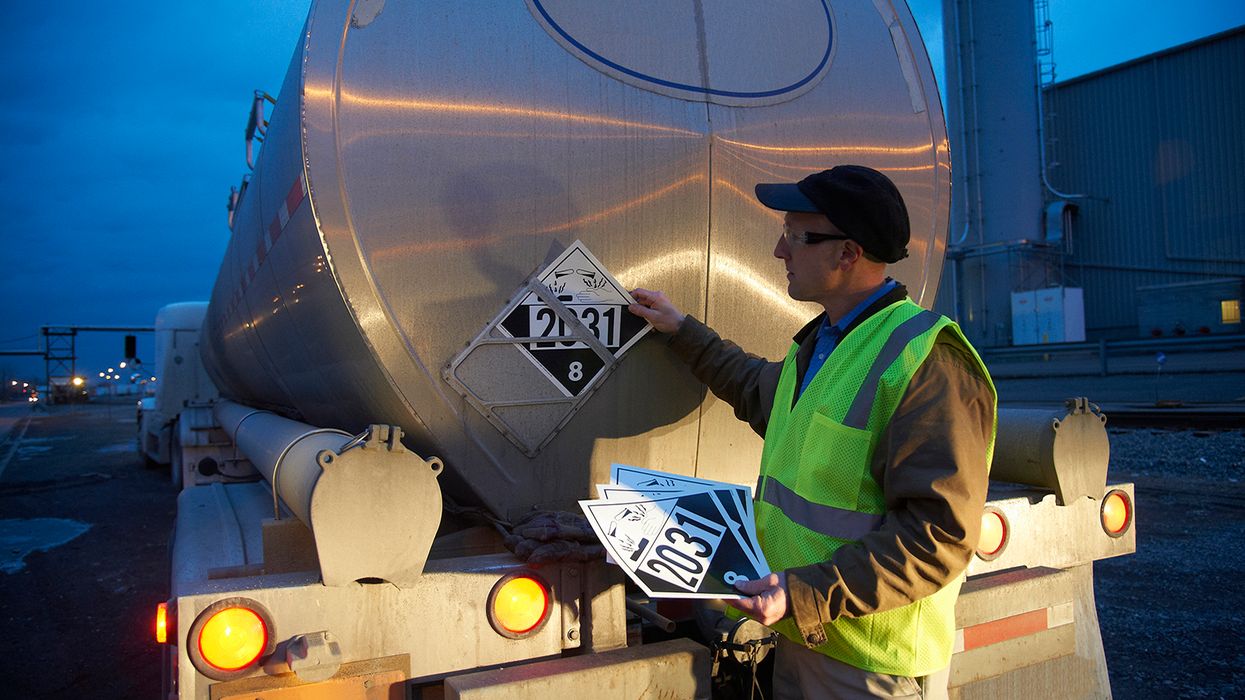
NewsIndustry NewsHazmat SafetyHazmat: HighwayFocus AreaIn-Depth ArticleHazmat EnforcementEnglishTransportationUSA
2022-12-27T06:00:00Z
Placarding responsibility – Whose is it?
Many shippers are unaware of their responsibility to provide placards to drivers, but the responsibility shifts as soon as the driver hits the road.
Check the regulations
According to Section 172.506 of the Hazardous Materials Regulations (HMR), a shipper offering a hazardous material for transportation by highway must provide the motor carrier with the required placards for the material being offered. The shipper must offer the placards to the carrier prior to, or at the same time as, the material is offered for transportation — unless the vehicle is already placarded for the hazmat.
Section 172.506 also states that no motor carrier may transport a hazardous material in a motor vehicle unless the required placards for the hazmat are affixed to the vehicle. Before transport, the driver is responsible for displaying the required placards for all the hazmat that is on the vehicle.
Avoid issues with shippers
Many trailers are equipped with flip placards that represent most classes of hazardous materials but without adequate training, shippers may not understand their responsibility to provide the driver with the required placards. If a driver arrives and the shipper fails to provide placards, the driver should contact dispatch for additional instructions or drive to a truck stop to secure the necessary placards. The driver becomes responsible for placards as soon as the trailer enters a public highway, so train your drivers to temporarily refuse the shipment until the proper placards can be obtained. If necessary, the driver must bobtail or leave empty before driving to pick up placards.
Another common placarding question with shippers involves combination loads. If a driver arrives at a shipper’s location and is already transporting a hazardous material below the placarding threshold, is the shipper required to provide placards for the combination load on the trailer? In this scenario, the driver already has 600 pounds of a Class 8 corrosive material on the trailer, and the shipper is offering an additional 500 pounds of the same commodity. The regulations state that the shipper is only required to provide placards for the commodity that is being offered, not for the aggregate weight of both shipments. In this scenario, the driver is responsible for providing placards since it involves a combination load.
The Hazardous Materials Regulations are complex, especially for newer employees. Drivers that can speak “hazmat” to shippers often secure additional business, so be sure to train your drivers and give them the confidence to have impactful conversations with shippers.
Key to remember: Carry extra placards in case a shipper is unable to supply the required placards or a combination of hazmat on the vehicle requires different placards.

NewsIndustry NewsIndustry NewsEnglishFocus AreaFleet OperationsEnforcement - DOTRoadside InspectionsTransportationUSA
2026-04-16T05:00:00Z
FMCSA updates the DataQs data-correction system
The Federal Motor Carrier Safety Administration (FMCSA) has announced updates to its DataQs program to improve turnaround times for drivers and motor carriers awaiting corrections to their safety records.
States will need to meet strict deadlines and follow a three-step independent review process when handling requests to fix data on crashes, inspections, and violations.
DataQs background
DataQs is an online system that allows motor carriers, drivers, and other industry personnel to view and track FMCSA crash and inspection data. Interested parties use the system — available at dataqs.fmcsa.dot.gov — to submit a “Request for Data Review” (RDR) when they believe data may be incomplete or incorrect. In 2024, DataQs processed more than 71,000 requests, including at least 8,300 related to crash data. The FMCSA says the revisions announced April 15, 2026, will establish a more streamlined framework for handling RDRs, specifically for states receiving Motor Carrier Safety Assistance Program (MCSAP) funding from FMCSA. The states will need to:
- Designate points of contact for crash and inspection RDRs.
- Review requests submitted within three years of an inspection and within five years of a crash.
- Include detailed explanations of their decisions, including evidence reviewed and next steps in the review process, for all decisions, especially those where no data correction is made.
- Participate in FMCSA program reviews and follow established policies, including those related to adjudicated citations.
Three-stage review
States will also need to implement a multi-stage, independent review structure that includes:
- Initial review within 21 days to ensure decisions are not made solely by the issuing officer when denying a correction;
- Reconsideration within 21 days. conducted by independent subject matter experts not involved in the initial decision; and
- Final review completed within 45 days by a senior decision-maker or independent panel, helping to remove bias from the determination.
The FMCSA is requiring states to submit DataQs Implementation Plans detailing how they will meet the new requirements, address backlogs, and prevent future delays. The approved plans will be publicly available through the DataQs system.
States will need to begin submitting draft plans in June 2026 and implement them before the end of September.
Find more information at https://roar-assets-auto.rbl.ms/documents/108770/2026-07429.pdf

NewsIndustry NewsFleet SafetyDrug and Alcohol Testing - DOTFocus AreaIn-Depth ArticleEnglishDilute specimen - motor carrerTransportationUSA
2023-06-26T05:00:00Z
Dilute drug test? Follow these steps to compliance
For truck and bus drivers, having too much to drink can be problematic in several ways — even if the drink is just water.
Staying hydrated is normally a good thing, but drinking too much water can cause a driver’s urine to become so diluted that testing it for drugs becomes difficult. There can be multiple (and legitimate) reasons for dilute urine, but so far this year, over 1,000 drivers have tested positive but dilute, according to the Federal Motor Carrier Safety Administration (FMCSA).
If your medical review officer (MRO) reports that a driver’s urine was dilute, do you know what to do next? The actions you need to take will depend on a few specifics.
Positive dilute
If a test result is positive but dilute, you’ll need to treat it the same as a positive test result. You must:
- Not order another test;
- Notify the driver;
- Remove the driver from safety-sensitive functions;
- Give the driver a list of substance abuse professionals (SAPs) from whom the driver can seek treatment;
- Not use the driver again until the driver completes treatment and passes a return-to-duty test; and
- Retain the test results for five years.
The MRO will report the test result to the Drug & Alcohol Clearinghouse, the same as any other positive test.
| Learn more about Clearinghouse reporting in our ez Explanation! |
Negative dilute
For results that are negative but dilute, your actions will depend on the creatinine level (creatinine is a waste product found in urine), as follows:
2 to 5 mg/dL — The MRO will contact you to request an immediate re-collection under direct observation.
- If the driver refuses this test, it’s treated the same as any refusal (which means following the steps above for a positive test, including reporting to the Clearinghouse).
- If the driver goes for this follow-up test, the result becomes the official result of record.
- If the result comes back as negative dilute again, the test is declared negative.
Over 5 mg/dL — No retest required. However, you can have a company policy requiring a retest, as long as you communicate it to drivers and enforce it uniformly. If you do retests in this situation, be aware that:
- The test cannot be under direct observation;
- A refusal of the test is treated the same as any other refusal;
- If the result is once again negative dilute with a creatinine level over 5 mg/dL, you cannot retest the driver (i.e., no third test) and it’s deemed a negative result.
- If the result is negative dilute with a creatinine level of 2 to 5 mg/dL, the MRO will demand yet another test immediately under direct observation.
A positive, adulterated, or substituted test result on any retest becomes the result of record, and all the consequences of a drug testing violation apply.
Key to Remember: If a driver’s drug test result comes back as dilute, be sure you know what to do next.

NewsIndustry NewsCompliance reviews - Motor CarrierFleet SafetyElectronic logging device (ELD)Electronic logging device (ELD)Enforcement - DOTFocus AreaIn-Depth ArticleEnglishTransportationUSA
2022-10-20T05:00:00Z
FMCSA auditing secrets revealed: ELD falsification
Log falsification is a common and potentially expensive violation, with fines reaching into the thousands of dollars per occurrence. Despite widespread use of electronic logging devices (ELDs), falsification remains a major problem. In fact, it was the second most common violation found during audits last year.
This means you need to look for it, but how? Details from the FMCSA’s audit playbook reveal key methods you can use today.
The DOT playbook
FMCSA investigators are given a training manual — over 1,000 pages long — that provides step-by-step instructions for performing audits, finding violations, and issuing penalties. Included are instructions for weeding out ELD falsification. Follow these steps — taken from the FMCSA’s own how-to manual — to audit for false ELD records like a pro:
- Review login/logout activity and any adjacent, unassigned driving time. This can reveal whether the driver has used another driver’s login to get additional hours or has not logged in properly to avoid violations.
- Check the location where the driver went on duty or began driving and make sure it matches the location where the driver earlier went off duty or into the sleeper. If the locations differ and there’s no co-driver, the log may be false.
- Check whether all non-driving periods began and ended in the same location by comparing beginning and ending odometer readings. If they differ but the driver’s log indicates a non-driving status, the driver may have falsified the log if no other drivers were present.
- Look for off-duty driving (personal use) and ensure that it meets the FMCSA’s personal-conveyance guidelines. Check odometer readings for excessive use of personal conveyance, as defined under company policy.
- Pay close attention to edits. Review the driver’s annotations and verify the edits were justified. Check the edited records against the unedited originals. Look for any edits of on-duty time to off duty or sleeper berth, which could allow the driver to exceed the 60/70-hour limit.
- Review your ELD back-end system settings to make sure no thresholds were customized to any value not allowed in the regulations. For example, the speed threshold at which a vehicle is “in motion” can be no more than 5 mph. (Contact your ELD vendor if a setting doesn’t look compliant.)
- Review any ELD malfunctions and data diagnostic events to identify possible tampering, and make sure malfunctions have been repaired.
- Compare any available supporting documents and reports to the logs to verify that they are accurate. Pay special attention to any time that was logged off duty but which was actually spent performing an on-duty activity (refer to the definition of “on-duty time” in 395.2).
Other falsification
FMCSA auditors are also taught to look for certain patterns that can reveal an effort to falsify:
- Drivers who log “off duty” for an entire day that is not normally an off-duty day. Auditors will check all available records to find evidence the driver was on duty, especially if the driver reached the 60/70-hour limit on the day before, i.e., the driver ran out of hours but needed to drive.
- Drivers who log “off duty” for 10 hours immediately following 11 hours of driving, but who in fact continue to drive, often to reach home.
- Drivers’ logs that consistently show 11-hour driving periods followed by exactly 10 hours off duty, or which consistently add up to 58 or 68 total duty hours on the driver’s 6th or 7th day of the period, or which show accumulated duty hours just short of 60 or 70 total duty hours and with little or no time shown as “on duty/not driving” for loading/unloading.
- Concealment of part of a day’s work, especially by drivers who typically spend a lot of time performing non-driving tasks. This pattern of falsification can often be detected using dispatch records, shipping documents, and/or payroll records.
Additional considerations
If you find falsification, don’t ignore it. Take immediate steps to reprimand and coach the driver(s) involved.
A few additional steps can help ensure you pass an ELD audit:
- Make sure your vehicle list specifies which vehicles have ELDs in them.
- Verify that your ELDs still appear on the FMCSA’s ELD registry, at www.fmcsa.dot.gov/elds.
- Pay attention to your ELD system’s violation reports and make sure violations are verified and addressed, especially when they’re significant or when patterns emerge (i.e., the same drivers having the same violations repeatedly).
- Verify that drivers who claim an exception from the normal rules are actually eligible for it.
- Be sure to explain all unassigned driving that cannot be assigned to someone, and strive to minimize it.
Did you know? The average FMCSA fine for log falsification is nearly $7,000!
Key to remember: The FMCSA’s auditor training manual explains how to check ELDs for falsification. Use those instructions to your advantage during self-audits and take action to prevent falsification and fines.
Most Popular Highlights In Human Resources

NewsIndustry NewsIndustry NewsHR GeneralistFamily and Medical Leave Act (FMLA)Family and Medical Leave Act (FMLA)USAHR ManagementEnglishFocus AreaHuman Resources
2023-09-06T05:00:00Z
Appellate court sided with employee's (almost) 3-year-delayed FMLA claim
Back in October 2018, Laffon had a medical emergency and needed some time off under the federal Family and Medical Leave Act (FMLA).
Her leave lasted until November 15. Ten days after she returned to work, on November 26, her employer terminated her.
She sued, arguing that the employer retaliated against her because of her FMLA leave.
The catch? She didn't bring the suit until almost three years later.
No link between leave and termination
In court, the employer argued that there was no causal link between Laffon taking FMLA leave and her termination. Although the court documents aren't robust, they do reveal that the employer indicated that Laffon's allegations didn't show that her taking FMLA leave was a factor in the decision to terminate her. The documents showed only that the termination chronologically followed her leave.
The court agreed with the employer. It also agreed that Laffon failed to allege a willful violation of the FMLA, which would allow her to benefit from the FMLA's three-year statute of limitations.
Laffon appealed the case to the Ninth Circuit.
Statute of limitations
Under the FMLA, employees have two years from the date of the last event constituting the alleged violation for which they can bring a claim.
Those two years are extended to three years if the employer's actions were "willful." This means that an employee must show that the employer either knew or showed reckless disregard for whether its conduct violated the FMLA.
Ruling overturned
Fast forward to August 2023, when the Ninth Circuit reversed the lower court's decision. It indicated that, based on Laffon's amended complaint and liberally construing the law, her allegations establish that her leave was causally connected to her termination and that the employer's action (her termination) was willful.
Glymph v. CT Corporation Systems, No. 22-35735, Ninth Circuit Court of Appeals, August 22, 2023.
Key to remember: Terminating an employee soon after returning from FMLA leave is risky, unless there is a clear, well-documented, non-leave-related reason. Case documents did not show such a clear reason, which can also increase the risk of a willful finding. Employees have time to file claims, even years.
NewsLeaveTime offHR ManagementEnglishLeaveAssociate Benefits & CompensationNew YorkSafety & HealthChange NoticesConstruction SafetyChange NoticeGeneral Industry SafetyHR GeneralistAssociate RelationsFocus AreaHuman Resources
2026-04-20T05:00:00Z
New York paid family leave expanded
Effective date: January 1, 2027
This applies to: Employers with employees in New York
Description of change: New York Gov. Kathy Hochul signed a measure extending the New York paid family leave (PFL) benefits to certain construction employees.
Effective January 1, 2027, construction employees are eligible for PFL benefits if they were employed for at least 26 of the last 39 weeks by employers that are party to a collective bargaining agreement. Unpaid leave and vacation apply to the 26 weeks.
Construction employees are those who perform construction, demolition, reconstruction, excavation, rehabilitation, repairs, renovations, alterations, or improvements for multiple employers per a collective bargaining agreement.
View related state info: FMLA – New York

NewsIndustry NewsWellnessHR GeneralistIn-Depth ArticleWorkplace StressAssociate RelationsEnglishWellnessHR ManagementFocus AreaHuman ResourcesUSA
2026-04-16T05:00:00Z
Help employees spend wisely and stretch their paychecks
With inflation on the upswing and the cost of everyday items rising, your workers are likely looking for ways to stretch their money. Smart spending can help them do that.
April is Financial Literacy month and is the perfect time to share these money-saving tips:
- Track spending for a month so you understand where your money is going. Use information from credit card statements and your debit or checking account to see how much is spent on food, rent, clothing, transportation, and other items. Cash purchases can be tracked using receipts or a phone app.
- Add up your spending and consider where to cut back. Optional expenses such as eating out, streaming services, alcohol, entertainment, and gifts can be good places to trim.
- If you use a credit card, make payments on time to avoid late fees. Pay off the balance in full each month, or at least pay more than the minimum, to reduce finance charges.
- Curb impulse buys by waiting 24 hours before making a purchase that isn’t a necessity. Remove shopping apps from your phone and unfollow brands on social media that are too tempting.
- To cut back on your food bill, create a meal plan and a shopping list before going to the grocery store. Advanced planning will prevent you from buying more than you need. Look for recipes with common ingredients that can go a long way; plan to make extra so that you have leftovers and aren’t tempted to eat out as often. Inexpensive ingredients such as beans, rice, tortillas, pasta, potatoes, and lean meats can bolster numerous meals.
- At the grocery store, look for sales on frozen and canned fruits and vegetables. These options last longer and can be purchased in bulk when they’re on sale. In addition, savings from store-brand items can add up.
- Look for free fun. Take advantage of free concerts and museum days in your community. Visit the local library to see if passes for the zoo or other local attractions are available. Explore biking and hiking trails or stroll through the city.
Key to remember: Employers can help employees make the most of their pay with money-saving tips.

NewsIn-Depth ArticleHR ManagementEnglishHuman ResourcesIndustry NewsHR PoliciesCompensationWage and HourWage and HourPolicies and ProceduresCompensationHR GeneralistMinimum WageFair Labor Standards Act (FLSA)Salary deductionsFocus AreaUSA
2023-08-22T05:00:00Z
Making employees pay for uniforms can be illegal
Last month, the U.S. Department of Labor (DOL) filed suit against a restaurant and its owner for back wages and liquidated damages for 26 employees.
An investigation by the DOL’s Wage and Hour Division (WHD) found multiple violations of the federal Fair Labor Standards Act (FLSA), including making illegal deductions from servers’ pay for uniforms, aprons, name tags, and lost items such as crackers and utensils, resulting in employees not earning minimum wage.
The WHD alleged that the company owes $75,402 in back wages to the 26 workers.
Limits on employee wage deductions
While restaurant profit margins might be thin and overhead expenses high, that doesn’t mean the business may dock employees’ pay for these kinds of costs. Many companies in the service industry have business-related expenses like the ones listed above, as well as:
- Cash drawer shortages,
- Tools required for work,
- Broken equipment,
- Lost supplies, and
- Customers who don’t pay their bills.
The FLSA does not, however, allow employers to make deductions from employee pay for any items which:
- Are considered primarily for the employer’s benefit or convenience, and
- Would reduce employee earnings below the minimum wage.
Case in point
If, for example, Bob’s Business requires Jo Employee to wear a uniform because it’s required by:
- Law,
- The nature of the business, or
- The employer,
The cost is considered Bob’s Business’ expense and not Jo’s.
If Bob wants Jo to wear specific clothing not worn outside of work, Bob will likely need to cover the cost. If Bob wants Jo to wear a general uniform like regular khakis and a polo shirt that can also be worn outside of work, Bob may require Jo to pay for it without considering the cost as coming out of Jo’s wages.
Otherwise, Bob may not require Jo or any employee to pay for uniforms that would bring their pay below the federal minimum wage.
How much do employees pay?
If an employer requires employees to bear the cost of work-related expenses, it may not reduce the employee’s wage below the federal minimum wage of $7.25 per hour. Nor may that cost cut into overtime compensation required by the FLSA.
If, for example, Jo was paid $7.75 per hour and worked 30 hours in the workweek, the maximum amount the employer could legally deduct from Jo’s wages would be $15 ($.50 X 30 hours).
Employers may spread out deductions for uniform or other costs over a period of paydays, as long as they’re compliant with the FLSA.
Key to remember: Improper wage deductions are on the WHD’s radar, especially in certain segments. The restaurant industry employs people who, in addition to being among the nation’s lowest paid workers, can also be vulnerable to wage theft because they might not know their rights and protections or be reluctant to exercise them. Therefore, the WHD takes these cases seriously.

NewsIndustry NewsPerformance ManagementAssociate Benefits & CompensationHR GeneralistFamily and Medical Leave Act (FMLA)Focus AreaIn-Depth ArticleFamily and Medical Leave Act (FMLA)Performance AppraisalsEnglishHR ManagementAssociate RelationsHuman ResourcesUSA
2023-01-12T06:00:00Z
Performance review timing and FMLA leave
A new year often begins a new round of employee performance reviews. Since the Family and Medical Leave Act (FMLA) allows eligible employees to take up to 12 (or 26) weeks of leave, many events can occur during an employee’s leave, including the employee’s pre-scheduled performance review. Such reviews might take place on an annual or other scheduled basis. How you treat the timing of those reviews should include some thought.
If, for example, Jo Employee takes 12 weeks of FMLA leave, during which her annual performance review is scheduled, here are some questions to ponder:
- Do you look at all 12 months of Jo’s performance?
- What if she hasn’t worked a full 12 months because of leave?
- When can you actual do the review?
- Can you delay it so you can look at a full 12-months of work?
Delaying a review
An annual performance review generally takes into consideration a full years’ worth of work. Some employers think it’s best to delay the performance review by the same amount of time an employee took FMLA leave to capture an entire years’ work. This practice, however, might risk running afoul of one of the cornerstones of the FMLA: Returning the employee to his or her position, including the equivalent pay, benefits, and working conditions.
The issues can be particularly concerning if the performance review affects wage increases or other compensation.
What the regulations say
The FMLA regulations indicate that an equivalent position includes equivalent pay, which includes any unconditional pay increases that may have occurred during the FMLA leave period. Equivalent pay also includes bonuses or payments, whether discretionary or non-discretionary. FMLA leave cannot undermine the employee’s right to such pay.
Furthermore, “… employers cannot use the taking of FMLA leave as a negative factor in employment actions, such as hiring, promotions, or disciplinary actions; nor can FMLA leave be counted under no fault attendance policies.” [29 CFR 825.220(c)]
Avoiding a negative factor
Therefore, you would need to look at whether delaying an employee’s performance review could be seen as having a negative factor for the employee.
If, for example, Jo Employee took 12 weeks of leave from April through June, during which she would otherwise have obtained a pay increase in May, but you delayed this increase until September (so you could use a full 12 months of work), you may have violated the equivalent pay provision. If delaying a review creates a new review schedule going forward, the negative impacts could continue.
If, however, a pay increase is conditioned upon seniority, length of service, or work performed, you would grant it in accordance with your policy or practice as applied to other employees on an equivalent leave status for a reason that does not qualify as FMLA leave.
In other words, don’t treat an employee on FMLA leave differently than you would an employee on other forms of leave.
Key to remember: It might be less risky to keep the performance review on schedule and prorate wage increases to account for FMLA leave.

NewsIndustry NewsAssociate Benefits & CompensationHR GeneralistFamily and Medical Leave Act (FMLA)In-Depth ArticleFamily and Medical Leave Act (FMLA)Associate RelationsEnglishHR ManagementFocus AreaHuman ResourcesUSA
2025-03-27T05:00:00Z
Who can fill out FMLA forms? The answer might surprise you
One of the most common questions involving the federal Family and Medical Leave Act (FMLA) that we see is: “Can ________ fill out the medical certification?”
This question stumps a lot of HR people and can be a little confusing.
It might be easier to start with who CAN’T fill out an FMLA certification. That includes your coworker, best friend, neighbor, or pet.
Jokes aside, often (but not always) a doctor fills out the FMLA certification, and since March 30 is “Doctors’ Day,” this is a great time to discuss this topic.
FMLA certification basics
Employers aren’t required to use certifications, but if they do, the U.S. Department of Labor (DOL) has five different certification forms to use for various FMLA leave situations.
The forms are as follows:
- Certification of Health Care Provider for Employee's Serious Health Condition,
- Certification of Health Care Provider for Family Member's Serious Health Condition,
- Certification of Qualifying Exigency for Military Family Leave,
- Certification for Serious Injury or Illness of a Current Servicemember for Military Family Leave, and
- Certification for Serious Injury or Illness of a Veteran for Military Family Leave.
Let’s focus on the first two, as these are the most common ones HR administrators use.
Who can fill out an FMLA certification?
The FMLA regulations describe the person who has the authority to fill out a certification as a “health care provider.” The good news is, the regulations include a lengthy list of medical professionals who fit this role.
Under the FMLA, a health care provider includes:
- A doctor of medicine or osteopathy,
- A podiatrist,
- A dentist,
- A clinical psychologist,
- An optometrist,
- A chiropractor (limited to manual manipulation of the spine as demonstrated by X-ray),
- A nurse practitioner,
- A nurse midwife,
- A clinical social worker,
- A physician assistant,
- A Christian Science practitioner, and
- Any health care provider from whom the employer or the employer's group health plan's benefits manager will accept a medical certification to substantiate a claim for benefits.
To be qualified to fill out FMLA forms, medical professionals must be authorized to practice in the state and perform within the scope of their practice. This means that the provider must be authorized to diagnose and treat physical or mental health conditions.
What about doctors in a foreign country?
If an employee or an employee's family member is visiting another country, or a family member resides in another country, and a serious health condition develops, the employer must accept a medical certification from a health care provider who practices in that country. This includes second and third opinions.
If a medical certification from a foreign health care provider is not in English, the employee may be required to provide a written translation of the certification.
Key to remember: The FMLA regulations spell out which medical professionals can fill out certification forms.
Most Popular Highlights In Safety & Health

NewsPersonal Protective EquipmentIn-Depth ArticleWellnessEnglishWellnessIndustry NewsHead ProtectionSafety & HealthConstruction SafetyGeneral Industry SafetyAgriculture SafetyEmployee Mental HealthFocus AreaUSA
2026-04-02T05:00:00Z
From hard hats to headspace: Why mental health is critical for every worker
Protecting workers’ heads takes more than a hard hat. A 2017 National Institute of Health (NIH) study looked at employees across four Kansas worksites and found a clear link between stress and productivity. The study revealed that higher stress scores were significantly associated with lower productivity and greater job dissatisfaction. The result of this study suggests that employers who actively work to reduce stress are not just improving mental health and morale, but they’re boosting productivity as well.
Hidden in plain sight
When Sebastian walked into the office each morning, no one could see the weight he carried. Deadlines were met, meetings attended, yet his smile never faltered. Inside, stress and anxiety were taking a toll, and his story isn’t unique.
One study showed a very interesting contrast: most employees (about 77%) stated they were comfortable supporting a coworker’s mental health. However, when it comes to their own stress or burnout, 42% worry that opening up about it or seeking help could hurt their career or make them a target. Even more striking, one in four have thought about quitting because of mental health challenges. And it’s not just long-term stress. A recent Gallup poll found that 41% of workers felt highly stressed just “yesterday.”
These statistics underscore a troubling theme that employees value and wish to nurture mental wellness; however, stigma, insufficient support, and overwhelming stress persist. Employers need to begin recognizing and proactively addressing workplace mental health in order to cultivate resilient, productive teams.
What one state is doing
The state of Michigan is piloting a new initiative aimed at improving workplace mental health which is increasingly being recognized as an occupational safety and health issue. This expands the state’s historically stringent approach to reducing on-the-job risks.
Michigan’s LEADS program—short for Learn, Educate, Act, Deploy, Study—is a four-month initiative designed to give employers practical tools to tackle stress, burnout, and communication breakdowns that often lead to safety incidents. The idea is simple: when communication falters and stress goes unchecked, mistakes happen. Those mistakes can mean more human errors, higher injury rates, quiet quitting, and turnover.
One of the program’s key features is an evidence-based organizational assessment. Think of it like a safety audit that’s focused on mental health risks rather than physical hazards. Employers get a clear picture of issues such as heavy workloads, unclear roles, workplace conflict or bullying, and weak support systems that can quickly erode a strong safety culture.
The end goal of the LEADS program is not to replace existing safety programs but rather strengthen them. Consider joining Michigan in their effort to enhance communication, better define workers’ roles, support unfettered reporting, and more effectively engage employees.
Key to remember: Stress doesn’t just weigh people down; it can have significant safety and productivity consequences. Programs like Michigan’s LEADS pilot initiative are giving employers the ability to tackle stress and burnout before they lead to mistakes, injuries, or turnover.
NewsMaterials Handling and StorageSafety & HealthChange NoticesChange NoticeMaritime SafetyOccupational Safety and Health Administration (OSHA), DOLFocus AreaEnglishMaterials Handling and StorageUSA
2026-04-17T05:00:00Z
OSHA Final Rule: House Falls in Marine Terminals
View final rule.
| Part 1917-Marine Terminals | ||
| Authority | Revised | View text |
| §1917.41 House falls. | ||
| Entire section | Removed and reserved | View text |
Previous Text
Part 1917-Marine Terminals
Authority: 33 U.S.C. 941; 29 U.S.C. 653, 655, 657; Secretary of Labor's Order No. 12-71 (36 FR 8754), 8-76 (41 FR 25059), 9-83 (48 FR 35736), 1-90 (55 FR 9033), 6-96 (62 FR 111), 3-2000 (65 FR 50017), 5-2002 (67 FR 65008), 5-2007 (72 FR 31160), 4-2010 (75 FR 55355), 1-2012 (77 FR 3912), 8-2020 (85 FR 58393), or 7-2025 (90 FR 27878), as applicable; and 29 CFR part 1911.
Sections 1917.28 and 1917.31 also issued under 5 U.S.C. 553. Section 1917.29 also issued under 49 U.S.C. 1801-1819 and 5 U.S.C. 553.

NewsExcavation Hazard IdentificationIndustry NewsIndustry NewsExcavation InspectionsSafety & HealthConstruction SafetyExcavationsOccupational Safety and Health Administration (OSHA), DOLUSAEnglishFocus AreaCompetent Person
2025-08-05T05:00:00Z
OSHA urges employers to protect workers from trenching, excavation hazards
Following a series of trench collapses in the Midwest, OSHA is urging employers to take steps to protect workers from trenching and excavation hazards. These hazards are preventable when appropriate protections are used; employers must follow the regulations at 29 CFR 1926 Subpart P.
Workers should follow these safe work practices to protect themselves from hazards:
- Test the soil at every worksite before work begins;
- Never enter a trench unless it has been properly inspected by a competent person;
- Ensure there is a safe way to enter and exit a trench; and
- Keep materials away from the edge of a trench.
Additionally, trench collapses can be prevented by doing the following:
- SLOPE or bench trench walls at an angle;
- SHORE trench walls with supports, such as aluminum hydraulic, to prevent soil movement; and
- SHIELD trench walls with trench boxes.
Additional information about trenching and excavation hazards and solutions can be found on OSHA’s Trenching and Excavation webpage.

NewsIndustry NewsSafety & HealthGeneral Industry SafetyFood SafetySpecialized IndustriesIn-Depth ArticleEnglishFocus AreaUSA
2026-04-14T05:00:00Z
Training keeps safety on the menu in food manufacturing
Employees who handle food, clean food processing areas, or work around food-contact surfaces must be trained to understand the practices and procedures used to ensure food is safe to consume. Equally important, however, is the OSHA-related side of training aimed at keeping workers safe.
Busy production lines, heavy equipment, and frequent cleaning tasks can expose employees to numerous hazards. OSHA recently cited a commercial bakery in Illinois for repeatedly exposing employees to safety hazards and failing to train them in electrical work, implement safety-related practices, and enforce the use of personal protective equipment (PPE) when performing electrical work. Proposed penalties totaled over $300,000!
The following table highlights the Top 10 most frequently cited violations for food manufacturing in fiscal year 2025.
| Rank | 29 CFR | Title |
| 1 | 1910.147 | The control of hazardous energy (lockout/tagout) |
| 2 | 1910.212 | Machine guarding |
| 3 | 1910.1200 | Hazard communication |
| 4 | 1910.178 | Powered industrial trucks |
| 5 | 1910.305 | Wiring methods, components, and equipment for general use |
| 6 | 1910.303 | Wiring – general |
| 7 | 1910.219 | Mechanical power-transmission apparatus |
| 8 | 1910.132 | Personal protective equipment – general requirements |
| 9 | 1910.134 | Respiratory protection |
| 10 | 1910.28 | Duty to have fall protection and falling object protection |
| *Data reflect October 2024 through September 2025. | ||
Lockout/tagout. Employees who operate or perform service or maintenance on machines or equipment that must be locked out or tagged must be trained on the energy control procedures to be used. Training must be given prior to employees performing maintenance or service, as needed for employee proficiency, and when there are new or revised procedures. Energy control procedures must be reviewed annually to ensure they’re being followed and to correct any deficiencies.
Machine guarding. Exposed moving parts, frequent cleaning/changeovers, and close employee interaction with equipment make machine guarding critical. Although OSHA’s machine guarding regulations don’t specify training, the General Duty Clause requires that you provide a safe work environment. Employees should understand the purpose of machine guards, the types of guards used at your facility and the importance of not bypassing them, and who to contact if guards are missing or damaged.
Hazard communication (HazCom). Cleaning and sanitation of food production equipment is an integral component of food manufacturing. HazCom gives employees the right to know the hazards of the chemicals they’re exposed to. Paragraph (h) of 1910.1200 outlines the standard’s information and training requirements related to chemical hazards.
Powered industrial trucks (PITs). Congested production areas and warehouses, tight aisles, and limited visibility can pose hazards for both forklift drivers and nearby employees. PIT operators must be trained and evaluated according to the criteria at 1910.178(l)(1) and you must maintain certification that this was completed.
Electrical. In food manufacturing environments, electrical systems are often exposed to moisture, washdowns, chemicals, vibration, and temperature extremes, which increases the potential for hazards. Under 1910.332, training must be provided to employees who are exposed to electrical shock and those who work on or near exposed energized parts.
Personal protective equipment (PPE). In food manufacturing, PPE often serves the dual purpose of protecting workers from injury and protecting food from contamination. Employees must be trained to understand when PPE is necessary; what PPE is necessary; how to properly don, doff, remove, adjust, and wear PPE; its limitations; and its proper care, maintenance, useful life, and disposal.
Respiratory protection. Respirators may be needed during ingredient handling, sanitation, or maintenance processes. OSHA’s regulation at 1910.134 requires training for employees who wear respirators. Training must be conducted before employees use a respirator, repeated annually, and as often as necessary to ensure safe use.
Duty to have fall protection and falling object protection. Food manufacturing facilities often have fall-risk areas such as mezzanines or catwalks above production lines, elevated platforms for mixers and other equipment, and conveyor crossings. Employees who use fall protection or are otherwise exposed to fall hazards must be trained under the requirements at 1910.30. Training must be conducted by a qualified person, as defined at 1910.21(b).
Key to remember: Food manufacturing can expose employees to numerous hazards. Workplace safety training plays a key role in helping employees recognize hazards, work safely, and protect both themselves and the product.

NewsIndustry NewsIndustry NewsHeat and Cold ExposureEnforcement and Audits - OSHAEnforcement and Audits - OSHASafety & HealthConstruction SafetyGeneral Industry SafetyAgriculture SafetyMaritime SafetyEnglishHeat StressFocus AreaUSA
2026-04-14T05:00:00Z
OSHA revises heat emphasis program
OSHA revised its National Emphasis Program (NEP) on outdoor and indoor heat-related hazards on April 10. Using OSHA and Bureau of Labor Statistics data from 2022-2025, the agency will prioritize inspections in 55 “high-risk industries” in indoor and outdoor work settings.
The revised NEP introduces two reorganized appendices: one that includes information on how OSHA investigators will evaluate heat illnesses and prevention programs and another that provides citation guidance. The updated NEP also includes better guidance designed to strengthen tracking procedures and more effectively implement the program’s enforcement and outreach efforts.
Compliance officers will provide outreach and compliance assistance and broaden inspections if heat hazards are found on heat priority days. Additionally, random inspections will occur on days when the National Weather Service issues a heat advisory or warning.
The revised NEP remains in place for 5 years after the effective date.

NewsIndustry NewsHeat and Cold ExposureSafety & HealthConstruction SafetyGeneral Industry SafetyAgriculture SafetyMaritime SafetyIn-Depth ArticleExtreme Temperature PreparationEnglishMine SafetyHeat StressFocus AreaUSA
2026-04-20T05:00:00Z
How heat becomes fatal
Imagine a workplace where the real danger is something you can’t even see. Extreme temperatures don’t just make workers uncomfortable; they can silently push the human body past its limits, triggering a deadly chain reaction. When cooling mechanisms fail, organs shut down, and what starts as simple dehydration can spiral into heatstroke which kills more workers than many realize. Understanding how heat becomes lethal is the first step toward preventing tragedy.
What’s happening to the body?
No one is immune from extreme heat when controls are lacking. While some workers are more vulnerable (e.g., older workers, seasonal workers, or those not acclimatized to the heat), the human body still reacts to heat when temperatures soar.
As temperatures rise, the heart pumps harder to maintain core body temperature. Blood helps millions of sweat glands in the body to send moisture to the skin’s surface, allowing heat to evaporate into the air. This process is meant to cool the body. However, when it’s extremely hot and humid, the sweat glands just can’t keep up, and cooling becomes impossible without the additional help of cooling aids.
Humidity, or moisture in the air, prevents sweat from evaporating off the skin. This keeps the body from cooling effectively which can create overheating. As the body continues to overheat, it sweats more, which results in reduced blood volume and dehydration. This can quickly lead to two additional negative consequences:
- Blood pressure drops. The heart is required to pump more to maintain pressure so blood can reach vital organs. When blood can’t effectively reach the lungs or brain, the body begins to shut down quickly and cognitive abilities can decrease rapidly or cease altogether.
- Dehydration ensues. Typically, by the time you feel thirsty, you are already dehydrated. Continued fluid loss means the body has nothing to create sweat with to send to the skins surface.
A lack of blood flow to vital organs, along with dehydration, lead to poor decision-making and impaired judgment, which can result in serious workplace incidents; some of which can be fatal.
What are the warning signs?
The body will tell you when it’s in trouble. Heat exhaustion warning signs begin with symptoms such as:
- Excessive sweating;
- Cool, pale, or clammy skin;
- Light-headedness from a weak pulse;
- Nausea or vomiting;
- Muscle cramps; and /or
- Unusual irritability.
These are tell-tale signs that your body is dehydrated and starting to lose the ability to self-cool. If protective measures like hydration, rest, and external cooling aren’t taken right away, heat exhaustion can quickly become heat stroke. This can happen within minutes, creating a quick downward spiral to disorientation, unconsciousness, organ shutdown, and heart failure.
How can killer heat be stopped?
Heat can be deadly, but it doesn’t have to be. By applying these simple controls and safe work practices, you can help protect workers from life-threatening heat exposure:
- Water: Ensure workers consume at least 1 quart of suitably cool water per hour (or 8 oz every 15 minutes) during excessive heat. Avoiding caffeinated or sugary drinks will also help ward off dehydration.
- Rest: Encourage workers to take frequent breaks from the heat in artificially or naturally shaded areas, where there is air movement, or in an air-conditioned area.. Ensure break areas are as close as possible to the work area and are sufficient enough to hydrate, remove PPE, and cool down.
- Shade: Provide shade areas (e.g., tents), fans, air-conditioning, or cooling stations.
- Acclimatization: Gradually increase employee exposure over time so the body isn’t more stressed in the heat, then monitor workers closely during this time.
- Administrative controls: Plan more intensive work activities for cooler parts of the day, implement a buddy system for monitoring workers, and rotate workers so frequent breaks are possible. Monitor weather conditions so work can be adjusted accordingly.
- Clothing and PPE: Provide hats and cooling gear for workers and encourage them to wear lightweight, loose-fitting, and light-colored clothing.
- Training: Train workers to understand dangerous temperatures and how to recognize and respond to symptoms of heat stress.
- Be prepared! Implement a heat injury and illness prevention plan that includes quick medical access and care.
Keys to remember: Heat becomes lethal when the body’s cooling mechanisms fail, allowing core temperature to rise beyond control. Prevention methods are essential for halting heat stress that can trigger widespread cellular damage, inflammation, and organ failure.
Saved to my EVENT CALENDAR!
View your saved links by clicking the arrow next to your profile picture located in the header. Then, click “My Activity” to view the Event Calendar on your Activity page.
OK
J. J. Keller is the trusted source for DOT / Transportation, OSHA / Workplace Safety, Human Resources, Construction Safety and Hazmat / Hazardous Materials regulation compliance products and services. J. J. Keller helps you increase safety awareness, reduce risk, follow best practices, improve safety training, and stay current with changing regulations.
Copyright 2026 J. J. Keller & Associate, Inc. For re-use options please contact copyright@jjkeller.com or call 800-558-5011.