Compliance Just Got Easier: Stay ahead of regulatory changes with instant notifications on updates that matter.
['Drug and Alcohol Testing']
['Drug and Alcohol Testing', 'Marijuana', 'Drug Free Workplace']
2025-12-19T06:00:00Z
JOIN TODAY TO CONTINUE READING THIS ARTICLE & OTHER INDUSTRY NEWS!
You'll also get exclusive access to:
A database of easy-to-understand regulationsAsk unlimited questions to our expertsPre-led discussions forumsAnd more
TRY IT FREE TODAY
Already have an account? Log in now.

Copyright 2026 J. J. Keller & Associate, Inc. For re-use options please contact copyright@jjkeller.com or call 800-558-5011.
NewsDrug and Alcohol TestingIndustry NewsDrug and Alcohol TestingMarijuanaDrug Free WorkplaceHR GeneralistIn-Depth ArticleUSAAssociate RelationsEnglishHR ManagementFocus AreaHuman Resources
Marijuana on the move: Be ready to review workplace policies
2025-12-19T06:00:00Z
A proposal to move marijuana to a less risky classification of drugs has been revived, and employers should watch closely for potential impacts on workplace drug policies.
An executive order issued by the president on December 18 directs the U.S. attorney general to expedite the rulemaking process that would move marijuana from schedule I of the Controlled Substances Act (CSA) to schedule III, a lower-class drug category.
Accepted medical use
The change would move marijuana out of a classification for drugs with no accepted medical use and high potential for abuse. These drugs include heroin, LSD, and ecstasy.
The CSA classification system places drugs in one of five schedules, or categories, based on their medical usefulness and potential for abuse, and rescheduling would place marijuana into a category of drugs that includes Tylenol with codeine, ketamine (an anesthesia-type drug), and anabolic steroids. These drugs have an accepted medical use and a lower potential for abuse than drugs in the higher schedules.
Moving forward
The White House executive order aims to speed up marijuana rescheduling to make it easier for researchers to study the drug. Rescheduling was initially proposed in May 2024 when a proposed rule was published in the Federal Register.
The proposal noted that a review by the Health and Human Services Agency found that marijuana has a currently accepted medical use for:
- Treatment of anorexia related to a medical condition,
- Nausea and vomiting caused by chemotherapy treatment, and
- Chronic pain.
Hearings on the proposal were scheduled to begin in December 2024, but they have been stalled by procedural delays.
Workplace impacts
Although the process for marijuana rescheduling has been restarted, it will be months before a final rule is issued. After it is released, employers will need to:
- Review drug testing policies. A positive test for marijuana would need to be treated with care. As with any legally prescribed drug, the test result would be reviewed to determine whether the employee was taking the medication in line with a legal prescription. The result wouldn’t be considered positive for an employee legally using the drug. State law governs drug testing, however, and employers need to continue to look there for specifics. Some states do not allow marijuana testing, and that would not change if marijuana were to be rescheduled.
- Consider accommodations. Employees using legally prescribed medications have protections under the federal Americans with Disabilities Act (ADA). The ADA does not currently protect individuals who use medical marijuana, but this would likely change if marijuana were to be moved to a drug schedule that allows it to be prescribed by a medical professional. Employers may need to consider whether an employee’s use of medical marijuana can be accommodated and discuss options.
- Reconsider marijuana use and possession at work. Employers can currently prohibit employees from using and possessing marijuana in the workplace. If marijuana is reclassified to the same level as other prescription drugs, employees would need to consider how they treat possession of those medications when deciding whether to allow employees to use or have marijuana at work for medical purposes.
- Remember that marijuana is still illegal federally. Rescheduling marijuana doesn’t make it fully legal on the federal level. The manufacture, distribution, and sale of marijuana could still be prohibited in the workplace.
- Continue to enforce federal drug-free workplace policies. An employer required to have a drug-free workplace under the Drug-Free Workplace Act of 1988 because of a federal contract or grant will need to continue to prohibit the use, possession, manufacture, distribution or dispensing of marijuana. Under the act, a controlled substance includes substances in schedules 1 through 5 of the CSA.
- Be aware of state laws. Some state laws protect the off-duty use of recreational marijuana. Employers will need to continue to navigate state requirements even if the federal government legalizes marijuana for medical purposes.
Keep following your policy
Until the final rule takes effect, employers should continue to follow workplace drug policies, making updates as needed based on workplace needs or state laws. After changes are formally announced, employers will likely have 30 to 90 days before a final rule takes effect to make necessary changes to workplace policies.
Key to remember: A proposal to reschedule marijuana is now on the fast track. Employers should be prepared to update workplace drug policies when it takes effect.

NewsDrug and Alcohol TestingIndustry NewsDrug and Alcohol TestingMarijuanaDrug Free WorkplaceHR GeneralistIn-Depth ArticleUSAAssociate RelationsEnglishHR ManagementFocus AreaHuman Resources
Marijuana on the move: Be ready to review workplace policies
2025-12-19T06:00:00Z

Written by
Terri Dougherty
Sr. Compliance Expert - HR
Terri Dougherty
SHRM-CP, PHR
University of Wisconsin Oshkosh
Compliance Expert specializing in labor law posters, employee wellness, drug testing and other employment-related issues. She has spoken to local and national audiences on these topics.
A proposal to move marijuana to a less risky classification of drugs has been revived, and employers should watch closely for potential impacts on workplace drug policies.
An executive order issued by the president on December 18 directs the U.S. attorney general to expedite the rulemaking process that would move marijuana from schedule I of the Controlled Substances Act (CSA) to schedule III, a lower-class drug category.
Accepted medical use
The change would move marijuana out of a classification for drugs with no accepted medical use and high potential for abuse. These drugs include heroin, LSD, and ecstasy.
The CSA classification system places drugs in one of five schedules, or categories, based on their medical usefulness and potential for abuse, and rescheduling would place marijuana into a category of drugs that includes Tylenol with codeine, ketamine (an anesthesia-type drug), and anabolic steroids. These drugs have an accepted medical use and a lower potential for abuse than drugs in the higher schedules.
Moving forward
The White House executive order aims to speed up marijuana rescheduling to make it easier for researchers to study the drug. Rescheduling was initially proposed in May 2024 when a proposed rule was published in the Federal Register.
The proposal noted that a review by the Health and Human Services Agency found that marijuana has a currently accepted medical use for:
- Treatment of anorexia related to a medical condition,
- Nausea and vomiting caused by chemotherapy treatment, and
- Chronic pain.
Hearings on the proposal were scheduled to begin in December 2024, but they have been stalled by procedural delays.
Workplace impacts
Although the process for marijuana rescheduling has been restarted, it will be months before a final rule is issued. After it is released, employers will need to:
- Review drug testing policies. A positive test for marijuana would need to be treated with care. As with any legally prescribed drug, the test result would be reviewed to determine whether the employee was taking the medication in line with a legal prescription. The result wouldn’t be considered positive for an employee legally using the drug. State law governs drug testing, however, and employers need to continue to look there for specifics. Some states do not allow marijuana testing, and that would not change if marijuana were to be rescheduled.
- Consider accommodations. Employees using legally prescribed medications have protections under the federal Americans with Disabilities Act (ADA). The ADA does not currently protect individuals who use medical marijuana, but this would likely change if marijuana were to be moved to a drug schedule that allows it to be prescribed by a medical professional. Employers may need to consider whether an employee’s use of medical marijuana can be accommodated and discuss options.
- Reconsider marijuana use and possession at work. Employers can currently prohibit employees from using and possessing marijuana in the workplace. If marijuana is reclassified to the same level as other prescription drugs, employees would need to consider how they treat possession of those medications when deciding whether to allow employees to use or have marijuana at work for medical purposes.
- Remember that marijuana is still illegal federally. Rescheduling marijuana doesn’t make it fully legal on the federal level. The manufacture, distribution, and sale of marijuana could still be prohibited in the workplace.
- Continue to enforce federal drug-free workplace policies. An employer required to have a drug-free workplace under the Drug-Free Workplace Act of 1988 because of a federal contract or grant will need to continue to prohibit the use, possession, manufacture, distribution or dispensing of marijuana. Under the act, a controlled substance includes substances in schedules 1 through 5 of the CSA.
- Be aware of state laws. Some state laws protect the off-duty use of recreational marijuana. Employers will need to continue to navigate state requirements even if the federal government legalizes marijuana for medical purposes.
Keep following your policy
Until the final rule takes effect, employers should continue to follow workplace drug policies, making updates as needed based on workplace needs or state laws. After changes are formally announced, employers will likely have 30 to 90 days before a final rule takes effect to make necessary changes to workplace policies.
Key to remember: A proposal to reschedule marijuana is now on the fast track. Employers should be prepared to update workplace drug policies when it takes effect.


See More
RELATED NEWS


NewsDrug and Alcohol TestingDrug and Alcohol TestingDrug Free WorkplaceMarijuanaIn-Depth ArticleHR ManagementEnglishHuman ResourcesIndustry NewsSafety & HealthGeneral Industry SafetyHR GeneralistAssociate RelationsFocus AreaUSA
07/28/2026
Federal marijuana changes mean it’s time for a drug and alcohol policy review


Specialized Industries
Go beyond the regulations! Visit the Institute for in-depth guidance on a wide range of compliance subjects in safety and health, transportation, environment, and human resources.
J. J. Keller® COMPLIANCE NETWORK is a premier online safety and compliance community, offering members exclusive access to timely regulatory content in workplace safety (OSHA), transportation (DOT), environment (EPA), and human resources (DOL).

Interact With Our Compliance Experts
Puzzled by a regulatory question or issue? Let our renowned experts provide the answers and get your business on track to full compliance!

Upcoming Events
Reference the Compliance Network Safety Calendar to keep track of upcoming safety and compliance events. Browse by industry or search by keyword to see relevant dates and observances, including national safety months, compliance deadlines, and more.

SAFETY & COMPLIANCE NEWS
Keep up with the latest regulatory developments from OSHA, DOT, EPA, DOL, and more.



REGSENSE® REGULATORY REFERENCE
Explore a comprehensive database of word-for-word regulations on a wide range of compliance topics, with simplified explanations and best practices advice from our experts.

THE J. J. KELLER INSTITUTE
The Institute is your destination for in-depth content on 120+ compliance subjects. Discover articles, videos, and interactive exercises that will strengthen your understanding of regulatory concepts relevant to your business.



ADD HAZMAT, ENVIRONMENTAL, & HR RESOURCES
Unlock exclusive content offering expert insights into hazmat, environmental, and human resources compliance with a COMPLIANCE NETWORK EDGE membership.

DIRECT ACCESS TO COMPLIANCE EXPERTS
Struggling with a compliance challenge? Get the solution from our in-house team of experts! You can submit a question to our experts by email, set up a phone or video call, or request a detailed research report.



EVENTS
Register to attend live online events hosted by our experts. These webcasts and virtual conferences feature engaging discussions on important compliance topics in a casual, knowledge-sharing environment.
Most Recent Highlights In Environmental
NewsGroundwaterChange NoticesChange NoticeWater ProgramsEnvironmentalCWA ComplianceEnglishWisconsinFocus Area
2026-11-18T06:00:00Z
Wisconsin adopts groundwater standards for six PFAS
Effective date: December 1, 2026
This applies to: Entities subject to Wisconsin’s groundwater standards, such as landfills as well as industrial and publicly owned wastewater treatment facilities that discharge treated wastewater to groundwater through a land treatment or disposal system
Description of change: The Wisconsin Department of Natural Resources approved a rule adding numeric groundwater standards for per- and polyfluoroalkyl substances (PFAS). The department adopted EPA’s National Primary Drinking Water Regulation maximum contaminant levels (MCLs) for six PFAS:
- Perfluorooctanoic acid (PFOA),
- Perfluorooctane sulfonic acid (PFOS),
- Perfluorohexane sulfonic acid (PFHxS),
- Perfluorononanoic acid (PFNA),
- Perfluorobutane sulfonic acid (PFBS), and
- Hexafluoropropylene oxide dimer acid (HFPO-DA or “GenX Chemicals").
| PFAS | Enforcement standard (nanograms per liter (ng/L)) |
|---|---|
| PFOA | 4 |
| PFOS | 4 |
| PFHxS | 10 |
| PFNA | 10 |
| PFBS | 2,000 |
| HFPO-DA | 10 |
The standards are consistent with Wisconsin’s drinking water standards, except for PFBS. The state’s drinking water standards for PFBS are a Hazard Index MCL of 1 for mixtures of PFHxS, PFNA, PFBS, and HFPO-DA.
Exceeding the enforcement standard for any of the established PFAS limits will require regulatory action.
Under the amended rule, covered facilities may be required to:
- Monitor discharged liquid waste for PFAS,
- Monitor groundwater for PFAS,
- Conduct source-reduction measures, and
- Treat liquid waste before discharging it to groundwater.
NewsEnglishUniversal WasteChange NoticesChange NoticeWasteEnvironmentalWaste/HazWasteLouisianaFocus Area
2026-11-18T06:00:00Z
Louisiana expands universal waste rule to cover energy production electronic devices
Effective date: November 20, 2026
This applies to: Generators and handlers of qualifying electronic devices from energy production or transmission
Description: The Louisiana Department of Environmental Quality (LDEQ) expanded the definition of “electronics or electronic device” to include devices and components used primarily for energy production, such as:
- Renewable energy production components,
- Energy transmission components, and
- Ancillary equipment associated with energy production or transmission.
Facilities may choose to manage qualifying devices as universal waste. The LDEQ’s universal waste regulations reduce regulatory burdens compared to its hazardous waste rules.
Related state info: Universal waste regulations and adoption state comparison
NewsPesticidesPesticide Registration and LabelingChange NoticesChange NoticeColoradoEnvironmentalEnglishFocus AreaPesticides
2026-11-18T06:00:00Z
Colorado adopts pesticide recycling rules
Effective date: November 14, 2026
This applies to: Registrants of pesticides under the Colorado Pesticide Act and Pesticide Disposal and Recycling Program participants
Description of change: The Colorado Department of Agriculture’s Pesticide Disposal Enterprise Board adopted regulations to implement the Pesticide Product Disposal and Container Recycling Program, including requirements for pesticide product disposal events and program funding.
The regulations require that all entities registering or renewing a registration under the Colorado Pesticide Act pay the annual Pesticide Registration Product Disposal Fee ($40) for each eligible pesticide product, unless it qualifies for an exemption listed in Part 4 of 8 CCR 1210-1.
The regulations clarify that the program doesn’t require pesticide product containers to be recycled. Instead, licensed commercial applicators and private applicators may choose to participate in a disposal event for eligible pesticide products. The remaining regulations apply to these entities. Examples of requirements include disposal event registration and disposal fees due at the events.
Related state info: Pesticide (FIFRA) regulations state comparison
2026-11-18T06:00:00Z
Arizona establishes solid waste transfer facility requirements
Effective date: December 13, 2026
This applies to: Solid waste transfer facilities
Description of change: The Arizona Department of Environmental Quality (ADEQ) established requirements for solid waste transfer facilities operating in the state, including:
- Design, operation, and closure standards; and
- Financial assurance requirements.
Previously, solid waste transfer facilities were subject to minimal statutory requirements and weren’t required to maintain or demonstrate financial responsibility or capacity for operations, closure, or emergency preparedness.
Examples of ADEQ’s regulatory changes include:
- Giving best management practice (BMP) facilities an exceedance allowance on the daily throughput threshold to prevent BMP facilities from having to reclassify as self-certification facilities;
- Setting clear registration procedures for BMP and self-certification facilities;
- Establishing design and operation standards for access and vector control, waste screening, site management, and liquid waste handling;
- Codifying a formal closure process; and
- Adding financial assurance demonstration requirements for facility closure, post-closure care (if applicable), and corrective action for known releases.
Related state info: Non-hazardous solid waste and recycling state comparison
NewsHazardous WasteIndustry NewsEnglishWasteUniversal WasteWasteEnvironmentalIn-Depth ArticleSolid WasteWaste/HazWasteFocus AreaUSA
2026-11-18T06:00:00Z
RCRA at 50: Waste rules enter a new era
The Resource Conservation and Recovery Act (RCRA) turned 50 in October 2026. While the milestone offers a chance to look back at five decades of waste regulation, EPA is using the anniversary to look ahead.
EPA announced its Common Sense RCRA Reform initiative on October 21, 2026. The initiative seeks to modernize the RCRA program through permitting reform, greater use of technology, recovery of critical materials from waste streams, and faster cleanups.
For facilities that generate or manage waste, the announcement does not change existing compliance duties by itself. However, it provides a useful look at where EPA intends to take the RCRA program and what regulated facilities may see in years ahead.
RCRA established cradle-to-grave waste management
Congress enacted RCRA in 1976 as the nation faced growing problems with municipal and industrial waste. The law created a framework for managing solid and hazardous waste while protecting human health and the environment.
For hazardous waste, RCRA established the familiar “cradle-to-grave” approach. EPA’s regulations govern hazardous waste from generation through transportation, treatment, storage, and disposal. Federal hazardous waste requirements appear primarily in 40 CFR Parts 260 through 273.
That framework remains in place, but the tools used to carry it out continue to evolve.
Electronic manifests could replace paper
One of the most visible examples is EPA’s Hazardous Waste Electronic Manifest, or e-Manifest, system. The system already allows electronic transmission of the Uniform Hazardous Waste Manifest used to track hazardous waste shipments.
In March 2026, EPA proposed phasing out paper manifests and moving to a fully electronic system. EPA says the change would improve efficiency, accuracy, and transparency while allowing real-time tracking of hazardous waste shipments.
For generators, the proposal is also a reminder that electronic compliance systems require preparation. Facilities may need to consider who is registered in EPA systems, who has authority to sign records, and how employees will be trained to use electronic processes.
For now, generators may continue using paper manifests as allowed under existing requirements. Facilities should watch for a final rule and applicable implementation dates.
EPA provides current information through its e-Manifest website.
EPA is looking beyond disposal
EPA’s RCRA reform strategy also emphasizes recovering critical minerals and other materials trapped in waste streams.
That goal reflects a long-standing part of RCRA. Resource conservation is built into the law, and EPA programs have long addressed recycling and beneficial reuse. The current initiative suggests that EPA may look for additional ways to help recover valuable materials while maintaining protections for human health and the environment.
This area can be complicated for regulated facilities. Recycling a material does not automatically place it outside RCRA. How a secondary material is generated, handled, reclaimed, reused, or recycled can affect whether and how the hazardous waste regulations apply.
Facilities considering new recycling or recovery options should evaluate the applicable RCRA requirements before changing how they manage a waste stream.
Permitting and cleanup are also priorities
EPA’s strategy goes beyond generators. The agency plans to reduce unnecessary burdens in RCRA permitting and accelerate hazardous waste cleanups. It also wants the program to better account for innovative technologies and unusual waste management situations.
EPA is working on more than 25 additional actions as part of the reform effort. Those actions could include rulemakings, guidance, policies, or other measures. The compliance effects will depend on the details.
That distinction matters. An EPA announcement about a planned regulatory change does not change the regulations. A proposed rule also generally does not change existing obligations. Facilities need to distinguish between ideas under consideration and final requirements that have taken effect.
Keep an eye on state requirements
RCRA compliance also has an important state component. EPA may authorize states to run their own hazardous waste programs in place of the federal program. Authorized state programs must generally be at least as stringent as the federal program, and states may adopt requirements that are more stringent or broader in scope.
As EPA updates federal requirements, facilities should determine how their states respond. A federal change may not immediately produce an identical change in every authorized state.
At 50, RCRA remains the foundation of waste management in the United States. The next phase appears likely to rely more heavily on electronic systems, resource recovery, and efforts to streamline parts of the program. For regulated facilities, the challenge is keeping up with that modernization without getting ahead of requirements that have not yet changed.
Key to remember: EPA is pursuing a broad effort to modernize RCRA, but announcements and proposed rules do not replace current requirements. Continue following applicable federal and state waste rules while watching for final actions that may change how your facility manages and documents waste.
Most Recent Highlights In Transportation
NewsWater ProgramsEnvironmental Protection Agency (EPA)CAA ComplianceIn-Depth ArticleAir PermittingWater ProgramsWaste/HazWasteSolid WasteCWA ComplianceEnglishAir ProgramsIndustry NewsWater PermittingWasteEnvironmentalWaste PermittingFocus AreaAir ProgramsUSA
2026-11-17T06:00:00Z
Partial state environmental programs: What you should know
Many federal environmental regulatory programs are implemented at the state level. When EPA approves a state agency to enforce a federal program, it directly affects the facilities subject to that program. And if the state receives only partial program approval, compliance may not be as straightforward as you’d think.
For example, EPA recently approved the state of Virginia to administer the coal combustion residuals (CCR) permitting program in lieu of the federal solid waste program established under the Resource Conservation and Recovery Act (RCRA). However, EPA granted partial, not full, approval for the state program. As a result, only the state requirements approved by EPA can operate in place of the federal CCR program.
When EPA grants a state agency partial approval to implement a federal program, there are certain questions facilities should ask. Let’s take a look.
Is it a partial or full state program?
First things first — you need to determine whether EPA granted the state partial or full program approval. In a state with partial approval, the state agency can operate only the approved parts of a regulatory program. Covered facilities must continue to meet the federal requirements for the parts of the program that EPA didn’t approve the state to administer.
Consider Virginia’s CCR permitting program. EPA partially approved the Virginia Department of Environmental Quality (VADEQ) to implement a partial CCR permitting program. The corresponding federal requirements that are outside of Virginia’s approved program will continue to apply, with EPA remaining the implementing authority for those provisions.
How can this impact you? If your state administers a partial program, you’re responsible for complying with the state’s regulations in addition to the federal requirements that EPA didn’t approve for the state to operate.
Which regulations apply?
In a state with partial program approval, facilities must identify which requirements are implemented by the state and which are enforced by EPA.
Returning to our example, EPA approved the VADEQ to administer the CCR requirements in 40 CFR Part 257 Subpart D as amended through December 14, 2020. Later federal requirements that Virginia didn’t incorporate into its approved program remain federally applicable and administered by EPA, including:
- The Legacy CCR surface impoundments and CCR management units (CCRMUs) final rule (2024 Legacy Rule), and
- The CCR Management Unit Deadline Extension Rule (2026 Final Rule).
How can this impact you? Determining which of the regulatory agencies’ requirements apply is vital to ensure that you comply with the right rules. The state’s provisions must be at least as stringent as EPA’s, but they could be stricter.
What activities, units, or sources are covered?
State programs may not apply to all activities, units, or sources subject to EPA’s federal programs.
For instance, EPA’s CCR permitting program applies to these CCR units:
- CCR surface impoundments,
- CCR landfills,
- Legacy CCR surface impoundments, and
- CCRMUs.
However, the VADEQ’s CCR permitting program only applies to CCR surface impoundments and CCR landfills. The other types of CCR units remain subject to EPA’s rules.
How can this impact you? Applicability determines which set of requirements your facility must meet. It’s important to determine whether you’re subject to the state program or remain covered by the federal program.
Where should I start?
EPA’s website contains helpful information about federal environmental programs that are administered at the state level. Examples of these programs include:
- The Title V operating permitting program,
- The RCRA hazardous waste permitting program, and
- The National Pollutant Discharge Elimination System (NPDES) permitting program.
For example, EPA’s “NPDES State Program Authority” webpage identifies which states are authorized to administer the NPDES permitting program. The federal agency has authorized nearly all states to implement it (excluding Massachusetts, New Hampshire, New Mexico, and the District of Columbia).
Key to remember: When a state receives partial approval to implement a federal environmental regulatory program, there are certain questions regulated facilities need to answer to ensure they comply with the right requirements.
NewsWasteWater ProgramsEnvironmental Protection Agency (EPA)CAA ComplianceIn-Depth ArticleAir PermittingWater ProgramsWaste/HazWasteCWA ComplianceEnglishAir ProgramsIndustry NewsWater PermittingWasteEnvironmentalWaste PermittingFocus AreaAir ProgramsUSA
2026-11-17T06:00:00Z
Partial state environmental programs: What you should know
Many federal environmental regulatory programs are implemented at the state level. When EPA approves a state agency to enforce a federal program, it directly affects the facilities subject to that program. And if the state receives only partial program approval, compliance may not be as straightforward as you’d think.
For example, EPA recently approved the state of Virginia to administer the coal combustion residuals (CCR) permitting program in lieu of the federal solid waste program established under the Resource Conservation and Recovery Act (RCRA). However, EPA granted partial, not full, approval for the state program. As a result, only the state requirements approved by EPA can operate in place of the federal CCR program.
When EPA grants a state agency partial approval to implement a federal program, there are certain questions facilities should ask. Let’s take a look.
Is it a partial or full state program?
First things first — you need to determine whether EPA granted the state partial or full program approval. In a state with partial approval, the state agency can operate only the approved parts of a regulatory program. Covered facilities must continue to meet the federal requirements for the parts of the program that EPA didn’t approve the state to administer.
Consider Virginia’s CCR permitting program. EPA partially approved the Virginia Department of Environmental Quality (VADEQ) to implement a partial CCR permitting program. The corresponding federal requirements that are outside of Virginia’s approved program will continue to apply, with EPA remaining the implementing authority for those provisions.
How can this impact you? If your state administers a partial program, you’re responsible for complying with the state’s regulations in addition to the federal requirements that EPA didn’t approve for the state to operate.
Which regulations apply?
In a state with partial program approval, facilities must identify which requirements are implemented by the state and which are enforced by EPA.
Returning to our example, EPA approved the VADEQ to administer the CCR requirements in 40 CFR Part 257 Subpart D as amended through December 14, 2020. Later federal requirements that Virginia didn’t incorporate into its approved program remain federally applicable and administered by EPA, including:
- The Legacy CCR surface impoundments and CCR management units (CCRMUs) final rule (2024 Legacy Rule), and
- The CCR Management Unit Deadline Extension Rule (2026 Final Rule).
How can this impact you? Determining which of the regulatory agencies’ requirements apply is vital to ensure that you comply with the right rules. The state’s provisions must be at least as stringent as EPA’s, but they could be stricter.
What activities, units, or sources are covered?
State programs may not apply to all activities, units, or sources subject to EPA’s federal programs.
For instance, EPA’s CCR permitting program applies to these CCR units:
- CCR surface impoundments,
- CCR landfills,
- Legacy CCR surface impoundments, and
- CCRMUs.
However, the VADEQ’s CCR permitting program only applies to CCR surface impoundments and CCR landfills. The other types of CCR units remain subject to EPA’s rules.
How can this impact you? Applicability determines which set of requirements your facility must meet. It’s important to determine whether you’re subject to the state program or remain covered by the federal program.
Where should I start?
EPA’s website contains helpful information about federal environmental programs that are administered at the state level. Examples of these programs include:
- The Title V operating permitting program,
- The RCRA hazardous waste permitting program, and
- The National Pollutant Discharge Elimination System (NPDES) permitting program.
For example, EPA’s “NPDES State Program Authority” webpage identifies which states are authorized to administer the NPDES permitting program. The federal agency has authorized nearly all states to implement it (excluding Massachusetts, New Hampshire, New Mexico, and the District of Columbia).
Key to remember: When a state receives partial approval to implement a federal environmental regulatory program, there are certain questions regulated facilities need to answer to ensure they comply with the right requirements.

NewsGreenhouse GasesAir QualityEnforcement and Audits - OSHAToxic Substances Control Act - EPAToxic Subtances Control Act - EPAAir EmissionsTSCA ComplianceLockout/TagoutWater QualityWater ProgramsMonthly Roundup VideoCAA ComplianceFire Protection and PreventionUSACWA ComplianceEnglishIndustry NewsLockout/TagoutOSHA InspectionsSafety & HealthGeneral Industry SafetyEnvironmentalFocus AreaFire Protection and PreventionAir ProgramsStationary Emission SourcesVideo
EHS Monthly Round Up - October 2026
In this October 2026 roundup video, we'll review the most impactful environmental, health, and safety news.
Hi everyone! Welcome to the monthly news roundup video, where we’ll review the most impactful environmental, health, and safety news. Let’s take a look at what happened over the past month.
A Department of Labor Office of Inspector General investigation found that OSHA may have conducted certain small employer inspections in low-hazard industries that did not comply with its appropriations acts. The investigation stemmed from a September 2025 hotline complaint. OSHA disputes the findings, and its review of the cases and the Inspector General’s recommendations is ongoing.
OSHA issued guidance to help employers respond to opioid emergencies. The factsheet provides employers with practical information on recognizing the signs of an overdose and responding immediately.
The National Institute for Occupational Safety and Health published toolbox talks addressing workplace fire hazards and lockout/tagout. The talks highlight the importance of fire prevention programs and following lockout/tagout procedures.
Turning to environmental news, EPA proposes to reallocate the excess 2025 small refinery exemption volumes to the 2026 and 2027 compliance years. The proposed rule would adjust the renewable volume and percentage standards for biomass-based diesel, advanced biofuel, and total renewable fuel. The deadline for public comments is December 4.
EPA further extended the submission deadline for the reporting year 2025 annual greenhouse gas report from October 30, 2026, to March 10, 2027. This applies to facilities subject to the greenhouse gas reporting program.
EPA proposes to extend additional compliance dates for the trichloroethylene risk management rule finalized in 2024. If finalized, the rule would delay compliance deadlines for certain chemical processors and refrigerant manufacturers.
And finally, EPA extended the compliance date to submit Facility Response Plans for worst-case discharges of Clean Water Act hazardous substances by 3 years, to June 1, 2030. Effective December 14, the final rule also removes provisions related to climate change and environmental justice.
Thanks for tuning in to the monthly news roundup. We’ll see you next month!

NewsEnforcement and Audits - OSHACERCLA, SARA, EPCRAToxics Release Inventory ReportingVideoMonthly Roundup VideoCAA ComplianceInjury and Illness RecordkeepingEnglishOSHA Violations and PenaltiesAir ProgramsIndustry NewsSafety & HealthGeneral Industry Safety300-A Annual SummaryEnvironmentalFocus AreaAir ProgramsUSA
EHS Monthly Round Up - January 2023
In this monthly roundup video, we’ll review the most impactful environmental, safety, and health news.
Hi everyone! Welcome to the monthly roundup video, where we’ll review the most impactful environmental, safety, and health news. First, let’s take a look at what’s happening in safety and health.
If you haven’t already done so, now is the time to post your OSHA 300A Summary. Employers are required to post the Summary in a conspicuous place from February 1st through April 30th.
As required by law, OSHA increased its penalties for inflation in mid-January. Penalties went up 7.7 percent, effective January 17th.
Also in January, OSHA released its long-awaited Fall 2022 regulatory agenda. Along with numerous proposed rules in the works, three major final rules are slated for 2023 – COVID-19 in healthcare, Injury and Illness tracking, and an update to the hazard communication standard.
OSHA recently released two new letters of interpretation, which address exit signs and lockout/tagout. Specifically, OSHA states that the International Standards Organization emergency exit symbol can be located beside the mandatory EXIT text on an existing sign.
The second letter addresses the applicability of lockout/tagout and the maintenance and operations of cathodic protection rectifiers when working on pipelines.
New York’s Warehouse Worker Protection Act was signed into law in December and takes effect in late February. It protects warehouse distribution workers from undisclosed or unlawful work speed quotas and includes protections for workers who fail to meet these quotas.
In 2021, a worker died every 101 minutes from a work-related injury, according to the Bureau of Labor Statistics. A total of 5,190 fatal work injuries was recorded in the U.S. in 2021, an 8.9 percent increase over 2020.
Turning to environmental news, EPA automatically added nine per- and polyfluoroalkyl substances, or PFAS, to the Toxics Release Inventory, or TRI, list. Four PFAS were added since they are no longer claimed as confidential business information.
EPA released its Fall 2022 regulatory agenda in early January. Included are major regulations impacting the National Ambient Air Quality Standards, waters of the United States, and modifications to the Risk Management Program under the Clean Air Act.
There are also a number of rules related to the National Emission Standards for Hazardous Air Pollutants in various rule stages.
And finally, beginning with model year 2027, heavy-duty trucks will be required to meet clean air standards that are 80 percent more stringent than current requirements.
EPA says this final rule is aimed at reducing smog- and soot-forming emissions, increasing the life of governed vehicles by up to 250 percent, and increasing emissions warranty periods up to 450 percent.
Thanks for tuning in to the monthly news roundup!
NewsWaste GeneratorsWaste ManifestsWasteTennesseeSolid WasteEnglishWaste/HazWasteWaste HandlersChange NoticesChange NoticeWasteWaste TransportersWaste ManagementEnvironmentalWaste Collection CentersFocus Area
2026-11-02T06:00:00Z
Tennessee establishes waste tire hauler registration program
Effective date: January 18, 2027
This applies to: Waste tire generators, commercial waste tire haulers, and permitted waste tire management facilities
Description of change: The Tennessee Underground Storage Tanks and Solid Waste Disposal Control Board approved regulations establishing a waste tire hauler registration program that tracks and regulates the transportation of waste tires from the point of generation to the delivery for permitted storage, processing, or disposal.
The regulations include:
- Administrative requirements for registration;
- Decal requirements for vehicles that commercially haul waste tires;
- An annual registration fee for registered waste tire hauler vehicles;
- Terms and conditions for registered waste tire haulers;
- Manifest requirements for all waste tire generators, transporters, and permitted waste tire management facilities; and
- Financial assurance requirements for registered waste tire haulers.
Most Recent Highlights In Safety & Health
NewsGreenhouse GasesChange NoticesChange NoticeCaliforniaCAA ComplianceEnvironmentalFocus AreaEnglishAir Programs
2026-11-02T06:00:00Z
California adopts regulations for initial corporate GHG report
Effective date: October 12, 2026
This applies to: U.S.-based companies that do business in California with total annual revenues above $1 billion (reporting entities) and with total annual revenues above $500 million (covered entities)
Description of change: The California Office of Administrative Law (OAL) approved the California Corporate Greenhouse Gas Reporting and Climate-Related Financial Risk Disclosure Initial Regulation, which was approved by the California Air Resources Board (CARB) in February 2026.
The adopted regulations help implement the Climate Corporate Data Accountability Act and the Climate-Related Financial Risk Reporting Act, which require U.S.-based companies operating in California to report greenhouse gas (GHG) emissions and climate-related financial risks.
The regulation:
- Establishes annual fee calculations and procedures,
- Specifies definitions to help entities determine applicability (whether the rule applies and if they must comply with both emissions reporting and fee requirements), and
- Sets the first-year reporting deadline of November 10, 2026, for reporting Scope 1 and Scope 2 GHG emissions.
Annual report
CARB has sent a reminder letter to organizations potentially required to sumbit the inital report by November 10, 2026.
Entities that weren’t collecting data or weren’t planning to collect data when CARB issued its December 2024 Enforcement Notice aren’t expected to submit Scope 1 and 2 reporting data for this first reporting cycle in 2026 only.
Starting in 2027, reporting entities must annually disclose Scope 1, Scope 2, and Scope 3 GHG emissions for the previous fiscal year. CARB is developing reporting regulations for 2027 and later.
Annual fee
Reporting entities and covered entities must pay the applicable annual implementation fee within 60 calendar days of receiving a fee determination notice from CARB.
NewsGreenhouse GasesCERCLA, SARA, EPCRA CERCLA, SARA, EPCRAToxics Release Inventory ReportingWater ProgramsEnvironmental Protection Agency (EPA)CAA ComplianceIn-Depth ArticleCWA ComplianceStormwaterWaste/HazWasteEnglishTier II Inventory ReportingIndustry NewsWaste ReportingWasteEnvironmentalFocus AreaSARA ComplianceAir ProgramsUSA
2026-11-02T06:00:00Z
Federal environmental reporting: 5 annual reports due in 2027
With the new year quickly approaching, many businesses take time to reflect on the previous year to evaluate their performance. For numerous facilities subject to federal environmental regulations, this isn’t just a good practice; it’s mandated through annual reporting requirements.
Mark your compliance calendars for these common federal environmental annual reports due in 2027.
Multi-Sector General Permit (MSGP) annual report
Due: January 30, 2027
EPA issues industrial stormwater MSGPs in areas where it serves as the permitting authority. Examples include Massachusetts, New Hampshire, New Mexico, and the District of Columbia.
Facilities with MSGPs must submit the Annual Report for Stormwater Discharges Associated with Industrial Activity Under the NPDES MSGP (NPDES Form 6100-28) electronically via the NPDES Electronic Reporting Tool (NeT). The report covers information from calendar year 2026.
Take note! EPA has administratively continued the 2021 MSGP for facilities covered under the permit before it expired in February 2026.
New facilities must comply with the requirements in EPA’s No Action Assurance for New Industrial Facilities Needing Stormwater Permit Coverage under EPA’s Multi-Sector General Permit memorandum (issued February 27, 2026) until the agency issues a new MSGP. The memorandum mandates that facilities provide the electronically reported information required by the 2021 MSGP (including the annual report) if EPA requests it.
Emergency and Hazardous Chemical Inventory (Tier II Inventory Report)
Due: March 1, 2027
Section 312 of the Emergency Planning and Community Right-to-Know Act (EPCRA) requires covered facilities to submit the Tier II Inventory Report (or a state-equivalent form) to the State Emergency Response Commission, Local Emergency Planning Committee, and local fire department. Reporting applies to facilities:
- That are required by OSHA’s Hazard Communication standard (29 CFR 1910.1200) to prepare or have available Safety Data Sheets (SDSs), and
- That have on-site at any one time emergency hazardous substances (EHSs) or non-EHS hazardous chemicals at or above certain thresholds (40 CFR Part 370 Subpart B).
The report provides information on the covered hazardous chemicals used or stored at the facility in 2026, including locations, amounts, and potential hazards.
Take note! Facilities should check state regulations to:
- Confirm Tier II reporting thresholds, as they may be more stringent;
- Determine whether any additional chemicals are covered; and
- Verify how the report must be submitted, including whether Tier2 Submit files are accepted.
Hazardous Waste Export Annual Report
Due: March 1, 2027
The Resource Conservation and Recovery Act (RCRA) requires exporters of regulated hazardous waste to submit an annual report electronically through the RCRA Information (RCRAInfo) Waste Import and Export Tracking System (WIETS). The report lists the types, quantities, shipment frequency, and ultimate destination of all hazardous waste exported in 2026.
Take note! If an exporter doesn’t ship any hazardous waste after obtaining consent to export certain hazardous wastes, the exporter must still submit an annual report that lists the quantity shipped under the issued consent as 0.
2025 Greenhouse Gas (GHG) Annual Report
Due: March 10, 2027
The GHG Reporting Program (GHGRP) requires large industrial sources of GHG emissions, fuel and industrial gas suppliers, and carbon dioxide injection facilities to report GHG emissions from 2025 for all applicable source categories. Facilities submit reports through EPA’s Greenhouse Gas Reporting Tool (e-GGRT).
Take note! Annual GHG reports for the previous calendar year are usually due by March 31 of the next calendar year. However, EPA issued an interim final rule (effective October 14, 2026) extending the submission deadline for Reporting Year 2025 GHG reports to March 10, 2027.
Toxics Release Inventory (TRI) Report
Due: July 1, 2027
Section 313 of EPCRA requires facilities in specific industry sectors to submit a TRI Form R for each TRI-listed chemical (372.65) manufactured, processed, or otherwise used above threshold levels (listed at 372.25, 372.27, and 372.28) in the previous calendar year. The report, submitted through TRI-MEweb, covers waste management activities and any actions taken to reduce or prevent chemical waste during 2026.
Take note! TRI reports must be submitted to both EPA and the state. If your facility’s state participates in the TRI Data Exchange (TDX), TRI-MEweb will automatically send your report to the state. If your facility’s state doesn’t participate in TRI TDX, check the state’s TRI submission requirements to determine how to submit the required state copy.
Key to remember: The new year is quickly approaching, and the annual reporting compliance deadlines for many federal environmental programs are following closely behind.

NewsGreenhouse GasesIndustry NewsIndustry NewsStationary Emission SourcesEnvironmental Protection Agency (EPA)Air ProgramsCAA ComplianceEnvironmentalEnglishVolatile Organic CompoundsFocus AreaAir ProgramsUSA
2026-10-29T05:00:00Z
EPA proposes major changes to oil, gas emission rules
On October 29, 2026, EPA published a proposed rule to amend certain emission standards that were established by a rule finalized in 2024 (2024 Final Rule) for new and existing crude oil and natural gas facilities.
Who’s impacted?
The proposed rule primarily applies to:
- New, modified, and reconstructed crude oil and natural gas facilities subject to the New Source Performance Standards (NSPS) at 40 CFR Part 60 Subpart OOOOb; and
- Existing crude oil and natural gas facilities subject to the emission guidelines (EGs) at Part 60 Subpart OOOOc.
Collectively, these standards are known as the OOOOb/c rule.
What are the proposed changes?
EPA’s rule proposes revisions to a range of regulations established by the 2024 Final Rule.
Well site categories
The agency co-proposes two options for creating distinct categories of well sites, either:
- By production level as marginal or non-marginal (with reduced requirements for marginal wells), or
- By resource type as conventional or unconventional (with reduced requirements for conventional wells).
EPA also proposes an alternative approach to the marginal or non-marginal option, adding further sub-categories of marginal wells based on production levels.
Covers and closed vent systems (CVSs)
EPA proposes to divide the No Identifiable Emissions (NIE) standard into:
- Design requirements, and
- Operational requirements.
Additionally, the operational requirements would allow for repairs so that emissions that are fixed within a limited timeframe wouldn’t be a deviation.
Associated gas
EPA proposes to modify the best system of emission reduction (BSER) for associated gas from oil wells, including an approach that would allow routing associated gas to a control device or flare meeting specific emission-reduction requirements.
Control devices
The agency proposes to change control device requirements related to:
- Continuous burning pilot flames,
- Flame monitoring data deviations,
- Control device alerts,
- Visible emissions test conditions for fugitive emissions,
- Temporary or backup control devices,
- Temporary process controllers, and
- Control device categories.
Other requirements
EPA addresses other aspects of the 2024 Final Rule, proposing to revise requirements for:
- Liquids unloading,
- Process controllers,
- Pumps,
- Fugitive emissions,
- Storage vessels,
- Covers and CVSs, and
- Equipment leaks at gas plants.
Further, the proposed rule would allow gas processing facilities subject to the NSPS at Part 60 Subparts OOOO, OOOOa, and KKK to conduct optical gas imaging surveys according to Appendix K.
Super Emitter Program
EPA plans to rescind the Super Emitter Program that requires regulated sources to be monitored for methane leaks and releases above a specific threshold by certified third parties using remote-sensing technology. If the threshold is exceeded, it’s known as a “super-emitter event.” The third party notifies EPA, which then notifies a regulated source that a super-emitter event has occurred at its facility. The source must find the leak or release, report its investigation results to EPA, and take corrective action if needed.
Note that the Super Emitter Program isn’t in effect. EPA’s July 2025 interim final rule delayed the program start date to January 22, 2027.
Key to remember: EPA proposes significant changes to emission standards for new and existing oil and natural gas facilities.
NewsStationary Emission SourcesAir EmissionsChange NoticesChange NoticeVirginiaCAA ComplianceEnvironmentalAir PermittingFocus AreaEnglishAir ProgramsAir Programs
2026-10-29T05:00:00Z
Virginia establishes emission limits for data center generators
Effective date: November 4, 2026
This applies to: Data centers that apply for an air permit on or after July 1, 2026
Description of change: The Virginia State Air Pollution Control Board established new emission regulations for engine-generator sets (gen-sets) at data centers. A gen-set refers to an electrical generator and engine mounted together that form one piece of equipment.
The new regulation requires each gen-set covered in the air permit to emit no more than the emissions achieved by a Tier 4 equivalent gen-set. It also grants the Virginia Department of Environmental Quality the authority to require stricter emission limits.
Related state info: Clean air operating permits state comparison
NewsHazardous WasteKansasChange NoticesChange NoticeWasteTSD FacilitiesWaste/HazWasteEnvironmentalWaste PermittingEnglishFocus Area
2026-10-29T05:00:00Z
Kansas adds TSDF permit application review fees
Effective date: October 16, 2026
This applies to: Hazardous waste treatment, storage, and disposal facilities (TSDFs)
Description of change: The Kansas Department of Health and Environment (KDHE) approved a new regulation establishing review fees for new and renewal permit applications from TSDFs. Facility permits must be renewed every 10 years.
The review fee is $20,000 for a permit renewal or an application from a TSDF that has a permit, order, agreement, post-closure plan, or other regulatory mechanism issued or approved by EPA or the KDHE.
The review fee is $50,000 for an application from a TSDF that doesn’t have a permit, order, agreement, post-closure plan, or other regulatory mechanism issued or approved by EPA or the KDHE.
Most Recent Highlights In Human Resources
NewsKansasWater PermittingChange NoticesChange NoticeWater ProgramsEnvironmentalWater ProgramsEnglishFocus AreaCWA Compliance
2026-10-29T05:00:00Z
Kansas extends duration of state non-discharging water pollution permit
Effective date: October 30, 2026
This applies to: State-issued non-discharging water pollution control permit holders
Description of change: The Kansas Department of Health and Environment adopted amendments to extend the maximum duration of state-issued non-discharging water pollution control permits from 5 to 10 years.
Related state info: Industrial water permitting state comparison
NewsChange NoticesChange NoticeWater ProgramsWater QualityWyomingEnvironmentalCWA ComplianceEnglishFocus Area
2026-10-29T05:00:00Z
Wyoming updates noncoal surface mining regulations
Effective date: August 21, 2026
This applies to: Noncoal surface mining operations
Description of change: The Wyoming Land Quality Division (LQD) adopted a new chapter and amended three related chapters governing noncoal surface mining operation regulations.
The LQD added Noncoal Chapter 14 to set blasting requirements for noncoal surface mining operations, including requirements for blasting plans for operations that anticipate using explosives.
It also revised Noncoal Chapters 2, 9, and 10 to establish that other types of operations are subject to some or all of the blasting regulations established by Noncoal Chapter 14. For example, the following types of operations must develop blasting plans if the operations are expected to use blasting as part of the mining:
- Regular noncoal mine permit applicants,
- Small mining operations, and
- Limited mining operations on 15 acres or less of affected land.

NewsIndustry NewsIndustry NewsToxic Substances Control Act - EPAToxic Subtances Control Act - EPATSCA ComplianceToxic Substances - EPAEnvironmental Protection Agency (EPA)EnvironmentalEnglishFocus AreaUSA
2026-10-29T05:00:00Z
EPA updates formaldehyde testing standards for composite wood products
EPA published a final rule on October 28, 2026, updating the formaldehyde emission standards for composite wood products under the Toxic Substances Control Act (TSCA). The rule provides a new quality control test method option and updates specific voluntary consensus standards incorporated by reference.
Who’s impacted?
The formaldehyde emission standards apply to entities that manufacture (including import), sell, supply, offer for sale, or certify certain composite wood products that use formaldehyde, including:
- Hardwood plywood,
- Medium-density fiberboard,
- Particleboard, and
- Products containing these composite wood materials.
It may also apply to entities that test these materials or work with certification firms that certify them.
Regulated entities use approved voluntary consensus standards to comply with the formaldehyde emission standards (40 CFR Part 770).
What are the changes?
EPA’s final rule updates six voluntary consensus standards incorporated by reference to the most current standards issued by the American National Standards Institute (ANSI), the American Society for Testing and Materials (ASTM), the International Organization for Standardization (ISO), and the National Institute of Standards and Technology (NIST). Regulated entities must comply with the updated versions of these standards.
The final rule also adds an allowable quality control testing method. ISO 12460-2:2024(en), “Wood-based panels — Determination of Formaldehyde Release — Part 2: Small-scale Chamber Method,” is a small-scale chamber test method for measuring formaldehyde emissions from wood products. The new standard contains a wider range of analytical methods that entities can use (e.g., laser absorption spectroscopy).
Finally, the rule removes the British Standards Institute BS EN ISO 12460-3:2020 standard from the allowable quality control methods since ISO 12460-3:2023(E), one of the existing standards that’s being updated by the final rule, is identical.
The final rule takes effect November 27, 2026.
Key to remember: EPA updated the formaldehyde testing standards for composite wood products, adding a quality control test method and updating multiple voluntary consensus standards.
NewsIndustry NewsWater AnalysisToxic Water PollutantsWater ProgramsWater MonitoringEnvironmentalIn-Depth ArticleWater ProgramsUSAEnglishFocus AreaCWA Compliance
2026-10-23T05:00:00Z
Looking beyond PFAS: Emerging contaminants draw EPA's attention
For years, conversations about emerging contaminants have focused on per- and polyfluoroalkyl substances (PFAS). While PFAS remain a major regulatory and public concern, they represent only one part of a much larger picture. Regulators and researchers are increasingly evaluating a broader range of chemicals that may be present in drinking water and the environment.
A recent EPA research initiative highlights this shift. In September 2026, EPA announced a scientific study that will use non-targeted analysis (NTA) to improve the agency's understanding of emerging contaminants in drinking water. Unlike traditional analytical methods that look for a limited list of chemicals, NTA allows researchers to screen for thousands of potential contaminants and identify previously unknown substances.
Emerging contaminants continue to evolve
There's no single regulatory definition of "emerging contaminant." Generally, the term refers to chemicals that have been detected in the environment and may present risks to human health or ecosystems but aren't yet fully understood, routinely monitored, or regulated.
Many emerging contaminants are not new chemicals. In many cases, they've been used for decades. What's changed is the ability to detect them at very low concentrations and to better understand where they occur, how they move through the environment, and what impacts they may have.
PFAS are a prime example. Once largely unknown outside technical circles, they're now the subject of drinking water standards, reporting requirements, cleanup efforts, and litigation. Other contaminant groups may follow a similar path as research continues.
EPA is expanding its view beyond PFAS
As part of its study, EPA developed a screening library containing more than 1,400 emerging contaminants. According to EPA, the library includes more than 1,000 pesticides and pesticide metabolites, more than 250 pharmaceuticals and personal care products, more than 70 PFAS, and other emerging contaminants.
While PFAS remain the most recognized emerging contaminant family, EPA's screening efforts extend far beyond fluorinated chemicals. The pharmaceutical and personal care product category includes compounds such as antibiotics, hormones, and other medicinal ingredients that can enter the environment through wastewater systems and other pathways. The pesticide category encompasses herbicide, insecticide, fungicide, and pesticide degradation products that may persist in soil, groundwater, or surface water.
EPA states that the study will help identify contaminants that may warrant additional investigation in the future.
Why this matters now
Most facilities aren't currently required to monitor for hundreds or thousands of emerging contaminants. However, today's research efforts often become tomorrow's regulatory priorities.
Historically, contaminants often attract scientific attention long before regulatory requirements follow. As occurrence data grows and analytical methods improve, regulators gain a better understanding of where contaminants are found and whether additional action is needed.
Facilities that manufacture, process, use, discharge, or dispose of chemicals should understand which substances are present in their operations and waste streams. This includes evaluating raw materials, wastewater discharges, byproducts, and residual wastes. Facilities may also want to monitor supplier communications and regulatory developments related to chemicals used in their operations.
Organizations with strong chemical inventory management and environmental review processes are often better positioned to adapt when new contaminants attract regulatory attention.
Preparing for what comes next
Organizations don't need to become experts on every emerging contaminant. However, focusing solely on PFAS could cause them to overlook broader trends developing across the environmental landscape.
EPA's latest drinking water study demonstrates that regulators are increasingly using advanced analytical tools to evaluate a much wider universe of chemicals. Whether the next major concern involves pharmaceuticals, pesticide metabolites, or another group of contaminants, facilities that stay informed about emerging issues will be better positioned to anticipate and respond to future compliance challenges.
Key to remember: PFAS may be the most visible emerging contaminant today, but they're unlikely to be the last. EPA's recent drinking water study shows that regulators are evaluating a much broader range of contaminants, making it important for facilities to stay informed about emerging chemical concerns before they become regulatory requirements.
NewsEnglishWasteHawaiiChange NoticesChange NoticeWasteSpecial WasteWaste ManagementEnvironmentalSolid WasteWaste/HazWasteFocus Area
2026-10-20T05:00:00Z
Hawaii overhauls solid waste landfill regulations
Effective date: September 25, 2026
This applies to: Facilities that manage solid waste
Description of change: The State of Hawaii Department of Health made the first major update to the solid waste management control regulations in decades. The amended regulations:
- Increase flexibility for small municipal solid waste landfills (MSWLFs),
- Revise siting restrictions for MSWLFs,
- Add requirements for construction and demolition landfills and special waste landfills,
- Add leachate control and closure requirements for all solid waste management facilities,
- Require auto processing and salvaging on an impervious surface, and
- Update the solid waste permitting program.
Examples of significant changes include:
- Adding requirements for facilities that manage solid waste (except landfills), such as leachate control for all facilities and use of impervious working surfaces for solid waste salvage facilities;
- Updating MSWLF requirements (such as requiring compliance with the federal maximum contaminant level or state level (whichever is lower) for groundwater contaminants); and
- Adding new requirements for construction and demolition landfills.
Related state info: Non-hazardous solid waste and recycling state comparison
New Network Poll


No active poll
Please come back soon!
Most Popular Highlights In Environmental
NewsPesticidesPesticide Registration and LabelingChange NoticesChange NoticeColoradoEnvironmentalEnglishFocus AreaPesticides
2026-11-18T06:00:00Z
Colorado adopts pesticide recycling rules
Effective date: November 14, 2026
This applies to: Registrants of pesticides under the Colorado Pesticide Act and Pesticide Disposal and Recycling Program participants
Description of change: The Colorado Department of Agriculture’s Pesticide Disposal Enterprise Board adopted regulations to implement the Pesticide Product Disposal and Container Recycling Program, including requirements for pesticide product disposal events and program funding.
The regulations require that all entities registering or renewing a registration under the Colorado Pesticide Act pay the annual Pesticide Registration Product Disposal Fee ($40) for each eligible pesticide product, unless it qualifies for an exemption listed in Part 4 of 8 CCR 1210-1.
The regulations clarify that the program doesn’t require pesticide product containers to be recycled. Instead, licensed commercial applicators and private applicators may choose to participate in a disposal event for eligible pesticide products. The remaining regulations apply to these entities. Examples of requirements include disposal event registration and disposal fees due at the events.
Related state info: Pesticide (FIFRA) regulations state comparison

NewsIndustry NewsIndustry NewsToxic Substances Control Act - EPAToxic Subtances Control Act - EPATSCA ComplianceEnvironmental Protection Agency (EPA)EnvironmentalEnglishFocus AreaUSA
2026-05-22T05:00:00Z
Final rule extends TSCA Section 8(d) health and safety reporting deadline
The Environmental Protection Agency (EPA) issued a final rule on May 22, 2026, extending the reporting deadline for the Toxic Substances Control Act (TSCA) Section 8(d) Health and Safety Data Reporting Rule from May 22, 2026, to May 21, 2027.
Who’s impacted?
The TSCA Section 8(d) Health and Safety Data Reporting Rule applies to manufacturers (including importers) of any of the 16 chemical substances listed at 40 CFR 716.120(d), including:
- Entities that currently manufacture (including import) any of the chemicals; and
- Entities that have manufactured (including imported) or have proposed to manufacture (including import) any of the chemicals since January 13, 2015.
What’s required?
The rule requires covered manufacturers (including importers) to submit a one-time report of data on the chemicals from unpublished studies on:
- Health and safety;
- Environmental effects; and
- Occupational, general population, and consumer exposure.
Which chemicals are covered?
The TSCA Section 8(d) Health and Safety Data Reporting Rule applies to:
|
|
Why the delay?
EPA has extended the deadline to allow additional time to reconsider the rule’s scope and possibly propose revisions to the regulations. Once any major changes are finalized, EPA will communicate the updated reporting requirements and timelines accordingly.
Key to remember: EPA has extended the submission date for the TSCA Section 8(d) Health and Safety Data Reporting Rule’s one-time report to May 2027.

NewsWater ProgramsEnvironmental Protection Agency (EPA)Mobile Emission SourcesCAA ComplianceAir PermittingWater ProgramsCWA ComplianceEnglishAir ProgramsIndustry NewsIndustry NewsWater PermittingPoint SourcesCriteria Air PollutantsIndustrial WastewaterEnvironmentalFocus AreaAir ProgramsStationary Emission SourcesUSA
2026-05-19T05:00:00Z
EPA proposes major changes to multiple rules
The Environmental Protection Agency (EPA) has been on a rulemaking roll! In recent weeks, the agency has published significant proposed rules in the Federal Register that affect coal-fired power plant wastewater, pre-construction air permits, and vehicle emission requirements.
Coal-fired power plants: Unmanaged CRL discharges
EPA proposes to revise the wastewater requirements established by a 2024 final rule (2024 Rule) for unmanaged combustion residual leachate (CRL) from coal-fired power plants.
Unmanaged CRL (a type of waste stream) is water that contains coal combustion residuals and leaks from landfills or surface impoundments (i.e., waste management units). Unmanaged CRL includes:
- Pumped unmanaged CRL (leached CRL that’s captured, pumped to the surface, and discharged directly to waters of the United States); and
- The functional equivalent of an unmanaged CRL direct discharge (determined by the permitting authority).
The proposed rule applies to coal-fired power plants with unmanaged CRL that are subject to the 2024 Rule’s technology-based effluent limitations guidelines and standards.
The agency proposes three options to revise the unmanaged CRL requirements:
- Option 1 (preferred by EPA) would maintain the 2024 rule’s mercury and arsenic numeric limits for pumped unmanaged CRL discharges, but it would delay the compliance deadline from December 31, 2029, to December 31, 2034. Additionally, the permitting authorities would determine best available technology economically achievable (BAT) limits for functional equivalents on a case-by-case basis.
- Option 2 would maintain the 2024 rule’s mercury and arsenic numeric limits for pumped unmanaged CRL discharges and functional equivalents. It would also maintain the original compliance timeline of December 31, 2029.
- Option 3 would impose zero-discharge limits for all pollutants in pumped unmanaged CRL discharges and functional equivalents. It would also establish interim BAT limits for mercury and arsenic. Facilities would have to meet the zero-discharge limits by December 31, 2034.
Public comments are due by June 17, 2026 (Docket ID No. EPA–HQ–OW–2009–0819).
Pre-construction air permits: Begin actual construction
EPA proposes to allow construction-related activities on components or structures that don’t emit air pollutants to start before obtaining a New Source Review (NSR) pre-construction permit to build or modify a stationary source. The proposed rule:
- Redefines “begin actual construction," and
- Adds “pollutant-emitting activities” to the regulatory definitions.
Both definitions list equipment, components, and processes that are excluded, meaning that construction on these activities may begin before obtaining an NSR permit. Examples of exempt activities include compacting and stabilizing soil, paving surfaces, and installing concrete pads.
If finalized, the proposed rule will distinguish between construction on stationary sources and construction on non-emitting components (e.g., utility infrastructure, certain building foundations) and codify that on-site construction of non-emitting components or structures can begin before getting an NSR permit.
Public comments are due by June 29, 2026 (Docket ID No. EPA-HQ-OAR-2025-0618).
Light- and medium-duty vehicle regulations: Tier 4 standards
EPA published Part 1 of a two-part rulemaking effort to revise the Tier 4 criteria air pollutant standards set in 2024 (Tier 4 Rule) for light- and medium-duty vehicles (LMDVs), which include:
- Light-duty vehicles and trucks,
- Medium-duty passenger vehicles, and
- Medium-duty vehicles.
In Part 1, EPA proposes to amend the phase-in schedule for Tier 4 criteria air pollutant requirements by:
- Extending the Tier 3 standards set in 2014 (Tier 3 Rule) for LMDVs to model years (MYs) 2027 and 2028,
- Delaying the start of phasing in Tier 4 standards for LMDVs from MY 2027 to MY 2029, and
- Removing the optional early phase-in of Tier 4 standards for LMDVs with a gross vehicle weight rating of more than 6,000 pounds from MYs 2027 and 2028.
The agency also proposes to delay changes to the test protocols for emissions performance certification evaluations to MY 2029.
In Part 2, EPA will reconsider the Tier 4 Rule for LMDVs, which may include changing emission standards, lead time and phase-in schedules, and test procedures.
Public comments are due by July 6, 2026 (Docket ID No. EPA–HQ–OAR–2025–3297).
Key to remember: EPA has issued a series of proposed rules that, if finalized, may have significant regulatory impacts on power plant wastewater, pre-construction air permits, and vehicle emission requirements.
2026-11-18T06:00:00Z
Arizona establishes solid waste transfer facility requirements
Effective date: December 13, 2026
This applies to: Solid waste transfer facilities
Description of change: The Arizona Department of Environmental Quality (ADEQ) established requirements for solid waste transfer facilities operating in the state, including:
- Design, operation, and closure standards; and
- Financial assurance requirements.
Previously, solid waste transfer facilities were subject to minimal statutory requirements and weren’t required to maintain or demonstrate financial responsibility or capacity for operations, closure, or emergency preparedness.
Examples of ADEQ’s regulatory changes include:
- Giving best management practice (BMP) facilities an exceedance allowance on the daily throughput threshold to prevent BMP facilities from having to reclassify as self-certification facilities;
- Setting clear registration procedures for BMP and self-certification facilities;
- Establishing design and operation standards for access and vector control, waste screening, site management, and liquid waste handling;
- Codifying a formal closure process; and
- Adding financial assurance demonstration requirements for facility closure, post-closure care (if applicable), and corrective action for known releases.
Related state info: Non-hazardous solid waste and recycling state comparison

NewsIndustry NewsIndustry NewsToxic Substances Control Act - EPAToxic Subtances Control Act - EPATSCA ComplianceToxic Substances - EPAEnvironmental Protection Agency (EPA)EnvironmentalEnglishFocus AreaUSA
2026-04-13T05:00:00Z
EPA delays TSCA Section 8(a)(7) PFAS reporting timeline again
On April 13, 2026, the Environmental Protection Agency (EPA) published a final rule that further delays the submission period for the one-time report required of manufacturers on per- and polyfluoroalkyl substances (PFAS) by the PFAS Reporting and Recordkeeping Rule (PFAS Reporting Rule).
This final rule pushes the starting submission period to either 60 days after the effective date of a future final rule updating the PFAS Reporting Rule or January 31, 2027, whichever is earlier.
Who’s impacted?
Established under Toxic Substances Control Act (TSCA) Section 8(a)(7), the PFAS Reporting Rule (40 CFR Part 705) requires any business that manufactured (including imported) any PFAS or PFAS-containing article between 2011 and 2022 to report. Covered manufacturers and importers must submit information on:
- Chemical identity, uses, and volumes made and processed;
- Byproducts;
- Environmental and health effects;
- Worker exposure; and
- Disposal.
What’s the new timeline?
The opening submission period was moved from April 13, 2026, to either 60 days after the effective date of a future final PFAS Reporting Rule or January 31, 2027, whichever is earlier.
Most manufacturers have 6 months to submit the report. Small manufacturers reporting only as importers of PFAS-containing articles have 1 year.
| TSCA Section 8(a)(7) PFAS Reporting Rule submission period | ||
|---|---|---|
| Start date | End date | |
| Most manufacturers | 60 days from effective date of final PFAS Reporting Rule or January 31, 2027 (whichever is earlier) | 6 months from start date or July 31, 2027 (whichever is earlier) |
| Small manufacturers reporting solely as PFAS article importers | 60 days from effective date of final PFAS Reporting Rule or January 31, 2027 (whichever is earlier) | 1 year from start date or January 31, 2028 (whichever is earlier) |
Why the delay?
In November 2025, the agency proposed updates to the PFAS Reporting Rule. EPA has delayed the reporting period to give the agency time to issue a final rule (expected later this year).
Key to remember: EPA has delayed the starting submission deadline for the TSCA Section 8(a)(7) PFAS Reporting Rule from April 2026 to no later than January 2027.
NewsEnglishUniversal WasteChange NoticesChange NoticeWasteEnvironmentalWaste/HazWasteLouisianaFocus Area
2026-11-18T06:00:00Z
Louisiana expands universal waste rule to cover energy production electronic devices
Effective date: November 20, 2026
This applies to: Generators and handlers of qualifying electronic devices from energy production or transmission
Description: The Louisiana Department of Environmental Quality (LDEQ) expanded the definition of “electronics or electronic device” to include devices and components used primarily for energy production, such as:
- Renewable energy production components,
- Energy transmission components, and
- Ancillary equipment associated with energy production or transmission.
Facilities may choose to manage qualifying devices as universal waste. The LDEQ’s universal waste regulations reduce regulatory burdens compared to its hazardous waste rules.
Related state info: Universal waste regulations and adoption state comparison
Most Popular Highlights In Transportation

NewsIndustry NewsTransportationBusiness planning - Motor CarrierIn-Depth ArticleFleet OperationsEnglishFocus AreaBusiness planning - Motor CarrierUSA
2026-11-10T06:00:00Z
Follow the freight: When an intrastate trip becomes interstate
When most carriers think about interstate commerce, they picture a truck crossing a state line. A driver picks up a load in Wisconsin and drops it off in Illinois. That's clearly interstate.
But what if the truck never leaves Wisconsin? That trip could still be interstate commerce.
Under the federal definition in 49 CFR 390.5, interstate commerce includes transportation between two places in the same state when that transportation is part of trade, traffic, or transportation that starts or ends outside of that state or country.
This means you can't just look at the route your truck takes. You also need to know where the freight came from, where it's headed, and how the whole movement works.
Look beyond the truck’s route
In other words, a trip can stay entirely inside one state and still be interstate if it's one piece of a larger movement that starts or ends somewhere else.
Say your driver picks up freight at a Wisconsin warehouse and delivers it to a customer elsewhere in Wisconsin. The truck never leaves the state, but if that freight came from another state and your delivery is part of that same continuing movement, the trip could still be classified as interstate.
Likewise, if your driver hauls freight to a Wisconsin rail terminal and the freight continues by rail to another state, your part of the trip may be considered interstate commerce.
For passenger carriers, this may look like picking up passengers from the airport and driving them to their hotel. If their flight took off in a different state, you are operating interstate.
The question isn't just, "Did our driver and vehicle cross a state line?" It's, "How does our trip fit into the overall movement of the freight?"
Five questions to ask
Before you call an operation intrastate just because the truck stays in one state, ask yourself:
- Where did the freight (or passengers) originate?
- Where was it headed when the shipment began?
- Did it come from another state or country?
- Will it continue to another state or country after my part of the trip?
- Is my trip just one leg of a larger movement?
Shipping documents, bills of lading, customer orders, and distribution arrangements can help you answer these questions.
Why the distinction matters
If you treat an interstate movement as intrastate, you could end up applying the wrong federal and state requirements. That can include:
- Federal Motor Carrier Safety Regulations applicability;
- USDOT registration;
- Driver qualification requirements;
- Hours-of-service requirements;
- Drug and alcohol testing requirements, when applicable;
- Unified Carrier Registration (UCR); and
- State-specific registration or operating requirements.
Please note being interstate doesn't automatically mean every federal motor carrier rule applies. To determine what applies, you'll still need to look at vehicle weight or passenger capacity, the type of operation, whether a CDL is required, any exceptions or exemptions, and the specific regulation in question.
But you can't make those calls correctly if you've incorrectly classified your transportation as intrastate from the start.
Key to remember: The state line isn't always the dividing line between interstate and intrastate commerce. A truck can spend its whole trip in one state and still be part of interstate commerce. That's why it pays to look past the route on the map and follow the freight.
NewsIndustry NewsIndustry NewsSpeed limitsAnnual inspections - Motor CarrierCMV drivingFocus AreaUSAFleet OperationsEnglishTransportationCMV Inspections
2026-10-15T05:00:00Z
Safe driving habits are on cruise control: Tickets/warnings issued to over half of drivers
Of the 8,083 commercial motor vehicle and passenger vehicle drivers tested across North American roadways during the 2026 Operation Safe Driver Week initiative, 3,968 warnings and 2,604 tickets were issued for unsafe driving behaviors.
Speeding, distracted driving, and aggressive driving were among the leading causes of roadway crashes cited, according to the Commercial Vehicle Safety Alliance’s (CVSA’s) 2026 North America safety event findings from July 12–18.
The top unsafe behaviors of 2026 include:
- Reckless, careless, and dangerous driving, which was the focus of this year’s Operation Safe Driver Week: 83 warnings and 33 citations were issued. Broken down by driver type, 50 warnings and 22 citations were issued to commercial motor vehicle drivers, and 33 warnings and 11 citations were issued to passenger vehicle drivers.
- Speeding, which was the most cited behavior: 1,003 warnings and 691 citations were issued. Broken down by driver type, 772 warnings and 342 citations were issued to commercial motor vehicle drivers, and 231 warnings and 349 citations were issued to passenger vehicle drivers.
- Failure to wear a seat belt: 292 warnings and 311 citations were issued. Broken down by driver type, 267 warnings and 270 citations were issued to commercial motor vehicle drivers, and 25 warnings and 41 citations were issued to passenger vehicle drivers.
- Possession, use or impairment of drugs or alcohol: 17 warnings and 26 citations were issued. Broken down by type, 12 warnings and 22 citations were issued to commercial motor vehicle drivers, and 5 warnings and 4 citations were issued to passenger vehicle drivers.
| Other Top Warnings, Citations, and Tickets Issued to CMV Drivers | ||
| Offense | Total # Warnings | Total # Citations |
| Failure to obey traffic control device | 652 | 319 |
| Improper lane change | 76 | 23 |
| Following too closely | 48 | 23 |
| Improper passing | 29 | 10 |
| Improper turn | 12 | 3 |
NewsIndustry NewsHazmat SafetyHazmat: HighwayFocus AreaIn-Depth ArticleHazmat EnforcementEnglishTransportationUSA
2022-12-27T06:00:00Z
Placarding responsibility – Whose is it?
Many shippers are unaware of their responsibility to provide placards to drivers, but the responsibility shifts as soon as the driver hits the road.
Check the regulations
According to Section 172.506 of the Hazardous Materials Regulations (HMR), a shipper offering a hazardous material for transportation by highway must provide the motor carrier with the required placards for the material being offered. The shipper must offer the placards to the carrier prior to, or at the same time as, the material is offered for transportation — unless the vehicle is already placarded for the hazmat.
Section 172.506 also states that no motor carrier may transport a hazardous material in a motor vehicle unless the required placards for the hazmat are affixed to the vehicle. Before transport, the driver is responsible for displaying the required placards for all the hazmat that is on the vehicle.
Avoid issues with shippers
Many trailers are equipped with flip placards that represent most classes of hazardous materials but without adequate training, shippers may not understand their responsibility to provide the driver with the required placards. If a driver arrives and the shipper fails to provide placards, the driver should contact dispatch for additional instructions or drive to a truck stop to secure the necessary placards. The driver becomes responsible for placards as soon as the trailer enters a public highway, so train your drivers to temporarily refuse the shipment until the proper placards can be obtained. If necessary, the driver must bobtail or leave empty before driving to pick up placards.
Another common placarding question with shippers involves combination loads. If a driver arrives at a shipper’s location and is already transporting a hazardous material below the placarding threshold, is the shipper required to provide placards for the combination load on the trailer? In this scenario, the driver already has 600 pounds of a Class 8 corrosive material on the trailer, and the shipper is offering an additional 500 pounds of the same commodity. The regulations state that the shipper is only required to provide placards for the commodity that is being offered, not for the aggregate weight of both shipments. In this scenario, the driver is responsible for providing placards since it involves a combination load.
The Hazardous Materials Regulations are complex, especially for newer employees. Drivers that can speak “hazmat” to shippers often secure additional business, so be sure to train your drivers and give them the confidence to have impactful conversations with shippers.
Key to remember: Carry extra placards in case a shipper is unable to supply the required placards or a combination of hazmat on the vehicle requires different placards.

NewsIndustry NewsFleet SafetyExpert InsightsBusiness planning - Motor CarrierBusiness policies and procedures - Motor CarrierFocus AreaFleet OperationsEnglishTransportationBusiness planning - Motor CarrierUSA
2026-06-12T05:00:00Z
Expert Insights: Motus — FMCSA's forward momentum
The Federal Motor Carrier Safety Administration (FMCSA) has rolled out the first phase of Motus, a new USDOT registration system designed to streamline compliance and modernize the way motor carriers, brokers, and supporting companies manage their regulatory obligations. Motus, which is Latin for movement/motion, represents a significant shift from the current systems and will involve consolidating USDOT numbers, biennial updates, hazmat registrations, and other filings into one secure, user friendly platform.
The initiative aims to simplify processes, enhance fraud prevention, and provide registrants with intuitive tools such as auto population, real time data validation, and mobile accessibility.
Troubleshooting Motus issues
Many carriers are running into obstacles when registering for Motus. The most frequent issue is not being able to claim DOT numbers, and the most common reason for this is that the carrier didn’t update its information before the deadline.
For example, only the company official can claim your USDOT number. This means that if your company official left earlier this year and you didn’t update this information in your portal, then you won’t be able to claim your USDOT number.
If you’re struggling to get your Motus account set up or claim your USDOT number, you must contact FMCSA at 800-832-5660. FMCSA will only work directly with the motor carrier at this point. Once you have set up your account, you can then grant permissions to other individuals — both within and outside of your organization.
Motus watchouts
Motus gives you more control over your registration, but it also puts more responsibility on you. For example, Motus has simplified applying for operating authority, but knowing which authority your company needs remains unclear. Obtaining the incorrect authority type can be costly, and making mistakes on your application can lead to long delays.
Without the correct authority in place, you may run into:
- A delay in approval, which would lead to a delay in beginning operations.
- Additional application fees, as you may need to reapply.
- Compliance issues, which could lead to expensive fees, audits, or even being placed out of service.
Key to remember: FMCSA has rolled out the first phase of Motus, which aims to streamline and simplify compliance, but it also comes with a few additional challenges for motor carriers.
NewsIndustry NewsHazmat SafetyHazmatIn-Depth ArticleFocus AreaUSAEnglishTransportationHazmat Rulemaking procedures
2023-12-22T06:00:00Z
Navigating change: Key updates to 2024 IATA DGR take effect
Every year the International Air Transport Association (IATA) updates its Dangerous Goods Regulations (DGR) to ensure the safe and secure handling of dangerous goods that are shipped or transported by air. While changes to the 2024 IATA DGR (65th edition) are not as plentiful as they were in previous years, they are no less important.
Mandatory compliance with the 2024 IATA DGR begins on January 1, 2024, and will be valid until the 2025 IATA DGR comes into effect. Let’s look at the key updates, listed by Section, for the 65th edition of the IATA DGR:
Need additional information for IATA? Check out this ezExplanation.
Limitations
- Dangerous Goods Carried by Passengers or Crew (2.3)— Provisions for battery-powered mobility aids have been revised to include reference to the guidance on the end-to-end processes associated with the carriage of mobility aids.
Packing
The following packing instructions have been updated:
- 5.2.0.9 - Added a water capacity limit for non-refillable cylinders containing a flammable gas, limited to a water capacity not exceeding 1.25 L.
- PI 952 - Revised to include reference to "equipment."
- PI 954 - Clarified the rules for marking overpacks containing dry ice. The total net quantity of dry ice in the overpack must be marked on the outside of the overpack.
Packaging specifications and performance tests
- 6.0.3 - Clarified the requirements and formatting for UN specification marks on packages.
Documentation
- 8.1.6.9.2, Step 6 – Added a note to "reinforce that there is no requirement for the type, number and net quantity in inner packagings within the outer packaging of a combination packaging to be shown" on the shipping papers (Shippers Declaration for Dangerous Goods).
Radioactive materials
- 10.8.3.9.1—Added an additional example of the description for the first sequence of information on the Shipper's Declaration to address where a radioactive material has a subsidiary hazard, and the proper shipping name must be supplemented by the technical or chemical name.
- 10.8.6—Added two examples to show how radioactive materials with a subsidiary hazard should be described and how packages in an overpack should be shown.
Appendices
IATA has added a new appendix to the list of appendices in the DGR. Appendix H includes a list of changes IATA will make to the 2025 IATA DGR. IATA added Appendix H so that shippers and carriers have time to prepare for the substantial updates that are coming for 2025. Some of the changes include:
- Adding an exception for data loggers and cargo trackers with installed lithium batteries.
- Modifying the exception for COVID-19 vaccines to now apply to all pharmaceutical products.
- Adding a new classification for sodium ion batteries.
- Updating the list of dangerous goods and special provisions.
- Amending and adding several packing instructions.
- Revising the "lithium battery mark", which will be known as the "battery mark" in the future.
Making sure you are keeping up with these regulatory changes and preparing for future updates is extremely important if you want to avoid costly delays, fines, and lost revenue. Keep your hazmat employees up to speed and inform them of any changes they need to be aware of.
Key to Remember: IATA updates their DGR every year and changes to the 2024 IATA DGR become effective on January 1, 2024.
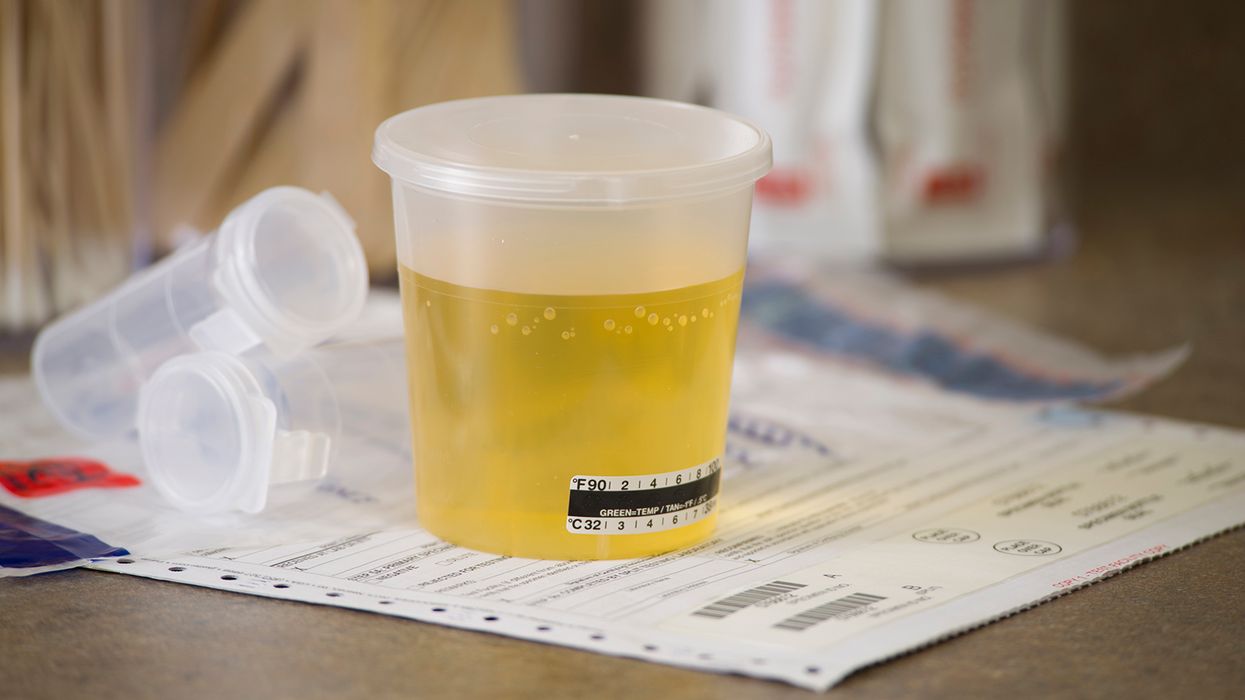
NewsIndustry NewsFleet SafetyDrug and Alcohol Testing - DOTFocus AreaIn-Depth ArticleEnglishDilute specimen - motor carrerTransportationUSA
2023-06-26T05:00:00Z
Dilute drug test? Follow these steps to compliance
For truck and bus drivers, having too much to drink can be problematic in several ways — even if the drink is just water.
Staying hydrated is normally a good thing, but drinking too much water can cause a driver’s urine to become so diluted that testing it for drugs becomes difficult. There can be multiple (and legitimate) reasons for dilute urine, but so far this year, over 1,000 drivers have tested positive but dilute, according to the Federal Motor Carrier Safety Administration (FMCSA).
If your medical review officer (MRO) reports that a driver’s urine was dilute, do you know what to do next? The actions you need to take will depend on a few specifics.
Positive dilute
If a test result is positive but dilute, you’ll need to treat it the same as a positive test result. You must:
- Not order another test;
- Notify the driver;
- Remove the driver from safety-sensitive functions;
- Give the driver a list of substance abuse professionals (SAPs) from whom the driver can seek treatment;
- Not use the driver again until the driver completes treatment and passes a return-to-duty test; and
- Retain the test results for five years.
The MRO will report the test result to the Drug & Alcohol Clearinghouse, the same as any other positive test.
| Learn more about Clearinghouse reporting in our ez Explanation! |
Negative dilute
For results that are negative but dilute, your actions will depend on the creatinine level (creatinine is a waste product found in urine), as follows:
2 to 5 mg/dL — The MRO will contact you to request an immediate re-collection under direct observation.
- If the driver refuses this test, it’s treated the same as any refusal (which means following the steps above for a positive test, including reporting to the Clearinghouse).
- If the driver goes for this follow-up test, the result becomes the official result of record.
- If the result comes back as negative dilute again, the test is declared negative.
Over 5 mg/dL — No retest required. However, you can have a company policy requiring a retest, as long as you communicate it to drivers and enforce it uniformly. If you do retests in this situation, be aware that:
- The test cannot be under direct observation;
- A refusal of the test is treated the same as any other refusal;
- If the result is once again negative dilute with a creatinine level over 5 mg/dL, you cannot retest the driver (i.e., no third test) and it’s deemed a negative result.
- If the result is negative dilute with a creatinine level of 2 to 5 mg/dL, the MRO will demand yet another test immediately under direct observation.
A positive, adulterated, or substituted test result on any retest becomes the result of record, and all the consequences of a drug testing violation apply.
Key to Remember: If a driver’s drug test result comes back as dilute, be sure you know what to do next.
Most Popular Highlights In Human Resources

NewsIndustry NewsIndustry NewsHR GeneralistFamily and Medical Leave Act (FMLA)Family and Medical Leave Act (FMLA)USAHR ManagementEnglishFocus AreaHuman Resources
2023-09-06T05:00:00Z
Appellate court sided with employee's (almost) 3-year-delayed FMLA claim
Back in October 2018, Laffon had a medical emergency and needed some time off under the federal Family and Medical Leave Act (FMLA).
Her leave lasted until November 15. Ten days after she returned to work, on November 26, her employer terminated her.
She sued, arguing that the employer retaliated against her because of her FMLA leave.
The catch? She didn't bring the suit until almost three years later.
No link between leave and termination
In court, the employer argued that there was no causal link between Laffon taking FMLA leave and her termination. Although the court documents aren't robust, they do reveal that the employer indicated that Laffon's allegations didn't show that her taking FMLA leave was a factor in the decision to terminate her. The documents showed only that the termination chronologically followed her leave.
The court agreed with the employer. It also agreed that Laffon failed to allege a willful violation of the FMLA, which would allow her to benefit from the FMLA's three-year statute of limitations.
Laffon appealed the case to the Ninth Circuit.
Statute of limitations
Under the FMLA, employees have two years from the date of the last event constituting the alleged violation for which they can bring a claim.
Those two years are extended to three years if the employer's actions were "willful." This means that an employee must show that the employer either knew or showed reckless disregard for whether its conduct violated the FMLA.
Ruling overturned
Fast forward to August 2023, when the Ninth Circuit reversed the lower court's decision. It indicated that, based on Laffon's amended complaint and liberally construing the law, her allegations establish that her leave was causally connected to her termination and that the employer's action (her termination) was willful.
Glymph v. CT Corporation Systems, No. 22-35735, Ninth Circuit Court of Appeals, August 22, 2023.
Key to remember: Terminating an employee soon after returning from FMLA leave is risky, unless there is a clear, well-documented, non-leave-related reason. Case documents did not show such a clear reason, which can also increase the risk of a willful finding. Employees have time to file claims, even years.

NewsFamily and Medical Leave Act (FMLA)LeaveFamily and Medical Leave Act (FMLA)In-Depth ArticleTime offLeaveHR ManagementEnglishUSAAssociate Benefits & CompensationIndustry NewsHR PoliciesEmployee BenefitsPolicies and ProceduresEmployee BenefitsHR GeneralistAssociate RelationsFocus AreaHuman Resources
2026-11-10T06:00:00Z
Employer beware: 11 percent of employees plan to take off November 19
The popular video game series Grand Theft Auto (GTA) has been around for years. On November 19, however, the latest version (VI) of the game is scheduled to drop. GTA fans are chomping at the bit for it, but employers aren’t playing games when it comes to employee attendance.
According to Zety, a professional career site, 11 percent of workers plan to take time off or adjust their schedules for the release. Employees might simply call in sick, ask for vacation, request paid time off (PTO), or ask to work remotely.
Taking time off for major cultural events isn’t new. People have long enjoyed blockbuster occasions, such as:
- Sporting events (i.e., World Series, Super Bowl, Olympics, World Cup);
- Concerts or album releases (i.e., Taylor Swift); or
- Other big entertainment days.
Employers, however, might want to be prepared for higher absences on November 19 and beyond.
While a concert or sporting event might last a few hours, people will want to take some extra time to actually play GTA VI. That extra time off might run into the Thanksgiving holiday the following week.
Employers might experience dips in production resulting from increased absenteeism.
GTA is NOT FMLA
To help curb potential leave abuse, employers might want to keep a close watch on employees who have been approved to take leave under the federal Family and Medical Leave Act (FMLA), particularly intermittent leave. They might try to claim time off for GTA as FMLA leave. Employers shouldn’t jump to conclusions, but they can carefully review the certification to ensure it supports the time off.
PTO policies
Employers generally govern their company policies regarding PTO or vacation time. Thus, they have the wiggle room to deny requested time off if work demands are high. In light of the upcoming video game release rolling into Thanksgiving week, employers might want to remind employees of this and note that PTO requests will be scrutinized and that violating company policies could result in discipline.
State laws
A few states, such as Illinois, Maine, and Nevada, have laws that entitle employees to take leave for any reason. Employees, however, must give employers notice of the leave, and might have to schedule leave to prevent undue hardship on the employer’s operations.
Key to remember: Employers might want to prepare for a smaller workforce on and after November 19 due to the release of the latest version of a popular video game.

NewsIndustry NewsAssociate RelationsHR GeneralistFamily and Medical Leave Act (FMLA)In-Depth ArticleFamily and Medical Leave Act (FMLA)HR ManagementEnglishUSAFocus AreaHuman Resources
2026-11-12T06:00:00Z
May employees make up FMLA leave? If so, does it count?
One of the biggest challenges facing employers that administer leave under the federal Family and Medical Leave Act (FMLA) is unforeseeable intermittent leave — when an employee suddenly needs time off.
When the time off is only an hour or so, employees might want to make up that time during the workweek.
The FMLA doesn’t specifically prohibit this. If the leave is unpaid, the employee might want to work a full week to receive a full paycheck.
Employers, however, should not mandate that employees make up the time. Doing so can dissuade employees from taking FMLA leave, which can risk a claim that the employer interfered with the employee’s FMLA rights.
Employees may, however, choose to make up the time taken as FMLA leave.
To count as FMLA leave or not
When an employee makes up time taken as FMLA leave, employers might wonder whether they can count the leave taken against the employee’s 12-week FMLA leave entitlement.
Currently, there’s no definitive word on this. Employers could argue that they fully observed the employee’s protections when they allowed the time off, so they should be able to count it as FMLA leave.
On the other hand, a good argument could be made that if the employee made up the time, and no shortfall in hours occurred, then nothing should count – and employers shouldn’t require the employee to take more FMLA leave than is necessary.
Most employers in this situation don’t treat the missed time as FMLA leave if it’s made up during the workweek.
Company policies
If employers have policies where employees are allowed to make up time missed for non-FMLA leave, they should permit them (but not require them) to make up time taken as FMLA leave and not count it against their 12-week entitlement.
If employers want to count the time as FMLA leave, they should have a policy that allows employees to make up work time to replace lost wages (as a result of unpaid FMLA leave). The policy should clearly indicate that:
- The employer will count the time missed for unpaid FMLA leave as FMLA leave, and the make-up time is to compensate for lost wages; and
- The employer doesn’t require the employee to make up the time on unpaid FMLA leave.
Employers might consider prohibiting make-up time if the FMLA leave ran concurrently with paid leave, such as sick or vacation time.
Key to remember: Employees may make up FMLA leave taken during a workweek, and employers have some considerations regarding whether to count the time off as FMLA leave or not.

NewsIndustry NewsIndustry NewsAssociate Benefits & CompensationHR GeneralistFamily and Medical Leave Act (FMLA)Family and Medical Leave Act (FMLA)Associate RelationsEnglishHR ManagementFocus AreaHuman ResourcesUSA
2026-09-16T05:00:00Z
Employer used an algorithm to detect FMLA fraud
In 2018, an employer suspended or fired 81 employees after they used Family and Medical Leave Act (FMLA) leave over the holidays in December 2017 and January 2018. That amounted to about 10 percent of the employees in one area of the company suspected of abusing FMLA leave.
Some of those 80 employees felt that they took FMLA leave that had previously been approved and that, by disciplining them for taking the leave, the employer interfered with their FMLA rights and retaliated against them for taking pre-approved leave. As a result, they sued.
Ferreting out leave abuse
From the employer’s perspective, using FMLA leave solely to avoid working on or around holidays, weekends, vacations, and rest days constituted dishonesty in violation of company policy.
Jolanda from HR had an automated system that ferreted out FMLA misuse. Each week, the system looked back at every employee’s FMLA usage over the preceding 12 weeks. If an employee had 5 suspicious uses of FMLA leave within 12 weeks, the algorithm flagged that employee. A suspicious use was any FMLA use on a weekend and any FMLA use that was taken immediately before or after a day off.
If Jolanda believed that an employee’s actions amounted to FMLA “pattern use,” she would conduct an individualized review. This involved reviewing each employee’s:
- Medical information,
- Absences that were identified as pattern use, and
- Statuses of those absences.
To further investigate this FMLA usage, Jolanda used a modified version of the algorithm, which flagged any employee who had used FMLA leave on 4 of the 10 most recent holidays and other special occasions (such as Black Friday and Christmas Eve). Jolanda removed from the list anyone whose leave involved cancer, a terminal illness, or was about to give birth.
Court disagrees with employer
Despite dozens of employees being terminated for misusing their leave, only three of the employees continued their lawsuit. In court, the judge pointed out that the algorithm didn’t show their total FMLA leave, just their holiday use. It didn’t include non-holiday use, so it didn’t give the whole picture.
If an employee used FMLA leave for 10 days in 12 months, and 5 of those days were holidays, an employer might have reason to suspect misuse. If an employee used FMLA leave for 60 days in 12 months and 5 of those days were holidays, there would be much less reason for an investigation. The employer focused on employees’ use of FMLA leave on holidays without considering the context of each situation.
The employer argued in court that it acted on its honest belief that the employees were abusing FMLA leave.
The employees argued that the company’s stated reason for the discipline was untrue and that retaliation was the actual reason for the discipline. The employees were given an internal hearing, but the hearings were suspicious, as a company manager acted both as judge by conducting the hearing and ruling on objections, and as prosecutor by questioning witnesses. The company witness told the hearing manager which questions the prosecutor (the same manager) should ask.
Employees, on the other hand, weren’t allowed to have legal counsel present, nor were there formal rules of evidence that governed the hearings. They also didn’t know the questions in advance, as the employer did.
In denying the employer’s request to have the entire case dismissed, the court determined that the employer’s decision process wasn’t credible and its reliance on that process was, therefore, not honestly held. It sent the case to a jury.
Burgess, et al., v. CSX Transportation, Inc., District of Maryland, No. JKB-18-0744, July 6, 2026.
Court decisions are based on the specific facts presented and each court’s interpretation of the law. Because courts may reach different conclusions, similar situations can lead to different outcomes. Employers should avoid relying on a single case as definitive guidance and instead assess each situation carefully, considering applicable laws and seeking advice when needed.
Key to remember: Employers may use procedures and tools to discern FMLA leave abuse, but they have to use those procedures and tools through the lens of the big picture.

NewsFamily and Medical Leave Act (FMLA)Family and Medical Leave Act (FMLA)In-Depth ArticleHR ManagementEnglishHuman ResourcesAssociate Benefits & CompensationIndustry NewsCompensationEmployee BenefitsEmployee BenefitsBenefits communicationHR GeneralistCompensationFocus AreaUSA
2024-10-22T05:00:00Z
How FMLA leave affects (or doesn’t affect) holiday pay
It might be October, but holiday decorations are already on retail shelves. While holidays creep into stores earlier and earlier, they might even show up at work, not as decorations, but as questions about holiday pay, including for employees on leave under the federal Family and Medical Leave Act (FMLA).
This begs questions for these two scenarios:
- Do employees get holiday pay if they are on FMLA leave?
- What if they don’t work the day before or after the holiday, as many company policies require?
The FMLA regulations state:
“An employee's entitlement to benefits other than group health benefits during a period of FMLA leave (e.g., holiday pay) is to be determined by the employer's established policy for providing such benefits when the employee is on other forms of leave (paid or unpaid, as appropriate).”
Reference: 29 CFR 825.209(h)
Therefore, whether employees receive holiday pay (or not) while on FMLA leave is up to company policies.
Workplace policies rule
Many company policies require employees to be at work the day before and after the holiday to receive holiday pay.
In that situation, if an employee is not at work the day before and after the holiday because they are on FMLA leave, they would not be entitled to holiday pay – unless the policy specifically says they do.
Remember, the FMLA rarely governs employee pay; it provides for job-protected, unpaid leave.
Such a policy doesn’t always include how the FMLA leave is treated, but that doesn’t mean it can’t.
If a company has no related policy, it will need to see how it addressed such situations in the past. If a company never had to handle such a situation, it would need to figure out how to proceed., being careful not to set an unwanted precedent.
Now’s a good time to plan
For employers that would like to craft a holiday pay policy, now might be a good time to do so. A new policy could indicate whether employees on FMLA leave would be entitled to holiday pay or not. That way, employees will know what to expect before the first snowflakes begin to fall.
Knowledgeable legal counsel should review all policies, so getting a head start is suggested.
Employers that already have holiday pay policies might want to review them. If they don’t include information about the pay during FMLA leave, perhaps it’s time to add such information.
Key to remember: Employees on FMLA leave are entitled to holiday pay based on company policy, not on the FMLA statute or regulations.
NewsShiftworkRhode IslandHR ManagementEnglishTalent Management & RecruitingAssociate Benefits & CompensationRecordkeepingRecruiting and hiringWage and HourChange NoticesChange NoticeWage and HourRecordkeepingBreaks and Meal PeriodsHours WorkedRecruiting and hiringMinimum WageHR GeneralistNon-Exempt employees StaffingUnions/Labor RelationsAssociate RelationsEmployee OrientationOnboardingFocus AreaHuman Resources
2026-11-11T06:00:00Z
Rhode Island Warehouse Worker Protection Act to take effect
Effective date: January 1, 2027
This applies to: The law defines “employer” as a person who directly or indirectly, or through an agent or any other person, including through the services of a third-party employer, temporary service, or staffing agency or similar entity, employs or exercises control over the wages, hours, or working conditions of 100 or more employees at a single warehouse distribution center or 1,000 or more employees at one or more warehouse distribution centers in the state.
Description of change: Effective January 1, 2027, Rhode Island’s Warehouse Worker Protection Act takes effect. It requires covered employers to provide nonexempt (“hourly”) employees who work at a warehouse distribution center, upon their hire, with a written description of their daily tasks, expectations, and quotas that they’re expected to complete. This also includes what materials might be produced or handled.
A “quota” is broadly defined to mean a work standard under which an employee is assigned or required to perform at a specified productivity speed, or perform a quantified number of tasks, or to handle or produce a quantified mount of material, within a defined time period and under which the employee may suffer an adverse employment action, if the employee fails to complete the performance standard.
An employee shall not be required to meet a quota that prevents compliance with meal or rest periods, use of bathroom facilities, including reasonable travel time to and from bathroom facilities, or occupational health and safety laws in the labor laws or department standards.
An employer shall not take adverse employment action against an employee for failure to meet a quota that doesn't allow a worker to comply with meal and rest periods, use of bathroom facilities, or occupational health and safety laws, labor laws, or for failure to meet a quota that has not been disclosed to an employee.
Rhode Island is the 7th state to enact this type of legislation, along with similar laws in California, Minnesota, New York, Oregon, Washington, and Connecticut.
View related state info: Employee notices – Rhode Island
Most Popular Highlights In Safety & Health

NewsSafety and Health Programs and TrainingRisk Assessment and ManagementOccupational Safety and Health Administration (OSHA), DOLSafety and Health Programs and TrainingIn-Depth ArticleEnglishRisk Assessment and ManagementIndustry NewsSafety & HealthConstruction SafetyGeneral Industry SafetyAgriculture SafetyMaritime SafetyFocus AreaUSA
2026-11-11T06:00:00Z
The Swiss Cheese Model: Use it for safety AND sanity!
What does Swiss cheese have to do with safety and sanity? If you’ve spent any time in the safety field, you’ve likely heard of the Swiss Cheese Model for safety program effectiveness. The model is a powerful way to understand why incidents happen and when used properly, preventing these incidents becomes more manageable. Applying this model will help you to strengthen your safety program, one cheese hole at a time, so you can close gaps without feeling overwhelmed.
The Model
The Swiss Cheese Model is pictorial way to look at why incidents still occur when multiple layers of protection fail. Imagine several slices of Swiss cheese stacked together, each slice represents a safety barrier such as machine guarding, work procedures, or training.
The holes in the slices symbolize safety weaknesses like human error, poor communication, or equipment failure. When the holes perfectly align across all layers, a hazard can pass all the way through every line of defense and result in an incident.
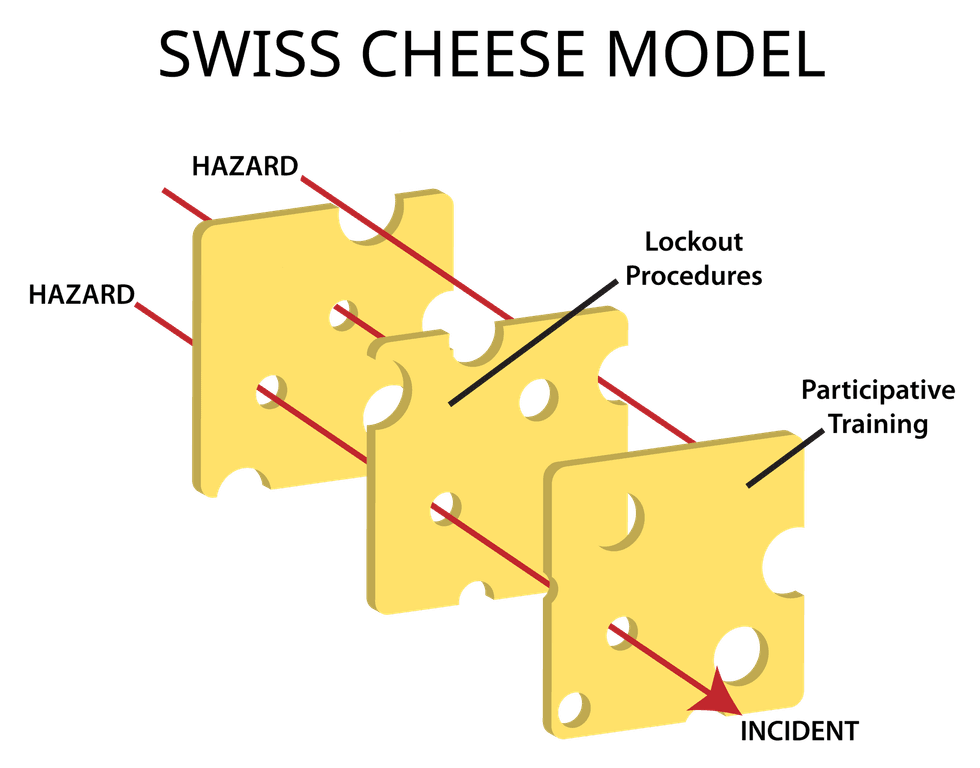
Visualizing your safety program in this simple and easy-to-remember graphic can help you identify gaps and strengthen protections.
The Myth
One misconception with the Swiss Cheese Model is that as long you are addressing the basics of regulatory standards, incidents would be prevented. Unfortunately, this is not always the case, and additional factors must be considered.
Factors that influence the layers of protection include:
- Organizational such as the prioritization of safety in the workplace, a strong safety culture, resource management, and consistent processes;
- Supervisory including communication, leadership and oversight, planning, enforcing safety, and corrective actions;
- Environmental like tools and technology, work tasks, and workplace conditions;
- Individual which includes workers’ mental and physical conditions, fitness for duty, and overall well-being; and
- Behavioral that result from decisions or skill-based mistakes, perceptual failures, or errors in judgment that lead to unsafe acts.
The Message
Plugging the holes in your Swiss Cheese requires evaluating and strengthening each layer of defense so that gaps or weaknesses don’t align and provide a window of opportunity for an incident to occur. Here’s how:
- Audit compliance regularly to update procedures and correct gaps right away. Gap-fillers include:
- Managerial support and safety enforcement
- Policies (behavioral expectations, safety management, incident reporting, etc.)
- Procedures (lockout/tagout, inspections, medical surveillance, etc.)
- Engineering and administrative controls (ventilation, work practices, hygiene, etc.)
- Emergency preparedness and contingency planning
- Training and communication
- Inspect and maintain protective controls and equipment routinely to ensure upgrades and repairs are made when needed.
- Provide regular, role-specific, and engaging training that will reinforce hazard recognition along with proper procedures and protections.
- Communicate openly across all levels of the organization to build trust that encourages workers to report safety issues, near misses, and incidents.
- Address human factors like production or time pressure, fatigue, and workplace tensions that may lead to shortcuts or unsafe acts.
Key to remember: Picture workplace safety initiatives like a stack of Swiss cheese where the slices are defenses and the holes are vulnerabilities. Close gaps by filling one hole at a time, strengthening worker protection without overwhelming your team.

NewsProcess Safety ManagementIndustry NewsEnforcement and Audits - OSHASafety & HealthConstruction SafetyIn-Depth ArticleGeneral Industry SafetyFlammable LiquidsFocus AreaHazardous Materials Safety - OSHAEnglishOSHA Violations and PenaltiesHazardous Materials Safety - OSHAUSA
2026-11-11T06:00:00Z
$95M wake-up call for OSHA PSM: What a flammable gas explosion can teach us
A recent government probe of an explosion and fire at a Pennsylvania chemical facility illustrates what can go wrong when Process Safety Management (PSM) safeguards fail. It also helps us understand why certain flammable gas processes are covered by 29 CFR 1910.119.
In September, the Chemical Safety and Hazard Investigation Board (CSB) announced its final report examining a June 2025 incident that occurred at the facility when flammable cracked gas backflowed into the firebox of an ethane cracking furnace, contacted lit pilots, and ignited. The explosion severely damaged the furnace and was followed by a fire that resulted in the evacuation of 15 employees. Despite the seriousness of the incident, no one was injured, but the explosion came with an estimated $95 million price tag.
CSB determined that the cause of the incident was the inadvertent simultaneous opening of two motor-operated valves used to isolate the furnace. Opening both valves created an unintended flow path that allowed flammable cracked gas to backflow into the furnace firebox.
Flammable gas coverage under the PSM standard
OSHA’s PSM standard at 1910.119 was created to prevent or minimize the consequences of catastrophic releases of toxic, reactive, flammable, or explosive chemicals. This includes flammable gases, so it’s important to know when the standard kicks in for them.
Barring any exceptions and exemptions, a process is subject to the standard when it involves a Category 1 flammable gas onsite in one location in a quantity of 10,000 pounds or more. A flammable gas does not have to be listed in Appendix A of 1910.119 to come under the standard. If it meets the criteria at 1910.119(a)(1)(ii), it is covered unless it has an exception or exemption.
The CSB investigation report says the Pennsylvania chemical facility considered its ethane cracking unit to fall under the OSHA PSM standard because the chemical quantities used or stored in the process exceeded the threshold quantity (TQ) of 10,000 pounds of flammable gas. Determining applicability takes more than knowing how much flammable gas is in a vessel. Subparagraph (a)(1)(ii) is only the starting point for an applicability determination.
Turn to the directive for applicability questions
OSHA directive CPL 02-01-065 provides interpretations of definitions, exceptions and exemptions, and complex issues like interconnected and co-located vessels, aggregation of quantities, mixtures, and which threshold to use. Several go over scenarios involving flammable gases. For example:
- Each aerosol container in a warehouse might hold only a small quantity of flammable gas, but if they are near each other such that an incident in one container could cause the potential release in another container, these containers are a single process. In that case, the individual amounts must be aggregated to determine if a TQ exists.
- When determining the TQ, flammable gases and flammable liquids are aggregated separately.
- For a flammable gas mixture, the non-flammable components are included in the TQ. If the mixture meets subparagraph (a)(1)(ii) for a flammable gas, the quantity of the entire mixture is used to determine if a TQ exists.
- If a substance that is a flammable gas is listed in Appendix A of the standard, the TQ used in determining PSM coverage is the lower of the following amounts: the TQ specified in Appendix A or 10,000 pounds.
PSM elements are required
When 1910.119 applies to a process, the employer must put PSM program elements in place to address the hazards. Key elements include, but are not limited to, compiling process safety information, performing process hazard analyses (PHAs), implementing written operating procedures (OPs), training employees, ensuring mechanical integrity, and conducting compliance audits.
In December 2025, OSHA issued citations stemming from the June 2025 incident relating to 1910.119(e)(3)(i) and (vi) and (f)(1)(i)(C). Those citations alleged that:
- The PHA didn’t address the process hazards during decoking operations and the startup to return to normal cracking operations.
- The PHA didn’t adequately address human factors for non-routine operations, such as what happens if a critical step is performed incorrectly.
- The employer didn’t develop and implement written OPs that provide clear instructions for safely conducting temporary operations.
CSB concludes that the company actively chose to rely solely on administrative controls to prevent a potentially fatal explosion in its PHA revalidation. CSB Investigator Owen Trippany said, “This incident demonstrates the importance of using engineered safeguards to control serious process hazards in all modes of operation, rather than relying solely on procedures and worker actions.”
Key to remember
Employers with processes that involve flammable gases should determine whether those processes are subject to the PSM standard. If so, they must comply with several program elements, including performing PHAs and implementing written OPs. At the same time, CSB offers this lesson: administrative controls should not be solely relied on to prevent fire and explosions.
NewsIndustry NewsIndustry NewsHeat and Cold ExposureSafety & HealthConstruction SafetyGeneral Industry SafetyAgriculture SafetyMaritime SafetyEnglishHeat StressFocus AreaUSA
2026-09-10T05:00:00Z
OSHA’s proposed heat rule debated during House subcommittee hearing
OSHA’s proposed heat illness and prevention rule took center stage during a September 2 hearing held by the House Workforce Protections Subcommittee.
Elizabeth Milito of the National Federation of Independent Business urged Congress to pass a bill that would prevent OSHA from issuing a permanent heat rule, citing the General Duty Clause already protects workers from heat-related hazards. Rebecca Reindel, director of occupational safety and health for the American Federation of Labor and Congress of Industrial Organizations (AFL-CIO) countered that the clause has a “broader, higher burden of proof” than a regular OSHA standard, including the need to satisfy a four-part test to issue a citation.
The rule, originally published in the Federal Register on August 30, 2024, would apply to employers conducting outdoor and indoor work in general industry, construction, maritime, and agriculture sectors where OSHA has jurisdiction and require them to implement a heat injury and illness prevention plan, along with other provisions.

NewsIndustry NewsIndustry NewsEnforcement and Audits - OSHAOSHA InspectionsCrystalline SilicaSafety & HealthGeneral Industry SafetyToxic and Hazardous Substances - OSHAEnglishFocus AreaOSHA Emphasis ProgramsUSA
2024-08-28T05:00:00Z
Silica enforcement inspections reveal violations of multiple standards
In addition to the silica standard, OSHA most often found violations of the hazard communication, respiratory protection, and noise standards during its silica enforcement inspections. The enforcement initiative, which supplements the agency’s National Emphasis Program for Respirable Crystalline Silica, establishes procedures for prioritizing inspections in covered industries where workers face exposure to high levels of silica dust.
From September 2023 through July 8, 2024, OSHA conducted 204 targeted inspections of cut stone and stone product manufacturers and wholesalers of brick, stone, and related material, and issued 149 citations.
Outside of the silica standard, the most common violations were:
- Lack of a written hazard communication program,
- Lack of or deficient written respiratory protection program, and
- Lack of medical examinations for employees required to wear respirators.
More details on OSHA’s findings can be found on their website.

NewsIndustry NewsIndustry NewsSafety & HealthConstruction SafetyWork ZonesSignals and BarricadesUSAEnglishHeavy Equipment and VehiclesFocus AreaWork Zones
2025-06-03T05:00:00Z
OSHA launches initiative to prevent backover incidents
Each year, backover incidents lead to serious injuries and fatalities in construction zones and workplaces. To help prevent these incidents, OSHA has launched an initiative to raise awareness of safety practices.
OSHA’s #MirrorCheck initiative provides resources to help educate workers and employers and reduce the risk of backover incidents. Safe work practices include:
- Equipping heavy machinery with audio and visual alarms and encouraging caution when operating machinery around workers.
- Properly adjusting mirrors to minimize blind spots.
- Using spotters to maintain constant visual contact with drivers and establishing hand signals to communicate effectively.
- Installing rearview cameras to enhance safety without blocking a driver’s view.
- Employing proximity detection systems, such as radar or ultrasonic technologies, that can be mounted on some vehicles.
- Developing internal traffic control plans to coordinate equipment, worker, and vehicle movement.
More information about #MirrorCheck can be found on OSHA’s webpage.

NewsIndustry NewsSafety and Health Programs and TrainingSafety & HealthConstruction SafetyGeneral Industry SafetyOSHA Outreach TrainingMaritime SafetyIn-Depth ArticleEnglishFocus AreaUSA
2026-10-29T05:00:00Z
OSHA 10- and 30-hour training: Common questions answered
Is an OSHA 10 or 30 card a certification? Who’s required to take the training? Does completing a course mean an employee is qualified to perform specific tasks? Can employers use the training as proof they’ve met all OSHA training requirements? Let’s dive into these and other common questions surrounding OSHA 10- and 30-hour courses.
Is an OSHA 10 or 30 card a certification?
No, the card isn’t a certification and completing a course doesn’t mean an employee is qualified to perform specific tasks. The courses are a foundation for hazard awareness and emphasize hazard identification, avoidance, control, and prevention, rather than OSHA standards. Employers must ensure employees receive job-specific training on the hazards they may encounter in the workplace.
Who’s required to take the training?
OSHA’s 10- and 30-hour Outreach Training Program is a voluntary program for workers in general industry, construction, maritime, and disaster site work. No OSHA standard requires employees to take the 10- or 30-hour outreach courses. Some states and municipalities, however, have enacted laws mandating the training, particularly for certain construction projects. It’s also not uncommon for private construction or service contracts to include requirements that only workers who have completed a 10- or 30-hour OSHA outreach course be allowed to work on the site.
10 vs. 30: What’s the difference?
Both courses provide basic awareness training on the recognition, avoidance, abatement, and prevention of workplace hazards. They also provide information regarding workers’ rights, employer responsibilities, and filing a complaint with OSHA.
The 10-hour training program is primarily intended for entry level workers while the 30-hour training program is more appropriate for supervisors or workers with some safety responsibility. It provides a greater depth and variety of training on an expanded list of topics associated with workplace hazards in each industry.
When the 10- or 30-hour courses are taught by OSHA authorized trainers, trainees will receive course completion cards from OSHA. As mentioned, these cards are not certifications, but they do acknowledge that the person has taken either a 10-hour or 30-hour OSHA outreach training course that was taught by an authorized trainer.
At the federal level, student course completion cards don’t have an expiration date. However, some states and municipalities do have further training requirements, such as refresher training every five years, so it’s important to be aware of such requirements.
How do you become an authorized trainer?
To become an authorized trainer to conduct 10- and 30-hour general industry outreach courses, you must complete OSHA’s Course #501, Trainer Course in Occupational Safety and Health Standards for General Industry. For construction courses, you must complete OSHA’s Course #500, Trainer Course in Occupational Safety and Health Standards for the Construction Industry. The trainer course is mandatory for those trainers who conduct 10- and 30-hour courses and issue OSHA course completion cards to the students.
Only the OSHA Training Institute (OTI) and OTI Education Centers can offer OSHA courses. The #500 and #501 courses are offered at OTI Education Centers around the country.
Trainers are independent service providers and their schedules and fees may vary. All trainers should possess a trainer card which includes an expiration date along with the name of the authorizing OTI Education Center.
Key to remember: No OSHA standard requires employees to take 10- or 30-hour outreach courses. However, some states, municipalities, and private employers may have such requirements. Even if employees take OSHA 10 or 30 courses, employers must ensure they receive job-specific training on the hazards they may encounter in the workplace.
True
Saved to my EVENT CALENDAR!
View your saved links by clicking the arrow next to your profile picture located in the header. Then, click “My Activity” to view the Event Calendar on your Activity page.
OK
J. J. Keller is the trusted source for DOT / Transportation, OSHA / Workplace Safety, Human Resources, Construction Safety and Hazmat / Hazardous Materials regulation compliance products and services. J. J. Keller helps you increase safety awareness, reduce risk, follow best practices, improve safety training, and stay current with changing regulations.
Copyright 2026 J. J. Keller & Associate, Inc. For re-use options please contact copyright@jjkeller.com or call 800-558-5011.