Compliance Just Got Easier: Stay ahead of regulatory changes with instant notifications on updates that matter.
['Water Programs']
['Safe Drinking Water']
2021-12-27T06:00:00Z
JOIN TODAY TO CONTINUE READING THIS ARTICLE & OTHER INDUSTRY NEWS!
You'll also get exclusive access to:
A database of easy-to-understand regulationsAsk unlimited questions to our expertsPre-led discussions forumsAnd more
TRY IT FREE TODAY
Already have an account? Log in now.

Copyright 2026 J. J. Keller & Associate, Inc. For re-use options please contact copyright@jjkeller.com or call 800-558-5011.
ENVIRONMENTAL PROTECTION AGENCY
40 CFR Part 141
[EPA-HQ-OW-2020-0530; FRL-6791-03-OW]
RIN 2040-AF89
Revisions to the Unregulated Contaminant Monitoring Rule (UCMR 5) for Public Water Systems and Announcement of Public Meetings
AGENCY: Environmental Protection Agency (EPA).
ACTION: Final rule and notice of public meetings.
SUMMARY: The U.S. Environmental Protection Agency (EPA) is finalizing a Safe Drinking Water Act (SDWA) rule that requires certain public water systems (PWSs) to collect national occurrence data for 29 per- and polyfluoroalkyl substances (PFAS) and lithium. Subject to the availability of appropriations, EPA will include all systems serving 3,300 or more people and a representative sample of 800 systems serving 25 to 3,299 people. If EPA does not receive the appropriations needed for monitoring all of these systems in a given year, EPA will reduce the number of systems serving 25 to 10,000 people that will be asked to perform monitoring. This final rule is a key action to ensure science-based decision-making and prioritize protection of disadvantaged communities in accordance with EPA's PFAS Strategic Roadmap. EPA is also announcing plans for public webinars to discuss implementation of the fifth Unregulated Contaminant Monitoring Rule (UCMR 5).
DATES: This final rule is effective on January 26, 2022. The incorporation by reference of certain publications listed in this final rule is approved by the Director of the Federal Register as of January 26, 2022.
ADDRESSES: EPA has established a docket for this action under Docket ID No. EPA-HQ-OW-2020-0530. All documents in the docket are listed on the https://www.regulations.gov website. Although listed in the index, some information is not publicly available, e.g., CBI or other information whose disclosure is restricted by statute. Certain other material, such as copyrighted material, is not placed on the internet and will be publicly available only in hard copy form. Publicly available docket materials are available electronically through https://www.regulations.gov.
FOR FURTHER INFORMATION CONTACT: Brenda D. Bowden, Standards and Risk Management Division (SRMD), Office of Ground Water and Drinking Water (OGWDW) (MS 140), Environmental Protection Agency, 26 West Martin Luther King Drive, Cincinnati, Ohio 45268; telephone number: (513) 569-7961; email address: bowden.brenda@epa.gov; or Melissa Simic, SRMD, OGWDW (MS 140), Environmental Protection Agency, 26 West Martin Luther King Drive, Cincinnati, Ohio 45268; telephone number: (513) 569-7864; email address: simic.melissa@epa.gov. For general information, visit the Ground Water and Drinking Water web page at: https://www.epa.gov/ground-water-and-drinking-water.
SUPPLEMENTARY INFORMATION:
Table of Contents
I. Summary Information
A. Purpose of the Regulatory Action
1. What action is EPA taking?
2. Does this action apply to me?
3. What is EPA's authority for taking this action?
4. What is the applicability date?
B. Summary of the Regulatory Action
C. Economic Analysis
1. What is the estimated cost of this action?
2. What are the benefits of this action?
II. Public Participation
A. What meetings have been held in preparation for UCMR 5?
B. How do I participate in the upcoming meetings?
1. Meeting Participation
2. Meeting Materials
III. General Information
A. How are CCL, UCMR, Regulatory Determination process, and NCOD interrelated?
B. What are the Consumer Confidence Reporting and Public Notice Reporting requirements for public water systems that are subject to UCMR?
C. What is the UCMR 5 timeline?
D. What is the role of “States” in UCMR?
E. How did EPA consider Children's Environmental Health?
F. How did EPA address Environmental Justice?
G. How did EPA coordinate with Indian Tribal Governments?
H. How are laboratories approved for UCMR 5 analyses?
1. Request To Participate
2. Registration
3. Application Package
4. EPA's Review of Application Package
5. Proficiency Testing
6. Written EPA Approval
I. What documents are being incorporated by reference?
1. Methods From the U.S. Environmental Protection Agency
2. Alternative Methods From American Public Health Association—Standard Methods (SM)
3. Methods From ASTM International
IV. Description of Final Rule and Summary of Responses to Public Comments
A. What contaminants must be monitored under UCMR 5?
1. This Final Rule
2. Summary of Major Comments and EPA Responses
a. Aggregate PFAS Measure
b. Legionella Pneumophila
c. Haloacetonitriles
d. 1,2,3-Trichloropropane
B. What is the UCMR 5 sampling design?
1. This Final Rule
2. Summary of Major Comments and EPA Responses
C. What is the sampling frequency and timing?
1. This Final Rule
2. Summary of Major Comments and EPA Responses
D. Where are the sampling locations and what is representative monitoring?
1. This Final Rule
2. Summary of Major Comments and EPA Responses
E. How long do laboratories and PWSs have to report data?
1. This Final Rule
2. Summary of Major Comments and EPA Responses
F. What are the reporting requirements for UCMR 5?
1. This Final Rule
2. Summary of Major Comments and EPA Responses
a. Data Elements
b. Reporting State Data
G. What are the UCMR 5 Minimum Reporting Levels (MRLs) and how were they determined?
1. This Final Rule
2. Summary of Major Comments and EPA Responses
H. What are the requirements for laboratory analysis of field reagent blank samples?
1. This Final Rule
2. Summary of Major Comments and EPA Responses
I. How will EPA support risk communication for UCMR 5 results?
V. Statutory and Executive Order Reviews
A. Executive Order 12866: Regulatory Planning and Review and Executive Order 13563: Improving Regulation and Regulatory Review
B. Paperwork Reduction Act (PRA)
C. Regulatory Flexibility Act (RFA)
D. Unfunded Mandates Reform Act (UMRA)
E. Executive Order 13132: Federalism
F. Executive Order 13175: Consultation and Coordination With Indian Tribal Governments
G. Executive Order 13045: Protection of Children From Environmental Health Risks and Safety Risks
H. Executive Order 13211: Actions Concerning Regulations That Significantly Affect Energy Supply, Distribution or Use
I. National Technology Transfer and Advancement Act (NTTAA)
J. Executive Order 12898: Federal Actions To Address Environmental Justice in Minority Populations and Low-Income Populations
K. Congressional Review Act (CRA)
VI. References
Abbreviations and Acronyms
μg/L Microgram per Liter
11Cl-PF3OUdS 11-chloroeicosafluoro-3-oxaundecane-1-sulfonic Acid
4:2 FTS 1H, 1H, 2H, 2H-perfluorohexane Sulfonic Acid
6:2 FTS 1H, 1H, 2H, 2H-perfluorooctane Sulfonic Acid
8:2 FTS 1H, 1H, 2H, 2H-perfluorodecane Sulfonic Acid
9Cl-PF3ONS 9-chlorohexadecafluoro-3-oxanone-1-sulfonic Acid
ADONA 4,8-dioxa-3H-perfluorononanoic Acid
AES Atomic Emission Spectrometry
ASDWA Association of State Drinking Water Administrators
ASTM ASTM International
AWIA America's Water Infrastructure Act of 2018
CASRN Chemical Abstracts Service Registry Number
CBI Confidential Business Information
CCL Contaminant Candidate List
CCR Consumer Confidence Report
CFR Code of Federal Regulations
CRA Congressional Review Act
CWS Community Water System
DBP Disinfection Byproduct
DWSRF Drinking Water State Revolving Fund
EPA United States Environmental Protection Agency
EPTDS Entry Point to the Distribution System
FR Federal Register
FRB Field Reagent Blank
GW Ground Water
GWRMP Ground Water Representative Monitoring Plan
HFPO-DA Hexafluoropropylene Oxide Dimer Acid (GenX)
HRL Health Reference Level
ICP Inductively Coupled Plasma
ICR Information Collection Request
IDC Initial Demonstration of Capability
LCMRL Lowest Concentration Minimum Reporting Level
LC/MS/MS Liquid Chromatography/Tandem Mass Spectrometry
MDBP Microbial and Disinfection Byproduct
MRL Minimum Reporting Level
NAICS North American Industry Classification System
NCOD National Contaminant Occurrence Database
NDAA National Defense Authorization Act for Fiscal Year 2020
NEtFOSAA N-ethyl Perfluorooctanesulfonamidoacetic Acid
NFDHA Nonafluoro‐3,6‐dioxaheptanoic Acid
ng/L Nanogram per Liter
NMeFOSAA N-methyl Perfluorooctanesulfonamidoacetic Acid
NPDWR National Primary Drinking Water Regulation
NTNCWS Non-transient Non-community Water System
NTTAA National Technology Transfer and Advancement Act
NTWC National Tribal Water Council
OGWDW Office of Ground Water and Drinking Water
OMB Office of Management and Budget
PFAS Per- and Polyfluoroalkyl Substances
PFBA Perfluorobutanoic Acid
PFBS Perfluorobutanesulfonic Acid
PFDA Perfluorodecanoic Acid
PFDoA Perfluorododecanoic Acid
PFEESA Perfluoro (2‐ethoxyethane) Sulfonic Acid
PFHpA Perfluoroheptanoic Acid
PFHpS Perfluoroheptanesulfonic Acid
PFHxA Perfluorohexanoic Acid
PFHxS Perfluorohexanesulfonic Acid
PFMBA Perfluoro‐4‐methoxybutanoic Acid
PFMPA Perfluoro‐3‐methoxypropanoic Acid
PFNA Perfluorononanoic Acid
PFOA Perfluorooctanoic Acid
PFOS Perfluorooctanesulfonic Acid
PFPeA Perfluoropentanoic Acid
PFPeS Perfluoropentanesulfonic Acid
PFTA Perfluorotetradecanoic Acid
PFTrDA Perfluorotridecanoic Acid
PFUnA Perfluoroundecanoic Acid
PN Public Notice
PRA Paperwork Reduction Act
PT Proficiency Testing
PWS Public Water System
QC Quality Control
RFA Regulatory Flexibility Act
SBA Small Business Administration
SBREFA Small Business Regulatory Enforcement Fairness Act
SDWA Safe Drinking Water Act
SDWARS Safe Drinking Water Accession and Review System
SDWIS/Fed Safe Drinking Water Information System Federal Reporting Services
SM Standard Methods for the Examination of Water and Wastewater
SOP Standard Operating Procedure
SPE Solid Phase Extraction
SRMD Standards and Risk Management Division
SW Surface Water
SWTR Surface Water Treatment Rule
TNCWS Transient Non-community Water System
TOF Total Organic Fluorine
TOP Total Oxidizable Precursors
UCMR Unregulated Contaminant Monitoring Rule
UMRA Unfunded Mandates Reform Act of 1995
U.S. United States
USEPA United States Environmental Protection Agency
I. Summary Information
A. Purpose of the Regulatory Action
1. What action is EPA taking?
This final rule requires certain public water systems (PWSs), described in section I.A.2 of this preamble, to collect national occurrence data for 29 PFAS and lithium. PFAS and lithium are not currently subject to national primary drinking water regulations, and EPA is requiring collection of data under UCMR 5 to inform EPA regulatory determinations and risk-management decisions. Consistent with EPA's PFAS Strategic Roadmap, UCMR 5 will provide new data critically needed to improve EPA's understanding of the frequency that 29 PFAS (and lithium) are found in the nation's drinking water systems and at what levels. This data will ensure science-based decision-making and help prioritize protection of disadvantaged communities.
2. Does this action apply to me?
This final rule applies to PWSs described in this section. PWSs are systems that provide water for human consumption through pipes, or constructed conveyances, to at least 15 service connections or that regularly serve an average of at least 25 individuals daily at least 60 days out of the year. A community water system (CWS) is a PWS that has at least 15 service connections used by year-round residents or regularly serves at least 25 year-round residents. A non-transient non-community water system (NTNCWS) is a PWS that is not a CWS and that regularly serves at least 25 of the same people over 6 months per year. Under this final rule, all large CWSs and NTNCWSs serving more than 10,000 people are required to monitor. In addition, small CWSs and NTNCWSs serving between 3,300 and 10,000 people are required to monitor (subject to available EPA appropriations and EPA notification of such requirement) as are the PWSs included in a nationally representative sample of CWSs and NTNCWSs serving between 25 and 3,299 people (see “Selection of Nationally Representative Public Water Systems for the Unregulated Contaminant Monitoring Rule: 2021 Update” for a description of the statistical approach for EPA's selection of the nationally representative sample (USEPA, 2021a), available in the UCMR 5 public docket). EPA expects to clarify the monitoring responsibilities for affected small systems by approximately July 1 of each year preceding sample collection, based on the availability of appropriations each year.
As in previous UCMRs, transient non-community water systems (TNCWSs) ( i.e., non-community water systems that do not regularly serve at least 25 of the same people over 6 months per year) are not required to monitor under UCMR 5. EPA leads UCMR 5 monitoring as a direct-implementation program. States, Territories, and Tribes with primary enforcement responsibility (primacy) to administer the regulatory program for PWSs under SDWA (hereinafter collectively referred to in this document as “states”), can participate in the implementation of UCMR 5 through voluntary Partnership Agreements (see discussion of Partnership Agreements in Section III.D of this preamble). Under Partnership Agreements, states can choose to be involved in various aspects of UCMR 5 monitoring for PWSs they oversee; however, the PWS remains responsible for compliance with the final rule. Potentially regulated categories and entities are identified in the following table.
| Category | Examples of potentially regulated entities | NAICS * |
|---|---|---|
| * NAICS = North American Industry Classification System. | ||
| State, local, & Tribal governments | State, local, and Tribal governments that analyze water samples on behalf of PWSs required to conduct such analysis; State, local, and Tribal governments that directly operate CWSs and NTNCWSs required to monitor | 924110 |
| Industry | Private operators of CWSs and NTNCWSs required to monitor | 221310 |
| Municipalities | Municipal operators of CWSs and NTNCWSs required to monitor | 924110 |
This table is not intended to be exhaustive, but rather provides a guide for readers regarding entities likely to be regulated by this action. This table lists the types of entities that EPA is aware could potentially be regulated by this action. Other types of entities not listed in the table could also be regulated. To determine whether your entity is regulated by this action, you should carefully examine the definition of PWS found in Title 40 in the Code of Federal Regulations (CFR) at 40 CFR 141.2 and 141.3, and the applicability criteria found in 40 CFR 141.40(a)(1) and (2). If you have questions regarding the applicability of this action to a particular entity, please consult the contacts listed in the preceding FOR FURTHER INFORMATION CONTACT section of this preamble.
3. What is EPA's authority for taking this action?
As part of EPA's responsibilities under SDWA, the agency implements section 1445(a)(2), Monitoring Program for Unregulated Contaminants. This section, as amended in 1996, requires that once every five years, beginning in August 1999, EPA issue a list of not more than 30 unregulated contaminants to be monitored by PWSs. SDWA requires that EPA enter the monitoring data into the agency's publicly available National Contaminant Occurrence Database (NCOD) at https://www.epa.gov/sdwa/national-contaminant-occurrence-database-ncod.
EPA must vary the frequency and schedule for monitoring based on the number of people served, the source of supply, and the contaminants likely to be found. EPA is using SDWA Section 1445(a)(2) authority as the basis for monitoring the unregulated contaminants under this final rule.
Section 2021 of America's Water Infrastructure Act of 2018 (AWIA) (Pub. L. 115-270) amended SDWA and specifies that, subject to the availability of EPA appropriations for such purpose and sufficient laboratory capacity, EPA's UCMR program must require all PWSs serving between 3,300 and 10,000 people to monitor for the contaminants in a particular UCMR cycle, and ensure that only a nationally representative sample of systems serving between 25 and 3,299 people are required to monitor for those contaminants. EPA has developed this final rule anticipating that necessary appropriations will become available; however, to date, Congress has not appropriated additional funding ( i.e., funding in addition to the $2.0 million that EPA has historically set aside each year from the Drinking Water State Revolving Fund, using SDWA authority, to support UCMR monitoring at small systems) to cover monitoring expenses for all PWSs serving between 3,300 and 10,000 people. Provisions in the final rule enable the agency to adjust the number of these systems that must monitor based upon available appropriations.
AWIA did not amend the original SDWA requirements for large PWSs. Therefore, PWSs serving a population larger than 10,000 people continue to be responsible for participating in UCMR.
Section 7311 of the National Defense Authorization Act for Fiscal Year 2020 (NDAA) (Pub. L. 116-92) amended SDWA and specifies that EPA shall include all PFAS in UCMR 5 for which a drinking water method has been validated by the Administrator and that are not subject to a national primary drinking water regulation.
4. What is the applicability date?
The applicability date represents an internal milestone used by EPA to determine if a PWS is included in the UCMR program and whether it will be treated as small ( i.e., serving 25 to 10,000 people) or large ( i.e., serving more than 10,000 people). It does not represent a date by which respondents need to take any action. The determination of whether a PWS is required to monitor under UCMR 5 is based on the type of system ( e.g., CWS, NTNCWS, etc.) and its retail population served, as indicated by the Safe Drinking Water Information System Federal Reporting Services (SDWIS/Fed) inventory on February 1, 2021. SDWIS/Fed can be accessed at https://www.epa.gov/ground-water-and-drinking-water/safe-drinking-water-information-system-sdwis-federal-reporting. Examining water system type and population served as of February 1, 2021 allowed EPA to develop a draft list of PWSs tentatively subject to UCMR 5 and share that list with the states during 2021 for their review. This advance planning and review then allowed EPA to load state-reviewed PWS information into EPA's reporting system so that those PWSs can be promptly notified upon publication of this final rule. If a PWS receives such notification and believes it has been erroneously included in UCMR 5 based on an incorrect retail population, the system should contact their state authority to verify its population served as of the applicability date. If an error impacting rule applicability is identified, the state or the PWS may contact EPA to address the error. The 5-year UCMR 5 cycle spans January 2022 through December 2026, with preparations in 2022, sample collection between January 1, 2023, and December 31, 2025, and completion of data reporting in 2026. By approximately July 1 of the year prior to each year's sample collection ( i.e., by July 1, 2022 for 2023 sampling; by July 1, 2023 for 2024 sampling; and by July 1, 2024 for 2025 sampling) EPA expects to determine whether it has received necessary appropriations to support its plan to monitor at all systems serving between 3,300 and 10,000 people and at a representative group of 800 smaller systems. As EPA finalizes its small-system plan for each sample collection year, the agency will notify the small PWSs accordingly.
B. Summary of the Regulatory Action
EPA is requiring certain PWSs to collect occurrence data for 29 PFAS and lithium. This document addresses key aspects of UCMR 5, including the following: Analytical methods to measure the contaminants; laboratory approval; monitoring timeframe; sampling locations; data elements ( i.e., information required to be collected along with the occurrence data); data reporting timeframes; monitoring cost; public participation; conforming and editorial changes, such as those necessary to remove requirements solely related to UCMR 4; and EPA responses to public comments on the proposed rule. This document also discusses the implication for UCMR 5 of the AWIA Section 2021(a) requirement that EPA collect monitoring data from all systems serving more than 3,300 people “subject to the availability of appropriations.”
Regardless of whether EPA is able to carry out the small-system monitoring as planned, or instead reduces the scope of that monitoring, the small-system data collection, coupled with data collection from all systems serving more than 10,000 people under this action, will provide scientifically valid data on the national occurrence of 29 PFAS and lithium in drinking water. The UCMR data are the primary source of national occurrence data that EPA uses to inform regulatory and other risk management decisions for drinking water contaminant candidates.
EPA is required under SDWA Section 1445(a)(2)(C)(ii) to pay the “reasonable cost of such testing and laboratory analysis” for all applicable PWSs serving 25 to 10,000 people. Consistent with AWIA, EPA will require monitoring at as many systems serving 3,300 to 10,000 people as appropriations support (see Section IV.B of this preamble for more information on the agency's sampling design).
The agency received several public comments expressing concern that significant laboratory capacity will be needed to support the full scope envisioned for UCMR 5 PFAS monitoring. EPA anticipates that sufficient laboratory capacity will exist to support the expanded UCMR 5 scope. EPA's experience over the first four cycles of UCMR implementation has been that laboratory capacity quickly grows to meet UCMR demand. EPA also notes that the number of laboratories successfully participating in the early stages of the UCMR 5 laboratory approval program is a good indicator that there will be a robust national network of laboratories experienced in PFAS drinking water analysis.
By early 2022, EPA will notify all small CWSs and NTNCWSs serving between 3,300 and 10,000 people of their anticipated requirement to monitor, which EPA expects to confirm and schedule by July 1 preceding each collection year based on the availability of appropriations. The nationally representative sample of smaller PWSs described in Section I.A of this preamble will be similarly notified and advised of their schedules.
This final rule addresses the requirements of the NDAA by including all 29 PFAS that are within the scope of EPA Methods 533 and 537.1. Both of these methods have been validated by EPA for drinking water analysis.
C. Economic Analysis
1. What is the estimated cost of this action?
EPA estimates the total average national cost of this action would be $21 million per year over the 5-year effective period of the final rule (2022-2026) assuming EPA collects information from all systems serving between 3,300 and 10,000 people. All of these costs are associated with paperwork burden under the Paperwork Reduction Act (PRA). EPA discusses the expected costs as well as documents the assumptions and data sources used in the preparation of this estimate in the “Information Collection Request for the Final Unregulated Contaminant Monitoring Rule (UCMR 5)” (USEPA, 2021b). Costs are incurred by large PWSs (for sampling and analysis); small PWSs (for sampling); state regulatory agencies ( i.e., those who volunteer to assist EPA with oversight and implementation support); and EPA (for regulatory support and oversight activities, and analytical and shipping costs for samples from small PWSs). These costs are also summarized in Exhibit 1 of this preamble. EPA's estimates are based on executing the full monitoring plan for small systems ( i.e., including all systems serving 3,300 to 10,000 people and a representative group of 800 smaller systems). As such, those estimates represent an upper bound. If EPA does not receive the necessary appropriations in one or more of the collections years—and thus collects data from fewer small systems—the actual costs would be lower than those estimated here.
EPA received several comments on the cost of monitoring. EPA has accounted for the cost/burden associated with all of the PWS activities as part of the comprehensive cost/burden estimates. In order to provide the most accurate and updated cost estimate, EPA re-examined labor burden estimates for states, EPA, and PWS activities and updated costs of laboratory services for sample analysis, based on consultations with national drinking water laboratories, when developing this final rule.
The costs for a particular UCMR cycle are heavily influenced by the selection of contaminants and associated analytical methods. EPA identified three EPA-developed analytical methods (and, in the case of lithium, multiple optional alternative methods) to analyze samples for UCMR 5 contaminants. EPA's estimate of the UCMR 5 analytical cost is $740 per sample set ( i.e., $740 to analyze a set of samples from one sample point and one sample event for the 30 UCMR 5 contaminants).
Exhibit 1 of this preamble details the EPA-estimated annual average national costs (accounting for labor and non-labor expenses). Laboratory analysis and sample shipping account for approximately 65 percent of the estimated total national cost for the implementation of UCMR 5. EPA estimated laboratory costs based on consultations with multiple commercial drinking water testing laboratories. EPA's cost estimates for the laboratory methods include shipping and analysis.
EPA expects that states will incur modest labor costs associated with voluntary assistance with the implementation of UCMR 5. EPA estimated state costs using the relevant assumptions from the State Resource Model developed by the Association of State Drinking Water Administrators (ASDWA) (ASDWA, 2013) to help states forecast resource needs. Model estimates were adjusted to account for actual levels of state participation under UCMR 4. State assistance with EPA's implementation of UCMR 5 is voluntary; thus, the level of effort is expected to vary among states and will depend on their individual agreements with EPA.
EPA assumes that one-third of the systems will collect samples during each of the three sample-collection years from January 2023 through December 2025.
| Entity | Average annual cost (million) (2022-2026) 2 |
|---|---|
| 1 Based on the scope of small-system monitoring described in AWIA. | |
| 2 Totals may not equal the sum of components due to rounding. | |
| 3 Labor costs pertain to PWSs, states, and EPA. Costs include activities such as reading the final rule, notifying systems selected to participate, sample collection, data review, reporting, and record keeping. | |
| 4 Non-labor costs will be incurred primarily by EPA and by large and very large PWSs. They include the cost of shipping samples to laboratories for testing and the cost of the laboratory analyses. | |
| 5 For a typical UCMR program that involves the expanded scope prescribed by AWIA, EPA estimates an average annual cost to the agency of $17M/year (over a 5-year cycle) ($2M/year for the representative sample of 800 PWSs serving between 25 and 3,299 people and $15M/year for all PWSs serving between 3,300 and 10,000 people). The projected cost to EPA for UCMR 5 implementation is lower than for a typical UCMR program because of lower sample analysis expenses. Those lower expenses are a result of analytical method efficiencies ( i.e., being able to monitor for 30 chemicals with only three analytical methods). | |
| Small PWSs (25-10,000), including labor 3 only (non-labor costs 4 paid for by EPA) | $0.3 |
| Large PWSs (10,001-100,000), including labor and non-labor costs | 7.0 |
| Very Large PWSs (100,001 and greater), including labor and non-labor costs | 2.2 |
| States, including labor costs related to implementation coordination | 0.8 |
| EPA, including labor for implementation and non-labor for small system testing | 5 10.5 |
| Average Annual National Total | 20.8 |
Additional details regarding EPA's cost assumptions and estimates can be found in the Information Collection Request (ICR) (USEPA, 2021b), ICR Number 2040-0304, which presents estimated cost and labor hours for the 5-year UCMR 5 period of 2022-2026. Copies of the ICR may be obtained from the EPA public docket for this final rule under Docket ID No. EPA-HQ-OW-2020-0530.
2. What are the benefits of this action?
The public benefits from the information about whether or not unregulated contaminants are present in their drinking water. If contaminants are not found, consumer confidence in their drinking water should improve. If contaminants are found, related health effects may be avoided when subsequent actions, such as regulations, are implemented, reducing or eliminating those contaminants.
II. Public Participation
A. What meetings have been held in preparation for UCMR 5?
EPA held three public meetings on UCMR 5 over the period of 2018 through 2021. EPA held a meeting focused on drinking water methods for unregulated contaminants on June 6, 2018, in Cincinnati, Ohio. Representatives from state agencies, laboratories, PWSs, environmental organizations, and drinking water associations joined the meeting via webinar and in person. Meeting topics included an overview of regulatory process elements (including the Contaminant Candidate List (CCL), UCMR, and Regulatory Determination), and drinking water methods under development (see USEPA, 2018 for presentation materials). EPA held a second meeting on July 16, 2019, in Cincinnati, Ohio. Representatives from State agencies, Tribes, laboratories, PWSs, environmental organizations, and drinking water associations participated in the meeting via webinar and in person. Meeting topics included the impacts of AWIA, analytical methods and contaminants being considered by EPA, potential sampling design, and other possible aspects of the UCMR 5 approach (see USEPA, 2019a for meeting materials). EPA held two identical virtual meetings on April 6 and 7, 2021, during the public comment period for the proposed rule (see USEPA, 2021c for presentation materials). Topics included the proposed UCMR 5 monitoring requirements, analyte selection and rationale, analytical methods, the laboratory approval process, and ground water representative monitoring plans (GWRMPs). Representatives of state agencies, laboratories, PWSs, environmental organizations, and drinking water associations participated in the meeting via webinar. In Section II.B of this preamble, the agency is announcing additional meetings to be held in 2022, which will assist with implementation.
B. How do I participate in the upcoming meetings?
EPA will hold multiple virtual meetings during 2022 to discuss UCMR 5 implementation planning, data reporting using Safe Drinking Water Accession and Review System (SDWARS), and best practices for sample collection. Dates and times of the upcoming meetings will be posted on EPA's website at https://www.epa.gov/dwucmr/unregulated-contaminant-monitoring-rule-ucmr-meetings-and-materials. EPA anticipates hosting the meetings focused on implementation planning in spring 2022, and the SDWARS and sample-collection meetings in fall 2022. Stakeholders who have participated in past UCMR meetings and/or those who register to use SDWARS will receive notification of these events. Other interested stakeholders are also welcome to participate.
1. Meeting Participation
Those who wish to participate in the public meetings, via webinar, can find information on how to register at https://www.epa.gov/dwucmr/unregulated-contaminant-monitoring-rule-ucmr-meetings-and-materials. The number of webinar connections available for the meetings are limited and will be available on a first-come, first-served basis. If stakeholder interest results in exceeding the maximum number of available connections for participants in upcoming webinar offerings, EPA may schedule additional webinars, with dates and times posted on EPA's Unregulated Contaminant Monitoring Program Meetings and Materials web page at https://www.epa.gov/dwucmr/unregulated-contaminant-monitoring-rule-ucmr-meetings-and-materials.
2. Meeting Materials
EPA expects to send meeting materials by email to all registered participants prior to the meeting. The materials will be posted on EPA's website at https://www.epa.gov/dwucmr/unregulated-contaminant- monitoring-rule-ucmr-meetings-and-materials for people who do not participate in the webinar.
III. General Information
A. How are CCL, UCMR, Regulatory Determination process, and NCOD interrelated?
Under the 1996 amendments to SDWA, Congress established a multi-step, risk-based approach for determining which contaminants would become subject to drinking water standards. Under the first step, EPA is required to publish a CCL every five years that identifies contaminants that are not subject to any proposed or promulgated drinking water regulations, are known or anticipated to occur in PWSs, and may require future regulation under SDWA. EPA published the draft CCL 5 in the Federal Register on July 19, 2021 (86 FR 37948, July 19, 2021 (USEPA, 2021d)). Under the second step, EPA must require, every five years, monitoring of unregulated contaminants as described in this action. The third step requires EPA to determine, every five years, whether or not to regulate at least five contaminants from the CCL. Under Section 1412(b)(1)(A) of SDWA, EPA regulates a contaminant in drinking water if the Administrator determines that:
(1) The contaminant may have an adverse effect on the health of persons;
(2) The contaminant is known to occur or there is substantial likelihood that the contaminant will occur in PWSs with a frequency and at levels of public health concern; and
(3) In the sole judgment of the Administrator, regulation of such contaminant presents a meaningful opportunity for health risk reduction for persons served by PWSs.
For the contaminants that meet all three criteria, SDWA requires EPA to publish national primary drinking water regulations (NPDWRs). Information on the CCL and the regulatory determination process can be found at: https://www.epa.gov/ccl.
The data collected through the UCMR program are made available to the public through the National Contaminant Occurrence Database (NCOD) for drinking water. EPA developed the NCOD to satisfy requirements in SDWA Section 1445(g), to assemble and maintain a drinking water contaminant occurrence database for both regulated and unregulated contaminants in drinking water systems. NCOD houses data on unregulated contaminant occurrence; data from EPA's “Six-Year Review” of national drinking water regulations; and ambient and/or source water data. Section 1445(g)(3) of SDWA requires that EPA maintain UCMR data in the NCOD and use the data when evaluating the frequency and level of occurrence of contaminants in drinking water at a level of public health concern. UCMR results can be viewed by the public via NCOD ( https://www.epa.gov/sdwa/national-contaminant-occurrence-database-ncod ) or via the UCMR web page at: https://www.epa.gov/dwucmr.
B. What are the Consumer Confidence Reporting and Public Notice Reporting requirements for public water systems that are subject to UCMR?
In addition to reporting UCMR monitoring data to EPA, PWSs are responsible for presenting and addressing UCMR results in their annual Consumer Confidence Reports (CCRs) (40 CFR 141.153) and must address Public Notice (PN) requirements associated with UCMR (40 CFR 141.207). More details about the CCR and PN requirements can be viewed by the public at: https://www.epa.gov/ccr and https://www.epa.gov/dwreginfo/public-notification-rule, respectively.
C. What is the UCMR 5 timeline?
This final rule identifies a UCMR 5 sampling period of 2023 to 2025. Prior to 2023 EPA will coordinate laboratory approval, tentatively select representative small systems (USEPA, 2021a), organize Partnership Agreements, develop State Monitoring Plans (see Section III.D of this preamble), establish monitoring schedules and inventory, and conduct outreach and training. Exhibit 2 of this preamble illustrates the major activities that EPA expects will take place in preparation for and during the implementation of UCMR 5.
BILLING CODE 6560-50-P
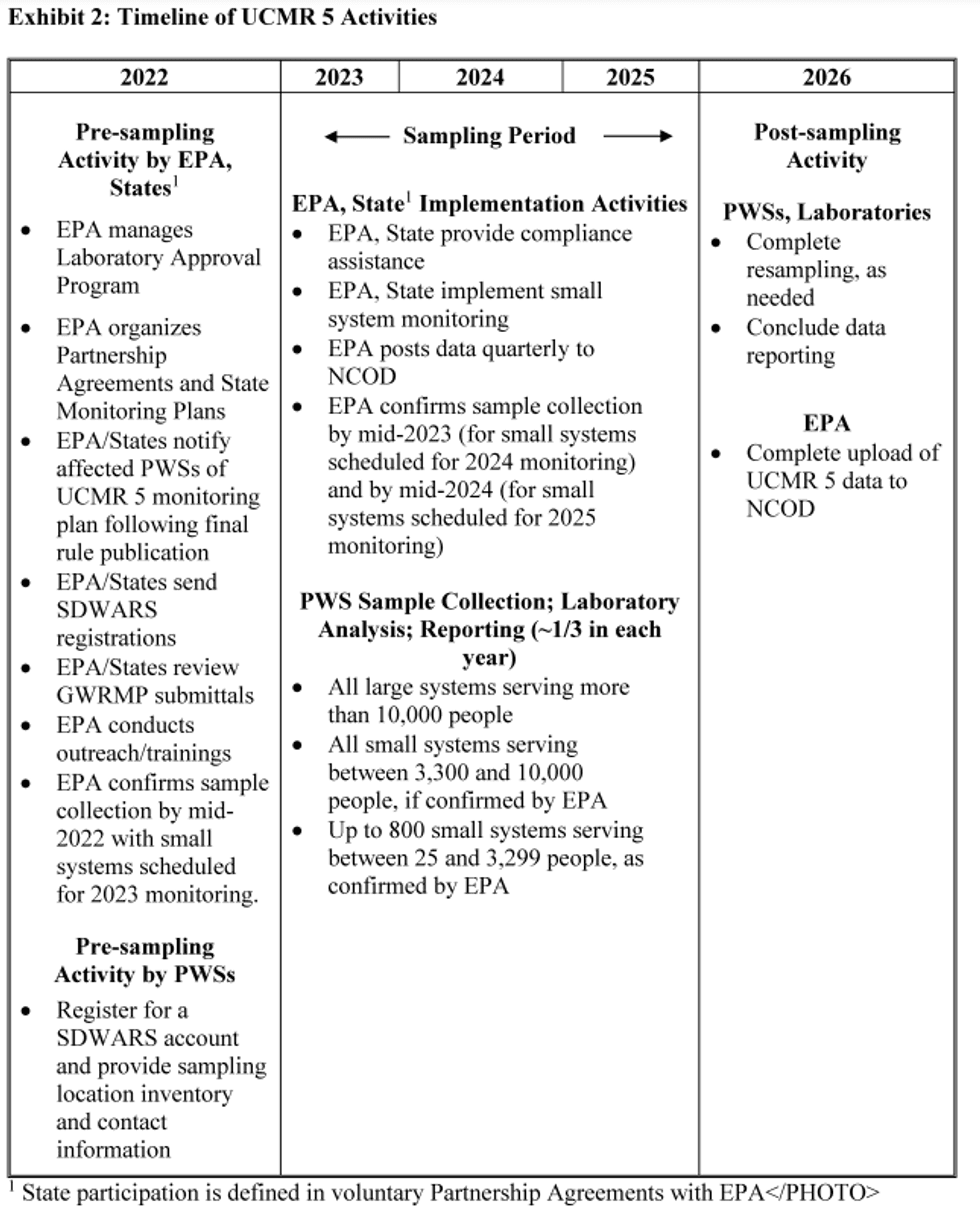
BILLING CODE 6560-50-C
D. What is the role of “States” in UCMR?
UCMR is a direct implementation rule ( i.e., EPA has primary responsibility for its implementation) and state participation is voluntary. Under the previous UCMR cycles, specific activities that individual states agreed to carry out or assist with were identified and established exclusively through Partnership Agreements. Through Partnership Agreements, states can help EPA implement UCMR and help ensure that the UCMR data are of the highest quality possible to best support the agency decision making. Under UCMR 5, EPA will continue to use the Partnership Agreement process to determine and document the following: The process for review and revision of the State Monitoring Plans; replacing and updating PWS information, including inventory ( i.e., PWS identification codes (PWSID), facility identification code along with associated facility types and water source type, etc.); review of proposed GWRMPs; notification and instructions for systems; and compliance assistance. EPA recognizes that states often have the best information about their PWSs and encourages them to partner in the UCMR 5 program.
E. How did EPA consider Children's Environmental Health?
By monitoring for unregulated contaminants that may pose health risks via drinking water, UCMR furthers the protection of public health for all citizens, including children. Children consume more water per unit of body weight compared to adults. Moreover, formula-fed infants drink a large amount of water compared to their body weight; thus, children's exposure to contaminants in drinking water may present a disproportionate health risk (USEPA, 2011). The objective of UCMR 5 is to collect nationally representative drinking water occurrence data on unregulated contaminants for future regulatory consideration. Information on the prioritization process, as well as contaminant-specific information ( e.g., source, use, production, release, persistence, mobility, health effects, and occurrence), that EPA used to select the analyte list, is contained in “Information Compendium for Contaminants for the Final Unregulated Contaminant Monitoring Rule (UCMR 5)” (USEPA, 2021e), available in the UCMR 5 public docket.
Since this is a final rule to monitor for contaminants and not to reduce their presence in drinking water to an acceptable level, the rule does not concern environmental health or safety risks presenting a disproportionate risk to children that would be addressed by this action (See Section V.G Executive Order 13045 of this preamble). Therefore, Executive Order 13045 does not apply to UCMR. However, EPA's Policy on Evaluating Health Risks to Children, which ensures that the health of infants and children is explicitly considered in the agency's decision making, is applicable, see: https://www.epa.gov/children/epas-policy-evaluating-risk-children.
EPA considered children's health risks during the development of UCMR 5. This included considering public comments about candidate contaminant priorities. Many commenters supported the agency's inclusion of PFAS and lithium in UCMR 5. Some commenters requested that EPA consider children and infant health risks in its risk communication for UCMR 5.
Using quantitation data from multiple laboratories, EPA establishes statistically-based UCMR reporting levels the agency considers feasible for the national network of approved drinking water laboratories. EPA generally sets the reporting levels as low as is technologically practical for measurement by that national network of laboratories, even if that level is well below concentrations that are currently associated with known or suspected health effects. In doing so, EPA positions itself to better address contaminant risk information in the future, including that associated with unique risks to children.
F. How did EPA address Environmental Justice (EJ)?
EPA has concluded that this action is not subject to Executive Order 12898 because it does not establish an environmental health or safety standard (see Section V.J Executive Order 12898 of this preamble). EPA Administrator Regan issued a directive to all EPA staff to incorporate environmental justice (EJ) into the agency's work, including regulatory activities, such as integrating EJ considerations into the regulatory development processes and considering regulatory options to maximize benefits to communities that “continue to suffer from disproportionately high pollution levels and the resulting adverse health and environmental impacts.” In keeping with this directive, and consistent with AWIA, EPA will, subject to the availability of sufficient appropriations, expand UCMR 5 to include all PWSs serving between 3,300 and 10,000 people as described in Sections I.A.4 and IV.B of this preamble. If there are sufficient appropriations, the expansion in the number of participating PWSs will provide a more comprehensive assessment of contaminant occurrence data from small and rural communities, including disadvantaged communities.
By developing a national characterization of unregulated contaminants that may pose health risks via drinking water from PWSs, UCMR furthers the protection of public health for all citizens. If EPA receives the needed appropriations, the expansion in monitoring scope reflected in UCMR 5 ( i.e., including all PWSs serving 3,300 to 10,000 people) will better support state and regional analyses and determination of potential EJ-related issues that need to be addressed. EPA structured the UCMR 5 rulemaking process to allow for meaningful involvement and transparency. EPA organized public meetings and webinars to share information regarding the development and implementation of UCMR 5; consulted with Tribal governments; and convened a workgroup that included representatives from several states. EPA will support stakeholder interest in UCMR 5 results by making them publicly available, as described in Section III.A of this preamble, and by developing additional risk-communication materials to help individuals and communities understand the significance of contaminant occurrence.
EPA received multiple comments on environmental justice considerations. Commenters expressed support for the continued collection of U.S. Postal Service Zip Codes for each PWS's service area and requested that EPA provide multilingual UCMR materials. EPA will continue to collect Zip Codes for UCMR 5, as collected under UCMR 3 and UCMR 4, to support potential assessments of whether or not certain communities are disproportionately impacted by particular drinking water contaminants. EPA also intends to develop the sampling instructions, fact sheets, and data summaries in both English and Spanish.
G. How did EPA coordinate with Indian Tribal Governments?
EPA has concluded that this action has Tribal implications. However, it will neither impose substantial direct compliance costs on federally recognized Tribal governments, nor preempt Tribal law. (See section V.F Executive Order 13175 of this preamble).
EPA consulted with Tribal officials under the EPA Policy on Consultation and Coordination with Indian Tribes early in the process of developing this action to ensure meaningful and timely input into its development. EPA initiated the Tribal consultation and coordination process before proposing the rule by mailing a “Notification of Consultation and Coordination” letter on June 26, 2019, to the Tribal leadership of the then 573 federally recognized Tribes. The letter invited Tribal leaders and representatives of Tribal governments to participate in an August 6, 2019, UCMR 5 Tribal consultation and coordination informational meeting. Presentation topics included an overview of the UCMR program, potential approaches to monitoring and implementation for UCMR 5, and the UCMR 5 contaminants and analytical methods under consideration. After the presentation, EPA provided an opportunity for input and questions on the action. Eight representatives from five Tribes attended the August meeting. Tribal representatives asked clarifying questions regarding program costs to PWSs and changes in PWS participation per AWIA. EPA addressed the questions during the meeting. Following the meeting, EPA received and addressed one additional clarifying question from a Tribal representative during the Tribal consultation process. No other Tribal representatives submitted written comments during the UCMR 5 consultation comment period that ended September 1, 2019.
Prior to the August 2019 meeting, EPA provided additional opportunities for Tribal officials to provide meaningful and timely input into the development of the proposed rule. On July 10, 2019, EPA participated in a monthly conference call with the National Tribal Water Council (NTWC). EPA shared a brief summary of UCMR statutory requirements with the Council and highlighted the upcoming official Tribal meeting. EPA also invited Tribal leaders and representatives to participate in a public meeting, held on July 16, 2019, to discuss the development of the proposed rule. Representatives from six Tribes participated in the public meeting. Following the publication of the proposal, EPA advised the Indian Health Services of the 60-day public comment period to assist with facilitating additional Tribal comments on the proposed rule. EPA received no public comments from Tribal officials.
A complete summary of the consultation, titled, “Summary of the Tribal Coordination and Consultation Process for the Fifth Unregulated Contaminant Monitoring Rule (UCMR 5) Proposal,” is provided in the UCMR 5 public docket listed in the ADDRESSES section of this preamble.
H. How are laboratories approved for UCMR 5 analyses?
Consistent with prior UCMRs, this action maintains the requirement that PWSs use laboratories approved by EPA to analyze UCMR 5 samples. Interested laboratories are encouraged to apply for EPA approval as early as possible. The UCMR 5 laboratory approval process, which began with the publication of the UCMR 5 proposal, is designed to assess whether laboratories possess the required equipment and can meet laboratory-performance and data-reporting criteria described in this action.
EPA expects demand for laboratory support to increase significantly based on the greater number of PWSs expected to participate in UCMR 5. EPA anticipates that the number of participating small water systems will increase from the typical 800 to approximately 6,000 (see Exhibit 5 in Section IV.B of this preamble). In preparation for this increase, EPA will solicit proposals and award contracts to laboratories to support small system monitoring prior to the end of the proficiency testing (PT) program. As in previous UCMR programs, EPA expects that laboratories awarded contracts by EPA will be required to first be approved to perform all methods. The requirements for the laboratory approval process are described in steps 1 through 6 of the following paragraphs.
EPA will require laboratories seeking approval to: (1) Provide EPA with data documenting an initial demonstration of capability (IDC) as outlined in each method; (2) verify successful performance at or below the minimum reporting levels (MRLs) as specified in this action; (3) provide information about laboratory standard operating procedures (SOPs); and (4) participate in two EPA PT studies for the analytes of interest. Audits of laboratories may be conducted by EPA prior to and/or following approval, and maintaining approval is contingent on timely and accurate reporting. The “UCMR 5 Laboratory Approval Manual” (USEPA, 2021f), available in the UCMR 5 public docket, provides more specific guidance on EPA laboratory approval program and the specific method acceptance criteria. EPA has included sample-collection procedures that are specific to the methods in the “UCMR 5 Laboratory Manual,” and will address these procedures in our outreach to the PWSs that will be collecting samples.
The UCMR 5 laboratory approval program will provide an assessment of the ability of laboratories to perform analyses using the methods listed in 40 CFR 141.40(a)(3), Table 1 of this preamble. Laboratory participation in the program is voluntary. However, as in the previous UCMRs, EPA will require PWSs to exclusively use laboratories that have been approved under the program. EPA will post a list of approved UCMR 5 laboratories to https://www.epa.gov/dwucmr and will bring this to the attention of the PWSs in our outreach.
1. Request To Participate
Laboratories interested in the UCMR 5 laboratory approval program first email EPA at: UCMR_Lab_Approval@epa.gov to request registration materials. EPA began accepting requests beginning with the publication of the proposal in the Federal Register .
2. Registration
Laboratory applicants provide registration information that includes laboratory name, mailing address, shipping address, contact name, phone number, email address, and a list of the UCMR 5 methods for which the laboratory is seeking approval. This registration step provides EPA with the necessary contact information and ensures that each laboratory receives a customized application package.
3. Application Package
Laboratory applicants will complete and return a customized application package that includes the following: IDC data, including precision, accuracy, and results of MRL studies; information regarding analytical equipment and other materials; proof of current drinking water laboratory certification (for select compliance monitoring methods); method-specific SOPs; and example chromatograms for each method under review.
As a condition of receiving and maintaining approval, the laboratory must promptly post UCMR 5 monitoring results and quality control data that meet method criteria (on behalf of its PWS clients) to EPA's UCMR electronic data reporting system, SDWARS.
Based on the January 1, 2023 start for UCMR 5 sample collection, the deadline for a laboratory to submit the necessary registration and application information is August 1, 2022.
4. EPA's Review of Application Package
EPA will review the application packages and, if necessary, request follow-up information. Laboratories that successfully complete the application process become eligible to participate in the UCMR 5 PT program.
5. Proficiency Testing
A PT sample is a synthetic sample containing a concentration of an analyte or mixture of analytes that is known to EPA, but unknown to the laboratory. To be approved, a laboratory must meet specific acceptance criteria for the analysis of a UCMR 5 PT sample(s) for each analyte in each method, for which the laboratory is seeking approval. EPA offered three PT studies between publication of the proposed rule and final rule, and anticipates offering at least two additional studies. Interested laboratories must participate in and report data for at least two PT studies. This allows EPA to collect a robust dataset for PT results, and provides laboratories with extra analytical experience using UCMR 5 methods. Laboratories must pass a PT for every analyte in the method to be approved for that method and may participate in multiple PT studies in order to produce passing results for each analyte. EPA has taken this approach in UCMR 5, recognizing that EPA Method 533 contains 25 analytes. EPA does not expect to conduct additional PT studies after the start of PWS monitoring; however, EPA expects to conduct laboratory audits (remote and/or on-site) throughout the implementation of UCMR 5 on an as needed and/or random basis. Initial laboratory approval is contingent on successful completion of PT studies, which includes properly uploading the PT results to SDWARS. Continued laboratory approval is contingent on successful completion of the audit process and satisfactorily meeting all the other stated conditions.
6. Written EPA Approval
For laboratories that have already successfully completed steps 1 through 5, EPA sent the laboratory a notification letter listing the methods for which approval was “pending” ( i.e., pending promulgation of this final rule). Because no changes have been made to the final rule that impact the laboratory approval program, laboratories that received pending-approval letters will be notified of full approval without further action on their part. Approval actions for additional laboratories that successfully complete steps 1 through 5 will also be documented by EPA in writing.
I. What documents are being incorporated by reference?
The following methods are being incorporated by reference into this section for UCMR 5 monitoring. All method material is available for inspection electronically at https://www.regulations.gov (Docket ID No. EPA-HQ-OW-2020-0530), or from the sources listed for each method. The methods that may be used to support monitoring under this final rule are as follows:
1. Methods From the U.S. Environmental Protection Agency
The following methods are available at EPA's Docket No. EPA-HQ-OW-2020-0530.
(i) EPA Method 200.7 “Determination of Metals and Trace Elements in Water and Wastes by Inductively Coupled Plasma-Atomic Emission Spectrometry,” Revision 4.4, 1994. Available at https://www.epa.gov/esam/method-2007-determination-metals-and-trace-elements-water-and-wastes-inductively-coupled-plasma. This is an EPA method for the analysis of metals and trace elements in water by ICP-AES and may be used to measure lithium during UCMR 5. See also the discussion of non-EPA alternative methods for lithium in this section.
(ii) EPA Method 533 “Determination of Per- and Polyfluoroalkyl Substances in Drinking Water by Isotope Dilution Anion Exchange Solid Phase Extraction and Liquid Chromatography/Tandem Mass Spectrometry,” November 2019, EPA 815-B-19-020. Available at https://www.epa.gov/dwanalyticalmethods/analytical-methods-developed-epa-analysis-unregulated-contaminants. This is an EPA method for the analysis PFAS in drinking water using SPE and LC/MS/MS and is to be used to measure 25 PFAS during UCMR 5 (11Cl-PF3OUdS, 8:2 FTS, 4:2 FTS, 6:2 FTS, ADONA, 9Cl-PF3ONS, HFPO-DA (GenX), NFDHA, PFEESA, PFMPA, PFMBA, PFBS, PFBA, PFDA, PFDoA, PFHpS, PFHpA, PFHxS, PFHxA, PFNA, PFOS, PFOA, PFPeS, PFPeA, and PFUnA).
(iii) EPA Method 537.1 “Determination of Selected Per- and Polyfluorinated Alkyl Substances in Drinking Water by Solid Phase Extraction and Liquid Chromatography/Tandem Mass Spectrometry (LC/MS/MS),” Version 2.0, March 2020, EPA/600/R-20/006. Available at https://www.epa.gov/dwanalyticalmethods/analytical-methods-developed-epa-analysis-unregulated-contaminants. This is an EPA method for the analysis of PFAS in drinking water using SPE and LC/MS/MS and is to be used to measure four PFAS during UCMR 5 (NEtFOSAA, NMeFOSAA, PFTA, and PFTrDA).
2. Alternative Methods From American Public Health Association—Standard Methods (SM)
The following methods are from American Public Health—Standard Methods (SM), 800 I Street NW, Washington, DC 20001-3710.
(i) “Standard Methods for the Examination of Water & Wastewater,” 23rd edition (2017).
(a) SM 3120 B, “Metals by Plasma Emission Spectroscopy (2017): Inductively Coupled Plasma (ICP) Method.” This is a Standard Method for the analysis of metals in water and wastewater by emission spectroscopy using ICP and may be used for the analysis of lithium.
(ii) “Standard Methods Online,” approved 1999. Available for purchase at https://www.standardmethods.org.
(a) SM 3120 B, “Metals by Plasma Emission Spectroscopy: Inductively Coupled Plasma (ICP) Method, Standard Methods Online,” revised December 14, 2020. This is a Standard Method for the analysis of metals in water and wastewater by emission spectroscopy using ICP and may be used for the analysis of lithium.
3. Methods From ASTM International
The following methods are from ASTM International, 100 Barr Harbor Drive, West Conshohocken, PA 19428-2959.
(i) ASTM D1976-20, “Standard Test Method for Elements in Water by Inductively-Coupled Plasma Atomic Emission Spectroscopy,” approved May 1, 2020. Available for purchase at https://www.astm.org/Standards/D1976.htm. This is an ASTM method for the analysis of elements in water by ICP-AES and may be used to measure lithium.
IV. Description of Final Rule and Summary of Responses to Public Comments
EPA published “Revisions to the Unregulated Contaminant Monitoring Rule (UCMR 5) for Public Water Systems and Announcement of Public Meeting;” Proposed Rule, on March 11, 2021 (86 FR 13846, (USEPA, 2021g)). The UCMR 5 proposal identified three EPA analytical methods, and multiple alternative methods, to support water system monitoring for 30 UCMR 5 contaminants (29 PFAS and lithium) and detailed other potential changes relative to UCMR 4. Among the other changes reflected in the UCMR 5 proposal were the following: Requirement for water systems serving 3,300 to 10,000 people to monitor per AWIA requirements “subject to the availability of appropriations”; provisions for sampling frequency, timing, and locations; submission timeframe for GWRMPs; data reporting timeframes; and reporting requirements.
EPA received 75 sets of comments from 72 public commenters, including other federal agencies, state and local governments, utilities and utility stakeholder organizations, laboratories, academia, non-governmental organizations, and other interested stakeholders. After considering the comments, EPA developed the final UCMR 5 as described in Exhibit 3 of this preamble. Except as noted, the UCMR 5 final rule approach is consistent with the proposed rule. A track-changes version of the rule language, comparing UCMR 4 to UCMR 5, (“Revisions to 40 CFR 141.35 and 141.40” (USEPA, 2021h)), is included in the electronic docket listed in the ADDRESSES section of this preamble.
This section summarizes key aspects of this final rule and the associated comments received in response to the proposed rule. EPA has compiled all public comments and EPA's responses in the “Response to Comments on the Fifth Unregulated Contaminant Monitoring Rule (UCMR 5) Proposal,” (USEPA, 2021i), which can be found in the electronic docket listed in the ADDRESSES section of this preamble.
| Number | Title | ||
|---|---|---|---|
| CFR rule section | Description of section | Corresponding preamble section | |
| Number | Title | ||
| 40 CFR 141.40(a)(3) | Contaminants in UCMR 5 | Maintains proposed list of 29 PFAS and lithium for monitoring | IV.A |
| 40 CFR 141.35(d), 40 CFR 141.40(a)(2)(ii), and 40 CFR 141.40(a)(4)(ii) | Scope of UCMR 5 applicability | Revises the scope of UCMR 5 to reflect that small CWSs and NTNCWSs serving 25 to 10,000 people will monitor (consistent with AWIA), if they are notified by the agency | IV.B |
| 40 CFR 141.40(a)(i)(B) | Sampling frequency and timing | Maintains proposed sample frequency (four sample events for SW, two sample events for GW) | IV.C |
| 40 CFR 141.35(c)(3) | Sampling locations and Ground Water Representative Monitoring Plans (GWRMPs) | Maintains proposed flexibility for PWSs to submit a GWRMP proposal to EPA | IV.D |
| 40 CFR 141.35(c)(6)(ii) and 40 CFR 141.40(a)(5)(vi) | Reporting timeframe | Maintains proposed timeframe (“within 90 days from the sample collection date”) for laboratories to post and approve analytical results in EPA's electronic data reporting system (for review by the PWS). Maintains proposed timeframe (“30 days from when the laboratory posts the data to EPA's electronic data reporting system”) for PWSs to review, approve, and submit data to the state and EPA | IV.E |
| 40 CFR 141.35(e) | Reporting requirements | Removes one proposed data element, maintains 27 proposed data elements, and clarifies the use of state data | IV.F |
| 40 CFR 141.40(a)(3) | Minimum reporting levels (MRL) | Maintains proposed MRLs for contaminants | IV.G |
A. What contaminants must be monitored under UCMR 5?
1. This Final Rule
EPA is maintaining the proposed list of UCMR 5 contaminants and the methods associated with analyzing those contaminants (see Exhibit 4 of this preamble). Further information on the prioritization process, as well as contaminant-specific information ( e.g., source, use, production, release, persistence, mobility, health effects, and occurrence), that EPA used to select the analyte list, is contained in “Information Compendium for Contaminants for the Final Unregulated Contaminant Monitoring Rule (UCMR 5)” (USEPA, 2021e). This Information Compendium can be found in the electronic docket listed in the ADDRESSES section of this preamble.
| 1 EPA Method 533 (Solid phase extraction (SPE) liquid chromatography/tandem mass spectrometry (LC/MS/MS)) (USEPA, 2019b). | |
| 2 EPA Method 537.1 Version 2.0 (Solid phase extraction (SPE) liquid chromatography/tandem mass spectrometry (LC/MS/MS)) (USEPA, 2020). | |
| 3 EPA Method 200.7 (Inductively coupled plasma-atomic emission spectrometry (ICP-AES)) (USEPA, 1994). | |
| 4 Standard Methods (SM) 3120 B (SM, 2017) or SM 3120 B-99 (SM Online, 1999). | |
| 5 ASTM International (ASTM) D1976-20 (ASTM, 2020). | |
| Twenty-five Per- and Polyfluoroalkyl Substances (PFAS) using EPA Method 533 (SPE LC/MS/MS): | |
| 11-chloroeicosafluoro-3-oxaundecane-1-sulfonic acid (11Cl-PF3OUdS) | perfluorodecanoic acid (PFDA). |
| 1H, 1H, 2H, 2H-perfluorodecane sulfonic acid (8:2 FTS) | perfluorododecanoic acid (PFDoA). |
| 1H, 1H, 2H, 2H-perfluorohexane sulfonic acid (4:2 FTS) | perfluoroheptanesulfonic acid (PFHpS). |
| 1H, 1H, 2H, 2H-perfluorooctane sulfonic acid (6:2 FTS) | perfluoroheptanoic acid (PFHpA). |
| 4,8-dioxa-3H-perfluorononanoic acid (ADONA) | perfluorohexanesulfonic acid (PFHxS). |
| 9-chlorohexadecafluoro-3-oxanone-1-sulfonic acid (9Cl-PF3ONS) | perfluorohexanoic acid (PFHxA). |
| hexafluoropropylene oxide dimer acid (HFPO-DA) (GenX) | perfluorononanoic acid (PFNA). |
| nonafluoro‐3,6‐dioxaheptanoic acid (NFDHA) | perfluorooctanesulfonic acid (PFOS). |
| perfluoro (2‐ethoxyethane) sulfonic acid (PFEESA) | perfluorooctanoic acid (PFOA). |
| perfluoro‐3‐methoxypropanoic acid (PFMPA) | perfluoropentanesulfonic acid (PFPeS). |
| perfluoro‐4‐methoxybutanoic acid (PFMBA) | perfluoropentanoic acid (PFPeA). |
| perfluorobutanesulfonic acid (PFBS) | perfluoroundecanoic acid (PFUnA). |
| perfluorobutanoic acid (PFBA) | |
| Four Per- and Polyfluoroalkyl Substances (PFAS) using EPA Method 537.1 (SPE LC/MS/MS): | |
| n-ethyl perfluorooctanesulfonamidoacetic acid (NEtFOSAA) | perfluorotetradecanoic acid (PFTA). |
| n-methyl perfluorooctanesulfonamidoacetic acid (NMeFOSAA) | perfluorotridecanoic acid (PFTrDA). |
| One Metal/Pharmaceutical using EPA Method 200.7 (ICP-AES) or alternate SM or ASTM: | |
| lithium | |
2. Summary of Major Comments and EPA Responses
Those who expressed an opinion about the proposed UCMR 5 analytes were supportive of EPA's inclusion of the 29 PFAS and lithium. Commenters expressed mixed opinions on the consideration of additional contaminants, particularly “aggregate PFAS,” Legionella pneumophilia, haloacetonitriles, and 1,2,3-trichloropropane. The major comments and EPA responses regarding these contaminants are summarized in the discussion that follows.
a. Aggregate PFAS Measure
EPA received multiple comments encouraging the agency to validate and include a total organic fluorine (TOF) and/or total oxidizable precursors (TOP) technique in UCMR 5 as a screening tool to determine “total PFAS.” EPA also received comments expressing concern for the limitations of the analytical methodologies, including a lack of sensitivity and specificity for PFAS using TOF.
EPA has not identified a complete, validated, peer-reviewed aggregate PFAS method with the appropriate specificity and sensitivity to support UCMR 5 monitoring. EPA's Office of Water and Office of Research and Development are currently developing and evaluating methodologies for broader PFAS analysis in drinking water, however, the measurement approaches are subject to significant technical challenges. The sensitivity of TOF is currently in the low μg/L range, as opposed to the low ng/L range of interest required for PFAS analysis in drinking water. TOF is also not specific to PFAS. TOP, while focusing on PFAS, is limited to measuring compounds that can be detected by LC/MS/MS and the technique requires two LC/MS/MS analyses; one before oxidation and one after oxidation. EPA is evaluating the TOP approach to understand the degree to which certain precursors are oxidized, and subsequently measurable by LC/MS/MS, as well as the degree to which PFAS that were measured in the pre-oxidation sample are still measured post-oxidation.
EPA is also monitoring progress by commercial laboratories and academia. In 2020 and 2021, EPA contacted commercial laboratories that advertised TOF capability, and these laboratories indicated that they had not yet commercialized the TOF method (see Appendix 4 in “Response to Comments on the Fifth Unregulated Contaminant Monitoring Rule (UCMR 5) Proposal,” (USEPA, 2021i), which can be found in the electronic docket listed in the ADDRESSES section of this preamble). TOP has been more widely commercialized but is often used as an exploratory tool to estimate precursors.
In summary, there are still analytical challenges leading to uncertainties in the results using the TOF and TOP techniques. More research and method refinement are needed before a peer-reviewed validated method that meets UCMR quality control needs is available to address PFAS more broadly.
b. Legionella Pneumophila
Some comments supported EPA's proposal to not include Legionella pneumophila in UCMR 5, while others encouraged EPA to add it. EPA has decided not to include Legionella pneumophila in the final UCMR 5.
Under EPA's Surface Water Treatment Rule (SWTR), EPA established NPDWRs for Giardia, viruses, Legionella, turbidity and heterotrophic bacteria and set maximum contaminant level goals of zero for Giardia lamblia, viruses and Legionella pneumophila (54 FR 27486, June 29, 1989 (USEPA, 1989)). EPA is currently examining opportunities to enhance protection against Legionella pneumophila through revisions to the suite of Microbial and Disinfection Byproduct (MDBP) rules. In addition to the SWTR, the MDBP suite includes the Stage 1 and Stage 2 Disinfectants and Disinfection Byproduct Rules; the Interim Enhanced Surface Water Treatment Rule; and the Long Term 1 Enhanced Surface Water Treatment Rule.
As stated in the conclusions from EPA's third “Six-Year Review of Drinking Water Standards” (82 FR 3518, January 11, 2017 (USEPA, 2017)), “EPA identified the following NPDWRs under the SWTR as candidates for revision, because of the opportunity to further reduce residual risk from pathogens (including opportunistic pathogens such as Legionella ) beyond the risk addressed by the current SWTR.” In accordance with the dates in the Settlement Agreement between EPA and Waterkeeper Alliance ( Waterkeeper Alliance, Inc. v. U.S. EPA, No. 1:19-cv-00899-LJL (S.D.N.Y. Jun. 1, 2020)), the agency anticipates signing a proposal for revisions to the MDBP rules and a final action on the proposal by July 31, 2024 and September 30, 2027, respectively. EPA has concluded that UCMR 5 data collection for Legionella pneumophila would not be completed in time to meaningfully inform MDBP revision and that UCMR 5 data for Legionella pneumophila would soon lack significance because it would not reflect conditions in water systems after any regulatory revisions become effective (because water quality would be expected to change as a result of PWSs complying with such regulatory revisions).
EPA estimates that Legionella pneumophila monitoring under UCMR 5 would have added $10.5 million in new expenses for large PWSs, $20 million in new expenses for the agency for small system monitoring, and $0.5 million in new expenses for small PWSs and states over the 5-year UCMR period. Because the data would not be available in time to inform MDBP regulatory revisions and because MDBP revisions could change the presence of Legionella pneumophila in drinking water distribution systems ( Legionella occurrence may change, for example, if the required minimum disinfectant residual concentration is higher following MDBP revisions), EPA concluded that the expense of this monitoring is not warranted given the limited utility of the data.
c. Haloacetonitriles
Some commenters agreed with EPA's rationale for not including the four unregulated haloacetonitrile disinfection byproducts (DBPs) in UCMR 5, while others encouraged EPA to include them. EPA has decided not to include haloacetonitrile DBPs in the final UCMR 5.
As was the case with Legionella pneumophila, EPA has concluded that UCMR 5 data collection for haloacetonitriles would not be completed in time to meaningfully inform MDBP revision and that UCMR 5 data would not reflect conditions in water systems after any regulatory revisions become effective (haloacetonitrile occurrence may change, for example, if the required minimum disinfectant residual concentration is higher following MDBP revisions).
As with Legionella pneumophila, inclusion of haloacetonitriles in UCMR 5 would introduce significant monitoring and reporting complexity and cost compared to the sampling design for PFAS and lithium. If haloacetonitriles were to be added to UCMR 5, most of the additional expenses would be borne by large PWSs (for analysis of their samples) and EPA (for analysis of samples from small PWSs). EPA estimates this would result in $13 million in new expenses for large PWSs, $19 million in new expenses for the agency, and $0.5 million in new expenses for small PWSs and states over the 5-year UCMR period.
Because the data would not be available in time to inform MDBP regulatory revisions and because MDBP revisions could change the presence of haloacetonitriles in drinking water distribution systems, EPA concluded that the expense of this monitoring is not warranted given the limited utility of the data.
d. 1,2,3-Trichloropropane
EPA received some comments that support the agency's proposed decision to not include 1,2,3-trichloropropane (1,2,3-TCP) monitoring in UCMR 5, and others recommending that 1,2,3-TCP be included. EPA concluded that appropriate analytical methods are not currently available to support additional UCMR data collection ( i.e., above and beyond the data collection under UCMR 3 (USEPA, 2019c)).
Several commenters suggested that EPA consider analytical methods to monitor for 1,2,3-trichloropropane at lower levels. They suggested, for example, that the agency use California method SRL-524M (California DHS, 2002), which is prescribed by the state for compliance monitoring at 0.005 μg/L (5 ng/L). EPA has reviewed SRL 524M and determined that the associated quality control (QC) and IDC criteria do not meet the EPA's needs for drinking water analysis. See also EPA's “Response to Comments on the Fifth Unregulated Contaminant Monitoring Rule (UCMR 5) Proposal,” (USEPA, 2021i), which can be found in the electronic docket listed in the ADDRESSES section of this preamble.
Occurrence data collected during UCMR 3 (77 FR 26072, May 2, 2012 (USEPA, 2012)) for 1,2,3-trichloropropane may be found at https://www.epa.gov/dwucmr/occurrence-data-unregulated-contaminant-monitoring-rule#3.
B. What is the UCMR 5 sampling design?
1. This Final Rule
EPA has utilized up to three different tiers of contaminant monitoring, associated with three different “lists” of contaminants, in past UCMRs. EPA designed the monitoring tiers to reflect the availability and complexity of analytical methods, laboratory capacity, sampling frequency, and cost. The Assessment Monitoring tier is the largest in scope and is used to collect data to determine the national occurrence of “List 1” contaminants for the purpose of estimating national population exposure. Assessment Monitoring has been used in the four previous UCMRs to collect occurrence data from all systems serving more than 10,000 people and a representative sample of 800 smaller systems. Consistent with AWIA, the Assessment Monitoring approach was redesigned for UCMR 5 and reflects the plan, subject to additional appropriations being made available for this purpose, that would require all systems serving 3,300 or more people and a representative sample of systems serving 25 to 3,299 people to perform monitoring (USEPA, 2021a). The population-weighted sampling design for the nationally representative sample of small systems (used in previous UCMR cycles to select 800 systems serving 25 to 10,000 people and used in UCMR 5 to select 800 systems serving 25 to 3,299 people) calls for the sample to be stratified by water source type (ground water or surface water), service size category, and state (where each state is allocated a minimum of two systems in its State Monitoring Plan). The allowable margin of error at the 99 percent confidence level is ±1 percent for an expected contaminant occurrence of 1 percent at the national level. Assessment Monitoring is the primary tier used for contaminants and generally relies on analytical methods that use more common techniques that are expected to be widely available. EPA has used an Assessment Monitoring tier for 72 contaminants and contaminant groups over the course of UCMR 1 through UCMR 4. The agency is exclusively requiring Assessment Monitoring in UCMR 5. This monitoring approach yields the most complete set of occurrence data to support EPA's decision making.
2. Summary of Major Comments and EPA Responses
Many commenters expressed support for the increase in small system Assessment Monitoring, with no opposition to the inclusion of all PWSs serving 3,300 to 10,000 people in UCMR 5. The U.S. Small Business Administration asked that EPA clarify small-system responsibilities in the event of inadequate EPA funding to fully support the envisioned monitoring.
Recognizing the uncertainty in funding from year-to-year, the agency will implement a “monitor if notified” approach for PWSs serving 25 to 10,000 people. In 2022, EPA will notify the approximately 6,000 small PWSs tentatively selected for the expanded UCMR 5 (all PWSs serving 3,300 to 10,000 people and a statistically-based, nationally representative set of 800 PWSs serving 25 to 3,299 people) of their anticipated UCMR 5 monitoring requirements; that initial notification will specify that monitoring is conditioned on EPA having sufficient funds and will be confirmed in a second notification. Upon receiving appropriations for a particular year, EPA will determine the number of small PWSs whose monitoring is covered by the appropriations, and notify the included small PWSs of their upcoming requirements at least six months prior to their scheduled monitoring. EPA has made minor edits to 40 CFR 141.35 and 40 CFR 141.40 for consistency with this approach.
Additionally, to ensure that EPA has access to a nationally representative set of small-system data, even in the absence of sufficient appropriations to support the planned monitoring by small systems, a statistically-based nationally representative set of 800 PWSs will also be selected from among the PWSs serving 25 to 10,000 people. An updated description of the statistical approach for the nationally representative samples for UCMR 5 is available in the docket as “Selection of Nationally Representative Public Water Systems for the Unregulated Contaminant Monitoring Rule: 2021 Update” (USEPA 2021a).
To minimize the impact of the final rule on small systems (those serving 25 to 10,000 people), EPA pays for their sample kit preparation, sample shipping fees, and sample analysis. Large systems (those serving more than 10,000 people) pay for all costs associated with their monitoring. Exhibit 5 of this preamble shows a summary of the estimated number of PWSs subject to monitoring.
| List 1 chemicals | ||
|---|---|---|
| 1 EPA pays for all analytical costs associated with monitoring at small systems. | ||
| 2 Counts for small PWSs serving 3,300-10,000 people are approximate. | ||
| 3 Large system counts are approximate. | ||
| 4 In the absence of appropriations to support monitoring at all PWSs serving 3,300 to 10,000 people, EPA could instead include as few as 400 PWSs serving 25 to 3,299 people and 400 PWSs serving 3,300 to 10,000 people (for a representative sample of 800 PWSs serving 25 to 10,000 people). | ||
| System size (number of people served) | National sample: Assessment monitoring design | Total number of systems per size category |
| List 1 chemicals | ||
| Small Systems 1 (25-3,299) | 800 randomly selected systems (CWSs and NTNCWSs) | 4 800 |
| Small Systems 1 2 (3,300-10,000) | All systems (CWSs and NTNCWSs) subject to the availability of appropriations | 4 5,147 |
| Large Systems 3 (10,001 and over) | All systems (CWSs and NTNCWSs) | 4,364 |
| Total | 10,311 | |
C. What is the sampling frequency and timing?
1. This Final Rule
This final rule maintains the proposed sampling frequency and timeframe for Assessment Monitoring. On a per-system basis, the anticipated number of samples collected by each system is consistent with sample collection during prior UCMR cycles (although, as described elsewhere in this document, the number of water systems expected to participate in UCMR 5 is significantly greater under this final rule per AWIA). Water systems will be required to collect samples based on the typical UCMR sampling frequency and timeframe as follows: For surface water, ground water under the direct influence of surface water, and mixed locations, sampling will take place for four consecutive quarters over the course of 12 months (total of 4 sampling events). Sampling events will occur three months apart. For example, if the first sample is taken in January, the second will then occur anytime in April, the third will occur anytime in July, and the fourth will occur anytime in October. For ground water locations, sampling will take place twice over the course of 12 months (total of 2 sampling events). Sampling events will occur five to seven months apart. For example, if the first sample is taken in April, the second sample will then occur anytime in September, October, or November.
EPA, in conjunction with the states, will initially determine schedules (year and months of monitoring) for large water systems. Thereafter, large PWSs will have an opportunity to modify this initial schedule for planning purposes or other reasons ( e.g., to spread costs over multiple years, if a sampling location will be closed during the scheduled month of monitoring, etc.). EPA will schedule and coordinate small system monitoring (for PWSs serving 3,300 to 10,000 people and for the nationally representative sample of smaller PWSs) by working closely with partnering states. State Monitoring Plans provide an opportunity for states to review and revise the initial sampling schedules developed by EPA (see discussion of State Monitoring Plans in Section III.D of this preamble).
2. Summary of Major Comments and EPA Responses
EPA received two comments recommending that the agency reduce the sampling frequency for both ground water (GW) and surface water (SW) systems, including a suggestion that UCMR 5 require only one sample per system. EPA concluded that less frequent data collection would affect the integrity of the data and result in insufficient data to fulfill the needs envisioned by the 1996 SDWA Amendments, particularly with regard to supporting the Administrator's regulatory determinations and drinking water regulation development. Maintaining the proposed sampling frequency allows the resulting contaminant data to be analyzed for temporal variability, in addition to between-system variability. These analyses are not possible with a single-sample structure. When making regulatory determinations, EPA evaluates the number of systems (and populations) with means or single measured values above health levels of concern, as both values provide important information.
EPA acknowledges that based on UCMR 3 (77 FR 26072, May 2, 2012 (USEPA, 2012)) data, the correlation between results from multiple sample events can be high; however, the approach suggested by commenters would yield less accurate data for several reasons. EPA's assessment of sampling frequency using UCMR 3 and UCMR 4 data (see Appendix 2 in “Response to Comments on the Fifth Unregulated Contaminant Monitoring Rule (UCMR 5) Proposal,” (USEPA, 2021i), which can be found in the electronic docket listed in the ADDRESSES section of this preamble) shows that for both SW and GW systems, there are numerous cases where occurrence is notably different between sample events. Focusing first on UCMR 3 results for PWS with SW sources, the number of sample points at which PFOS was measured at or above the MRL was 108 percent greater when considering multiple sample events, versus only considering the first sample event. There were multiple occasions where the results from the first sample event were below the health-based reference concentration while subsequent results were above it. Looking at UCMR 3 results for PWSs with GW sources, PFOS was measured at or above the MRL at 26 percent more sample points in the second sample event relative to the first. Similar to the UCMR 3 results for SW systems, there were multiple occasions where the second result from a GW system exceeded the reference concentration while the first result did not.
Some commenters suggested that between-system variability is much greater for PFAS than within-system variability. While it may be less than between-system variability, within-system variability can still be important. Shifting to a single sample prevents reasonable assessments of within-system variability and limits the ability to observe between-system variability estimates. This would then drastically reduce the ability to characterize uncertainty.
Additionally, although the provisions of AWIA could include the addition of approximately 5,200 more PWSs to UCMR 5 relative to earlier cycles and thus capture more spatial variation in the resulting dataset, it is important to note that spatial variation is different than temporal or seasonal variation. Capturing more of one does not diminish the influence of the others on national occurrence data and reducing the frequency of sampling eliminates the possibility of analyzing the resulting data for temporal variation. In addition, statistical means based on two measurements have considerably less error than a single measurement per system, and provide a more robust dataset for future regulatory decisions. Having more than one sample event also greatly reduces the chance of underestimating the true proportion of occurrence of the contaminant in drinking water ( i.e., exposure).
Regarding monitoring frequency and burden, EPA notes that the agency allows large GW systems the opportunity to reduce monitoring burden by using approved representative entry points (40 CFR 141.35(c)(3)) as described in Section IV.D of this preamble. Representative monitoring plans will result in fewer samples and thus time and cost savings to the PWS. Consecutive systems with multiple connections from a particular wholesaler are also permitted to choose one entry point as representative, thus reducing burden.
D. Where are the sampling locations and what is representative monitoring?
1. This Final Rule
Consistent with past UCMR cycles, sample collection for UCMR 5 contaminants will take place at the entry point to the distribution system (EPTDS). As during past UCMRs and as described in 40 CFR 141.35(c)(3) of this preamble, this final rule will allow large ground water systems (or large surface water systems with ground water sources) that have multiple ground water EPTDSs to request approval to sample at representative monitoring locations rather than at each ground water EPTDS. GWRMPs approved under prior UCMRs may be used for UCMR 5, presuming no significant changes in the configuration of the ground water EPTDSs since the prior approval. Water systems that intend to use a previously approved plan must send EPA a copy of the approval documents received under prior UCMRs from their state (if reviewed by the state) or EPA.
Relative to the rules for prior UCMR cycles, this final rule provides greater flexibility to PWSs in submitting GWRMPs to EPA. Plans must be submitted to EPA six months prior to the PWS's scheduled sample collection, instead of by a specified date; those PWSs scheduled to collect samples in 2024 or 2025 will have significant additional time to develop and propose representative plans. PWSs, particularly those scheduled for sample collection in 2023, are encouraged to submit proposals for a new GWRMP by December 31, 2022, to allow time for review by EPA and, as appropriate, the state. EPA will work closely with the states to coordinate the review of GWRMPs in those cases where such review is part of the state's Partnership Agreement. Changes to inventory data in SDWARS that impact a PWS's representative plan before or during the UCMR sampling period must be reported within 30 days of the change. EPA will collaborate with small systems (particularly those with many ground water locations) to develop a GWRMP when warranted, recognizing that EPA pays for the analysis of samples from small systems.
2. Summary of Major Comments and EPA Responses
EPA received multiple comments regarding GWRMPs and representative sampling for wholesale systems and consecutive connections. Generally, commenters supported the continued use of GWRMPS and the use of previously approved monitoring plans. An additional supporting document, titled, “Instructions for Preparing a Ground Water Representative Monitoring Plan for the Unregulated Contaminant Monitoring Rule,” (USEPA, 2021j) has been placed in the electronic docket listed in the ADDRESSES section of this preamble.
Several commenters recommended that EPA not require monitoring by consecutive systems that purchase 100 percent of their water from wholesale systems that are already subject to UCMR 5 monitoring. They requested that EPA instead require wholesalers to identify the PWSIDs of consecutive systems receiving water from the wholesaler, and that EPA rely on wholesaler monitoring in lieu of monitoring by the consecutive systems. EPA has decided to require monitoring by consecutive systems to conduct monitoring in accordance with UCMR 5. Previous UCMR data demonstrate that wholesalers and purchasers can have different analytical results (see Appendix 3 in “Response to Comments on the Fifth Unregulated Contaminant Monitoring Rule (UCMR 5) Proposal,” (USEPA, 2021i), which can be found in the electronic docket listed in the ADDRESSES section of this preamble). For example, pairing the results from wholesaler to consecutive connections for 190 manganese results from UCMR 4 (81 FR 92666, December 20, 2016 (USEPA, 2016)), one-third of the results are higher at the wholesaler and one-third of the results are higher at the consecutive connection, with one-third of all results being comparable [±0.4 μg/L]. The agency therefore elected to maintain the proposed approach in which all eligible consecutive systems must monitor, irrespective of monitoring being conducted by the wholesale system from which they purchase drinking water.
E. How long do laboratories and PWSs have to report data?
1. This Final Rule
EPA is maintaining the revised reporting timeframes for laboratories and PWSs as proposed. For UCMR 5, laboratories have 90 days (versus 120 days in prior UCMR cycles) from the sample collection date to post and approve analytical results in SDWARS for PWS review. Large PWSs have 30 days (versus 60 days in prior UCMR cycles) to review and approve the analytical results posted to SDWARS. As with the UCMR 4 requirements, data will be considered approved and available for state and EPA review if the PWS takes no action within their allotted review period.
In the proposed rule for UCMR 5, EPA noted that multiple states have expressed an interest in earlier access to UCMR data (see Docket ID No. EPA-HQ-OW-2020-0530). EPA believes that the shorter timeframes for posting and approving data are feasible and reasonable based on our experience with UCMR reporting to date.
2. Summary of Major Comments and EPA Responses
Commenters generally agreed with the revised timeframes for laboratories to post and approve analytical results in SDWARS. The 90-day laboratory timeframe makes UCMR results more readily available to interested stakeholders and states. Some commenters supported the timely reporting of data by laboratories to ensure that PWSs have adequate time to reconcile QC issues, especially those that may require a PWS to resample. Some expressed concerns that the revised timeframe could be challenging for laboratories. Some suggested that the shorter timeframe be conditioned on consistent functionality and availability of SDWARS.
Commenters generally agreed with the changes in the timeframes for large PWSs to review and approve analytical results posted to SDWARS, though several requested that EPA maintain the 60-day review period.
EPA has observed that many laboratories are routinely posting data to SDWARS within 90 days of sample collection and that many large PWSs are approving and submitting data within 30 days of their laboratory posting the data. Judging by reporting for 2020 monitoring under UCMR 4 (81 FR 92666, December 20, 2016 (USEPA, 2016)), more than 75 percent of laboratories posted and approved data within 90 days, and more than 85 percent of large PWSs who chose to act on their data, did so within 30 days of the laboratory posting it. During UCMR 3 and UCMR 4, less than half of large PWSs chose to actively review and approve their data, as opposed to letting the results default to “approved” status after the review period. The many large PWSs that have routinely chosen to not review and approve their data will not be impacted by the revised timeframe for PWS data review for UCMR 5. See also Appendix 5 in “Response to Comments on the Fifth Unregulated Contaminant Monitoring Rule (UCMR 5) Proposal,” (USEPA, 2021i), which can be found in the electronic docket listed in the ADDRESSES section of this preamble.
EPA does not anticipate functionality or availability issues with SDWARS during UCMR 5 but is prepared to make case-by-case exceptions for reporting timeframes should significant issues occur with the reporting system.
F. What are the reporting requirements for UCMR 5?
1. This Final Rule
Today's final rule removes 1 of the proposed data elements (“Direct Potable Reuse Water Information”) and maintains the 27 others described in the proposed rule. EPA has updated some of the data-element definitions for clarity and consistency in the reporting requirements. Please see Table 1 of 40 CFR 141.35(e) of this preamble for the complete list of data elements, definitions and drop-down options that will be provided in the data reporting system.
2. Summary of Major Comments and EPA Responses
a. Data Elements
EPA received multiple comments on the proposed contaminant-specific data elements, with some commenters questioning the quality, reliability, and utility of some of the data that would be provided to the agency per the proposed data element requirements. Several commenters requested that EPA include rationale explaining the intended use of such data. EPA has updated the data elements for clarity ( e.g., clarifying treatment types, and abbreviations for them; adding the treatment option “NMT = not modified after testing”) and has provided additional rationale (including describing how the information could impact regulatory decision making and risk-management strategies) in the “Response to Comments on the Fifth Unregulated Contaminant Monitoring Rule (UCMR 5) Proposal,” (USEPA, 2021i), available in the UCMR 5 public docket (see the ADDRESSES section of this preamble). EPA acknowledges the data collected will have some limitations but believes that the collection of the information is still valuable. In addition, EPA notes the modest burden associated with the collection.
b. Reporting State Data
EPA received several comments suggesting that PWSs be permitted to submit occurrence data collected under state-based monitoring, in lieu of conducting UCMR 5 monitoring, to reduce the monitoring burden. In those cases where the monitoring required by a state is aligned with the requirements of UCMR 5, PWSs may be able to conduct PFAS monitoring that meets the needs of their state and UCMR 5, with the understanding that UCMR 5 requirements must be met. This includes the requirement that PFAS samples be analyzed by a UCMR 5-approved laboratory using EPA Method 533 and Method 537.1. EPA offers flexibility for PWSs to reschedule their UCMR 5 monitoring, and PWSs may do so to coordinate it with their state-required monitoring. PWSs wishing to conduct “dual purpose” monitoring ( i.e., concurrently meeting the state and UCMR 5 needs) may contact their state or EPA, as appropriate, if there are questions about whether the state and UCMR 5 requirements are being met.
G. What are the UCMR 5 Minimum Reporting Levels (MRLs) and how were they determined?
1. This Final Rule
EPA is maintaining the proposed minimum reporting levels for the UCMR 5 contaminants. EPA establishes MRLs to ensure consistency in the quality of the information reported to the agency. As defined in 40 CFR 141.40(a)(5)(iii) of this preamble, the MRL is the minimum quantitation level that, with 95 percent confidence, can be achieved by capable analysts at 75 percent or more of the laboratories using a specified analytical method. More detailed explanation of the MRL calculation is in the “Technical Basis for the Lowest Concentration Minimum Reporting Level (LCMRL) Calculator” (USEPA, 2010), available at ( https://www.epa.gov/dwanalyticalmethods/lowest-concentration-minimum-reporting-level-lcmrl-calculator ).
EPA requires each laboratory interested in supporting UCMR analyses to demonstrate that they can reliably make quality measurements at or below the established MRL to ensure that high quality results are being reported by participating laboratories. EPA established the proposed MRLs in 40 CFR 141.40(a)(3), Table 1 of this preamble, for each analyte/method by obtaining data from at least three laboratories that performed “lowest concentration minimum reporting level” (LCMRL) studies. The results from these laboratory LCMRL studies can be found in the “UCMR 5 Laboratory Approval Manual” (USEPA, 2021f), available in the electronic docket (see the ADDRESSES section of this preamble).
The multiple laboratory LCMRLs were then processed through a statistical routine to derive an MRL that, with 95 percent confidence, is predicted to be attainable by 75 percent of laboratories using the prescribed method. EPA considers these to be the lowest reporting levels that can practically and consistently be achieved on a national basis (recognizing that individual laboratories may be able to measure at lower levels).
2. Summary of Major Comments and EPA Responses
Some commenters recommended that EPA establish lower MRLs for the 29 PFAS in UCMR 5. MRLs used for the UCMR program are based on calculations that account for the ability of laboratories to report accurate and precise measurements with a specific statistical confidence. Based on the results from multiple laboratories that participated in MRL-setting studies, EPA concluded that the proposed MRLs represent the lowest feasible levels for a national MRL measure. Sensitivity ( i.e., quantitation limit) may improve with time, experience, and instrumentation advances.
H. What are the requirements for laboratory analysis of field reagent blank samples?
1. This Final Rule
EPA initially proposed that laboratories analyze all field reagent blank (FRB) samples, along with the corresponding field samples, to reduce the possibility of invalidating a positive field sample result ( i.e., a field sample result at or above the MRL) because of FRB hold times being exceeded.
2. Summary of Major Comments and EPA Responses
EPA did not receive any comments expressing concerns with the laboratory approval process; however, the agency did receive a comment on the FRB sample analysis criteria, suggesting that the agency not require analysis of every FRB sample. EPA Method 537.1 and Method 533, used for PFAS analysis, require collection of a corresponding FRB sample from each unique sampling location for each sampling event. The methods require that the FRB be analyzed if there is a positive result for a PFAS analyte in a corresponding field sample. Based on further consideration, EPA is now providing laboratories with discretion as to whether they analyze every FRB sample proactively or only those associated with positive field sample results. This is with the understanding that laboratories must analyze field samples promptly enough such that the corresponding FRB analyses, if needed, may be completed within the prescribed hold time. Compliance with the method hold-time requirements, and other provisions of the methods, is a condition of maintaining laboratory approval. EPA is studying the possibility of extending the FRB hold times for EPA Method 537.1 and Method 533, and will communicate the results of the studies with the approved laboratories.
I. How will EPA support risk communication for UCMR 5 results?
EPA received comments requesting that the agency develop and provide risk communication materials to support interpretation and characterization of UCMR 5 results. EPA intends to publish a “reference concentration” summary document with available EPA health values; provide a template for PWSs to consider using in communicating with their customers about the detection of PFAS in drinking water; and provide other supporting material as risk-related information becomes available.
V. Statutory and Executive Order Reviews
Additional information about these statutes and Executive Orders can be found at http://www2.epa.gov/laws-regulations/laws-and-executive-orders.
A. Executive Order 12866: Regulatory Planning and Review and Executive Order 13563: Improving Regulation and Regulatory Review
This action is a significant regulatory action that was submitted to the Office of Management and Budget (OMB) for review. Any changes made in response to OMB recommendations have been documented in the docket. A full analysis of potential costs associated with this action, the “Information Collection Request for the Final Unregulated Contaminant Monitoring Rule (UCMR 5),” (USEPA, 2021b) ICR Number 2040-0304, is also available in the docket (Docket ID No. EPA-HQ-OW-2020-0530). A summary of the ICR can be found in Section I.C of this preamble.
B. Paperwork Reduction Act (PRA)
The information collection activities in this final rule have been submitted for approval to the Office of Management and Budget (OMB) under the PRA. The Information Collection Request (ICR) document (USEPA, 2021b) that EPA prepared has been assigned EPA ICR number ICR 2683.02. You can find a copy of the ICR in the docket for this final rule, and it is briefly summarized here. The information collection requirements are not enforceable until OMB approves them.
The information that EPA will collect under this final rule fulfills the statutory requirements of Section1445(a)(2) of SDWA, as amended in 1996, 2018, and 2019. The data will describe the source of the water, location, and test results for samples taken from public water systems (PWSs) as described in 40 CFR 141.35(e). The information collected will support EPA's decisions as to whether or not to regulate particular contaminants under SDWA. Reporting is mandatory. The data are not subject to confidentiality protection.
The 5-year UCMR 5 period spans 2022-2026. UCMR 5 sample collection begins in 2023 and continues through 2025. Since ICRs cannot be approved by OMB for a period longer than three years pursuant to 5 CFR 1320.10, the primary analysis in the ICR only covers the first three years of the UCMR 5 period ( i.e., 2022-2024). Prior to expiration of the initial UCMR 5 ICR, EPA will seek to extend the ICR and thus receive approval to collect information under the PRA in the remaining two years of the UCMR 5 period (2025-2026).
EPA received several comments regarding cost and burden of the proposed rule. Those comments recommended that EPA provide more accurate cost estimates. EPA's response is detailed more fully in the “Response to Comments on the Fifth Unregulated Contaminant Monitoring Rule (UCMR 5) Proposal,” (USEPA, 2021i), which can be found in the electronic docket listed in the ADDRESSES section of this preamble.
EPA has reviewed and, as appropriate, revised the cost and burden figures for UCMR 5; this includes using updated unit cost estimates for sample analysis. The annual burden and cost estimates described in this section are based on the implementation assumptions described in Section III of this preamble, among them the inclusion of all systems serving 3,300 to 10,000 people and a representative sample of smaller systems. As such, those estimates represent an upper bound. If EPA does not receive the necessary appropriations in one or more of the collections years—and thus collects data from fewer small systems—the actual costs would be lower than those estimated here. In general, burden hours were calculated by:
1. Determining the activities that PWSs and states would complete to comply with UCMR activity;
2. Estimating the number of hours per activity;
3. Estimating the number of respondents per activity; and
4. Multiplying the hours per activity by the number of respondents for that activity.
Respondents/affected entities: The respondents/affected entities are small PWSs (those serving 25 to 10,000 people); large PWSs (those serving 10,001 to 100,000 people); very large PWSs (those serving more than 100,000 people); and states.
Respondent's obligation to respond: Mandatory (40 CFR 141.35).
Estimated number of respondents: Respondents to UCMR 5 include 5,947 small PWSs, 4,364 large PWSs, and the 56 primacy agencies (50 States, one Tribal nation, and five Territories) for a total of 10,367 respondents.
Frequency of response: The frequency of response varies across respondents and years. Across the initial 3-year ICR period for UCMR 5, small PWSs will sample an average of 2.8 times per PWS ( i.e., number of responses per PWS); large PWSs will sample and report an average of 3.2 times per PWS; and very large PWSs will sample and report an average of 3.7 times per PWS.
Total estimated burden: 48,469 hours (per year). Burden is defined at 5 CFR 1320.3(b).
Total estimated cost: $9,404,007 annualized capital or operation & maintenance costs.
An agency may not conduct or sponsor, and a person is not required to respond to, a collection of information unless it displays a currently valid OMB control number. The OMB control numbers for the EPA's regulations in 40 CFR are listed in 40 CFR part 9. When OMB approves this ICR, the agency will announce that approval in the Federal Register and publish a technical amendment to 40 CFR part 9 to display the OMB control number for the approved information collection activities contained in this final rule.
C. Regulatory Flexibility Act (RFA)
For purposes of assessing the impacts of this final rule on small entities, EPA considered small entities to be PWSs serving 25 to 10,000 people. As required by the RFA, EPA proposed using this alternative definition in the Federal Register (63 FR 7606, February 13, 1998 (USEPA, 1998a)), sought public comment, consulted with the Small Business Administration (SBA) Office of Advocacy, and finalized the alternative definition in the Consumer Confidence Reports rulemaking (63 FR 44512, August 19, 1998 (USEPA, 1998b)). As stated in that document, the alternative definition applies to this regulation.
| 1 In the absence of appropriations to support monitoring at all PWSs serving 3,300 to 10,000 people, EPA could instead include as few as 400 PWSs serving 25 to 3,299 people and 400 PWSs serving 3,300 to 10,000 people (for a representative sample of 800 PWSs serving 25 to 10,000 people). | |||
| 2 PWS counts were adjusted to display as whole numbers in each size category. | |||
| System size (number of people served) | Publicly-owned | Privately-owned | Total 2 |
| Ground Water | |||
| 500 and under | 42 | 126 | 168 |
| 501 to 3,300 | 320 | 121 | 441 |
| 3,301 to 10,000 | 2,334 | 541 | 2,875 |
| Subtotal Ground Water | 2,696 | 788 | 3,484 |
| Surface Water (and Ground Water Under the Direct Influence of Surface Water) | |||
| 500 and under | 9 | 11 | 20 |
| 501 to 3,300 | 126 | 45 | 171 |
| 3,301 to 10,000 | 1,762 | 510 | 2,272 |
| Subtotal Surface Water | 1,897 | 566 | 2,463 |
| Total of Small Water Systems | 4,593 | 1,354 | 5,947 |
The basis for the UCMR 5 RFA certification is as follows: For the 5,947 small water systems that EPA anticipates will be affected, per the planned monitoring, the average annual cost for complying with this final rule represents an average of 0.02 percent of system revenues. The average yearly cost to small systems to comply with UCMR 5 over the 5-year period of 2022-2026, is approximately $0.3 million. EPA anticipates that approximately one third of the 5,947 small PWSs will collect samples in each of three years (2023, 2024, and 2025).
PWS costs are attributed to the labor required for reading about UCMR 5 requirements, monitoring, reporting, and record keeping. The estimated average annual burden across the 5-year UCMR 5 implementation period of 2022-2026 is 1.3 hours at $52 per small system. By assuming all costs for laboratory analyses, shipping and quality control for small entities, EPA incurs the entirety of the non-labor costs associated with UCMR 5 small system monitoring, or 96 percent of total small system testing costs. Exhibit 7 and Exhibit 8 of this preamble present the estimated economic impacts in the form of a revenue test for publicly- and privately-owned systems.
| System size (number of people served) | Annual number of systems impacted 2 | Average annual hours per system | Average annual cost per system | SBREFA criteria- revenue test 3 (%) |
|---|---|---|---|---|
| 1 In the absence of appropriations to support monitoring at all PWSs serving 3,300 to 10,000 people, EPA could instead include as few as 400 PWSs serving 25 to 3,299 people and 400 PWSs serving 3,300 to 10,000 people (for a representative sample of 800 PWSs serving 25 to 10,000 people). | ||||
| 2 PWS counts were adjusted to display as whole numbers in each size category. Includes the publicly-owned portion of small systems subject to UCMR 5. | ||||
| 3 Costs are presented as a percentage of median annual revenue for each size category. | ||||
| Ground Water Systems | ||||
| 500 and under | 8 | 1.0 | $40.65 | 0.09 |
| 501 to 3,300 | 64 | 1.1 | 43.37 | 0.02 |
| 3,301 to 10,000 | 467 | 1.3 | 49.92 | 0.01 |
| Surface Water (and Ground Water Under the Direct Influence of Surface Water) Systems | ||||
| 500 and under | 2 | 1.4 | 54.39 | 0.07 |
| 501 to 3,300 | 25 | 1.4 | 56.19 | 0.02 |
| 3,301 to 10,000 | 353 | 1.5 | 57.39 | 0.004 |
| System size (number of people served) | Annual number of systems impacted 2 | Average annual hours per system | Average annual cost per system | SBREFA criteria- revenue test 3 (%) |
|---|---|---|---|---|
| 1 In the absence of appropriations to support monitoring at all PWSs serving 3,300 to 10,000 people, EPA could instead include as few as 400 PWSs serving 25 to 3,299 people and 400 PWSs serving 3,300 to 10,000 people (for a representative sample of 800 PWSs serving 25 to 10,000 people). | ||||
| 2 PWS counts were adjusted to display as whole numbers in each size category. Includes the privately-owned portion of small systems subject to UCMR 5. | ||||
| 3 Costs are presented as a percentage of median annual revenue for each size category. | ||||
| Ground Water Systems | ||||
| 500 and under | 25 | 1.0 | $40.65 | 0.48 |
| 501 to 3,300 | 24 | 1.1 | $43.37 | 0.03 |
| 3,301 to 10,000 | 108 | 1.3 | $49.92 | 0.004 |
| Surface Water (and Ground Water Under the Direct Influence of Surface Water) Systems | ||||
| 500 and under | 2 | 1.4 | $54.39 | 0.11 |
| 501 to 3,300 | 9 | 1.4 | $56.19 | 0.02 |
| 3,301 to 10,000 | 102 | 1.5 | $57.39 | 0.004 |
Up to 9.4 percent of all small systems ( i.e., up to 5,947 small PWSs serving 25 to 10,000 people) will participate in UCMR 5 if EPA receives the necessary appropriations to support its plan. EPA has determined that participating small systems will experience an average impact of 0.02 percent of revenues. This accounts for small PWSs familiarizing themselves with the regulatory requirements; reading sampling instructions; traveling to the sampling location; collecting and shipping the samples; and maintaining their records. The 5,947 small PWSs are comprised of all 5,147 systems serving between 3,300 and 10,000 people, and the representative group of 800 systems serving between 25 and 3,299 people; the remainder of small systems will not participate in UCMR 5 monitoring and will not be impacted.
I certify that this action will not have a significant economic impact on a substantial number of small entities under the RFA. The small entities subject to the requirements of this action along with a description of the very minor impacts are previously addressed in this section. Although this final rule will not have a significant economic impact on a substantial number of small entities, EPA has attempted to reduce impacts by assuming all costs for analyses of the samples, and for shipping the samples from small systems to laboratories contracted by EPA to analyze the UCMR 5 samples (the cost of shipping is included in the cost of each analytical method). EPA has historically set aside $2.0 million each year from the Drinking Water State Revolving Fund (DWSRF) with its authority to use DWSRF monies for the purposes of implementing this provision of SDWA. EPA anticipates drawing on these and additional funds, if available, to implement the plan and carry out the expanded UCMR monitoring approach outlined in AWIA. We have therefore concluded that this action will have no significant impact on any directly regulated small entities.
D. Unfunded Mandates Reform Act (UMRA)
This action does not contain an unfunded mandate of $100 million or more as described in UMRA, 2 U.S.C. 1531-1538, and does not significantly or uniquely affect small governments. The action implements mandate(s) specifically and explicitly set forth in SDWA Section 1445(a)(2), Monitoring Program for Unregulated Contaminants.
E. Executive Order 13132: Federalism
This action does not have federalism implications. It will not have substantial direct effects on the states, on the relationship between the national government and the states, or on the distribution of power and responsibilities among the various levels of government.
F. Executive Order 13175: Consultation and Coordination With Indian Tribal Governments
This action has Tribal implications. However, it will neither impose substantial direct compliance costs on federally recognized Tribal governments, nor preempt Tribal law. As described previously in this document, this final rule requires monitoring by all large PWSs. Information in the SDWIS/Fed water system inventory indicates there are approximately 27 large Tribal PWSs (serving 10,001 to 40,000 people). EPA estimates the average annual cost to each of these large PWSs, over the 5-year rule period, to be $1,783. This cost is based on a labor component (associated with the collection of samples), and a non-labor component (associated with shipping and laboratory fees). As planned, UCMR 5 is expected to also require monitoring by all small PWSs serving 3,300 to 10,000 people and a nationally representative sample of small PWSs serving 25 to 3,299 people. Information in the SDWIS/Fed water system inventory indicates there are approximately 75 small Tribal PWSs (serving 3,300 to 10,000 people). EPA estimates that less than 2 percent of small Tribal systems serving 25 to 3,299 people will be selected as part of the nationally representative sample. EPA estimates the average annual cost to small Tribal systems over the 5-year rule period to be $52. Such cost is based on the labor associated with collecting a sample and preparing it for shipping. All other small-PWS expenses (associated with shipping and laboratory fees) are paid by EPA.
EPA consulted with Tribal officials under the EPA Policy on Consultation and Coordination with Indian Tribes early in the process of developing this regulation to permit them to have meaningful and timely input into its development. A summary of that consultation, titled, “Summary of the Tribal Coordination and Consultation Process for the Fifth Unregulated Contaminant Monitoring Rule (UCMR 5) Proposal,” is provided in the electronic docket listed in the ADDRESSES section of this preamble.
As required by section 7(a), the EPA's Tribal Consultation Official has certified that the requirements of the executive order have been met in a meaningful and timely manner. A copy of the certification is included in the docket for this action.
G. Executive Order 13045: Protection of Children From Environmental Health Risks and Safety Risks
EPA interprets Executive Order 13045 as applying only to those regulatory actions that concern environmental health or safety risks that EPA has reason to believe may disproportionately affect children, per the definition of “covered regulatory action” in section 2-202 of the Executive Order. This action is not subject to Executive Order 13045 because it does not concern such an environmental health risk or safety risk.
H. Executive Order 13211: Actions Concerning Regulations That Significantly Affect Energy Supply, Distribution or Use
This action is not a “significant energy action” because it is not likely to have a significant adverse effect on the supply, distribution or use of energy and has not otherwise been designated by the Administrator of the Office of Information and Regulatory Affairs as a significant energy action. This is a national drinking water occurrence study that was submitted to OMB for review.
I. National Technology Transfer and Advancement Act (NTTAA)
This action involves technical standards. EPA has identified options that involve using analytical methods developed by the agency and three major voluntary consensus method organizations to support UCMR 5 monitoring. The voluntary consensus method organizations are Standard Methods for the Examination of Water and Wastewater, and ASTM International. EPA identified acceptable consensus method organization standards for the analysis of lithium. A summary of each method along with how the method specifically applies to UCMR 5 can be found in Section III.I of this preamble.
All of these standards are reasonably available for public use. EPA methods are free for download on the agency's website. The methods in the Standard Methods for the Examination of Water and Wastewater 23rd edition are consensus standards, available for purchase from the publisher, and are commonly used by the drinking water laboratory community. The methods in the Standard Methods Online are consensus standards, available for purchase from the publisher's website, and are commonly used by the drinking water laboratory community. The methods from ASTM International are consensus standards, are available for purchase from the publisher's website, and are commonly used by the drinking water laboratory community.
J. Executive Order 12898: Federal Actions To Address Environmental Justice in Minority Populations and Low-Income Populations
EPA believes that this action is not subject to Executive Order 12898 (59 FR 7629, February 16, 1994) because it does not establish an environmental health or safety standard. Background information regarding EPA's consideration of Executive Order 12898 in the development of this final rule is provided in Section III.F of this preamble, and an additional supporting document, titled, “Summary of Environmental Justice Considerations for the Fifth Unregulated Contaminant Monitoring Rule (UCMR 5) Proposal,” has been placed in the electronic docket listed in the ADDRESSES section of this preamble.
K. Congressional Review Act (CRA)
This action is subject to the CRA, and EPA will submit a rule report to each House of the Congress and to the Comptroller General of the United States. This action is not a “major rule” as defined by 5 U.S.C. 804(2).
VI. References
(i) ASDWA. 2013. Insufficient Resources for State Drinking Water Programs Threaten Public Health: An Analysis of State Drinking Water Programs' Resources and Needs. December 2013. Available at https://www.asdwa.org/asdwa-reports/.
(ii) ASTM. 2020. ASTM D1976-20— Standard Test Method for Elements in Water by Inductively-Coupled Plasma Atomic Emission Spectroscopy. ASTM, 100 Barr Harbor Drive, West Conshohocken, PA, 19428. Approved May 1, 2020. Available for purchase at https://www.astm.org/Standards/D1976.htm.
(iii) California DHS. 2002. California Department of Health Services. Determination of 1,2,3-Trichloropropane in Drinking Water by Purge and Trap Gas Chromatography/Mass Spectrometry. Division of Drinking Water and Environmental Management, Sanitation and Radiation Laboratories Branch, Berkeley, CA. Available at https://www.waterboards.ca.gov/drinking_water/certlic/drinkingwater/documents/123-tcp/tcp_by_pt_gcms.pdf.
(iv) Settlement Agreement, Waterkeeper Alliance, Inc. v. U.S. EPA, No. 1:19-cv-00899-LJL (S.D.N.Y. Jun. 1, 2020).
(v) SM. 2017. 3120B—Metals by Plasma Emission Spectroscopy (2017): Inductively Coupled Plasma (ICP) Method. Standard Methods for the Examination of Water and Wastewater, 23rd edition. American Public Health Association, 800 I Street NW, Washington, DC 20001-3710.
(vi) SM Online. 1999. 3120B-99—Metals by Plasma Emission Spectroscopy: Inductively Coupled Plasma (ICP) Method (Editorial Revisions, 2020). Standard Methods Online. Available for purchase at http://www.standardmethods.org.
(vii) USEPA. 1989. National Primary Drinking Water Regulations; Filtration, Disinfection; Turbidity, Giardia lamblia, Viruses, Legionella, and Heterotrophic Bacteria; Final Rule. Federal Register . Vol. 54, No. 124, p. 27486, June 29, 1989.
(viii) USEPA. 1994. EPA Method 200.7—Determination of Metals and Trace Elements in Water and Wastes by Inductively Coupled Plasma-Atomic Emission Spectrometry, Revision 4.4. Office of Research and Development, Cincinnati, OH. Available at https://www.epa.gov/esam/method-2007-determination-metals-and-trace-elements-water-and-wastes-inductively-coupled-plasma.
(ix) USEPA. 1998a. National Primary Drinking Water Regulations: Consumer Confidence Reports; Proposed Rule. Federal Register . Vol. 63, No. 30, p. 7606, February 13, 1998.
(x) USEPA. 1998b. National Primary Drinking Water Regulation: Consumer Confidence Reports; Final Rule. Federal Register . Vol. 63, No. 160, p. 44512, August 19, 1998.
(xi) USEPA. 2010. Technical Basis for the Lowest Concentration Minimum Reporting Level (LCMRL) Calculator. EPA 815-R-11-001. Office of Water. December 2010. Available at https://www.epa.gov/dwanalyticalmethods.
(xii) USEPA. 2011. Exposure Factors Handbook 2011 Edition (Final Report). U.S. EPA, Washington, DC, EPA/600/R-09/052F. Office of Research and Development, Washington, DC. September 2011. Available at https://www.epa.gov/expobox/about-exposure-factors-handbook.
(xiii) USEPA. 2012. Revisions to the Unregulated Contaminant Monitoring Regulation (UCMR 3) for Public Water Systems; Final Rule. Federal Register . Vol. 77, No. 85, p. 26072, May 2, 2012.
(xiv) USEPA. 2016. Revisions to the Unregulated Contaminant Monitoring Rule (UCMR 4) for Public Water Systems and Announcement of Public Meeting. Federal Register . Vol. 81, No. 244, p. 92666, December 20, 2016.
(xv) USEPA. 2017. National Primary Drinking Water Regulations; Announcement of the Results of EPA's Review of Existing Drinking Water Standards and Request for Public Comment and/or Information on Related Issues. Federal Register . Vol. 82, No. 7, p. 3518, January 11, 2017.
(xvi) USEPA. 2018. Method Development for Unregulated Contaminants in Drinking Water: Public Meeting and Webinar. EPA 815-A-18-001. Office of Water. June 2018. Available at https://www.epa.gov/dwanalyticalmethods.
(xvii) USEPA. 2019a. Development of the Proposed Unregulated Contaminant Monitoring Rule for the Fifth Monitoring Cycle (UCMR 5). Presentation Slides. EPA 815-A-19-001. Office of Water. Available at https://www.epa.gov/dwucmr/unregulated-contaminant-monitoring-rule-ucmr-meetings-and-materials.
(xviii) USEPA. 2019b. EPA Method 533—Determination of Per- and Polyfluoroalkyl Substances in Drinking Water by Isotope Dilution Anion Exchange Solid Phase Extraction and Liquid Chromatography/Tandem Mass Spectrometry. EPA 815-B-19-020. Office of Water, Cincinnati, OH. November 2019. Available at https://www.epa.gov/dwanalyticalmethods.
(xix) USEPA. 2019c. Appendix C: 1,2,3-Trichloropropane in Regulatory Determination 4 Support Document for Selected Contaminants from the Fourth Drinking Water Contaminant Candidate List (CCL 4). EPA 815-R-19-006. Docket ID EPA-HQ-OW-2019-0583. Available at https://www.regulations.gov.
(xx) USEPA. 2020. EPA Method 537.1—Determination of Selected Per- and Polyfluorinated Alkyl Substances in Drinking Water by Solid Phase Extraction and Liquid Chromatography/Tandem Mass Spectrometry (LC/MS/MS). Version 2.0. EPA/600/R-20/006. Office of Research and Development, Cincinnati, OH. March 2020. Available at https://www.epa.gov/dwanalyticalmethods.
(xxii) USEPA. 2021a. Selection of Nationally Representative Public Water Systems for the Unregulated Contaminant Monitoring Rule: 2021 Update. EPA 815-B-21-012. Office of Water. December 2021.
(xxiii) USEPA. 2021b. Information Collection Request for the Final Unregulated Contaminant Monitoring Rule (UCMR 5). EPA 815-B-21-008. Office of Water. December 2021.
(xxiv) USEPA. 2021c. Revisions to the Unregulated Contaminant Monitoring Rule for the Fifth Monitoring Cycle (UCMR 5): Public Meeting and Webinar. Presentation Slides. EPA 815-A-21-001. Office of Water. April 2021. Available at https://www.epa.gov/dwucmr/unregulated-contaminant-monitoring-rule-ucmr-meetings-and-materials.
(xxv) USEPA. 2021d. Drinking Water Contaminant Candidate List 5—Draft. Federal Register . Vol. 86, No. 135 p. 37948, July 19, 2021.
(xxvi) USEPA. 2021e. Information Compendium for Contaminants for the Final Unregulated Contaminant Monitoring Rule (UCMR 5). EPA 815-B-21-009. Office of Water. December 2021.
(xxvii) USEPA. 2021f. UCMR 5 Laboratory Approval Manual. EPA 815-B-21-010. Office of Water. December 2021.
(xxviii) USEPA. 2021g. Revisions to the Unregulated Contaminant Monitoring Rule for Public Water Systems and Announcement of Public Meeting; Proposed Rule and Notice of Public Meeting. Federal Register . Vol. 86, No. 46, p. 13846, March 11, 2021.
(xxix) USEPA. 2021h. Revisions to 40 CFR 141.35 and 141.40. EPA 815-B-21-011. Office of Water. December 2021. Available in EPA's public docket (under Docket ID No. EPA-HQ-OW-2020-0530) at https://www.regulations.gov.
(xxx) USEPA. 2021i. Response to Comments on the Fifth Unregulated Contaminant Monitoring Rule (UCMR 5) Proposal. EPA 815-R-21-008. Office of Water. December 2021.
(xxi) USEPA. 2021j. Instructions for Preparing a Ground Water Representative Monitoring Plan for the Unregulated Contaminant Monitoring Rule. EPA 815-B-21-013. Office of Water. December 2021.
List of Subjects in 40 CFR Part 141
Environmental protection, Chemicals, Incorporation by reference, Indian—lands, Intergovernmental relations, Reporting and recordkeeping requirements, Water supply.
Michael S. Regan,
Administrator.
For the reasons set forth in the preamble, EPA amends 40 CFR part 141 as follows:
PART 141—NATIONAL PRIMARY DRINKING WATER REGULATIONS
1. The authority citation for part 141 continues to read as follows:
Authority:
42 U.S.C. 300f, 300g-1, 300g-2, 300g-3, 300g-4, 300g-5, 300g-6, 300j-4, 300j-9, and 300j-11.
Subpart D—Reporting and Recordkeeping
2. Amend §141.35 as follows:
a. In paragraph (a), revise the fourth sentence;
b. In paragraph (c)(1), remove the text “December 31, 2017” and add, in its place the text “December 31, 2022”;
c. Revise paragraphs (c)(2), (c)(3)(i) through (iii), (c)(4), (c)(5)(i), and (c)(6)(ii);
d. In paragraph (d)(2), revise the first, second, and third sentences; and
f. Revise paragraph (e).
The revisions read as follows:
§141.35 Reporting for unregulated contaminant monitoring results.
(a) * * * For the purposes of this section, PWS “population served” is the retail population served directly by the PWS as reported to the Federal Safe Drinking Water Information System (SDWIS/Fed). * * *
* * * * *
(c) * * *
(2) Sampling location inventory information. You must provide your inventory information by December 31, 2022, using EPA's electronic data reporting system, as specified in paragraph (b)(1) of this section. You must submit, verify, or update data elements 1-9 (as defined in Table 1 of paragraph (e) of this section) for each sampling location, or for each approved representative sampling location (as specified in paragraph (c)(3) of this section) regarding representative sampling locations. If this information changes, you must report updates, including new sources, and sampling locations that are put in use before or during the UCMR sampling period, to EPA's electronic data reporting system within 30 days of the change.
(3) * * *
(i) Qualifications. Large PWSs that have EPA- or State-approved representative EPTDS sampling locations from a previous UCMR cycle, or as provided for under 40 CFR 141.23(a)(1), 40 CFR 141.24(f)(1), or 40 CFR 141.24(h)(1), may submit a copy of documentation from your State or EPA that approves your representative sampling plan. PWSs that do not have an approved representative EPTDS sampling plan may submit a proposal to sample at representative EPTDS(s) rather than at each individual EPTDS if: You use ground water as a source; all of your well sources have either the same treatment or no treatment; and you have multiple EPTDSs from the same source ( i.e., same aquifer). You must submit a copy of the existing or proposed representative EPTDS sampling plan, as appropriate, at least six months prior to your scheduled sample collection, as specified in paragraph (b)(1) of this section. If changes to your inventory that impact your representative plan occur before or during the UCMR sampling period, you must report updates within 30 days of the change.
(ii) Demonstration. If you are submitting a proposal to sample at representative EPTDS(s) rather than at each individual EPTDS, you must demonstrate that any EPTDS that you propose as representative of multiple wells is associated with a well that draws from the same aquifer as the wells it will represent. The proposed well must be representative of the highest annual volume and most consistently active wells in the representative array. If that representative well is not in use at the scheduled sampling time, you must select and sample an alternative representative well. You must submit the information defined in Table 1, paragraph (e) of this section for each proposed representative sampling location. You must also include documentation to support your proposal that the specified wells are representative of other wells. This documentation can include system-maintained well logs or construction drawings indicating that the representative well(s) is/are at a representative depth, and details of well casings and grouting; data demonstrating relative homogeneity of water quality constituents ( e.g., pH, dissolved oxygen, conductivity, iron, manganese) in samples drawn from each well; and data showing that your wells are located in a limited geographic area ( e.g., all wells within a 0.5 mile radius) and/or, if available, the hydrogeologic data indicating the ground water travel time between the representative well and each of the individual wells it represents ( e.g., all wells within a five-year time of travel delineation). Your proposal must be sent in writing to EPA, as specified in paragraph (b)(1) of this section.
(iii) Approval. EPA or the State (as specified in the Partnership Agreement reached between the State and EPA) will review your proposal and coordinate any necessary changes with you. Your plan will not be final until you receive written approval from EPA, identifying the final list of EPTDSs where you will be required to monitor.
(4) Contacting EPA if your PWS has not been notified of requirements. If you believe you are subject to UCMR requirements, as defined in 40 CFR 141.40(a)(1) and (a)(2)(i), and you have not been contacted by either EPA or your State by April 26, 2022, you must send a letter to EPA, as specified in paragraph (b)(1) of this section. The letter must be from your PWS Official and must include an explanation as to why the UCMR requirements are applicable to your system along with the appropriate contact information. A copy of the letter must also be submitted to the State as directed by the State. EPA will make an applicability determination based on your letter, and in consultation with the State when necessary and will notify you regarding your applicability status and required sampling schedule. However, if your PWS meets the applicability criteria specified in 40 CFR 141.40(a)(2)(i), you are subject to the UCMR monitoring and reporting requirements, regardless of whether you have been contacted by the State or EPA.
(5) * * *
(i) General rescheduling notification requirements. Large systems may independently change their monitoring schedules up to December 31, 2022, using EPA's electronic data reporting system, as specified in paragraph (b)(1) of this section. After this date has passed, if your PWS cannot sample according to your assigned sampling schedule ( e.g., because of budget constraints, or if a sampling location will be closed during the scheduled month of monitoring), you must mail or email a letter to EPA, as specified in paragraph (b)(1) of this section, prior to the scheduled sampling date. You must include an explanation of why the samples cannot be taken according to the assigned schedule, and you must provide the alternative schedule you are requesting. You must not reschedule monitoring specifically to avoid sample collection during a suspected vulnerable period. You are subject to your assigned UCMR sampling schedule or the schedule that you revised on or before December 31, 2022, unless and until you receive a letter from EPA specifying a new schedule.
* * * * *
(6) * * *
(ii) Reporting schedule. You must require your laboratory, on your behalf, to post and approve the data in EPA's electronic data reporting system, accessible at https://www.epa.gov/dwucmr, for your review within 90 days from the sample collection date (sample collection must occur as specified in 40 CFR 141.40(a)(4)). You then have 30 days from when the laboratory posts and approves your data to review, approve, and submit the data to the State and EPA via the agency's electronic data reporting system. If you do not electronically approve and submit the laboratory data to EPA within 30 days of the laboratory posting approved data, the data will be considered approved by you and available for State and EPA review.
* * * * *
(d) * * *
(2) Sampling location inventory information. You must provide your inventory information by December 31, 2022, using EPA's electronic data reporting system, as specified in paragraph (b)(1) of this section. If this information changes, you must report updates, including new sources, and sampling locations that are put in use before or during the UCMR sampling period, to EPA's electronic data reporting system within 30 days of the change, as specified in paragraph (b)(1) of this section. * * *
(e) Data elements. Table 1 defines the data elements that must be provided for UCMR monitoring.
| Data element | Definition |
|---|---|
| 1. Public Water System Identification (PWSID) Code | The code used to identify each PWS. The code begins with the standard 2-character postal State abbreviation or Region code; the remaining 7 numbers are unique to each PWS in the State. The same identification code must be used to represent the PWS identification for all current and future UCMR monitoring. |
| 2. Public Water System Name | Unique name, assigned once by the PWS. |
| 3. Public Water System Facility Identification Code | An identification code established by the State or, at the State's discretion, by the PWS, following the format of a 5-digit number unique within each PWS for each applicable facility (i.e., for each source of water, treatment plant, distribution system, or any other facility associated with water treatment or delivery). The same identification code must be used to represent the facility for all current and future UCMR monitoring. |
| 4. Public Water System Facility Name | Unique name, assigned once by the PWS, for every facility ID ( e.g., Treatment Plant). |
| 5. Public Water System Facility Type | That code that identifies that type of facility as either: CC = Consecutive connection. SS = Sampling station. TP = Treatment plant. OT = Other. |
| 6. Water Source Type | The type of source water that supplies a water system facility. Systems must report one of the following codes for each sampling location: |
| SW = Surface water (to be reported for water facilities that are served entirely by a surface water source during the 12-month period). | |
| GU = Ground water under the direct influence of surface water (to be reported for water facilities that are served all or in part by ground water under the direct influence of surface water at any time during the 12-month sampling period), and are not served at all by surface water during this period. | |
| MX = Mixed water (to be reported for water facilities that are served by a mix of surface water, ground water, and/or ground water under the direct influence of surface water during the 12-month period). | |
| GW = Ground water (to be reported for water facilities that are served entirely by a ground water source during the 12-month period). | |
| 7. Sampling Point Identification Code | An identification code established by the State, or at the State's discretion, by the PWS, that uniquely identifies each sampling point. Each sampling code must be unique within each applicable facility, for each applicable sampling location (i.e ., entry point to the distribution system). The same identification code must be used to represent the sampling location for all current and future UCMR monitoring. |
| 8. Sampling Point Name | Unique sample point name, assigned once by the PWS, for every sample point ID ( e.g., Entry Point). |
| 9. Sampling Point Type Code | A code that identifies the location of the sampling point as: EP = Entry point to the distribution system. |
| 10. Disinfectant Type | All of the disinfectants/oxidants that have been added prior to and at the entry point to the distribution system. Please select all that apply: |
| PEMB = Permanganate. | |
| HPXB = Hydrogen peroxide. | |
| CLGA = Gaseous chlorine. | |
| CLOF = Offsite generated hypochlorite (stored as a liquid form). | |
| CLON = Onsite generated hypochlorite. | |
| CAGC = Chloramine (formed with gaseous chlorine). | |
| CAOF = Chloramine (formed with offsite hypochlorite). | |
| CAON = Chloramine (formed with onsite hypochlorite). | |
| CLDB = Chlorine dioxide. | |
| OZON = Ozone. | |
| ULVL = Ultraviolet light. | |
| OTHD = All other types of disinfectant/oxidant. | |
| NODU = No disinfectant/oxidant used. | |
| 11. Treatment Information | Treatment information associated with the sample point. Please select all that apply. |
| CON = Conventional (non-softening, consisting of at least coagulation/sedimentation basins and filtration). | |
| SFN = Softening. | |
| RBF = River bank filtration. | |
| PSD = Pre-sedimentation. | |
| INF = In-line filtration. | |
| DFL = Direct filtration. | |
| SSF = Slow sand filtration. | |
| BIO = Biological filtration (operated with an intention of maintaining biological activity within filter). | |
| UTR = Unfiltered treatment for surface water source. | |
| GWD = Groundwater system with disinfection only. | |
| PAC = Application of powder activated carbon. | |
| GAC = Granular activated carbon adsorption (not part of filters in CON, SFN, INF, DFL, or SSF). | |
| AIR = Air stripping (packed towers, diffused gas contactors). | |
| POB = Pre-oxidation with chlorine (applied before coagulation for CON or SFN plants or before filtration for other filtration plants). | |
| MFL = Membrane filtration. | |
| IEX = Ionic exchange. | |
| DAF = Dissolved air floatation. | |
| CWL = Clear well/finished water storage without aeration. | |
| CWA = Clear well/finished water storage with aeration. | |
| ADS = Aeration in distribution system (localized treatment). | |
| OTH = All other types of treatment. | |
| NTU = No treatment used. | |
| DKN = Do not know. | |
| 12. Sample Collection Date | The date the sample is collected, reported as 4-digit year, 2-digit month, and 2-digit day (YYYYMMDD). |
| 13. Sample Identification Code | An alphanumeric value up to 30 characters assigned by the laboratory to uniquely identify containers, or groups of containers, containing water samples collected at the same sampling location for the same sampling date. |
| 14. Contaminant | The unregulated contaminant for which the sample is being analyzed. |
| 15. Analytical Method Code | The identification code of the analytical method used. |
| 16. Extraction Batch Identification Code | Laboratory assigned extraction batch ID. Must be unique for each extraction batch within the laboratory for each method. For CCC samples report the Analysis Batch Identification Code as the value for this field. For methods without an extraction batch, leave this field null. |
| 17. Extraction Date | Date for the start of the extraction batch (YYYYMMDD). For methods without an extraction batch, leave this field null. |
| 18. Analysis Batch Identification Code | Laboratory assigned analysis batch ID. Must be unique for each analysis batch within the laboratory for each method. |
| 19. Analysis Date | Date for the start of the analysis batch (YYYYMMDD). |
| 20. Sample Analysis Type | The type of sample collected and/or prepared, as well as the fortification level. Permitted values include: CCCL = MRL level continuing calibration check; a calibration standard containing the contaminant, the internal standard, and surrogate analyzed to verify the existing calibration for those contaminants. |
| CCCM = Medium level continuing calibration check; a calibration standard containing the contaminant, the internal standard, and surrogate analyzed to verify the existing calibration for those contaminants. | |
| CCCH = High level continuing calibration check; a calibration standard containing the contaminant, the internal standard, and surrogate analyzed to verify the existing calibration for those contaminants. | |
| FS = Field sample; sample collected and submitted for analysis under this final rule. | |
| LFB = Laboratory fortified blank; an aliquot of reagent water fortified with known quantities of the contaminants and all preservation compounds. | |
| LRB = Laboratory reagent blank; an aliquot of reagent water treated exactly as a field sample, including the addition of preservatives, internal standards, and surrogates to determine if interferences are present in the laboratory, reagents, or other equipment. | |
| LFSM = Laboratory fortified sample matrix; a UCMR field sample with a known amount of the contaminant of interest and all preservation compounds added. | |
| LFSMD = Laboratory fortified sample matrix duplicate; duplicate of the laboratory fortified sample matrix. | |
| QCS = Quality control sample; a sample prepared with a source external to the one used for initial calibration and CCC. The QCS is used to check calibration standard integrity. | |
| FRB = Field reagent blank; an aliquot of reagent water treated as a sample including exposure to sampling conditions to determine if interferences or contamination are present from sample collection through analysis. | |
| 21. Analytical Result—Sign | A value indicating whether the sample analysis result was: (<) “less than” means the contaminant was not detected, or was detected at a level below the Minimum Reporting Level. (=) “equal to” means the contaminant was detected at the level reported in “Analytical Result— Measured Value.” |
| 22. Analytical Result—Measured Value | The actual numeric value of the analytical results for: Field samples; laboratory fortified matrix samples; laboratory fortified sample matrix duplicates; and concentration fortified. |
| 23. Additional Value | Represents the true value or the fortified concentration for spiked samples for QC Sample Analysis Types (CCCL, CCCM, CCCH, QCS, LFB, LFSM, and LFSMD). |
| 24. Laboratory Identification Code | The code, assigned by EPA, used to identify each laboratory. The code begins with the standard two-character State postal abbreviation; the remaining five numbers are unique to each laboratory in the State. |
| 25. Sample Event Code | A code assigned by the PWS for each sample event. This will associate samples with the PWS monitoring plan to allow EPA to track compliance and completeness. Systems must assign the following codes: |
| SE1, SE2, SE3, and SE4—Represent samples collected to meet UCMR Assessment Monitoring requirements; where “SE1” and “SE2” represent the first and second sampling period for all water types; and “SE3” and “SE4” represent the third and fourth sampling period for SW, GU, and MX sources only. | |
| 26. Historical Information for Contaminant Detections and Treatment | A yes or no answer provided by the PWS for each entry point to the distribution system. Question: Have you tested for the contaminant in your drinking water in the past? YES = If yes, did you modify your treatment and if so, what types of treatment did you implement? Select all that apply. |
| PAC = Application of powder activated carbon. | |
| GAC = Granular activated carbon adsorption (not part of filters in CON, SFN, INF, DFL, or SSF). | |
| IEX = Ionic exchange. | |
| NRO = Nanofiltration and reverse osmosis. | |
| OZN = Ozone. | |
| BAC = Biologically active carbon. | |
| MFL = Membrane filtration. | |
| UVL = Ultraviolet light. | |
| OTH = Other. | |
| NMT = Not modified after testing. | |
| NO = Have never tested for the contaminant. | |
| DK = Do not know. | |
| 27. Potential PFAS Sources | A yes or no answer provided by the PWS for each entry point to the distribution system. Question: Are you aware of any potential current and/or historical sources of PFAS that may have impacted the drinking water sources at your water system? |
| YES = If yes, select all that apply: | |
| MB = Military base. | |
| FT = Firefighting training school. | |
| AO = Airport operations. | |
| CW = Car wash or industrial launderers. | |
| PS = Public safety activities ( e.g., fire and rescue services). | |
| WM = Waste management. | |
| HW = Hazardous waste collection, treatment, and disposal. | |
| UW = Underground injection well. | |
| SC = Solid waste collection, combustors, incinerators. | |
| MF = Manufacturing. | |
| FP = Food packaging. | |
| TA = Textile and apparel ( e.g., stain- and water-resistant, fiber/thread, carpet, house furnishings, leather). | |
| PP = Paper. | |
| CC = Chemical. | |
| PR = Plastics and rubber products. | |
| MM = Machinery. | |
| CE = Computer and electronic products. | |
| FM = Fabricated metal products (e.g., nonstick cookware). | |
| PC = Petroleum and coal products. | |
| FF = Furniture. | |
| OG = Oil and gas production. | |
| UT = Utilities (e.g ., sewage treatment facilities). | |
| CT = Construction (e.g ., wood floor finishing, electrostatic painting). | |
| OT = Other. | |
| NO = Not aware of any potential current and/or historical sources. | |
| DK = Do not know. |
Subpart E—Special Regulations, Including Monitoring Regulations and Prohibition on Lead Use
3. Amend §141.40 as follows:
a. In paragraph (a) introductory text, remove the text “December 31, 2015” and add in its place the text “February 1, 2021 or subsequent corrections from the State”;
b. Revise paragraphs (a)(2)(ii) introductory text, (a)(2)(ii)(A), and (a)(3);
c. In paragraph (a)(4)(i) introductory text, remove the text “December 31, 2017” and add in its place the text “December 31, 2022”;
d. Revise paragraphs (a)(4)(i)(A) through (C), (a)(4)(ii) introductory text, and the first sentence in paragraph (a)(4)(ii)(A);
e. Remove paragraph (a)(4)(iii);
f. In paragraph (a)(5)(ii), revise the fifth and sixth sentences;
g. Revise paragraph (a)(5)(iii) introductory text;
h. Remove and reserve paragraph (a)(5)(iv); and
i. Revise paragraphs (a)(5)(v) and (vi) and paragraph (c).
The revisions read as follows:
§141.40 Monitoring requirements for unregulated contaminants.
(a) * * *
(2) * * *
(ii) Small systems. EPA will provide sample containers, provide pre-paid air bills for shipping the sampling materials, conduct the laboratory analysis, and report and review monitoring results for all small systems selected to conduct monitoring under paragraphs (a)(2)(ii)(A) through (C) of this section. If you own or operate a PWS (other than a transient non-community water system) that serves a retail population of 10,000 or fewer people and you are notified of monitoring requirements by the State or EPA, you must monitor as follows:
(A) Assessment Monitoring. You must monitor for the contaminants on List 1 per table 1 to paragraph (a)(3) if you are notified by your State or EPA that you are part of the State Monitoring Plan for Assessment Monitoring.
* * * * *
(3) Analytes to be monitored. Lists 1, 2, and 3 contaminants are provided in table 1 to paragraph (a)(3):
| 1—Contaminant | 2—CASRN | 3—Analytical methods a | 4—Minimum reporting level b | 5—Sampling location c | 6—Period during which sample collection to be completed |
|---|---|---|---|---|---|
| Column headings are: | |||||
| 1—Contaminant: The name of the contaminant to be analyzed. | |||||
| 2—CASRN (Chemical Abstracts Service Registry Number) or Identification Number: A unique number identifying the chemical contaminants. | |||||
| 3—Analytical Methods: Method numbers identifying the methods that must be used to test the contaminants. | |||||
| 4—Minimum Reporting Level (MRL): The value and unit of measure at or above which the concentration of the contaminant must be measured using the approved analytical methods. If EPA determines, after the first six months of monitoring that the specified MRLs result in excessive resampling, EPA will establish alternate MRLs and will notify affected PWSs and laboratories of the new MRLs. N/A is defined as non-applicable. | |||||
| 5—Sampling Location: The locations within a PWS at which samples must be collected. | |||||
| 6—Period During Which Sample Collection to be Completed: The time period during which the sampling and testing will occur for the indicated contaminant. | |||||
| a The analytical procedures shall be performed in accordance with the documents associated with each method, see paragraph (c) of this section. | |||||
| b The MRL is the minimum concentration of each analyte that must be reported to EPA. | |||||
| c Sampling must occur at your PWS's entry points to the distribution system (EPTDSs), after treatment is applied, that represent each non-emergency water source in routine use over the 12-month period of monitoring. Systems that purchase water with multiple connections from the same wholesaler may select one representative connection from that wholesaler. The representative EPTDS must be a location within the purchaser's water system. This EPTDS sampling location must be representative of the highest annual volume connections. If the connection selected as the representative EPTDS is not available for sampling, an alternate highest volume representative connection must be sampled. See 40 CFR 141.35(c)(3) for an explanation of the requirements related to the use of representative GW EPTDSs. | |||||
| List 1: Assessment Monitoring | |||||
| Per- and Polyfluoroalkyl Substances (PFAS) | |||||
| 11-chloroeicosafluoro-3-oxaundecane-1-sulfonic acid (11Cl-PF3OUdS) | 763051-92-9 | EPA 533 | 0.005 µg/L | EPTDS | 1/1/2023-12/31/2025 |
| 1H, 1H, 2H, 2H-perfluorodecane sulfonic acid (8:2 FTS) | 39108-34-4 | EPA 533 | 0.005 µg/L | EPTDS | 1/1/2023-12/31/2025 |
| 1H, 1H, 2H, 2H-perfluorohexane sulfonic acid (4:2 FTS) | 757124-72-4 | EPA 533 | 0.003 µg/L | EPTDS | 1/1/2023-12/31/2025 |
| 1H, 1H, 2H, 2H-perfluorooctane sulfonic acid (6:2 FTS) | 27619-97-2 | EPA 533 | 0.005 µg/L | EPTDS | 1/1/2023-12/31/2025 |
| 4,8-dioxa-3H-perfluorononanoic acid (ADONA) | 919005-14-4 | EPA 533 | 0.003 µg/L | EPTDS | 1/1/2023-12/31/2025 |
| 9-chlorohexadecafluoro-3-oxanone-1-sulfonic acid (9Cl-PF3ONS) | 756426-58-1 | EPA 533 | 0.002 µg/L | EPTDS | 1/1/2023-12/31/2025 |
| hexafluoropropylene oxide dimer acid (HFPO-DA) (GenX) | 13252-13-6 | EPA 533 | 0.005 µg/L | EPTDS | 1/1/2023-12/31/2025 |
| nonafluoro‐3,6‐dioxaheptanoic acid (NFDHA) | 151772-58-6 | EPA 533 | 0.02 µg/L | EPTDS | 1/1/2023-12/31/2025 |
| perfluoro (2‐ethoxyethane) sulfonic acid (PFEESA) | 113507-82-7 | EPA 533 | 0.003 µg/L | EPTDS | 1/1/2023-12/31/2025 |
| perfluoro‐3‐methoxypropanoic acid (PFMPA) | 377-73-1 | EPA 533 | 0.004 µg/L | EPTDS | 1/1/2023-12/31/2025 |
| perfluoro‐4‐methoxybutanoic acid (PFMBA) | 863090-89-5 | EPA 533 | 0.003 µg/L | EPTDS | 1/1/2023-12/31/2025 |
| perfluorobutanesulfonic acid (PFBS) | 375-73-5 | EPA 533 | 0.003 µg/L | EPTDS | 1/1/2023-12/31/2025 |
| perfluorobutanoic acid (PFBA) | 375-22-4 | EPA 533 | 0.005 µg/L | EPTDS | 1/1/2023-12/31/2025 |
| perfluorodecanoic acid (PFDA) | 335-76-2 | EPA 533 | 0.003 µg/L | EPTDS | 1/1/2023-12/31/2025 |
| perfluorododecanoic acid (PFDoA) | 307-55-1 | EPA 533 | 0.003 µg/L | EPTDS | 1/1/2023-12/31/2025 |
| perfluoroheptanesulfonic acid (PFHpS) | 375-92-8 | EPA 533 | 0.003 µg/L | EPTDS | 1/1/2023-12/31/2025 |
| perfluoroheptanoic acid (PFHpA) | 375-85-9 | EPA 533 | 0.003 µg/L | EPTDS | 1/1/2023-12/31/2025 |
| perfluorohexanesulfonic acid (PFHxS) | 355-46-4 | EPA 533 | 0.003 µg/L | EPTDS | 1/1/2023-12/31/2025 |
| perfluorohexanoic acid (PFHxA) | 307-24-4 | EPA 533 | 0.003 µg/L | EPTDS | 1/1/2023-12/31/2025 |
| perfluorononanoic acid (PFNA) | 375-95-1 | EPA 533 | 0.004 µg/L | EPTDS | 1/1/2023-12/31/2025 |
| perfluorooctanesulfonic acid (PFOS) | 1763-23-1 | EPA 533 | 0.004 µg/L | EPTDS | 1/1/2023-12/31/2025 |
| perfluorooctanoic acid (PFOA) | 335-67-1 | EPA 533 | 0.004 µg/L | EPTDS | 1/1/2023-12/31/2025 |
| perfluoropentanesulfonic acid (PFPeS) | 2706-91-4 | EPA 533 | 0.004 µg/L | EPTDS | 1/1/2023-12/31/2025 |
| perfluoropentanoic acid (PFPeA) | 2706-90-3 | EPA 533 | 0.003 µg/L | EPTDS | 1/1/2023-12/31/2025 |
| perfluoroundecanoic acid (PFUnA) | 2058-94-8 | EPA 533 | 0.002 µg/L | EPTDS | 1/1/2023-12/31/2025 |
| n-ethyl perfluorooctanesulfonamidoacetic acid (NEtFOSAA) | 2991-50-6 | EPA 537.1 | 0.005 µg/L | EPTDS | 1/1/2023-12/31/2025 |
| n-methyl perfluorooctanesulfonamidoacetic acid (NMeFOSAA) | 2355-31-9 | EPA 537.1 | 0.006 µg/L | EPTDS | 1/1/2023-12/31/2025 |
| perfluorotetradecanoic acid (PFTA) | 376-06-7 | EPA 537.1 | 0.008 µg/L | EPTDS | 1/1/2023-12/31/2025 |
| perfluorotridecanoic acid (PFTrDA) | 72629-94-8 | EPA 537.1 | 0.007 µg/L | EPTDS | 1/1/2023-12/31/2025 |
| Metal/Pharmaceutical | |||||
| Lithium | 7439-93-2 | EPA 200.7, SM 3120 B, ASTM D1976-20 | 9 µg/L | EPTDS | 1/1/2023-12/31/2025 |
| List 2: Screening Survey | |||||
| Reserved | Reserved | Reserved | Reserved | Reserved | Reserved |
| List 3: Pre-Screen Testing | |||||
| Reserved | Reserved | Reserved | Reserved | Reserved | Reserved |
(4) * * *
(i) * * *
(A) Sample collection period. You must collect the samples in one continuous 12-month period for List 1 Assessment Monitoring, and, if applicable, for List 2 Screening Survey, or List 3 Pre-Screen Testing, during the timeframe indicated in column 6 of table 1 to paragraph (a)(3) of this section. EPA or your State will specify the month(s) and year(s) in which your monitoring must occur. As specified in 40 CFR 141.35(c)(5), you must contact EPA if you believe you cannot collect samples according to your schedule.
(B) Frequency. You must collect the samples within the timeframe and according to the frequency specified by contaminant type and water source type for each sampling location, as specified in table 2 to this paragraph (a)(4)(i)(B). For the second or subsequent round of sampling, if a sample location is non-operational for more than one month before and one month after the scheduled sampling month ( i.e., it is not possible for you to sample within the window specified in table 2), you must notify EPA as specified in 40 CFR 141.35(c)(5) to reschedule your sampling.
| Contaminant type | Water source type | Timeframe | Frequency 1 |
|---|---|---|---|
| 1 Systems must assign a sample event code for each contaminant listed in Table 1. Sample event codes must be assigned by the PWS for each sample event. For more information on sample event codes see 40 CFR 141.35(e) Table 1. | |||
| List 1 Contaminants | Surface water, Mixed, or GWUDI | 12 months | You must monitor for four consecutive quarters. Sample events must occur three months apart. (Example: If first monitoring is in January, the second monitoring must occur any time in April, the third any time in July, and the fourth any time in October). |
| Ground water | 12 months | You must monitor twice in a consecutive 12-month period. Sample events must occur 5-7 months apart. (Example: If the first monitoring event is in April, the second monitoring event must occur any time in September, October, or November.) | |
(C) Location. You must collect samples for each List 1 Assessment Monitoring contaminant, and, if applicable, for each List 2 Screening Survey, or List 3 Pre-Screen Testing contaminant, as specified in table 1 to paragraph (a)(3) of this section. Samples must be collected at each sample point that is specified in column 5 and footnote c of table 1 to paragraph (a)(3) of this section. If you are a GW system with multiple EPTDSs, and you request and receive approval from EPA or the State for sampling at representative EPTDS(s), as specified in 40 CFR 141.35(c)(3), you must collect your samples from the approved representative sampling location(s).
* * * * *
(ii) Small systems. If you serve a population of 10,000 or fewer people and are notified that you are part of the State Monitoring Plan, you must comply with the requirements specified in paragraphs (a)(4)(ii)(A) through (H) of this section. If EPA or the State informs you that they will be collecting your UCMR samples, you must assist them in identifying the appropriate sampling locations and in collecting the samples.
(A) Sample collection and frequency. You must collect samples at the times specified for you by the State or EPA. Your schedule must follow both the timing of monitoring specified in table 1 to paragraph (a)(3) of this section, List 1, and, if applicable, List 2, or List 3, and the frequency of monitoring in table 2 to paragraph (a)(4)(i)(B) of this section.
* * * * *
(5) * * *
(ii) * * * To participate in the UCMR Laboratory Approval Program, the laboratory must register and complete the necessary application materials by August 1, 2022. Correspondence must be addressed to: UCMR Laboratory Approval Coordinator, USEPA, Technical Support Center, 26 West Martin Luther King Drive, (MS 140), Cincinnati, Ohio 45268; or emailed to EPA at: UCMR_Lab_Approval@epa.gov.
(iii) Minimum Reporting Level. The MRL is defined by EPA as the quantitation limit achievable, with 95 percent confidence, by 75 percent of laboratories nationwide, assuming the use of good instrumentation and experienced analysts.
* * * * *
(v) Method defined quality control. You must ensure that your laboratory analyzes Laboratory Fortified Blanks and conducts Laboratory Performance Checks, as appropriate to the method's requirements, for those methods listed in column 3 in table 1 to paragraph (a)(3) of this section. Each method specifies acceptance criteria for these QC checks.
(vi) Reporting. You must require your laboratory, on your behalf, to post and approve these data in EPA's electronic data reporting system, accessible at https://www.epa.gov/dwucmr, for your review within 90 days from the sample collection date. You then have 30 days from when the laboratory posts and approves your data to review, approve, and submit the data to the State and EPA, via the agency's electronic data reporting system. If you do not electronically approve and submit the laboratory data to EPA within 30 days of the laboratory posting approved data, the data will be considered approved by you and available for State and EPA review.
* * * * *
(c) Incorporation by reference. The standards required in this section are incorporated by reference into this section with the approval of the Director of the Federal Register under 5 U.S.C. 552(a) and 1 CFR part 51. All approved material is available for inspection at U.S. Environmental Protection Agency, Water Docket, EPA/DC, EPA West, Room 3334, 1301 Constitution Ave. NW, Washington, DC 20004, (202) 566-1744, email Docket-customerservice@epa.gov, or go to https://www.epa.gov/dockets/epa-docket-center-reading-room, and is available from the sources indicated elsewhere in this paragraph. The material is also available for inspection at the National Archives and Records Administration (NARA). For information on the availability of this material at NARA, email fr.inspection@nara.gov, or go to www.archives.gov/federal-register/cfr/ibr-locations.html.
(1) U.S. Environmental Protection Agency, EPA West, Room 3334, 1301 Constitution Ave. NW, Washington, DC 20004; telephone: (202) 566-1744.
(i) Method 200.7, “Determination of Metals and Trace Elements in Water and Wastes by Inductively Coupled Plasma-Atomic Emission Spectrometry,” Revision 4.4, EMMC Version, 1994. Available at https://www.epa.gov/esam/method-2007-determination-metals-and-trace-elements-water-and-wastes-inductively-coupled-plasma.
(ii) Method 537.1, “Determination of Selected Per- and Polyfluorinated Alkyl Substances in Drinking Water by Solid Phase Extraction and Liquid Chromatography/Tandem Mass Spectrometry,” Version 2.0, 2020. Available at https://www.epa.gov/water-research/epa-drinking-water-research-methods.
(iii) Method 533, “Determination of Per- and Polyfluoroalkyl Substances in Drinking Water by Isotope Dilution Anion Exchange Solid Phase Extraction and Liquid Chromatography/Tandem Mass Spectrometry,” November 2019, EPA 815-B-19-020. Available at https://www.epa.gov/dwanalyticalmethods.
(2) American Public Health Association, 800 I Street NW, Washington, DC 20001-3710; telephone: (202) 777-2742; email: comments@apha.org; www.apha.org.
(i) “Standard Methods for the Examination of Water & Wastewater,” 23rd edition (2017).
(A) SM 3120 B, “Metals by Plasma Emission Spectroscopy (2017): Inductively Coupled Plasma (ICP) Method.”
(B) [Reserved]
(ii) “Standard Methods Online,” approved 1999; https://www.standardmethods.org.
(A) SM 3120 B, “Metals by Plasma Emission Spectroscopy: Inductively Coupled Plasma (ICP) Method,” revised December 14, 2020.
(B) [Reserved]
(3) ASTM International, 100 Barr Harbor Drive, West Conshohocken, PA 19428-2959; telephone: (610) 832-9500; email: service@astm.org; www.astm.org.
(i) ASTM D1976-20, “Standard Test Method for Elements in Water by Inductively-Coupled Plasma Atomic Emission Spectroscopy,” approved May 1, 2020.
(ii) [Reserved]
[FR Doc. 2021-27858 Filed 12-23-21; 8:45 am]
BILLING CODE 6560-50-P


ENVIRONMENTAL PROTECTION AGENCY
40 CFR Part 141
[EPA-HQ-OW-2020-0530; FRL-6791-03-OW]
RIN 2040-AF89
Revisions to the Unregulated Contaminant Monitoring Rule (UCMR 5) for Public Water Systems and Announcement of Public Meetings
AGENCY: Environmental Protection Agency (EPA).
ACTION: Final rule and notice of public meetings.
SUMMARY: The U.S. Environmental Protection Agency (EPA) is finalizing a Safe Drinking Water Act (SDWA) rule that requires certain public water systems (PWSs) to collect national occurrence data for 29 per- and polyfluoroalkyl substances (PFAS) and lithium. Subject to the availability of appropriations, EPA will include all systems serving 3,300 or more people and a representative sample of 800 systems serving 25 to 3,299 people. If EPA does not receive the appropriations needed for monitoring all of these systems in a given year, EPA will reduce the number of systems serving 25 to 10,000 people that will be asked to perform monitoring. This final rule is a key action to ensure science-based decision-making and prioritize protection of disadvantaged communities in accordance with EPA's PFAS Strategic Roadmap. EPA is also announcing plans for public webinars to discuss implementation of the fifth Unregulated Contaminant Monitoring Rule (UCMR 5).
DATES: This final rule is effective on January 26, 2022. The incorporation by reference of certain publications listed in this final rule is approved by the Director of the Federal Register as of January 26, 2022.
ADDRESSES: EPA has established a docket for this action under Docket ID No. EPA-HQ-OW-2020-0530. All documents in the docket are listed on the https://www.regulations.gov website. Although listed in the index, some information is not publicly available, e.g., CBI or other information whose disclosure is restricted by statute. Certain other material, such as copyrighted material, is not placed on the internet and will be publicly available only in hard copy form. Publicly available docket materials are available electronically through https://www.regulations.gov.
FOR FURTHER INFORMATION CONTACT: Brenda D. Bowden, Standards and Risk Management Division (SRMD), Office of Ground Water and Drinking Water (OGWDW) (MS 140), Environmental Protection Agency, 26 West Martin Luther King Drive, Cincinnati, Ohio 45268; telephone number: (513) 569-7961; email address: bowden.brenda@epa.gov; or Melissa Simic, SRMD, OGWDW (MS 140), Environmental Protection Agency, 26 West Martin Luther King Drive, Cincinnati, Ohio 45268; telephone number: (513) 569-7864; email address: simic.melissa@epa.gov. For general information, visit the Ground Water and Drinking Water web page at: https://www.epa.gov/ground-water-and-drinking-water.
SUPPLEMENTARY INFORMATION:
Table of Contents
I. Summary Information
A. Purpose of the Regulatory Action
1. What action is EPA taking?
2. Does this action apply to me?
3. What is EPA's authority for taking this action?
4. What is the applicability date?
B. Summary of the Regulatory Action
C. Economic Analysis
1. What is the estimated cost of this action?
2. What are the benefits of this action?
II. Public Participation
A. What meetings have been held in preparation for UCMR 5?
B. How do I participate in the upcoming meetings?
1. Meeting Participation
2. Meeting Materials
III. General Information
A. How are CCL, UCMR, Regulatory Determination process, and NCOD interrelated?
B. What are the Consumer Confidence Reporting and Public Notice Reporting requirements for public water systems that are subject to UCMR?
C. What is the UCMR 5 timeline?
D. What is the role of “States” in UCMR?
E. How did EPA consider Children's Environmental Health?
F. How did EPA address Environmental Justice?
G. How did EPA coordinate with Indian Tribal Governments?
H. How are laboratories approved for UCMR 5 analyses?
1. Request To Participate
2. Registration
3. Application Package
4. EPA's Review of Application Package
5. Proficiency Testing
6. Written EPA Approval
I. What documents are being incorporated by reference?
1. Methods From the U.S. Environmental Protection Agency
2. Alternative Methods From American Public Health Association—Standard Methods (SM)
3. Methods From ASTM International
IV. Description of Final Rule and Summary of Responses to Public Comments
A. What contaminants must be monitored under UCMR 5?
1. This Final Rule
2. Summary of Major Comments and EPA Responses
a. Aggregate PFAS Measure
b. Legionella Pneumophila
c. Haloacetonitriles
d. 1,2,3-Trichloropropane
B. What is the UCMR 5 sampling design?
1. This Final Rule
2. Summary of Major Comments and EPA Responses
C. What is the sampling frequency and timing?
1. This Final Rule
2. Summary of Major Comments and EPA Responses
D. Where are the sampling locations and what is representative monitoring?
1. This Final Rule
2. Summary of Major Comments and EPA Responses
E. How long do laboratories and PWSs have to report data?
1. This Final Rule
2. Summary of Major Comments and EPA Responses
F. What are the reporting requirements for UCMR 5?
1. This Final Rule
2. Summary of Major Comments and EPA Responses
a. Data Elements
b. Reporting State Data
G. What are the UCMR 5 Minimum Reporting Levels (MRLs) and how were they determined?
1. This Final Rule
2. Summary of Major Comments and EPA Responses
H. What are the requirements for laboratory analysis of field reagent blank samples?
1. This Final Rule
2. Summary of Major Comments and EPA Responses
I. How will EPA support risk communication for UCMR 5 results?
V. Statutory and Executive Order Reviews
A. Executive Order 12866: Regulatory Planning and Review and Executive Order 13563: Improving Regulation and Regulatory Review
B. Paperwork Reduction Act (PRA)
C. Regulatory Flexibility Act (RFA)
D. Unfunded Mandates Reform Act (UMRA)
E. Executive Order 13132: Federalism
F. Executive Order 13175: Consultation and Coordination With Indian Tribal Governments
G. Executive Order 13045: Protection of Children From Environmental Health Risks and Safety Risks
H. Executive Order 13211: Actions Concerning Regulations That Significantly Affect Energy Supply, Distribution or Use
I. National Technology Transfer and Advancement Act (NTTAA)
J. Executive Order 12898: Federal Actions To Address Environmental Justice in Minority Populations and Low-Income Populations
K. Congressional Review Act (CRA)
VI. References
Abbreviations and Acronyms
μg/L Microgram per Liter
11Cl-PF3OUdS 11-chloroeicosafluoro-3-oxaundecane-1-sulfonic Acid
4:2 FTS 1H, 1H, 2H, 2H-perfluorohexane Sulfonic Acid
6:2 FTS 1H, 1H, 2H, 2H-perfluorooctane Sulfonic Acid
8:2 FTS 1H, 1H, 2H, 2H-perfluorodecane Sulfonic Acid
9Cl-PF3ONS 9-chlorohexadecafluoro-3-oxanone-1-sulfonic Acid
ADONA 4,8-dioxa-3H-perfluorononanoic Acid
AES Atomic Emission Spectrometry
ASDWA Association of State Drinking Water Administrators
ASTM ASTM International
AWIA America's Water Infrastructure Act of 2018
CASRN Chemical Abstracts Service Registry Number
CBI Confidential Business Information
CCL Contaminant Candidate List
CCR Consumer Confidence Report
CFR Code of Federal Regulations
CRA Congressional Review Act
CWS Community Water System
DBP Disinfection Byproduct
DWSRF Drinking Water State Revolving Fund
EPA United States Environmental Protection Agency
EPTDS Entry Point to the Distribution System
FR Federal Register
FRB Field Reagent Blank
GW Ground Water
GWRMP Ground Water Representative Monitoring Plan
HFPO-DA Hexafluoropropylene Oxide Dimer Acid (GenX)
HRL Health Reference Level
ICP Inductively Coupled Plasma
ICR Information Collection Request
IDC Initial Demonstration of Capability
LCMRL Lowest Concentration Minimum Reporting Level
LC/MS/MS Liquid Chromatography/Tandem Mass Spectrometry
MDBP Microbial and Disinfection Byproduct
MRL Minimum Reporting Level
NAICS North American Industry Classification System
NCOD National Contaminant Occurrence Database
NDAA National Defense Authorization Act for Fiscal Year 2020
NEtFOSAA N-ethyl Perfluorooctanesulfonamidoacetic Acid
NFDHA Nonafluoro‐3,6‐dioxaheptanoic Acid
ng/L Nanogram per Liter
NMeFOSAA N-methyl Perfluorooctanesulfonamidoacetic Acid
NPDWR National Primary Drinking Water Regulation
NTNCWS Non-transient Non-community Water System
NTTAA National Technology Transfer and Advancement Act
NTWC National Tribal Water Council
OGWDW Office of Ground Water and Drinking Water
OMB Office of Management and Budget
PFAS Per- and Polyfluoroalkyl Substances
PFBA Perfluorobutanoic Acid
PFBS Perfluorobutanesulfonic Acid
PFDA Perfluorodecanoic Acid
PFDoA Perfluorododecanoic Acid
PFEESA Perfluoro (2‐ethoxyethane) Sulfonic Acid
PFHpA Perfluoroheptanoic Acid
PFHpS Perfluoroheptanesulfonic Acid
PFHxA Perfluorohexanoic Acid
PFHxS Perfluorohexanesulfonic Acid
PFMBA Perfluoro‐4‐methoxybutanoic Acid
PFMPA Perfluoro‐3‐methoxypropanoic Acid
PFNA Perfluorononanoic Acid
PFOA Perfluorooctanoic Acid
PFOS Perfluorooctanesulfonic Acid
PFPeA Perfluoropentanoic Acid
PFPeS Perfluoropentanesulfonic Acid
PFTA Perfluorotetradecanoic Acid
PFTrDA Perfluorotridecanoic Acid
PFUnA Perfluoroundecanoic Acid
PN Public Notice
PRA Paperwork Reduction Act
PT Proficiency Testing
PWS Public Water System
QC Quality Control
RFA Regulatory Flexibility Act
SBA Small Business Administration
SBREFA Small Business Regulatory Enforcement Fairness Act
SDWA Safe Drinking Water Act
SDWARS Safe Drinking Water Accession and Review System
SDWIS/Fed Safe Drinking Water Information System Federal Reporting Services
SM Standard Methods for the Examination of Water and Wastewater
SOP Standard Operating Procedure
SPE Solid Phase Extraction
SRMD Standards and Risk Management Division
SW Surface Water
SWTR Surface Water Treatment Rule
TNCWS Transient Non-community Water System
TOF Total Organic Fluorine
TOP Total Oxidizable Precursors
UCMR Unregulated Contaminant Monitoring Rule
UMRA Unfunded Mandates Reform Act of 1995
U.S. United States
USEPA United States Environmental Protection Agency
I. Summary Information
A. Purpose of the Regulatory Action
1. What action is EPA taking?
This final rule requires certain public water systems (PWSs), described in section I.A.2 of this preamble, to collect national occurrence data for 29 PFAS and lithium. PFAS and lithium are not currently subject to national primary drinking water regulations, and EPA is requiring collection of data under UCMR 5 to inform EPA regulatory determinations and risk-management decisions. Consistent with EPA's PFAS Strategic Roadmap, UCMR 5 will provide new data critically needed to improve EPA's understanding of the frequency that 29 PFAS (and lithium) are found in the nation's drinking water systems and at what levels. This data will ensure science-based decision-making and help prioritize protection of disadvantaged communities.
2. Does this action apply to me?
This final rule applies to PWSs described in this section. PWSs are systems that provide water for human consumption through pipes, or constructed conveyances, to at least 15 service connections or that regularly serve an average of at least 25 individuals daily at least 60 days out of the year. A community water system (CWS) is a PWS that has at least 15 service connections used by year-round residents or regularly serves at least 25 year-round residents. A non-transient non-community water system (NTNCWS) is a PWS that is not a CWS and that regularly serves at least 25 of the same people over 6 months per year. Under this final rule, all large CWSs and NTNCWSs serving more than 10,000 people are required to monitor. In addition, small CWSs and NTNCWSs serving between 3,300 and 10,000 people are required to monitor (subject to available EPA appropriations and EPA notification of such requirement) as are the PWSs included in a nationally representative sample of CWSs and NTNCWSs serving between 25 and 3,299 people (see “Selection of Nationally Representative Public Water Systems for the Unregulated Contaminant Monitoring Rule: 2021 Update” for a description of the statistical approach for EPA's selection of the nationally representative sample (USEPA, 2021a), available in the UCMR 5 public docket). EPA expects to clarify the monitoring responsibilities for affected small systems by approximately July 1 of each year preceding sample collection, based on the availability of appropriations each year.
As in previous UCMRs, transient non-community water systems (TNCWSs) ( i.e., non-community water systems that do not regularly serve at least 25 of the same people over 6 months per year) are not required to monitor under UCMR 5. EPA leads UCMR 5 monitoring as a direct-implementation program. States, Territories, and Tribes with primary enforcement responsibility (primacy) to administer the regulatory program for PWSs under SDWA (hereinafter collectively referred to in this document as “states”), can participate in the implementation of UCMR 5 through voluntary Partnership Agreements (see discussion of Partnership Agreements in Section III.D of this preamble). Under Partnership Agreements, states can choose to be involved in various aspects of UCMR 5 monitoring for PWSs they oversee; however, the PWS remains responsible for compliance with the final rule. Potentially regulated categories and entities are identified in the following table.
| Category | Examples of potentially regulated entities | NAICS * |
|---|---|---|
| * NAICS = North American Industry Classification System. | ||
| State, local, & Tribal governments | State, local, and Tribal governments that analyze water samples on behalf of PWSs required to conduct such analysis; State, local, and Tribal governments that directly operate CWSs and NTNCWSs required to monitor | 924110 |
| Industry | Private operators of CWSs and NTNCWSs required to monitor | 221310 |
| Municipalities | Municipal operators of CWSs and NTNCWSs required to monitor | 924110 |
This table is not intended to be exhaustive, but rather provides a guide for readers regarding entities likely to be regulated by this action. This table lists the types of entities that EPA is aware could potentially be regulated by this action. Other types of entities not listed in the table could also be regulated. To determine whether your entity is regulated by this action, you should carefully examine the definition of PWS found in Title 40 in the Code of Federal Regulations (CFR) at 40 CFR 141.2 and 141.3, and the applicability criteria found in 40 CFR 141.40(a)(1) and (2). If you have questions regarding the applicability of this action to a particular entity, please consult the contacts listed in the preceding FOR FURTHER INFORMATION CONTACT section of this preamble.
3. What is EPA's authority for taking this action?
As part of EPA's responsibilities under SDWA, the agency implements section 1445(a)(2), Monitoring Program for Unregulated Contaminants. This section, as amended in 1996, requires that once every five years, beginning in August 1999, EPA issue a list of not more than 30 unregulated contaminants to be monitored by PWSs. SDWA requires that EPA enter the monitoring data into the agency's publicly available National Contaminant Occurrence Database (NCOD) at https://www.epa.gov/sdwa/national-contaminant-occurrence-database-ncod.
EPA must vary the frequency and schedule for monitoring based on the number of people served, the source of supply, and the contaminants likely to be found. EPA is using SDWA Section 1445(a)(2) authority as the basis for monitoring the unregulated contaminants under this final rule.
Section 2021 of America's Water Infrastructure Act of 2018 (AWIA) (Pub. L. 115-270) amended SDWA and specifies that, subject to the availability of EPA appropriations for such purpose and sufficient laboratory capacity, EPA's UCMR program must require all PWSs serving between 3,300 and 10,000 people to monitor for the contaminants in a particular UCMR cycle, and ensure that only a nationally representative sample of systems serving between 25 and 3,299 people are required to monitor for those contaminants. EPA has developed this final rule anticipating that necessary appropriations will become available; however, to date, Congress has not appropriated additional funding ( i.e., funding in addition to the $2.0 million that EPA has historically set aside each year from the Drinking Water State Revolving Fund, using SDWA authority, to support UCMR monitoring at small systems) to cover monitoring expenses for all PWSs serving between 3,300 and 10,000 people. Provisions in the final rule enable the agency to adjust the number of these systems that must monitor based upon available appropriations.
AWIA did not amend the original SDWA requirements for large PWSs. Therefore, PWSs serving a population larger than 10,000 people continue to be responsible for participating in UCMR.
Section 7311 of the National Defense Authorization Act for Fiscal Year 2020 (NDAA) (Pub. L. 116-92) amended SDWA and specifies that EPA shall include all PFAS in UCMR 5 for which a drinking water method has been validated by the Administrator and that are not subject to a national primary drinking water regulation.
4. What is the applicability date?
The applicability date represents an internal milestone used by EPA to determine if a PWS is included in the UCMR program and whether it will be treated as small ( i.e., serving 25 to 10,000 people) or large ( i.e., serving more than 10,000 people). It does not represent a date by which respondents need to take any action. The determination of whether a PWS is required to monitor under UCMR 5 is based on the type of system ( e.g., CWS, NTNCWS, etc.) and its retail population served, as indicated by the Safe Drinking Water Information System Federal Reporting Services (SDWIS/Fed) inventory on February 1, 2021. SDWIS/Fed can be accessed at https://www.epa.gov/ground-water-and-drinking-water/safe-drinking-water-information-system-sdwis-federal-reporting. Examining water system type and population served as of February 1, 2021 allowed EPA to develop a draft list of PWSs tentatively subject to UCMR 5 and share that list with the states during 2021 for their review. This advance planning and review then allowed EPA to load state-reviewed PWS information into EPA's reporting system so that those PWSs can be promptly notified upon publication of this final rule. If a PWS receives such notification and believes it has been erroneously included in UCMR 5 based on an incorrect retail population, the system should contact their state authority to verify its population served as of the applicability date. If an error impacting rule applicability is identified, the state or the PWS may contact EPA to address the error. The 5-year UCMR 5 cycle spans January 2022 through December 2026, with preparations in 2022, sample collection between January 1, 2023, and December 31, 2025, and completion of data reporting in 2026. By approximately July 1 of the year prior to each year's sample collection ( i.e., by July 1, 2022 for 2023 sampling; by July 1, 2023 for 2024 sampling; and by July 1, 2024 for 2025 sampling) EPA expects to determine whether it has received necessary appropriations to support its plan to monitor at all systems serving between 3,300 and 10,000 people and at a representative group of 800 smaller systems. As EPA finalizes its small-system plan for each sample collection year, the agency will notify the small PWSs accordingly.
B. Summary of the Regulatory Action
EPA is requiring certain PWSs to collect occurrence data for 29 PFAS and lithium. This document addresses key aspects of UCMR 5, including the following: Analytical methods to measure the contaminants; laboratory approval; monitoring timeframe; sampling locations; data elements ( i.e., information required to be collected along with the occurrence data); data reporting timeframes; monitoring cost; public participation; conforming and editorial changes, such as those necessary to remove requirements solely related to UCMR 4; and EPA responses to public comments on the proposed rule. This document also discusses the implication for UCMR 5 of the AWIA Section 2021(a) requirement that EPA collect monitoring data from all systems serving more than 3,300 people “subject to the availability of appropriations.”
Regardless of whether EPA is able to carry out the small-system monitoring as planned, or instead reduces the scope of that monitoring, the small-system data collection, coupled with data collection from all systems serving more than 10,000 people under this action, will provide scientifically valid data on the national occurrence of 29 PFAS and lithium in drinking water. The UCMR data are the primary source of national occurrence data that EPA uses to inform regulatory and other risk management decisions for drinking water contaminant candidates.
EPA is required under SDWA Section 1445(a)(2)(C)(ii) to pay the “reasonable cost of such testing and laboratory analysis” for all applicable PWSs serving 25 to 10,000 people. Consistent with AWIA, EPA will require monitoring at as many systems serving 3,300 to 10,000 people as appropriations support (see Section IV.B of this preamble for more information on the agency's sampling design).
The agency received several public comments expressing concern that significant laboratory capacity will be needed to support the full scope envisioned for UCMR 5 PFAS monitoring. EPA anticipates that sufficient laboratory capacity will exist to support the expanded UCMR 5 scope. EPA's experience over the first four cycles of UCMR implementation has been that laboratory capacity quickly grows to meet UCMR demand. EPA also notes that the number of laboratories successfully participating in the early stages of the UCMR 5 laboratory approval program is a good indicator that there will be a robust national network of laboratories experienced in PFAS drinking water analysis.
By early 2022, EPA will notify all small CWSs and NTNCWSs serving between 3,300 and 10,000 people of their anticipated requirement to monitor, which EPA expects to confirm and schedule by July 1 preceding each collection year based on the availability of appropriations. The nationally representative sample of smaller PWSs described in Section I.A of this preamble will be similarly notified and advised of their schedules.
This final rule addresses the requirements of the NDAA by including all 29 PFAS that are within the scope of EPA Methods 533 and 537.1. Both of these methods have been validated by EPA for drinking water analysis.
C. Economic Analysis
1. What is the estimated cost of this action?
EPA estimates the total average national cost of this action would be $21 million per year over the 5-year effective period of the final rule (2022-2026) assuming EPA collects information from all systems serving between 3,300 and 10,000 people. All of these costs are associated with paperwork burden under the Paperwork Reduction Act (PRA). EPA discusses the expected costs as well as documents the assumptions and data sources used in the preparation of this estimate in the “Information Collection Request for the Final Unregulated Contaminant Monitoring Rule (UCMR 5)” (USEPA, 2021b). Costs are incurred by large PWSs (for sampling and analysis); small PWSs (for sampling); state regulatory agencies ( i.e., those who volunteer to assist EPA with oversight and implementation support); and EPA (for regulatory support and oversight activities, and analytical and shipping costs for samples from small PWSs). These costs are also summarized in Exhibit 1 of this preamble. EPA's estimates are based on executing the full monitoring plan for small systems ( i.e., including all systems serving 3,300 to 10,000 people and a representative group of 800 smaller systems). As such, those estimates represent an upper bound. If EPA does not receive the necessary appropriations in one or more of the collections years—and thus collects data from fewer small systems—the actual costs would be lower than those estimated here.
EPA received several comments on the cost of monitoring. EPA has accounted for the cost/burden associated with all of the PWS activities as part of the comprehensive cost/burden estimates. In order to provide the most accurate and updated cost estimate, EPA re-examined labor burden estimates for states, EPA, and PWS activities and updated costs of laboratory services for sample analysis, based on consultations with national drinking water laboratories, when developing this final rule.
The costs for a particular UCMR cycle are heavily influenced by the selection of contaminants and associated analytical methods. EPA identified three EPA-developed analytical methods (and, in the case of lithium, multiple optional alternative methods) to analyze samples for UCMR 5 contaminants. EPA's estimate of the UCMR 5 analytical cost is $740 per sample set ( i.e., $740 to analyze a set of samples from one sample point and one sample event for the 30 UCMR 5 contaminants).
Exhibit 1 of this preamble details the EPA-estimated annual average national costs (accounting for labor and non-labor expenses). Laboratory analysis and sample shipping account for approximately 65 percent of the estimated total national cost for the implementation of UCMR 5. EPA estimated laboratory costs based on consultations with multiple commercial drinking water testing laboratories. EPA's cost estimates for the laboratory methods include shipping and analysis.
EPA expects that states will incur modest labor costs associated with voluntary assistance with the implementation of UCMR 5. EPA estimated state costs using the relevant assumptions from the State Resource Model developed by the Association of State Drinking Water Administrators (ASDWA) (ASDWA, 2013) to help states forecast resource needs. Model estimates were adjusted to account for actual levels of state participation under UCMR 4. State assistance with EPA's implementation of UCMR 5 is voluntary; thus, the level of effort is expected to vary among states and will depend on their individual agreements with EPA.
EPA assumes that one-third of the systems will collect samples during each of the three sample-collection years from January 2023 through December 2025.
| Entity | Average annual cost (million) (2022-2026) 2 |
|---|---|
| 1 Based on the scope of small-system monitoring described in AWIA. | |
| 2 Totals may not equal the sum of components due to rounding. | |
| 3 Labor costs pertain to PWSs, states, and EPA. Costs include activities such as reading the final rule, notifying systems selected to participate, sample collection, data review, reporting, and record keeping. | |
| 4 Non-labor costs will be incurred primarily by EPA and by large and very large PWSs. They include the cost of shipping samples to laboratories for testing and the cost of the laboratory analyses. | |
| 5 For a typical UCMR program that involves the expanded scope prescribed by AWIA, EPA estimates an average annual cost to the agency of $17M/year (over a 5-year cycle) ($2M/year for the representative sample of 800 PWSs serving between 25 and 3,299 people and $15M/year for all PWSs serving between 3,300 and 10,000 people). The projected cost to EPA for UCMR 5 implementation is lower than for a typical UCMR program because of lower sample analysis expenses. Those lower expenses are a result of analytical method efficiencies ( i.e., being able to monitor for 30 chemicals with only three analytical methods). | |
| Small PWSs (25-10,000), including labor 3 only (non-labor costs 4 paid for by EPA) | $0.3 |
| Large PWSs (10,001-100,000), including labor and non-labor costs | 7.0 |
| Very Large PWSs (100,001 and greater), including labor and non-labor costs | 2.2 |
| States, including labor costs related to implementation coordination | 0.8 |
| EPA, including labor for implementation and non-labor for small system testing | 5 10.5 |
| Average Annual National Total | 20.8 |
Additional details regarding EPA's cost assumptions and estimates can be found in the Information Collection Request (ICR) (USEPA, 2021b), ICR Number 2040-0304, which presents estimated cost and labor hours for the 5-year UCMR 5 period of 2022-2026. Copies of the ICR may be obtained from the EPA public docket for this final rule under Docket ID No. EPA-HQ-OW-2020-0530.
2. What are the benefits of this action?
The public benefits from the information about whether or not unregulated contaminants are present in their drinking water. If contaminants are not found, consumer confidence in their drinking water should improve. If contaminants are found, related health effects may be avoided when subsequent actions, such as regulations, are implemented, reducing or eliminating those contaminants.
II. Public Participation
A. What meetings have been held in preparation for UCMR 5?
EPA held three public meetings on UCMR 5 over the period of 2018 through 2021. EPA held a meeting focused on drinking water methods for unregulated contaminants on June 6, 2018, in Cincinnati, Ohio. Representatives from state agencies, laboratories, PWSs, environmental organizations, and drinking water associations joined the meeting via webinar and in person. Meeting topics included an overview of regulatory process elements (including the Contaminant Candidate List (CCL), UCMR, and Regulatory Determination), and drinking water methods under development (see USEPA, 2018 for presentation materials). EPA held a second meeting on July 16, 2019, in Cincinnati, Ohio. Representatives from State agencies, Tribes, laboratories, PWSs, environmental organizations, and drinking water associations participated in the meeting via webinar and in person. Meeting topics included the impacts of AWIA, analytical methods and contaminants being considered by EPA, potential sampling design, and other possible aspects of the UCMR 5 approach (see USEPA, 2019a for meeting materials). EPA held two identical virtual meetings on April 6 and 7, 2021, during the public comment period for the proposed rule (see USEPA, 2021c for presentation materials). Topics included the proposed UCMR 5 monitoring requirements, analyte selection and rationale, analytical methods, the laboratory approval process, and ground water representative monitoring plans (GWRMPs). Representatives of state agencies, laboratories, PWSs, environmental organizations, and drinking water associations participated in the meeting via webinar. In Section II.B of this preamble, the agency is announcing additional meetings to be held in 2022, which will assist with implementation.
B. How do I participate in the upcoming meetings?
EPA will hold multiple virtual meetings during 2022 to discuss UCMR 5 implementation planning, data reporting using Safe Drinking Water Accession and Review System (SDWARS), and best practices for sample collection. Dates and times of the upcoming meetings will be posted on EPA's website at https://www.epa.gov/dwucmr/unregulated-contaminant-monitoring-rule-ucmr-meetings-and-materials. EPA anticipates hosting the meetings focused on implementation planning in spring 2022, and the SDWARS and sample-collection meetings in fall 2022. Stakeholders who have participated in past UCMR meetings and/or those who register to use SDWARS will receive notification of these events. Other interested stakeholders are also welcome to participate.
1. Meeting Participation
Those who wish to participate in the public meetings, via webinar, can find information on how to register at https://www.epa.gov/dwucmr/unregulated-contaminant-monitoring-rule-ucmr-meetings-and-materials. The number of webinar connections available for the meetings are limited and will be available on a first-come, first-served basis. If stakeholder interest results in exceeding the maximum number of available connections for participants in upcoming webinar offerings, EPA may schedule additional webinars, with dates and times posted on EPA's Unregulated Contaminant Monitoring Program Meetings and Materials web page at https://www.epa.gov/dwucmr/unregulated-contaminant-monitoring-rule-ucmr-meetings-and-materials.
2. Meeting Materials
EPA expects to send meeting materials by email to all registered participants prior to the meeting. The materials will be posted on EPA's website at https://www.epa.gov/dwucmr/unregulated-contaminant- monitoring-rule-ucmr-meetings-and-materials for people who do not participate in the webinar.
III. General Information
A. How are CCL, UCMR, Regulatory Determination process, and NCOD interrelated?
Under the 1996 amendments to SDWA, Congress established a multi-step, risk-based approach for determining which contaminants would become subject to drinking water standards. Under the first step, EPA is required to publish a CCL every five years that identifies contaminants that are not subject to any proposed or promulgated drinking water regulations, are known or anticipated to occur in PWSs, and may require future regulation under SDWA. EPA published the draft CCL 5 in the Federal Register on July 19, 2021 (86 FR 37948, July 19, 2021 (USEPA, 2021d)). Under the second step, EPA must require, every five years, monitoring of unregulated contaminants as described in this action. The third step requires EPA to determine, every five years, whether or not to regulate at least five contaminants from the CCL. Under Section 1412(b)(1)(A) of SDWA, EPA regulates a contaminant in drinking water if the Administrator determines that:
(1) The contaminant may have an adverse effect on the health of persons;
(2) The contaminant is known to occur or there is substantial likelihood that the contaminant will occur in PWSs with a frequency and at levels of public health concern; and
(3) In the sole judgment of the Administrator, regulation of such contaminant presents a meaningful opportunity for health risk reduction for persons served by PWSs.
For the contaminants that meet all three criteria, SDWA requires EPA to publish national primary drinking water regulations (NPDWRs). Information on the CCL and the regulatory determination process can be found at: https://www.epa.gov/ccl.
The data collected through the UCMR program are made available to the public through the National Contaminant Occurrence Database (NCOD) for drinking water. EPA developed the NCOD to satisfy requirements in SDWA Section 1445(g), to assemble and maintain a drinking water contaminant occurrence database for both regulated and unregulated contaminants in drinking water systems. NCOD houses data on unregulated contaminant occurrence; data from EPA's “Six-Year Review” of national drinking water regulations; and ambient and/or source water data. Section 1445(g)(3) of SDWA requires that EPA maintain UCMR data in the NCOD and use the data when evaluating the frequency and level of occurrence of contaminants in drinking water at a level of public health concern. UCMR results can be viewed by the public via NCOD ( https://www.epa.gov/sdwa/national-contaminant-occurrence-database-ncod ) or via the UCMR web page at: https://www.epa.gov/dwucmr.
B. What are the Consumer Confidence Reporting and Public Notice Reporting requirements for public water systems that are subject to UCMR?
In addition to reporting UCMR monitoring data to EPA, PWSs are responsible for presenting and addressing UCMR results in their annual Consumer Confidence Reports (CCRs) (40 CFR 141.153) and must address Public Notice (PN) requirements associated with UCMR (40 CFR 141.207). More details about the CCR and PN requirements can be viewed by the public at: https://www.epa.gov/ccr and https://www.epa.gov/dwreginfo/public-notification-rule, respectively.
C. What is the UCMR 5 timeline?
This final rule identifies a UCMR 5 sampling period of 2023 to 2025. Prior to 2023 EPA will coordinate laboratory approval, tentatively select representative small systems (USEPA, 2021a), organize Partnership Agreements, develop State Monitoring Plans (see Section III.D of this preamble), establish monitoring schedules and inventory, and conduct outreach and training. Exhibit 2 of this preamble illustrates the major activities that EPA expects will take place in preparation for and during the implementation of UCMR 5.
BILLING CODE 6560-50-P
BILLING CODE 6560-50-C
D. What is the role of “States” in UCMR?
UCMR is a direct implementation rule ( i.e., EPA has primary responsibility for its implementation) and state participation is voluntary. Under the previous UCMR cycles, specific activities that individual states agreed to carry out or assist with were identified and established exclusively through Partnership Agreements. Through Partnership Agreements, states can help EPA implement UCMR and help ensure that the UCMR data are of the highest quality possible to best support the agency decision making. Under UCMR 5, EPA will continue to use the Partnership Agreement process to determine and document the following: The process for review and revision of the State Monitoring Plans; replacing and updating PWS information, including inventory ( i.e., PWS identification codes (PWSID), facility identification code along with associated facility types and water source type, etc.); review of proposed GWRMPs; notification and instructions for systems; and compliance assistance. EPA recognizes that states often have the best information about their PWSs and encourages them to partner in the UCMR 5 program.
E. How did EPA consider Children's Environmental Health?
By monitoring for unregulated contaminants that may pose health risks via drinking water, UCMR furthers the protection of public health for all citizens, including children. Children consume more water per unit of body weight compared to adults. Moreover, formula-fed infants drink a large amount of water compared to their body weight; thus, children's exposure to contaminants in drinking water may present a disproportionate health risk (USEPA, 2011). The objective of UCMR 5 is to collect nationally representative drinking water occurrence data on unregulated contaminants for future regulatory consideration. Information on the prioritization process, as well as contaminant-specific information ( e.g., source, use, production, release, persistence, mobility, health effects, and occurrence), that EPA used to select the analyte list, is contained in “Information Compendium for Contaminants for the Final Unregulated Contaminant Monitoring Rule (UCMR 5)” (USEPA, 2021e), available in the UCMR 5 public docket.
Since this is a final rule to monitor for contaminants and not to reduce their presence in drinking water to an acceptable level, the rule does not concern environmental health or safety risks presenting a disproportionate risk to children that would be addressed by this action (See Section V.G Executive Order 13045 of this preamble). Therefore, Executive Order 13045 does not apply to UCMR. However, EPA's Policy on Evaluating Health Risks to Children, which ensures that the health of infants and children is explicitly considered in the agency's decision making, is applicable, see: https://www.epa.gov/children/epas-policy-evaluating-risk-children.
EPA considered children's health risks during the development of UCMR 5. This included considering public comments about candidate contaminant priorities. Many commenters supported the agency's inclusion of PFAS and lithium in UCMR 5. Some commenters requested that EPA consider children and infant health risks in its risk communication for UCMR 5.
Using quantitation data from multiple laboratories, EPA establishes statistically-based UCMR reporting levels the agency considers feasible for the national network of approved drinking water laboratories. EPA generally sets the reporting levels as low as is technologically practical for measurement by that national network of laboratories, even if that level is well below concentrations that are currently associated with known or suspected health effects. In doing so, EPA positions itself to better address contaminant risk information in the future, including that associated with unique risks to children.
F. How did EPA address Environmental Justice (EJ)?
EPA has concluded that this action is not subject to Executive Order 12898 because it does not establish an environmental health or safety standard (see Section V.J Executive Order 12898 of this preamble). EPA Administrator Regan issued a directive to all EPA staff to incorporate environmental justice (EJ) into the agency's work, including regulatory activities, such as integrating EJ considerations into the regulatory development processes and considering regulatory options to maximize benefits to communities that “continue to suffer from disproportionately high pollution levels and the resulting adverse health and environmental impacts.” In keeping with this directive, and consistent with AWIA, EPA will, subject to the availability of sufficient appropriations, expand UCMR 5 to include all PWSs serving between 3,300 and 10,000 people as described in Sections I.A.4 and IV.B of this preamble. If there are sufficient appropriations, the expansion in the number of participating PWSs will provide a more comprehensive assessment of contaminant occurrence data from small and rural communities, including disadvantaged communities.
By developing a national characterization of unregulated contaminants that may pose health risks via drinking water from PWSs, UCMR furthers the protection of public health for all citizens. If EPA receives the needed appropriations, the expansion in monitoring scope reflected in UCMR 5 ( i.e., including all PWSs serving 3,300 to 10,000 people) will better support state and regional analyses and determination of potential EJ-related issues that need to be addressed. EPA structured the UCMR 5 rulemaking process to allow for meaningful involvement and transparency. EPA organized public meetings and webinars to share information regarding the development and implementation of UCMR 5; consulted with Tribal governments; and convened a workgroup that included representatives from several states. EPA will support stakeholder interest in UCMR 5 results by making them publicly available, as described in Section III.A of this preamble, and by developing additional risk-communication materials to help individuals and communities understand the significance of contaminant occurrence.
EPA received multiple comments on environmental justice considerations. Commenters expressed support for the continued collection of U.S. Postal Service Zip Codes for each PWS's service area and requested that EPA provide multilingual UCMR materials. EPA will continue to collect Zip Codes for UCMR 5, as collected under UCMR 3 and UCMR 4, to support potential assessments of whether or not certain communities are disproportionately impacted by particular drinking water contaminants. EPA also intends to develop the sampling instructions, fact sheets, and data summaries in both English and Spanish.
G. How did EPA coordinate with Indian Tribal Governments?
EPA has concluded that this action has Tribal implications. However, it will neither impose substantial direct compliance costs on federally recognized Tribal governments, nor preempt Tribal law. (See section V.F Executive Order 13175 of this preamble).
EPA consulted with Tribal officials under the EPA Policy on Consultation and Coordination with Indian Tribes early in the process of developing this action to ensure meaningful and timely input into its development. EPA initiated the Tribal consultation and coordination process before proposing the rule by mailing a “Notification of Consultation and Coordination” letter on June 26, 2019, to the Tribal leadership of the then 573 federally recognized Tribes. The letter invited Tribal leaders and representatives of Tribal governments to participate in an August 6, 2019, UCMR 5 Tribal consultation and coordination informational meeting. Presentation topics included an overview of the UCMR program, potential approaches to monitoring and implementation for UCMR 5, and the UCMR 5 contaminants and analytical methods under consideration. After the presentation, EPA provided an opportunity for input and questions on the action. Eight representatives from five Tribes attended the August meeting. Tribal representatives asked clarifying questions regarding program costs to PWSs and changes in PWS participation per AWIA. EPA addressed the questions during the meeting. Following the meeting, EPA received and addressed one additional clarifying question from a Tribal representative during the Tribal consultation process. No other Tribal representatives submitted written comments during the UCMR 5 consultation comment period that ended September 1, 2019.
Prior to the August 2019 meeting, EPA provided additional opportunities for Tribal officials to provide meaningful and timely input into the development of the proposed rule. On July 10, 2019, EPA participated in a monthly conference call with the National Tribal Water Council (NTWC). EPA shared a brief summary of UCMR statutory requirements with the Council and highlighted the upcoming official Tribal meeting. EPA also invited Tribal leaders and representatives to participate in a public meeting, held on July 16, 2019, to discuss the development of the proposed rule. Representatives from six Tribes participated in the public meeting. Following the publication of the proposal, EPA advised the Indian Health Services of the 60-day public comment period to assist with facilitating additional Tribal comments on the proposed rule. EPA received no public comments from Tribal officials.
A complete summary of the consultation, titled, “Summary of the Tribal Coordination and Consultation Process for the Fifth Unregulated Contaminant Monitoring Rule (UCMR 5) Proposal,” is provided in the UCMR 5 public docket listed in the ADDRESSES section of this preamble.
H. How are laboratories approved for UCMR 5 analyses?
Consistent with prior UCMRs, this action maintains the requirement that PWSs use laboratories approved by EPA to analyze UCMR 5 samples. Interested laboratories are encouraged to apply for EPA approval as early as possible. The UCMR 5 laboratory approval process, which began with the publication of the UCMR 5 proposal, is designed to assess whether laboratories possess the required equipment and can meet laboratory-performance and data-reporting criteria described in this action.
EPA expects demand for laboratory support to increase significantly based on the greater number of PWSs expected to participate in UCMR 5. EPA anticipates that the number of participating small water systems will increase from the typical 800 to approximately 6,000 (see Exhibit 5 in Section IV.B of this preamble). In preparation for this increase, EPA will solicit proposals and award contracts to laboratories to support small system monitoring prior to the end of the proficiency testing (PT) program. As in previous UCMR programs, EPA expects that laboratories awarded contracts by EPA will be required to first be approved to perform all methods. The requirements for the laboratory approval process are described in steps 1 through 6 of the following paragraphs.
EPA will require laboratories seeking approval to: (1) Provide EPA with data documenting an initial demonstration of capability (IDC) as outlined in each method; (2) verify successful performance at or below the minimum reporting levels (MRLs) as specified in this action; (3) provide information about laboratory standard operating procedures (SOPs); and (4) participate in two EPA PT studies for the analytes of interest. Audits of laboratories may be conducted by EPA prior to and/or following approval, and maintaining approval is contingent on timely and accurate reporting. The “UCMR 5 Laboratory Approval Manual” (USEPA, 2021f), available in the UCMR 5 public docket, provides more specific guidance on EPA laboratory approval program and the specific method acceptance criteria. EPA has included sample-collection procedures that are specific to the methods in the “UCMR 5 Laboratory Manual,” and will address these procedures in our outreach to the PWSs that will be collecting samples.
The UCMR 5 laboratory approval program will provide an assessment of the ability of laboratories to perform analyses using the methods listed in 40 CFR 141.40(a)(3), Table 1 of this preamble. Laboratory participation in the program is voluntary. However, as in the previous UCMRs, EPA will require PWSs to exclusively use laboratories that have been approved under the program. EPA will post a list of approved UCMR 5 laboratories to https://www.epa.gov/dwucmr and will bring this to the attention of the PWSs in our outreach.
1. Request To Participate
Laboratories interested in the UCMR 5 laboratory approval program first email EPA at: UCMR_Lab_Approval@epa.gov to request registration materials. EPA began accepting requests beginning with the publication of the proposal in the Federal Register .
2. Registration
Laboratory applicants provide registration information that includes laboratory name, mailing address, shipping address, contact name, phone number, email address, and a list of the UCMR 5 methods for which the laboratory is seeking approval. This registration step provides EPA with the necessary contact information and ensures that each laboratory receives a customized application package.
3. Application Package
Laboratory applicants will complete and return a customized application package that includes the following: IDC data, including precision, accuracy, and results of MRL studies; information regarding analytical equipment and other materials; proof of current drinking water laboratory certification (for select compliance monitoring methods); method-specific SOPs; and example chromatograms for each method under review.
As a condition of receiving and maintaining approval, the laboratory must promptly post UCMR 5 monitoring results and quality control data that meet method criteria (on behalf of its PWS clients) to EPA's UCMR electronic data reporting system, SDWARS.
Based on the January 1, 2023 start for UCMR 5 sample collection, the deadline for a laboratory to submit the necessary registration and application information is August 1, 2022.
4. EPA's Review of Application Package
EPA will review the application packages and, if necessary, request follow-up information. Laboratories that successfully complete the application process become eligible to participate in the UCMR 5 PT program.
5. Proficiency Testing
A PT sample is a synthetic sample containing a concentration of an analyte or mixture of analytes that is known to EPA, but unknown to the laboratory. To be approved, a laboratory must meet specific acceptance criteria for the analysis of a UCMR 5 PT sample(s) for each analyte in each method, for which the laboratory is seeking approval. EPA offered three PT studies between publication of the proposed rule and final rule, and anticipates offering at least two additional studies. Interested laboratories must participate in and report data for at least two PT studies. This allows EPA to collect a robust dataset for PT results, and provides laboratories with extra analytical experience using UCMR 5 methods. Laboratories must pass a PT for every analyte in the method to be approved for that method and may participate in multiple PT studies in order to produce passing results for each analyte. EPA has taken this approach in UCMR 5, recognizing that EPA Method 533 contains 25 analytes. EPA does not expect to conduct additional PT studies after the start of PWS monitoring; however, EPA expects to conduct laboratory audits (remote and/or on-site) throughout the implementation of UCMR 5 on an as needed and/or random basis. Initial laboratory approval is contingent on successful completion of PT studies, which includes properly uploading the PT results to SDWARS. Continued laboratory approval is contingent on successful completion of the audit process and satisfactorily meeting all the other stated conditions.
6. Written EPA Approval
For laboratories that have already successfully completed steps 1 through 5, EPA sent the laboratory a notification letter listing the methods for which approval was “pending” ( i.e., pending promulgation of this final rule). Because no changes have been made to the final rule that impact the laboratory approval program, laboratories that received pending-approval letters will be notified of full approval without further action on their part. Approval actions for additional laboratories that successfully complete steps 1 through 5 will also be documented by EPA in writing.
I. What documents are being incorporated by reference?
The following methods are being incorporated by reference into this section for UCMR 5 monitoring. All method material is available for inspection electronically at https://www.regulations.gov (Docket ID No. EPA-HQ-OW-2020-0530), or from the sources listed for each method. The methods that may be used to support monitoring under this final rule are as follows:
1. Methods From the U.S. Environmental Protection Agency
The following methods are available at EPA's Docket No. EPA-HQ-OW-2020-0530.
(i) EPA Method 200.7 “Determination of Metals and Trace Elements in Water and Wastes by Inductively Coupled Plasma-Atomic Emission Spectrometry,” Revision 4.4, 1994. Available at https://www.epa.gov/esam/method-2007-determination-metals-and-trace-elements-water-and-wastes-inductively-coupled-plasma. This is an EPA method for the analysis of metals and trace elements in water by ICP-AES and may be used to measure lithium during UCMR 5. See also the discussion of non-EPA alternative methods for lithium in this section.
(ii) EPA Method 533 “Determination of Per- and Polyfluoroalkyl Substances in Drinking Water by Isotope Dilution Anion Exchange Solid Phase Extraction and Liquid Chromatography/Tandem Mass Spectrometry,” November 2019, EPA 815-B-19-020. Available at https://www.epa.gov/dwanalyticalmethods/analytical-methods-developed-epa-analysis-unregulated-contaminants. This is an EPA method for the analysis PFAS in drinking water using SPE and LC/MS/MS and is to be used to measure 25 PFAS during UCMR 5 (11Cl-PF3OUdS, 8:2 FTS, 4:2 FTS, 6:2 FTS, ADONA, 9Cl-PF3ONS, HFPO-DA (GenX), NFDHA, PFEESA, PFMPA, PFMBA, PFBS, PFBA, PFDA, PFDoA, PFHpS, PFHpA, PFHxS, PFHxA, PFNA, PFOS, PFOA, PFPeS, PFPeA, and PFUnA).
(iii) EPA Method 537.1 “Determination of Selected Per- and Polyfluorinated Alkyl Substances in Drinking Water by Solid Phase Extraction and Liquid Chromatography/Tandem Mass Spectrometry (LC/MS/MS),” Version 2.0, March 2020, EPA/600/R-20/006. Available at https://www.epa.gov/dwanalyticalmethods/analytical-methods-developed-epa-analysis-unregulated-contaminants. This is an EPA method for the analysis of PFAS in drinking water using SPE and LC/MS/MS and is to be used to measure four PFAS during UCMR 5 (NEtFOSAA, NMeFOSAA, PFTA, and PFTrDA).
2. Alternative Methods From American Public Health Association—Standard Methods (SM)
The following methods are from American Public Health—Standard Methods (SM), 800 I Street NW, Washington, DC 20001-3710.
(i) “Standard Methods for the Examination of Water & Wastewater,” 23rd edition (2017).
(a) SM 3120 B, “Metals by Plasma Emission Spectroscopy (2017): Inductively Coupled Plasma (ICP) Method.” This is a Standard Method for the analysis of metals in water and wastewater by emission spectroscopy using ICP and may be used for the analysis of lithium.
(ii) “Standard Methods Online,” approved 1999. Available for purchase at https://www.standardmethods.org.
(a) SM 3120 B, “Metals by Plasma Emission Spectroscopy: Inductively Coupled Plasma (ICP) Method, Standard Methods Online,” revised December 14, 2020. This is a Standard Method for the analysis of metals in water and wastewater by emission spectroscopy using ICP and may be used for the analysis of lithium.
3. Methods From ASTM International
The following methods are from ASTM International, 100 Barr Harbor Drive, West Conshohocken, PA 19428-2959.
(i) ASTM D1976-20, “Standard Test Method for Elements in Water by Inductively-Coupled Plasma Atomic Emission Spectroscopy,” approved May 1, 2020. Available for purchase at https://www.astm.org/Standards/D1976.htm. This is an ASTM method for the analysis of elements in water by ICP-AES and may be used to measure lithium.
IV. Description of Final Rule and Summary of Responses to Public Comments
EPA published “Revisions to the Unregulated Contaminant Monitoring Rule (UCMR 5) for Public Water Systems and Announcement of Public Meeting;” Proposed Rule, on March 11, 2021 (86 FR 13846, (USEPA, 2021g)). The UCMR 5 proposal identified three EPA analytical methods, and multiple alternative methods, to support water system monitoring for 30 UCMR 5 contaminants (29 PFAS and lithium) and detailed other potential changes relative to UCMR 4. Among the other changes reflected in the UCMR 5 proposal were the following: Requirement for water systems serving 3,300 to 10,000 people to monitor per AWIA requirements “subject to the availability of appropriations”; provisions for sampling frequency, timing, and locations; submission timeframe for GWRMPs; data reporting timeframes; and reporting requirements.
EPA received 75 sets of comments from 72 public commenters, including other federal agencies, state and local governments, utilities and utility stakeholder organizations, laboratories, academia, non-governmental organizations, and other interested stakeholders. After considering the comments, EPA developed the final UCMR 5 as described in Exhibit 3 of this preamble. Except as noted, the UCMR 5 final rule approach is consistent with the proposed rule. A track-changes version of the rule language, comparing UCMR 4 to UCMR 5, (“Revisions to 40 CFR 141.35 and 141.40” (USEPA, 2021h)), is included in the electronic docket listed in the ADDRESSES section of this preamble.
This section summarizes key aspects of this final rule and the associated comments received in response to the proposed rule. EPA has compiled all public comments and EPA's responses in the “Response to Comments on the Fifth Unregulated Contaminant Monitoring Rule (UCMR 5) Proposal,” (USEPA, 2021i), which can be found in the electronic docket listed in the ADDRESSES section of this preamble.
| Number | Title | ||
|---|---|---|---|
| CFR rule section | Description of section | Corresponding preamble section | |
| Number | Title | ||
| 40 CFR 141.40(a)(3) | Contaminants in UCMR 5 | Maintains proposed list of 29 PFAS and lithium for monitoring | IV.A |
| 40 CFR 141.35(d), 40 CFR 141.40(a)(2)(ii), and 40 CFR 141.40(a)(4)(ii) | Scope of UCMR 5 applicability | Revises the scope of UCMR 5 to reflect that small CWSs and NTNCWSs serving 25 to 10,000 people will monitor (consistent with AWIA), if they are notified by the agency | IV.B |
| 40 CFR 141.40(a)(i)(B) | Sampling frequency and timing | Maintains proposed sample frequency (four sample events for SW, two sample events for GW) | IV.C |
| 40 CFR 141.35(c)(3) | Sampling locations and Ground Water Representative Monitoring Plans (GWRMPs) | Maintains proposed flexibility for PWSs to submit a GWRMP proposal to EPA | IV.D |
| 40 CFR 141.35(c)(6)(ii) and 40 CFR 141.40(a)(5)(vi) | Reporting timeframe | Maintains proposed timeframe (“within 90 days from the sample collection date”) for laboratories to post and approve analytical results in EPA's electronic data reporting system (for review by the PWS). Maintains proposed timeframe (“30 days from when the laboratory posts the data to EPA's electronic data reporting system”) for PWSs to review, approve, and submit data to the state and EPA | IV.E |
| 40 CFR 141.35(e) | Reporting requirements | Removes one proposed data element, maintains 27 proposed data elements, and clarifies the use of state data | IV.F |
| 40 CFR 141.40(a)(3) | Minimum reporting levels (MRL) | Maintains proposed MRLs for contaminants | IV.G |
A. What contaminants must be monitored under UCMR 5?
1. This Final Rule
EPA is maintaining the proposed list of UCMR 5 contaminants and the methods associated with analyzing those contaminants (see Exhibit 4 of this preamble). Further information on the prioritization process, as well as contaminant-specific information ( e.g., source, use, production, release, persistence, mobility, health effects, and occurrence), that EPA used to select the analyte list, is contained in “Information Compendium for Contaminants for the Final Unregulated Contaminant Monitoring Rule (UCMR 5)” (USEPA, 2021e). This Information Compendium can be found in the electronic docket listed in the ADDRESSES section of this preamble.
| 1 EPA Method 533 (Solid phase extraction (SPE) liquid chromatography/tandem mass spectrometry (LC/MS/MS)) (USEPA, 2019b). | |
| 2 EPA Method 537.1 Version 2.0 (Solid phase extraction (SPE) liquid chromatography/tandem mass spectrometry (LC/MS/MS)) (USEPA, 2020). | |
| 3 EPA Method 200.7 (Inductively coupled plasma-atomic emission spectrometry (ICP-AES)) (USEPA, 1994). | |
| 4 Standard Methods (SM) 3120 B (SM, 2017) or SM 3120 B-99 (SM Online, 1999). | |
| 5 ASTM International (ASTM) D1976-20 (ASTM, 2020). | |
| Twenty-five Per- and Polyfluoroalkyl Substances (PFAS) using EPA Method 533 (SPE LC/MS/MS): | |
| 11-chloroeicosafluoro-3-oxaundecane-1-sulfonic acid (11Cl-PF3OUdS) | perfluorodecanoic acid (PFDA). |
| 1H, 1H, 2H, 2H-perfluorodecane sulfonic acid (8:2 FTS) | perfluorododecanoic acid (PFDoA). |
| 1H, 1H, 2H, 2H-perfluorohexane sulfonic acid (4:2 FTS) | perfluoroheptanesulfonic acid (PFHpS). |
| 1H, 1H, 2H, 2H-perfluorooctane sulfonic acid (6:2 FTS) | perfluoroheptanoic acid (PFHpA). |
| 4,8-dioxa-3H-perfluorononanoic acid (ADONA) | perfluorohexanesulfonic acid (PFHxS). |
| 9-chlorohexadecafluoro-3-oxanone-1-sulfonic acid (9Cl-PF3ONS) | perfluorohexanoic acid (PFHxA). |
| hexafluoropropylene oxide dimer acid (HFPO-DA) (GenX) | perfluorononanoic acid (PFNA). |
| nonafluoro‐3,6‐dioxaheptanoic acid (NFDHA) | perfluorooctanesulfonic acid (PFOS). |
| perfluoro (2‐ethoxyethane) sulfonic acid (PFEESA) | perfluorooctanoic acid (PFOA). |
| perfluoro‐3‐methoxypropanoic acid (PFMPA) | perfluoropentanesulfonic acid (PFPeS). |
| perfluoro‐4‐methoxybutanoic acid (PFMBA) | perfluoropentanoic acid (PFPeA). |
| perfluorobutanesulfonic acid (PFBS) | perfluoroundecanoic acid (PFUnA). |
| perfluorobutanoic acid (PFBA) | |
| Four Per- and Polyfluoroalkyl Substances (PFAS) using EPA Method 537.1 (SPE LC/MS/MS): | |
| n-ethyl perfluorooctanesulfonamidoacetic acid (NEtFOSAA) | perfluorotetradecanoic acid (PFTA). |
| n-methyl perfluorooctanesulfonamidoacetic acid (NMeFOSAA) | perfluorotridecanoic acid (PFTrDA). |
| One Metal/Pharmaceutical using EPA Method 200.7 (ICP-AES) or alternate SM or ASTM: | |
| lithium | |
2. Summary of Major Comments and EPA Responses
Those who expressed an opinion about the proposed UCMR 5 analytes were supportive of EPA's inclusion of the 29 PFAS and lithium. Commenters expressed mixed opinions on the consideration of additional contaminants, particularly “aggregate PFAS,” Legionella pneumophilia, haloacetonitriles, and 1,2,3-trichloropropane. The major comments and EPA responses regarding these contaminants are summarized in the discussion that follows.
a. Aggregate PFAS Measure
EPA received multiple comments encouraging the agency to validate and include a total organic fluorine (TOF) and/or total oxidizable precursors (TOP) technique in UCMR 5 as a screening tool to determine “total PFAS.” EPA also received comments expressing concern for the limitations of the analytical methodologies, including a lack of sensitivity and specificity for PFAS using TOF.
EPA has not identified a complete, validated, peer-reviewed aggregate PFAS method with the appropriate specificity and sensitivity to support UCMR 5 monitoring. EPA's Office of Water and Office of Research and Development are currently developing and evaluating methodologies for broader PFAS analysis in drinking water, however, the measurement approaches are subject to significant technical challenges. The sensitivity of TOF is currently in the low μg/L range, as opposed to the low ng/L range of interest required for PFAS analysis in drinking water. TOF is also not specific to PFAS. TOP, while focusing on PFAS, is limited to measuring compounds that can be detected by LC/MS/MS and the technique requires two LC/MS/MS analyses; one before oxidation and one after oxidation. EPA is evaluating the TOP approach to understand the degree to which certain precursors are oxidized, and subsequently measurable by LC/MS/MS, as well as the degree to which PFAS that were measured in the pre-oxidation sample are still measured post-oxidation.
EPA is also monitoring progress by commercial laboratories and academia. In 2020 and 2021, EPA contacted commercial laboratories that advertised TOF capability, and these laboratories indicated that they had not yet commercialized the TOF method (see Appendix 4 in “Response to Comments on the Fifth Unregulated Contaminant Monitoring Rule (UCMR 5) Proposal,” (USEPA, 2021i), which can be found in the electronic docket listed in the ADDRESSES section of this preamble). TOP has been more widely commercialized but is often used as an exploratory tool to estimate precursors.
In summary, there are still analytical challenges leading to uncertainties in the results using the TOF and TOP techniques. More research and method refinement are needed before a peer-reviewed validated method that meets UCMR quality control needs is available to address PFAS more broadly.
b. Legionella Pneumophila
Some comments supported EPA's proposal to not include Legionella pneumophila in UCMR 5, while others encouraged EPA to add it. EPA has decided not to include Legionella pneumophila in the final UCMR 5.
Under EPA's Surface Water Treatment Rule (SWTR), EPA established NPDWRs for Giardia, viruses, Legionella, turbidity and heterotrophic bacteria and set maximum contaminant level goals of zero for Giardia lamblia, viruses and Legionella pneumophila (54 FR 27486, June 29, 1989 (USEPA, 1989)). EPA is currently examining opportunities to enhance protection against Legionella pneumophila through revisions to the suite of Microbial and Disinfection Byproduct (MDBP) rules. In addition to the SWTR, the MDBP suite includes the Stage 1 and Stage 2 Disinfectants and Disinfection Byproduct Rules; the Interim Enhanced Surface Water Treatment Rule; and the Long Term 1 Enhanced Surface Water Treatment Rule.
As stated in the conclusions from EPA's third “Six-Year Review of Drinking Water Standards” (82 FR 3518, January 11, 2017 (USEPA, 2017)), “EPA identified the following NPDWRs under the SWTR as candidates for revision, because of the opportunity to further reduce residual risk from pathogens (including opportunistic pathogens such as Legionella ) beyond the risk addressed by the current SWTR.” In accordance with the dates in the Settlement Agreement between EPA and Waterkeeper Alliance ( Waterkeeper Alliance, Inc. v. U.S. EPA, No. 1:19-cv-00899-LJL (S.D.N.Y. Jun. 1, 2020)), the agency anticipates signing a proposal for revisions to the MDBP rules and a final action on the proposal by July 31, 2024 and September 30, 2027, respectively. EPA has concluded that UCMR 5 data collection for Legionella pneumophila would not be completed in time to meaningfully inform MDBP revision and that UCMR 5 data for Legionella pneumophila would soon lack significance because it would not reflect conditions in water systems after any regulatory revisions become effective (because water quality would be expected to change as a result of PWSs complying with such regulatory revisions).
EPA estimates that Legionella pneumophila monitoring under UCMR 5 would have added $10.5 million in new expenses for large PWSs, $20 million in new expenses for the agency for small system monitoring, and $0.5 million in new expenses for small PWSs and states over the 5-year UCMR period. Because the data would not be available in time to inform MDBP regulatory revisions and because MDBP revisions could change the presence of Legionella pneumophila in drinking water distribution systems ( Legionella occurrence may change, for example, if the required minimum disinfectant residual concentration is higher following MDBP revisions), EPA concluded that the expense of this monitoring is not warranted given the limited utility of the data.
c. Haloacetonitriles
Some commenters agreed with EPA's rationale for not including the four unregulated haloacetonitrile disinfection byproducts (DBPs) in UCMR 5, while others encouraged EPA to include them. EPA has decided not to include haloacetonitrile DBPs in the final UCMR 5.
As was the case with Legionella pneumophila, EPA has concluded that UCMR 5 data collection for haloacetonitriles would not be completed in time to meaningfully inform MDBP revision and that UCMR 5 data would not reflect conditions in water systems after any regulatory revisions become effective (haloacetonitrile occurrence may change, for example, if the required minimum disinfectant residual concentration is higher following MDBP revisions).
As with Legionella pneumophila, inclusion of haloacetonitriles in UCMR 5 would introduce significant monitoring and reporting complexity and cost compared to the sampling design for PFAS and lithium. If haloacetonitriles were to be added to UCMR 5, most of the additional expenses would be borne by large PWSs (for analysis of their samples) and EPA (for analysis of samples from small PWSs). EPA estimates this would result in $13 million in new expenses for large PWSs, $19 million in new expenses for the agency, and $0.5 million in new expenses for small PWSs and states over the 5-year UCMR period.
Because the data would not be available in time to inform MDBP regulatory revisions and because MDBP revisions could change the presence of haloacetonitriles in drinking water distribution systems, EPA concluded that the expense of this monitoring is not warranted given the limited utility of the data.
d. 1,2,3-Trichloropropane
EPA received some comments that support the agency's proposed decision to not include 1,2,3-trichloropropane (1,2,3-TCP) monitoring in UCMR 5, and others recommending that 1,2,3-TCP be included. EPA concluded that appropriate analytical methods are not currently available to support additional UCMR data collection ( i.e., above and beyond the data collection under UCMR 3 (USEPA, 2019c)).
Several commenters suggested that EPA consider analytical methods to monitor for 1,2,3-trichloropropane at lower levels. They suggested, for example, that the agency use California method SRL-524M (California DHS, 2002), which is prescribed by the state for compliance monitoring at 0.005 μg/L (5 ng/L). EPA has reviewed SRL 524M and determined that the associated quality control (QC) and IDC criteria do not meet the EPA's needs for drinking water analysis. See also EPA's “Response to Comments on the Fifth Unregulated Contaminant Monitoring Rule (UCMR 5) Proposal,” (USEPA, 2021i), which can be found in the electronic docket listed in the ADDRESSES section of this preamble.
Occurrence data collected during UCMR 3 (77 FR 26072, May 2, 2012 (USEPA, 2012)) for 1,2,3-trichloropropane may be found at https://www.epa.gov/dwucmr/occurrence-data-unregulated-contaminant-monitoring-rule#3.
B. What is the UCMR 5 sampling design?
1. This Final Rule
EPA has utilized up to three different tiers of contaminant monitoring, associated with three different “lists” of contaminants, in past UCMRs. EPA designed the monitoring tiers to reflect the availability and complexity of analytical methods, laboratory capacity, sampling frequency, and cost. The Assessment Monitoring tier is the largest in scope and is used to collect data to determine the national occurrence of “List 1” contaminants for the purpose of estimating national population exposure. Assessment Monitoring has been used in the four previous UCMRs to collect occurrence data from all systems serving more than 10,000 people and a representative sample of 800 smaller systems. Consistent with AWIA, the Assessment Monitoring approach was redesigned for UCMR 5 and reflects the plan, subject to additional appropriations being made available for this purpose, that would require all systems serving 3,300 or more people and a representative sample of systems serving 25 to 3,299 people to perform monitoring (USEPA, 2021a). The population-weighted sampling design for the nationally representative sample of small systems (used in previous UCMR cycles to select 800 systems serving 25 to 10,000 people and used in UCMR 5 to select 800 systems serving 25 to 3,299 people) calls for the sample to be stratified by water source type (ground water or surface water), service size category, and state (where each state is allocated a minimum of two systems in its State Monitoring Plan). The allowable margin of error at the 99 percent confidence level is ±1 percent for an expected contaminant occurrence of 1 percent at the national level. Assessment Monitoring is the primary tier used for contaminants and generally relies on analytical methods that use more common techniques that are expected to be widely available. EPA has used an Assessment Monitoring tier for 72 contaminants and contaminant groups over the course of UCMR 1 through UCMR 4. The agency is exclusively requiring Assessment Monitoring in UCMR 5. This monitoring approach yields the most complete set of occurrence data to support EPA's decision making.
2. Summary of Major Comments and EPA Responses
Many commenters expressed support for the increase in small system Assessment Monitoring, with no opposition to the inclusion of all PWSs serving 3,300 to 10,000 people in UCMR 5. The U.S. Small Business Administration asked that EPA clarify small-system responsibilities in the event of inadequate EPA funding to fully support the envisioned monitoring.
Recognizing the uncertainty in funding from year-to-year, the agency will implement a “monitor if notified” approach for PWSs serving 25 to 10,000 people. In 2022, EPA will notify the approximately 6,000 small PWSs tentatively selected for the expanded UCMR 5 (all PWSs serving 3,300 to 10,000 people and a statistically-based, nationally representative set of 800 PWSs serving 25 to 3,299 people) of their anticipated UCMR 5 monitoring requirements; that initial notification will specify that monitoring is conditioned on EPA having sufficient funds and will be confirmed in a second notification. Upon receiving appropriations for a particular year, EPA will determine the number of small PWSs whose monitoring is covered by the appropriations, and notify the included small PWSs of their upcoming requirements at least six months prior to their scheduled monitoring. EPA has made minor edits to 40 CFR 141.35 and 40 CFR 141.40 for consistency with this approach.
Additionally, to ensure that EPA has access to a nationally representative set of small-system data, even in the absence of sufficient appropriations to support the planned monitoring by small systems, a statistically-based nationally representative set of 800 PWSs will also be selected from among the PWSs serving 25 to 10,000 people. An updated description of the statistical approach for the nationally representative samples for UCMR 5 is available in the docket as “Selection of Nationally Representative Public Water Systems for the Unregulated Contaminant Monitoring Rule: 2021 Update” (USEPA 2021a).
To minimize the impact of the final rule on small systems (those serving 25 to 10,000 people), EPA pays for their sample kit preparation, sample shipping fees, and sample analysis. Large systems (those serving more than 10,000 people) pay for all costs associated with their monitoring. Exhibit 5 of this preamble shows a summary of the estimated number of PWSs subject to monitoring.
| List 1 chemicals | ||
|---|---|---|
| 1 EPA pays for all analytical costs associated with monitoring at small systems. | ||
| 2 Counts for small PWSs serving 3,300-10,000 people are approximate. | ||
| 3 Large system counts are approximate. | ||
| 4 In the absence of appropriations to support monitoring at all PWSs serving 3,300 to 10,000 people, EPA could instead include as few as 400 PWSs serving 25 to 3,299 people and 400 PWSs serving 3,300 to 10,000 people (for a representative sample of 800 PWSs serving 25 to 10,000 people). | ||
| System size (number of people served) | National sample: Assessment monitoring design | Total number of systems per size category |
| List 1 chemicals | ||
| Small Systems 1 (25-3,299) | 800 randomly selected systems (CWSs and NTNCWSs) | 4 800 |
| Small Systems 1 2 (3,300-10,000) | All systems (CWSs and NTNCWSs) subject to the availability of appropriations | 4 5,147 |
| Large Systems 3 (10,001 and over) | All systems (CWSs and NTNCWSs) | 4,364 |
| Total | 10,311 | |
C. What is the sampling frequency and timing?
1. This Final Rule
This final rule maintains the proposed sampling frequency and timeframe for Assessment Monitoring. On a per-system basis, the anticipated number of samples collected by each system is consistent with sample collection during prior UCMR cycles (although, as described elsewhere in this document, the number of water systems expected to participate in UCMR 5 is significantly greater under this final rule per AWIA). Water systems will be required to collect samples based on the typical UCMR sampling frequency and timeframe as follows: For surface water, ground water under the direct influence of surface water, and mixed locations, sampling will take place for four consecutive quarters over the course of 12 months (total of 4 sampling events). Sampling events will occur three months apart. For example, if the first sample is taken in January, the second will then occur anytime in April, the third will occur anytime in July, and the fourth will occur anytime in October. For ground water locations, sampling will take place twice over the course of 12 months (total of 2 sampling events). Sampling events will occur five to seven months apart. For example, if the first sample is taken in April, the second sample will then occur anytime in September, October, or November.
EPA, in conjunction with the states, will initially determine schedules (year and months of monitoring) for large water systems. Thereafter, large PWSs will have an opportunity to modify this initial schedule for planning purposes or other reasons ( e.g., to spread costs over multiple years, if a sampling location will be closed during the scheduled month of monitoring, etc.). EPA will schedule and coordinate small system monitoring (for PWSs serving 3,300 to 10,000 people and for the nationally representative sample of smaller PWSs) by working closely with partnering states. State Monitoring Plans provide an opportunity for states to review and revise the initial sampling schedules developed by EPA (see discussion of State Monitoring Plans in Section III.D of this preamble).
2. Summary of Major Comments and EPA Responses
EPA received two comments recommending that the agency reduce the sampling frequency for both ground water (GW) and surface water (SW) systems, including a suggestion that UCMR 5 require only one sample per system. EPA concluded that less frequent data collection would affect the integrity of the data and result in insufficient data to fulfill the needs envisioned by the 1996 SDWA Amendments, particularly with regard to supporting the Administrator's regulatory determinations and drinking water regulation development. Maintaining the proposed sampling frequency allows the resulting contaminant data to be analyzed for temporal variability, in addition to between-system variability. These analyses are not possible with a single-sample structure. When making regulatory determinations, EPA evaluates the number of systems (and populations) with means or single measured values above health levels of concern, as both values provide important information.
EPA acknowledges that based on UCMR 3 (77 FR 26072, May 2, 2012 (USEPA, 2012)) data, the correlation between results from multiple sample events can be high; however, the approach suggested by commenters would yield less accurate data for several reasons. EPA's assessment of sampling frequency using UCMR 3 and UCMR 4 data (see Appendix 2 in “Response to Comments on the Fifth Unregulated Contaminant Monitoring Rule (UCMR 5) Proposal,” (USEPA, 2021i), which can be found in the electronic docket listed in the ADDRESSES section of this preamble) shows that for both SW and GW systems, there are numerous cases where occurrence is notably different between sample events. Focusing first on UCMR 3 results for PWS with SW sources, the number of sample points at which PFOS was measured at or above the MRL was 108 percent greater when considering multiple sample events, versus only considering the first sample event. There were multiple occasions where the results from the first sample event were below the health-based reference concentration while subsequent results were above it. Looking at UCMR 3 results for PWSs with GW sources, PFOS was measured at or above the MRL at 26 percent more sample points in the second sample event relative to the first. Similar to the UCMR 3 results for SW systems, there were multiple occasions where the second result from a GW system exceeded the reference concentration while the first result did not.
Some commenters suggested that between-system variability is much greater for PFAS than within-system variability. While it may be less than between-system variability, within-system variability can still be important. Shifting to a single sample prevents reasonable assessments of within-system variability and limits the ability to observe between-system variability estimates. This would then drastically reduce the ability to characterize uncertainty.
Additionally, although the provisions of AWIA could include the addition of approximately 5,200 more PWSs to UCMR 5 relative to earlier cycles and thus capture more spatial variation in the resulting dataset, it is important to note that spatial variation is different than temporal or seasonal variation. Capturing more of one does not diminish the influence of the others on national occurrence data and reducing the frequency of sampling eliminates the possibility of analyzing the resulting data for temporal variation. In addition, statistical means based on two measurements have considerably less error than a single measurement per system, and provide a more robust dataset for future regulatory decisions. Having more than one sample event also greatly reduces the chance of underestimating the true proportion of occurrence of the contaminant in drinking water ( i.e., exposure).
Regarding monitoring frequency and burden, EPA notes that the agency allows large GW systems the opportunity to reduce monitoring burden by using approved representative entry points (40 CFR 141.35(c)(3)) as described in Section IV.D of this preamble. Representative monitoring plans will result in fewer samples and thus time and cost savings to the PWS. Consecutive systems with multiple connections from a particular wholesaler are also permitted to choose one entry point as representative, thus reducing burden.
D. Where are the sampling locations and what is representative monitoring?
1. This Final Rule
Consistent with past UCMR cycles, sample collection for UCMR 5 contaminants will take place at the entry point to the distribution system (EPTDS). As during past UCMRs and as described in 40 CFR 141.35(c)(3) of this preamble, this final rule will allow large ground water systems (or large surface water systems with ground water sources) that have multiple ground water EPTDSs to request approval to sample at representative monitoring locations rather than at each ground water EPTDS. GWRMPs approved under prior UCMRs may be used for UCMR 5, presuming no significant changes in the configuration of the ground water EPTDSs since the prior approval. Water systems that intend to use a previously approved plan must send EPA a copy of the approval documents received under prior UCMRs from their state (if reviewed by the state) or EPA.
Relative to the rules for prior UCMR cycles, this final rule provides greater flexibility to PWSs in submitting GWRMPs to EPA. Plans must be submitted to EPA six months prior to the PWS's scheduled sample collection, instead of by a specified date; those PWSs scheduled to collect samples in 2024 or 2025 will have significant additional time to develop and propose representative plans. PWSs, particularly those scheduled for sample collection in 2023, are encouraged to submit proposals for a new GWRMP by December 31, 2022, to allow time for review by EPA and, as appropriate, the state. EPA will work closely with the states to coordinate the review of GWRMPs in those cases where such review is part of the state's Partnership Agreement. Changes to inventory data in SDWARS that impact a PWS's representative plan before or during the UCMR sampling period must be reported within 30 days of the change. EPA will collaborate with small systems (particularly those with many ground water locations) to develop a GWRMP when warranted, recognizing that EPA pays for the analysis of samples from small systems.
2. Summary of Major Comments and EPA Responses
EPA received multiple comments regarding GWRMPs and representative sampling for wholesale systems and consecutive connections. Generally, commenters supported the continued use of GWRMPS and the use of previously approved monitoring plans. An additional supporting document, titled, “Instructions for Preparing a Ground Water Representative Monitoring Plan for the Unregulated Contaminant Monitoring Rule,” (USEPA, 2021j) has been placed in the electronic docket listed in the ADDRESSES section of this preamble.
Several commenters recommended that EPA not require monitoring by consecutive systems that purchase 100 percent of their water from wholesale systems that are already subject to UCMR 5 monitoring. They requested that EPA instead require wholesalers to identify the PWSIDs of consecutive systems receiving water from the wholesaler, and that EPA rely on wholesaler monitoring in lieu of monitoring by the consecutive systems. EPA has decided to require monitoring by consecutive systems to conduct monitoring in accordance with UCMR 5. Previous UCMR data demonstrate that wholesalers and purchasers can have different analytical results (see Appendix 3 in “Response to Comments on the Fifth Unregulated Contaminant Monitoring Rule (UCMR 5) Proposal,” (USEPA, 2021i), which can be found in the electronic docket listed in the ADDRESSES section of this preamble). For example, pairing the results from wholesaler to consecutive connections for 190 manganese results from UCMR 4 (81 FR 92666, December 20, 2016 (USEPA, 2016)), one-third of the results are higher at the wholesaler and one-third of the results are higher at the consecutive connection, with one-third of all results being comparable [±0.4 μg/L]. The agency therefore elected to maintain the proposed approach in which all eligible consecutive systems must monitor, irrespective of monitoring being conducted by the wholesale system from which they purchase drinking water.
E. How long do laboratories and PWSs have to report data?
1. This Final Rule
EPA is maintaining the revised reporting timeframes for laboratories and PWSs as proposed. For UCMR 5, laboratories have 90 days (versus 120 days in prior UCMR cycles) from the sample collection date to post and approve analytical results in SDWARS for PWS review. Large PWSs have 30 days (versus 60 days in prior UCMR cycles) to review and approve the analytical results posted to SDWARS. As with the UCMR 4 requirements, data will be considered approved and available for state and EPA review if the PWS takes no action within their allotted review period.
In the proposed rule for UCMR 5, EPA noted that multiple states have expressed an interest in earlier access to UCMR data (see Docket ID No. EPA-HQ-OW-2020-0530). EPA believes that the shorter timeframes for posting and approving data are feasible and reasonable based on our experience with UCMR reporting to date.
2. Summary of Major Comments and EPA Responses
Commenters generally agreed with the revised timeframes for laboratories to post and approve analytical results in SDWARS. The 90-day laboratory timeframe makes UCMR results more readily available to interested stakeholders and states. Some commenters supported the timely reporting of data by laboratories to ensure that PWSs have adequate time to reconcile QC issues, especially those that may require a PWS to resample. Some expressed concerns that the revised timeframe could be challenging for laboratories. Some suggested that the shorter timeframe be conditioned on consistent functionality and availability of SDWARS.
Commenters generally agreed with the changes in the timeframes for large PWSs to review and approve analytical results posted to SDWARS, though several requested that EPA maintain the 60-day review period.
EPA has observed that many laboratories are routinely posting data to SDWARS within 90 days of sample collection and that many large PWSs are approving and submitting data within 30 days of their laboratory posting the data. Judging by reporting for 2020 monitoring under UCMR 4 (81 FR 92666, December 20, 2016 (USEPA, 2016)), more than 75 percent of laboratories posted and approved data within 90 days, and more than 85 percent of large PWSs who chose to act on their data, did so within 30 days of the laboratory posting it. During UCMR 3 and UCMR 4, less than half of large PWSs chose to actively review and approve their data, as opposed to letting the results default to “approved” status after the review period. The many large PWSs that have routinely chosen to not review and approve their data will not be impacted by the revised timeframe for PWS data review for UCMR 5. See also Appendix 5 in “Response to Comments on the Fifth Unregulated Contaminant Monitoring Rule (UCMR 5) Proposal,” (USEPA, 2021i), which can be found in the electronic docket listed in the ADDRESSES section of this preamble.
EPA does not anticipate functionality or availability issues with SDWARS during UCMR 5 but is prepared to make case-by-case exceptions for reporting timeframes should significant issues occur with the reporting system.
F. What are the reporting requirements for UCMR 5?
1. This Final Rule
Today's final rule removes 1 of the proposed data elements (“Direct Potable Reuse Water Information”) and maintains the 27 others described in the proposed rule. EPA has updated some of the data-element definitions for clarity and consistency in the reporting requirements. Please see Table 1 of 40 CFR 141.35(e) of this preamble for the complete list of data elements, definitions and drop-down options that will be provided in the data reporting system.
2. Summary of Major Comments and EPA Responses
a. Data Elements
EPA received multiple comments on the proposed contaminant-specific data elements, with some commenters questioning the quality, reliability, and utility of some of the data that would be provided to the agency per the proposed data element requirements. Several commenters requested that EPA include rationale explaining the intended use of such data. EPA has updated the data elements for clarity ( e.g., clarifying treatment types, and abbreviations for them; adding the treatment option “NMT = not modified after testing”) and has provided additional rationale (including describing how the information could impact regulatory decision making and risk-management strategies) in the “Response to Comments on the Fifth Unregulated Contaminant Monitoring Rule (UCMR 5) Proposal,” (USEPA, 2021i), available in the UCMR 5 public docket (see the ADDRESSES section of this preamble). EPA acknowledges the data collected will have some limitations but believes that the collection of the information is still valuable. In addition, EPA notes the modest burden associated with the collection.
b. Reporting State Data
EPA received several comments suggesting that PWSs be permitted to submit occurrence data collected under state-based monitoring, in lieu of conducting UCMR 5 monitoring, to reduce the monitoring burden. In those cases where the monitoring required by a state is aligned with the requirements of UCMR 5, PWSs may be able to conduct PFAS monitoring that meets the needs of their state and UCMR 5, with the understanding that UCMR 5 requirements must be met. This includes the requirement that PFAS samples be analyzed by a UCMR 5-approved laboratory using EPA Method 533 and Method 537.1. EPA offers flexibility for PWSs to reschedule their UCMR 5 monitoring, and PWSs may do so to coordinate it with their state-required monitoring. PWSs wishing to conduct “dual purpose” monitoring ( i.e., concurrently meeting the state and UCMR 5 needs) may contact their state or EPA, as appropriate, if there are questions about whether the state and UCMR 5 requirements are being met.
G. What are the UCMR 5 Minimum Reporting Levels (MRLs) and how were they determined?
1. This Final Rule
EPA is maintaining the proposed minimum reporting levels for the UCMR 5 contaminants. EPA establishes MRLs to ensure consistency in the quality of the information reported to the agency. As defined in 40 CFR 141.40(a)(5)(iii) of this preamble, the MRL is the minimum quantitation level that, with 95 percent confidence, can be achieved by capable analysts at 75 percent or more of the laboratories using a specified analytical method. More detailed explanation of the MRL calculation is in the “Technical Basis for the Lowest Concentration Minimum Reporting Level (LCMRL) Calculator” (USEPA, 2010), available at ( https://www.epa.gov/dwanalyticalmethods/lowest-concentration-minimum-reporting-level-lcmrl-calculator ).
EPA requires each laboratory interested in supporting UCMR analyses to demonstrate that they can reliably make quality measurements at or below the established MRL to ensure that high quality results are being reported by participating laboratories. EPA established the proposed MRLs in 40 CFR 141.40(a)(3), Table 1 of this preamble, for each analyte/method by obtaining data from at least three laboratories that performed “lowest concentration minimum reporting level” (LCMRL) studies. The results from these laboratory LCMRL studies can be found in the “UCMR 5 Laboratory Approval Manual” (USEPA, 2021f), available in the electronic docket (see the ADDRESSES section of this preamble).
The multiple laboratory LCMRLs were then processed through a statistical routine to derive an MRL that, with 95 percent confidence, is predicted to be attainable by 75 percent of laboratories using the prescribed method. EPA considers these to be the lowest reporting levels that can practically and consistently be achieved on a national basis (recognizing that individual laboratories may be able to measure at lower levels).
2. Summary of Major Comments and EPA Responses
Some commenters recommended that EPA establish lower MRLs for the 29 PFAS in UCMR 5. MRLs used for the UCMR program are based on calculations that account for the ability of laboratories to report accurate and precise measurements with a specific statistical confidence. Based on the results from multiple laboratories that participated in MRL-setting studies, EPA concluded that the proposed MRLs represent the lowest feasible levels for a national MRL measure. Sensitivity ( i.e., quantitation limit) may improve with time, experience, and instrumentation advances.
H. What are the requirements for laboratory analysis of field reagent blank samples?
1. This Final Rule
EPA initially proposed that laboratories analyze all field reagent blank (FRB) samples, along with the corresponding field samples, to reduce the possibility of invalidating a positive field sample result ( i.e., a field sample result at or above the MRL) because of FRB hold times being exceeded.
2. Summary of Major Comments and EPA Responses
EPA did not receive any comments expressing concerns with the laboratory approval process; however, the agency did receive a comment on the FRB sample analysis criteria, suggesting that the agency not require analysis of every FRB sample. EPA Method 537.1 and Method 533, used for PFAS analysis, require collection of a corresponding FRB sample from each unique sampling location for each sampling event. The methods require that the FRB be analyzed if there is a positive result for a PFAS analyte in a corresponding field sample. Based on further consideration, EPA is now providing laboratories with discretion as to whether they analyze every FRB sample proactively or only those associated with positive field sample results. This is with the understanding that laboratories must analyze field samples promptly enough such that the corresponding FRB analyses, if needed, may be completed within the prescribed hold time. Compliance with the method hold-time requirements, and other provisions of the methods, is a condition of maintaining laboratory approval. EPA is studying the possibility of extending the FRB hold times for EPA Method 537.1 and Method 533, and will communicate the results of the studies with the approved laboratories.
I. How will EPA support risk communication for UCMR 5 results?
EPA received comments requesting that the agency develop and provide risk communication materials to support interpretation and characterization of UCMR 5 results. EPA intends to publish a “reference concentration” summary document with available EPA health values; provide a template for PWSs to consider using in communicating with their customers about the detection of PFAS in drinking water; and provide other supporting material as risk-related information becomes available.
V. Statutory and Executive Order Reviews
Additional information about these statutes and Executive Orders can be found at http://www2.epa.gov/laws-regulations/laws-and-executive-orders.
A. Executive Order 12866: Regulatory Planning and Review and Executive Order 13563: Improving Regulation and Regulatory Review
This action is a significant regulatory action that was submitted to the Office of Management and Budget (OMB) for review. Any changes made in response to OMB recommendations have been documented in the docket. A full analysis of potential costs associated with this action, the “Information Collection Request for the Final Unregulated Contaminant Monitoring Rule (UCMR 5),” (USEPA, 2021b) ICR Number 2040-0304, is also available in the docket (Docket ID No. EPA-HQ-OW-2020-0530). A summary of the ICR can be found in Section I.C of this preamble.
B. Paperwork Reduction Act (PRA)
The information collection activities in this final rule have been submitted for approval to the Office of Management and Budget (OMB) under the PRA. The Information Collection Request (ICR) document (USEPA, 2021b) that EPA prepared has been assigned EPA ICR number ICR 2683.02. You can find a copy of the ICR in the docket for this final rule, and it is briefly summarized here. The information collection requirements are not enforceable until OMB approves them.
The information that EPA will collect under this final rule fulfills the statutory requirements of Section1445(a)(2) of SDWA, as amended in 1996, 2018, and 2019. The data will describe the source of the water, location, and test results for samples taken from public water systems (PWSs) as described in 40 CFR 141.35(e). The information collected will support EPA's decisions as to whether or not to regulate particular contaminants under SDWA. Reporting is mandatory. The data are not subject to confidentiality protection.
The 5-year UCMR 5 period spans 2022-2026. UCMR 5 sample collection begins in 2023 and continues through 2025. Since ICRs cannot be approved by OMB for a period longer than three years pursuant to 5 CFR 1320.10, the primary analysis in the ICR only covers the first three years of the UCMR 5 period ( i.e., 2022-2024). Prior to expiration of the initial UCMR 5 ICR, EPA will seek to extend the ICR and thus receive approval to collect information under the PRA in the remaining two years of the UCMR 5 period (2025-2026).
EPA received several comments regarding cost and burden of the proposed rule. Those comments recommended that EPA provide more accurate cost estimates. EPA's response is detailed more fully in the “Response to Comments on the Fifth Unregulated Contaminant Monitoring Rule (UCMR 5) Proposal,” (USEPA, 2021i), which can be found in the electronic docket listed in the ADDRESSES section of this preamble.
EPA has reviewed and, as appropriate, revised the cost and burden figures for UCMR 5; this includes using updated unit cost estimates for sample analysis. The annual burden and cost estimates described in this section are based on the implementation assumptions described in Section III of this preamble, among them the inclusion of all systems serving 3,300 to 10,000 people and a representative sample of smaller systems. As such, those estimates represent an upper bound. If EPA does not receive the necessary appropriations in one or more of the collections years—and thus collects data from fewer small systems—the actual costs would be lower than those estimated here. In general, burden hours were calculated by:
1. Determining the activities that PWSs and states would complete to comply with UCMR activity;
2. Estimating the number of hours per activity;
3. Estimating the number of respondents per activity; and
4. Multiplying the hours per activity by the number of respondents for that activity.
Respondents/affected entities: The respondents/affected entities are small PWSs (those serving 25 to 10,000 people); large PWSs (those serving 10,001 to 100,000 people); very large PWSs (those serving more than 100,000 people); and states.
Respondent's obligation to respond: Mandatory (40 CFR 141.35).
Estimated number of respondents: Respondents to UCMR 5 include 5,947 small PWSs, 4,364 large PWSs, and the 56 primacy agencies (50 States, one Tribal nation, and five Territories) for a total of 10,367 respondents.
Frequency of response: The frequency of response varies across respondents and years. Across the initial 3-year ICR period for UCMR 5, small PWSs will sample an average of 2.8 times per PWS ( i.e., number of responses per PWS); large PWSs will sample and report an average of 3.2 times per PWS; and very large PWSs will sample and report an average of 3.7 times per PWS.
Total estimated burden: 48,469 hours (per year). Burden is defined at 5 CFR 1320.3(b).
Total estimated cost: $9,404,007 annualized capital or operation & maintenance costs.
An agency may not conduct or sponsor, and a person is not required to respond to, a collection of information unless it displays a currently valid OMB control number. The OMB control numbers for the EPA's regulations in 40 CFR are listed in 40 CFR part 9. When OMB approves this ICR, the agency will announce that approval in the Federal Register and publish a technical amendment to 40 CFR part 9 to display the OMB control number for the approved information collection activities contained in this final rule.
C. Regulatory Flexibility Act (RFA)
For purposes of assessing the impacts of this final rule on small entities, EPA considered small entities to be PWSs serving 25 to 10,000 people. As required by the RFA, EPA proposed using this alternative definition in the Federal Register (63 FR 7606, February 13, 1998 (USEPA, 1998a)), sought public comment, consulted with the Small Business Administration (SBA) Office of Advocacy, and finalized the alternative definition in the Consumer Confidence Reports rulemaking (63 FR 44512, August 19, 1998 (USEPA, 1998b)). As stated in that document, the alternative definition applies to this regulation.
| 1 In the absence of appropriations to support monitoring at all PWSs serving 3,300 to 10,000 people, EPA could instead include as few as 400 PWSs serving 25 to 3,299 people and 400 PWSs serving 3,300 to 10,000 people (for a representative sample of 800 PWSs serving 25 to 10,000 people). | |||
| 2 PWS counts were adjusted to display as whole numbers in each size category. | |||
| System size (number of people served) | Publicly-owned | Privately-owned | Total 2 |
| Ground Water | |||
| 500 and under | 42 | 126 | 168 |
| 501 to 3,300 | 320 | 121 | 441 |
| 3,301 to 10,000 | 2,334 | 541 | 2,875 |
| Subtotal Ground Water | 2,696 | 788 | 3,484 |
| Surface Water (and Ground Water Under the Direct Influence of Surface Water) | |||
| 500 and under | 9 | 11 | 20 |
| 501 to 3,300 | 126 | 45 | 171 |
| 3,301 to 10,000 | 1,762 | 510 | 2,272 |
| Subtotal Surface Water | 1,897 | 566 | 2,463 |
| Total of Small Water Systems | 4,593 | 1,354 | 5,947 |
The basis for the UCMR 5 RFA certification is as follows: For the 5,947 small water systems that EPA anticipates will be affected, per the planned monitoring, the average annual cost for complying with this final rule represents an average of 0.02 percent of system revenues. The average yearly cost to small systems to comply with UCMR 5 over the 5-year period of 2022-2026, is approximately $0.3 million. EPA anticipates that approximately one third of the 5,947 small PWSs will collect samples in each of three years (2023, 2024, and 2025).
PWS costs are attributed to the labor required for reading about UCMR 5 requirements, monitoring, reporting, and record keeping. The estimated average annual burden across the 5-year UCMR 5 implementation period of 2022-2026 is 1.3 hours at $52 per small system. By assuming all costs for laboratory analyses, shipping and quality control for small entities, EPA incurs the entirety of the non-labor costs associated with UCMR 5 small system monitoring, or 96 percent of total small system testing costs. Exhibit 7 and Exhibit 8 of this preamble present the estimated economic impacts in the form of a revenue test for publicly- and privately-owned systems.
| System size (number of people served) | Annual number of systems impacted 2 | Average annual hours per system | Average annual cost per system | SBREFA criteria- revenue test 3 (%) |
|---|---|---|---|---|
| 1 In the absence of appropriations to support monitoring at all PWSs serving 3,300 to 10,000 people, EPA could instead include as few as 400 PWSs serving 25 to 3,299 people and 400 PWSs serving 3,300 to 10,000 people (for a representative sample of 800 PWSs serving 25 to 10,000 people). | ||||
| 2 PWS counts were adjusted to display as whole numbers in each size category. Includes the publicly-owned portion of small systems subject to UCMR 5. | ||||
| 3 Costs are presented as a percentage of median annual revenue for each size category. | ||||
| Ground Water Systems | ||||
| 500 and under | 8 | 1.0 | $40.65 | 0.09 |
| 501 to 3,300 | 64 | 1.1 | 43.37 | 0.02 |
| 3,301 to 10,000 | 467 | 1.3 | 49.92 | 0.01 |
| Surface Water (and Ground Water Under the Direct Influence of Surface Water) Systems | ||||
| 500 and under | 2 | 1.4 | 54.39 | 0.07 |
| 501 to 3,300 | 25 | 1.4 | 56.19 | 0.02 |
| 3,301 to 10,000 | 353 | 1.5 | 57.39 | 0.004 |
| System size (number of people served) | Annual number of systems impacted 2 | Average annual hours per system | Average annual cost per system | SBREFA criteria- revenue test 3 (%) |
|---|---|---|---|---|
| 1 In the absence of appropriations to support monitoring at all PWSs serving 3,300 to 10,000 people, EPA could instead include as few as 400 PWSs serving 25 to 3,299 people and 400 PWSs serving 3,300 to 10,000 people (for a representative sample of 800 PWSs serving 25 to 10,000 people). | ||||
| 2 PWS counts were adjusted to display as whole numbers in each size category. Includes the privately-owned portion of small systems subject to UCMR 5. | ||||
| 3 Costs are presented as a percentage of median annual revenue for each size category. | ||||
| Ground Water Systems | ||||
| 500 and under | 25 | 1.0 | $40.65 | 0.48 |
| 501 to 3,300 | 24 | 1.1 | $43.37 | 0.03 |
| 3,301 to 10,000 | 108 | 1.3 | $49.92 | 0.004 |
| Surface Water (and Ground Water Under the Direct Influence of Surface Water) Systems | ||||
| 500 and under | 2 | 1.4 | $54.39 | 0.11 |
| 501 to 3,300 | 9 | 1.4 | $56.19 | 0.02 |
| 3,301 to 10,000 | 102 | 1.5 | $57.39 | 0.004 |
Up to 9.4 percent of all small systems ( i.e., up to 5,947 small PWSs serving 25 to 10,000 people) will participate in UCMR 5 if EPA receives the necessary appropriations to support its plan. EPA has determined that participating small systems will experience an average impact of 0.02 percent of revenues. This accounts for small PWSs familiarizing themselves with the regulatory requirements; reading sampling instructions; traveling to the sampling location; collecting and shipping the samples; and maintaining their records. The 5,947 small PWSs are comprised of all 5,147 systems serving between 3,300 and 10,000 people, and the representative group of 800 systems serving between 25 and 3,299 people; the remainder of small systems will not participate in UCMR 5 monitoring and will not be impacted.
I certify that this action will not have a significant economic impact on a substantial number of small entities under the RFA. The small entities subject to the requirements of this action along with a description of the very minor impacts are previously addressed in this section. Although this final rule will not have a significant economic impact on a substantial number of small entities, EPA has attempted to reduce impacts by assuming all costs for analyses of the samples, and for shipping the samples from small systems to laboratories contracted by EPA to analyze the UCMR 5 samples (the cost of shipping is included in the cost of each analytical method). EPA has historically set aside $2.0 million each year from the Drinking Water State Revolving Fund (DWSRF) with its authority to use DWSRF monies for the purposes of implementing this provision of SDWA. EPA anticipates drawing on these and additional funds, if available, to implement the plan and carry out the expanded UCMR monitoring approach outlined in AWIA. We have therefore concluded that this action will have no significant impact on any directly regulated small entities.
D. Unfunded Mandates Reform Act (UMRA)
This action does not contain an unfunded mandate of $100 million or more as described in UMRA, 2 U.S.C. 1531-1538, and does not significantly or uniquely affect small governments. The action implements mandate(s) specifically and explicitly set forth in SDWA Section 1445(a)(2), Monitoring Program for Unregulated Contaminants.
E. Executive Order 13132: Federalism
This action does not have federalism implications. It will not have substantial direct effects on the states, on the relationship between the national government and the states, or on the distribution of power and responsibilities among the various levels of government.
F. Executive Order 13175: Consultation and Coordination With Indian Tribal Governments
This action has Tribal implications. However, it will neither impose substantial direct compliance costs on federally recognized Tribal governments, nor preempt Tribal law. As described previously in this document, this final rule requires monitoring by all large PWSs. Information in the SDWIS/Fed water system inventory indicates there are approximately 27 large Tribal PWSs (serving 10,001 to 40,000 people). EPA estimates the average annual cost to each of these large PWSs, over the 5-year rule period, to be $1,783. This cost is based on a labor component (associated with the collection of samples), and a non-labor component (associated with shipping and laboratory fees). As planned, UCMR 5 is expected to also require monitoring by all small PWSs serving 3,300 to 10,000 people and a nationally representative sample of small PWSs serving 25 to 3,299 people. Information in the SDWIS/Fed water system inventory indicates there are approximately 75 small Tribal PWSs (serving 3,300 to 10,000 people). EPA estimates that less than 2 percent of small Tribal systems serving 25 to 3,299 people will be selected as part of the nationally representative sample. EPA estimates the average annual cost to small Tribal systems over the 5-year rule period to be $52. Such cost is based on the labor associated with collecting a sample and preparing it for shipping. All other small-PWS expenses (associated with shipping and laboratory fees) are paid by EPA.
EPA consulted with Tribal officials under the EPA Policy on Consultation and Coordination with Indian Tribes early in the process of developing this regulation to permit them to have meaningful and timely input into its development. A summary of that consultation, titled, “Summary of the Tribal Coordination and Consultation Process for the Fifth Unregulated Contaminant Monitoring Rule (UCMR 5) Proposal,” is provided in the electronic docket listed in the ADDRESSES section of this preamble.
As required by section 7(a), the EPA's Tribal Consultation Official has certified that the requirements of the executive order have been met in a meaningful and timely manner. A copy of the certification is included in the docket for this action.
G. Executive Order 13045: Protection of Children From Environmental Health Risks and Safety Risks
EPA interprets Executive Order 13045 as applying only to those regulatory actions that concern environmental health or safety risks that EPA has reason to believe may disproportionately affect children, per the definition of “covered regulatory action” in section 2-202 of the Executive Order. This action is not subject to Executive Order 13045 because it does not concern such an environmental health risk or safety risk.
H. Executive Order 13211: Actions Concerning Regulations That Significantly Affect Energy Supply, Distribution or Use
This action is not a “significant energy action” because it is not likely to have a significant adverse effect on the supply, distribution or use of energy and has not otherwise been designated by the Administrator of the Office of Information and Regulatory Affairs as a significant energy action. This is a national drinking water occurrence study that was submitted to OMB for review.
I. National Technology Transfer and Advancement Act (NTTAA)
This action involves technical standards. EPA has identified options that involve using analytical methods developed by the agency and three major voluntary consensus method organizations to support UCMR 5 monitoring. The voluntary consensus method organizations are Standard Methods for the Examination of Water and Wastewater, and ASTM International. EPA identified acceptable consensus method organization standards for the analysis of lithium. A summary of each method along with how the method specifically applies to UCMR 5 can be found in Section III.I of this preamble.
All of these standards are reasonably available for public use. EPA methods are free for download on the agency's website. The methods in the Standard Methods for the Examination of Water and Wastewater 23rd edition are consensus standards, available for purchase from the publisher, and are commonly used by the drinking water laboratory community. The methods in the Standard Methods Online are consensus standards, available for purchase from the publisher's website, and are commonly used by the drinking water laboratory community. The methods from ASTM International are consensus standards, are available for purchase from the publisher's website, and are commonly used by the drinking water laboratory community.
J. Executive Order 12898: Federal Actions To Address Environmental Justice in Minority Populations and Low-Income Populations
EPA believes that this action is not subject to Executive Order 12898 (59 FR 7629, February 16, 1994) because it does not establish an environmental health or safety standard. Background information regarding EPA's consideration of Executive Order 12898 in the development of this final rule is provided in Section III.F of this preamble, and an additional supporting document, titled, “Summary of Environmental Justice Considerations for the Fifth Unregulated Contaminant Monitoring Rule (UCMR 5) Proposal,” has been placed in the electronic docket listed in the ADDRESSES section of this preamble.
K. Congressional Review Act (CRA)
This action is subject to the CRA, and EPA will submit a rule report to each House of the Congress and to the Comptroller General of the United States. This action is not a “major rule” as defined by 5 U.S.C. 804(2).
VI. References
(i) ASDWA. 2013. Insufficient Resources for State Drinking Water Programs Threaten Public Health: An Analysis of State Drinking Water Programs' Resources and Needs. December 2013. Available at https://www.asdwa.org/asdwa-reports/.
(ii) ASTM. 2020. ASTM D1976-20— Standard Test Method for Elements in Water by Inductively-Coupled Plasma Atomic Emission Spectroscopy. ASTM, 100 Barr Harbor Drive, West Conshohocken, PA, 19428. Approved May 1, 2020. Available for purchase at https://www.astm.org/Standards/D1976.htm.
(iii) California DHS. 2002. California Department of Health Services. Determination of 1,2,3-Trichloropropane in Drinking Water by Purge and Trap Gas Chromatography/Mass Spectrometry. Division of Drinking Water and Environmental Management, Sanitation and Radiation Laboratories Branch, Berkeley, CA. Available at https://www.waterboards.ca.gov/drinking_water/certlic/drinkingwater/documents/123-tcp/tcp_by_pt_gcms.pdf.
(iv) Settlement Agreement, Waterkeeper Alliance, Inc. v. U.S. EPA, No. 1:19-cv-00899-LJL (S.D.N.Y. Jun. 1, 2020).
(v) SM. 2017. 3120B—Metals by Plasma Emission Spectroscopy (2017): Inductively Coupled Plasma (ICP) Method. Standard Methods for the Examination of Water and Wastewater, 23rd edition. American Public Health Association, 800 I Street NW, Washington, DC 20001-3710.
(vi) SM Online. 1999. 3120B-99—Metals by Plasma Emission Spectroscopy: Inductively Coupled Plasma (ICP) Method (Editorial Revisions, 2020). Standard Methods Online. Available for purchase at http://www.standardmethods.org.
(vii) USEPA. 1989. National Primary Drinking Water Regulations; Filtration, Disinfection; Turbidity, Giardia lamblia, Viruses, Legionella, and Heterotrophic Bacteria; Final Rule. Federal Register . Vol. 54, No. 124, p. 27486, June 29, 1989.
(viii) USEPA. 1994. EPA Method 200.7—Determination of Metals and Trace Elements in Water and Wastes by Inductively Coupled Plasma-Atomic Emission Spectrometry, Revision 4.4. Office of Research and Development, Cincinnati, OH. Available at https://www.epa.gov/esam/method-2007-determination-metals-and-trace-elements-water-and-wastes-inductively-coupled-plasma.
(ix) USEPA. 1998a. National Primary Drinking Water Regulations: Consumer Confidence Reports; Proposed Rule. Federal Register . Vol. 63, No. 30, p. 7606, February 13, 1998.
(x) USEPA. 1998b. National Primary Drinking Water Regulation: Consumer Confidence Reports; Final Rule. Federal Register . Vol. 63, No. 160, p. 44512, August 19, 1998.
(xi) USEPA. 2010. Technical Basis for the Lowest Concentration Minimum Reporting Level (LCMRL) Calculator. EPA 815-R-11-001. Office of Water. December 2010. Available at https://www.epa.gov/dwanalyticalmethods.
(xii) USEPA. 2011. Exposure Factors Handbook 2011 Edition (Final Report). U.S. EPA, Washington, DC, EPA/600/R-09/052F. Office of Research and Development, Washington, DC. September 2011. Available at https://www.epa.gov/expobox/about-exposure-factors-handbook.
(xiii) USEPA. 2012. Revisions to the Unregulated Contaminant Monitoring Regulation (UCMR 3) for Public Water Systems; Final Rule. Federal Register . Vol. 77, No. 85, p. 26072, May 2, 2012.
(xiv) USEPA. 2016. Revisions to the Unregulated Contaminant Monitoring Rule (UCMR 4) for Public Water Systems and Announcement of Public Meeting. Federal Register . Vol. 81, No. 244, p. 92666, December 20, 2016.
(xv) USEPA. 2017. National Primary Drinking Water Regulations; Announcement of the Results of EPA's Review of Existing Drinking Water Standards and Request for Public Comment and/or Information on Related Issues. Federal Register . Vol. 82, No. 7, p. 3518, January 11, 2017.
(xvi) USEPA. 2018. Method Development for Unregulated Contaminants in Drinking Water: Public Meeting and Webinar. EPA 815-A-18-001. Office of Water. June 2018. Available at https://www.epa.gov/dwanalyticalmethods.
(xvii) USEPA. 2019a. Development of the Proposed Unregulated Contaminant Monitoring Rule for the Fifth Monitoring Cycle (UCMR 5). Presentation Slides. EPA 815-A-19-001. Office of Water. Available at https://www.epa.gov/dwucmr/unregulated-contaminant-monitoring-rule-ucmr-meetings-and-materials.
(xviii) USEPA. 2019b. EPA Method 533—Determination of Per- and Polyfluoroalkyl Substances in Drinking Water by Isotope Dilution Anion Exchange Solid Phase Extraction and Liquid Chromatography/Tandem Mass Spectrometry. EPA 815-B-19-020. Office of Water, Cincinnati, OH. November 2019. Available at https://www.epa.gov/dwanalyticalmethods.
(xix) USEPA. 2019c. Appendix C: 1,2,3-Trichloropropane in Regulatory Determination 4 Support Document for Selected Contaminants from the Fourth Drinking Water Contaminant Candidate List (CCL 4). EPA 815-R-19-006. Docket ID EPA-HQ-OW-2019-0583. Available at https://www.regulations.gov.
(xx) USEPA. 2020. EPA Method 537.1—Determination of Selected Per- and Polyfluorinated Alkyl Substances in Drinking Water by Solid Phase Extraction and Liquid Chromatography/Tandem Mass Spectrometry (LC/MS/MS). Version 2.0. EPA/600/R-20/006. Office of Research and Development, Cincinnati, OH. March 2020. Available at https://www.epa.gov/dwanalyticalmethods.
(xxii) USEPA. 2021a. Selection of Nationally Representative Public Water Systems for the Unregulated Contaminant Monitoring Rule: 2021 Update. EPA 815-B-21-012. Office of Water. December 2021.
(xxiii) USEPA. 2021b. Information Collection Request for the Final Unregulated Contaminant Monitoring Rule (UCMR 5). EPA 815-B-21-008. Office of Water. December 2021.
(xxiv) USEPA. 2021c. Revisions to the Unregulated Contaminant Monitoring Rule for the Fifth Monitoring Cycle (UCMR 5): Public Meeting and Webinar. Presentation Slides. EPA 815-A-21-001. Office of Water. April 2021. Available at https://www.epa.gov/dwucmr/unregulated-contaminant-monitoring-rule-ucmr-meetings-and-materials.
(xxv) USEPA. 2021d. Drinking Water Contaminant Candidate List 5—Draft. Federal Register . Vol. 86, No. 135 p. 37948, July 19, 2021.
(xxvi) USEPA. 2021e. Information Compendium for Contaminants for the Final Unregulated Contaminant Monitoring Rule (UCMR 5). EPA 815-B-21-009. Office of Water. December 2021.
(xxvii) USEPA. 2021f. UCMR 5 Laboratory Approval Manual. EPA 815-B-21-010. Office of Water. December 2021.
(xxviii) USEPA. 2021g. Revisions to the Unregulated Contaminant Monitoring Rule for Public Water Systems and Announcement of Public Meeting; Proposed Rule and Notice of Public Meeting. Federal Register . Vol. 86, No. 46, p. 13846, March 11, 2021.
(xxix) USEPA. 2021h. Revisions to 40 CFR 141.35 and 141.40. EPA 815-B-21-011. Office of Water. December 2021. Available in EPA's public docket (under Docket ID No. EPA-HQ-OW-2020-0530) at https://www.regulations.gov.
(xxx) USEPA. 2021i. Response to Comments on the Fifth Unregulated Contaminant Monitoring Rule (UCMR 5) Proposal. EPA 815-R-21-008. Office of Water. December 2021.
(xxi) USEPA. 2021j. Instructions for Preparing a Ground Water Representative Monitoring Plan for the Unregulated Contaminant Monitoring Rule. EPA 815-B-21-013. Office of Water. December 2021.
List of Subjects in 40 CFR Part 141
Environmental protection, Chemicals, Incorporation by reference, Indian—lands, Intergovernmental relations, Reporting and recordkeeping requirements, Water supply.
Michael S. Regan,
Administrator.
For the reasons set forth in the preamble, EPA amends 40 CFR part 141 as follows:
PART 141—NATIONAL PRIMARY DRINKING WATER REGULATIONS
1. The authority citation for part 141 continues to read as follows:
Authority:
42 U.S.C. 300f, 300g-1, 300g-2, 300g-3, 300g-4, 300g-5, 300g-6, 300j-4, 300j-9, and 300j-11.
Subpart D—Reporting and Recordkeeping
2. Amend §141.35 as follows:
a. In paragraph (a), revise the fourth sentence;
b. In paragraph (c)(1), remove the text “December 31, 2017” and add, in its place the text “December 31, 2022”;
c. Revise paragraphs (c)(2), (c)(3)(i) through (iii), (c)(4), (c)(5)(i), and (c)(6)(ii);
d. In paragraph (d)(2), revise the first, second, and third sentences; and
f. Revise paragraph (e).
The revisions read as follows:
§141.35 Reporting for unregulated contaminant monitoring results.
(a) * * * For the purposes of this section, PWS “population served” is the retail population served directly by the PWS as reported to the Federal Safe Drinking Water Information System (SDWIS/Fed). * * *
* * * * *
(c) * * *
(2) Sampling location inventory information. You must provide your inventory information by December 31, 2022, using EPA's electronic data reporting system, as specified in paragraph (b)(1) of this section. You must submit, verify, or update data elements 1-9 (as defined in Table 1 of paragraph (e) of this section) for each sampling location, or for each approved representative sampling location (as specified in paragraph (c)(3) of this section) regarding representative sampling locations. If this information changes, you must report updates, including new sources, and sampling locations that are put in use before or during the UCMR sampling period, to EPA's electronic data reporting system within 30 days of the change.
(3) * * *
(i) Qualifications. Large PWSs that have EPA- or State-approved representative EPTDS sampling locations from a previous UCMR cycle, or as provided for under 40 CFR 141.23(a)(1), 40 CFR 141.24(f)(1), or 40 CFR 141.24(h)(1), may submit a copy of documentation from your State or EPA that approves your representative sampling plan. PWSs that do not have an approved representative EPTDS sampling plan may submit a proposal to sample at representative EPTDS(s) rather than at each individual EPTDS if: You use ground water as a source; all of your well sources have either the same treatment or no treatment; and you have multiple EPTDSs from the same source ( i.e., same aquifer). You must submit a copy of the existing or proposed representative EPTDS sampling plan, as appropriate, at least six months prior to your scheduled sample collection, as specified in paragraph (b)(1) of this section. If changes to your inventory that impact your representative plan occur before or during the UCMR sampling period, you must report updates within 30 days of the change.
(ii) Demonstration. If you are submitting a proposal to sample at representative EPTDS(s) rather than at each individual EPTDS, you must demonstrate that any EPTDS that you propose as representative of multiple wells is associated with a well that draws from the same aquifer as the wells it will represent. The proposed well must be representative of the highest annual volume and most consistently active wells in the representative array. If that representative well is not in use at the scheduled sampling time, you must select and sample an alternative representative well. You must submit the information defined in Table 1, paragraph (e) of this section for each proposed representative sampling location. You must also include documentation to support your proposal that the specified wells are representative of other wells. This documentation can include system-maintained well logs or construction drawings indicating that the representative well(s) is/are at a representative depth, and details of well casings and grouting; data demonstrating relative homogeneity of water quality constituents ( e.g., pH, dissolved oxygen, conductivity, iron, manganese) in samples drawn from each well; and data showing that your wells are located in a limited geographic area ( e.g., all wells within a 0.5 mile radius) and/or, if available, the hydrogeologic data indicating the ground water travel time between the representative well and each of the individual wells it represents ( e.g., all wells within a five-year time of travel delineation). Your proposal must be sent in writing to EPA, as specified in paragraph (b)(1) of this section.
(iii) Approval. EPA or the State (as specified in the Partnership Agreement reached between the State and EPA) will review your proposal and coordinate any necessary changes with you. Your plan will not be final until you receive written approval from EPA, identifying the final list of EPTDSs where you will be required to monitor.
(4) Contacting EPA if your PWS has not been notified of requirements. If you believe you are subject to UCMR requirements, as defined in 40 CFR 141.40(a)(1) and (a)(2)(i), and you have not been contacted by either EPA or your State by April 26, 2022, you must send a letter to EPA, as specified in paragraph (b)(1) of this section. The letter must be from your PWS Official and must include an explanation as to why the UCMR requirements are applicable to your system along with the appropriate contact information. A copy of the letter must also be submitted to the State as directed by the State. EPA will make an applicability determination based on your letter, and in consultation with the State when necessary and will notify you regarding your applicability status and required sampling schedule. However, if your PWS meets the applicability criteria specified in 40 CFR 141.40(a)(2)(i), you are subject to the UCMR monitoring and reporting requirements, regardless of whether you have been contacted by the State or EPA.
(5) * * *
(i) General rescheduling notification requirements. Large systems may independently change their monitoring schedules up to December 31, 2022, using EPA's electronic data reporting system, as specified in paragraph (b)(1) of this section. After this date has passed, if your PWS cannot sample according to your assigned sampling schedule ( e.g., because of budget constraints, or if a sampling location will be closed during the scheduled month of monitoring), you must mail or email a letter to EPA, as specified in paragraph (b)(1) of this section, prior to the scheduled sampling date. You must include an explanation of why the samples cannot be taken according to the assigned schedule, and you must provide the alternative schedule you are requesting. You must not reschedule monitoring specifically to avoid sample collection during a suspected vulnerable period. You are subject to your assigned UCMR sampling schedule or the schedule that you revised on or before December 31, 2022, unless and until you receive a letter from EPA specifying a new schedule.
* * * * *
(6) * * *
(ii) Reporting schedule. You must require your laboratory, on your behalf, to post and approve the data in EPA's electronic data reporting system, accessible at https://www.epa.gov/dwucmr, for your review within 90 days from the sample collection date (sample collection must occur as specified in 40 CFR 141.40(a)(4)). You then have 30 days from when the laboratory posts and approves your data to review, approve, and submit the data to the State and EPA via the agency's electronic data reporting system. If you do not electronically approve and submit the laboratory data to EPA within 30 days of the laboratory posting approved data, the data will be considered approved by you and available for State and EPA review.
* * * * *
(d) * * *
(2) Sampling location inventory information. You must provide your inventory information by December 31, 2022, using EPA's electronic data reporting system, as specified in paragraph (b)(1) of this section. If this information changes, you must report updates, including new sources, and sampling locations that are put in use before or during the UCMR sampling period, to EPA's electronic data reporting system within 30 days of the change, as specified in paragraph (b)(1) of this section. * * *
(e) Data elements. Table 1 defines the data elements that must be provided for UCMR monitoring.
| Data element | Definition |
|---|---|
| 1. Public Water System Identification (PWSID) Code | The code used to identify each PWS. The code begins with the standard 2-character postal State abbreviation or Region code; the remaining 7 numbers are unique to each PWS in the State. The same identification code must be used to represent the PWS identification for all current and future UCMR monitoring. |
| 2. Public Water System Name | Unique name, assigned once by the PWS. |
| 3. Public Water System Facility Identification Code | An identification code established by the State or, at the State's discretion, by the PWS, following the format of a 5-digit number unique within each PWS for each applicable facility (i.e., for each source of water, treatment plant, distribution system, or any other facility associated with water treatment or delivery). The same identification code must be used to represent the facility for all current and future UCMR monitoring. |
| 4. Public Water System Facility Name | Unique name, assigned once by the PWS, for every facility ID ( e.g., Treatment Plant). |
| 5. Public Water System Facility Type | That code that identifies that type of facility as either: CC = Consecutive connection. SS = Sampling station. TP = Treatment plant. OT = Other. |
| 6. Water Source Type | The type of source water that supplies a water system facility. Systems must report one of the following codes for each sampling location: |
| SW = Surface water (to be reported for water facilities that are served entirely by a surface water source during the 12-month period). | |
| GU = Ground water under the direct influence of surface water (to be reported for water facilities that are served all or in part by ground water under the direct influence of surface water at any time during the 12-month sampling period), and are not served at all by surface water during this period. | |
| MX = Mixed water (to be reported for water facilities that are served by a mix of surface water, ground water, and/or ground water under the direct influence of surface water during the 12-month period). | |
| GW = Ground water (to be reported for water facilities that are served entirely by a ground water source during the 12-month period). | |
| 7. Sampling Point Identification Code | An identification code established by the State, or at the State's discretion, by the PWS, that uniquely identifies each sampling point. Each sampling code must be unique within each applicable facility, for each applicable sampling location (i.e ., entry point to the distribution system). The same identification code must be used to represent the sampling location for all current and future UCMR monitoring. |
| 8. Sampling Point Name | Unique sample point name, assigned once by the PWS, for every sample point ID ( e.g., Entry Point). |
| 9. Sampling Point Type Code | A code that identifies the location of the sampling point as: EP = Entry point to the distribution system. |
| 10. Disinfectant Type | All of the disinfectants/oxidants that have been added prior to and at the entry point to the distribution system. Please select all that apply: |
| PEMB = Permanganate. | |
| HPXB = Hydrogen peroxide. | |
| CLGA = Gaseous chlorine. | |
| CLOF = Offsite generated hypochlorite (stored as a liquid form). | |
| CLON = Onsite generated hypochlorite. | |
| CAGC = Chloramine (formed with gaseous chlorine). | |
| CAOF = Chloramine (formed with offsite hypochlorite). | |
| CAON = Chloramine (formed with onsite hypochlorite). | |
| CLDB = Chlorine dioxide. | |
| OZON = Ozone. | |
| ULVL = Ultraviolet light. | |
| OTHD = All other types of disinfectant/oxidant. | |
| NODU = No disinfectant/oxidant used. | |
| 11. Treatment Information | Treatment information associated with the sample point. Please select all that apply. |
| CON = Conventional (non-softening, consisting of at least coagulation/sedimentation basins and filtration). | |
| SFN = Softening. | |
| RBF = River bank filtration. | |
| PSD = Pre-sedimentation. | |
| INF = In-line filtration. | |
| DFL = Direct filtration. | |
| SSF = Slow sand filtration. | |
| BIO = Biological filtration (operated with an intention of maintaining biological activity within filter). | |
| UTR = Unfiltered treatment for surface water source. | |
| GWD = Groundwater system with disinfection only. | |
| PAC = Application of powder activated carbon. | |
| GAC = Granular activated carbon adsorption (not part of filters in CON, SFN, INF, DFL, or SSF). | |
| AIR = Air stripping (packed towers, diffused gas contactors). | |
| POB = Pre-oxidation with chlorine (applied before coagulation for CON or SFN plants or before filtration for other filtration plants). | |
| MFL = Membrane filtration. | |
| IEX = Ionic exchange. | |
| DAF = Dissolved air floatation. | |
| CWL = Clear well/finished water storage without aeration. | |
| CWA = Clear well/finished water storage with aeration. | |
| ADS = Aeration in distribution system (localized treatment). | |
| OTH = All other types of treatment. | |
| NTU = No treatment used. | |
| DKN = Do not know. | |
| 12. Sample Collection Date | The date the sample is collected, reported as 4-digit year, 2-digit month, and 2-digit day (YYYYMMDD). |
| 13. Sample Identification Code | An alphanumeric value up to 30 characters assigned by the laboratory to uniquely identify containers, or groups of containers, containing water samples collected at the same sampling location for the same sampling date. |
| 14. Contaminant | The unregulated contaminant for which the sample is being analyzed. |
| 15. Analytical Method Code | The identification code of the analytical method used. |
| 16. Extraction Batch Identification Code | Laboratory assigned extraction batch ID. Must be unique for each extraction batch within the laboratory for each method. For CCC samples report the Analysis Batch Identification Code as the value for this field. For methods without an extraction batch, leave this field null. |
| 17. Extraction Date | Date for the start of the extraction batch (YYYYMMDD). For methods without an extraction batch, leave this field null. |
| 18. Analysis Batch Identification Code | Laboratory assigned analysis batch ID. Must be unique for each analysis batch within the laboratory for each method. |
| 19. Analysis Date | Date for the start of the analysis batch (YYYYMMDD). |
| 20. Sample Analysis Type | The type of sample collected and/or prepared, as well as the fortification level. Permitted values include: CCCL = MRL level continuing calibration check; a calibration standard containing the contaminant, the internal standard, and surrogate analyzed to verify the existing calibration for those contaminants. |
| CCCM = Medium level continuing calibration check; a calibration standard containing the contaminant, the internal standard, and surrogate analyzed to verify the existing calibration for those contaminants. | |
| CCCH = High level continuing calibration check; a calibration standard containing the contaminant, the internal standard, and surrogate analyzed to verify the existing calibration for those contaminants. | |
| FS = Field sample; sample collected and submitted for analysis under this final rule. | |
| LFB = Laboratory fortified blank; an aliquot of reagent water fortified with known quantities of the contaminants and all preservation compounds. | |
| LRB = Laboratory reagent blank; an aliquot of reagent water treated exactly as a field sample, including the addition of preservatives, internal standards, and surrogates to determine if interferences are present in the laboratory, reagents, or other equipment. | |
| LFSM = Laboratory fortified sample matrix; a UCMR field sample with a known amount of the contaminant of interest and all preservation compounds added. | |
| LFSMD = Laboratory fortified sample matrix duplicate; duplicate of the laboratory fortified sample matrix. | |
| QCS = Quality control sample; a sample prepared with a source external to the one used for initial calibration and CCC. The QCS is used to check calibration standard integrity. | |
| FRB = Field reagent blank; an aliquot of reagent water treated as a sample including exposure to sampling conditions to determine if interferences or contamination are present from sample collection through analysis. | |
| 21. Analytical Result—Sign | A value indicating whether the sample analysis result was: (<) “less than” means the contaminant was not detected, or was detected at a level below the Minimum Reporting Level. (=) “equal to” means the contaminant was detected at the level reported in “Analytical Result— Measured Value.” |
| 22. Analytical Result—Measured Value | The actual numeric value of the analytical results for: Field samples; laboratory fortified matrix samples; laboratory fortified sample matrix duplicates; and concentration fortified. |
| 23. Additional Value | Represents the true value or the fortified concentration for spiked samples for QC Sample Analysis Types (CCCL, CCCM, CCCH, QCS, LFB, LFSM, and LFSMD). |
| 24. Laboratory Identification Code | The code, assigned by EPA, used to identify each laboratory. The code begins with the standard two-character State postal abbreviation; the remaining five numbers are unique to each laboratory in the State. |
| 25. Sample Event Code | A code assigned by the PWS for each sample event. This will associate samples with the PWS monitoring plan to allow EPA to track compliance and completeness. Systems must assign the following codes: |
| SE1, SE2, SE3, and SE4—Represent samples collected to meet UCMR Assessment Monitoring requirements; where “SE1” and “SE2” represent the first and second sampling period for all water types; and “SE3” and “SE4” represent the third and fourth sampling period for SW, GU, and MX sources only. | |
| 26. Historical Information for Contaminant Detections and Treatment | A yes or no answer provided by the PWS for each entry point to the distribution system. Question: Have you tested for the contaminant in your drinking water in the past? YES = If yes, did you modify your treatment and if so, what types of treatment did you implement? Select all that apply. |
| PAC = Application of powder activated carbon. | |
| GAC = Granular activated carbon adsorption (not part of filters in CON, SFN, INF, DFL, or SSF). | |
| IEX = Ionic exchange. | |
| NRO = Nanofiltration and reverse osmosis. | |
| OZN = Ozone. | |
| BAC = Biologically active carbon. | |
| MFL = Membrane filtration. | |
| UVL = Ultraviolet light. | |
| OTH = Other. | |
| NMT = Not modified after testing. | |
| NO = Have never tested for the contaminant. | |
| DK = Do not know. | |
| 27. Potential PFAS Sources | A yes or no answer provided by the PWS for each entry point to the distribution system. Question: Are you aware of any potential current and/or historical sources of PFAS that may have impacted the drinking water sources at your water system? |
| YES = If yes, select all that apply: | |
| MB = Military base. | |
| FT = Firefighting training school. | |
| AO = Airport operations. | |
| CW = Car wash or industrial launderers. | |
| PS = Public safety activities ( e.g., fire and rescue services). | |
| WM = Waste management. | |
| HW = Hazardous waste collection, treatment, and disposal. | |
| UW = Underground injection well. | |
| SC = Solid waste collection, combustors, incinerators. | |
| MF = Manufacturing. | |
| FP = Food packaging. | |
| TA = Textile and apparel ( e.g., stain- and water-resistant, fiber/thread, carpet, house furnishings, leather). | |
| PP = Paper. | |
| CC = Chemical. | |
| PR = Plastics and rubber products. | |
| MM = Machinery. | |
| CE = Computer and electronic products. | |
| FM = Fabricated metal products (e.g., nonstick cookware). | |
| PC = Petroleum and coal products. | |
| FF = Furniture. | |
| OG = Oil and gas production. | |
| UT = Utilities (e.g ., sewage treatment facilities). | |
| CT = Construction (e.g ., wood floor finishing, electrostatic painting). | |
| OT = Other. | |
| NO = Not aware of any potential current and/or historical sources. | |
| DK = Do not know. |
Subpart E—Special Regulations, Including Monitoring Regulations and Prohibition on Lead Use
3. Amend §141.40 as follows:
a. In paragraph (a) introductory text, remove the text “December 31, 2015” and add in its place the text “February 1, 2021 or subsequent corrections from the State”;
b. Revise paragraphs (a)(2)(ii) introductory text, (a)(2)(ii)(A), and (a)(3);
c. In paragraph (a)(4)(i) introductory text, remove the text “December 31, 2017” and add in its place the text “December 31, 2022”;
d. Revise paragraphs (a)(4)(i)(A) through (C), (a)(4)(ii) introductory text, and the first sentence in paragraph (a)(4)(ii)(A);
e. Remove paragraph (a)(4)(iii);
f. In paragraph (a)(5)(ii), revise the fifth and sixth sentences;
g. Revise paragraph (a)(5)(iii) introductory text;
h. Remove and reserve paragraph (a)(5)(iv); and
i. Revise paragraphs (a)(5)(v) and (vi) and paragraph (c).
The revisions read as follows:
§141.40 Monitoring requirements for unregulated contaminants.
(a) * * *
(2) * * *
(ii) Small systems. EPA will provide sample containers, provide pre-paid air bills for shipping the sampling materials, conduct the laboratory analysis, and report and review monitoring results for all small systems selected to conduct monitoring under paragraphs (a)(2)(ii)(A) through (C) of this section. If you own or operate a PWS (other than a transient non-community water system) that serves a retail population of 10,000 or fewer people and you are notified of monitoring requirements by the State or EPA, you must monitor as follows:
(A) Assessment Monitoring. You must monitor for the contaminants on List 1 per table 1 to paragraph (a)(3) if you are notified by your State or EPA that you are part of the State Monitoring Plan for Assessment Monitoring.
* * * * *
(3) Analytes to be monitored. Lists 1, 2, and 3 contaminants are provided in table 1 to paragraph (a)(3):
| 1—Contaminant | 2—CASRN | 3—Analytical methods a | 4—Minimum reporting level b | 5—Sampling location c | 6—Period during which sample collection to be completed |
|---|---|---|---|---|---|
| Column headings are: | |||||
| 1—Contaminant: The name of the contaminant to be analyzed. | |||||
| 2—CASRN (Chemical Abstracts Service Registry Number) or Identification Number: A unique number identifying the chemical contaminants. | |||||
| 3—Analytical Methods: Method numbers identifying the methods that must be used to test the contaminants. | |||||
| 4—Minimum Reporting Level (MRL): The value and unit of measure at or above which the concentration of the contaminant must be measured using the approved analytical methods. If EPA determines, after the first six months of monitoring that the specified MRLs result in excessive resampling, EPA will establish alternate MRLs and will notify affected PWSs and laboratories of the new MRLs. N/A is defined as non-applicable. | |||||
| 5—Sampling Location: The locations within a PWS at which samples must be collected. | |||||
| 6—Period During Which Sample Collection to be Completed: The time period during which the sampling and testing will occur for the indicated contaminant. | |||||
| a The analytical procedures shall be performed in accordance with the documents associated with each method, see paragraph (c) of this section. | |||||
| b The MRL is the minimum concentration of each analyte that must be reported to EPA. | |||||
| c Sampling must occur at your PWS's entry points to the distribution system (EPTDSs), after treatment is applied, that represent each non-emergency water source in routine use over the 12-month period of monitoring. Systems that purchase water with multiple connections from the same wholesaler may select one representative connection from that wholesaler. The representative EPTDS must be a location within the purchaser's water system. This EPTDS sampling location must be representative of the highest annual volume connections. If the connection selected as the representative EPTDS is not available for sampling, an alternate highest volume representative connection must be sampled. See 40 CFR 141.35(c)(3) for an explanation of the requirements related to the use of representative GW EPTDSs. | |||||
| List 1: Assessment Monitoring | |||||
| Per- and Polyfluoroalkyl Substances (PFAS) | |||||
| 11-chloroeicosafluoro-3-oxaundecane-1-sulfonic acid (11Cl-PF3OUdS) | 763051-92-9 | EPA 533 | 0.005 µg/L | EPTDS | 1/1/2023-12/31/2025 |
| 1H, 1H, 2H, 2H-perfluorodecane sulfonic acid (8:2 FTS) | 39108-34-4 | EPA 533 | 0.005 µg/L | EPTDS | 1/1/2023-12/31/2025 |
| 1H, 1H, 2H, 2H-perfluorohexane sulfonic acid (4:2 FTS) | 757124-72-4 | EPA 533 | 0.003 µg/L | EPTDS | 1/1/2023-12/31/2025 |
| 1H, 1H, 2H, 2H-perfluorooctane sulfonic acid (6:2 FTS) | 27619-97-2 | EPA 533 | 0.005 µg/L | EPTDS | 1/1/2023-12/31/2025 |
| 4,8-dioxa-3H-perfluorononanoic acid (ADONA) | 919005-14-4 | EPA 533 | 0.003 µg/L | EPTDS | 1/1/2023-12/31/2025 |
| 9-chlorohexadecafluoro-3-oxanone-1-sulfonic acid (9Cl-PF3ONS) | 756426-58-1 | EPA 533 | 0.002 µg/L | EPTDS | 1/1/2023-12/31/2025 |
| hexafluoropropylene oxide dimer acid (HFPO-DA) (GenX) | 13252-13-6 | EPA 533 | 0.005 µg/L | EPTDS | 1/1/2023-12/31/2025 |
| nonafluoro‐3,6‐dioxaheptanoic acid (NFDHA) | 151772-58-6 | EPA 533 | 0.02 µg/L | EPTDS | 1/1/2023-12/31/2025 |
| perfluoro (2‐ethoxyethane) sulfonic acid (PFEESA) | 113507-82-7 | EPA 533 | 0.003 µg/L | EPTDS | 1/1/2023-12/31/2025 |
| perfluoro‐3‐methoxypropanoic acid (PFMPA) | 377-73-1 | EPA 533 | 0.004 µg/L | EPTDS | 1/1/2023-12/31/2025 |
| perfluoro‐4‐methoxybutanoic acid (PFMBA) | 863090-89-5 | EPA 533 | 0.003 µg/L | EPTDS | 1/1/2023-12/31/2025 |
| perfluorobutanesulfonic acid (PFBS) | 375-73-5 | EPA 533 | 0.003 µg/L | EPTDS | 1/1/2023-12/31/2025 |
| perfluorobutanoic acid (PFBA) | 375-22-4 | EPA 533 | 0.005 µg/L | EPTDS | 1/1/2023-12/31/2025 |
| perfluorodecanoic acid (PFDA) | 335-76-2 | EPA 533 | 0.003 µg/L | EPTDS | 1/1/2023-12/31/2025 |
| perfluorododecanoic acid (PFDoA) | 307-55-1 | EPA 533 | 0.003 µg/L | EPTDS | 1/1/2023-12/31/2025 |
| perfluoroheptanesulfonic acid (PFHpS) | 375-92-8 | EPA 533 | 0.003 µg/L | EPTDS | 1/1/2023-12/31/2025 |
| perfluoroheptanoic acid (PFHpA) | 375-85-9 | EPA 533 | 0.003 µg/L | EPTDS | 1/1/2023-12/31/2025 |
| perfluorohexanesulfonic acid (PFHxS) | 355-46-4 | EPA 533 | 0.003 µg/L | EPTDS | 1/1/2023-12/31/2025 |
| perfluorohexanoic acid (PFHxA) | 307-24-4 | EPA 533 | 0.003 µg/L | EPTDS | 1/1/2023-12/31/2025 |
| perfluorononanoic acid (PFNA) | 375-95-1 | EPA 533 | 0.004 µg/L | EPTDS | 1/1/2023-12/31/2025 |
| perfluorooctanesulfonic acid (PFOS) | 1763-23-1 | EPA 533 | 0.004 µg/L | EPTDS | 1/1/2023-12/31/2025 |
| perfluorooctanoic acid (PFOA) | 335-67-1 | EPA 533 | 0.004 µg/L | EPTDS | 1/1/2023-12/31/2025 |
| perfluoropentanesulfonic acid (PFPeS) | 2706-91-4 | EPA 533 | 0.004 µg/L | EPTDS | 1/1/2023-12/31/2025 |
| perfluoropentanoic acid (PFPeA) | 2706-90-3 | EPA 533 | 0.003 µg/L | EPTDS | 1/1/2023-12/31/2025 |
| perfluoroundecanoic acid (PFUnA) | 2058-94-8 | EPA 533 | 0.002 µg/L | EPTDS | 1/1/2023-12/31/2025 |
| n-ethyl perfluorooctanesulfonamidoacetic acid (NEtFOSAA) | 2991-50-6 | EPA 537.1 | 0.005 µg/L | EPTDS | 1/1/2023-12/31/2025 |
| n-methyl perfluorooctanesulfonamidoacetic acid (NMeFOSAA) | 2355-31-9 | EPA 537.1 | 0.006 µg/L | EPTDS | 1/1/2023-12/31/2025 |
| perfluorotetradecanoic acid (PFTA) | 376-06-7 | EPA 537.1 | 0.008 µg/L | EPTDS | 1/1/2023-12/31/2025 |
| perfluorotridecanoic acid (PFTrDA) | 72629-94-8 | EPA 537.1 | 0.007 µg/L | EPTDS | 1/1/2023-12/31/2025 |
| Metal/Pharmaceutical | |||||
| Lithium | 7439-93-2 | EPA 200.7, SM 3120 B, ASTM D1976-20 | 9 µg/L | EPTDS | 1/1/2023-12/31/2025 |
| List 2: Screening Survey | |||||
| Reserved | Reserved | Reserved | Reserved | Reserved | Reserved |
| List 3: Pre-Screen Testing | |||||
| Reserved | Reserved | Reserved | Reserved | Reserved | Reserved |
(4) * * *
(i) * * *
(A) Sample collection period. You must collect the samples in one continuous 12-month period for List 1 Assessment Monitoring, and, if applicable, for List 2 Screening Survey, or List 3 Pre-Screen Testing, during the timeframe indicated in column 6 of table 1 to paragraph (a)(3) of this section. EPA or your State will specify the month(s) and year(s) in which your monitoring must occur. As specified in 40 CFR 141.35(c)(5), you must contact EPA if you believe you cannot collect samples according to your schedule.
(B) Frequency. You must collect the samples within the timeframe and according to the frequency specified by contaminant type and water source type for each sampling location, as specified in table 2 to this paragraph (a)(4)(i)(B). For the second or subsequent round of sampling, if a sample location is non-operational for more than one month before and one month after the scheduled sampling month ( i.e., it is not possible for you to sample within the window specified in table 2), you must notify EPA as specified in 40 CFR 141.35(c)(5) to reschedule your sampling.
| Contaminant type | Water source type | Timeframe | Frequency 1 |
|---|---|---|---|
| 1 Systems must assign a sample event code for each contaminant listed in Table 1. Sample event codes must be assigned by the PWS for each sample event. For more information on sample event codes see 40 CFR 141.35(e) Table 1. | |||
| List 1 Contaminants | Surface water, Mixed, or GWUDI | 12 months | You must monitor for four consecutive quarters. Sample events must occur three months apart. (Example: If first monitoring is in January, the second monitoring must occur any time in April, the third any time in July, and the fourth any time in October). |
| Ground water | 12 months | You must monitor twice in a consecutive 12-month period. Sample events must occur 5-7 months apart. (Example: If the first monitoring event is in April, the second monitoring event must occur any time in September, October, or November.) | |
(C) Location. You must collect samples for each List 1 Assessment Monitoring contaminant, and, if applicable, for each List 2 Screening Survey, or List 3 Pre-Screen Testing contaminant, as specified in table 1 to paragraph (a)(3) of this section. Samples must be collected at each sample point that is specified in column 5 and footnote c of table 1 to paragraph (a)(3) of this section. If you are a GW system with multiple EPTDSs, and you request and receive approval from EPA or the State for sampling at representative EPTDS(s), as specified in 40 CFR 141.35(c)(3), you must collect your samples from the approved representative sampling location(s).
* * * * *
(ii) Small systems. If you serve a population of 10,000 or fewer people and are notified that you are part of the State Monitoring Plan, you must comply with the requirements specified in paragraphs (a)(4)(ii)(A) through (H) of this section. If EPA or the State informs you that they will be collecting your UCMR samples, you must assist them in identifying the appropriate sampling locations and in collecting the samples.
(A) Sample collection and frequency. You must collect samples at the times specified for you by the State or EPA. Your schedule must follow both the timing of monitoring specified in table 1 to paragraph (a)(3) of this section, List 1, and, if applicable, List 2, or List 3, and the frequency of monitoring in table 2 to paragraph (a)(4)(i)(B) of this section.
* * * * *
(5) * * *
(ii) * * * To participate in the UCMR Laboratory Approval Program, the laboratory must register and complete the necessary application materials by August 1, 2022. Correspondence must be addressed to: UCMR Laboratory Approval Coordinator, USEPA, Technical Support Center, 26 West Martin Luther King Drive, (MS 140), Cincinnati, Ohio 45268; or emailed to EPA at: UCMR_Lab_Approval@epa.gov.
(iii) Minimum Reporting Level. The MRL is defined by EPA as the quantitation limit achievable, with 95 percent confidence, by 75 percent of laboratories nationwide, assuming the use of good instrumentation and experienced analysts.
* * * * *
(v) Method defined quality control. You must ensure that your laboratory analyzes Laboratory Fortified Blanks and conducts Laboratory Performance Checks, as appropriate to the method's requirements, for those methods listed in column 3 in table 1 to paragraph (a)(3) of this section. Each method specifies acceptance criteria for these QC checks.
(vi) Reporting. You must require your laboratory, on your behalf, to post and approve these data in EPA's electronic data reporting system, accessible at https://www.epa.gov/dwucmr, for your review within 90 days from the sample collection date. You then have 30 days from when the laboratory posts and approves your data to review, approve, and submit the data to the State and EPA, via the agency's electronic data reporting system. If you do not electronically approve and submit the laboratory data to EPA within 30 days of the laboratory posting approved data, the data will be considered approved by you and available for State and EPA review.
* * * * *
(c) Incorporation by reference. The standards required in this section are incorporated by reference into this section with the approval of the Director of the Federal Register under 5 U.S.C. 552(a) and 1 CFR part 51. All approved material is available for inspection at U.S. Environmental Protection Agency, Water Docket, EPA/DC, EPA West, Room 3334, 1301 Constitution Ave. NW, Washington, DC 20004, (202) 566-1744, email Docket-customerservice@epa.gov, or go to https://www.epa.gov/dockets/epa-docket-center-reading-room, and is available from the sources indicated elsewhere in this paragraph. The material is also available for inspection at the National Archives and Records Administration (NARA). For information on the availability of this material at NARA, email fr.inspection@nara.gov, or go to www.archives.gov/federal-register/cfr/ibr-locations.html.
(1) U.S. Environmental Protection Agency, EPA West, Room 3334, 1301 Constitution Ave. NW, Washington, DC 20004; telephone: (202) 566-1744.
(i) Method 200.7, “Determination of Metals and Trace Elements in Water and Wastes by Inductively Coupled Plasma-Atomic Emission Spectrometry,” Revision 4.4, EMMC Version, 1994. Available at https://www.epa.gov/esam/method-2007-determination-metals-and-trace-elements-water-and-wastes-inductively-coupled-plasma.
(ii) Method 537.1, “Determination of Selected Per- and Polyfluorinated Alkyl Substances in Drinking Water by Solid Phase Extraction and Liquid Chromatography/Tandem Mass Spectrometry,” Version 2.0, 2020. Available at https://www.epa.gov/water-research/epa-drinking-water-research-methods.
(iii) Method 533, “Determination of Per- and Polyfluoroalkyl Substances in Drinking Water by Isotope Dilution Anion Exchange Solid Phase Extraction and Liquid Chromatography/Tandem Mass Spectrometry,” November 2019, EPA 815-B-19-020. Available at https://www.epa.gov/dwanalyticalmethods.
(2) American Public Health Association, 800 I Street NW, Washington, DC 20001-3710; telephone: (202) 777-2742; email: comments@apha.org; www.apha.org.
(i) “Standard Methods for the Examination of Water & Wastewater,” 23rd edition (2017).
(A) SM 3120 B, “Metals by Plasma Emission Spectroscopy (2017): Inductively Coupled Plasma (ICP) Method.”
(B) [Reserved]
(ii) “Standard Methods Online,” approved 1999; https://www.standardmethods.org.
(A) SM 3120 B, “Metals by Plasma Emission Spectroscopy: Inductively Coupled Plasma (ICP) Method,” revised December 14, 2020.
(B) [Reserved]
(3) ASTM International, 100 Barr Harbor Drive, West Conshohocken, PA 19428-2959; telephone: (610) 832-9500; email: service@astm.org; www.astm.org.
(i) ASTM D1976-20, “Standard Test Method for Elements in Water by Inductively-Coupled Plasma Atomic Emission Spectroscopy,” approved May 1, 2020.
(ii) [Reserved]
[FR Doc. 2021-27858 Filed 12-23-21; 8:45 am]
BILLING CODE 6560-50-P



Specialized Industries

Interact With Our Compliance Experts

Upcoming Events












Most Recent Highlights In Environmental

Most Recent Highlights In Transportation



Most Recent Highlights In Safety & Health

Most Recent Highlights In Human Resources





Most Popular Highlights In Environmental



Most Popular Highlights In Transportation




Most Popular Highlights In Human Resources






Most Popular Highlights In Safety & Health




Saved to my EVENT CALENDAR!
View your saved links by clicking the arrow next to your profile picture located in the header. Then, click “My Activity” to view the Event Calendar on your Activity page.
OK