
Pipe marking elements, format, color schemes, and location
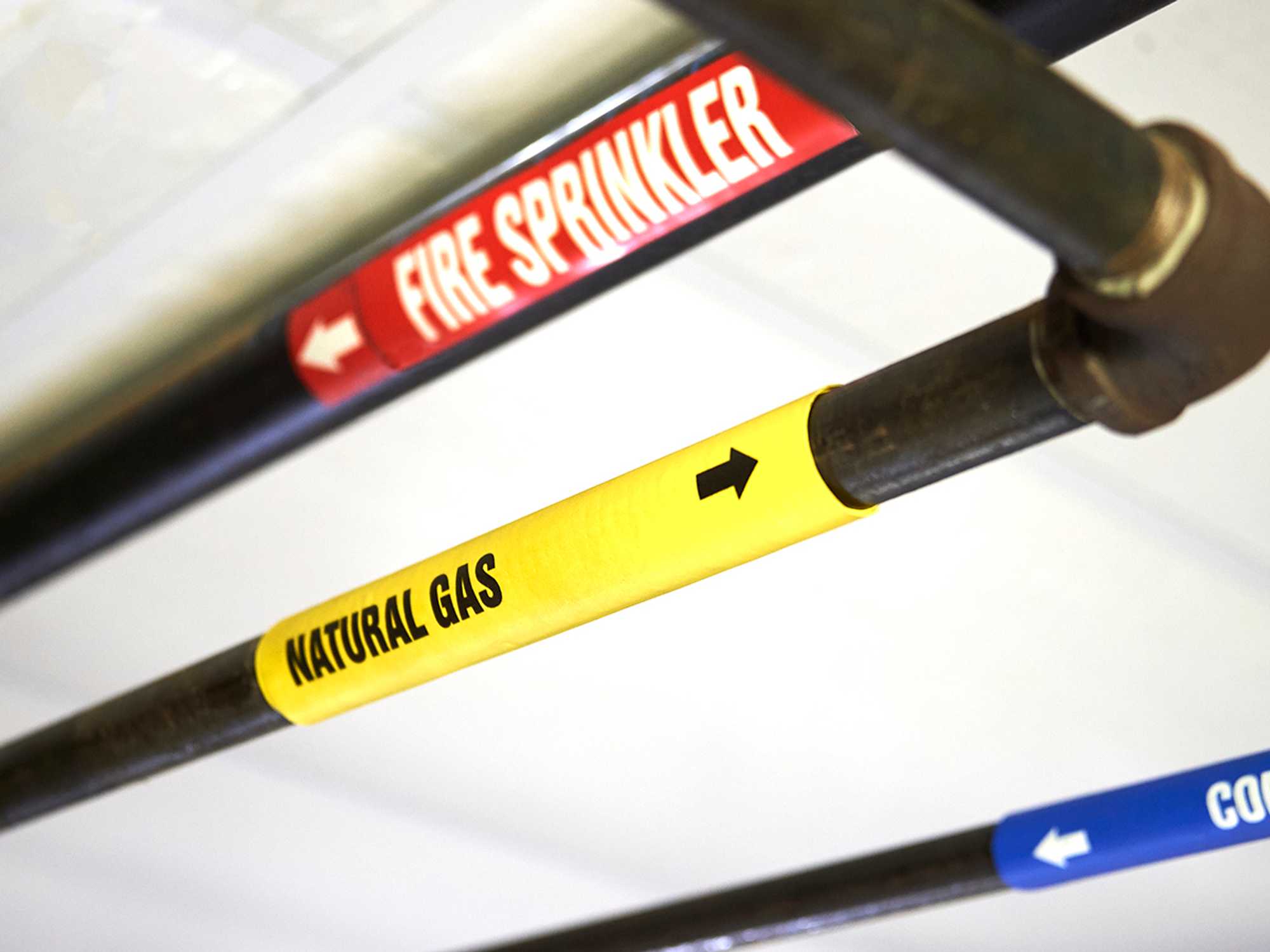
- Requirements and best practices for pipe markings include their necessary elements, format and color schemes, and placement.
- The ASME standard uses color coding to signal what type of material a pipe contains.
Pipe marking elements
Pipe markings offer the following elements:
- The legend or wording is the primary means by which the employee can identify pipe contents.
- The legend may use the full name of the material or an abbreviation.
- Adding Globally Harmonized System (GHS) product identifier, pictogram(s), signal word, and/or hazard statements is optional.
- For abandoned pipes, the legend should mention any pressurized fluid or residual materials remaining in the piping.
- Arrows accompany the legend to indicate the directional flow of the contents.
- Other indicators, such as temperature or pressure, add further hazard information as needed.
Pipe marking format and color schemes
For readability, American Society of Mechanical Engineers (ASME) A13.1-2020 calls for the legend to use a readable font type, such as but not limited to Sans Serif Gothic Bold. Readable letter sizes are specified in the ASME standard based on the pipe diameter. Font sizes smaller than one-half inch are not recommended.
ASME A13.1-2020 uses a color code to designate whether a material is combustible, flammable, oxidizing, toxic, or corrosive or whether it is compressed air, water, a fire quencher, or other material type. The voluntary standard suggests pipes be colored as follows:
| Material type | Color of letters | Color of background |
|---|---|---|
| Compressed air | White | Blue |
| Water (potable, boiler, or cooling) | White | Green |
| Combustible fluid | White | Brown |
| Flammable | Black | Yellow |
| Oxidizing fluid | Black | Yellow |
| Toxic fluid | Black | Orange |
| Corrosive fluid | Black | Orange |
| Fire quencher (CO2, foam, or water) | White | Red |
| Abandoned piping | Black | White with a black border |
| Other materials as determined by facility | White | Purple, gray, or black |
| Other materials as determined by facility | Black | White |
Pipe marking locations
The Occupational Safety and Health Administration (OSHA) has no requirements for the interval at which to apply pipe markers, except where the agency references the older ANSI standard from 1956. However, facility owners and operators may wish to check with state and local authorities for any applicable pipe marking requirements.
Non-mandatory ASME A13.1-2020 recommends that pipe markers be applied at intervals “sufficient for identification.” The standard adds that markings should be placed where pipes bend, divide, or pass through surfaces. Markings are also recommended near flanges/valves.