Compliance Just Got Easier: Stay ahead of regulatory changes with instant notifications on updates that matter.
['Signs and Markings']
['Signs and Markings', 'Safety Color Coding']
04/09/2025

Copyright 2026 J. J. Keller & Associate, Inc. For re-use options please contact copyright@jjkeller.com or call 800-558-5011.
:
|
InstituteSafety & HealthGeneral Industry SafetySafety Color CodingSigns and MarkingsSigns and MarkingsEnglishAnalysisFocus AreaCompliance and Exceptions (Level 2)USA
Permanent floor markings and floor signs
['Signs and Markings']
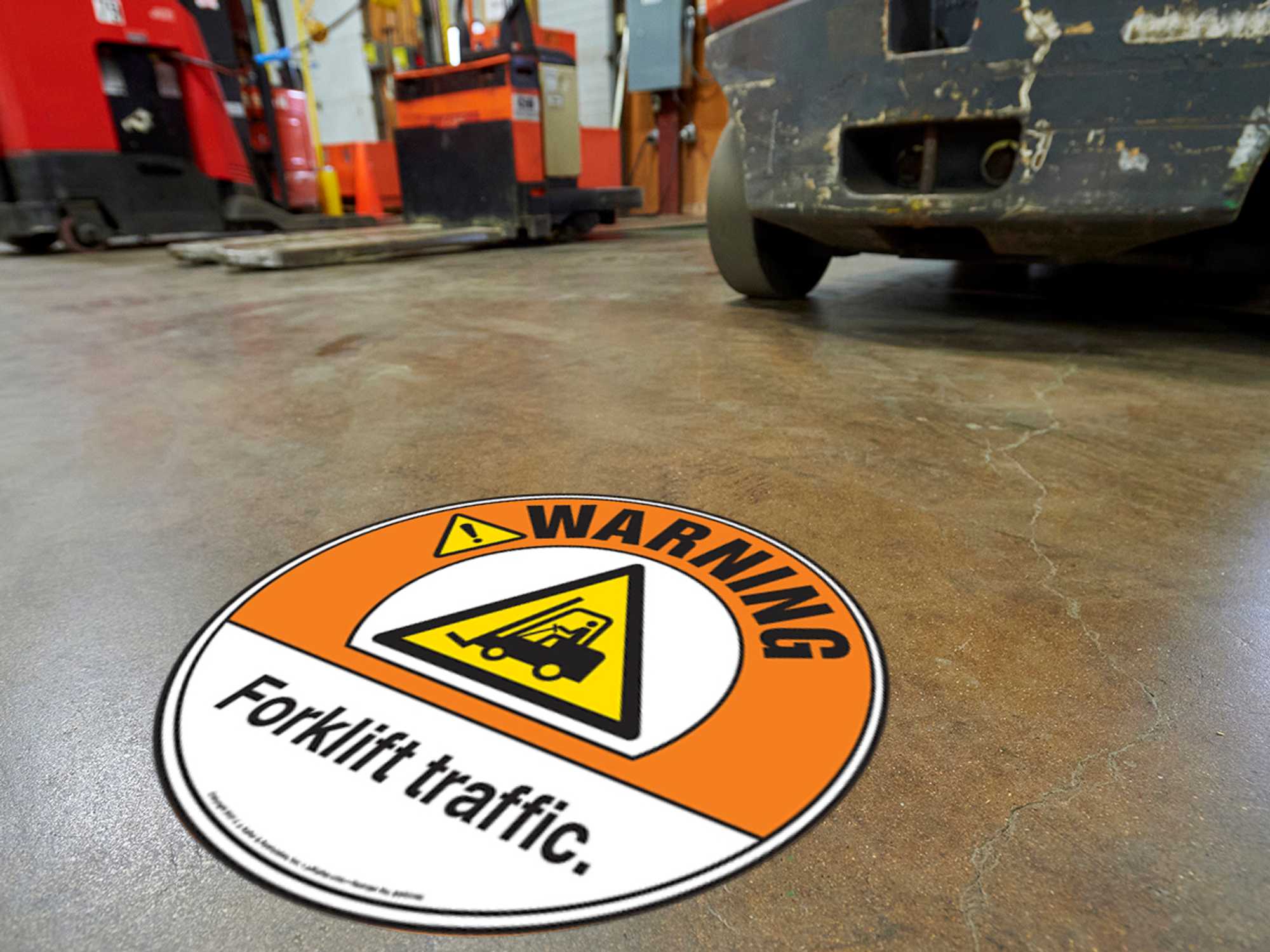
- Floor markings and floor signs are two types of markings that are found directly on the surface of and parallel to the floor.
- Both OSHA and ANSI have standards related to floor markings and floor signs.
Two types of markings may be found directly on the surface of and parallel to the floor:
- Floor markings are slip-resistant paint, tape, or other coating media applied to, adhered to, or integral with the floor. The markings can be a solid color, angled bars of alternating color, a checkerboard of alternating color, a geometric combination of colors, or a photoluminescent application.
- Floor signs are non-required slip-resistant signs or decals that are adhered to or painted on the floor.
Both types of markings have applications in the workplace. However, neither floor markings or floor signs replace signs, training, guarding, or protection required by the Occupational Safety and Health Administration (OSHA).
Purpose
Floor markings or floor signs are often used to indicate an area designated as a/an:
- Egress route;
- Safety zone, such as a pedestrian-only aisle;
- Hazard, such as a change in elevation like a stair, a loading dock edge, or an uneven sidewalk surface;
- Restricted area meant only for authorized employees;
- Clearance area, such as in front of fire extinguishers, eyewash stations, or live electrical parts;
- Location for a particular type of storage, piece of equipment, or work activity, such as an aisle designated for powered industrial truck traffic only; or
- Location where employees or customers are recommended to stand.
Related regulations and standards
OSHA has regulations that relate to floor markings and floor signs, including, but not limited to:
- 29 CFR 1910.28 — Duty to have fall protection and falling object protection.
- 29 CFR 1910.35 — Compliance with alternate exit-route codes.
- 29 CFR 1910.144 — Safety color code for marking physical hazards.
- 29 CFR 1910.151 — Medical services and first aid.
- 29 CFR 1910.157 — Portable fire extinguishers.
- 29 CFR 1910.158 — Standpipe and hose systems.
- 29 CFR 1910.176 — Handling materials—general.
- 29 CFR 1910.303 — General (electrical).
- 29 CFR 1926.200 — Accident prevention signs and tags.
The American National Standards Institute (ANSI) also has standards that relate to floor markings and floor signs:
- ANSI Z535.1-1998, American National Standard Safety Color Code, which offers safety color definitions that give examples of the hazard or message identified by each color.
- ANSI Z535.1-2011, American National Standard for Safety Colors, which does not offer color definitions but does specify the latest safety colors incorporated by reference by OSHA.
- ANSI Z535.1-2017, American National Standard for Safety Colors, which does not offer color definitions but does specify the latest safety colors recommended by ANSI (not OSHA).
- ANSI Z535.1-2022, American National Standard for Safety Colors, which does not offer color definitions but does specify the latest safety colors recommended by ANSI (not OSHA).
- ANSI Z535.2-2011 — American National Standard for Environmental and Facility Safety Signs, which specifies the latest safety sign formats incorporated by reference by OSHA. While floor signs are not required, a facility may wish to follow the ANSI specifications for sign signal word, message, color, and format, when creating a floor sign.
- ANSI Z535.2-2017 — American National Standard for Environmental and Facility Safety Signs, which specifies the latest safety sign formats recommended by ANSI (not OSHA). While floor signs are not required, a facility may wish to follow the ANSI specifications for sign signal word, message, color, and format, when creating a floor sign.
Note: It is important to check state and local fire and building codes to see if any floor marking requirements are specified. For example, many states adopt National Fire Protection Association (NFPA) 101, Life Safety Code. The 2009 and later editions of NFPA 101 call for the marking of the top and bottom stair (on their tread nosing) with safety yellow if the riser is inconsistent with the other risers in the flight by over 3/8 inch.
:
signs-and-markings
signs-and-markings
FOUNDATIONAL LEARNING
Permanent floor markings and floor signs
InstituteSafety & HealthGeneral Industry SafetySafety Color CodingSigns and MarkingsSigns and MarkingsEnglishAnalysisFocus AreaCompliance and Exceptions (Level 2)USA
['Signs and Markings']
- Floor markings and floor signs are two types of markings that are found directly on the surface of and parallel to the floor.
- Both OSHA and ANSI have standards related to floor markings and floor signs.
Two types of markings may be found directly on the surface of and parallel to the floor:
- Floor markings are slip-resistant paint, tape, or other coating media applied to, adhered to, or integral with the floor. The markings can be a solid color, angled bars of alternating color, a checkerboard of alternating color, a geometric combination of colors, or a photoluminescent application.
- Floor signs are non-required slip-resistant signs or decals that are adhered to or painted on the floor.
Both types of markings have applications in the workplace. However, neither floor markings or floor signs replace signs, training, guarding, or protection required by the Occupational Safety and Health Administration (OSHA).
Purpose
Floor markings or floor signs are often used to indicate an area designated as a/an:
- Egress route;
- Safety zone, such as a pedestrian-only aisle;
- Hazard, such as a change in elevation like a stair, a loading dock edge, or an uneven sidewalk surface;
- Restricted area meant only for authorized employees;
- Clearance area, such as in front of fire extinguishers, eyewash stations, or live electrical parts;
- Location for a particular type of storage, piece of equipment, or work activity, such as an aisle designated for powered industrial truck traffic only; or
- Location where employees or customers are recommended to stand.
Related regulations and standards
OSHA has regulations that relate to floor markings and floor signs, including, but not limited to:
- 29 CFR 1910.28 — Duty to have fall protection and falling object protection.
- 29 CFR 1910.35 — Compliance with alternate exit-route codes.
- 29 CFR 1910.144 — Safety color code for marking physical hazards.
- 29 CFR 1910.151 — Medical services and first aid.
- 29 CFR 1910.157 — Portable fire extinguishers.
- 29 CFR 1910.158 — Standpipe and hose systems.
- 29 CFR 1910.176 — Handling materials—general.
- 29 CFR 1910.303 — General (electrical).
- 29 CFR 1926.200 — Accident prevention signs and tags.
The American National Standards Institute (ANSI) also has standards that relate to floor markings and floor signs:
- ANSI Z535.1-1998, American National Standard Safety Color Code, which offers safety color definitions that give examples of the hazard or message identified by each color.
- ANSI Z535.1-2011, American National Standard for Safety Colors, which does not offer color definitions but does specify the latest safety colors incorporated by reference by OSHA.
- ANSI Z535.1-2017, American National Standard for Safety Colors, which does not offer color definitions but does specify the latest safety colors recommended by ANSI (not OSHA).
- ANSI Z535.1-2022, American National Standard for Safety Colors, which does not offer color definitions but does specify the latest safety colors recommended by ANSI (not OSHA).
- ANSI Z535.2-2011 — American National Standard for Environmental and Facility Safety Signs, which specifies the latest safety sign formats incorporated by reference by OSHA. While floor signs are not required, a facility may wish to follow the ANSI specifications for sign signal word, message, color, and format, when creating a floor sign.
- ANSI Z535.2-2017 — American National Standard for Environmental and Facility Safety Signs, which specifies the latest safety sign formats recommended by ANSI (not OSHA). While floor signs are not required, a facility may wish to follow the ANSI specifications for sign signal word, message, color, and format, when creating a floor sign.
Note: It is important to check state and local fire and building codes to see if any floor marking requirements are specified. For example, many states adopt National Fire Protection Association (NFPA) 101, Life Safety Code. The 2009 and later editions of NFPA 101 call for the marking of the top and bottom stair (on their tread nosing) with safety yellow if the riser is inconsistent with the other risers in the flight by over 3/8 inch.
2656866704
2656869217
UPGRADE TO CONTINUE READING
RELATED TOPICS
J. J. Keller is the trusted source for DOT / Transportation, OSHA / Workplace Safety, Human Resources, Construction Safety and Hazmat / Hazardous Materials regulation compliance products and services. J. J. Keller helps you increase safety awareness, reduce risk, follow best practices, improve safety training, and stay current with changing regulations.
Copyright 2026 J. J. Keller & Associate, Inc. For re-use options please contact copyright@jjkeller.com or call 800-558-5011.