Compliance Just Got Easier: Stay ahead of regulatory changes with instant notifications on updates that matter.
['Fall Protection']
['Fall Protection']
04/22/2025

Copyright 2026 J. J. Keller & Associate, Inc. For re-use options please contact copyright@jjkeller.com or call 800-558-5011.
:
|
InstituteSafety & HealthGeneral Industry SafetyFall ProtectionFall ProtectionIn Depth (Level 3)EnglishAnalysisFocus AreaUSA
Understand system-use criteria for personal fall arrest systems
['Fall Protection']
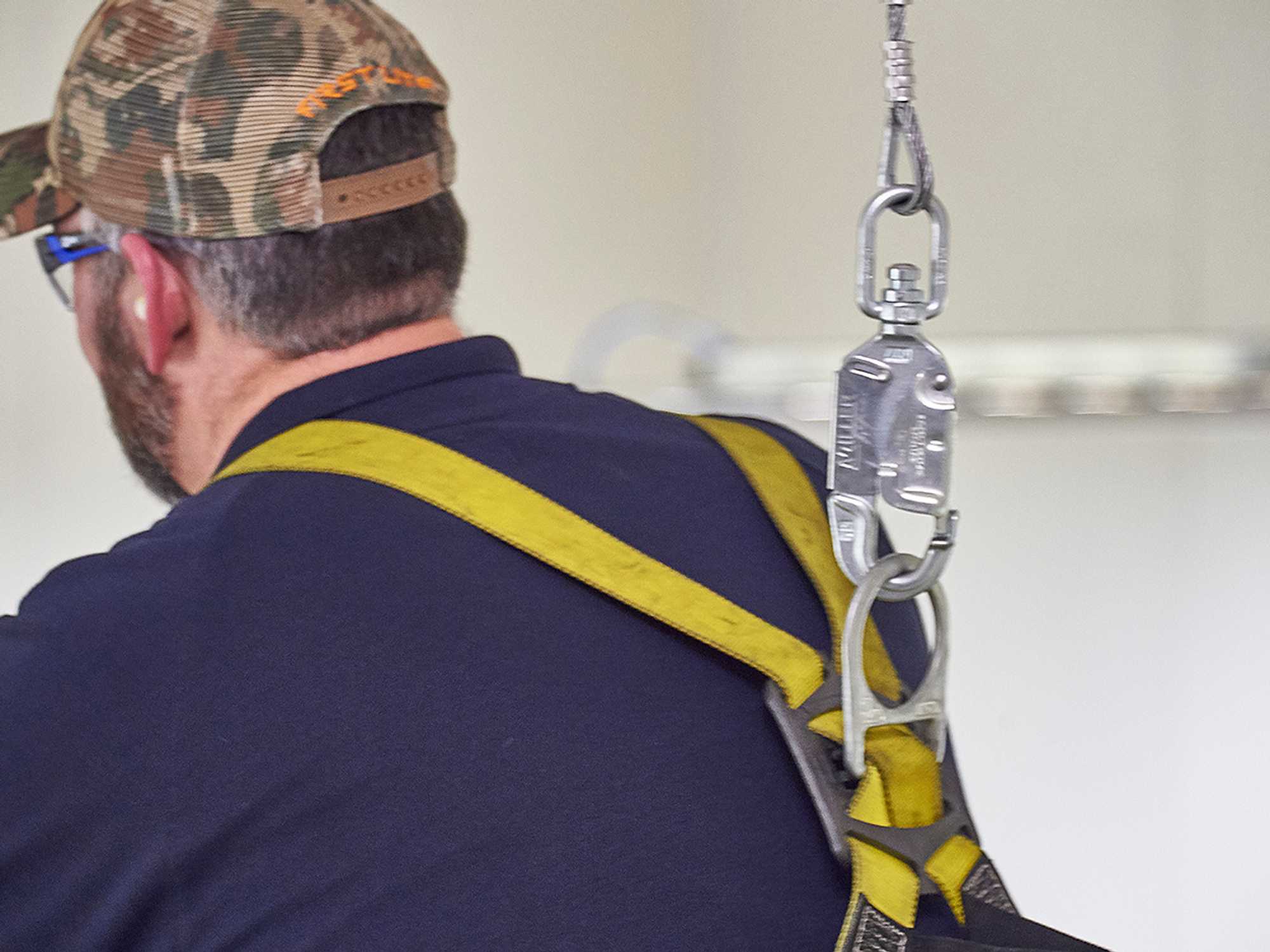
- Personal fall arrest systems are designed to prevent employees from falling from an elevated work surface.
- OSHA sets criteria for the design and installation of personal fall protection systems.
Personal fall arrest systems must meet all the general personal fall protection design requirements and several additional design requirements, including:
- The maximum arresting force on the employee may only be up to 1,800 pounds.
- The system must bring the employee to a complete stop (the six-foot free fall distance) and limit the maximum deceleration distance to 3.5 feet. Therefore, the total maximum distance a worker may travel during a fall is 9.5 feet.
- The system must have sufficient strength to withstand twice the potential impact energy of the employee free fall distance of six feet, or the free fall distance allowed by the system.
- The system must be capable of keeping the worker within the system or strap configuration without making contact with the worker’s neck or chin area. This requires the employer to ensure that personal arrest systems properly fit each employee that uses it.
The Occupational Safety and Health Administration (OSHA) has developed system-use criteria for personal fall arrest systems. The criteria include the following:
- The device used to connect to a horizontal lifeline must be capable of locking in both directions. The horizontal lifeline may become a vertical lifeline if the support lines on one end fails. If this occurs and the locking device (i.e., grab rope) does not lock in both directions on the now-vertical lifeline, it could fail to hold the worker.
- The system must ensure that an employee cannot free fall more than six feet or make contact with a lower level. An employer may allow a free fall of more than six feet only if they can demonstrate that the manufacturer designed the system to allow a free fall of more than six feet and tested the system to ensure a maximum arresting force of 1,800 pounds is not exceeded.
- Body belts are not allowed as part of a personal fall arrest system.
:
fall-protection
fall-protection
FOUNDATIONAL LEARNING
Understand system-use criteria for personal fall arrest systems
InstituteSafety & HealthGeneral Industry SafetyFall ProtectionFall ProtectionIn Depth (Level 3)EnglishAnalysisFocus AreaUSA
['Fall Protection']
- Personal fall arrest systems are designed to prevent employees from falling from an elevated work surface.
- OSHA sets criteria for the design and installation of personal fall protection systems.
Personal fall arrest systems must meet all the general personal fall protection design requirements and several additional design requirements, including:
- The maximum arresting force on the employee may only be up to 1,800 pounds.
- The system must bring the employee to a complete stop (the six-foot free fall distance) and limit the maximum deceleration distance to 3.5 feet. Therefore, the total maximum distance a worker may travel during a fall is 9.5 feet.
- The system must have sufficient strength to withstand twice the potential impact energy of the employee free fall distance of six feet, or the free fall distance allowed by the system.
- The system must be capable of keeping the worker within the system or strap configuration without making contact with the worker’s neck or chin area. This requires the employer to ensure that personal arrest systems properly fit each employee that uses it.
The Occupational Safety and Health Administration (OSHA) has developed system-use criteria for personal fall arrest systems. The criteria include the following:
- The device used to connect to a horizontal lifeline must be capable of locking in both directions. The horizontal lifeline may become a vertical lifeline if the support lines on one end fails. If this occurs and the locking device (i.e., grab rope) does not lock in both directions on the now-vertical lifeline, it could fail to hold the worker.
- The system must ensure that an employee cannot free fall more than six feet or make contact with a lower level. An employer may allow a free fall of more than six feet only if they can demonstrate that the manufacturer designed the system to allow a free fall of more than six feet and tested the system to ensure a maximum arresting force of 1,800 pounds is not exceeded.
- Body belts are not allowed as part of a personal fall arrest system.
2656872011
2656870565
UPGRADE TO CONTINUE READING
RELATED TOPICS
J. J. Keller is the trusted source for DOT / Transportation, OSHA / Workplace Safety, Human Resources, Construction Safety and Hazmat / Hazardous Materials regulation compliance products and services. J. J. Keller helps you increase safety awareness, reduce risk, follow best practices, improve safety training, and stay current with changing regulations.
Copyright 2026 J. J. Keller & Associate, Inc. For re-use options please contact copyright@jjkeller.com or call 800-558-5011.