Compliance Just Got Easier: Stay ahead of regulatory changes with instant notifications on updates that matter.
['Fall Protection']
['Fall Protection for Construction', 'Fall Protection']
04/22/2025

Copyright 2026 J. J. Keller & Associate, Inc. For re-use options please contact copyright@jjkeller.com or call 800-558-5011.
:
|
InstituteSafety & HealthGeneral Industry SafetyFall ProtectionFall ProtectionFall Protection for ConstructionEnglishAnalysisFocus AreaCompliance and Exceptions (Level 2)USA
Key definitions for Construction
['Fall Protection']
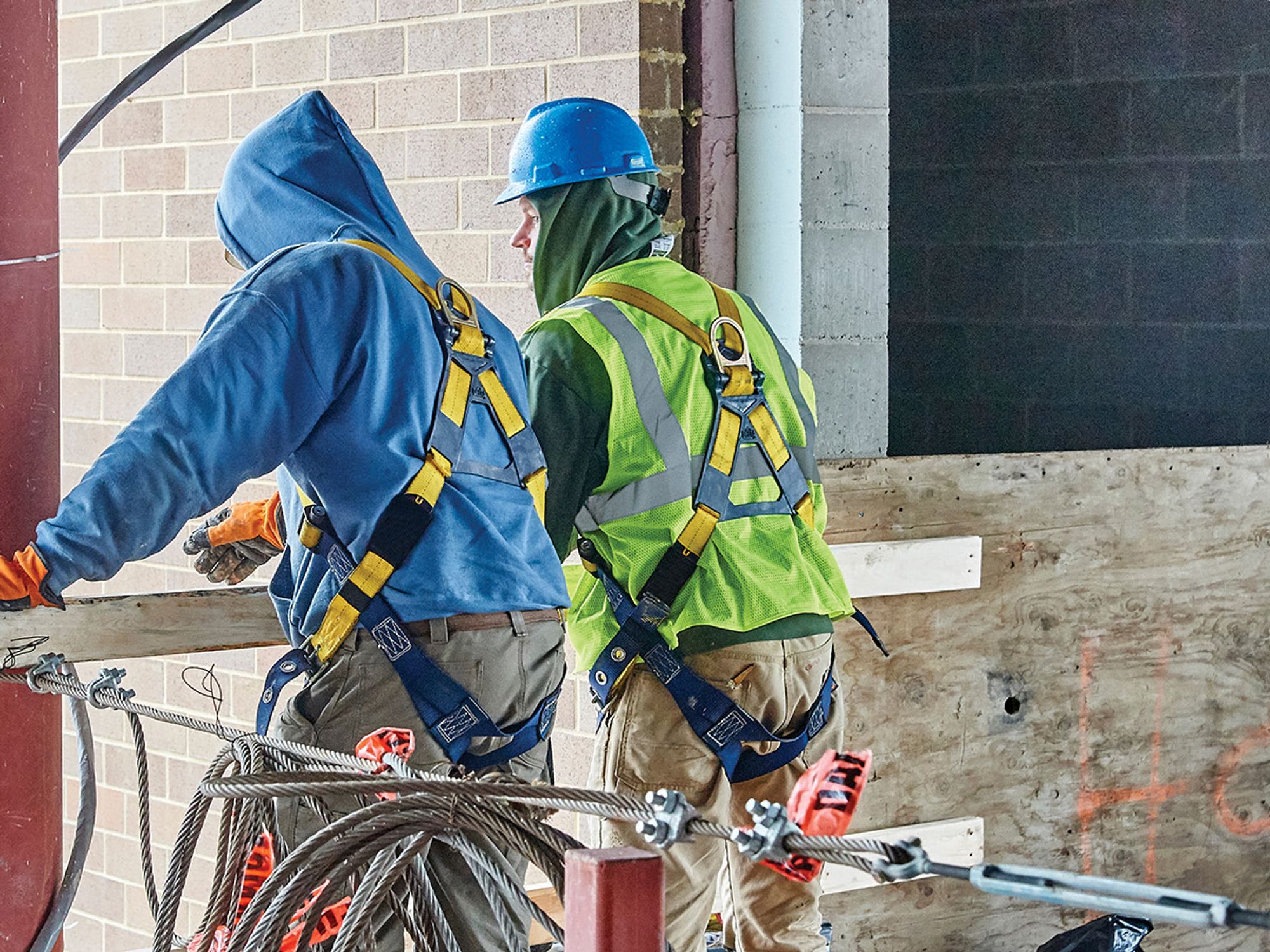
- Key terms for employers in the Construction industry are defined in this section.
Guardrail system: A barrier erected to prevent employees from falling to lower levels.
Lower levels: Areas or surfaces onto which an employee can fall. Such areas or surfaces include, but are not limited to, ground levels, floors, platforms, ramps, runways, excavations, pits, tanks, material, water, equipment, structures, or portions thereof.
Low-slope roof: A roof having a slope less than or equal to 4 to 12 (vertical to horizontal).
Overhand bricklaying and related work: The process of laying bricks and masonry units such that the surface of the wall to be jointed is on the opposite side of the wall from the mason, requiring the mason to lean over the wall to complete the work. Related work includes mason tending and electrical installation incorporated into the brick wall during the overhand bricklaying process.
Personal fall arrest system: A system used to arrest an employee in a fall from a working level. It consists of an anchorage, connectors, a body belt or body harness and may include a lanyard, deceleration device, lifeline, or suitable combinations of these. As of January 1, 1998, the use of a body belt for fall arrest is prohibited.
Steep roof: A roof having a slope greater than 4 to 12 (vertical to horizontal).
Unprotected sides and edges: Any side or edge (except at entrances to points of access) of a walking-working surface, e.g., floor, roof, ramp, or runway where there is no wall or guardrail system at least 39 inches (1.0 m) high.
Walking-working surface: Any surface, horizontal or vertical, on which an employee walks or works, including, but not limited to, floors, roofs, ramps, bridges, runways, formwork and concrete reinforcing steel, but not including ladders, vehicles, or trailers on which employees must be located in order to perform their job duties.
:
fall-protection
fall-protection
FOUNDATIONAL LEARNING
Key definitions for Construction
InstituteSafety & HealthGeneral Industry SafetyFall ProtectionFall ProtectionFall Protection for ConstructionEnglishAnalysisFocus AreaCompliance and Exceptions (Level 2)USA
['Fall Protection']
- Key terms for employers in the Construction industry are defined in this section.
Guardrail system: A barrier erected to prevent employees from falling to lower levels.
Lower levels: Areas or surfaces onto which an employee can fall. Such areas or surfaces include, but are not limited to, ground levels, floors, platforms, ramps, runways, excavations, pits, tanks, material, water, equipment, structures, or portions thereof.
Low-slope roof: A roof having a slope less than or equal to 4 to 12 (vertical to horizontal).
Overhand bricklaying and related work: The process of laying bricks and masonry units such that the surface of the wall to be jointed is on the opposite side of the wall from the mason, requiring the mason to lean over the wall to complete the work. Related work includes mason tending and electrical installation incorporated into the brick wall during the overhand bricklaying process.
Personal fall arrest system: A system used to arrest an employee in a fall from a working level. It consists of an anchorage, connectors, a body belt or body harness and may include a lanyard, deceleration device, lifeline, or suitable combinations of these. As of January 1, 1998, the use of a body belt for fall arrest is prohibited.
Steep roof: A roof having a slope greater than 4 to 12 (vertical to horizontal).
Unprotected sides and edges: Any side or edge (except at entrances to points of access) of a walking-working surface, e.g., floor, roof, ramp, or runway where there is no wall or guardrail system at least 39 inches (1.0 m) high.
Walking-working surface: Any surface, horizontal or vertical, on which an employee walks or works, including, but not limited to, floors, roofs, ramps, bridges, runways, formwork and concrete reinforcing steel, but not including ladders, vehicles, or trailers on which employees must be located in order to perform their job duties.
2656870561
2656871702
UPGRADE TO CONTINUE READING
RELATED TOPICS
J. J. Keller is the trusted source for DOT / Transportation, OSHA / Workplace Safety, Human Resources, Construction Safety and Hazmat / Hazardous Materials regulation compliance products and services. J. J. Keller helps you increase safety awareness, reduce risk, follow best practices, improve safety training, and stay current with changing regulations.
Copyright 2026 J. J. Keller & Associate, Inc. For re-use options please contact copyright@jjkeller.com or call 800-558-5011.