Compliance Just Got Easier: Stay ahead of regulatory changes with instant notifications on updates that matter.
['Injury and Illness Recordkeeping']
['OSHA Recordkeeping']
04/16/2026

Copyright 2026 J. J. Keller & Associate, Inc. For re-use options please contact copyright@jjkeller.com or call 800-558-5011.
Introduction
Under the OSHA Recordkeeping regulation (29 CFR 1904), covered employers are required to prepare and maintain records of certain occupational injuries and illnesses, using the OSHA 300 series of documentation. This information is important for employers, workers, and OSHA in evaluating the safety of a workplace, understanding industry hazards, and implementing worker protections to reduce and eliminate hazards.
The key challenge for employers is to ensure that they are recording injuries that meet OSHA’s criteria for tracking, but not recording those that don’t. Unfortunately, the way the rules are written, it can be tough for employers to distinguish between what should and shouldn’t be recorded—in other words, what is and isn’t a “recordable.”
This chapter is your compliance guide through the regulatory maze of injury and illness recordkeeping. Use it to determine if your company is covered; and if so, how to document and maintain accurate records of employees’ work-related injuries and illnesses. Also, at the end of the chapter, you will find copies of the new forms you are required to use.
Determine if the rule applies to your company
All employers covered by the Occupational Safety and Health Act are covered by the recordkeeping regulations. However, there are two categories of employers that are exempted from routinely recording injuries and illnesses—those with 10 or fewer employees, and business establishments in certain industry classifications.
Employers with 10 or fewer employees
If your company had 10 or fewer employees at all times during the last calendar year, you do not need to keep OSHA’s occupational injury and illness records unless OSHA or the Bureau of Labor Statistics (BLS) informs you in writing that you must keep the records for the upcoming year. This partial exemption for size is based on the number of employees in your entire company, not just at a single location.
You are, however, still required to notify OSHA if certain events, such as a fatality or hospitalization, occur. Note: Reporting/notifying requirements are discussed in detail later in this chapter.
Employers in low hazard industries
If your business is classified in certain low-hazard industries (listed below), you do not need to keep injury and illness records unless the government asks you to do so. In cases where one or more of a company’s establishments are classified in a non-exempt industry, records must be kept for those establishments (unless they are exempted for size).
The partial industry classification exemption applies to individual business establishments. If your company has several establishments engaged in different classes of business activities, you may need to keep records on some of them, while others are exempt.
Even though a low hazard business is exempted, it still is required to report any workplace incident that results in a fatality or the hospitalization of three or more employees.
NOTE: Businesses classified in agriculture; mining; construction; manufacturing; transportation; communication, electric, gas and sanitary services; or wholesale trade do not qualify for this exemption.
Establishments in the following Standard Industrial Classification (SIC) and North American Industry Classification (NAICS) codes are not required to keep OSHA injury and illness records unless they are asked to do so by OSHA or the Bureau of Labor Statistics.
| NAICS Code and Industry Description | |||||||
| 4412 | Other Motor Vehicle Dealers | 5151 | Radio and Television Broadcasting | 5412 | Accounting, Tax Preparation, Bookkeeping, and Payroll Services | 6213 | Offices of Other Health Practitioners |
| 4431 | Electronics and Appliance Stores | 5172 | Wireless Telecommunications Carriers (except Satellite) | 5413 | Architectural, Engineering, and Related Services | 6214 | Outpatient Care Centers |
| 4461 | Health and Personal Care Stores | 5173 | Telecommunications Resellers | 5414 | Specialized Design Services | 6215 | Medical and Diagnostic Laboratories |
| 4471 | Gasoline Stations | 5179 | Other Telecommunications | 5415 | Computer Systems Design and Related Services | 6244 | Child Day Care Services |
| 4481 | Clothing Stores | 5181 | Internet Service Providers and Web Search Portals | 5416 | Management, Scientific, and Technical Consulting Services | 7114 | Agents and Managers for Artists, Athletes, Entertainers, and Other Public Figures |
| 4482 | Shoe Stores | 5182 | Data Processing, Hosting, and Related Services | 5417 | Scientific Research and Development Services | 7115 | Independent Artists, Writers, and Performers |
| 4483 | Jewelry, Luggage, and Leather Goods Stores | 5191 | Other Information Services | 5418 | Advertising and Related Services | 7213 | Rooming and Boarding Houses |
| 4511 | Sporting Goods, Hobby, and Musical Instrument Stores | 5211 | Monetary Authorities - Central Bank | 5511 | Management of Companies and Enterprises | 7221 | Full-Service Restaurants |
| 4512 | Book, Periodical, and Music Stores | 5221 | Depository Credit Intermediation | 5611 | Office Administrative Services | 7222 | Limited-Service Eating Places |
| 4531 | Florists | 5222 | Nondepository Credit Intermediation | 5614 | Business Support Services | 7224 | Drinking Places (Alcoholic Beverages) |
| 4532 | Office Supplies, Stationery, and Gift Stores | 5223 | Activities Related to Credit Intermediation | 5615 | Travel Arrangement and Reservation Services | 8112 | Electronic and Precision Equipment Repair and Maintenance |
| 4812 | Nonscheduled Air Transportation | 5231 | Securities and Commodity Contracts Intermediation and Brokerage | 5616 | Investigation and Security Services | 8114 | Personal and Household Goods Repair and Maintenance |
| 4861 | Pipeline Transportation of Crude Oil | 5232 | Securities and Commodity Exchanges | 6111 | Elementary and Secondary Schools | 8121 | Personal Care Services |
| 4862 | Pipeline Transportation of Natural Gas | 5239 | Other Financial Investment Activities | 6112 | Junior Colleges | 8122 | Death Care Services |
| 4869 | Other Pipeline Transportation | 5241 | Insurance Carriers | 6113 | Colleges, Universities, and Professional Schools | 8131 | Religious Organizations |
| 4879 | Scenic and Sightseeing Transportation, Other | 5242 | Agencies, Brokerages, and Other Insurance Related Activities | 6114 | Business Schools and Computer and Management Training | 8132 | Grantmaking and Giving Services |
| 4885 | Freight Transportation Arrangement | 5251 | Insurance and Employee Benefit Funds | 6115 | Technical and Trade Schools | 8133 | Social Advocacy Organizations |
| 5111 | Newspaper, Periodical, Book, and Directory Publishers | 5259 | Other Investment Pools and Funds | 6116 | Other Schools and Instruction | 8134 | Civic and Social Organizations |
| 5112 | Software Publishers | 5312 | Offices of Real Estate Agents and Brokers | 6117 | Educational Support Services | 8139 | Business, Professional, Labor, Political, and Similar Organizations |
| 5121 | Motion Picture and Video Industries | 5331 | Lessors of Nonfinancial Intangible Assets (except Copyrighted Works) | 6211 | Offices of Physicians | ||
| 5122 | Sound Recording Industries | 5411 | Legal Services | 6212 | Offices of Dentists | ||
Decide which employees to record
On your 300 Log, enter the recordable injuries and illnesses of all employees on your payroll, whether they are labor, executive, hourly, salary, part-time, seasonal, or migrant workers. Also enter the recordable injuries and illnesses that occur to employees who are not on your payroll, such as temporary and leased workers, if you supervise them on a day-to-day basis.
If your business is organized as a sole proprietorship or partnership, the owner or partners are not considered employees for recordkeeping purposes. Likewise, self-employed individuals are not covered by the recordkeeping regulation and you do not need to record it if they become ill or are injured while doing work in your establishment.
Temporary and contractor’s employees
When injuries or illnesses occur to employees from a temporary help service, employee leasing service, or personnel supply service, record them on your 300 Log if you supervise them on a day-to-day basis.
If a contractor’s employee is under the daily supervision of the contractor, the contractor is responsible for recording the injury or illness. But, if you supervise the contractor employee’s work on a day-to-day basis, record the injury or illness on your 300 Log.
Each injury or illness must be recorded only once. You and the temporary help service, employee leasing service, personnel supply service, or contractor need to coordinate the recordkeeping to make sure that each injury and illness is recorded only once, either on your 300 Log (if you provide daily supervision) or on the other employer’s 300 Log (if that company provides daily supervision).
Employee training and involvement
OSHA requires that your employees and their representatives be involved in the recordkeeping system in the following ways:
- Inform each employee of how he or she is to report an injury or illness. Set up a way for them to report work-related injuries and illnesses promptly, and explain the reporting method to them.
- Provide limited access to your injury and illness records for your employees, former employees, and their representatives (authorized collective bargaining agent, a person designated in writing by the employee, or the legal representative of a deceased or legally incapacitated employee or former employee) . You can’t charge for these copies the first time they are provided. However, if one of the designated persons asks for additional copies, you may assess a reasonable charge for retrieving and copying the records.
The Occupational Safety and Health Act prohibits you from discriminating against an employee for reporting a work-related fatality, injury, or illness. The Act also protects employees who file a safety and health complaint, ask for access to the injury and illness records, or otherwise exercise their rights under the OSH Act.
Recordkeeping forms
OSHA 300 log of work-related injuries and illnesses
The OSHA 300 Log of Work-Related Injuries and Illnesses is used to document recordable injuries and illnesses, either electronically or on paper. You may use forms that are different from the OSHA 300 Log, provided that the electronic record or paper forms are equivalent to the 300 Log. Record the injury or illness within seven calendar days of receiving information that it occurred.
OSHA 301 injury and illness incident report
The OSHA 301 Injury and Illness Incident Report (or equivalent) must be completed for each recordable injury or illness on the 300 Log. The 301 is designed to accommodate lengthier, detailed information about the incident. Many employers use a workers’ compensation or an insurance form instead of the 301 Incident Report, or supplement a workers’ comp/insurance form by adding any additional information required by OSHA. Record the injury or illness within seven calendar days of receiving information that it occurred.
OSHA 300A summary of work-related injuries and illnesses
The OSHA 300A Summary of Work-Related Injuries and Illnesses is a form required to be used for posting the annual summary of injuries and illnesses. At the end of each calendar year:
- Review your 300 Log to verify that the entries are complete and accurate, and correct any deficiencies identified.
- Create an annual summary by totaling the columns on the 300 Log. If you had no recordable cases, enter zeros for each column total. Using the OSHA 300A (or an equivalent), enter the calendar year covered, the company’s name, establishment name, establishment address, annual average number of employees covered by the 300 Log, and the total hours worked by all employees covered by the Log. If you are using an equivalent form, also include the employee access and employer penalty statements found on the OSHA 300A Summary.
- Certify that the information is accurate. A company executive must certify that he or she has examined the 300 Log and believes that the summary is correct and complete. The company executive may be the owner (only if the company is a sole proprietorship or partnership), an officer in the corporation, the highest ranking official (or immediate supervisor) working at the establishment.
- Post a copy of the annual summary in each establishment in a conspicuous place or places where notices to employees are customarily posted. Post it no later than February 1 of the year following the year covered by the records and keep the Summary in place until April 30. Ensure that it is always available for viewing by employees.
Equivalent forms
You can keep your records on computer equipment only if the computer system can produce paper copies of equivalent forms when access to them is required by OSHA, an employee or former employee, or employee representative. Many employers use a workers’ compensation or insurance form instead of the 301 Incident Report or supplement a workers’ comp/insurance form by adding any additional information required by OSHA. Also, the records may be emailed, if requested. A record is considered “equivalent” when it:
- Has the same information,
- Is as readable and understandable, and
- Is completed using the same instructions as the OSHA form it replaces.
Seven calendar days to record
In most instances, you will know immediately or within a short time that a recordable case has occurred. Sometimes, however, it may be several days before you are informed that an employee’s injury or illness meets recordable criteria. OSHA requires that each recordable injury or illness be recorded on the 300 Log and 301 Incident Report within seven calendar days of receiving information that a recordable injury or illness has occurred.
Location and retrieval of records
You can keep the records for an establishment at your headquarters or other central location if you can transmit information about the injuries and illnesses from the establishment to the central location within seven calendar days of receiving information that a recordable injury or illness occurred. You must also be able to produce and send the records from the central location to the establishment within the required time frames when the records are requested.
- OSHA inspector or other government representative: When an OSHA inspector or other government representative asks for the records you keep under Part 1904, provide them copies within four business hours. If you maintain the records at a location in a different time zone, use the business hours of the establishment at which the records are located when calculating the deadline.
- Employee, former employee, or representative: When an employee, former employee, personal representative, or authorized employee representative asks for copies of your current or stored 300 Log(s) for an establishment the employee or former employee has worked in, you must give the requester a copy of the relevant page(s) by the
end of the next business day.
You cannot remove the names of the employees or any other information from the OSHA 300 Log before you give copies to the requester. However, to protect the privacy of injured and ill employees, do not record the employee’s name on the 300 Log for certain privacy concern cases. - Employee, former employee, or representative: When an employee, former employee, or personal representative asks for a copy of the OSHA 301 Incident Report describing an injury or illness to that employee or former employee, give it to the requester by the end of the next business day.
- Union representative: When an authorized employee representative asks for a copy of the 301 Incident Report for an establishment where the agent represents employees under a collective bargaining agreement, give copies of those forms to the authorized employee representative within seven calendar days. You are only required to provide information from the section titled “About the case.“ Remove all other information from the copy of the 301 Incident Report (or the equivalent substitute form) that you give to the authorized employee representative.
Multiple business establishments
When you have multiple business establishments, keep a separate OSHA 300 Log for each one that is expected to be in operation for a year or longer. Do not, however, keep a separate log for each establishment that will exist for less than a year.
You can keep one 300 Log that covers all of your short-term establishments and include the short-term establishments’ recordable injuries and illnesses on an 300 Log that covers short-term establishments for individual company divisions or geographic regions.
Recording employees at different locations
For recording purposes, those employees who work at several different locations or do not work in a specific location at all, will need to be linked to one of your business locations.
When an employee from one of your locations is injured or becomes ill while visiting or working at another of your locations, record the injury or illness on the 300 Log of the location at which the injury or illness occurred. If one of your employees is injured or becomes ill while working away from any of your business locations, record the case on the 300 Log at the location where the employee normally works.
Retaining recordkeeping forms
Retain your OSHA 300 Log, the privacy case list (if one exists), the 300A Summary, and the OSHA 301 Incident Report forms for five years following the end of the calendar year that these records cover.
If, during the five-year storage period, newly discovered recordable injuries or illnesses occur, update the stored 300 Logs to include them. If the description or outcome of a case changes, remove or line out the original entry and enter the new information. You do not have to update the 300A Annual Summary or 301 Incident Report, but you may, if you choose.
Save your copies of the OSHA 200 and 101 forms for five years following the year to which they relate and continue to provide access to the data as though these forms were the OSHA 300 and 301 forms. You are not required to update your old 200 and 101 forms.
Change in business ownership
If your business changes ownership, you are responsible for recording and reporting work-related injuries and illnesses only for that period of the year during which you owned the establishment. When you transfer the injury and illness records to the new owner, he or she must save all records of the establishment kept by the prior owner, but need not update or correct them.
Electronic submission of injury and illness data
OSHA requires that certain employers electronically submit injury and illness data to OSHA. Some of the data will also be posted to the OSHA website.
What must be reported? (effective Jan. 1, 2017)
Certain employers have to electronically submit to OSHA the injury and illness information they are already required to keep under existing OSHA regulations. The requirement applies to the following:
- Establishments with 250 or more employees that are currently required to keep OSHA injury and illness records must electronically submit information from OSHA Forms 300 — Log of Work-Related Injuries and Illnesses, 300A — Summary of Work-Related Injuries and Illnesses, and 301 — Injury and Illness Incident Report. Editor’s note: OSHA is currently only accepting Form 300A; a rulemaking to reflect this change is underway.
- Establishments with 20-249 employees that are classified in certain industries with historically high rates of occupational injuries and illnesses must electronically submit information from OSHA Form 300A. OSHA lists those industries by NAICS (North American Industry Classification System) classification.
What about state-plan OSHA programs?
Some OSHA State-Plan States have not yet adopted OSHA’s e-submission rule. However, in an April 30, 2018, notice OSHA says that covered establishments in these states, which include CA, MD, MN, SC, UT, WA, and WY, must submit their Form 300A summaries using the Federal portal, just like establishments in other states. At least one of those states (WA) has indicated it will not require establishments in the state to comply until the regulation is finalized, despite the OSHA notice. Check with the state for a status update if you have establishments in one of these seven states.
High-risk industries
Establishments with 20 to 249 employees in the following industries must submit injury and illness summary (Form 300A) data to OSHA electronically (beginning in 2017).
| NAICS Code and Industry Description | |||||||
|---|---|---|---|---|---|---|---|
| 11 | Agriculture, forestry, fishing and hunting | 4811 | Scheduled air transportation | 4922 | Local messengers and local delivery | 6232 | Residential mental retardation, mental health and substance abuse facilities |
| 22 | Utilities | 4841 | General freight trucking | 4931 | Warehousing and storage | 6233 | Community care facilities for the elderly |
| 23 | Construction | 4842 | Specialized freight trucking | 5152 | Cable and other subscription programming | 6239 | Other residential care facilities |
| 31-33 | Manufacturing | 4851 | Urban transit systems | 5311 | Lessors of real estate | 6242 | Community food and housing, and emergency and other relief services |
| 42 | Wholesale trade | 4852 | Interurban and rural bus transportation | 5321 | Automotive equipment rental and leasing | 6243 | Vocational rehabilitation services |
| 4413 | Automotive parts, accessories, and tire stores | 4853 | Taxi and limousine service | 5322 | Consumer goods rental | 7111 | Performing arts companies |
| 4421 | Furniture stores | 4854 | School and employee bus transportation | 5323 | General rental centers | 7112 | Spectator sports |
| 4422 | Home furnishing stores | 4855 | Charter bus industry | 5617 | Services to buildings and dwellings | 7121 | Museums, historical sites, and similar institutions |
| 4441 | Building material and supplies dealers | 4859 | Other transit and ground passenger transportation | 5621 | Waste collection | 7131 | Amusement parks and arcades |
| 4442 | Home furnishing stores | 4871 | Scenic and sightseeing transportation, land | 5622 | Waste treatment and disposal | 7132 | Gambling industries |
| 4451 | Grocery stores | 4881 | Support activities for air transportation | 5629 | Remediation and other waste management services | 7211 | Traveler accommodation |
| 4452 | Specialty food stores | 4882 | Support activities for rail transportation | 6219 | Other ambulatory health care services | 7212 | RV (recreational vehicle) parks and recreational camps |
| 4521 | Department stores | 4883 | Support activities for water transportation | 6221 | General medical and surgical hospitals | 7213 | Rooming and boarding houses |
| 4529 | Other general merchandise stores | 4884 | Support activities for road transportation | 6222 | Psychiatric and substance abuse hospitals | 7223 | Special food services |
| 4533 | Used merchandise stores | 4889 | Other support activities for transportation | 6223 | Specialty (except psychiatric and substance abuse) hospitals | 8113 | Commercial and industrial machinery and equipment (except automotive and electronic) repair and maintenance |
| 4542 | Vending machine operators | 4911 | Postal service | 6231 | Nursing care services | 8123 | Dry-cleaning and laundry services |
| 4543 | Direct selling establishments | 4921 | Couriers and express delivery services | ||||
Anti-retaliation protections
One of the goals of this recordkeeping rule is to improve the completeness and accuracy of injury and illness data collected by employers and reported to OSHA. When workers are discouraged from reporting occupational injuries and illnesses, the information gathered and reported is incomplete and inaccurate. The rule includes three provisions that are intended to address this issue:
- An employer's procedure for reporting work-related injuries and illnesses must be reasonable and must not deter or discourage employees from reporting. This rule does not prescribe specific procedures that employers must establish. Rather, employers are free to establish their own procedures. Employers should review their reporting procedures for elements that might deter or discourage a reasonable employee from accurately reporting a workplace injury or illness.
- Employers must inform employees of their right to report work-related injuries and illnesses free from retaliation. Employers can meet this requirement by posting the current version of the OSHA poster or by otherwise informing their employees of their right to report work-related injuries and illnesses free from retaliation.
- An employer may not retaliate against employees for reporting work-related injuries or illnesses.
Drug-testing, incentives
While the rule does not ban appropriate disciplinary, incentive, or drug-testing programs, it allows OSHA to issue citations for retaliatory actions against workers when these programs are used to discourage workers from exercising their right to report workplace injuries and illnesses. Employers should review their reporting procedures, programs, and policies for elements that may result in retaliatory actions against an employee for reporting an injury or illness.
Post-incident drug testing
The rule does not prohibit drug testing of employees, including drug testing pursuant to the Department of Transportation rules or any other federal or state law. It only prohibits employers from using drug testing, or the threat of drug testing, to retaliate against an employee for reporting an injury or illness. Employers may conduct post-incident drug testing pursuant to a state or federal law, including Workers' Compensation Drug Free Workplace policies. Random drug testing and pre-employment drug testing are also not subject to this OSHA provision.
Aside from legally-mandated testing, employers may conduct post-incident drug testing if there is a reasonable possibility that employee drug use could have contributed to the reported injury or illness. However, if employee drug use could not have contributed to the injury or illness, post-incident drug testing would likely only discourage reporting without contributing to the employer's understanding of why the injury occurred. Drug testing under these conditions could constitute prohibited retaliation. For example, if an employee reports a repetitive strain injury or is injured as an innocent bystander and the employer requires post-incident drug testing, then that testing could violate the OSHA rule because it is unlikely that such injuries would be related to drug use by the reporting employee. In contrast, it would be reasonable for an employer to require post-incident drug testing for a worker who reported an injury experienced while operating a crane or a forklift if the employee's conduct contributed to the injury. Employers need not specifically suspect drug use before post-incident testing, but there should be a reasonable possibility that drug use by the reporting employee could have contributed to the reported injury or illness.
When OSHA evaluates the reasonableness of drug testing a particular employee who has reported a work-related injury or illness, it will consider factors including whether the employer had a reasonable basis for concluding that drug use could have contributed to the injury or illness (and therefore the result of the drug test could provide insight into why the injury or illness occurred), whether other employees involved in the incident that caused the injury or illness were also tested or whether the employer only tested the employee who reported the injury or illness, and whether the employer has a heightened interest in determining if drug use could have contributed to the injury or illness due the hazardousness of the work being performed when the injury or illness occurred. For substances other than alcohol, currently available tests are generally unable to establish a relationship between impairment and drug use. Employers should be aware that post-incident drug testing will not necessarily indicate whether drug use played a direct role in the incident. When evaluating the reasonableness of drug testing a particular employee, OSHA will consider whether the drug test is capable of measuring impairment at the time the injury or illness occurred where such a test is available. Therefore, at this time, OSHA may consider this factor for tests that measure alcohol use, but not for tests that measure the use of any other drugs.
Below are examples of drug testing programs and how the new rule may be interpreted to apply:
Scenario 1: Employer required Employee X to take a drug test after Employee X reported work-related carpal tunnel syndrome. Employer had no reasonable basis for suspecting that drug use could have contributed to her condition, and it had no other reasonable basis for requiring her to take a drug test. Rather, Employer routinely subjects all employees who report work-related injuries to a drug test regardless of the circumstances surrounding the injury. The state workers' compensation program applicable to Employer did not address drug testing, and no other state or federal law requires Employer to drug test employees who sustain injuries at work.
Question: Did Employer violate section 1904.35(b)(1)(iv) by subjecting Employee X to a drug test simply because she reported a work-related injury?
Answer: Yes. Section 1904.35(b)(1)(iv) prohibits an employer from taking adverse action against employees simply because they report work-related injuries. Rather, employers must have a legitimate business reason for requiring a drug test, such as a reasonable belief that drug use contributed to the injury. If drug use could not reasonably have contributed to a particular injury and the employer has no other reasonable basis for requiring a drug test, section 1904.35(b)(1)(iv) prohibits the employer from drug testing employees simply because they report injuries unless the drug test is conducted pursuant to a state workers' compensation law or other state or federal law.
Scenario 2: Employee X was injured when he inadvertently drove a forklift into a piece of stationary equipment, and he reported the injury to Employer. Employer required Employee X to take a drug test.
Question: Did Employer violate section 1904.35(b)(1)(iv) for drug testing Employee X?
Answer: No. Because Employee X's conduct—the manner in which he operated the forklift—contributed to his injury, and because drug use can affect conduct, it was objectively reasonable to require Employee X to take a drug test after Employer learned of his injury. Drug testing an employee who engaged in conduct that caused an injury is objectively reasonable because conduct can be affected by drug use.
Scenario 3: Employer drug tests all employees who report work-related injuries to the employer to get a 5% reduction in its workers' compensation premiums under the state's voluntary Drug-Free Workplace program. Employer drug tests Employee X when she reports a work-related injury that could not reasonably have been caused by drug use, such as a bee sting or carpal tunnel syndrome.
Question: Did Employer violate section 1904.35(b)(1)(iv) by drug testing Employee X?
Answer: No. Drug testing conducted pursuant to a state workers' compensation law, whether voluntary or mandatory, is not affected by section 1904.35(b)(1)(iv).
Scenario 4: Employer requires all employees who report lost-time injuries to take a drug test because the employer's private insurance carrier provides discounted rates to employers that implement such a drug-testing policy. The relevant rate discount provisions in the private policy are identical to those in the applicable state workers' compensation law. Employer drug tests Employee X when she reports a lost-time injury that could not reasonably have been caused by drug use, such as a bee sting or carpal tunnel syndrome.
Question: Would OSHA cite Employer for violating section 1904.35(b)(1)(iv) in these circumstances by drug testing Employee X to secure lower private insurance premiums?
Answer: No. To maintain consistency between public and private worker's compensation coverage in the same state, OSHA will not cite employers under section 1904.35(b)(1)(iv) who conduct post-accident drug testing under private party policies that mirror the applicable state workers' compensation law.
Scenario 5: Employer requires all employees who report lost-time injuries to take a drug test regardless of whether drug use could have contributed to the injury because the drug testing requirement is included in the collective bargaining agreement at the workplace. Employer drug tests Employee X (who is covered by the collective bargaining agreement) when she reports a lost-time injury that could not reasonably have been caused by drug use, such as a bee sting or carpal tunnel syndrome. The employer had no reasonable basis for suspecting that drug use could have contributed to her injury and had no other reasonable basis for requiring the test.
Question: Did Employer violate section 1904.35(b)(1)(iv) by drug testing Employee X pursuant to a collective bargaining agreement?
Answer: Yes. Section 1904.35(b)(1)(iv) prohibits an employer from taking adverse action against employees simply because they report work-related injuries absent a reasonable belief that drug use could have contributed to the injury or another reasonable basis for requiring a drug test. Although OSHA does not intend for section 1904.35(b)(1)(iv) to supersede other state or federal programs addressing post-injury drug testing of employees, collective bargaining agreements may not supersede section 1904.35(b)(1)(iv).
Incentive programs
This rule does not prohibit incentive programs. However, employers must not use incentive programs in a way that penalizes workers for reporting work-related injuries or illnesses. If an employee reports an injury or illness, and is subsequently denied a benefit as part of an incentive program, this may constitute retaliatory action against the employee for exercising his or her right to report an injury or illness.
Incentive programs should encourage safe work practices and promote worker participation in safety-related activities. Employers should consider programs that reward:
- Worker participation in safety program activities and evaluations;
- Worker completion of safety and health training;
- Reporting and responding to hazards and close calls/near misses;
- Safety walkthroughs and identification of hazards during safety walkthroughs/inspections;
- Conformance to planned preventive maintenance schedules;
- Compliance with legitimate workplace safety rules.
Below are example scenarios of incentive programs and how the new rule may be interpreted to apply:
Scenario 1: Employer informs its employees that it will hold a substantial cash prize drawing for each work group at the end of each month in which no employee in the work group sustains a lost-time injury. Employee X reports an injury that she sustained while operating a mechanical power press. Employee X did not violate any employer safety rules when she sustained her injury. Employee X's injury requires her to miss work for two days. Employer cancels the cash prize drawing for that month for Employee X's work group because of Employee X's lost-time injury.
Question: Did Employer violate 1904.35(b)(1)(iv) when it cancelled the cash prize drawing for Employee X's work group because of a lost-time injury that was sustained while Employee X was following the employer's work rules?
Answer: Yes. Cancelling a substantial cash prize drawing solely because an employee was injured and reported the injury, without regard to the circumstances surrounding the injury, would likely violate section 1904.35(b)(1)(iv). In this case, the employer retaliated against the employee (by cancelling a substantial cash prize drawing) because the employee engaged in protected activity (reporting her injury to the employer). This type of activity may also discourage reporting because a worker may feel pressure from coworkers not to cancel the drawing, or may be reluctant to report out of loyalty to those coworkers.
Scenario 2: Employer informs its employees that it will hold a substantial cash prize drawing for each work group at the end of each month in which all members of the work group comply with applicable safety rules, such as wearing required fall protection. Employee X sustains a lost-time injury when he falls from a platform while not wearing required fall protection, and he reports the injury to Employer. Employer cancels the cash prize drawing for Employee X's work group that month because Employee X failed to wear required fall protection. Employer actively monitors its workforce for compliance with applicable work rules and cancels the cash prize drawings when it discovers work rule violations regardless of whether the employee who violated the work rule also reported an injury.
Question: Did Employer violate 1904.35(b)(1)(iv) when it cancelled the cash prize drawing for Employee X's work group because Employee X failed to wear required fall protection?
Answer: No. In this case, Employer cancelled the cash prize drawing because Employee X violated a legitimate work rule, not because he reported a work-related injury. OSHA encourages employers to enforce legitimate workplace safety rules by monitoring for compliance with those rules and taking consistent, appropriate corrective action when violations occur whether or not the employee who violated the rule also reported an injury.
Scenario 3: Employer informs its employees that it will hold a substantial cash prize drawing for each work group at the end of each month in which all members of the work group comply with applicable safety rules, such as wearing required fall protection. Employee X sustains a lost-time injury when he falls from a platform while not wearing required fall protection. Employer cancels the cash prize drawing for Employee X's work group that month ostensibly because Employee X failed to wear required fall protection. However, Employer's employees routinely fail to wear required fall protection but the only time Employer cancels the cash prize drawing is when an employee reports an injury.
Question: Did Employer violate 1904.35(b)(1)(iv) when it cancelled the cash prize drawing for Employee X's work group because Employee X failed to wear required fall protection?
Answer: Yes. This is an example of a pretextual disciplinary action, which is prohibited. Although Employer ostensibly took the adverse action because Employee X violated a legitimate work rule, Employer failed to take the same action when other employees violated the same work rule without reporting an injury. Employer treated employees who engaged in the same unsafe conduct differently based on whether they reported an injury to the employer, which indicates that the real reason Employer took the adverse action against Employee X was because of the injury report, not because of the work rule violation.
Scenario 4: Employer holds a party for all employees who complete a safety training course. Employee X failed to attend the training because she was absent from work due to a work-related injury that she reported. Employer excluded Employee X from the training-completion party because she did not complete the training. Employer consistently excluded all employees who failed to complete a training course from the training-completion party regardless of why they failed to complete the training, including those who were on vacation or absent because of a non-work-related injury or illness.
Question: Did Employer violate 1904.35(b)(1)(iv) by excluding Employee X from the party?
Answer: No. In this case Employer excluded Employee X from the party because Employee X did not complete the safety training, not simply because Employee X reported a work-related injury. OSHA encourages employers to celebrate workplace safety achievements such as completing safety training and complying with legitimate workplace safety rules.
Definitions
Days away, restricted, or transferred (DART) rate
This includes cases involving days away from work, restricted work activity, and transfers to another job and is calculated based on (N/EH) x (200,000) where N is the number of cases involving days away and/or job transfer or restriction, EH is the total number of hours worked by all employees during the calendar year, and 200,000 is the base for 100 full-time equivalent employees.
Example: Employees of an establishment (XYZ Company), including temporary and leased workers, worked 645,089 hours at XYZ company. There were 22 injury and illness cases involving days away and/or restricted work activity and/or job transfer from the OSHA 300 Log (total of column H plus column I). The DART rate would be (22/645,089) x (200,000) = 6.8.
Note: The DART rate replaces the Lost Workday Injury and Illness (LWDII) rate.
Establishment
An establishment is a single physical location where business is conducted or where services or industrial operations are performed. For activities where employees do not work at a single physical location, such as construction; transportation; communications, electric, gas and sanitary services; and similar operations, the establishment is represented by main or branch offices, terminals, stations, etc. that either supervise such activities or are the base from which personnel carry out these activities.
Normally, one business location has only one establishment. Under limited conditions, the employer may consider two or more separate businesses that share a single location to be separate establishments. An employer may divide one location into two or more establishments only when:
- Each of the establishments represents a distinctly separate business;
- Each business is engaged in a different economic activity;
- No one industry description in the Standard Industrial Classification Manual (1987) applies to the joint activities of the establishments; and
- Separate reports are routinely prepared for each establishment on the number of employees, their wages and salaries, sales or receipts, and other business information. For example, if an employer operates a construction company at the same location as a lumber yard, the employer may consider each business to be a separate establishment.
An establishment can include more than one physical location, but only under certain conditions. An employer may combine two or more physical locations into a single establishment only when:
- The employer operates the locations as a single business operation under common management;
- The locations are all located in close proximity to each other; and
- The employer keeps one set of business records for the locations, such as records on the number of employees, their wages and salaries, sales or receipts, and other kinds of business information. For example, one manufacturing establishment might include the main plant, a warehouse a few blocks away, and an administrative services building across the street.
For employees who telecommute from home, the employee’s home is not a business establishment and a separate OSHA 300 Log is not required. Employees who telecommute must be linked to one of your establishments.
First aid
In general, first aid treatment can be distinguished from medical treatment because:
- First aid is usually administered after the injury or illness occurs and at the location (workplace) where it occurred.
- First aid usually consists of one-time or short-term treatment.
- First aid treatments are usually simple and require little or no technology.
- First aid can be administered by people with little training (beyond first aid training) and even by the injured or ill person.
- First aid is usually administered to keep the condition from worsening, while the injured or ill person is awaiting medical treatment.
For the recordkeeping standard, first aid treatment means the following:
- Using a non-prescription medication at non-prescription strength (for medications available in both prescription and non-prescription form, a recommendation by a physician or HCP to use a non-prescription medication at prescription strength is considered medical treatment);
- Administering tetanus immunizations (other immunizations, such as hepatitis B vaccine or rabies vaccine, are considered medical treatment);
- Cleaning, flushing, or soaking wounds on the surface of the skin;
- Using wound coverings such as bandages, Band-Aids™, gauze pads, etc.; or using butterfly bandages or Steri-Strips™ (other wound closing devices such as sutures or staples are considered medical treatment);
- Using hot or cold therapy;
- Using any non-rigid means of support, such as elastic bandages, wraps, non-rigid back belts, etc. (devices with rigid stays or other systems designed to immobilize parts of the body are considered medical treatment);
- Using temporary immobilization devices while transporting an accident victim (splints, slings, neck collars, back boards, etc.);
- Drilling of a fingernail or toenail to relieve pressure, or draining fluid from a blister;
- Using eye patches;
- Removing foreign bodies from the eye using only irrigation or a cotton swab;
- Removing splinters or foreign material from areas other than the eye by irrigation, tweezers, cotton swabs or other simple means;
- Using finger guards;
- Using massages (physical therapy or chiropractic treatment are considered medical treatment for recordkeeping purposes); or
- Drinking fluids for relief of heat stress.
Injury or illness
An injury or illness is an abnormal condition or disorder. Injuries include cases such as, but not limited to, a cut, fracture, sprain, or amputation. Illnesses include both acute and chronic illnesses, such as, but not limited to, a skin disease, respiratory disorder, or poisoning. (Note: Injuries and illnesses are recordable only if they are new, work-related cases that meet one or more of the Part 1904 recording criteria.)
Medical treatment
Medical treatment means the management and care of a patient to combat disease or disorder. Under OSHA’s recordkeeping standard, medical treatment does not include:
- Visits to a physician or other licensed healthcare professional solely for observation or counseling;
- The conduct of diagnostic procedures, such as X-rays and blood tests, including the administration of prescription medications used solely for diagnostic purposes (eye drops to dilate pupils); or
- Procedures that constitute the standard’s definition of first aid.
Physician or other licensed healthcare professional
A physician or other licensed healthcare professional is an individual whose legally permitted scope of practice (i.e., license, registration, or certification) allows him or her to independently perform, or be delegated the responsibility to perform, the activities described by this regulation.
Work environment
OSHA defines the work environment as the establishment and other locations where one or more employees are working or are present as a condition of their employment. The work environment includes not only physical locations, but also the equipment or materials used by an employee to perform work.
Determine if the injury or illness is work-related
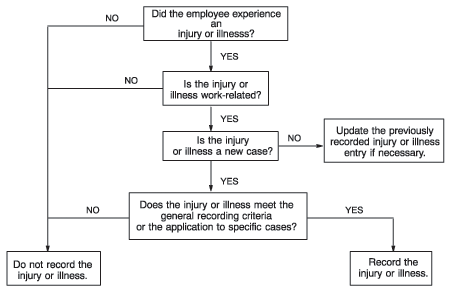
When an employee reports an illness or injury, you will have to decide if it should be recorded on the OSHA 300 Log. The following flow chart shows the steps you should use when making that decision.
Each fatality, injury, or illness is recordable if it:
- Is work-related;
- Is a new case; and
- Meets one or more of the general recording criteria.
What is “significant aggravation”
An injury or illness is work-related if an event or exposure in the workplace (the work environment) either caused or contributed to the resulting condition, or if it significantly aggravated a preexisting injury or illness. When the work-relatedness is not clear, evaluate the employee’s work duties and environment to decide whether or not one or more events or exposures at work either caused or contributed to the resulting condition or significantly aggravated a preexisting condition.
The preexisting injury or illness must be one caused entirely by non-occupational factors. An injury or illness is a “preexisting condition” if it results solely from a non-work-related event or exposure that occurred outside the work environment. Preexisting conditions also include any injury or illness that the employee experienced while working for another employer.
In order to be recordable, work must have clearly worsened the injury or illness. OSHA considers that a preexisting injury or illness has been significantly aggravated when an event or exposure in the workplace results in any of the following:
- Death, provided that the preexisting injury or illness would likely not have resulted in death but for the occupational event or exposure.
- Loss of consciousness, provided that the preexisting injury or illness would likely not have resulted in loss of consciousness but for the occupational event or exposure.
- One or more days away from work, or days of restricted work, or days of job transfer that otherwise would not have occurred but for the occupational event or exposure.
- Medical treatment in a case where no medical treatment was needed for the injury or illness before the workplace event or exposure, or a change in medical treatment was necessitated by the workplace event or exposure.
When employees are working or conducting other tasks in the interest of their employer but at a location away from the employer’s establishment, the work-relatedness of an injury or illness that arises is subject to the same decision making process that would occur if the case had occurred at the establishment itself. This applies when a delivery driver experiences an injury to his or her back while loading boxes and transporting them into a building, or when an employee is injured in a car accident while running errands for the company or traveling to make a speech on behalf of the company.
Exceptions: non-recordable situations
Work-relatedness is presumed for injuries and illnesses resulting from events or exposures occurring in the work environment, except under the following conditions, which are not recordable.
- At the time of the injury or illness, the employee was present in the work environment as a member of the general public rather than as an employee. In these situations, the injury or illness has nothing to do with the employee’s work or status as an employee.
Non-recordable — An employee of a retail store patronizing that store as a customer on a non-work day and was injured in a fall. - The injury or illness involves signs or symptoms that surface at work but result solely from a non-work-related event or exposure that occurs outside the work environment. For this exception to apply, the work environment cannot have caused, contributed to, or significantly aggravated the injury or illness.
Non-recordable — A diabetic incident that occurs while an employee is working. No event or exposure at work contributed in any way to the incident. - The injury or illness results solely from voluntary participation in a wellness program or in a medical, fitness, or recreational activity such as blood donation, physical examination, flu shot, exercise class, racquetball, or baseball. This allows you to exclude cases that are related to personal matters of exercise, recreation, medical examinations, or participation in blood donation programs when they are voluntary and are not being undertaken as a condition of work.
Non-recordable — A worker is injured while performing aerobics in the company gymnasium during his or her lunch hour.
Non-recordable — An employee suffers a severe reaction to a flu shot that was administered as part of a voluntary inoculation program. - The injury or illness is solely the result of an employee eating, drinking, or preparing food or drink for personal consumption, whether bought on your premises or brought in.
Non-recordable — An employee is injured by choking on a sandwich brought from home while in your establishment. Likewise, if the employee contracts food poisoning from a sandwich brought from home or purchased in the company cafeteria and must take time off to recover, the case is not considered work-related.
NOTE: If the employee is made ill by eating food contaminated by workplace contaminants (such as lead), or gets food poisoning from food supplied by your company for a business meeting or company function, the case would be considered work-related. - The injury or illness is solely the result of an employee doing personal tasks unrelated to their employment, at the establishment outside of the employee’s assigned working hours (off-shift time).
Non-recordable — An employee using a meeting room in your company, outside of his or her assigned work hours, to hold a meeting for a civic group and slipped and fell in the hallway. - The injury or illness is solely the result of personal grooming, self medication for a non-work-related condition, or is intentionally self-inflicted, such as attempted suicide.
Non-recordable — A burn injury from a hair dryer used at work to dry the employee’s hair.
Non-recordable — A negative reaction to a medication brought from home to treat a non-work related condition. - The injury or illness is caused by a motor vehicle accident and occurs on a company parking lot or company access road while the employee is commuting to or from work or on a personal errand.
Non-recordable — An employee is injured in a car accident while arriving at work, or while leaving the company’s property at the end of the day, or while driving on his or her lunch hour to run an errand.
NOTE: If an employee is injured in a car accident while leaving the property to purchase supplies for work, the case is considered work-related. Likewise, if an employee is injured by slipping on ice permitted to accumulate in the parking lot, the case is work-related. - The illness is the common cold or flu. These can be excluded, even if contracted while the employee was at work.
NOTE: You must evaluate cases of contagious diseases such as tuberculosis, brucellosis, or hepatitis C to determine if they are work-related. - The illness is a mental illness. Mental illness will not be considered work-related unless the employee voluntarily provides you with an opinion from a physician or other licensed healthcare professional with appropriate training and experience, such as a psychiatrist, psychologist, or psychiatric nurse practitioner, stating that the employee has a mental illness that is work-related.
NOTE: If you do not believe the reported mental illness is work-related, you may refer the case to a physician or other licensed healthcare professional for a second opinion.
Recording injuries/illnesses related to travel and telecommuting
Employees on travel status
Injuries and illnesses that occur while an employee is on travel status are work-related if, at the time of the injury or illness, the employee was engaged in work activities on behalf of your company. Some of these activities include travel to and from customer contacts, conducting job tasks, and entertaining or being entertained to transact, discuss, or promote business.
Work-related entertainment includes only entertainment activities being engaged in at your company’s direction. When an employee joins a private club or organization, perhaps to “network” or make business contacts, an injury that occurs there is not considered work-related.
Injuries or illnesses that occur when the employee is on travel status do not have to be recorded when:
- A traveling employee checks into a hotel, motel, or into another temporary residence for one or more days, he or she establishes a “home away from home.” You must evaluate the employee’s activities after he or she checks into the hotel, motel, or other temporary residence for their work-relatedness in the same manner as you evaluate the activities of a non-traveling employee.
- The employee checks into the temporary residence, he or she is considered to have left the work environment. When the employee begins work each day, he or she re-enters the work environment. If the employee has established a “home away from home” and is reporting to a fixed worksite each day, you also do not consider injuries or illnesses work-related if they occur while the employee is commuting between the temporary residence and the job location.
- An employee takes a side trip for personal reasons. Injuries or illnesses are not considered work-related if they occur while the employee is on a personal detour from a reasonably direct route of travel.
Employees working at home (telecommuting)
Injuries and illnesses that occur while an employee is working at home, including work in a home office, will be considered work-related if the injury or illness:
- Occurs while the employee is performing work for pay or compensation in the home, and
- Is directly related to the performance of work, rather than to the general home environment or setting.
For example, if an employee drops a box of work documents and injures his or her foot, the case is considered work-related. If an employee’s fingernail is punctured by a needle from a sewing machine used to perform garment work at home, becomes infected and requires medical treatment, the injury is considered work-related.
However, if an employee is injured because he or she trips on the family dog while rushing to answer a work phone call, the case is not considered work-related. If an employee working at home is electrocuted because of faulty home wiring, it is not considered work-related.
Determine if it is a new or continuing case
You may occasionally have difficulty determining whether new signs or symptoms are due to a new workplace event or exposure or whether they are the continuation of an existing work-related injury or illness that has already been recorded. This is an important distinction, because a new injury or illness requires you to make a new entry on the OSHA 300 Log, while the continuation of an old recorded case requires, at most, an updating of the original entry.
Consider an injury or illness to be a “new case” if the employee:
- Has not previously experienced a recorded injury or illness of the same type that affects the same part of the body, or
- Previously experienced a recorded injury or illness of the same type that affected the same part of the body but had recovered completely (all signs and symptoms had disappeared) from the previous injury or illness and an event or exposure in the work environment caused the signs or symptoms to reappear.
Recording chronic illnesses
The key to recording chronic illnesses is determining whether the conditions will progress even in the absence of workplace exposure or whether those conditions are triggered by events in the workplace.
In occupational illnesses where the signs or symptoms may recur or continue in the absence of an exposure in the workplace, the case must be recorded only once. Examples include occupational cancers, asbestosis, tuberculosis, byssinosis, and silicosis. These conditions are chronic — once the disease is contracted, it may never be cured or completely resolved.
However, when an employee experiences the signs or symptoms of an injury or illness that are the result of an event or exposure in the workplace, such as an episode of occupational asthma or contact dermatitis, you must treat the incident as a new case. It is typical, but not always the case, for individuals with these conditions to be symptom-free if exposure does not occur.
To help you determine if the case is new or recurring, you may, but are not required to, seek the advice of a physician or other licensed healthcare professional (HCP). However, if you do, you must follow the physician or HCP’s recommendation about whether the case is a new case or a recurrence. If you receive recommendations from two or more physicians or HCPs, you must decide which recommendation is the best documented, best reasoned, and most authoritative and record the case based on that recommendation.
Recording privacy cases
If you have a privacy concern case, you cannot enter the employee’s name on the 300 Log. Instead, enter “privacy case” in the space normally used for the employee’s name. This will protect the privacy of the injured or ill employee when an authorized person requests access to the Log. Keep a separate, confidential list of the case numbers and employee names for your privacy concern cases so you can update the cases and provide the information to the government if asked to do so. The following privacy concern cases are the only types of occupational injuries and illnesses that fall under this category:
- An injury or illness to an intimate body part or the reproductive system;
- An injury or illness resulting from a sexual assault;
- Mental illnesses;
- HIV infection, hepatitis, or tuberculosis;
- Needlestick injuries and cuts from sharp objects that are contaminated with another person’s blood or other potentially infectious material; and
- Other illnesses, if the employee independently and voluntarily requests that his or her name not be entered on the Log.
Identifiable information
In certain injury or illness cases, coworkers who are allowed to access the Log may be able to deduce the identity of the injured or ill worker and obtain inappropriate knowledge of a privacy-sensitive injury or illness. For instance, knowing the department in which the employee works could inadvertently divulge the person’s identity.
If you have a reasonable basis to believe that information describing the privacy concern case may be personally identifiable even though the employee’s name has been omitted, use discretion in describing the injury or illness on both the OSHA 300 and 301 forms. Enter enough information to identify the cause of the incident and the general severity of the injury or illness, but do not include details of an intimate or private nature. For example, a sexual assault case could be described as “injury from assault,” or an injury to a reproductive organ could be described as “lower abdominal injury.”
If you decide to voluntarily disclose the recordkeeping forms to persons other than government representatives, employees, former employees or authorized representatives, remove or hide the employees’ names and other personally identifying information, except for the following cases. You may disclose the forms with personally identifying information only to:
- An auditor or consultant hired by the employer to evaluate the safety and health program;
- The extent necessary for processing a claim for workers’ compensation or other insurance benefits; or
- A public health authority or law enforcement agency for uses and disclosures for which consent, an authorization, or opportunity to agree or object is not required.
General recording criteria
An injury or illness is recordable when it meets any of the following criteria: Death,
- Days away from work,
- Restricted work or transfer to another job,
- Medical treatment beyond first aid,
- Loss of consciousness, or
- A significant injury or illness diagnosed by a physician or HCP.
Although most cases are recorded because they meet one of these criteria, some cases may meet more than one as the case continues. For example, an injured worker may initially be sent home to recuperate (making the case recordable as a “days away” case) and then subsequently return to work on a restricted “light duty” basis.
Death
Record an injury or illness that results in an employee’s death by entering a check mark on the OSHA 300 Log in the space for cases resulting in death. Additionally, you have to verbally report a work-related fatality to OSHA within eight hours.
Days away from work
When an injury or illness involves one or more days away from work, record the injury or illness on the OSHA 300 Log with a check mark in the space for cases involving days away and an entry of the number of calendar days away from work. If the employee is out for an extended period of time, enter an estimate of the days that the employee will be away, and update the day count when the actual number of days is known.
NOTE: Begin counting days away on the day after the injury occurred or the illness began.
When a physician or HCP recommends that the worker stay at home but the employee comes to work anyway, record these injuries and illnesses on the OSHA 300 Log using the check box for cases with days away from work and enter the number of calendar days away recommended by the physician/HCP. Days away must be recorded whether or not the injured or ill employee follows the physician/HCP’s recommendation.
If the physician/HCP recommends that the employee return to work but he or she stays at home anyway, end the count of days away from work on the date the physician/HCP recommends that the employee return to work.
In cases where you receive recommendations from two or more physicians or HCPs, make a decision as to which recommendation is the most authoritative and record the case based on that recommendation. The employer is the ultimate recordkeeping decision-maker and must resolve the differences in opinion. You may turn to a third HCP for this purpose, or make the recordability decision yourself.
Weekends, holidays, and vacations
Count the number of calendar days the employee was unable to work as a result of the injury or illness, regardless of whether or not the employee was scheduled to work on those day(s). Weekend days, holidays, vacation days, or other days off are included in the total number of days recorded if the employee would not have been able to work on those days because of a work-related injury or illness.
If an employee is injured or becomes ill on a Friday and reports to work on a Monday, and was not scheduled to work on the weekend, you do not need to record the case unless you have received information from a physician or HCP indicating that the employee should not have worked, or should have performed only restricted work during the weekend. If so, record the injury or illness as a case with days away from work or restricted work and enter the day counts, as appropriate.
If an employee is injured or becomes ill on the day before scheduled time off such as a holiday, a planned vacation, or a temporary plant closing, the case should be recorded only if you receive information from a physician or HCP indicating that the employee should not have worked, or should have performed only restricted work, during the scheduled time off. If that is the case, record the injury or illness as a case with days away from work or restricted work, and enter the day counts, as appropriate.
Capping the count
You are not required to keep track of the number of calendar days away from work if the injury or illness resulted in more than 180 calendar days away from work and/or days of job transfer or restriction. In such a case, “cap” the total days away by entering 180 (or 180+) in the total days away column of the OSHA 300 Log.
Retiring or leaving the company
If an employee leaves your company for some reason unrelated to the injury or illness, such as retirement, a plant closing, or to take another job, you can stop counting days away from work or days of restriction/job transfer.
However, when an employee leaves your company because of the injury or illness, estimate the total number of days away or days of restriction/job transfer the employee would have experienced if he or she had remained on your payroll and enter the day count on the OSHA 300 Log.
Cases carried into the next year
If a case occurs in one year but results in days away during the next calendar year, record the injury or illness only once. Enter the number of calendar days away for the injury or illness on the OSHA 300 Log for the year in which the injury or illness occurred. If the employee is still away from work because of the injury or illness when you prepare the annual summary, estimate the total number of calendar days you expect the employee to be away from work, use this number to calculate the total for the annual summary, and then update the initial log entry later when the day count is known or reaches the 180-day cap.
Restricted work or job transfer
According to the Bureau of Labor Statistics, the incidence of restricted work cases grew nearly 70 percent between 1994 through 2000, largely in an effort to encourage injured or ill employees to return to work as soon as possible.
The return-to-work programs increasingly being relied on by employers (often at the recommendation of their workers’ compensation insurers) are designed to:
- Prevent aggravating the injury or illness,
- Allow recuperation,
- Rehabilitate employees more effectively,
- Reintegrate them back into the workplace more rapidly,
- Limit workers’ compensation costs, and
- Retain productive workers.
Additionally, many employees want restricted work when it is available, and would rather return to work on a restricted basis over recuperating at home.
Decide if the injury or illness is considered “restricted work”
Restricted work occurs when, as the result of a work-related injury or illness:
- You keep the employee from performing one or more of the routine functions of his or her job (work activities regularly performed at least once per week), or from working the full workday that he or she would otherwise have been scheduled to work; or
- A physician or HCP recommends that the employee not perform one or more of the routine functions of his or her job, or not work the full workday that he or she would otherwise have been scheduled to work.
When an employee’s injury or illness involves restricted work or job transfer but does not involve days away from work, record it on the OSHA 300 Log by checking the space for job transfer or restriction and enter the number of restricted or transferred days in the “restricted workdays” column. However, you do not have to record restricted work or job transfers if the restriction or transfer occurs only for the day on which the injury occurred or the illness began.
Recording restricted work cases
When a physician or HCP recommends restricted work, record it only if it affects one or more of the employee’s routine job functions. To determine whether this is the case, evaluate the restriction in light of the routine functions of the injured or ill employee’s job. If the restriction from you or the physician/HCP keeps the employee from performing one or more of his or her routine job functions, or from working the full workday the employee would otherwise have worked, the employee’s work has been restricted and you must record the case.
If an employee works only for a partial work shift because of a work-related injury or illness, record it as a day of job transfer or restriction, except for the day on which the injury occurred or the illness began.
If a physician/HCP recommends vague restrictions, such as that the employee engage only in “light duty” or “take it easy for a week,” you should ask that person whether the employee can do all of his or her routine job functions and work all of his or her normally assigned work shift. If the answer to both of these questions is yes, then the case does not involve a work restriction and does not have to be recorded as such. However, if the answer to one or both of these questions is no, the case involves restricted work and must be recorded as a restricted work case. In cases where you are unable to get clarification from the physician/ HCP who recommended the restriction, record the injury or illness as a case involving restricted work.
When a physician/HCP recommends a job restriction meeting OSHA’s definition, but the employee does all of his or her routine job functions anyway, you still must record the injury or illness on the OSHA 300 Log as a restricted work case. If job restrictions are recommended, ensure that the employee complies with that restriction. If you receive recommendations from two or more physicians/HCPs, decide which recommendation is the most authoritative, and record the case based on that recommendation.
Recording job transfers
If you assign an injured or ill employee to a job other than his or her regular job for part of the day, the case involves transfer to another job. Both job transfer and restricted work cases are recorded in the same box on the OSHA 300 Log. Do not include the day on which the injury or illness occurred.
For example, if you assign, or a physician/HCP recommends that you assign, an injured or ill worker to his or her routine job duties for part of the day and to another job for the rest of the day, the injury or illness involves a job transfer.
You count days of job transfer or restriction in the same way you count days away from work. The only difference is that, if you permanently assign the injured or ill employee to a job that has been modified or permanently changed in a manner that eliminates the routine functions the employee was restricted from performing, you may stop the day count when the modification or change is made permanent. In these cases, count at least one day of restricted work or job transfer.
Medical treatment beyond first aid
First aid and medical treatment criteria will probably be the criteria you use the most when deciding whether a work-related injury must be recorded. OSHA’s list of first aid treatments is inclusive, that is, you can look at it and without elaborate analysis, determine whether a treatment is first aid and thus not recordable. These treatments are considered first aid whether they are provided by a lay person, a physician, or HCP. Any treatment not on the first aid list is considered medical treatment and recordable, even when it is provided by someone other than a physician or HCP.
If a work-related injury or illness results in medical treatment beyond first aid, record it on the OSHA 300 Log. If the injury or illness does not involve death, one or more days away from work, one or more days of restricted work, or one or more days of job transfer, enter a check mark in the box for cases where the employee received medical treatment but remained at work and was not transferred or restricted.
Loss of consciousness
Every work-related injury or illness case involving a complete loss of consciousness (not merely a sense of disorientation or other diminished level of awareness) is recordable, regardless of the length of time the employee remains unconscious. Fainting episodes involving voluntary activities such as vaccination programs or blood donations are not recordable. However, fainting episodes that result from mandatory medical procedures such as blood tests or physicals required by OSHA standards are considered work-related events and, as such, are recordable if they meet one or more of the recording criteria.
What makes an injury or illness “significant”
Significant diagnosed work-related injuries or illnesses are recordable under the general criteria, even if they do not result in death, days away from work, restricted work or job transfer, medical treatment beyond first aid, or loss of consciousness. However, there are significant injuries, such as a punctured eardrum or a fractured toe or rib, for which neither medical treatment nor work restrictions may be recommended. In addition, there are some significant progressive diseases, such as byssinosis, silicosis, and some types of cancer, for which medical treatment or work restrictions may not be recommended at the time of diagnosis but are likely to be recommended as the disease progresses.
OSHA believes that cancer, chronic irreversible diseases, fractured or cracked bones, and punctured eardrums are generally considered significant injuries and illnesses and must be recorded at the initial diagnosis, even if medical treatment or work restrictions are not recommended or are postponed in a particular case. Record these “significant” cases within seven days of receiving a diagnosis from a physician or HCP.
Recording specific types of cases
Needlestick and sharps injuries
Record all work-related needlestick injuries and cuts from sharp objects that are contaminated with another person’s blood or other potentially infectious material (as defined by OSHA’s Bloodborne Pathogens standard at §1910.1030). Enter the case on the OSHA 300 Log as an injury; however, to protect the employee’s privacy, do not enter the employee’s name on the OSHA 300 Log.
If the injured employee is later diagnosed with an infectious bloodborne disease, update the classification of the case on the OSHA 300 Log if the case results in death, days away from work, restricted work, or job transfer. Also update the description to identify the infectious disease and change the classification of the case from an injury (a needlestick) to an illness (that resulted from the needlestick).
Additionally, record incidents where employees are splashed or exposed to blood or other potentially infectious material without being cut or scratched if it results in the diagnosis of a bloodborne illness, such as HIV, hepatitis B, or hepatitis C; or it meets one or more of the general recording criteria.
Note: You need to record cuts, lacerations, punctures, and scratches only if they are work-related and involve contamination with another person’s blood or other potentially infectious material. If the cut, laceration, or scratch involves a clean object, or a contaminant other than blood or other potentially infectious material, record the case only if it meets one or more of the general recording criteria.
You may use the OSHA 300 and 301 forms to meet the sharps injury log requirement at §1910.1030(h)(5) in the Bloodborne Pathogens standard. To fulfill this requirement, enter the type and brand of the device causing the sharps injury on either form and maintain the records in a way that segregates sharps injuries from other types of work-related injuries and illnesses, or allows sharps injuries to be easily separated.
Medical removal
Some OSHA standards, such as lead, cadmium, methylene chloride, formaldehyde, and benzene, have medical removal requirements. If an employee is medically removed under a standard’s medical surveillance requirements, record the case on the OSHA 300 Log.
Enter a medical removal case as either a case involving days away from work or a case involving restricted work activity, depending on how you decide to comply with the medical removal requirement. If the medical removal is the result of a chemical exposure, enter the case on the 300 Log by checking the “poisoning” column.
NOTE: If the case involves voluntary medical removal before the medical removal levels required by an OSHA standard, you do not need to record the case on the OSHA 300 Log.
Noise-induced hearing loss
Noise-induced hearing loss is a serious and irreversible condition. However, it is not the type of occupational injury that typically requires days away from work for recuperation. Beginning January 1, 2003, record work-related hearing losses of 10 decibel shifts that result in a total 25 decibel shift above audiometric zero.
Recordability based on audiometric zero and a standard threshold shift
A standard threshold shift (STS) is a change in hearing threshold, relative to an employee’s baseline audiogram (hearing test), averaging 10 decibels (dB) or more at 2000, 3000, and 4000 hertz (Hz) in one or both ears. If an employee’s audiogram reveals that a work-related STS has occurred in one or both ears, and the total hearing level is 25 decibels or more above audiometric zero in the same ears as the STS, the case is recordable.
Through December 31, 2003, document the case on the 300 Log by checking either the “injury” or “all other illnesses” column, depending on the nature of the incident that caused the hearing loss.
NOTE: OSHA has revised the 300 Log and 300A Summary to include a check box and corresponding field specifically for occupational hearing loss cases. Beginning January 1, 2004, record these cases by checking the “hearing loss” column on the OSHA 300 Log.
Hearing loss that occurs with aging
You may take into account the hearing loss that occurs as a result of the aging process and retest an employee who has an STS on an audiogram to ensure that the STS is permanent before recording it. Retesting allows you to exclude false positive results and temporary threshold shifts from the data. If you retest the employee’s hearing within 30 days of the first test, and the retest does not confirm the STS, you are not required to record the hearing loss case on the OSHA 300 Log. However, if the retest confirms the STS, record the hearing loss illness within seven calendar days of the retest.
When comparing audiogram results, adjust the results for the employee’s age when the audiogram was taken using Tables F-1 or F-2, as appropriate, in Appendix F of the Occupational Noise Exposure standard at §1910.95.
Hearing loss is presumed to be work-related if the employee is exposed to noise in the workplace at an 8-hour time-weighted average of 85 dBA or greater, or to a total noise dose of 50 percent, as defined in OSHA’s Occupational Noise Exposure standard. Noise dose is defined as the amount of actual employee exposure to noise relative to the permissible exposure limit for noise. A dose greater than 100 percent represents exposure above the limit. For hearing loss cases where the employee is not exposed to this level of noise, refer to the rules in §1904.5 to determine if the hearing loss is work-related.
If a physician or HCP determines that the hearing loss is not work-related or has not been significantly aggravated by occupational noise exposure, you are not required to consider the case work-related or to record the case on the 300 Log. Examples include hearing loss occurring before the employee was hired or those unrelated to workplace noise, such as off the job traumatic injury to the ear or infections.
Tuberculosis (TB)
There are two general stages of TB — tuberculosis infection and active tuberculosis disease. Individuals with tuberculosis infection and no active disease are not infectious. Tuberculosis infections are asymptomatic and are only detected by a positive response to a tuberculin skin test.
If any of your employees has been occupationally exposed to anyone with a known case of active TB, and that employee subsequently develops a tuberculosis infection as evidenced by a positive skin test or diagnosis by a physician or HCP, record the case on the 300 Log by checking the “respiratory condition” column.
You do not have to record a positive TB skin test result obtained at a pre-employment physical because the employee was not occupationally exposed to a known case of active tuberculosis in your workplace. Line-out or erase the case from the Log if:
- The worker is living in a household with a person who has been diagnosed with active TB;
- The Public Health Department has identified the worker as a contact of an individual with a case of active TB unrelated to the workplace; or
- A medical investigation shows that the employee’s infection was caused by exposure to TB away from work, or proves that the case was not related to the workplace TB exposure.
Soft tissue injuries (MSDs)
Work-related injuries and illnesses involving the muscles, nerves, tendons, ligaments, joints, cartilage and spinal discs (often referred to as musculoskeletal disorders or MSDs) are recordable under the same requirements applicable to any other type of injury or illness. Soft-tissue injury cases are recordable only if they are work-related, are new cases, and involve medical treatment, days away, job transfer, or restricted work. Record soft tissue injuries by checking either the “injury” or the “all other illness” column.
Requesting a variance
If you wish to keep records in a different manner from that prescribed by the Part 1904 regulations, submit a variance petition to OSHA in Washington D.C. You may obtain a variance only if you can show that your alternative recordkeeping system:
- Collects the same information as Part 1904 requires;
- Meets the purposes of the OSH Act; and
- Does not interfere with the administration of the Act.
Include the following items in your variance petition:
- Name and address;
- A list of the state(s) where the variance would be used;
- The address(es) of the business establishment(s) involved;
- A description of why you are seeking a variance;
- A description of the different recordkeeping procedures you propose to use;
- A description of how your proposed procedures will collect the same information as would be collected by Part 1904 and achieve the purpose of the Act; and
- A statement that you have informed your employees of the petition by giving them or their authorized representative a copy of the petition and by posting a statement summarizing the petition in the same way as notices are posted under §1903.2(a).
During the time OSHA is processing your variance request, record injuries and illnesses according to Part 1904. You may not use your own system until it receives final approval. OSHA will take the following steps to process your variance petition:
- Offer your employees and their authorized representatives an opportunity to submit written data, views, and arguments about your variance petition.
- Allow the public to comment on your variance petition by publishing the petition in the Federal Register.If the petition is published, the notice will establish a public comment period and may include a schedule for a public meeting on the petition.
- After reviewing your variance petition and any comments from your employees and the public, OSHA will decide whether or not your proposed recordkeeping procedures will meet the purposes of the OSH Act, will not otherwise interfere with the Act, and will provide the same information as the Part 1904regulations. If your procedures meet these criteria, the Agency may grant the variance subject to such conditions as he or she finds appropriate.
- If the variance is granted, OSHA will publish a notice in the Federal Register to announce the variance. The notice will include the practices the variance allows you to use, any conditions that apply, and the reasons for allowing the variance.
If you have already been cited by OSHA for not following the Part 1904 regulations, your variance petition will not affect the citation and penalty. However, OSHA may elect not to review your variance petition if it includes an element for which you have been cited and the citation is still under review by a court, an Administrative Law Judge (ALJ), or the OSH Review Commission.
Your variance may be revoked if there is a good cause. The procedures revoking a variance will follow the same process as OSHA uses for reviewing variance petitions, except in cases of willfulness or where necessary for public safety, you will be:
- Notified in writing of the facts or conduct that may warrant revocation of your variance; and
- Provided (including your employees and authorized employee representatives) with an opportunity to participate in the revocation procedures.
Recordkeeping requirements in state-plan states
Some states operate their own OSHA programs. States operating OSHA-approved state plans must have occupational injury and illness recording and reporting requirements that are substantially identical to the requirements of federal OSHA’s Part 1904. These states must have the same requirements as federal OSHA for determining which injuries and illnesses are recordable and how they are recorded.
However, for other Part 1904 provisions, such as industry exemptions, reporting of fatalities and hospitalizations, record retention, or employee involvement, state-plan state requirements may be more stringent than the federal requirements. These states, however, have to get approval from federal OSHA to make such changes to the recordkeeping requirements.
State and local government employees
Although state and local government employees are not covered by federal OSHA, all state-plan states must provide coverage and develop injury and illness statistics for these workers. State plan recording and reporting requirements for state and local government entities may differ from those for the private sector, but must meet the general requirements as federal OSHA for determining which injuries and illnesses are recordable and how they are recorded.
A state-plan state cannot issue a variance to a private sector employer and must recognize all variances issued by federal OSHA. It can, however, grant a variance to a state or local government employer after obtaining approval from federal OSHA.
Reporting fatalities and multiple hospitalization incidents
OSHA requires that employers notify the Agency if certain events happen.
What must be reported? (effective Jan. 1, 2015)
Employers must report work-related fatalities within 8 hours of finding out about them. Employers only have to report fatalities that occurred within 30 days of a work-related incident.
For any inpatient hospitalization, amputation, or eye loss, employers must report the incident within 24 hours of learning about it. Employers only have to report an inpatient hospitalization, amputation or loss of an eye that occurs within 24 hours of a work-related incident.
How is “hospitalization” defined?
By “hospitalization” OSHA means an inpatient hospitalization,” which are defined as cases where an employee is “formally admitted” for care into a hospital or clinic. Employers do not have to report an inpatient hospitalization if it was for diagnostic testing or observation only, nor does formal admission to an emergency room trigger the reporting requirement—the injured worker must be formally admitted for care to the in-patient service of the hospital to be a reportable event.
To be reportable, the in-patient hospitalization must occur within 24 hours of the work-related incident that injured or made the employee ill. Scheduled surgeries that occur beyond this 24 hour period are not reportable to OSHA.
How is “amputation” defined?
OSHA defines “amputation” as the traumatic loss of a limb or other external body part. Amputations include a part, such as a limb or appendage, that has been severed, cut off, amputated (either completely or partially); fingertip amputations with or without bone loss; medical amputations resulting from irreparable damage; amputations of body parts that have since been reattached. (Amputations do not include avulsions (tissue torn away from the body), enucleations (removal of the eyeball), deglovings (skin torn away from the underlying tissue), scalpings (removal of the scalp), severed ears, or broken or chipped teeth.)
To differentiate between an amputation, which is reportable, and an avulsion, which is not reportable, employers must rely on health care professional's diagnosis if available. If the diagnosis is avulsion, the event does not need to be reported. If the diagnosis is amputation, the event must be reported. If there is no available diagnosis by a health care professional, the employer should rely on the definition and examples of amputation included in the regulatory text of section 1904.39.
Examples of avulsion that do not need to be reported include deglovings, scalpings, fingernail and toenail avulsions, eyelid avulsions, tooth avulsions, and severed ears. Remember, employers are required to report amputations to OSHA when they learn that the reportable event occurred. The employer must report the event when he or she has information that the injury is a work-related amputation.
As a working definition, OSHA says that if the employer believes the injury is extensive enough that the lost flesh will not grow back, and there is no medical diagnosis available, consider the wound an amputation and report the event.
How to make the report?
Employers have three options for reporting the event:
- By telephone to the nearest OSHA Area Office during normal business hours.
- By telephone to the 24-hour OSHA hotline at 1-800-321-OSHA (6742).
- Report online at www.osha.gov/pls/ser/serform.html.
Provide incident information
When you contact OSHA, you will need to provide the following information for each fatality or multiple hospitalization incident:
- Establishment name,
- Location of the incident,
- Time of the incident,
- Type of reportable event (i.e., fatality, in-patient hospitalization, amputation or loss of an eye),
- Number of employees who suffered the event,
- Names of employees who suffered the event,
- Contact person and his or her telephone number, and
- A brief description of the incident.
Motor vehicle accidents
You do not have to report every fatality or multiple hospitalization incident resulting from a motor vehicle accident. If the motor vehicle accident occurs on a public street or highway and does not occur in a construction work zone, you do not have to report the incident to OSHA. However, these injuries must be recorded on your OSHA injury and illness records, if you are required to keep them.
Commercial or public transportation systems
OSHA does not require that you call to report a fatality or multiple hospitalization incident if it involves a commercial airplane, train, subway, or bus accident. Fatalities or multiple hospitalization incidents that occur on a commercial or public transportation system must be recorded on your OSHA injury and illness records, if you are required to keep them.
Heart attacks
If an employee has a heart attack at work and dies, you must report the fatality to OSHA. Your local OSHA area office director will decide whether to investigate the incident, depending on the circumstances of the heart attack.
Citations and penalties
During an inspection, OSHA compliance officers are required to review and record a company’s injury and illness records for the three prior calendar years. They also must obtain any OSHA Data Initiative survey information available on the company.
Regarding the OSHA 300 and 301 forms, where no records are kept and there have been recordable injuries or illnesses, OSHA will issue a citation for failure to keep records. Where required records are kept but no entry is made for a recordable injury or illness, a citation for failure to record the case will be issued. However, if no records are kept and there have been no recordable injuries or illnesses, a citation will not be issued.
When the required records are kept but have not been completed with the necessary details, or the records contain minor inaccuracies, the records will be reviewed. If the lack of detail impairs understandability of the nature of the hazards or injuries and illnesses, an other-than-serious citation will be issued. In cases where the deficiencies do not impair understanding, no citation will be issued.
Bureau of Labor Statistics request for data
Annually, the Bureau of Labor Statistics (BLS) sends injury and illness survey forms to randomly selected employers and uses the information to create the Nation’s occupational injury and illness statistics. In any year, some employers will receive a BLS survey form and others will not. You do not have to send injury and illness data to the BLS unless you receive a survey form.
Even if you are exempt from keeping injury and illness records, the BLS may inform you in writing that it will be collecting injury and illness information from you in the coming year. If you receive such a letter, you must keep the injury and illness records required by OSHA’s recordkeeping rule and make a survey report for the year covered by the survey. All employers who receive a survey form must respond to the survey, even those in state-plan states.
Recordkeeping calculations
Annual average number of employees
The annual average number of employees is calculated by dividing your total paid employees by the number of pay periods.
To find your company’s annual average number of employees, you need to add the number of all full-time, part-time, temporary, seasonal, salaried, and hourly employees at your location throughout the year. You will need a total of all employees on the payroll for each pay period. This figure may vary from pay period to pay period due to seasonal work.
Divide this total number by the number of pay periods at your location during the year. Be sure to include all pay periods, even if you had no employees. This calculation will give you an average number of employees for each of your pay periods.
EXAMPLE
Acme Construction, which pays its employees once every two weeks (26 pay periods/year) figured its average employment this way:
| For pay period: | Acme paid this number of employees: |
| 1 | 10 |
| 2 | 0 |
| 3 | 15 |
| 4 | 30 |
| 5 | 40 |
| (NOTE: Pay periods 6 through 23 are not shown in this example. Include all pay periods in your calculation.) | |
| 24 | 20 |
| 25 | 15 |
| 26 | 10 |
| 830 | |
CALCULATION
- Number of employees paid = 830
- Number of pay periods = 26
- 830 = 31.92
- 26
- 31.92 rounds to 32
- 32 is the annual average number of employees
Total hours worked by all employees
The total number of hours worked by all employees is the number of full-time employees multiplied by the number of work hours for a full-time employee — plus overtime hours and hours worked by temporary, part-time, and seasonal employees. Use the following guidelines for calculating the total hours worked by all employees:
- Include the hours worked by all of your salaried, hourly, part-time and seasonal workers.
- Include hours worked by other workers subject to day-to-day supervision by your company (leased workers and temporary help services workers).
- Do not include vacation, sick leave, holidays, or any other non-work time, even if employees were paid for it.
If your company keeps records of only the hours paid or if you have employees who are not paid by the hour, estimate the hours that the employees actually worked. If this number isn’t available, you can use this optional worksheet to estimate it.
CALCULATION
- Find the number of full-time employees in your establishment for the year.
- Multiply by the number of work hours for a full-time employee in a year. This is the number of full-time hours worked.
- Add the number of any overtime hours as well as the hours worked by other employees (part-time, temporary, or seasonal)
- Round the answer to the next highest whole number. Write the rounded number in the blank marked “Total hours worked by all employees last year.”
Incident rate calculator
What is an incidence rate?
An incidence rate is the number of recordable injuries and illnesses occurring among a given number of full-time workers (usually 100 fulltime workers) over a given period of time (usually one year). To evaluate your company’s injury and illness experience over time or to compare your experience with that of your industry as a whole, you need to compute your incidence rate. Because a specific number of workers and a specific period of time are involved, these rates can help you identify problems in your workplace and/or progress you have made in preventing work-related injuries and illnesses.
To calculate your incidence rate for all recordable injuries and illnesses
To find the total number of recordable injuries and illnesses that occurred during the year, count the number of line entries on your OSHA Form 300, or refer to the OSHA Form 300A and sum the entries for columns (G), (H), (I), and (J).
To calculate your incidence rate for injuries and illnesses that involved days away from work
To find the number of injuries and illnesses that involved days away from work, count the number of line entries on your OSHA Form 300 that received a check mark in column (H), or refer to the entry for column (H) on the OSHA Form 300A.
Calculation formula
To calculate an incidence rate, you need to know the number of hours all employees actually worked during the year. Refer to OSHA Form 300A and optional worksheet to calculate this number.
All recordable cases:
Compute the incidence rate for all recordable cases of injuries and illnesses using the following formula:
Total number of injuries and illnesses x 200,000 + Number of hours worked by all employees = Total recordable case rate
(The 200,000 figure in the formula represents the number of hours 100 employees working 40 hours per week, 50 weeks per year would work, and provides the standard base for calculating incidence rates.)
Days away from work, restriction, or transfer (DART):
Compute the incidence rate for recordable cases involving days away from work, days of restricted work activity, or job transfer (DART) using the following formula:
(Number of entries in column H + Number of entries in column I) x 200,000 + Number of hours worked by all employees = DART incidence rate
NOTE: You can use the same formula to calculate incidence rates for other variables such as cases involving restricted work activity (column (I) on Form 300A), cases involving skin disorders (column (M-2) on Form 300A), etc. Just substitute the appropriate total for these cases, from Form 300A, into the formula in place of the total number of injuries and illnesses.
To calculate your severity rate
To calculate the severity rate (SR), use the same formula that you use to calculate the DART rate except that the total number of days away from work, days of restriction, and days of transfer are substituted into the numerator in place of the total number of incidents.
This calculation provides a measure of the severity of the cases and is used in conjunction with the DART rate to determine the magnitude of the case.
Frequently asked questions (FAQs)
General
Can I compare injury and illness rates generated from my OSHA 300 Log, and the new regulation, to injury and illness rates generated from my OSHA 200 Log under the old rule (i.e., compare 2001 data with 2002 data)?
The new recordkeeping rule changes some of the criteria used to determine which injuries and illnesses will be entered into the records and how they will be entered. Therefore, employers should use reasonable caution when comparing data produced under the old 1904 regulation with data produced under the new rule.
Are the recordkeeping requirements the same in all of the States?
The States operating OSHA-approved State Plans must adopt occupational injury and illness recording and reporting requirements that are substantially identical to the requirements in Part 1904 and which should also be in effect on January 1, 2002. For more information, see “States Requirements” §1904.37.
Why are employers required to keep records of work-related injuries and illnesses?
The OSH Act of 1970 requires the Secretary of Labor to produce regulations that require employers to keep records of occupational deaths, injuries, and illnesses. The records are used for several purposes.
Injury and illness statistics are used by OSHA. OSHA collects data through the OSHA Data Initiative (ODI) to help direct its programs and measure its own performance. Inspectors also use the data during inspections to help direct their efforts to the hazards that are hurting workers.
The records are also used by employers and employees to implement safety and health programs at individual workplaces. Analysis of the data is a widely recognized method for discovering workplace safety and health problems and for tracking progress in solving those problems.
The records provide the base data for the BLS Annual Survey of Occupational Injuries and Illnesses, the Nation’s primary source of occupational injury and illness data.
What is the effect of workers’ compensation reports on the OSHA records?
The purpose section of the rule includes a note to make it clear that recording an injury or illness neither affects a person’s entitlement to workers’ compensation nor proves a violation of an OSHA rule. The rules for compensability under workers’ compensation differ from state to state and do not have any effect on whether or not a case needs to be recorded on the OSHA 300 Log. Many cases will be OSHA recordable and compensable under workers’ compensation. However, some cases will be compensable but not OSHA recordable, and some cases will be OSHA recordable but not compensable under workers’ compensation.
Do States with OSHA-approved State plans have the same industry exemptions as Federal OSHA?
States with OSHA-approved plans may require employers to keep records for the State, even though those employers are within an industry exempted by the Federal rule.
Does an employee report of an injury or illness establish the existence of the injury or illness for recordkeeping purposes?
No. In determining whether a case is recordable, the employer must first decide whether an injury or illness, as defined by the rule, has occurred. If the employer is uncertain about whether an injury or illness has occurred, the employer may refer the employee to a physician or other healthcare professional for evaluation and may consider the healthcare professional’s opinion in determining whether an injury or illness exists.
NOTE: If a physician or other licensed healthcare professional diagnoses a significant injury or illness within the meaning of §1904.7(b)(7) and the employer determines that the case is work-related, the case must be recorded.
Work-relatedness
If a maintenance employee is cleaning the parking lot or an access road and is injured as a result, is the case work-related?
Yes, the case is work-related because the employee is injured as a result of conducting company business in the work environment. If the injury meets the general recording criteria of §1904.7 (death, days away, etc.), the case must be recorded.
Are cases of workplace violence considered work-related under the new record-keeping rule?
The recordkeeping rule contains no general exception, for purposes of determining work-relationship, for cases involving acts of violence in the work environment. However, some cases involving violent acts might be included within one of the exceptions listed in §1904.5(b)(2). For example, if an employee arrives at work early to use a company conference room for a civic club meeting and is injured by some violent act, the case would not be work-related under the exception in §1904.5(b)(2)(v).
What activities are considered “personal grooming” for purposes of the exception to the geographic presumption of work-relatedness in §1904.5(b)(2)(vi)?
Personal grooming activities are activities directly related to personal hygiene, such as combing and drying hair, brushing teeth, clipping fingernails and the like. Bathing or showering at the workplace when necessary because of an exposure to a substance at work is not within the personal grooming exception in §1904.5(b)(2)(vi). Thus, if an employee slips and falls while showering at work to remove a contaminant to which he has been exposed at work, and sustains an injury that meets one of the general recording criteria listed in §1904.7(b)(1), the case is recordable.
What are “assigned working hours” for purposes of the exception to the geographic presumption in §1904.5(b)(2)(v)?
“Assigned working hours,” for purposes of §1904.5(b)(2)(v), means those hours the employee is actually expected to work, including overtime.
What are “personal tasks” for purposes of the exception to the geographic presumption in §1904.5(b)(2)(v)?
“Personal tasks” for purposes of §1904.5(b)(2)(v) are tasks that are unrelated to the employee’s job. For example, if an employee uses a company break area to work on his child’s science project, he is engaged in a personal task.
If an employee stays at work after normal work hours to prepare for the next day’s tasks and is injured, is the case work-related? For example, if an employee stays after work to prepare air-sampling pumps and is injured, is the case work-related?
A case is work-related any time an event or exposure in the work environment either causes or contributes to an injury or illness or significantly aggravates a pre-existing injury or illness, unless one of the exceptions in §1904.5(b)(2) applies. The work environment includes the establishment and other locations where one or more employees are working or are present as a condition of their employment. The case in question would be work-related if the employee was injured as a result of an event or exposure at work, regardless of whether the injury occurred after normal work hours.
If an employee voluntarily takes work home and is injured while working at home, is the case recordable?
No. Injuries and illnesses occurring in the home environment are only considered work-related if the employee is being paid or compensated for working at home and the injury or illness is directly related to the performance of the work rather than to the general home environment.
If an employee’s pre-existing medical condition causes an incident which results in a subsequent injury, is the case work-related? For example, if an employee suffers an epileptic seizure, falls, and breaks his arm, is the case covered by the exception in §1904.5(b)(2)(ii)?
Neither the seizures nor the broken arm are recordable. Injuries and illnesses that result solely from non-work-related events or exposures are not recordable under the exception in §1904.5(b)(2)(ii). Epileptic seizures are a symptom of a disease of non-occupational origin, and the fact that they occur at work does not make them work-related. Because epileptic seizures are not work-related, injuries resulting solely from the seizures, such as the broken arm in the case in question, are not recordable.
This question involves the following sequence of events: Employee A drives to work, parks her car in the company parking lot and is walking across the lot when she is struck by a car driven by employee B, who is commuting to work. Both employees are seriously injured in the accident. Is either case work-related?
Neither employee’s injuries are recordable. While the employee parking lot is part of the work environment under §1904.5, injuries occurring there are not work-related if they meet the exception in §1904.5(b)(2)(vii). Section 1904.5(b)(2)(vii) excepts injuries caused by motor vehicle accidents occurring on the company parking lot while the employee is commuting to and from work. In the case in question, both employees’ injuries resulted from a motor vehicle accident in the company parking lot while the employees were commuting. Accordingly, the exception applies.
New cases
How is an employer to determine whether an employee has “recovered completely” from a previous injury or illness such that a later injury or illness of the same type affecting the same part of the body resulting from an event or exposure at work is a “new case” under §1904.6(a)(2)? If an employee’s signs and symptoms disappear for a day and then resurface the next day, should the employer conclude that the later signs and symptoms represent a new case?
An employee has “recovered completely” from a previous injury or illness, for purposes of §1904.6(a)(2), when he or she is fully healed or cured. The employer must use his best judgment based on factors such as the passage of time since the symptoms last occurred and the physical appearance of the affected part of the body. If the signs and symptoms of a previous injury disappear for a day only to reappear the following day, that is strong evidence the injury has not properly healed. The employer may, but is not required to, consult a physician or other licensed healthcare provider (PLHCP). Where the employer does consult a PLHCP to determine whether an employee has recovered completely from a prior injury or illness, it must follow the PLHCP’s recommendation. In the event the employer receives recommendations from two or more PLHCPs, the employer may decide which recommendation is the most authoritative and record the case based on that recommendation.
Recording criteria
The old rule required the recording of all occupational illnesses, regardless of severity. For example, a work-related skin rash was recorded even if it didn’t result in medical treatment. Does the rule still capture these minor illness cases?
No. Under the new rule, injuries and illnesses are recorded using the same criteria. As a result, some minor illness cases are no longer recordable. For example, a case of work-related skin rash is now recorded only if it results in days away from work, restricted work, transfer to another job, or medical treatment beyond first aid.
Does the size or degree of a burn determine recordability?
No, the size or degree of a work-related burn does not determine recordability. If a work-related first, second, or third degree burn results in one or more of the outcomes in §1904.7 (days away, work restrictions, medical treatment, etc.), the case must be recorded.
If an employee dies during surgery made necessary by a work-related injury or illness, is the case recordable? What if the surgery occurs weeks or months after the date of the injury or illness?
If an employee dies as a result of surgery or other complications following a work-related injury or illness, the case is recordable. If the underlying injury or illness was recorded prior to the employee’s death, the employer must update the Log by lining out information on less severe outcomes, e.g., days away from work or restricted work, and checking the column indicating death.
An employee hurts his or her left arm and is told by the doctor not to use the left arm for one week. The employee is able to perform all of his or her routine job functions using only the right arm (though at a slower pace and the employee is never required to use both arms to perform his or her job functions). Would this be considered restricted work?
No. If the employee is able to perform all of his or her routine job functions (activities the employee regularly performs at least once per week), the case does not involve restricted work. Loss of productivity is not considered restricted work.
Are surgical glues used to treat lacerations considered “first aid?”
No, surgical glue is a wound closing device. All wound closing devices except for butterfly and Steri-strips are by definition “medical treatment,” because they are not included on the first aid list.
Item N on the first aid list is “drinking fluids for relief of heat stress.” Does this include administering intravenous (IV) fluids?
No. Intravenous administration of fluids to treat work-related heat stress is medical treatment.
Is the use of a rigid finger guard considered first aid?
Yes, the use of finger guards is always first aid.
For medications such as Ibuprofen that are available in both prescription and non-prescription form, what is considered to be prescription strength? How is an employer to determine whether a non-prescription medication has been recommended at prescription strength for purposes of §1904.7(b)(5)(i)(C)(ii)(A)?
The prescription strength of such medications is determined by the measured quantity of the therapeutic agent to be taken at one time, i.e., a single dose. The single dosages that are considered prescription strength for four common over-the-counter drugs are:
Ibuprofen (such as Advil™) – greater than 467 mg
Diphenhydramine (such as Benadryl™) – greater than 50 mg
Naproxen Sodium (such as Aleve™) – greater than 220 mg
Ketoprofen (such as Orudus KT™) – greater than 25mg
To determine the prescription-strength dosages for other drugs that are available in prescription and non-prescription formulations, the employer should contact OSHA, the United States Food and Drug Administration, their local pharmacist or their physician.
If an employee who sustains a work-related injury requiring days away from work is terminated for drug use based on the results of a post-accident drug test, how is the case recorded? May the employer stop the day count upon termination of the employee for drug use under §1904.7(b)(3)(vii)?
Under §1904.7(b)(3)(vii), the employer may stop counting days away from work if an employee who is away from work because of an injury or illness leaves the company for some reason unrelated to the injury or illness, such as retirement or a plant closing. However, when the employer conducts a drug test based on the occurrence of an accident resulting in an injury at work and subsequently terminates the injured employee, the termination is related to the injury. Therefore, the employer must estimate the number of days that the employee would have been away from work due to the injury and enter that number on the 300 Log.
Once an employer has recorded a case involving days away from work, restricted work or medical treatment and the employee has returned to his regular work or has received the course of recommended medical treatment, is it permissible for the employer to delete the Log entry based on a physician’s recommendation, made during a year-end review of the Log, that the days away from work, work restriction or medical treatment were not necessary?
The employer must make an initial decision about the need for days away from work, a work restriction, or medical treatment based on the information available, including any recommendation by a physician or other licensed healthcare professional. Where the employer receives contemporaneous recommendations from two or more physicians or other licensed healthcare professionals about the need for days away, a work restriction, or medical treatment, the employer may decide which recommendation is the most authoritative and record the case based on that recommendation. Once the days away from work or work restriction have occurred or medical treatment has been given, however, the employer may not delete the Log entry because of a physician’s recommendation, based on a year-end review of the Log, that the days away, restriction or treatment were unnecessary.
Section 1904.7(b)(5)(ii) of the rule defines first aid, in part, as “removing splinters or foreign material from areas other than the eye by irrigation, tweezers, cotton swabs or other simple means.” What are “other simple means” of removing splinters that are considered first aid?
“Other simple means” of removing splinters, for purposes of the first aid definition, means methods that are reasonably comparable to the listed methods. Using needles, pins or small tools to extract splinters would generally be included.
How long must a modification to a job last before it can be considered a permanent modification under §1904.7(b)(4)(xi)?
Section 1904.7(b)(4)(xi) of the rule allows an employer to stop counting days of restricted work or transfer to another job if the restriction or transfer is made permanent. A permanent restriction or transfer is one that is expected to last for the remainder of the employee’s career. Where the restriction or transfer is determined to be permanent at the time it is ordered, the employer must count at least one day of the restriction or transfer on the Log. If the employee whose work is restricted or who is transferred to another job is expected to return to his or her former job duties at a later date, the restriction or transfer is considered temporary rather than permanent.
If an employee loses his arm in a work-related accident and can never return to his job, how is the case recorded? Is the day count capped at 180 days?
If an employee never returns to work following a work-related injury, the employer must check the “days away from work” column, and enter an estimate of the number of days the employee would have required to recuperate from the injury, up to 180 days.
If an employee who routinely works ten hours a day is restricted from working more than eight hours following a work-related injury, is the case recordable?
Generally, the employer must record any case in which an employee’s work is restricted because of a work-related injury. A work restriction, as defined in §1904.7(b)(4)(i)(A), occurs when the employer keeps the employee from performing one or more routine functions of the job, or from working the full workday the employee would otherwise have been scheduled to work. The case in question is recordable if the employee would have worked 10 hours had he or she not been injured.
If an employee is exposed to chlorine or some other substance at work and oxygen is administered as a precautionary measure, is the case recordable?
If oxygen is administered as a purely precautionary measure to an employee who does not exhibit any symptoms of an injury or illness, the case is not recordable. If the employee exposed to a substance exhibits symptoms of an injury or illness, the administration of oxygen makes the case recordable.
Is the employer subject to a citation for violating §1904.7(b)(4)(viii) if an employee fails to follow a recommended work restriction?
Section 1904.7(b)(4)(viii) deals with the recordablility of cases in which a physician or other healthcare professional has recommended a work restriction. The section also states that the employer “should ensure that the employee complies with the [recommended] restriction.” This language is purely advisory and does not impose an enforceable duty upon employers to ensure that employees comply with the recommended restriction.
NOTE: In the absence of conflicting opinions from two or more healthcare professionals, the employer ordinarily must record the case if a healthcare professional recommends a work restriction involving the employee’s routine job functions.
Needlestick and sharps injuries
Can you clarify the relationship between the OSHA recordkeeping requirements and the requirements in the Bloodborne Pathogens standard to maintain a sharps injury log?
The OSHA Bloodborne Pathogens standard states: “The requirement to establish and maintain a sharps injury log shall apply to any employer who is required to maintain a log of occupational injuries and illnesses under 29 CFR 1904.” Therefore, if an employer is exempted from the OSHA record-keeping rule, the employer does not have to maintain a sharps log. For example, dentists’ offices and doctors’ offices are not required to keep a sharps log after January 1, 2002.
Can I use the OSHA 300 Log to meet the Bloodborne Pathogen standard’s requirement for a sharps injury log?
Yes. You may use the 300 Log to meet the requirements of the sharps injury log provided you enter the type and brand of the device causing the sharps injury on the Log and you maintain your records in a way that segregates sharps injuries from other types of work-related injuries and illnesses, or allows sharps injuries to be easily separated.
Forms
How do I determine whether or not a case is an occupational injury or one of the occupational illness categories in Section M of the OSHA 300 Log?
The instructions that accompany the OSHA 300 Log contain examples of occupational injuries and the various types of occupational illnesses listed on the Log. If the case you are dealing with is on one of those lists, then check that injury or illness category. If the case you are dealing with is not listed, then you may check the injury or illness category that you believe best fits the circumstances of the case.
Does the employer decide if an injury or illness is a privacy concern case?
Yes. The employer must decide if a case is a privacy concern case, using §1904.29(b)(7), which lists the six types of injuries and illnesses the employer must consider privacy concern cases. If the case meets any of these criteria, the employer must consider it a privacy concern case. This is a complete list of all injury and illnesses considered privacy concern cases.
Under §1904.29(b)(9), the employer may use some discretion in describing a privacy concern case on the log so the employee cannot be identified. Can the employer also leave off the job title, date, or where the event occurred?
Yes. OSHA believes that this would be an unusual circumstance and that leaving this information off the log will rarely be needed. However, if the employer has reason to believe that the employee’s name can be identified through this information, these fields can be left blank.
May employers attach missing information to their accident investigation or workers’ compensation forms to make them an acceptable substitute form for the OSHA 301 for recordkeeping purposes?
Yes, the employer may use a workers’ compensation form or other form that does not contain all the required information, provided the form is supplemented to contain the missing information and the supplemented form is as readable and understandable as the OSHA 301 form and is completed using the same instructions as the OSHA 301 form.
If an employee reports an injury or illness and receives medical treatment this year, but states that the symptoms first arose at some unspecified date last year, on which year’s log do I record the case?
Ordinarily, the case should be recorded on the Log for the year in which the injury or illness occurred. Where the date of injury or illness cannot be determined, the date the employee reported the symptoms or received treatment must be used. In the case in question, the injury or illness would be recorded on this year’s Log because the employee cannot specify the date when the symptoms occurred.
Covered employees
How is the term “supervised” in §1904.31 defined for the purpose of determining whether the host employer must record the work-related injuries and illnesses of employees obtained from a temporary help service?
The host employer must record the recordable injuries and illnesses of employees not on its payroll if it supervises them on a day-to-day basis. Day-to-day supervision occurs when “in addition to specifying the output, product or result to be accomplished by the person’s work, the employer supervises the details, means, methods and processes by which the work is to be accomplished.”
If a temporary personnel agency sends its employees to work in an establishment that is not required to keep OSHA records, does the agency have to record the recordable injuries and illnesses of these employees?
A temporary personnel agency need not record injuries and illnesses of those employees that are supervised on a day-to-day basis by another employer. The temporary personnel agency must record the recordable injuries and illnesses of those employees it supervises on a day to day basis, even if these employees perform work for an employer who is not covered by the recordkeeping rule.
Annual summary
How do I calculate the “total hours worked” on my annual summary when I have both hourly and temporary workers?
To calculate the total hours worked by all employees, include the hours worked by salaried, hourly, part-time and seasonal workers, as well as hours worked by other workers you supervise (e.g., workers supplied by a temporary help service). Do not include vacation, sick leave, holidays, or any other non-work time even if employees were paid for it. If your establishment keeps records of only the hours paid or if you have employees who are not paid by the hour, you must estimate the hours that the employees actually worked.
Employee involvement
How does an employer inform each employee on how he or she is to report an injury or illness?
Employers are required to let employees know how and when to report work-related injuries and illnesses. This means that the employer must set up a way for the employees to report work-related injuries and illnesses and tell its employees how to use it. The recordkeeping rule does not specify how the employer must accomplish these objectives, so employers have flexibility to set up systems that are appropriate to their workplace. The size of the workforce, employee’s language proficiency and literacy levels, the workplace culture, and other factors will determine what will be effective for any particular workplace.
State recordkeeping regulations
Do I have to follow these rules if my State has an OSHA-approved State-Plan?
If your workplace is located in a State that operates an OSHA-approved State-Plan, you must follow the regulations of the State. However, these States must adopt occupational injury and illness recording and reporting requirements that are substantially identical to the requirements in Part 1904. State-Plan States must have the same requirements as federal OSHA for determining which injuries and illnesses are recordable and how they are recorded.
How may state regulations differ from the federal requirements?
For Part 1904 provisions other than recording and reporting, State requirements may be more stringent than or supplemental to the federal requirements. For example, a State-Plan could require employers to keep records for the State, even though those employers have 10 or fewer employees (1904.1) or are within an industry exempted by the federal rule. A State-Plan could also require employers to keep additional supplementary injury and illness information, require employers to report fatality and multiple hospitalization incidents within a shorter time frame than federal OSHA does (1904.39), require other types of incidents to be reported as they occur, require hearing loss to be recorded at a lower threshold level during CY 2002 (1904.10(c)), or impose other requirements.
Are State and local government employers covered by this rule?
No, but they are covered under the equivalent State rule in States that operate OSHA-approved State-Plans. State rules must cover these workplaces and require the recording and reporting of work-related injuries and illnesses.
How can I find out if my State has an OSHA-approved plan?
The following States have OSHA-approved plans: Alaska, Arizona, California, Hawaii, Indiana, Iowa, Kentucky, Maryland, Michigan, Minnesota, Nevada, New Mexico, North Carolina, Oregon, Puerto Rico, South Carolina, Tennessee, Utah, Vermont, Virginia, Washington, and Wyoming. Connecticut, New Jersey, New York, Illinois, and the Virgin Islands have plans that cover State and local government employees only.
Reporting fatalities and multiple hospitalization incidents to OSHA
How does OSHA define “amputation”?
An amputation is the traumatic loss of a limb or other external body part. Amputations include a part, such as a limb or appendage, that has been severed, cut off, amputated (either completely or partially); fingertip amputations with or without bone loss; medical amputations resulting from irreparable damage; amputations of body parts that have since been reattached. Amputations do not include avulsions (tissue torn away from the body), enucleations (removal of the eyeball), deglovings (skin torn away from the underlying tissue), scalpings (removal of the scalp), severed ears, or broken or chipped teeth.
How do you differentiate between an amputation without bone and avulsions?
If and when there is a health care professional's diagnosis available, the employer should rely on that diagnosis. If the diagnosis is avulsion, the event does not need to be reported. If the diagnosis is amputation, the event must be reported. If there is no available diagnosis by a health care professional, the employer should rely on the definition and examples of amputation included in the regulatory text of section 1904.39. Examples of avulsion that do not need to be reported include deglovings, scalpings, fingernail and toenail avulsions, eyelid avulsions, tooth avulsions, and severed ears. Remember, employers are required to report amputations to OSHA when they learn that the reportable event occurred. The employer must report the event when he or she has information that the injury is a work-related amputation.
What is meant by the “loss of an eye”?
Loss of an eye is the physical removal of the eye. This includes enucleation and evisceration.
If an injured worker is formally admitted to the Emergency Room of a hospital, is this a reportable event?
No, the injured worker must be formally admitted to the in-patient service of the hospital to be a reportable event.
Who should report a fatality or in-patient hospitalization of a temporary worker?
Similar to the requirements in section 1904.31 for recording injuries and illnesses, the employer that provides the day-to-day supervision of the worker must report to OSHA any work-related incident resulting in a fatality, in-patient hospitalization, amputation or loss of an eye.
If my employee spent the night at the hospital, do I have to report an in-patient hospitalization?
OSHA defines in-patient hospitalization as a formal admission to the in-patient service of a hospital or clinic for care or treatment. An overnight stay does not determine whether the case is reportable or not.
What if the fatality, in-patient hospitalization, amputation, or loss of an eye does not occur during or right after the work-related incident?
If a fatality occurs within 30 days of the work-related incident, or if an in-patient hospitalization, amputation, or loss of an eye occurs within 24 hours of the work-related incident, then you must report the event to OSHA. If the fatality occurs after more than 30 days of the work-related incident, or if the in-patient hospitalization, amputation, or loss of an eye occurs after more than 24 hours after the work-related incident, then you do not have to report the event to OSHA. However, you must record the event on your OSHA injury and illness records, if you are required to keep OSHA injury and illness records.
If an employee is admitted to the hospital for Carpal Tunnel surgery, is this reportable?
To be reportable, the in-patient hospitalization must occur within 24 hours of the work-related incident that injured or made the employee ill. Scheduled surgeries that occur beyond this 24 hour period are not reportable to OSHA.
Do I have to report the fatality, in-patient hospitalization, amputation, or loss of an eye if it resulted from a motor vehicle accident on a public street or highway?
If the motor vehicle accident occurred in a construction work zone, then you must report the fatality, in-patient hospitalization, amputation, or loss of an eye to OSHA. If the motor vehicle accident occurred on a public street or highway, but not in a construction work zone, then you do not have to report the fatality, in-patient hospitalization, amputation, or loss of an eye to OSHA. However, you must record the event on your OSHA injury and illness records, if you are required to keep OSHA injury and illness records.
Do I have to report an in-patient hospitalization that involves only observation or diagnostic testing?
No, you do not have to report an in-patient hospitalization that involves only observation or diagnostic testing. You must only report each in-patient hospitalization that involves care or treatment.
When a work-related heart attack occurs in the workplace and the employee dies one or more days later, how should the case be reported to OSHA?
The employer must orally report a work-related fatality by telephone or in person to the OSHA Area Office nearest to the site of the incident. The employer must report the fatality within eight hours of the employee’s death in cases where the death occurs within 30 days of the incident. The employer need not report a death occurring more than 30 days after a work-related incident.
Electronic reporting
Who must submit information electronically to OSHA?
Establishments with 250 or more employees that are subject to OSHA's recordkeeping regulation must electronically submit to OSHA some of the information from the Log of Work-Related Injuries and Illnesses (OSHA Form 300), the Summary of Work-Related Injuries and Illnesses (OSHA Form 300A), and the Injury and Illness Incident Report (OSHA Form 301).
Establishments with 20-249 employees in certain high-risk industries must electronically submit to OSHA some of the information from the Summary of Work-Related Injuries and Illnesses (OSHA Form 300A).
Establishments with fewer than 20 employees at all times during the year do not have to routinely submit information electronically to OSHA. However, they must submit information from the injury and illness records to OSHA if OSHA notifies them to do so for an individual data collection.
Why is OSHA collecting the data and how will it be used?
Electronic submission of establishment-specific injury and illness data will enable OSHA to use its enforcement and compliance assistance resources more efficiently. Analysis of the data will improve OSHA’s ability to identify, target, and remove safety and health hazards, thereby preventing workplace injuries, illnesses, and deaths.
The agency will make the injury and illness data public, and interested parties will be able to search and download the data. OSHA believes that posting timely, establishment-specific injury and illness data will provide valuable information to employers, employees, employee representatives, and researchers.
Does the rule require employers to start keeping new records or change how they keep records?
No. The new requirement does not add to or change an employer’s obligation to complete, retain, and certify injury and illness records. It only requires certain employers to electronically submit some of the information from these records to OSHA.
Does OSHA allow an employer to have an employee incentive program, despite the provisions at 29 CFR 1904.35 and .36?
Part 1904 does not prohibit incentive programs. However, employers must not create incentive programs that deter or discourage an employee from reporting an injury or illness. Incentive programs should encourage safe work practices and promote worker participation in safety-related activities. See OSHA memos dated October 11, 2018, and October 19, 2016, found at www.osha.gov/recordkeeping/modernization-guidance.
Does OSHA allow an employer to have an employee incentive program, despite the provisions at 29 CFR 1904.35 and .36?
Part 1904 does not prohibit incentive programs. However, employers must not create incentive programs that deter or discourage an employee from reporting an injury or illness. Incentive programs should encourage safe work practices and promote worker participation in safety-related activities. See OSHA memos dated October 11, 2018, and October 19, 2016, found at www.osha.gov/recordkeeping/modernization-guidance.
Does the rule allow a warehouse or storage facility to have an employee incentive program?
This rule does not prohibit incentive programs. However, employers must not create incentive programs that deter or discourage an employee from reporting an injury or illness. Incentive programs should encourage safe work practices and promote worker participation in safety-related activities.
May an employer require post-incident drug testing for an employee who reports a workplace injury or illness?
Post-incident drug testing is not prohibited for determining whether drug use contributed to the cause of an incident. However, OSHA prohibits employers from using drug testing or the threat of drug testing to retaliate against employees when they report a work-related injury or illness. Subparagraph 29 CFR 1904.35(b)(1)(iv) says, “You must not discharge or in any manner discriminate against any employee for reporting a work-related injury or illness.”
Most drug testing is still allowed despite this OSHA provision, e.g., random drug testing, drug testing unrelated to work injury/illness reports, and drug testing required under state or federal law. The agency notes that action taken under an employer's post-incident drug testing policy would only violate the requirement if the employer took action to penalize an employee for a work-related injury or illness rather than for the legitimate purpose of promoting workplace safety and health. For example, drug testing is permissible to evaluate the root cause of a workplace incident that harmed or could have harmed employees. If post-incident drug testing is conducted, the employer should test ALL employees whose conduct could have contributed to the incident, not just employees who reported injuries or illnesses.
OSHA also says that the agency would look at the reasonableness of the drug test for each specific incident. Employers may conduct post-incident drug testing if there is a reasonable possibility that employee drug use could have contributed to the reported injury or illness. If there is no way drug use could have played a role in the incident (such as a bee sting, repetitive motion injury, or injury due to lack of a machine guard), drug testing under these conditions could constitute prohibited retaliation.
For more information, see three OSHA memos dated October 11, 2018, November 10, 2016, and October 19, 2016, found at www.osha.gov/recordkeeping/modernization-guidance.
May a warehouse or storage operation require post-incident drug testing for an employee who reports a workplace injury or illness?
The rule does not prohibit drug testing of employees. It only prohibits employers from using drug testing, or the threat of drug testing, as a form of retaliation against employees who report injuries or illnesses. If an employer conducts drug testing to comply with the requirements of a state or federal law or regulation, the employer's motive would not be retaliatory and this rule would not prohibit such testing. OSHA also says that the agency would look at the reasonableness of the test for each specific incident. If it would be reasonable to presume that an employee was impaired based on the facts surrounding the incident, then drug testing would be allowed. However, if an employee is injured as a result of an incident that clearly has no relation to whether or not he/she was impaired (such as a bee sting, repetitive motion injury, or injury due to lack of a machine guard), OSHA would generally not be in favor of drug testing.
Highlights from OSHA’s Letters of Interpretation
Medical treatment: 10/29/2001
Do you always record cases in which a health care professional issues a prescription, whether that prescription is filled or not?
Section 1904.7(b)(5)(ii)(A) defines first aid as: Using a nonprescription medication at nonprescription strength (for medications available in both prescription and non prescription form, a recommendation by a physician or other licensed healthcare professional to use a non prescription medication at prescription strength is considered medical treatment for recordkeeping purposes).
OSHA has not included prescription medications, whether given once or over a longer period of time, in the list of first aid treatments. The Agency believes that the use of prescription medications is not first aid because prescription medications are powerful substances that can only be prescribed by a physician or licensed healthcare professional. The availability of these substances is carefully controlled and limited because they must be prescribed and administered by a highly trained and knowledgeable professional.
OSHA maintains its longstanding policy of requiring the recording of cases in which a healthcare professional issues a prescription, whether that prescription is filled or not. Medical treatment includes treatment that is used, as well as those that should have been used. The patient’s acceptance or refusal of the treatment does not alter the fact that, in the healthcare professional’s judgement, the case warranted a script for the issuance of prescription medicine. For these reasons, the new recordkeeping rule continues OSHA’s longstanding policy of considering the use of prescription medication as medical treatment, regardless of the reason it is prescribed.
No-fault recordkeeping: 02/06/02
Does OSHA’s no-fault recordkeeping system require recording work-related injuries and illnesses, regardless of the level of an employer’s control or non-control?
In the final rule, OSHA notes that many circumstances that lead to a recordable work-related injury or illness are “beyond the employer’s control.” Nevertheless, because such an injury or illness was caused, contributed to, or significantly aggravated by an event or exposure at work, it must be recorded on the OSHA form (assuming that it meets one or more of the recording criteria and does not qualify for an exception to the geographic presumption).
This approach is consistent with the no-fault recordkeeping system OSHA has historically adopted, which includes work-related injuries and illnesses, regardless of the level of employer control or non-control involved. The concept of fault has never been a consideration in any recordkeeping system of the U.S. Department of Labor. Both the Note to Subpart A of the final rule and the new OSHA Form 300 expressly state that recording a case does not indicate fault, negligence, or compensability.
In addition, OSHA recognizes that injury and illness rates do not necessarily indicate a lack of interest in safety and health or success or failure per se. OSHA feels it is to the benefit of all parties to go beyond the numbers and look at an employer’s safety and health program.
First aid or medical treatment: 08/08/2002
Is an injury that results in treatment with Band-Aid Brand Liquid Bandage™ considered first aid or medical treatment?
The concept that underlies the medical treatment vs. first aid distinction made between this type of treatment centers around the basic difference between wound closures and wound coverings.
The recordkeeping rule defines first aid under §1904.7(b)(5)(ii)(D). Using wound coverings, such as bandages, Band-Aids™, gauze pads, etc.; or using butterfly bandages or Steri-strips™ (other wound closing devices, such as sutures, staples, etc. are considered medical treatment). Therefore, the use of wound coverings, like Band-Aid Brand Liquid Bandage™ is deemed to be first aid treatment.
Physician’s recommendation: 03/19/03
An employee who sustained a work-related bruise on his knee was told by a physician not to return to work until undergoing an MRI. The employee was off work for some days before the procedure could be performed. The employer recorded the case based on the days away from work. The MRI showed that no OSHA recordable injury occurred. Should the entry be lined out?
The case was properly recorded based on the physician’s recommendation that the employee not return to work before undergoing an MRI for his bruised knee. Paragraph 1904.7(b)(3) contains the requirements for recording work-related injuries and illnesses that result in days away from work and for counting the total number of days away associated with a given case. In addition, paragraphs 1904.7(b)(3)(ii) and (iii) direct employers how to record days away cases when a physician or other licensed health care professional (HCP) recommends that the injured or ill worker stay at home or that he or she return to work but the employee chooses not to do so.
As these paragraphs make clear, OSHA requires employers to follow the physician’s or HCP’s recommendation when recording a case. For purposes of OSHA recordkeeping, the case met the criteria in 1904.7 at the time of recording because the employee had sustained a work-related injury — a bruised knee — involving one or more days away from work. The subsequent MRI results do not change these facts. Accordingly, the MRI results are not a basis to line out the entry.
Baseline audiogram revisions: 05/08/03
When the baseline audiogram has to be revised due to persistent STS or improved thresholds, must the revisions be made for each ear separately?
The Occupational Noise standard, §1910.95, requires employers to establish and maintain an audiometric testing program for all employees whose exposures equal or exceed an 8-hour time-weighted average (TWA) of 85 decibels on the “A” scale (dBA). Annual audiograms are compared to the baseline audiogram to determine if hearing loss is occurring.
If a standard threshold shift (STS), defined as an average of 10 dBA or more at 2000, 3000, and 4000 Hz, occurs in either ear, the employer must follow certain procedures outlined in the standard, including notifying the affected employee in writing. Hearing loss cases that meet specific criteria must be recorded on the OSHA 300 log according to the recordkeeping requirements of §1904.10.
With regard to your request for a clarification as to how to revise the baseline, OSHA allows employers to revise the baseline by substituting the annual audiogram for the baseline audiogram when the reviewing professional determines that an STS is persistent. Such a revision would serve to prevent the same STS from being identified repeatedly for an employee whose hearing has stabilized. As a corollary, an annual audiogram may be substituted for the baseline audiogram when thresholds have significantly improved.
When the professional evaluating the audiogram determines that a baseline revision is appropriate, whether due to a persistent STS or improved thresholds, the baseline must be revised for each ear separately. For example, although an employee’s annual audiogram shows hearing thresholds deteriorating in both ears simultaneously, occasionally an audiogram will show that an employee is suffering an STS in only one ear. This can sometimes be attributed to working near a loud noise source that is close to the affected ear. If such a shift is shown to be persistent in the judgment of the professional evaluating the audiogram, then the baseline audiogram may be revised due to the persistent STS. A baseline audiogram that shows a persistent shift for only one ear may be revised for only that ear. The baseline may not be revised for the other unaffected ear. This procedure is required because it provides a clear indication of how each ear is affected by noise.
Clarifying the recording criteria for temporary or leased workers: 06/23/03
1. Under §1904.31, employers who supervise temporary or leased employees at their facility are required to maintain the OSHA 300 Logs for those employees. With respect to those injuries, can the employer keep a separate 300 Log for the company employees and one log for the temporary or leased employees?
The log is to be kept for an establishment. Under §1904.46 Definitions, an establishment is a single physical location where business is conducted or where services or industrial operations are performed. The controlling employer (using firm) may subdivide the OSHA 300 Log to provide separate listings of temporary workers, but must consider the separate listings to be one record for all recordkeeping purposes, including access by government representatives, employees, former employees and employee representatives as required by §§1904.35 and 1904.40 in the recordkeeping regulation. OSHA’s view is that a given establishment should have one OSHA Log. Injuries and illnesses for all the covered employees at the establishment are then entered into that record to create a single OSHA 300A Summary form at the end of the year.
2. Under §1904.31, while the standard clearly indicates the 300 Logs must be maintained for supervised temporary or leased employees, it does not indicate who maintains the 301 documents or the first report of injuries, as well as the medical records on those employees. Also, if a temporary or leased employee has days away from work, it is normally the temporary or leased employee provider’s contractual responsibility to handle the medical treatment of the employee. The temporary or leased employee provider is the only person/entity to have the information on days away from work. Who is responsible for maintaining the 301 logs or the first report of injury forms as well as the medical records for these employees, assuming that the employee provider can produce the required documents to the employer for production in the time periods set forth in the standard?
Paragraph 1904.29(a) says: “You must use OSHA 300, 300A and 301 forms, or equivalent forms, for recordable injuries and illnesses.” In addition, §1904.29(b)(2) says: “You must complete an OSHA 301 Incident Report form, or an equivalent form, for each recordable injury or illness entered on the OSHA 300 Log.” Therefore, when the workers from a temporary help service or leasing firm are under the day-to-day supervision of the controlling party (using firm), the entire OSHA injury and illness recordkeeping responsibility belongs to the using firm.
3. Using the facts in Question 2, it is also important to note that an injured temporary or leased employee, who requires days from work, may be replaced by another leased or temporary employee at the worksite. From time of the injury, the employer has no information about the return to work status of the injured employee. In fact, the injured employee may be assigned to another employer once he or she is able to return to work. How can the original employer keep accurate 300 Logs when the employee provider has sole access to information on days away from work and return to work status?
The controlling employer has the ultimate responsibility for making good-faith recordkeeping determinations regarding an injury and illness to any of those temporary employees they supervise on a day-to-day basis. Although controlling employers ultimately decide if and how a particular case should be recorded, their decision must not be an arbitrary one, but should be made in accordance with the requirements of the Act, regulation, and the instructions on the forms.
Therefore, the controlling employer must make reasonable efforts to acquire the necessary information in order to satisfy its Part 1904 recordkeeping requirements. However, if the controlling employer is not able to obtain information from the employer of the leased or temporary employee, the controlling employer should record the injury based on whatever information is available to the controlling employer. The preamble contains a brief reference about OSHA’s expectation that the employers share information to produce accurate records, stating that “the two employers have shared responsibilities and may share information when there is a need to do so.”
Finally, the last question you raised is whether your client or contractor has any requirements under the recordkeeping standard to provide the new contractor the current OSHA 300 Logs for that facility covering those employees who now work for that contractor. Since there was no change of your client’s business ownership, he or she needs only to retain the records as per §1904.33 and provide access under §§1904.35 and 1904.40.
Clarification for recording a work-related exception: 07/22/03
An employee experienced an injury in the work environment during his assigned working hours, but the task was unrelated to the employee’s job, and therefore would not be considered work-related. Is this correct based on OSHA’s work-related exception specified at §1904.5(b)(2)(v) in which an injury or illness is solely the result of an employee doing personal tasks (unrelated to their employment) at the establishment outside of the employee’s assigned working hours?
OSHA explains that in order to correctly apply the work-related exception §1904.5(b)(2)(v), the case must meet both of the following conditions. The case must involve first, personal tasks at the establishment and second, must have occurred outside of the employee’s assigned working hours. The nature of the activity in which the employee is engaged in at the time of the event or exposure, the degree of employer control over the employee’s activity, the preventability of the incident, or the concept of fault do not affect the determination of work-relationship. For purposes of OSHA recordkeeping, the case did not meet the entire criteria under§1904.5(b)(2)(v).
Access rights to OSHA 300 and 300A: 11/07/03
Under §1904.35(b)(2), employees, former employees, their personal representatives, and their authorized employee representatives have the right to access the OSHA 300 Log and the OSHA 300A Summary. Does this apply to all or just some of the OSHA injury and illness records, specifically the OSHA 300A, the Summary of Work-Related Injuries and Illnesses?
The employer must give the requester a copy of the OSHA 300 and the OSHA 300A by the end of the next business day. In addition, employees, former employees, and their representatives have the right to access the OSHA 301 incident report with some limitations and provision time frame differences, as set out in §1904.35(b)(2)(v) of the recordkeeping regulation.
Posting the OSHA 300 Log and 300A summary: 12/18/03
An employer has received several complaints regarding the medical privacy of employees and the recordkeeping requirements. Is it appropriate for an employer to post the entire OSHA 300 Log in the employer’s establishment?
OSHA responds that she is correct in understanding that, while employers are required to complete both OSHA Form 300 Log of Work-Related Injuries and Illnesses and OSHA Form 300A Summary of Work-Related Injuries and Illnesses, only the latter, Form 300A, is required to be posted in the workplace.
Despite the fact that only the Summary Form 300A is required to be posted, some employers apparently have posted both the Form 300 and Form 300A in the workplace. The writer suggests that further clarification is needed with the recordkeeping forms or elsewhere, making clear to employers that the Form 300 should not be posted along with the Summary Form 300A.
The instructions that accompany the OSHA recordkeeping forms do include the following Question and Answer: “When must you post the Summary? You must post the Summary only — not the Log — by February 1 of the year following the year covered by the form and keep it posted until April 30 of that year.”
OSHA further clarified that, while the rules do not require the Form 300 to be posted, the regulation also does not prohibit an employer from posting the Form 300 along with the Form 300A. However, if the employer does choose to post the full Form 300 Log, they should post the Log in an area only accessible by those granted access under the rule (i.e., employees, former employees, employee representatives, and an authorized employee representative).
If the posting area is accessible by others (e.g., members of the public) the employer must remove or hide all names of the injured or ill employees as set out in §1904.29(b)(10). In addition, §1910.29 prohibits the employer from including the employee’s name for “privacy concern” cases whenever the Form 300 Log is made available to coworkers, former employees, or employee representatives.
Medical glue: 08/26/04
Is the use of glue to close a wound considered first aid or medical treatment?
The use of medical glue to close a wound is not first aid, and therefore must be considered medical treatment. First aid includes the use of the following wound-covering devices: bandages, Band Aids©, gauze pads, butterfly bandages, or Steri-Strips©. Other wound-closing devices, such as sutures, staples, tapes, or glues are considered medical treatment.
Prescription antibiotics: 08/26/04
Is the use of a prescription antibiotic or antiseptic for preventive treatment of a wound considered first aid or medical treatment?
The use of a prescription antibiotic to treat a wound is medical treatment. This follows even if the medication is an antibiotic or antiseptic administered following an injury to prevent a possible infection. In the preamble to the rule, OSHA specifically considered and rejected an exception for prescription antibiotics or antiseptics.
Personal task at lunch: 03/10/05
An employee is knitting a sweater during the lunch break. She lacerates her hand and needed sutures. She is engaged in a personal task. Are lunch breaks or other breaks considered “assigned working hours?” Is the case recordable?
This case must be recorded because it does not meet the exception to work-relatedness in 1904.5(b)(2)(v) for injuries that occur in the work environment but are solely due to personal tasks. For the “personal tasks” exception to apply, the injury or illness must:
- Be solely the result of the employee doing personal tasks (unrelated to their employment), and
- Occur outside of the employee’s assigned working hours.
OSHA has clarified that 1904.5(b)(2)(v) does not apply to injuries and illnesses that occur during breaks in the normal work schedule. Here, the exception does not apply because the injury occurred during the employee’s lunch break.
Clocking in and out of work: 03/10/05
Does an employee become a part of the general public once they have timed out? Or are they considered part of the work force from the time they get out of their car coming in to work to the time they step into their car to go home at the end of their workday? For example, if an employee experienced an injury or illness in the work environment before they had “clocked in” for the day. Is the case considered work related even if that employee was not officially “on the clock” for pay purposes?
Injuries and illnesses occurring in the work environment are considered work-related. Punching in and out with a time clock (or signing in and out) does not affect the outcome for determining work-relatedness. If the employee experienced a work-related injury or illness, and it meets one or more of the general recording criteria under section 1904.7, it must be entered on the employer’s OSHA 300 log.
Antibiotics as a preventive measure: 03/10/05
An employee was sent to the hospital to have a splinter removed and was given an antibiotic as a precautionary measure. Can you consider this case to be non-recordable because the medication was given only as a preventive measure?
If the antibiotic was a prescription medication, the case is recordable regardless of whether the medication was given solely as a preventive measure. In the preamble to the final recordkeeping rule, OSHA specifically addressed the use of prescription antibiotics for prophylactic reasons. It concluded that all prescription medications should be considered medical treatment because they are powerful substances that can only be prescribed by a licensed health care professional.
Doctor’s visits are not days away from work: 11/30/05
An employee sustained a work-related ankle injury (sprain) and received medical treatment. The employee immediately returned to work with restrictions. The employee’s doctor has requested that the employee return for periodic office visits so that he can observe the patient’s improvement. The employee’s doctor states that on the days the employee has an appointment, the employee is “unable to work that date.” Are the days used by the employee to visit the doctor for follow-up considered as days away from work?
The days the employee did not work because he needed to travel to his doctor’s office for observation of the injury should not be counted as days away from work on the OSHA Log. As long as the employee was physically able to perform his restricted duty job, and the doctor’s recommendation not to work on the days in question was made solely to ensure that the employee was free to keep the appointment for observation, you would count the time as restricted work activity.
Employer has ultimate responsibility to restrict work: 08/03/06
For injury and illness recording, who has the ultimate responsibility?
It is the employer who has the ultimate responsibility for making good-faith recordkeeping decisions regarding an injury and/or illness. OSHA was asked to clarify a case where the physician recommends an employee be placed on restricted work, but the employer can’t accommodate the restriction. Should the employer follow the physician’s mandate and record the injury as restricted work, or because no restricted work was available and the employee was sent home, must the injury be recorded as days away from work?
OSHA says that the case should be designated as “days away from work” based on the following discussion.
- The final rule’s restricted work provisions also clarify that work restriction must be imposed by the employer or be recommended by a healthcare professional before the case is recordable. Only the employer has the ultimate authority to restrict an employee’s work, so the definition is clear that, although a healthcare professional may recommend the restriction, the employer makes the final determination of whether or not the healthcare professional’s recommended restriction involves the employee’s routine functions.
- Restricted work assignments may involve several steps:
- A healthcare professional’s recommendation, or
- Employer’s determination to restrict the employee’s work,
- Employer’s analysis of jobs to determine whether a suitable job is available, and
- Assignment of the employee to that job.
All such restricted work cases are recordable, even if the healthcare professional allows some discretion in defining the type or duration of the restriction.
Routine job functions: 04/25/06
An employee has a work-related occupational injury and is examined by the company physician. The employee can be returned to work, full duty; however, the employee is given a 20-pound lifting restriction, or a “do not use left hand” restriction for 3 weeks.
The restriction is given because the employees may get rotated for non-routine tasks, or equipment breakdown that might occur once or twice a month. By issuing the restriction, the supervisor knows not to allow that employee to do non-routine tasks. Is this still considered a work restriction for recordkeeping purposes and do the total days need to be counted on the OSHA Log since the restriction is for non-routine tasks and the physician is saying the employee can perform all of his normal routine work and work the full work day?
This case should not be considered as a case involving restricted work activity. §1904.7(b)(4)(i)(A) states that restricted work occurs when an employer keeps the employee from performing one or more of the routine functions of his or her job. For recordkeeping purposes, an employee’s routine functions are those work activities the employee regularly performs at least once per week. In the above scenario, the employee is restricted from activities he or she may have performed only once or twice a month and therefore does not meet the definition of routine job functions.
No restricted work available: 06/23/06
An employee is injured and is placed under a work restriction(s) by a physician; however, the employer does not have any available restricted work for a period of time. Should this case be classified as “Days away from work” or “Job transfer or restriction”?
Assuming the employer sent the employee home since there wasn’t any restricted work available for the employee at the establishment, OSHA states, “the final rule’s restricted work provisions also clarify that work restriction must be imposed by the employer or be recommended by a health care professional before the case is recordable. Only the employer has the ultimate authority to restrict an employee’s work, so the definition is clear that, although a healthcare professional may recommend the restriction, the employer makes the final determination of whether or not the health care professional’s recommended restriction involves the employee’s routine functions.
Restricted work assignments may involve several steps: an HCP’s recommendation, or employer’s determination to restrict the employee’s work, the employer’s analysis of jobs to determine whether a suitable job is available, and assignment of the employee to that job. All such restricted work cases are recordable, even if the health care professional allows some discretion in defining the type or duration of the restriction....” In this scenario, the employer was more restrictive than the physician. Since the employer sent the employee home, this injury must be recorded as “Days away from work.”
Take medication as needed: 02/06/07
An employee is hurt on the job and that employee is sent to a medical center. At the medical center, the doctor gives the employee a prescription and tells the employee to take if needed. Are there any circumstances that would keep this incident from being recordable?
Section 1904.7(b) states that a work-related injury or illness must be recorded on the OSHA 300 Log if it results in death, days away from work, restricted work or transfer to another job, medical treatment beyond first aid, loss of consciousness, or diagnosis of a serious injury or illness.
Any treatment not included on OSHA’s first aid list is not considered first aid for recordkeeping purposes. The preamble to the final rule states: “In the final rule, OSHA has not included prescription medications, whether given once or over a longer period of time, in the list of first aid treatments. Moreover, OSHA’s longstanding policy has been that if a prescription medication of this type has been issued, medical treatment has been provided, and the case must therefore be recorded.” As a result, the patient’s acceptance or refusal of the treatment does not alter the fact that, in the healthcare professional’s judgment, the case warrants medical treatment, making it recordable.
Damage to dentures or prosthetic devices: 04/03/07
Would damage to dentures or a prosthetic device, in the presence of no other discernable injury, be considered a recordable case requiring entry on the OSHA 300 Log even when medical treatment is not administered?
Damage to an employee’s dentures or prosthetic device only would not be a recordable injury. Section 1904.7(b) provides that a work-related injury or illness must be recorded on the OSHA 300 Log if it results in death, days away from work, restricted work or transfer to another job, medical treatment beyond first aid, loss of consciousness, or a serious injury or illness diagnosed by a physician or other licensed healthcare professional.
Thus, recording injuries and illnesses is limited to disorders and abnormal conditions related to a person. Damage to artificial or mechanical devices, such as dentures, eye glasses, canes, or prosthetic arms or legs, would not be considered an injury or illness under Part 1904. Even if the employee is unable to work or must be placed on restricted duty until the prosthetic device is repaired or replaced, the case is not recordable.
Commuting to work: 07/14/08
Are the following two instances where employees commute from home to work and park their personally-owned vehicles in the company-controlled parking lot recordable cases?
- An employee parked his car in the company parking lot, opened the driver side door and started to exit the car when he caught his right foot on the raised door threshold. The employee subsequently fell onto the parking lot surface and sustained a right knee cap injury.
- Another employee was in the process of exiting his parked pick-up truck when he slipped on a rail used to enter and exit the vehicle. This employee fell onto the parking lot surface and sustained a twisted right knee.
OSHA defines the work environment as the establishment and other locations where one or more employees are working or are present as a condition of their employment. Company parking lots and company access roads are included within this definition.
Section 1904.5(b)(2)(vii) provides that employers can exclude cases when an employee is injured in a motor vehicle accident occurring in a company parking lot or company access road while commuting to or from work. For example, if an employee is injured in a car accident in the company parking lot while arriving at work or while leaving the company’s property at the end of the day, the case would not be work-related. Likewise, if an employee is commuting to work and is struck by a motor vehicle while walking across the company parking lot, the case would not be considered work-related.
For this exception to apply, the case must meet all three of the following conditions. The injury must:
- Occur when the employee is commuting to or from work, and not when the employee is traveling in the interest of the employer.
- Take place in the company parking lot or company access road (the work establishment).
- Result from a motor vehicle accident.
In other words, it narrowly applies to only those “motor vehicle accidents” involving moving vehicles which are solely being used for commuting at the time of the accident; that is, vehicles which have not been parked and which are not being used for work.
In the scenarios previously described, while both employees sustained injuries in the company parking lot, neither case involved a motor vehicle accident. Instead, the two employees were injured when they fell out of their parked vehicle and struck the parking lot surface (work environment). As a result, neither case meets the exception and, therefore, must be recorded on the 300 Log if they meet the other recording criteria listed in the regulation (e.g., medical treatment, days away from work, etc.).
Working from home: 08/26/08
An employee who performs office clerical work injures her knee in a work-related accident. She has out-patient surgery one month after the knee injury and is released by her doctor with the only restriction being: “May work at home.” The company sets up a computer and forwards her business phone to the employee’s house so she can work while recovering from surgery.
The employee works from home, but does not work the full 8 hours during the work day. The employee was able to perform all of her routine job functions from home during this time. Should the days that the employee is performing clerical services for the company from her home be treated as restricted work activity or days-away-from work?
OSHA requires employers to record a work-related injury or illness that results in days away from work, restricted work, or job transfer. Section 1904.7(b)(4)(i) makes clear that “restricted work” occurs when the employer keeps the employee from performing one or more routine job functions of his or her job, or from working the full workday that he or she would otherwise have been scheduled to work.
Based on the information provided in the question, and assuming that the employee does not work from home as part of her normal work schedule, the case should be recorded as days away from work. In this instance, the employer has made the determination that the employee cannot work in the office, but allows her to work from home while she recovers from surgery. In other words, the employer has made a decision that the employee needs days away (from the office) in order to recover from a work-related injury.
However, the answer would be different if the employee’s normal work schedule includes one or more work days at home. For example, if the employee is normally scheduled to work from home two days (8-hour work days) per week, you would count the days worked at home as restricted work because the employee did not work the full 8-hour work day. Under such a scenario, the other three days of the week the employee is scheduled to work in the office would be recorded as days away from work.
Electronic signatures: 01/29/09
Prior to posting, is it permissible to use an electronic signature to certify the OSHA 300-A Annual Summary?
The OSHA recordkeeping regulation does not prohibit the use of electronic signature to satisfy the Annual Summary certification requirement. The certification required by the regulation may be made by either signing and dating the certification section on the OSHA 300-A form, or by signing and dating a separate certification statement and appending it to the OSHA Form 300-A.
The requirement in Section 1904.32(a)(4) to post the Annual Summary also means that the certification must be posted in the workplace. In other words, if an employer chooses to certify the Annual Summary for an establishment by electronic signature, such certification must be printed and posted in the workplace from February 1 through April 30 of the year following the year covered by the OSHA Form 300-A.
Horseplay/fighting: 02/09/09
Two supervisors had completed their work for the day and had entered the change trailer to change clothes and proceed home. There was some bantering back and forth concerning how to beat the traffic at shift’s end. The discussion escalated into a physical confrontation where one supervisor allegedly pulled a knife and struck the other in the right bicep, causing a laceration that required sutures to close. Is the injury work-related?
An injury is presumed to be work-related if it results from an event occurring in the work environment, unless an enumerated exception to this geographic presumption applies. (See 29 CFR §1904.5(a).) The work environment includes any location where one or more employees are working or are present as a condition of their employment. If the supervisors were in the change trailer as a part of their work or as a condition of their employment, the injury resulted from an event (the altercation between the two supervisors) occurring in the work environment and was thus work-related. When a work-related injury requires treatment beyond first aid, it is recordable unless it falls within one of the §1904.5(b)(2) exceptions to the geographic presumption. Violence in the workplace does not generally qualify as an exception.
Furthermore, the geographic presumption (that is, an injury is work-related if it occurs in the work environment) covers cases in which an injury or illness results from activities that occur at work but that are not directly productive, such as horseplay.
OSHA’s position is that the injury was work-related and required medical treatment beyond first aid. This is so whether the incident leading to the injury is characterized as horseplay or as workplace violence, neither of which is covered by any exception to the geographic presumption.
Off-site team-building event: 02/24/09
An employee is injured while participating in go-cart racing, which occurred during an off-site team-building event. Employees were required to attend the off-site meeting and lunch, but were then free to choose among the following options: (1) Participating in the team-building event; (2) Returning to the office to finish the work day; or (3) Taking a half-day vacation. Is an injury incurred during the go-cart racing considered to be work-related?
Under Section 1904.5(b)(1), OSHA defines the work environment as “the establishment and other locations where one or more employees are working or are present as a condition of their employment. The work environment includes not only physical locations, but also the equipment or materials used by the employee during the course of his or her work.”
In the scenario presented, the employee is at the go-cart facility as a condition of employment. Therefore, he or she is in the work environment and any injury or illness that arises is presumed to be work-related and must then be evaluated for its recordability under the general recording criteria. This holds true for both participating in and observing the races.
Two physician’s opinions – Who to follow: 02/25/2011
An employee reports subjective, work-related aches and pains to the company doctor, who treats the employee with 400 mg of ibuprofen and returns the employee to full duty. The employee then goes to a doctor who writes a prescription for pain relief and puts the employee out of work for a few days. Can the employer rely on the first provider’s opinion above, assuming that the first provider’s opinion is more authoritative, about the need for both “medical treatment” and “days away from work,” and not record the case?
The concept of “most authoritative” conflicting medical opinion is intended to ensure that the severity of an occupational injury or illness is accurately recorded. OSHA has stated in the past that an employer can decline to record a case based on a contemporaneous second provider’s opinion that the recommended medical treatment, days away from work or work restriction are unnecessary, if the employer believes the second opinion is more authoritative. (Note: Once medical treatment is provided for a work-related injury or illness, or days away from work or work restriction have occurred, the case is recordable, regardless of a contemporaneous second opinion. In the case of prescription medications, OSHA considers that medical treatment is provided once a prescription is issued. )
In the most recent Letter, OSHA says that it considers evaluations to be contemporaneous if they are conducted within a time frame so that the underlying condition does not change. In other words, it is important for the physicians or licensed health care professionals involved in the examination of the injured or ill employee to evaluate the same condition. If the employee’s condition either improves or worsens between the examinations, they would not be evaluating the same condition. In most cases, medical recommendations provided on the day of the injury or illness would be “contemporaneous.”
Some factors an employer might consider when determining whether physicians or licensed health care professionals are examining the same condition might include, for example: whether the examination of the injured or ill employee is in person (i.e., review of documents only is generally not a substitute for a physical examination); whether the examinations were conducted on the same day; whether the employee was subjected to additional events or exposures between the examinations; and, whether medical treatment, restricted work activity, or days away from work occurred between the examinations.
Based on the information described in the question, the two physical examinations were conducted in person; it appears that the physicians evaluated the injury on the same day (day of injury) and in the same condition; and, the employee was not subjected to additional events or exposures between the examinations. Also, no medical treatment was provided or days away from work or work restriction occurred between the two examinations. Accordingly, the employer in this scenario may rely on the first medical opinion if they determine the opinion is the most authoritative. OSHA considers a contemporaneous medical opinion that is best documented, best reasoned and most persuasive as the most authoritative. Finally, please be aware that OSHA would consider the medical treatment and days away from work directed by the second physician as necessary unless the employer can document that the first opinion is most authoritative.
Physician says employee can work, employee doesn’t: 03/22/2011
An employee incurred a work-related injury on a Saturday, but did not think it was severe enough to see a doctor. He was not scheduled to work on Sunday, but did report at his assigned time on Monday. After working six hours, the employee left work and sought treatment at an emergency room for the injury from Saturday. After receiving treatment, the emergency room physician released the employee to return to work the next day (Tuesday), which was the employee’s next normally scheduled workday, with work restrictions. On Tuesday, prior to his next shift, the employee contacted the employer and stated that he was in so much pain he needed to see a doctor right away. The employee requested to use a bonus holiday (similar to a vacation day) for that day (Tuesday). The employer approved the request, and the employee saw the doctor and was again released to return to work with restricted duty. However, because the employee had already been approved to take a bonus holiday, he did not return to work until the next day (Wednesday). Is the absence on Tuesday recordable on the OSHA 300 Log as a day away from work or just as a day of restricted work? Does it make a difference if the employer tells the employee that he has been released to return to work with restricted work and can take the day off, but only as an unexcused absence?
Section 1904.7(b)(3) provides that work-related injuries and illnesses involving one or more days away from work must be recorded on the OSHA Log. Section 1904.7(b)(3)(iii) goes on to state that if a physician or other licensed health care professional recommends the employee can return to work, but the employee stays at home, the case does not have to be recorded as a day away.
Section 1904.7(b)(4)(i) provides that a work-related injury or illness must be recorded on the OSHA Log as restricted work activity if the employer assigns restricted work, or a physician or other licensed health care professional recommends restricted work. The preamble to the January 19, 2001, final rule revising OSHA’s recordkeeping regulation states that employers must follow the recommendation of a physician or licensed health care professional. Under OSHA’s recordkeeping system, an employee does not make the determination as to whether the physician’s recommendation affects the employee’s “routine job functions” and therefore is “restricted work activity.”
In the scenario described above, the physician recommended that the employee could return to work with restricted work duties. However, the injured employee decided not to return to work until Wednesday. Therefore, the day in question (Tuesday) should be recorded as a day of restricted work activity.
Additionally, please know that OSHA does not consider time spent traveling to and from medical evaluations as either days away from work or restricted work activity. Instead, the focus is on whether the injured or ill employee needs days away from work or restricted work activity to recuperate from the work-related injury or illness. Classification of the day off as a “bonus holiday” is not relevant to this determination.
In response to the second part of the question, OSHA said that the employer must count the number of calendar days the employee was unable to work (days away or restricted work activity) as a result of the injury or illness. If the employer determines that the employee needed time off because of their severe pain and was unable to work, the case should be recorded as a day away from work. On the other hand, if the employer determines that the injured employee was able to come to work, and perform restricted work, the case should be recorded as restricted work activity.
Exercise recommended by athletic trainer: 05/20/2011
If an exercise regime is directed by a Certified Athletic Trainer (ATC), does that constitute “first aid” or “medical treatment” for OSHA injury and illness recordkeeping purposes?
In general, if the ATC recommends exercise to an employee who exhibits any signs or symptoms of a work related injury, the case involves medical treatment and is a recordable case.
OSHA discussed the issue of therapeutic exercise in the preamble to the final rule revising OSHA’s injury and illness recordkeeping regulation. OSHA stated that it considers therapeutic exercise as a form of physical therapy and intentionally did not include it on the list of first aid treatments in Section 1904.7(b)(5)(ii). Section 1904.7(b)(5)(ii)(M) states that physical therapy or chiropractic treatment are considered medical treatment for OSHA recordkeeping purposes and are not considered first aid. Section 1904.7(b)(5)(iii) goes on to state that the treatments included in Section 1904.7(b)(5)(ii) is a comprehensive list of first aid treatments. Any treatment not included on this list is not considered first aid for OSHA recordkeeping purposes.
Please be aware that if a treatment is administered as a purely precautionary measure to an employee who does not exhibit any signs or symptoms of an injury or illness, the case is not recordable. For a case to be recordable, an injury or illness must exist. For example, if, as part of an employee wellness program, an ATC recommends exercise to employees that do not exhibit signs or symptoms of an abnormal condition, there is no case to record. Furthermore, if an employee has an injury or illness that is not work-related, (e.g., the employee is experiencing muscle pain from home improvement work) the administration of exercise does not make the case recordable either.
Trigger point injections: 04/18/2011
Are “trigger point” injections medical treatment since they can be either diagnostic or treatment?.
Section 1904.7(b)(5)(i) states that the administering of prescription medication solely for diagnostic purposes is not medical treatment. Although “trigger point” injections may be used diagnostically (for muscle knots), ultimately they also provide medical treatment (pain relief). Because the medication serves these dual purposes, it does not meet the criterion of being solely used for diagnostic procedure. Therefore, when “trigger point” injections are administered, the work-related injury or illness is recordable.
Recordable bites: OSHA Recordkeeping Handbook
Are insect bites and bee stings always recordable?
Most insect bites or stings that happen at work won’t result in recordable cases. However, if an insect bite or sting happens at work and results in medical treatment, it becomes recordable. In these cases, “medical treatment” usually means a shot to prevent an allergic reaction. Even if the shot is given only once, the case is recordable.
Additionally, if this treatment is given to prevent an allergic reaction to a work-related poison oak, ivy, or sumac exposure, it is considered medical treatment and recordable.
Medical treatment: Reduction therapy: 06/26/2013
Is a reduction therapy considered medical treatment and therefore triggering the recording requirement for work-related injuries?
Yes. OSHA states that reduction is the care of a disorder not included on the first aid list under 1904.7(b)(5) and therefore it is considered medical treatment for OSHA recordkeeping purposes—even if the injured employee could have performed this procedure by himself or herself.
In the specific scenario prompting the OSHA letter, an employee suffered a work-related injury that was treated by a reduction procedure performed on her dislocated ring finger (to place the finger back in normal position). The employee had no broken bones, no medication, no splints, and no restrictions and returned to work immediately after the reduction of her ring finger.
Discernable work-related cause: 02/28/2014
Is the task of walking up 80 feet of steps in the work environment considered an identifiable “event” and/or “exposure” for the purposes of the recordkeeping regulation, even if there was no slip, trip or fall involved before or after an employee just felt his knee pop (which resulted in medical treatment and job restrictions; one doctor said it was work-related, another said it was not)?
Yes, walking up the stairs in the work environment is an identifiable event. Under OSHA’s recordkeeping system, normal body movements in the work environment, such as walking, bending down or sneezing, are “events” which trigger the presumption for work-relatedness if they are a discernible cause of an injury. Thus, if a worker experiences a pulled muscle or knee strain while walking across a level floor or climbing a staircase, the case is presumed work-related if the activity of walking or climbing the staircase was a discernible cause of the injury. Also, as noted above, a work event or exposure need not be the sole, predominant, or significant cause of the injury, so long as a work event is a cause. Clearly, the event of walking up the stairs described in this scenario was a discernible cause of the employee’s knee sprain/strain and must be recorded.
Two different medical opinions: 02/28/2014
If the clinic physician who originally treated an employee for knee pain had determined or documented that the knee pain was due to a work-related injury, would a second physician’s opinion that it was not work-related be considered “contemporaneous” for recordkeeping purposes?
No—the concept of “contemporaneous” conflicting medical opinions is not applicable to decisions regarding work-relatedness. OSHA’s recordkeeping regulation allows an employer to seek and consider advice from one or more PLHCPs when determining whether an injury or illness is work-related. However, the employer has the ultimate responsibility for determining work-relatedness based on the rules set forth in section 1904.5. (The “contemporaneous” issue only applies to whether medical treatment (and the type of treatment) is needed.)
Multi-site operations – working at contractors’ sites: 02/28/2014
Does each site operated and controlled by a client at which employees are assigned constitute an “establishment” of the “company” for purposes of 29 CFR 1904.30(a)? Is the company required to maintain a separate OSHA 300 log at each client site?
Section 1904.46 of OSHA’s recordkeeping regulation includes a definition of the term “establishment.” An establishment is a “single physical location where business is conducted or where services or industrial operations are performed. For activities where employees do not work at a single physical location, such as construction; transportation; communications, electric, gas and sanitary services; and similar operations, the establishment is represented by main or branch offices, terminals, stations, etc. that either supervise such activities or are the base from which personnel carry out these activities.”
Section 1904.30(a) provides that employers must keep a separate OSHA 300 log for each establishment that is expected to be in operation for one year or longer. If a company has a continuous presence at a client’s site (i.e., a physical space at the job site for one year or longer), the company must treat it as an establishment and maintain an OSHA 300 log. On the other hand, Section 1904.30(b)(1) provides that for short-term establishments, (i.e., those that will exist for less than one year), employers are required to keep injury and illness records, but are not required to keep separate OSHA 300 logs. Instead, employers may keep one OSHA 300 log covering all short-term establishments, or they may include short-term establishment records in logs that cover individual company divisions or geographic regions.
Keeping logs at central location: 02/28/2014
Is a company permitted to maintain OSHA 300 logs for its employees working at client-controlled locations at its central headquarters?
Yes. Section 1904.30(b)(2) provides that employers can keep injury and illness records for all establishments at their headquarters or other central locations. However, Section 1904.30(b)(2) makes clear that this is only permitted when the employer can produce copies of the injury and illness forms when access to them is needed by a government representative, an employee or former employee, or an employee representative, as required by Sections 1904.35 and 40.
Pre-existing condition – Aggravation: 8/18/2014
Would “Blood-injury Phobia” be considered a pre-existing condition, such as epilepsy and diabetes? If an employee has a mandated venipuncture and declares he has a history of the Blood-injury Phobia, would it be exempt from being “work-related” under OSHA recordkeeping requirements?
The employee’s Blood-injury Phobia is a pre-existing condition for purposes of OSHA recordkeeping. It would not be “work-related” under OSHA’s recordkeeping requirements unless an event in the workplace “significantly” aggravated the condition. For example, if the drawing of blood was being done as an employer- or OSHA-mandated procedure and it resulted in the employee fainting (loss of consciousness), the case is work-related and must be recorded on the OSHA 300 Log. On the other hand, OSHA does point out that if the blood test was not required as a condition of work (i.e., it was voluntary, such as blood donation or flu shot), the case would not be considered recordable as it would fall under the “voluntary participation in a wellness program” exception.
Travel status: 10/20/2014
An employee traveled out of town to attend a one-day meeting at the direction of his supervisor. The employee arrived in the town the evening before and stayed at a nearby company apartment. The employee planned to travel back home directly from the meeting. On the way to the meeting, the employee was injured in a car accident. The employee went to the emergency room and received medical treatment. The questions posed to OSHA are:
- Does this travel fall under the Section 1904.5(b)(6)(i) exception for a “home away from home,” and therefore the injuries do not have to be reported?
- Does a return trip to the “home away from home” have to be planned in order for the commuting exception to apply to the travel to the meeting?
- Would this determination be any different if the employee drove only half of the distance to the town where the meeting was to be held due to fatigue, checked into a hotel for the night, and woke up early the next morning to drive the final 75 miles of the journey to arrive at the meeting on time?
First, the travel conducted between the apartment and the meeting worksite is considered the employee’s normal commute. An accident occurring during the normal commute is not considered work-related. Section 1904.5(b)(6)(i) states that when a traveling employee checks into a temporary residence, he or she is considered to have established a “home away from home.” The company apartment described in your scenario meets OSHA’s definition of a “home away from home” so long as the employee is not required to stay there as a condition of employment. When an employee has established a “home away from home” and is reporting to a fixed worksite, injuries or illnesses are not considered work-related if they occur while the employee is commuting between the temporary residence and the job location. These cases are parallel to those involving employees commuting to and from work when they are at their home location, and as such, do not have to be recorded.
The fact that the employee did not return to the apartment after the meeting does not affect the status of the trip from the apartment to the meeting. A normal commute is generally comprised of two legs, a trip from residence to work and a return trip from work to residence. Under the scenario described above, only the trip from the temporary residence to the meeting is considered the normal commute.
The second half of the scenario above is not considered a normal commute. Because the employee was still in the process of traveling to his ultimate destination, the continuation of the trip from the temporary residence to the meeting location is considered to be travel status. An accident occurring while in travel status is work-related.
Company-provided transportation: 10/20/2014
Employees travel to their normal workplace, a remote production site in a mountainous region, in a company-provided bus from a nearby community. The company provides the transport free of charge to its employees. Use of the bus service is encouraged, but optional. The questions posed to OSHA are:
- Is this travel considered part of the employees’ normal commute from home, even though the transportation is provided by the company?
- Would the bus ride be categorized differently if the employees were required to take the bus?
- If use of the bus service is required, does the bus become part of the work environment and the geographic presumption apply to any injuries that occur during the travel?
The mode of transportation is not determinative of OSHA’s definition of a “normal commute.” Under this scenario, the daily trips between the residence and work site are considered the employee’s normal commute, regardless of whether they are made by personal vehicle or company-provided vehicle. An accident occurring during the normal commute is not considered work-related.
The situation is different if the employer requires the employee to use the company-provided bus. A requirement to use the bus is a “condition of employment” (§1904.5(b)(1)), which makes the travel work-related. This interpretation is similar to the prior guidance provided for employer-furnished living accommodations...in that letter, OSHA explained that the furnishing of housing accommodations by an employer to employees is considered a “condition of their employment” when (1) employees are required by the employer to use them or (2) are compelled by the practical realities of the employment situation to use them. The same holds true for employer-provided travel arrangements. So, an accident during a commute is work-related where the mode of travel is a condition of employment.
Definition of amputation:12/16/2014
Please provide the definition of an amputation.
An amputation, for OSHA reporting purposes, is defined under §1904.39(b)(11). “An amputation is the traumatic loss of a limb or other external body part. Amputations include a part, such as a limb or appendage, that has been severed, cut off, amputated (either completely or partially); fingertip amputations with or without bone loss; medical amputations resulting from irreparable damage; amputations of body parts that have since been reattached. Amputations do not include avulsions, enucleations, deglovings, scalpings, severed ears, or broken or chipped teeth.”
How do you distinguish between an amputation and an avulsion?
If and when there is a health care professional's diagnosis available, the employer should rely on that diagnosis. If the diagnosis is avulsion, the event does not need to be reported. If the diagnosis is amputation, the event must be reported. If there is no available diagnosis by a health care professional, the employer should rely on the definition and examples of amputation included in the regulatory text of §1904.39(b)(11). Examples of avulsion that do not need to be reported include deglovings, scalpings, fingernail and toenail removal, eyelid removal, loss of a tooth, and severed ears. Remember, employers are required to report amputations to OSHA when they learn that the reportable event occurred. The employer must report the event when he or she has information that the injury is a work-related amputation.
If an employee loses the very tip of his finger, would this have to be reported to OSHA within 24 hours of the work-related event? What if the employee loses any part of the finger above the first joint?
If the tip of the finger is amputated, the work-related event must be reported. An amputation does not require loss of bone.
Loss of an eye: 12/16/2014
Does loss of an eye include loss of sight?
Loss of an eye is the physical removal of the eye, including enucleation and evisceration. Loss of sight without the removal of the eye is not reportable under the requirements of §1904.39. A case involving loss of sight that results in the in-patient hospitalization of the worker within 24 hours of the work-related incident is reportable.
If an employee has to have a glass eye after an event, would this be a reportable event?
The reportability of the loss of an eye is not determined by the type of medical care received to treat the injury. The physical removal of the eye from the socket as a result of a work-related event is a reportable event.
Kinesiology tape: 7/6/2015
Is kinesiology considered medical treatment beyond first aid?
No. OSHA has reevaluated its classification of the application of kinesiology tape as constituting medical treatment. OSHA reviewed information associated with such tape from patent applications, from relevant instructional materials and directions for when and how to use it, from evaluations and descriptive experiences involving recommended uses and their efficacy, from assessments regarding the nature and mechanisms of its effects, and from reviews of the extent and nature of any medicinal, neurological, and physical properties and impacts. Pursuant to 29 CFR 1904.7, first aid treatment includes “any non-rigid means of support, such as elastic bandages, wraps, non-rigid back belts, etc.” The use of kinesiology tape and other types of elastic taping is included within the definition of first aid treatment, and thus the use of such tape alone would not be considered medical treatment.
Multiple locations: 7/6/2015
Does a national janitorial service, that does not have satellite offices, but has workers across the country performing services at over 150 different work locations, need to have a log at each such location? Also, how do we number such cases?
OSHA's regulation at Section 1904.30(a) provides that employers must keep a separate log for each establishment that is expected to be in operation for one year or longer. Section 1904.46 provides, in part, that “An establishment is a single physical location where business is conducted or where services or industrial operations are performed.” With respect to short-term establishments, i.e., those worksites where employees are expected to be working for less than a year, Section 1904.30(b)(1) provides that employers are required to keep injury and illness records, but are not required to keep separate logs. Instead, employers may keep one log covering all short-term establishments, or may include the short-term establishment records in logs that cover individual company divisions or geographic regions.
Additionally, Section 1904.30(b)(2) allows employers to keep records for separate establishments at the business headquarters or another central location, provided that (1) information can be transmitted from the establishment to headquarters or central location within seven calendar days of the occurrence of the injury or illness, and (2) the employer is able to produce and send the records to each establishment within four hours when Section 1904.35, Employee involvement, or Section 1904.40, Providing records to government representatives, requires such transmission.
Regarding the numbering of cases, OSHA says the employer may choose any numbering system as long as the cases listed on any one log each have a unique number. The log for each establishment could simply use sequential numbering starting with the number “1“, or the employer could assign a unique numerical sequence across multiple logs based on the timing of the cases, or could assign a prefix ID as part of the case number in order to identify the specific establishment (e.g., 086001 for the first case at establishment 086).
Business travel: 2/12/2015
An employee returns to Atlanta on a Saturday morning from an out-of-town work trip. The employee is not scheduled to work on Saturday. The employee leaves the Atlanta airport and decides that he will not take the direct route home, but instead will go to a nearby convenience store. The employee drives past the highway entrance that is his normal route home and drives to the convenience store. At the convenience store, the employee purchases gas, food for himself, and a flower for his wife. After leaving the store, the employee takes the surface street toward a highway that would take him home. The employee is involved in an auto accident and is injured. Is the accident work-related?
The accident as described in the scenario is work-related for OSHA recordkeeping purposes.
Injuries and illnesses that occur to an employee while on travel status are work-related if, at the time of the injury or illness, the employee was engaged in work activities “in the interest of the employer.” See, Section 1904.5(b)(6). Work-related activities begin when the employee leaves home, assuming the employee did not intend to report to his or her office prior to beginning the trip. If the employee first reports to the office, travel status begins when the employee leaves the office to begin the trip. Travel status ends once the employee returns to the point of origin of the trip, in your scenario the employee’s home. Travel for work is a work-related activity even if the travel occurs on a day the employee is not scheduled to work.
Injuries or illnesses are not considered work-related if they occur while the employee is on a personal detour from a reasonably direct route of travel (e.g., has taken a side trip for personal reasons). See Section 1904.5(b)(6)(ii). This exception allows the employer to exclude injuries and illnesses that occur when the worker has taken a side trip for personal reasons while on a business trip, such as a vacation or sight-seeing excursion, to visit relatives, or for some other personal purpose. See, the preamble to the final rule revising OSHA’s recordkeeping regulation at 66 Federal Register 5960. The alternative route to the convenience store described in the scenario does not meet the intent of this exception. While the employee did not take the customary route home, it is evident the route taken is a “reasonably direct route of travel” to his home. Additionally, the reason for taking the alternative route in the scenario is not consistent with the examples of “personal reasons” provided in the preamble to the final rule. Stopping for gas and food are normal activities involved in business travel.
Job restriction: 11/21/2016
An employee suffers a work-related laceration but is physically capable of performing all routine job functions. However, the employee is prevented from performing normal job duties in close proximity to the biological production area of the facility as a precaution against potential biocontamination of the output of its processes. Would the employer need to count this a case of restricted work?
No. In the scenario presented, the restriction was placed on the employee to protect the integrity of the product being produced rather than for preventing exacerbation of, or to allow recuperation from, that injury or illness. Accordingly, the case does not involve restricted work activity.
Section 1904.7(a) of OSHA's recordkeeping regulation provides that employers must consider an injury or illness to meet the general recording criteria, and therefore to be recordable, if it results in restricted work or transfer to another job. Restricted work occurs when, as the result of a work-related injury or illness, (a) an employer keeps the employee from performing one or more of the routine functions of his or her job, or from working the full workday that he or she would otherwise have been scheduled to work; or (b) a physician or other licensed health care professional recommends that the employee not perform one or more of the routine functions of his or her job, or not work the full workday that he or she would otherwise have been scheduled to work. See Section 1904.7(b)(4)(i).
Restricted work cases are those which involve restrictions that are imposed or recommended as the result of a work-related injury or illness. If an employee has a work-related injury or illness, and that employee's work is restricted by the employer to prevent exacerbation of, or to allow recuperation from, that injury or illness, the case is recordable as a restricted work case because the restriction was necessitated by the work-related injury or illness. Please note that if the employee's work-related illness or injury played any role in the restriction, OSHA considers the case to be a restricted work case.
Traffic accidents: 08/23/2016
What constitutes a workplace event or exposure for accidents that occur on a public road or highway? In a situation where a motor vehicle incident was instigated by a drunk driver, leading to the death of two employees who were traveling back to headquarters from a client location.
Section 1904.5(a) states, "[the employer] must consider an injury or illness to be work-related if an event or exposure in the work environment either caused or contributed to the resulting condition. Work-relatedness is presumed for injuries and illnesses resulting from events or exposures occurring in the work environment...."
Under this language, a case is presumed work-related if, and only if, an event or exposure in the work environment is a discernible cause of the injury or illness or of a significant aggravation to a pre-existing condition. Under Section 1904.5(b)(1), "work environment" means the establishment and other locations where employees are working or are present as a condition of their employment (emphasis added).
Section 1904.5(b)(6) states injuries and illnesses that occur while an employee is on travel status are work-related if, at the time of the injury or illness, the employee was engaged in work activities "in the interest of the employer." Examples of such activities include travel to and from customer contacts, conducting job tasks, and entertaining or being entertained to transact, discuss, or promote business (work-related entertainment includes only entertainment activities being engaged in at the direction of the employer) (emphasis added).
You indicated in the description of the accident that your employees were traveling from your client's location in New Mexico back to their base location in Texas. Travel to and from a customer contact is specifically cited as an example of a work activity in the interest of the employer. Because the accident resulted in the death of your employees during the work activity, the two cases must be recorded on your OSHA Log.
There are many circumstances that lead to a recordable injury or illness that are beyond the employer's control. Nevertheless, because such an injury or illness was caused, contributed to, or significantly aggravated by an event or exposure in the work environment, it must be recorded on the OSHA 300 Log. This approach is consistent with the no-fault recordkeeping system OSHA has adopted, which includes work-related injuries and illnesses, regardless of the level of employer control or non-control involved.
Prescription drug impairment: 08/23/2016
Does the following meet OSHA’s work-related exception where the injury or illness involves signs or symptoms that surface at work but result solely from a non-work-related event or exposure that occurs outside the work environment? Scenario: An employee was operating a powered industrial truck (a "walkie"). Her foot became jammed between the walkie and a pallet and her steel toed shoe bent and cut the top of her toe. She received four stitches for the laceration. At the time of the incident, the employee was taking prescription medication for a non-work related condition, which had the potential to cause loss of awareness of her surroundings.
This case does not meet the exception. The case meets OSHA's definition of work-relationship. Because the case involved medical treatment beyond first aid it must be recorded on your OSHA Form 300. Section 1904.5(a) states, "[the employer] must consider an injury or illness to be work-related if an event or exposure in the work environment either caused or contributed to the resulting condition. Work-relatedness is presumed for injuries and illnesses resulting from events or exposures occurring in the work environment, unless an exception in Section 1904.5(b)(2) specifically applies."
Under this language, a case is presumed work-related if an event or exposure in the work environment is a discernible cause of the injury or illness or of a significant aggravation to a pre-existing condition. The work event or exposure need only be one of the discernable causes; it need not be the sole or predominant cause. Under Section 1904.5(b)(2)(ii), you are not required to record a case if the injury or illness involves signs or symptoms that surface at work but result solely from a non-work-related event or exposure that occurs outside the work environment.
For this exemption to apply, the resultant injury must be solely due to the employee's non-work related condition. In other words, an event or exposure in the work environment can play no part in the injury. The facts of your scenario do not meet this exception because the injury described resulted from operation of workplace equipment. Likewise, the exemption to work relatedness under Section 1904.5(b)(2)(vi) would not apply for the same reason. Under Section 1904.5(b)(2)(vi) you are not required to record an injury or illness if the injury or illness is solely the result of self-medication for a non-work-related condition. The injury described in your scenario resulted from operation of workplace equipment.
OSHA's no-fault recordkeeping system requires the recording of injuries and illnesses that result from work-related events or exposures, regardless of the level of employer control or non-control involved. The fact that the employee received training on the equipment, and the equipment was inspected and in proper working order, are not considerations for determining work-relationship for OSHA recordkeeping purposes.
Exercise vs. therapeutic treatment: 09/09/2016
When does exercise makes a case recordable? Specifically, what are the differences between the use of preventative exercise as an intervention strategy, and therapeutic exercise used to treat a work-related injury or illness?
Therapeutic exercise is considered medical treatment when it is designed and administered to combat a particular injury, illness, or disorder as part of a treatment plan that includes termination of the therapeutic exercise once the objectives of its implementation have been met. OSHA discussed the issue of therapeutic exercise in the preamble to the final rule establishing the current injury and illness recordkeeping regulation. OSHA stated that it considers therapeutic exercise as a form of physical therapy and intentionally did not include it on the list of first aid treatments, thereby making it medical treatment for OSHA recordkeeping purposes.
OSHA’s regulation at Section 1904.46 defines an injury or illness as an abnormal condition or disorder. Although injury and illness is broadly defined, they capture only those changes that reflect an adverse change in the employee’s condition that is of some significance, i.e., that reach the level of an abnormal condition or disorder, OSHA says. Pain and other symptoms that are wholly subjective are included in that definition. Accordingly, if an employee exhibits symptoms of an injury or illness, and that injury or illness is considered work-related as defined by Section 1904.5, the administration of exercise makes the case recordable.
OSHA notes that if a treatment is administered as a purely precautionary measure to an employee who does not exhibit any signs or symptoms of an injury or illness, the case is not recordable. For a case to be recordable, an injury or illness must exist. For example, if, as part of an employee wellness program, a health care provider recommends exercise to employees who do not exhibit signs or symptoms of an abnormal condition, there is no case to record. Furthermore, if an employee has an injury or illness that is not work-related, (e.g., the employee is experiencing muscle pain from home improvement work), the administration of exercise does not make the case recordable either.
Exercises that are generally part of safe work practices commonly recommended for anyone engaged in certain tasks or working with certain equipment are not considered medical treatment. For example, user instructions provided with a computer work station might include guidance on proper posture or intermittent minor exercises that are typically suggested to help reduce the risk of developing musculoskeletal disorders. Common advice for persons driving long distances may include taking breaks to get out and stretch. Counseling or reminding an employee to engage in such activities or adopt such practices is not considered to be medical treatment. Again, for purposes of OSHA recordkeeping, the focus is on whether an employee has sustained a work-related injury or illness, and whether exercise is used to treat that condition.
Contractors and subcontractors: 05/25/2017
In a recent letter of interpretation, OSHA makes it clear that day-to-day supervision is the key factor in determining which employer must record injuries to workers where more than one employer is involved. The Agency further emphasizes that there can be no “joint” day-to-day supervision — one employer must take on the recordkeeping duties.
OSHA had been asked to clarify recordkeeping responsibilities in a situation in which a company manufactures, constructs, and provides services for spent fuel storage and transportation casks for the nuclear fuel industry. The company contracts third party labor, operating engineers, electricians, boilermakers, welders, and craft supervisors (boiler maker foreman and general foremen) under the direction of the company’s project management.
At these worksites, the company is considered the “prime contractor,” and the third party labor is considered the “subcontractor.” There is also language in the contracts that the subcontractor will provide “secondary labor under the direction and supervision” of the company’s project management team.
OSHA notes that its recordkeeping regulation at Section 1904.31(a) requires employers to record the recordable injuries and illnesses of employees they supervise on a day-to-day basis, even if these workers are not carried on the employer’s payroll. Section 1904.31(b)(3) states that if a contractor’s employee is under the day-to-day supervision of the contractor, the contractor is responsible for recording the injury or illness. If another employer (e.g., host employer or prime contractor) supervises the contract employee’s work on a day-to-day basis, that employer must record the injury or illness.
OSHA’s Frequently Asked Question 31-1 clarifies the meaning of day-to-day supervision:
- Day-to-day supervision occurs when in addition to specifying the output, product or result to be accomplished by the person’s work, the employer supervises the details, means, methods and processes by which the work is to be accomplished.
Under OSHA’s recordkeeping regulation, the determination regarding which entity must record the injuries and illnesses of contract employees must be based on the actual facts concerning day-to-day supervision at the workplace. This means that the entity that actually provides day-today supervision is responsible for recording cases on the OSHA Log regardless of the wording of the parties’ contractual agreements.
Contract language not a factor in recordkeeping
In the scenario presented to OSHA, the company provides direction as the prime contractor, through its project management team, to the subcontractor workers.
There is no indication that the subcontractor companies supervise the “details, means, methods and processes by which the work is to be accomplished.” Supervision at this level is the determining factor of which company has the responsibility to record injuries and illnesses experienced by employees.
Finally, OSHA notes that in situations where more than one employer provides supervision, Section 1904.31(b)(4) requires that companies and their subcontractors coordinate their efforts to ensure that each injury and illness is recorded only once – by the employer who provides day-to-day supervision of the injured or ill employee. In other words, for purposes of OSHA recordkeeping, there cannot be joint day-to-day supervision of subcontractors. Accordingly, even though there is language in a contract that the subcontractor will remove the responsibility of day-to-day supervision from their craft supervisors to the company’s management team, and that all the liabilities are the legal responsibility of the subcontractor, there can only be one employer actually providing day-to-day supervision, and only one employer responsible for recording an injury or illness on the 300 log.
Recordkeeping forms
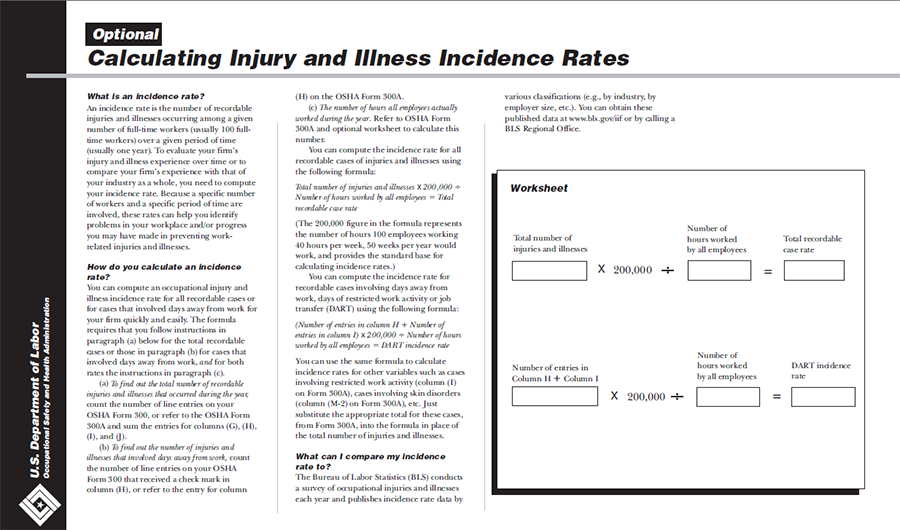
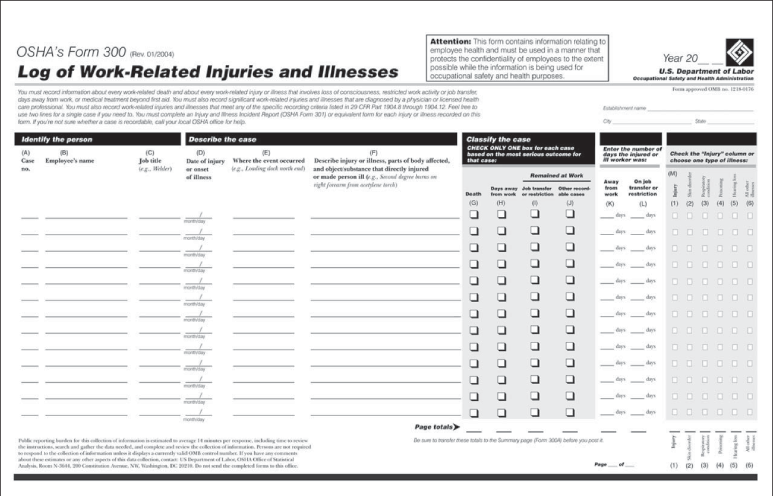
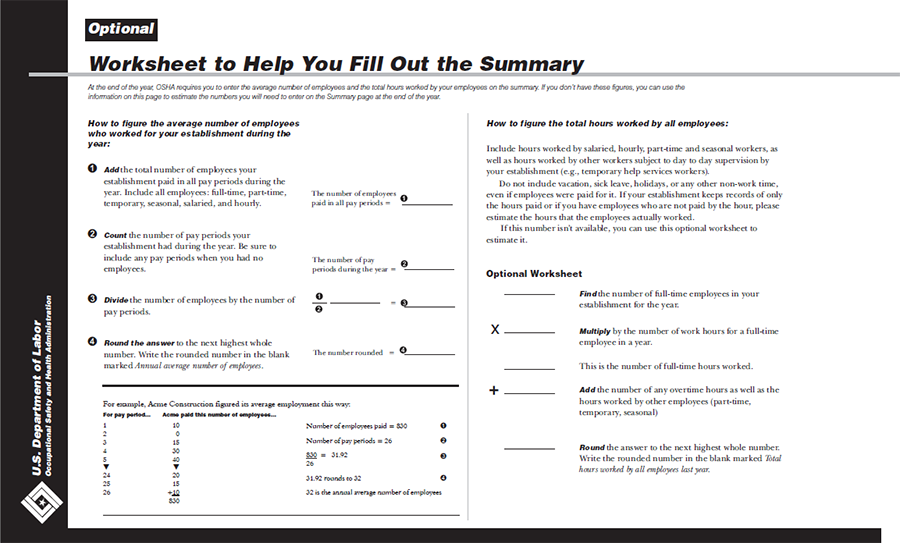
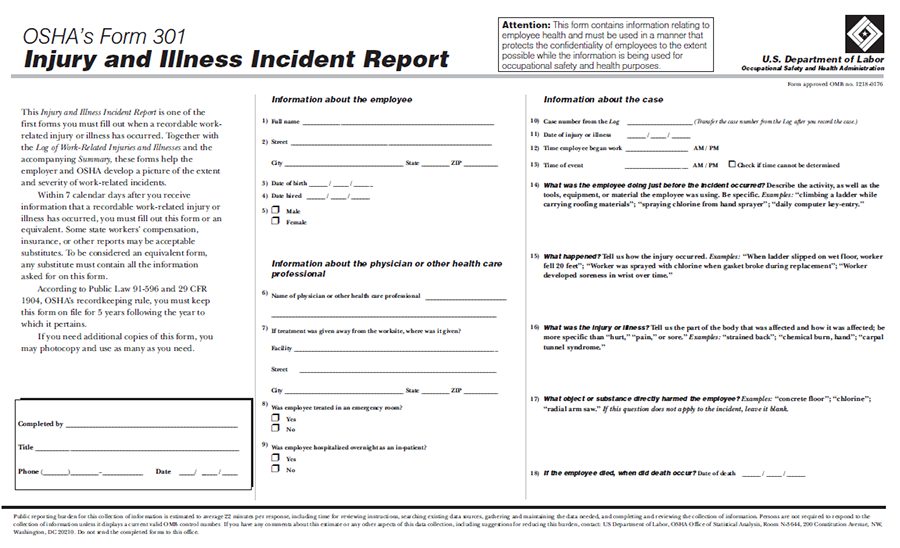
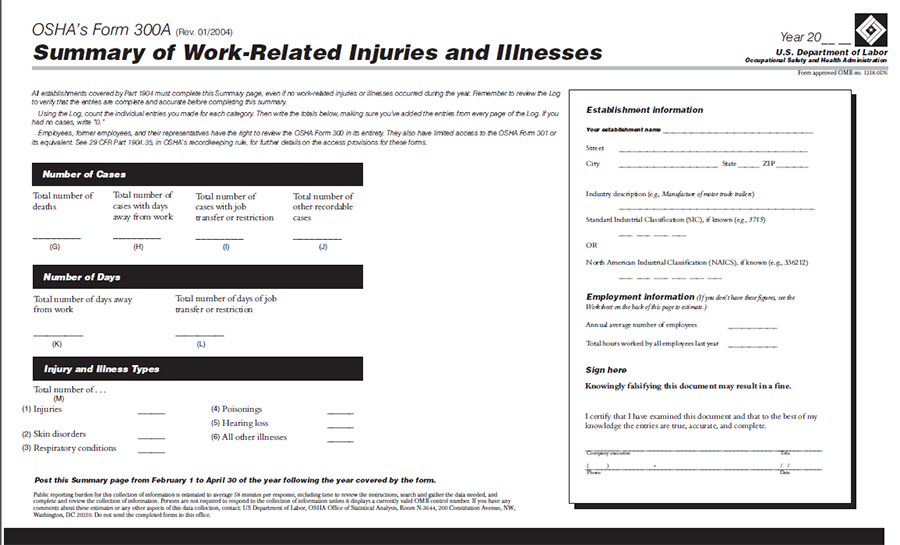
['Injury and Illness Recordkeeping']
['OSHA Recordkeeping']
UPGRADE TO CONTINUE READING