
...
(a) For each loop slitter affected source, you must conduct the initial compliance demonstration by the compliance date that is specified for your source in §63.8786.
(b) For each flame lamination affected source, you must conduct performance tests by the compliance date that is specified for your source in §63.8786 and according to the provisions in §63.7(a)(2).
(c) You must conduct subsequent performance tests to demonstrate compliance with the flame lamination emissions limitations in Table 1 to this subpart no less frequently than every 5 years from the date of the last performance test.
[86 FR 64399, Nov. 18, 2021
(a) You must conduct each performance test in Table 3 to this subpart that applies to you.
(b) Each performance test must be conducted according to the requirements in paragraph (c) of this section and under the specific conditions in Table 3 to this subpart.
(c) You must conduct each performance test under conditions representative of normal operations. You may not conduct performance tests during periods of SSM. The owner or operator must record the process information that is necessary to document operating conditions during the test and include in such record an explanation to support that such conditions represent normal operation. Upon request, the owner or operator shall make available to the Administrator such records as may be necessary to determine the conditions of performance tests.
(d) You must conduct at least three separate test runs for each performance test required in this section, as specified in §63.7(e)(3). Each test run must last at least 1 hour.
(e) For new and reconstructed affected sources, you must determine the percent reduction of HAP emissions during the performance test according to paragraphs (e)(1) through (3) of this section.
(1) If you use chlorinated fire retardant foams, determine the percent reduction of HCl to represent HAP emissions from the source. If you do not use chlorinated fire retardant foams, determine the percent reduction of HCN to represent HAP emissions from the source.
(2) Calculate the concentration of HAP at the control device inlet and at the control device outlet using the procedures in the specified test method.
(3) Compare the calculated HAP concentration at the control device inlet to the calculated HAP concentration at the control device outlet to determine the percent reduction over the period of the performance test, using Equation 1 of this section:
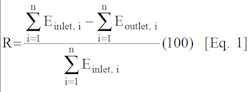
Where:
R = Efficiency of control device, percent.
Einlet,i = HAP concentration of control device inlet stream for test run i, mg/dscm.
Eoutlet,i = HAP concentration of control device outlet stream for test run i, mg/dscm.
n = Number of runs conducted for the performance test.
(f) For existing affected sources, you must determine the HCl emissions rate according to paragraphs (f)(1) through (3) of this section.
(1) Calculate the concentration of HCl in the vent outlet to the atmosphere or at the control device outlet, if a control device is used, using the procedures in the specified test method.
(2) Determine the vent outlet gas stream volumetric flow rate or if a control device is used, the control device outlet gas stream volumetric flow rate, using the procedures in the specified test method.
(3) Calculate the HCl emission rate for the period of the performance test using Equation 2 of this section:

Where:
E HCl = Emission rate of HCl, lbs/hr.
C= average HCl concentration of vent or control device outlet stream for all test runs, lb/dscft.
AOF = average outlet volumetric flow rate of gas stream, dry basis, dscft/hr.
(g) You must also meet the requirements in paragraphs (g)(1) and (2) of this section.
(1) Conduct the performance tests using foams that are representative of foams typically used at your flame lamination affected source. If you use foams containing chlorinated fire retardants, you must conduct the performance tests using these foams.
(2) Establish all applicable operating limits that correspond to the control system efficiency as described in Table 3 to this subpart.
[86 FR 64399, Nov. 18, 2021
(a) Determine the HAP content for each material used. To determine the HAP content for each material used in your foam fabrication operations, you must use one of the options in paragraphs (a)(1) through (3) of this section. If you use the option in paragraph (a)(3) of this section, you are subject to the provisions of paragraph (a)(4) of this section.
(1) Method 311 (appendix A to 40 CFR part 63). You may use Method 311 for determining the mass fraction of HAP. Use the procedures specified in paragraphs (a)(1)(i) and (ii) of this section when determining HAP content by Method 311.
(i) Include in the HAP total each HAP in Table 8 of this subpart that is measured at 0.1 percent by weight or more and any other HAP that is measured at 1.0 percent by weight or more. Express the weight fraction of each HAP you measure as a value truncated to four places after the decimal point (for example, 0.1234).
(ii) Calculate the total HAP content in the test material by adding up the individual HAP contents and truncating the result to three places after the decimal point (for example, 0.123).
(2) Alternative method. You may use an alternative test method for determining mass fraction of HAP if you obtain prior approval by the Administrator. You must follow the procedure in §63.7(f) to submit an alternative test method for approval.
(3) Information from the supplier or manufacturer of the material. You may rely on information other than that generated by the test methods specified in paragraphs (a)(1) and (2) of this section to determine the mass fraction of HAP according to paragraphs (a)(3)(i) and (ii) of this section. This information may include, but is not limited to, a material safety data sheet (MSDS), a certified product data sheet (CPDS), or a manufacturer's hazardous air pollutant data sheet.
(i) Include in the HAP total each HAP in Table 8 of this subpart that is present at 0.1 percent by weight or more and any other HAP that is present at 1.0 percent by weight or more.
(ii) If the HAP content is provided by the material supplier or manufacturer as a range, then you must use the upper limit of the range for determining compliance.
(4) Verification of supplier or manufacturer information. Although you are not required to perform testing to verify the information obtained according to paragraph (a)(3) of this section, the Administrator may require a separate measurement of the total HAP content using the methods specified in paragraph (a)(1) or (2) of this section. If this measurement exceeds the total HAP content provided by the material supplier or manufacturer, then you must use the measured HAP content to determine compliance.
(b) [Reserved]
[86 FR 64399, Nov. 18, 2021
(a) You must demonstrate initial compliance with each emission limit that applies to you according to Table 4 to this subpart.
(b) You must establish each site-specific operating limit in Table 2 to this subpart that applies to you according to the requirements in §63.8800 and Table 3 to this subpart.
(c) You must submit the Notification of Compliance Status containing the results of the initial compliance demonstration according to the requirements in §63.8816(e) through (h).