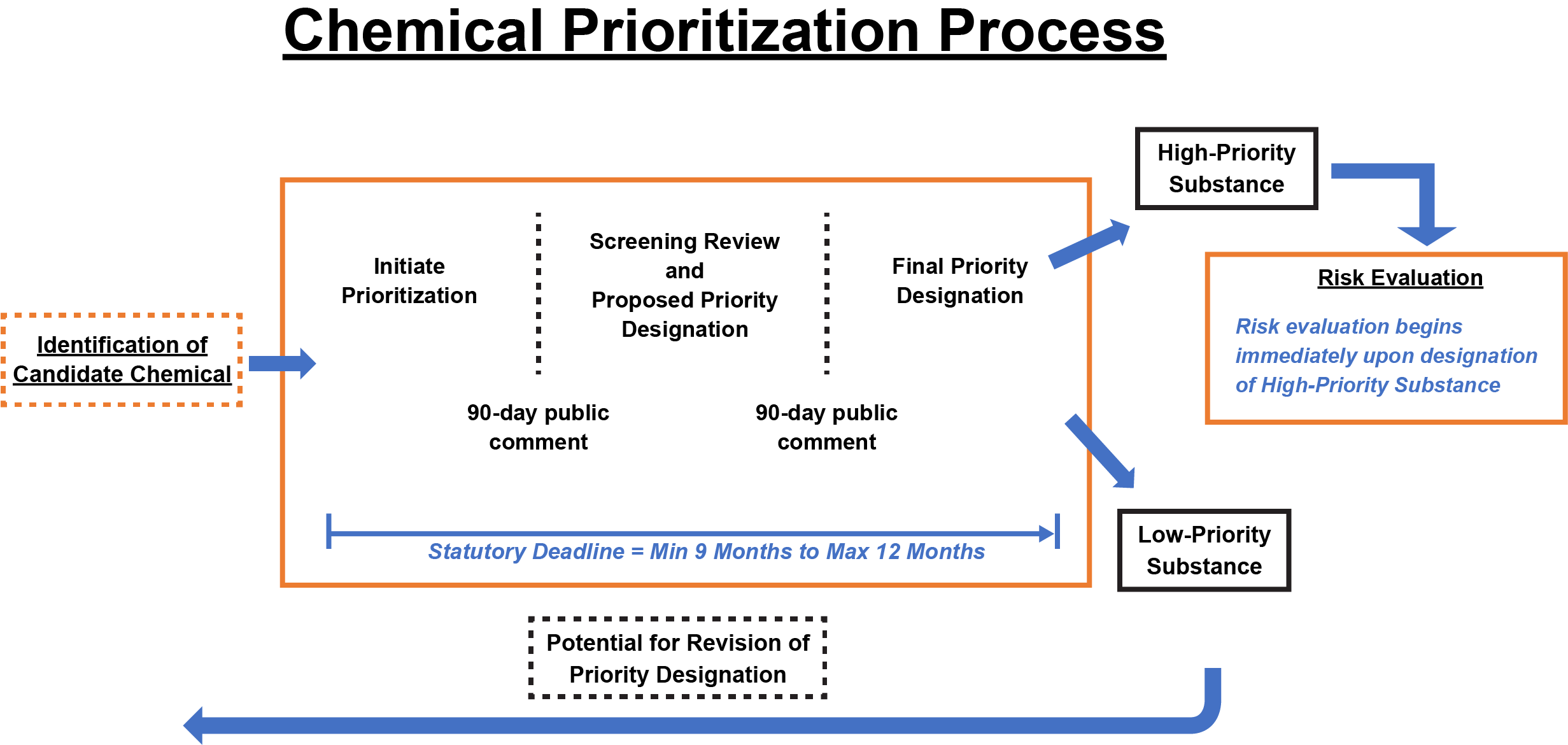
- Prioritization is a risk-based screening process for designating chemical substances as High-Priority Substances for risk evaluation, or Low-Priority Substances for which risk evaluation is not warranted at the time.
The first step in the Environmental Protection Agency’s (EPA’s) process for evaluating the safety of existing chemicals is prioritization. Prioritization is a risk-based screening process for designating chemical substances as either High-Priority Substances for risk evaluation, or Low-Priority Substances for which risk evaluation is not warranted at the time.
The Toxic Substances Control Act (TSCA) requires EPA to give certain preferences to prioritizing chemicals on the 2014 TSCA Work Plan, to consider certain criteria such as hazard/exposure, persistence, and bioaccumulation, but otherwise does not significantly limit EPA’s discretion to choose which chemicals enter the prioritization process. TSCA further prohibits EPA from considering non-risk factors (e.g., costs/benefits) during prioritization.
Once initiated, the process provides stakeholders with ample notice of any EPA risk evaluation activity, as well as two opportunities for the public to submit relevant information to the agency. The process has been designed to ensure that EPA’s limited resources are focused on chemicals with the greatest potential for risk.
Chemical substances with low hazard and/or exposure that meet the definition of Low-Priority Substances are taken out of consideration for further assessment at this time. This gives the public notice of chemical substances for which the hazard and/or exposure potential is anticipated to be low or nonexistent and provides insight into which chemical substances are likely not to need additional evaluation and risk management.
The following flowchart provides an overview of EPA’s chemical prioritization process: