
Polychlorinated biphenyls (PCBs)
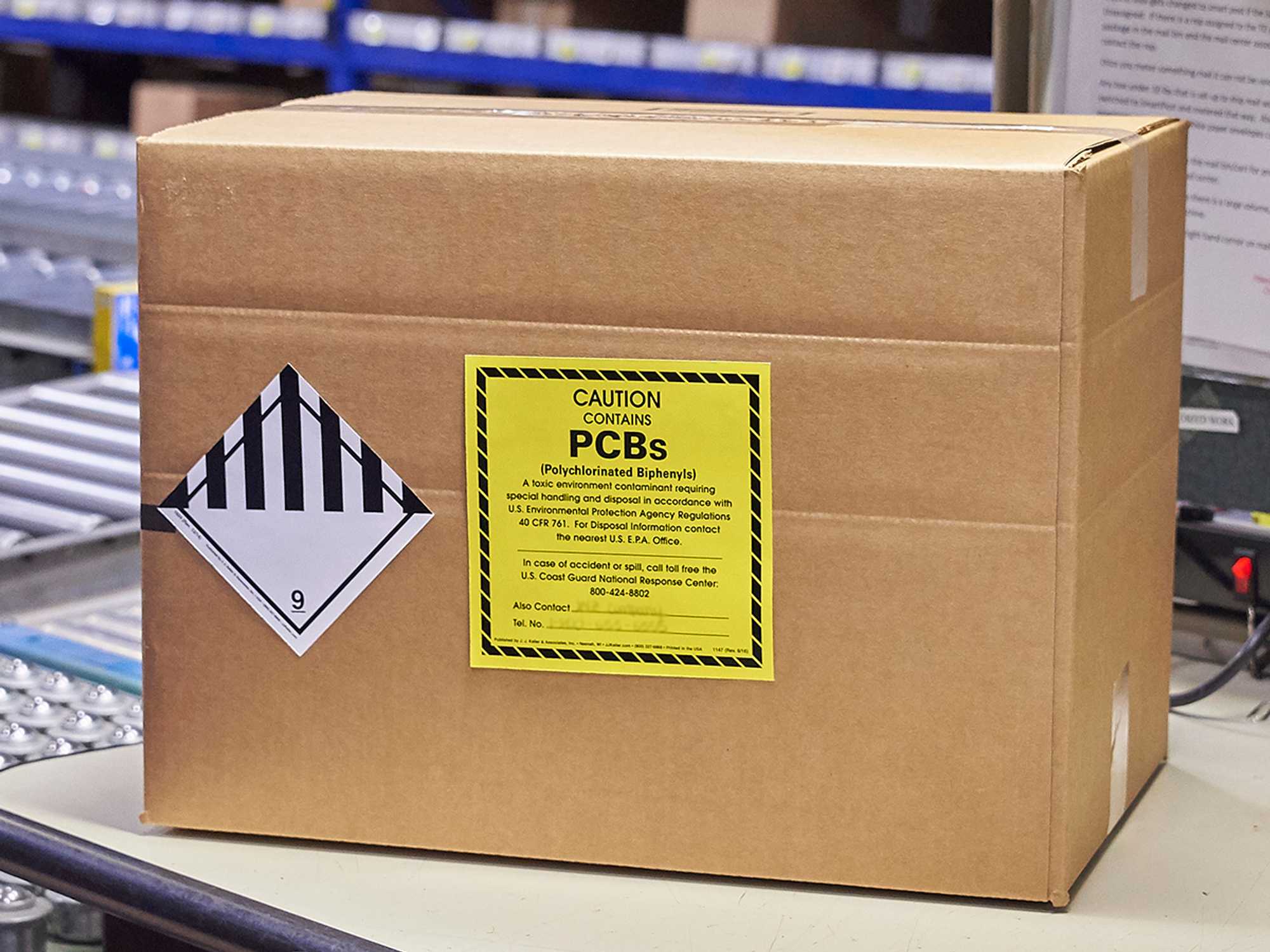
- TSCA and the PCB regulations are designed to ban the manufacture of PCBs and ensure the proper disposal of PCBs and PCB Items, while minimizing the risk posed by the storage, use, and handling of the substance.
- The PCB regulations apply to any substance, mixture, or item with a concentration of 50 ppm PCBs or greater or with a concentration below 50 ppm that resulted from dilution.
Polychlorinated biphenyls (PCBs) belong to a broad family of human-made organic chemicals known as chlorinated hydrocarbons. They have no known taste or smell, and range in consistency from an oil to a waxy solid. This chemical has been shown to cause cancer in animals as well as a number of serious non-cancer health effects in animals, including effects on the immune system, reproductive system, nervous system, endocrine system and other health effects. Moreover, PCBs persist and when released into the environment tend to accumulate in tissues of living organisms.
PCBs were domestically manufactured from 1929 until manufacturing was banned in 1979. They have a range of toxicity and vary in consistency from thin, light-colored liquids to yellow or black waxy solids. Due to their non-flammability, chemical stability, high boiling point and electrical insulating properties, PCBs were used in hundreds of industrial and commercial applications including:
- Electrical, heat transfer, and hydraulic equipment;
- Plasticizers in paints, plastics, and rubber products;
- Pigments, dyes, and carbonless copy paper; and
- Other industrial applications.
TSCA and regulatory actions related to PCBs
The Toxic Substances Control Act (TSCA) of 1976 provides the Environmental Protection Agency (EPA) with authority to require reporting, recordkeeping, and testing requirements and restrictions relating to chemical substances and/or mixtures, including PCBs. TSCA addresses the production, importation, use, and disposal of specific chemicals including PCBs.
Current PCB regulations, published pursuant to the TSCA section 6(e), can be found at 40 CFR 761, which has been in place since 1979, as amended. In general, TSCA and the PCB regulations are designed to ban the manufacture of PCBs and ensure the proper disposal of PCBs and PCB Items, while minimizing the risk posed by the storage, use, and handling of the substance.
The PCB regulations generally apply to any substance, mixture, or item with a concentration of 50 parts per million (ppm) PCBs or greater or with a concentration below 50 ppm that resulted from dilution. There are certain exceptions, however. For example, the regulations restrict the marketing and burning of used oil containing any quantifiable PCB level (2 ppm) and prohibit the use of waste oil that contains any detectible concentration of PCBs as a sealant, coating, or dust control agent. However, according to 761.1(b)(3), most provisions in Part 761 apply only if PCBs are present in concentrations above a specified level. Provisions that apply to PCBs at concentrations:
- Less than 50 ppm apply also to contaminated surfaces at PCB concentrations of less than or equal to 10 mg/100 cm2.
- Greater than or equal to 50 to less than 500 ppm apply also to contaminated surfaces at PCB concentrations of greater than 10 mg/100 cm2 to less than 100 mg/100 cm2.
- Greater than or equal to 500 ppm apply also to contaminated surfaces at PCB concentrations of greater than or equal to 100 mg/100 cm2.
Some of the major provisions of the PCB regulations at 40 CFR 761 include:
- General (Subpart A) — In addition to identifying who is regulated, establishing definitions, and listing reference documents, this subpart prescribes the assumed PCB concentrations, for regulatory purposes, of various articles (such as oil filled capacitors) for which the actual PCB concentration is unknown.
- Prohibitions/Authorizations (Subpart B) — There are numerous prohibitions on the use of PCBs or PCB items in a manner other than in a totally enclosed manner; on the manufacture of PCBs for use within the U.S. or for export; and on the processing and distribution of PCBs and PCB items for use within the U.S. or for export. However, the regulations also establish numerous exceptions and authorized activities (e.g., where “non-totally enclosed” activities may be conducted). Such authorizations pertain to the use of PCBs and servicing of PCBs in various PCB equipment, such as transformers, capacitors, natural gas pipelines, and hydraulic systems; the manufacturing of certain products with inadvertent, low-concentration production of PCBs; and the use of sewage sludge with PCBs where such sludge use is regulated by other parts of 40 CFR. Owners of PCB transformers must register the transformers with EPA. Owners of PCB articles may store them for reuse subject to storage area specifications, maximum storage periods, and/or recordkeeping requirements.
- Marking (Subpart C) — Specified items including PCB equipment (e.g., heat transfer systems using PCBs, PCB large low voltage capacitors, and storage areas used to store PCBs/PCB Items) must bear markings warning of PCBs in accordance with prescribed formats. The regulation does not require PCB-contaminated electrical equipment to be marked.
- Storage and disposal (Subpart D) — Regulations govern storage (for reuse or disposal) and disposal of PCBs, PCB waste, and PCB Items, including PCB articles (e.g., transformers, capacitors, and hydraulic machines) and PCB containers. Performance-based cleanup and disposal and cleanup and disposal of PCB wastes caused by an emergency situation are also covered in this subpart. The subpart includes separate sections that set out disposal requirements and allowed disposal methods for PCB remediation waste, PCB bulk product waste, and PCB waste from research and development activities. The regulations exempt PCB household waste from regulatory requirements. The regulations also set out requirements applicable to PCB waste and PCB items in storage for disposal and decontamination of various surfaces. Further regulatory sections specify requirements for each disposal method. PCB disposal and PCB commercial storage facilities must obtain written final approval to operate facilities.
- Exemptions (Subpart E) — This subpart grants exemptions to specific companies or groups of companies for the manufacture, processing, and distribution in commerce of PCBs for specified purposes, including microscopy, research and development, and laboratory sampling and analysis.
- Transboundary shipments of PCBs for disposal (Subpart F) — EPA prohibits the importation of PCBs for disposal without an exemption issued under the authority of TSCA section 6(e)(3). EPA prohibits the exportation of PCBs for disposal at concentrations greater than or equal to 50 ppm. Shipments that leave the U.S. only as part of their transit from one part of the U.S. to another are not considered exports or imports. Shipments passing through from Canada to Mexico or vice versa are not considered exports or imports.
- Recordkeeping/Reporting (Subpart J) — Owners and operators of facilities with PCBs and PCB items in service or projected for disposal, commercial storage facilities of PCB waste, incineration facilities, chemical waste landfill facilities, high efficiency boiler facilities, importers, facilities generating PCBs in excluded manufacturing processes, and facilities that manufacture, import, process, distribute in commerce, or use chemicals containing inadvertently generated PCBs must comply with recordkeeping and reporting requirements. Some types of data for which records may be required to be kept include PCB weights; the identification and numbers of items; storage, transfer, and disposal dates; and the identification of shippers and receivers. Note that EPA Form 6200-025 must be used for the report due July 15 annually per 761.180.
- PCB waste disposal records and reports (Subpart K) — Some generators and all transporters, storers, and disposers of PCB wastes must notify EPA that they are engaging in such activity and obtain an identification number from EPA. When a PCB waste generator sends such wastes offsite, the generator, transporter, and disposer must prepare and maintain manifests identifying the waste and tracking the dates and parties involved in the disposal process. The disposal facility must prepare a Certificate of Disposal and send it to the generator identified on the manifest. The subpart also includes recordkeeping requirements and procedures for cases in which manifests or Certificate of Disposal are not prepared by one of the parties in a transaction. Note that EPA issued final rules on September 6, 2012, July 2, 2015, and August 29, 2023, to update and clarify several sections of the PCB regulations at 40 CFR 761 associated with manifesting requirements.
- Sampling and decontamination procedures for wastes and surfaces (Subparts M through T) — These subparts set out recommended procedures for sampling PCBs in various wastes and surfaces, including sample site and size selection, sample collection, analytical requirements, and interpretation of results. The regulations also set out a method for decontaminating non-porous surfaces and requirements for studies of new decontamination solvents.
Recent rulemaking activity relating to Part 761 includes the August 29, 2023, final rule to address several issues related to implementing the PCB cleanup and disposal. Specifically, among the changes, EPA:
- Expanded the options for extraction and determinative methods used to characterize and verify the cleanup of PCB waste;
- Added more flexible provisions to facilitate cleanup and protective disposal of waste generated by spills that occur during emergency situations (e.g., hurricanes or floods);
- Amended the performance-based disposal option for PCB remediation waste by adding explicit cleanup provisions, including the requirement to notify EPA and follow specific sampling protocols; and
- Removed the provision that had allowed PCB bulk product waste to be disposed of as roadbed material.