Compliance Just Got Easier: Stay ahead of regulatory changes with instant notifications on updates that matter.
['Personal Protective Equipment']
['Eye and Face Protection', 'Respiratory Protection', 'Weather-specific PPE', 'Electrical Protective Equipment', 'Foot Protection', 'Head Protection', 'Personal Protective Equipment', 'Hearing Protection', 'Hand Protection']
09/02/2026

Copyright 2026 J. J. Keller & Associate, Inc. For re-use options please contact copyright@jjkeller.com or call 800-558-5011.
:
|
InstitutePersonal Protective EquipmentEnglishPersonal Protective EquipmentFoot ProtectionHead ProtectionEye and Face ProtectionElectrical Protective EquipmentWeather-specific PPESafety & HealthGeneral Industry SafetyHand ProtectionHearing ProtectionRespiratory ProtectionAnalysisFocus AreaCompliance and Exceptions (Level 2)USA
Key definitions
['Personal Protective Equipment']
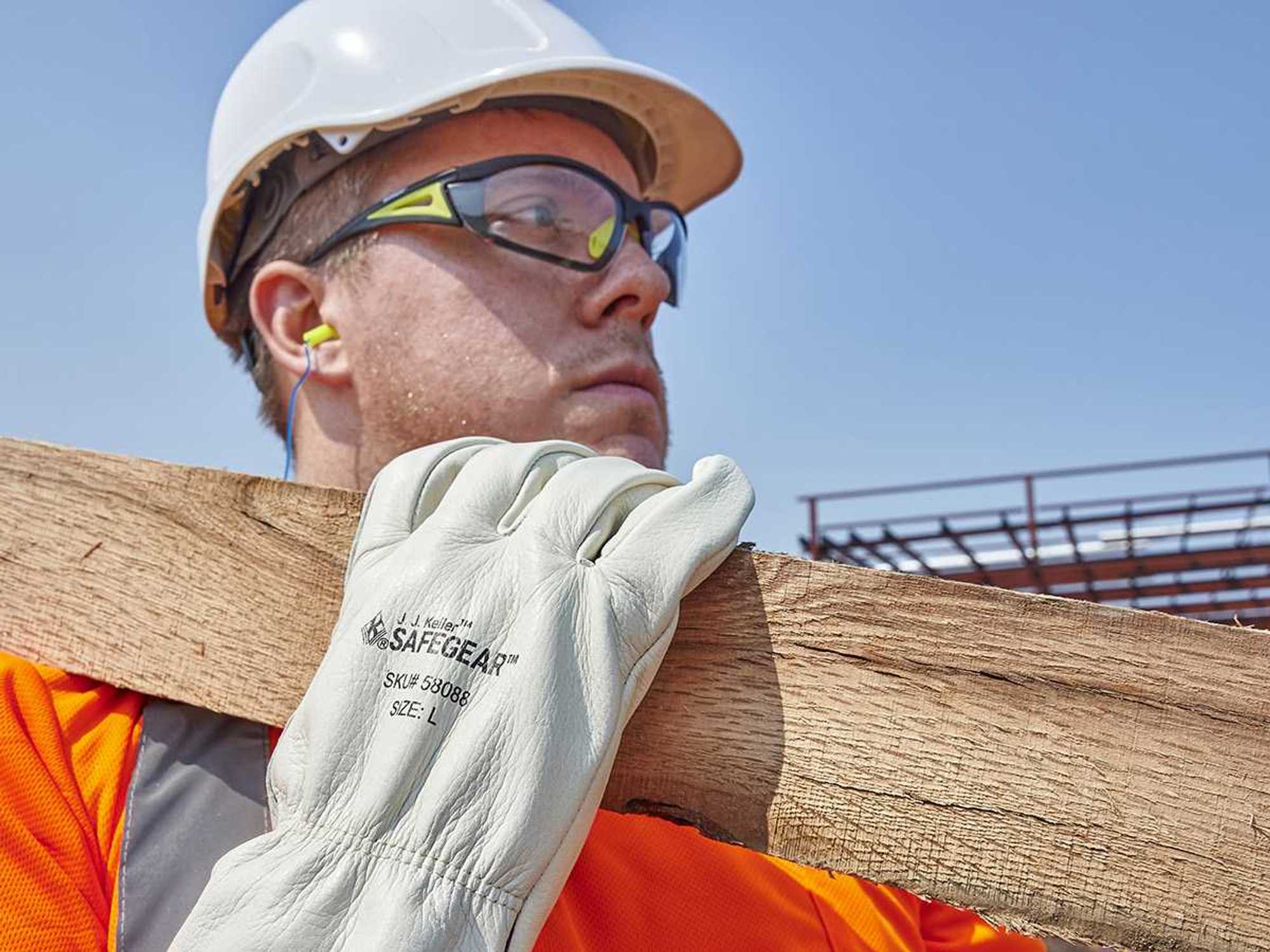
- Key terms for personal protective equipment in General Industry and Construction are defined in this section.
Every year, many workers on jobsites in General Industry and Construction are killed or seriously injured because the hazards they’re exposed to. Although PPE isn’t meant to be a permanent solution, it plays a necessary role in every workplace. Reference the key definitions below to gain a better understanding of which types of PPE may be most useful in your workplace. The key definitions in this section will cover PPE including:
- Electrical protection
- Eye and face protection
- Foot protection
- Head protection
- Hearing protection
- Hand protection
- Respiratory protection
Electrical protection
FR clothing: Flame-resistant clothing, often used for protection from arc flashes, that has been designed and tested to provide protection against specified electrical/heat hazards.
Eye and face protection
American National Standards Institute (ANSI) Z87.1: An American National Standard that provides specification for testing, selecting, maintaining, and designing eye and face protection. The Occupational Health and Safety Administration (OSHA) accepts eye/face protection meeting one of three editions of ANSI Z87.1 (2010, 2003, and 1989-Rev1998)
Face shields: Secondary protectors intended to protect the entire face against exposure to impact hazards.
Safety goggles: Primary protectors intended to shield the eyes against flying fragments, objects, large chips, and particles.
Safety spectacles: Primary protectors intended to shield the eyes from a variety of impact hazards.
Side shields: A type of eye protection that provides angular protection from impact hazards in addition to frontal protection.
Foot protection
American National Standards Institute (ANSI) Z41: An American National Standard that provides criteria for design, testing, and use of protective footwear. The Occupational Health and Safety Administration (OSHA) accepts shoes that adhere to two editions of ANSI Z41 (1999, 1991), or American Society for Testing and Materials (ASTM) F–2412–2005, Standard Test Methods for Foot Protection and ASTM F–2413–2005, Standard Specification for Performance.
ASTM F-2412 and F-2413: The most current industry standards for design, testing, and use of protective footwear. OSHA accepts shoes that adhere to ASTM F–2412–2005, Standard Test Methods for Foot Protection and ASTM F–2413–2005, Standard Specification for Performance, or either of two editions of ANSI Z41 (1999, 1991)
Combination foot and shin guards: Protect the lower legs and feet, and may be used in combination with toe guards when greater protection is needed.
Electrically conductive shoes: Provide protection against the buildup of static electricity. Employees working in explosive and hazardous locations such as explosives manufacturing facilities or grain elevators must wear conductive shoes to reduce the risk of static electricity buildup on the body that could produce a spark and cause an explosion or fire. Foot powder should not be used in conjunction with protective conductive footwear because it provides insulation, reducing the conductive ability of the shoes. Silk, wool and nylon socks can produce static electricity and should not be worn with conductive footwear. Conductive shoes must be removed when the task requiring their use is completed. Note: Employees exposed to electrical hazards must never wear conductive shoes.
Electrical hazard, safety-toe shoes: Nonconductive shoes that will prevent the wearers’ feet from completing an electrical circuit to the ground. These shoes can protect against open circuits of up to 600 volts in dry conditions and should be used in conjunction with other insulating equipment and additional precautions to reduce the risk of a worker becoming a path for hazardous electrical energy. The insulating protection of electrical hazard, safety-toe shoes may be compromised if the shoes become wet, the soles are worn through, metal particles become embedded in the sole or heel, or workers touch conductive, grounded items. Note: Nonconductive footwear must not be used in explosive or hazardous locations.
Foundry shoes: Insulate the feet from the extreme heat of molten metal, and also keep hot metal from lodging in shoe eyelets, tongues or other shoe parts.
Leggings: Protect the lower legs and feet from heat hazards such as molten metal or welding sparks. Safety snaps allow leggings to be removed quickly.
Metatarsal guards: Protect the instep area from impact and compression. Made of aluminum, steel, fiber or plastic, these guards may be strapped to the outside of shoes.
Safety shoes: Shoes that have impact-resistant toes and heat-resistant soles that protect the feet against hot work surfaces common in roofing, paving and hot metal industries. The metal insoles of some safety shoes protect against puncture wounds. Safety shoes may also be designed to be electrically conductive to prevent the buildup of static electricity in areas with the potential for explosive atmospheres or nonconductive to protect workers from workplace electrical hazards.
Toe guards: Fit over the toes of regular shoes to protect the toes from impact and compression hazards. They may be made of steel, aluminum or plastic.
Head protection
American National Standards Institute (ANSI) Z89.1: An American National Standard for the design, testing, and use of head protection. There are three editions of the standard for which the Occupational Health and Safety Administration (OSHA) says head protection can meet to comply with 1910.135 (1997, 2003, and 2009).
Hard hats (head protectors): Hard hats are worn by employees to lessen injury from falling objects; the equipment has a hard outer shell and a suspension system inside. Head protection is currently made and labeled as one of two types and one of three classes:
- Type 1 helmets: Intended to reduce the force of impact resulting from a blow only to the top of the head.
- Type 2 helmets: Intended to reduce the force of impact resulting from a blow to the top or sides of the head.
- Class G helmets: Intended to reduce the danger of contact exposure to low voltage conductors. Test samples are proof-tested at 2200 volts (phase to ground). This voltage is not intended as an indication of the voltage at which the helmet protects the wearer.
- Class E helmets: Intended to reduce the danger of contact with higher voltage conductors. Test samples are proof-tested at 20,000 volts (phase to ground). This voltage is not intended as an indication of the voltage at which the helmet protects the wearer.
- Class C helmets: Not intended to provide protection against contact with electrical hazards.
Hearing protection
Action level: An eight-hour time-weighted average of 85 decibels measured on the A-scale, slow response, or equivalently, a dose of 50 percent.
Audiogram: A chart, graph, or table resulting from an audiometric test showing an individual’s hearing threshold levels as a function of frequency.
Baseline audiogram: The audiogram against which future audiograms are compared.
Decibel (dB): A unit of measurement of sound level.
Noise dosimeter: An instrument that integrates a function of sound pressure over a period of time in such a manner that it directly indicates a noise dose.
Representative exposure: A measurement of an employee’s noise dose or eight-hour time-weighted average sound level that the employers deem to be representative of the exposures of other employees in the workplace.
Time-weighted average sound level: A sound level that, if constant over an eight-hour exposure, would result in the same noise dose as is measured.
Hand protection
Aluminized gloves: Provide reflective and insulating protection against heat and require an insert made of synthetic materials to protect against heat and cold.
Aramid fiber gloves: Protect against heat and cold, are cut- and abrasive-resistant, and wear well.
Butyl gloves: Gloves made of a synthetic rubber and protect against a wide variety of chemicals, such as peroxide, rocket fuels, highly corrosive acids (nitric acid, sulfuric acid, hydrofluoric acid and red-fuming nitric acid), strong bases, alcohols, aldehydes, ketones, esters, and nitro compounds. Butyl gloves also resist oxidation, ozone corrosion and abrasion, and remain flexible at low temperatures. Butyl rubber does not perform well with aliphatic and aromatic hydrocarbons and halogenated solvents.
Coated fabric gloves: Gloves normally made from cotton flannel with napping on one side. By coating the un-napped side with plastic, fabric gloves are transformed into general-purpose hand protection offering slip-resistant qualities. These gloves are used for tasks ranging from handling bricks and wire to chemical laboratory containers. When selecting gloves to protect against chemical exposure hazards, employers should always check with the manufacturer or review the manufacturer’s product literature to determine the gloves’ effectiveness against specific workplace chemicals and conditions.
Fabric gloves: Protect against dirt, slivers, chafing and abrasions. They do not provide sufficient protection for use with rough, sharp or heavy materials. Adding a plastic coating will strengthen some fabric gloves.
Natural (latex) rubber gloves: A popular general-purpose glove. They feature outstanding tensile strength, elasticity and temperature resistance. In addition to resisting abrasions caused by grinding and polishing, these gloves protect workers’ hands from most water solutions of acids, alkalis, salts and ketones. Latex gloves can cause allergic reactions in some individuals and may not be appropriate for all employees. Hypoallergenic gloves, glove liners and powderless gloves are possible alternatives for workers who are allergic to latex gloves.
Leather gloves: Protect against sparks, moderate heat, blows, chips and rough objects.
Neoprene gloves: Made of synthetic rubber and offer good pliability, finger dexterity, high density, and tear resistance. They protect against hydraulic fluids, gasoline, alcohols, organic acids, and alkalis. They generally have chemical and wear resistance properties superior to gloves made of natural rubber.
Nitrile gloves: Made of a copolymer and provide protection from chlorinated solvents such as trichloroethylene and perchloroethylene. Although intended for jobs requiring dexterity and sensitivity, nitrile gloves stand up to heavy use even after prolonged exposure to substances that cause other gloves to deteriorate. They offer protection when working with oils, greases, acids, caustics, and alcohols but are generally not recommended for use with strong oxidizing agents, aromatic solvents, ketones, and acetates.
Synthetic gloves: Offer protection against heat and cold, are cut- and abrasive-resistant, and may withstand some diluted acids. These materials do not stand up against alkalis and solvents.
Respiratory protection
Air-purifying respirator: A respirator with an air-purifying filter, cartridge, or canister that removes specific air contaminants by passing ambient air through the air-purifying element.
Assigned protection factor (APF): The workplace level of respiratory protection that a respirator or class of respirators is expected to provide to employees when the employer implements a continuing, effective respiratory protection program.
Atmosphere-supplying respirator: A respirator that supplies the respirator user with breathing air from a source independent of the ambient atmosphere, including SARs and SCBA units.
Canister or cartridge: A container with a filter, sorbent, or catalyst, or combination of these, which removes specific contaminants from the air passed through the container.
Continuous flow respirator: An atmosphere-supplying respirator that provides a continuous flow of breathable air to the respirator facepiece.
Demand respirator: An atmosphere-supplying respirator that admits breathing air to the facepiece only when a negative pressure is created inside the facepiece by inhalation.
Elastomeric: A respirator facepiece made of a natural or synthetic elastic material such as natural rubber, silicone, or synthetic rubber.
Emergency situation: Any occurrence such as, but not limited to, equipment failure, rupture of containers, or failure of control equipment that may or does result in an uncontrolled significant release of an airborne contaminant
Employee exposure: Exposure to a concentration of an airborne contaminant that would occur if the employee were not using respiratory protection.
End-of-service-life indicator (ESLI): A system that warns the respirator user of the approach of the end of adequate respiratory protection; for example, if the canister or cartridge sorbent is approaching saturation or is no longer effective.
Escape-only respirator: A respirator intended to be used only for emergency exit.
Filter or air-purifying element: A component used in respirators to remove solid or liquid aerosols from the inspired air.
Filtering facepiece (or dust mask): A negative pressure particulate respirator with a filter as an integral part of the facepiece or with the entire facepiece composed of the filtering medium.
Fit factor: A quantitative estimate of the fit of a particular respirator to a specific individual. It typically estimates the ratio of the concentration of a substance in ambient air to its concentration inside the respirator when worn.
Fit test: The use of a protocol to qualitatively or quantitatively evaluate the fit of a tight-fitting respirator facepiece on an individual.
High-efficiency particulate air filter (HEPA): A filter that is at least 99.97% efficient in removing monodispersed particles of 0.3 micrometers in diameter. The equivalent National Institute for Occupational Safety & Health (NIOSH) 42 CFR 84 particulate filters are the N100, R100, and P100 filters.
Hood: A respiratory inlet covering that completely covers the head and neck and may also cover portions of the shoulders and torso.
Immediately dangerous to life or health (IDLH): An atmosphere that poses an immediate threat to life, would cause irreversible adverse health effects, or would impair an individual’s ability to escape from a dangerous atmosphere.
Interior structural firefighting: The physical activity of fire suppression, rescue, or both, inside of buildings or enclosed structures which are involved in a fire situation beyond the incipient stage. (See 1910.155).
Loose-fitting facepiece: A respiratory inlet covering that is designed to form a partial seal with the face.
Maximum use concentration (MUC): The maximum atmospheric concentration of a hazardous substance from which an employee can be expected to be protected when wearing a respirator, determined by the assigned protection factor of the respirator or class of respirators and the exposure limit of the hazardous substance. The MUC can be determined mathematically by multiplying the assigned protection factor specified for a respirator by the required the Occupational Health and Safety Administration (OSHA)’s permissible exposure limit, short-term exposure limit, or ceiling limit. When no OSHA exposure limit is available for a hazardous substance, an employer must determine an MUC on the basis of relevant available information and informed professional judgment.
Negative pressure respirator (tight-fitting): A respirator in which the air pressure inside the facepiece is negative during inhalation with respect to the ambient air pressure outside the respirator.
Oxygen deficient atmosphere: An atmosphere with an oxygen content below 19.5% by volume.
Permissible exposure limit (PEL): An occupational exposure limit specified by OSHA.
Physician or other licensed healthcare professional (PLHCP): An individual whose legally permitted scope of practice (i.e., license, registration, or certification) allows that individual to independently provide, or be delegated the responsibility to provide, some or all of the healthcare services.
Positive pressure respirator: A respirator in which the pressure inside the respiratory inlet covering exceeds the ambient air pressure outside the respirator.
Powered air-purifying respirator (PAPR): An air-purifying respirator that uses a blower to force the ambient air through air-purifying elements to the inlet covering.
Pressure demand respirator: A positive pressure atmosphere-supplying respirator that admits breathing air to the facepiece when the positive pressure is reduced inside the facepiece by inhalation.
Qualitative fit test (QLFT): A pass/fail fit test to assess the adequacy of respirator fit that relies on the individual’s response to the test agent.
Quantitative fit test (QNFT): An assessment of the adequacy of respirator fit by numerically measuring the amount of leakage into the respirator.
Recommended exposure limit (REL): An occupational exposure level recommended by the National Institute for Occupational Safety & Health (NIOSH).
Self-contained breathing apparatus (SCBA): An atmosphere-supplying respirator for which the breathing air source is designed to be carried by the user.
Supplied-air respirator (or airline) respirator (SAR): An atmosphere-supplying respirator for which the source of breathing air is not designed to be carried by the user.
Threshold limit value (TLV): An occupational exposure level recommended by the American Conference of Governmental Industrial Hygienists (ACGIH).
Tight-fitting facepiece: A respiratory inlet covering that forms a complete seal with the face.
User seal check: An action conducted by the respirator user to determine if the respirator is properly seated to the face.
:
personal-protective-equipment
personal-protective-equipment
FOUNDATIONAL LEARNING
Key definitions
InstitutePersonal Protective EquipmentEnglishPersonal Protective EquipmentFoot ProtectionHead ProtectionEye and Face ProtectionElectrical Protective EquipmentWeather-specific PPESafety & HealthGeneral Industry SafetyHand ProtectionHearing ProtectionRespiratory ProtectionAnalysisFocus AreaCompliance and Exceptions (Level 2)USA
['Personal Protective Equipment']
- Key terms for personal protective equipment in General Industry and Construction are defined in this section.
Every year, many workers on jobsites in General Industry and Construction are killed or seriously injured because the hazards they’re exposed to. Although PPE isn’t meant to be a permanent solution, it plays a necessary role in every workplace. Reference the key definitions below to gain a better understanding of which types of PPE may be most useful in your workplace. The key definitions in this section will cover PPE including:
- Electrical protection
- Eye and face protection
- Foot protection
- Head protection
- Hearing protection
- Hand protection
- Respiratory protection
Electrical protection
FR clothing: Flame-resistant clothing, often used for protection from arc flashes, that has been designed and tested to provide protection against specified electrical/heat hazards.
Eye and face protection
American National Standards Institute (ANSI) Z87.1: An American National Standard that provides specification for testing, selecting, maintaining, and designing eye and face protection. The Occupational Health and Safety Administration (OSHA) accepts eye/face protection meeting one of three editions of ANSI Z87.1 (2010, 2003, and 1989-Rev1998)
Face shields: Secondary protectors intended to protect the entire face against exposure to impact hazards.
Safety goggles: Primary protectors intended to shield the eyes against flying fragments, objects, large chips, and particles.
Safety spectacles: Primary protectors intended to shield the eyes from a variety of impact hazards.
Side shields: A type of eye protection that provides angular protection from impact hazards in addition to frontal protection.
Foot protection
American National Standards Institute (ANSI) Z41: An American National Standard that provides criteria for design, testing, and use of protective footwear. The Occupational Health and Safety Administration (OSHA) accepts shoes that adhere to two editions of ANSI Z41 (1999, 1991), or American Society for Testing and Materials (ASTM) F–2412–2005, Standard Test Methods for Foot Protection and ASTM F–2413–2005, Standard Specification for Performance.
ASTM F-2412 and F-2413: The most current industry standards for design, testing, and use of protective footwear. OSHA accepts shoes that adhere to ASTM F–2412–2005, Standard Test Methods for Foot Protection and ASTM F–2413–2005, Standard Specification for Performance, or either of two editions of ANSI Z41 (1999, 1991)
Combination foot and shin guards: Protect the lower legs and feet, and may be used in combination with toe guards when greater protection is needed.
Electrically conductive shoes: Provide protection against the buildup of static electricity. Employees working in explosive and hazardous locations such as explosives manufacturing facilities or grain elevators must wear conductive shoes to reduce the risk of static electricity buildup on the body that could produce a spark and cause an explosion or fire. Foot powder should not be used in conjunction with protective conductive footwear because it provides insulation, reducing the conductive ability of the shoes. Silk, wool and nylon socks can produce static electricity and should not be worn with conductive footwear. Conductive shoes must be removed when the task requiring their use is completed. Note: Employees exposed to electrical hazards must never wear conductive shoes.
Electrical hazard, safety-toe shoes: Nonconductive shoes that will prevent the wearers’ feet from completing an electrical circuit to the ground. These shoes can protect against open circuits of up to 600 volts in dry conditions and should be used in conjunction with other insulating equipment and additional precautions to reduce the risk of a worker becoming a path for hazardous electrical energy. The insulating protection of electrical hazard, safety-toe shoes may be compromised if the shoes become wet, the soles are worn through, metal particles become embedded in the sole or heel, or workers touch conductive, grounded items. Note: Nonconductive footwear must not be used in explosive or hazardous locations.
Foundry shoes: Insulate the feet from the extreme heat of molten metal, and also keep hot metal from lodging in shoe eyelets, tongues or other shoe parts.
Leggings: Protect the lower legs and feet from heat hazards such as molten metal or welding sparks. Safety snaps allow leggings to be removed quickly.
Metatarsal guards: Protect the instep area from impact and compression. Made of aluminum, steel, fiber or plastic, these guards may be strapped to the outside of shoes.
Safety shoes: Shoes that have impact-resistant toes and heat-resistant soles that protect the feet against hot work surfaces common in roofing, paving and hot metal industries. The metal insoles of some safety shoes protect against puncture wounds. Safety shoes may also be designed to be electrically conductive to prevent the buildup of static electricity in areas with the potential for explosive atmospheres or nonconductive to protect workers from workplace electrical hazards.
Toe guards: Fit over the toes of regular shoes to protect the toes from impact and compression hazards. They may be made of steel, aluminum or plastic.
Head protection
American National Standards Institute (ANSI) Z89.1: An American National Standard for the design, testing, and use of head protection. There are three editions of the standard for which the Occupational Health and Safety Administration (OSHA) says head protection can meet to comply with 1910.135 (1997, 2003, and 2009).
Hard hats (head protectors): Hard hats are worn by employees to lessen injury from falling objects; the equipment has a hard outer shell and a suspension system inside. Head protection is currently made and labeled as one of two types and one of three classes:
- Type 1 helmets: Intended to reduce the force of impact resulting from a blow only to the top of the head.
- Type 2 helmets: Intended to reduce the force of impact resulting from a blow to the top or sides of the head.
- Class G helmets: Intended to reduce the danger of contact exposure to low voltage conductors. Test samples are proof-tested at 2200 volts (phase to ground). This voltage is not intended as an indication of the voltage at which the helmet protects the wearer.
- Class E helmets: Intended to reduce the danger of contact with higher voltage conductors. Test samples are proof-tested at 20,000 volts (phase to ground). This voltage is not intended as an indication of the voltage at which the helmet protects the wearer.
- Class C helmets: Not intended to provide protection against contact with electrical hazards.
Hearing protection
Action level: An eight-hour time-weighted average of 85 decibels measured on the A-scale, slow response, or equivalently, a dose of 50 percent.
Audiogram: A chart, graph, or table resulting from an audiometric test showing an individual’s hearing threshold levels as a function of frequency.
Baseline audiogram: The audiogram against which future audiograms are compared.
Decibel (dB): A unit of measurement of sound level.
Noise dosimeter: An instrument that integrates a function of sound pressure over a period of time in such a manner that it directly indicates a noise dose.
Representative exposure: A measurement of an employee’s noise dose or eight-hour time-weighted average sound level that the employers deem to be representative of the exposures of other employees in the workplace.
Time-weighted average sound level: A sound level that, if constant over an eight-hour exposure, would result in the same noise dose as is measured.
Hand protection
Aluminized gloves: Provide reflective and insulating protection against heat and require an insert made of synthetic materials to protect against heat and cold.
Aramid fiber gloves: Protect against heat and cold, are cut- and abrasive-resistant, and wear well.
Butyl gloves: Gloves made of a synthetic rubber and protect against a wide variety of chemicals, such as peroxide, rocket fuels, highly corrosive acids (nitric acid, sulfuric acid, hydrofluoric acid and red-fuming nitric acid), strong bases, alcohols, aldehydes, ketones, esters, and nitro compounds. Butyl gloves also resist oxidation, ozone corrosion and abrasion, and remain flexible at low temperatures. Butyl rubber does not perform well with aliphatic and aromatic hydrocarbons and halogenated solvents.
Coated fabric gloves: Gloves normally made from cotton flannel with napping on one side. By coating the un-napped side with plastic, fabric gloves are transformed into general-purpose hand protection offering slip-resistant qualities. These gloves are used for tasks ranging from handling bricks and wire to chemical laboratory containers. When selecting gloves to protect against chemical exposure hazards, employers should always check with the manufacturer or review the manufacturer’s product literature to determine the gloves’ effectiveness against specific workplace chemicals and conditions.
Fabric gloves: Protect against dirt, slivers, chafing and abrasions. They do not provide sufficient protection for use with rough, sharp or heavy materials. Adding a plastic coating will strengthen some fabric gloves.
Natural (latex) rubber gloves: A popular general-purpose glove. They feature outstanding tensile strength, elasticity and temperature resistance. In addition to resisting abrasions caused by grinding and polishing, these gloves protect workers’ hands from most water solutions of acids, alkalis, salts and ketones. Latex gloves can cause allergic reactions in some individuals and may not be appropriate for all employees. Hypoallergenic gloves, glove liners and powderless gloves are possible alternatives for workers who are allergic to latex gloves.
Leather gloves: Protect against sparks, moderate heat, blows, chips and rough objects.
Neoprene gloves: Made of synthetic rubber and offer good pliability, finger dexterity, high density, and tear resistance. They protect against hydraulic fluids, gasoline, alcohols, organic acids, and alkalis. They generally have chemical and wear resistance properties superior to gloves made of natural rubber.
Nitrile gloves: Made of a copolymer and provide protection from chlorinated solvents such as trichloroethylene and perchloroethylene. Although intended for jobs requiring dexterity and sensitivity, nitrile gloves stand up to heavy use even after prolonged exposure to substances that cause other gloves to deteriorate. They offer protection when working with oils, greases, acids, caustics, and alcohols but are generally not recommended for use with strong oxidizing agents, aromatic solvents, ketones, and acetates.
Synthetic gloves: Offer protection against heat and cold, are cut- and abrasive-resistant, and may withstand some diluted acids. These materials do not stand up against alkalis and solvents.
Respiratory protection
Air-purifying respirator: A respirator with an air-purifying filter, cartridge, or canister that removes specific air contaminants by passing ambient air through the air-purifying element.
Assigned protection factor (APF): The workplace level of respiratory protection that a respirator or class of respirators is expected to provide to employees when the employer implements a continuing, effective respiratory protection program.
Atmosphere-supplying respirator: A respirator that supplies the respirator user with breathing air from a source independent of the ambient atmosphere, including SARs and SCBA units.
Canister or cartridge: A container with a filter, sorbent, or catalyst, or combination of these, which removes specific contaminants from the air passed through the container.
Continuous flow respirator: An atmosphere-supplying respirator that provides a continuous flow of breathable air to the respirator facepiece.
Demand respirator: An atmosphere-supplying respirator that admits breathing air to the facepiece only when a negative pressure is created inside the facepiece by inhalation.
Elastomeric: A respirator facepiece made of a natural or synthetic elastic material such as natural rubber, silicone, or synthetic rubber.
Emergency situation: Any occurrence such as, but not limited to, equipment failure, rupture of containers, or failure of control equipment that may or does result in an uncontrolled significant release of an airborne contaminant
Employee exposure: Exposure to a concentration of an airborne contaminant that would occur if the employee were not using respiratory protection.
End-of-service-life indicator (ESLI): A system that warns the respirator user of the approach of the end of adequate respiratory protection; for example, if the canister or cartridge sorbent is approaching saturation or is no longer effective.
Escape-only respirator: A respirator intended to be used only for emergency exit.
Filter or air-purifying element: A component used in respirators to remove solid or liquid aerosols from the inspired air.
Filtering facepiece (or dust mask): A negative pressure particulate respirator with a filter as an integral part of the facepiece or with the entire facepiece composed of the filtering medium.
Fit factor: A quantitative estimate of the fit of a particular respirator to a specific individual. It typically estimates the ratio of the concentration of a substance in ambient air to its concentration inside the respirator when worn.
Fit test: The use of a protocol to qualitatively or quantitatively evaluate the fit of a tight-fitting respirator facepiece on an individual.
High-efficiency particulate air filter (HEPA): A filter that is at least 99.97% efficient in removing monodispersed particles of 0.3 micrometers in diameter. The equivalent National Institute for Occupational Safety & Health (NIOSH) 42 CFR 84 particulate filters are the N100, R100, and P100 filters.
Hood: A respiratory inlet covering that completely covers the head and neck and may also cover portions of the shoulders and torso.
Immediately dangerous to life or health (IDLH): An atmosphere that poses an immediate threat to life, would cause irreversible adverse health effects, or would impair an individual’s ability to escape from a dangerous atmosphere.
Interior structural firefighting: The physical activity of fire suppression, rescue, or both, inside of buildings or enclosed structures which are involved in a fire situation beyond the incipient stage. (See 1910.155).
Loose-fitting facepiece: A respiratory inlet covering that is designed to form a partial seal with the face.
Maximum use concentration (MUC): The maximum atmospheric concentration of a hazardous substance from which an employee can be expected to be protected when wearing a respirator, determined by the assigned protection factor of the respirator or class of respirators and the exposure limit of the hazardous substance. The MUC can be determined mathematically by multiplying the assigned protection factor specified for a respirator by the required the Occupational Health and Safety Administration (OSHA)’s permissible exposure limit, short-term exposure limit, or ceiling limit. When no OSHA exposure limit is available for a hazardous substance, an employer must determine an MUC on the basis of relevant available information and informed professional judgment.
Negative pressure respirator (tight-fitting): A respirator in which the air pressure inside the facepiece is negative during inhalation with respect to the ambient air pressure outside the respirator.
Oxygen deficient atmosphere: An atmosphere with an oxygen content below 19.5% by volume.
Permissible exposure limit (PEL): An occupational exposure limit specified by OSHA.
Physician or other licensed healthcare professional (PLHCP): An individual whose legally permitted scope of practice (i.e., license, registration, or certification) allows that individual to independently provide, or be delegated the responsibility to provide, some or all of the healthcare services.
Positive pressure respirator: A respirator in which the pressure inside the respiratory inlet covering exceeds the ambient air pressure outside the respirator.
Powered air-purifying respirator (PAPR): An air-purifying respirator that uses a blower to force the ambient air through air-purifying elements to the inlet covering.
Pressure demand respirator: A positive pressure atmosphere-supplying respirator that admits breathing air to the facepiece when the positive pressure is reduced inside the facepiece by inhalation.
Qualitative fit test (QLFT): A pass/fail fit test to assess the adequacy of respirator fit that relies on the individual’s response to the test agent.
Quantitative fit test (QNFT): An assessment of the adequacy of respirator fit by numerically measuring the amount of leakage into the respirator.
Recommended exposure limit (REL): An occupational exposure level recommended by the National Institute for Occupational Safety & Health (NIOSH).
Self-contained breathing apparatus (SCBA): An atmosphere-supplying respirator for which the breathing air source is designed to be carried by the user.
Supplied-air respirator (or airline) respirator (SAR): An atmosphere-supplying respirator for which the source of breathing air is not designed to be carried by the user.
Threshold limit value (TLV): An occupational exposure level recommended by the American Conference of Governmental Industrial Hygienists (ACGIH).
Tight-fitting facepiece: A respiratory inlet covering that forms a complete seal with the face.
User seal check: An action conducted by the respirator user to determine if the respirator is properly seated to the face.
2656868053
UPGRADE TO CONTINUE READING
RELATED TOPICS
J. J. Keller is the trusted source for DOT / Transportation, OSHA / Workplace Safety, Human Resources, Construction Safety and Hazmat / Hazardous Materials regulation compliance products and services. J. J. Keller helps you increase safety awareness, reduce risk, follow best practices, improve safety training, and stay current with changing regulations.
Copyright 2026 J. J. Keller & Associate, Inc. For re-use options please contact copyright@jjkeller.com or call 800-558-5011.