Compliance Just Got Easier: Stay ahead of regulatory changes with instant notifications on updates that matter.
['Welding and Cutting', 'Toxic and Hazardous Substances - OSHA', 'Personal Protective Equipment', 'Hazardous Materials Safety - OSHA', 'Signs and Markings']
['Welding and Cutting', 'Signs and Markings', 'Acetylene', 'Personal Protective Equipment', 'Cadmium', 'Eye and Face Protection', 'Hot Work', 'Compressed Gases']
04/21/2026

Copyright 2026 J. J. Keller & Associate, Inc. For re-use options please contact copyright@jjkeller.com or call 800-558-5011.
OSHA requirements for labeling equipment, materials, and facilities
General Requirements
§1910.252(b)(2)(ii), (b)(4)(vii); (c)(1)(iv)-(vi)
Protection of Personnel
Lenses (of shields or goggles) must have some distinctive marking by which the source and shade may be readily identified.
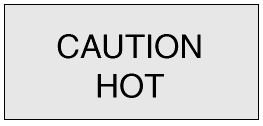
After welding operations are completed, the welder has to mark the hot metal or provide some other means of warning other workers.
Health Protection
Hazard Communication
In accordance with Hazard Communication Standard (HCS) (§1910.1200), the employer shall ensure that each employee has access to labels on containers of potentially hazardous materials employed in fluxes, coatings, coverings, and filler metals, all of which are potentially used in welding and cutting, or are released to the atmosphere during welding and cutting. Potentially hazardous materials shall include, but not be limited to, the materials itemized in paragraphs (c)(5) through (c)(12) of §1910.252.
Additional Considerations
Suppliers shall determine and shall label in accordance with §1910.1200 any hazards associated with the use of their materials in welding, cutting, and brazing. In addition to any requirements imposed by §1910.1200, all filler metals and fusible granular materials shall carry the following notice, as a minimum, on tags, boxes, or other containers:
- Do not use in areas without adequate ventilation. See ANSI Z49.1–1967 Safety in Welding, Cutting, and Allied Processes published by the American Welding Society.
- Where brazing (welding) filler metals contain cadmium in significant amounts, the labels shall indicate the hazards associated with cadmium including cancer, lung and kidney effects, and acute toxicity effects.
- Where brazing and gas welding fluxes contain fluorine compounds, the labels shall indicate the hazards associated with fluorine compounds including eye and respiratory tract effects.
Alternative Labeling
Prior to June 1, 2015, employers may include the following information on labels in lieu of the labeling requirements mentioned in the "Additional Considerations" above:
- All filler metals and fusible
granular materials shall carry the
following notice, as a minimum, on tags,
boxes, or other containers:
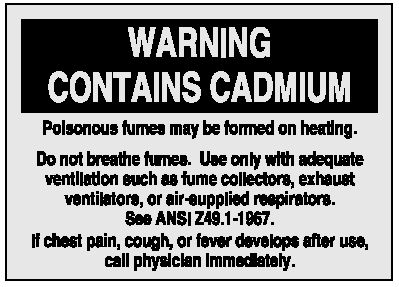
CAUTION Welding may produce fumes and gases hazardous to health. Avoid breathing these fumes and gases. Use adequate ventilation. See ANSI Z49.1–1967 Safety in Welding and Cutting published by the American Welding Society. - Brazing (welding) filler metals containing cadmium in significant amounts shall carry the following notice on tags, boxes, or other containers:
- Brazing and gas welding fluxes
containing fluorine compounds shall
have a cautionary wording to indicate
that they contain fluorine compounds.
One such cautionary wording
recommended by the American Welding Society for brazing and gas welding
fluxes reads as follows:
CAUTION
CONTAINS FLUORIDES
This flux when heated gives off fumes that may irritate eyes, nose and throat.
1. Avoid fumes—use only in well-ventilated spaces.
2. Avoid contact of flux with eyes or skin.
3. Do not take internally.
Oxygen-Fuel Gas Welding and Cutting
§1910.253(b)(1)(ii), (b)(5)(iii), (c)(3)(v), (d)(4)(ii)-(iii), (e)(6)(iii), (f)(1), (f)(7), (g)(1)(ii)
Cylinders and Containers
Compressed gas cylinders must be legibly marked, for the purpose of identifying the gas content, with either the chemical or the trade name of the gas.
Such marking shall be by means of stenciling, stamping, or labeling, and shall not be readily removable. Whenever practical, the marking shall be located on the shoulder of the cylinder.
The numbers and marking stamped into cylinders shall not be tampered with.
A warning should be placed near cylinders having leaking fuse plugs or other leaking safety devices not to approach them with a lighted cigarette or other source of ignition. Such cylinders should be plainly tagged.
Manifolding of Cylinders
The following sign must be conspicuously posted at each low-pressure oxygen manifold (for use with cylinders having a Department of Transportation service pressure not exceeding 200 p.s.i.g.):

Service Piping Systems
Above ground piping systems must be marked in accordance with the American National Standard Scheme for the Identification of Piping Systems, ANSI A13.1-1956.
Station outlets have to be marked to indicate the name of the gas.
Protective Equipment, Hose, and Regulators
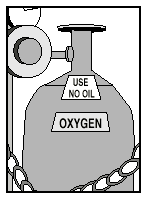
Gages on oxygen regulators must be marked “USE NO OIL.”
Acetylene Generators
Generators must be plainly marked with:
- Maximum rate of acetylene in cubic feet per hour for which they are designed;
- Weight and size of carbide necessary for a single charge;
- Manufacturer’s name and address; and
- Name or number of the type of generator.
Operating instructions shall be posted in a conspicuous place near the generator or kept in a suitable place available for ready reference.
Calcium Carbide Storage
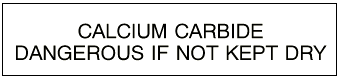
Packages containing calcium carbide have to be conspicuously marked with the following phrase or an equivalent warning:
Arc Welding and Cutting
Terminals for welding leads should be protected from accidental electrical contact by personnel or by metal objects, i.e., vehicles, crane hooks, etc. Protection may be obtained by use of: Dead-front receptacles for plug connections; recessed openings with nonremovable hinged covers; heavy insulating sleeving or taping or other equivalent electrical and mechanical protection. If a welding lead terminal which is intended to be used exclusively for connection to the work is connected to the grounded enclosure, it must be done by a conductor at least two AWG sizes smaller than the grounding conductor and the terminal shall be marked to indicate that it is grounded.
['Welding and Cutting', 'Toxic and Hazardous Substances - OSHA', 'Personal Protective Equipment', 'Hazardous Materials Safety - OSHA', 'Signs and Markings']
['Welding and Cutting', 'Signs and Markings', 'Acetylene', 'Personal Protective Equipment', 'Cadmium', 'Eye and Face Protection', 'Hot Work', 'Compressed Gases']
UPGRADE TO CONTINUE READING