Compliance Just Got Easier: Stay ahead of regulatory changes with instant notifications on updates that matter.
['Hazard Communication', 'Confined Spaces', 'Signs and Markings', 'Lockout/Tagout']
['Hazcom Labeling', 'Safety Color Coding', 'Lockout/Tagout', 'Confined Spaces', 'Signs and Markings']
04/22/2026

Copyright 2026 J. J. Keller & Associate, Inc. For re-use options please contact copyright@jjkeller.com or call 800-558-5011.
OSHA requirements for labeling equipment, materials, and facilities
Temporary Labor Camps
Toilet Facilities
Toilet facilities adequate for the capacity of the camp shall be provided. Where the toilet rooms are shared, such as in multifamily shelters and in barracks type facilities, separate toilet rooms shall be provided for each sex. These rooms shall be distinctly marked “for men” and “for women” by signs printed in English and in the native language of the persons occupying the camp, or marked with easily understood pictures or symbols.
Safety Color Code for Marking Physical Hazards
Color coding is a standard way of quickly transmitting information. Traffic lights use red for stop, yellow for caution, and green for go. The National Fire Protection Association (NFPA) uses red - fire, blue - health, and yellow - reactivity. OSHA has also developed color codes to convey safety information.
Red
Red is the basic identification color of:
- Fire protection equipment and apparatus
- Danger
- Stop
Safety cans or other portable containers of flammable liquids that have a flash point at or below 80°F, table containers of flammable liquids (open cup tester), excluding shipping containers, have to be painted red with some additional, clearly visible identification either in the form of a yellow band around the can or the name of the contents clearly stenciled or painted on the can in yellow.
Red lights must be provided at barricades and at temporary obstructions.
Danger signs have to be painted red.
Emergency stop bars on hazardous machines such as rubber mills, wire blocks, flat work ironers, etc., must be red.
Stop buttons or electrical switches on which letters or other markings appear, used for emergency stopping of machinery must be red.
Yellow
Yellow is the basic color for designating caution and for marking physical hazards such as:
- striking against,
- stumbling,
- falling,
- tripping, and
- caught-in-between.
Specifications for Accident Prevention Signs and Tags
These specifications apply to the design, application, and use of signs or symbols (as included in paragraphs (c) through (e) of this section) intended to indicate and, insofar as possible, to define specific hazards of a nature such that failure to designate them may lead to accidental injury to workers or the public, or both, or to property damage. These specifications are intended to cover all safety signs except those designed for streets, highways, and railroads. These specifications do not apply to plant bulletin boards or to safety posters.
Accident Prevention Signs
All signs shall have rounded or blunt corners and should not have any sharp edges, burrs, splinters or other sharp projections. The ends or heads of bolts or other fastening devices shall be located in such a way that they do not constitute a hazard.
The wording of any sign should:
- be easily read and to the point,
- contain sufficient, easy to understand information,
- make a positive suggestion, and
- be accurate in fact.
Danger Signs
Danger signs indicate immediate danger and that special precautions are necessary.

The danger sign colors red, black, and white shall be those of opaque glossy samples as specified in Table 1, “Fundamental Specification of Safety Colors for CIE Standard Source ‘C,’” of ANSI Z53.1-1967 or in Table 1, “Specification of the Safety Colors for CIE Illuminate C and the CIE 1931, 2º Standard Observer,” of ANSI Z535.1-2006(R2011), incorporated by reference in §1910.6.
There shall be no variation in the type of design of danger signs posted to warn of specific dangers and radiation hazards.
Caution Signs
Caution signs indicate a possible hazard against which proper precautions should be taken. Caution signs must be used only to warn against potential hazards or to caution against unsafe practices.
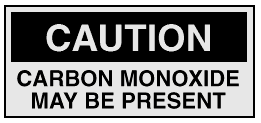
The standard color of the background on a caution sign shall be yellow; and the panel, black with yellow letters. Any letters used against the yellow background must be black. The caution sign colors shall be those of opaque glossy samples as specified in Table 1 of ANSI Z53.1-1967 or Table 1 of ANSI Z535.1-2006(R2011), incorporated by reference in §1910.6.
Safety Instruction Signs
Safety instruction signs shall be used where there is a need for general instructions and suggestions relative to safety measures. For safety instruction signs, the standard color of the background shall be white; and the panel, green with white letters. Any letters used against the white background shall be black. The colors shall be those of opaque glossy samples as specified in Table 1 of ANSI Z53.1-1967 or in Table 1 of ANSI Z535.1-2006(R2011), incorporated by reference in §1910.6.
Slow-moving Vehicle Emblem
The slow-moving vehicle emblem shall be used only on vehicles, which by design, move slowly (25 m.p.h. or less) on the public roads. This emblem is a fluorescent yellow-orange triangle with a dark red reflective border. The emblem is not a clearance marker for wide machinery nor is it intended to replace required lighting or marking of slow-moving vehicles. Neither the color film pattern and its dimensions nor the backing shall be altered to permit use of advertising or other markings. The material, location, mounting, etc., of the emblem shall be in accordance with the American Society of Agricultural Engineers Emblem for Identifying Slow-Moving Vehicles, ASAE R276, 1967, or ASAE S276.2 (ANSI B114.1-1971), which are incorporated by reference as specified in §1910.6.

Biological Hazard Signs
The biological hazard warning shall be used to signify the actual or potential presence of a biohazard (infectious agent which presents a risk of death, injury or illness to employees) and to identify equipment, containers, rooms, materials, experimental animals, or combinations thereof, which contain, or are contaminated with, viable hazardous agents.

Accident Prevention Tags
Tags are used as a means to prevent accidental injury or illness to employees who are exposed to hazardous or potentially hazardous conditions, equipment or operations which are out of the ordinary. All required tags (Danger, Caution, Warning, Biological Hazard) have to meet the following criteria:
- Tags shall contain a signal word (a word or words that gets the employees immediate attention) and a major message.
- The signal word shall be readable at a minimum distance of five feet (1.52 m).
- The tag’s major message shall be presented in either pictographs, written text, or both.
- The signal word shall be understandable to all employees.
- All employees shall be informed as to the meaning of various tags used throughout the workplace.
- Tags shall be affixed as close as safely possible to their respective hazards.
While §1910.145(f) does not specifically mandate colors to be used on accident prevention tags, the following color scheme is recommended by OSHA:
- DANGER—Red, or predominantly red, with lettering or symbols in a contrasting color.
- CAUTION—Yellow, or predominantly yellow, with lettering or symbols in a contrasting color.
- WARNING—Orange, or predominantly orange, with lettering or symbols in a contrasting color.
- BIOLOGICAL HAZARD—Fluorescent orange or orange-red, or predominantly so, with lettering or symbols in a contrasting color.
Danger Tags
Danger tags shall be used in major hazard situations where an immediate hazard presents a threat of death or serious injury to employees. Danger tags shall be used only in these situations.
Caution Tags
Caution tags shall be used in minor hazard situations where a non-immediate or potential hazard or unsafe practice presents a lesser threat of employee injury. Caution tags shall be used only in these situations.
Warning Tags
Warning tags may be used to represent a hazard level between "Caution" and "Danger," instead of the required "Caution" tag, provided that they have a signal word of "Warning," an appropriate major message, and otherwise meet the general tag criteria of paragraph (f)(4) of this section.
Biological Hazard Tags
Biological hazard tags shall be used to identify the actual or potential presence of a biological hazard and to identify equipment, containers, rooms, experimental animals, or combinations thereof, that contain or are contaminated with hazardous biological agents. The symbol design for biological hazard tags shall conform to the design shown Biohazard Symbol.
Other Tags
Other tags may be used in addition to those required by this paragraph (f), or in other situations where this paragraph (f) does not require tags, provided that they do not detract from the impact or visibility of the signal word and major message of any required tag.
Permit-Required Confined Spaces
§1910.146(c)(2); (d)(3)(v); (d)(4)(vi); (e)(3)
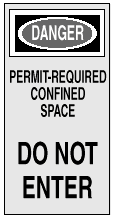
Exposed employees must be informed of the existence and location of and the danger posed by permit-required confined spaces through the posting of signs or by any other equally effective means.
A sign reading “DANGER-PERMIT-REQUIRED CONFINED SPACE, DO NOT ENTER” or using other similar language would satisfy the requirement for a sign. The completed permit for entry into a permit-required confined space must be made available at the time of entry to all authorized entrants, by posting it at the entry portal or by any other equally effective means, so that the entrants can confirm that pre-entry preparations have been completed.
Under the permit space program, the employer shall provide pedestrian, vehicle, or other barriers and shields as necessary to protect entrants from external hazards. This equipment must be provided at no cost to employees and maintained properly, and the employer must ensure that employees use that equipment properly.
Before entry is authorized, the employer shall document the completion of measures required by §1910.146(d)(3) by preparing an entry permit. Before entry begins, the entry supervisor identified on the permit shall sign the entry permit to authorize entry. The completed permit must be made available at the time of entry to all authorized entrants or their authorized representatives, by posting it at the entry portal or by any other equally effective means, so that the entrants can confirm that pre-entry preparations have been completed.
Control Of Hazardous Energy(Lockout/Tagout)
§1910.147(c)(2), (c)(5), (c)(7)(ii), (d)(4)
If an energy isolating device is not capable of being locked out, the employer's energy control program under paragraph (c)(1) of this section shall utilize a tagout system. If an energy isolating device is capable of being locked out, the employer's energy control program under paragraph (c)(1) of this section shall utilize lockout, unless the employer can demonstrate that the utilization of a tagout system will provide full employee protection as set forth in paragraph (c)(3) of this section. After January 2, 1990, whenever replacement or major repair, renovation or modification of a machine or equipment is performed, and whenever new machines or equipment are installed, energy isolating devices for such machine or equipment shall be designed to accept a lockout device.
Protective Materials and Hardware
Locks, tags, chains, wedges, key blocks, adapter pins, self-locking fasteners, or other hardware shall be provided by the employer for isolating, securing or blocking of machines or equipment from energy sources. Lockout devices and tagout devices shall be singularly identified; shall be the only device(s) used for controlling energy; shall not be used for other purposes; and shall meet the following requirements:
Durable. Lockout and tagout devices shall be capable of withstanding the environment to which they are exposed for the maximum period of time that exposure is expected. Tagout devices shall be constructed and printed so that exposure to weather conditions or wet and damp locations will not cause the tag to deteriorate or the message on the tag to become illegible. Tags shall not deteriorate when used in corrosive environments such as areas where acid and alkali chemicals are handled and stored.
Standardized. Lockout and tagout devices shall be standardized within the facility in at least one of the following criteria: Color; shape; or size; and additionally, in the case of tagout devices, print and format shall be standardized.
Substantial Lockout devices. Lockout devices shall be substantial enough to prevent removal without the use of excessive force or unusual techniques, such as with the use of bolt cutters or other metal cutting tools. Tagout devices, including their means of attachment, shall be substantial enough to prevent inadvertent or accidental removal. Tagout device attachment means shall be of a non-reusable type, attachable by hand, self-locking, and non-releasable with a minimum unlocking strength of no less than 50 pounds and having the general design and basic characteristics of being at least equivalent to a one-piece, all-environment-tolerant nylon cable tie.
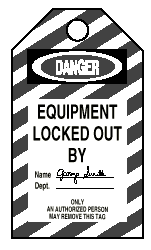
Identifiable. Lockout devices and tagout devices shall indicate the identity of the employee applying the device(s).
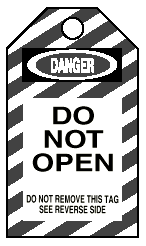
Tagout devices shall warn against hazardous conditions if the machine or equipment is energized and shall include a legend such as the following: Do Not Start, Do Not Open, Do Not Close, Do Not Energize, Do Not Operate.
Training and Communication
When tagout systems are used, employees shall also be trained in the following limitations of tags:
- Tags are essentially warning devices affixed to energy isolating devices, and do not provide the physical restraint on those devices that is provided by a lock.
- When a tag is attached to an energy isolating means, it is not to be removed without authorization of the authorized person responsible for it, and it is never to be bypassed, ignored, or otherwise defeated.
- Tags must be legible and understandable by all authorized employees, affected employees, and all other employees whose work operations are or may be in the area, in order to be effective.
- Tags and their means of attachment must be made of materials which will withstand the environmental conditions encountered in the workplace.
- Tags may evoke a false sense of security, and their meaning needs to be understood as part of the overall energy control program.
- Tags must be securely attached to energy isolating devices so that they cannot be inadvertently or accidentally detached during use.
Lockout or Tagout Device Application
Lockout or tagout devices shall be affixed to each energy isolating device by authorized employees. Tagout devices, where used, shall be affixed in such a manner as will clearly indicate that the operation or movement of energy isolating devices from the "safe" or "off" position is prohibited. Where tagout devices are used with energy isolating devices designed with the capability of being locked, the tag attachment shall be fastened at the same point at which the lock would have been attached. Where a tag cannot be affixed directly to the energy isolating device, the tag shall be located as close as safely possible to the device, in a position that will be immediately obvious to anyone attempting to operate the device.
['Hazard Communication', 'Confined Spaces', 'Signs and Markings', 'Lockout/Tagout']
['Hazcom Labeling', 'Safety Color Coding', 'Lockout/Tagout', 'Confined Spaces', 'Signs and Markings']
UPGRADE TO CONTINUE READING