Compliance Just Got Easier: Stay ahead of regulatory changes with instant notifications on updates that matter.
['Cranes, Lifts, and Scaffolding']
['Derricks', 'Cranes, Lifts, and Scaffolding']
04/17/2026

Copyright 2026 J. J. Keller & Associate, Inc. For re-use options please contact copyright@jjkeller.com or call 800-558-5011.
See Part 1 for sections I-III.
See Part 2 for section IV, Authority Citations to Subpart CC, §1926.1417.
See Part 4 for section V to end.
IV. Summary and Explanation of the Rule, Subpart CC (continued)
Section 1926.1418 Authority To Stop Operation
This section provides that whenever there is a concern as to safety, the operator has the authority to stop and refuse to handle loads until a qualified person has determined that safety has been assured. Section 1926.1401 defines "qualified person" as a person who, by possession of a recognized degree, certificate, or professional standing, or who by extensive knowledge, training and experience, successfully demonstrated the ability to solve/ resolve problems relating to the subject matter, the work, or the project.
Section 1926.1418 continues the long-standing requirements under subpart N and current consensus standards. (See former §1926.550(b)(2), incorporating by reference ANSI B30.5-1968, sec. 5-3.1.3(d).) As discussed in the proposed rule preamble, a capable equipment operator is highly knowledgeable in matters affecting equipment safety and is well qualified to determine whether an operation presents a safety concern (see 73 FR 59795-59796, Oct. 9, 2008). Under the provision, operations would be prohibited from resuming "until a qualified person had determined that safety has been assured," meaning that operations could resume only after the qualified person either: (1) assesses the factors that led the operator to stop and refuse to handle the load and determines that there is not, in fact, a safety hazard, or (2) after corrective action has been taken, determines that there is no longer a safety hazard.
Current consensus standards specify that an operator with a safety concern must raise that concern with a supervisor before proceeding with a lift. See sec. 5-3.1.3(d) of ASME B30.5-2004, "Mobile and Locomotive Cranes," sec. 2-3.1.7 of ASME B30.2-2001, "Overhead and Gantry Cranes," sec. 3-3.1.3(d) of ASME B30.3-1996, "Construction Tower Cranes," sec. 6-3.2.3 of ASME B30.6-2003, "Derricks," and other standards in the ASME B30 series.
One commenter argued that OSHA lacks the authority to promulgate §1926.1418. (ID-0232.1.) First, the commenter contended that the provision exceeds the Agency's standards-setting authority under sec. 3(8) of the OSH Act. Second, it expresses concern that §1926.1418 circumvents the limitations on OSHA's ability to grant employees (i.e., crane operators) stop-work authority. In support of its position, the commenter cited the U.S. Supreme Court opinions in Industrial Union Dep't, AFL-CIO v. American Petroleum Institute and Whirlpool Corp. v. Marshall.
The commenter nominated a C-DAC member who did not dissent on this section of the standard. The commenter has not explained why it has changed its position from the one taken by their C-DAC member during negotiations. In light of the unexplained inconsistency of its position, the Agency accords diminished weight to the commenter's comment and is hesitant to rely on it to undermine the product of the negotiation.
448 U.S. 607 (1980).
445 U.S. 1 (1980).
OSHA disagrees with the commenter's contention that OSHA lacks the authority to promulgate §1926.1418. Under sec. 3(8) of the OSH Act and applicable case law, the Agency has broad authority to promulgate standards that are reasonably necessary or appropriate to provide safe or healthful places of employment. In Whirlpool Corp., the U.S. Supreme Court stated that the Act "does not wait for an employee to die or become injured." Section 1926.1418 is an essential mechanism for preventing fatalities and injuries. It enables the person who has the expertise to recognize a safety concern and is best positioned to act quickly to do so where such a concern arises.
E.g., Indus. Union Dep't, AFL-CIO, 448 U.S. at 611-12.
445 U.S. at 12.
As stated above, current consensus standards manifest the industry's recognition of the necessity for a crane operator to have such authority. In concert with §1926.1400(f), §1926.1418 requires the employer to authorize its crane operator to halt operations upon a safety concern until a qualified person determines that safety has been assured.
OSHA also disagrees with the commenter's contention that §1926.1418 impermissibly grants stop- work authority, as well as a different commenter who asserted that the wording of the provision is too vague and could lead to an abuse of the operator's authority. Both commenters suggested that OSHA limit the operator's authority to specific reasons involving a potential violation of a requirement in subpart CC. (ID-0218.1; 0232.1.)
The provision does not authorize an operator to stop operations for reasons unrelated to a good faith belief that there may be a safety problem. In this respect the provision is similar to other provisions in the standard (and elsewhere in 29 CFR part 1926) in which an employer is required to have a person in a specialized role perform specific tasks involving the application of expertise (e.g., competent and qualified persons performing inspections under §1926.1412). In each case compliance with the standard is predicated on the good faith application of that expertise.
Two organizations that nominated C-DAC members reminded the Agency in their comments that OSHA had committed during the C-DAC negotiations to include a discussion in the preamble regarding this principle of good faith. (ID-0205.1;-213.1.) The Agency believes that the foregoing paragraph satisfies that agreement.
C-DAC thoroughly discussed the wording of this provision, mindful of the need for both clarity and sufficient flexibility to enable the operator to address myriad circumstances. The Committee's wording strikes an appropriate balance. The word "concern" refers to a good faith belief that safety may be in jeopardy. The word "assured" means that the qualified person has assessed whatever triggered the crane operator's belief that there was a concern as to safety and either: (1) Determines that there is not, in fact, a safety hazard, or (2) after corrective action is taken, determines that there is no longer a safety hazard.
OSHA disagrees with the commenter's suggestion to link the authority to a violation of subpart CC. While C-DAC and the Agency have made every effort to address the hazards associated with crane and derrick operation, there may be circumstances that present hazards that have not been anticipated here.
In addition, a particular situation may not be immediately recognized as falling within one of subpart CC's provisions. An operator's uncertainty in that regard could lead him/her to hesitate to exercise the authority even where it needs to be applied. Also, the determination by a qualified person to proceed with operations needs to be based on whether safety is assured, not on the resolution of a debate about whether the operator's concern fits within a provision of this standard.
Another commenter expressed the following concerns: "qualified person" should be better defined; the qualified person would feel undue pressure from the controlling entity or crane employer to find that safety had been assured, and that the qualified person's scope of responsibility once operations resume is unclear. (ID-0218.1.)
As explained in the preamble to the proposed rule, the definition of "qualified person" in §1926.1401 corresponds to the definition of "qualified" in §1926.32(m) and reflects the fact that the duties assigned to "qualified persons" here are similar to those assigned under other construction standards. The Committee intentionally used the same definition to make it clear that employers could rely on their current understanding of "qualified person." OSHA sees no reason to deviate from that definition where the commenter did not explain how it viewed the definition as vague or provide alternative language.
With respect to the issue of undue pressure on the qualified person, C-DAC shared the commenter's concern; the Committee identified pressure placed by some employers on operators to proceed with unsafe lifts as a significant problem in the industry. This led C-DAC, for example, to include the specific prohibition in §1926.1417(o)(2) against requiring an operator to operate the equipment in excess of its rated capacity (see the discussion of §1926.1417(o)(2) in 73 FR 59792-59793, Oct. 9, 2008). The commenter did not suggest, and OSHA is not aware of, any additional measures that could be included in the standard to help prevent the application of that type of pressure.
As to the commenter's final point, after a crane operator stops and refuses to proceed with operations due to a concern as to safety, the qualified person would then assess the situation and determine whether or when safety has been assured. At that point, the qualified person's responsibilities under §1926.1418 would be completed unless and until the crane operator identifies another concern as to safety. The Agency, therefore, is promulgating this provision as proposed.
Sections 1926.1419 Through 1926.1422 Signals
Sections 1926.1419 through 1926.1422 address the circumstances under which a signal person must be provided, the type of signals to be used, criteria for how signals are transmitted, and other criteria associated with the use of signals.
OSHA has decided to replace the term "lift supervisor" with the term "lift director" in §§1926.1419(c)(2), 1926.1421(a), and 1926.1421(c). This decision was made to be consistent with the similar change from "A/D supervisor" to "A/D director" in §1926.1404(a). For an explanation of the change, see the discussion of §1926.1404(a).
Section 1926.1419 Signals-General Requirements
This section sets requirements regarding signals when using equipment covered by this standard. C-DAC determined that addressing these issues is one of the means by which the number of injuries and fatalities caused by "struck-by" incidents, in which the equipment or load strikes an employee, can be reduced.
Paragraph (a)
Paragraphs (a)(1) through (a)(3) of this section address the circumstances that require the use of a signal person: (1) When the point of operation, meaning the load travel path or the area near or at load placement, is not in full view of the operator (§1926.1419(a)(1)); (2) when the equipment is traveling and the operator's view in the direction of travel is obstructed (§1926.1419(a)(2)); and (3) when, due to site specific safety concerns, either the operator or the person handling the load determines it is necessary (§1926.1419(a)(3)). The first two of these circumstances involve an obvious hazard-limited operator visibility. With respect to the third circumstance, C-DAC determined that other situations arise that, from a safety standpoint, necessitate the use of a signal person (see examples in the preamble to the proposed rule at 73 FR 59796, Oct. 9, 2008).
One commenter, representing the interests of the material delivery industry, suggested that §1926.1419(a) be changed to specify that, if a signal person is needed at the site due to the obstructed view of the operator when delivering building materials, then the construction site customer (not the material delivery employer) would be responsible for providing the signal person. (ID-0184.1.) OSHA concludes that the question of whether the material delivery employer or the construction site customer should bear the cost of providing the signal person when required is an economic issue that is most appropriately left to the parties to resolve.
During the public hearing, a labor representative stated that his organization believes that a signal person is always necessary when working with cranes. (ID-0343.) Two commenters representing the materials delivery industry disagreed (ID-0184.1;-0218.1.)
OSHA has decided to defer to the expertise of the Committee, which found that a signal person should only be required in the three circumstances listed in §1926.1419(a). Moreover, OSHA notes the requirement in §1926.1419(a)(3), which provides that a signal person must be provided if the crane operator or person handling the load determines a signal person is necessary due to site specific safety concerns. This provision, in particular, ensures that a signal person will be required when necessary.
One commenter asked for clarification on the meaning of "full view of the operator" in §1926.1419(a)(1). (ID-292.1.) In particular, the commenter asked whether mirror or camera systems would meet this requirement. Another commenter suggested adding language allowing the use of boom mounted video cameras for blind lifts. (ID-0120.0.)
A live video system that provides a full view to the crane operator-i.e., provides a sufficiently broad, clear and detailed view to enable the operator to see all that is needed to operate the equipment safely-would meet the "full view of the operator" requirement. Mirrors, on the other hand, typically distort images or distances and thus would not normally be sufficient to provide a "full view."
The sufficiency of any system will depend on the particular needs posed by each situation. For this reason, OSHA has decided to rely on C-DAC's clear and succinct phrase, "full view of the operator," rather than to attempt to further define that concept or to list acceptable devices in the regulatory text.
Paragraph (b) Types of Signals
As explained in the proposed rule preamble, under paragraph (b) of this section, signals to crane operators would have to be by hand, voice, audible, or "new" signals (see 73 FR 59796-59797, Oct. 9, 2008). As used in this standard, these terms refer to the type of signal, not the means by which the signal is transmitted. For example, signaling by voice refers to oral communication, not whether the oral communication is done with or without amplification or with or without electronic transmission. The manner of transmission of the signal is addressed separately. No comments were received on this paragraph; it is promulgated as proposed.
The criteria for the use of these signal types are set out in §§1926.1419(c)-(m) (additional voice signal requirements are in §1926.1421, Signals-voice signals-additional requirements). The Committee's intent was to reduce the potential for miscommunication, which can lead to injuries and fatalities, particularly from "struck-by" and "crushed-by" incidents. In setting parameters for the use of the various types of existing signal methods, and for signal methods that may be developed in the future, the Committee sought to promote a degree of standardization while still allowing appropriate flexibility. In addition, the provisions are designed to ensure that the selection of signal type and means of sending the signals are appropriate under the circumstances and reliable.
Paragraph (c) Hand Signals
Paragraph (c) of this section addresses the use of hand signals. The industry has long recognized the need for consistent, universal hand signals to minimize the potential for miscommunication between signal persons and operators. ANSI B30.5-1968, "Crawler, Locomotive and Truck Cranes," contains illustrations of hand signals that are the same as the current 2004 edition of ASME B30.5 and that are consistent with hand signals for other types of cranes in ASME B30 standards. The same hand signals have been expressed in similar charts published by a variety of other groups. (See, e.g., Construction Safety Association of Ontario, MIOSHA, MSHA.)
Because of the industry's long familiarity with these standard hand signals, C-DAC determined that, when using hand signals, the standardized version of the signals should continue to be required. These signals, which are located in Appendix A, are referred to as the "Standard Method," and this term is defined in §1926.1401 as "the protocol in Appendix A for hand signals." However, the Committee recognized that there are instances when use of the Standard Method is either infeasible or where there is no Standard Method signal applicable to the work being done.
In such instances, under this paragraph, non-standard signals may be used. To avoid confusion when non-standard signals are used, proposed §1926.1419(c)(2) requires that the signal person, crane operator, and lift director (where there is one) meet prior to the operation to agree upon the signals that will be used.
At the public hearing, one witness commented that the use of non-standard hand signals should not be allowed because it would unnecessarily confuse contractors and utility workers, and because standard signals are already used in the industry. (ID-345.17.) OSHA defers to the expertise of the Committee, which found that a non-standard signal may be needed on occasion (see 73 FR 59797, Oct. 9, 2008, in which the Agency described examples of such situations). Additionally, it should be noted that §1926.1419(c) requires the use of Standard Method hand signals and permits an exception only where the Standard Method signals are infeasible or where there is no Standard Method signal for the particular attachment.
One commenter pointed out that there are currently no hand signals specific to articulating cranes and asked which signals OSHA intended to be used with articulating cranes. (ID-0206.1.) The record contains no information on the extent to which hand signals for articulating cranes may differ from those used for other cranes. If the use of Standard Method hand signals is either infeasible for articulating cranes, or if the use or operation of an attachment is not covered by the Standard Method, then the exception in §1926.1419(c)(1) and the requirements for non-standard hand signals in §1926.1419(c)(2) would apply.
OSHA is only making two changes, neither of which is substantive, from §1926.1419(c) as proposed. The first is a grammatical correction, and the second merely removes the superfluous direction that "[t]he following requirements apply to the use of non-standard hand signals," which is already clear from the text of §1926.1419(c)(2).
Paragraph (d) New Signals
Paragraph (d) of this section allows signals other than hand, voice, or audible signals to be used if certain criteria are met. As explained in the discussion of §1926.1419(b) in the preamble to the proposed rule, C-DAC included §1926.1419(d) to allow for the development of new signals in the future (see 73 FR 59796-59797, Oct. 9, 2008). To ensure that any new signals developed by a particular employer are as effective as hand, voice, or audible signals, §§1926.1419(d)(1) and (d)(2) require the employer to demonstrate that the new signals are as effective as existing signals for communicating. Alternatively, an employer may use signals that comply with a national consensus standard. OSHA decided to change the language of paragraph (d)(2) to clarify that an employer's signals must comply with the national consensus standard signals. C-DAC determined it was appropriate to allow reliance on signals in a national consensus standard because their inclusion in such a standard shows a high degree of standardization and widespread acceptance by persons who are affected by the signals, thereby ensuring that the signals can be used safely to control equipment operations and preventing the "on the fly" development of signals cited as dangerous by the commenter. (ID-0110.1.)
The C-DAC draft refers to an "industry consensus standard." OSHA has changed this to "national consensus standard" to conform to the terminology used in the OSH Act. See definition in section 3(9) of the Act.
Paragraph (e) Suitability
Under paragraph (e) of this section, the type of signal (hand, voice, audible, or new) and the transmission method used must be suitable for the site conditions. For example, hand signals would not be suitable if site conditions do not allow for the signal person to be within the operator's line of sight. Radio signals would not be suitable if electronic interference on the site prohibits the signals from being readily understood.
One commenter requested that the determination of which type and means of signaling is appropriate for the site conditions be made by the crane operator or other qualified person. (ID-0172.1.)
The Agency concludes that this is a straight-forward determination that does not require the specialized expertise of a qualified person. Also, the crane operator will typically be involved in this determination, since there are several requirements relating to effective communication that, as a practical matter, will typically involve input from the operator (see, for example, §§1926.1419(f), 1926.1420(a), and 1926.1421(c)).
Paragraph (f)
Paragraph (f) of this section requires the ability to transmit signals between the operator and signal person to be maintained. If that ability is interrupted, the operator is required to safely stop operations until signal transmission is reestablished and a proper signal is given and understood. No comments were received on this provision; it is included in the final rule without change.
Paragraph (g)
As explained in the preamble to the proposed rule, paragraph (g) of this section requires the operator to stop operations if the operator becomes aware of a safety problem and needs to communicate with the signal person (see 73 FR 59797, Oct. 9, 2008). Operations may only be resumed after the operator and signal person agree that the problem has been resolved.
No comments were received on this provision; it is included in the final rule without change.
Paragraphs (h) and (j)
Paragraph (h) of this section requires that only one person at a time signal the operator. As explained in the preamble to the proposed rule, C-DAC determined this provision was needed to prevent confusion with respect to which signals the operator is supposed to follow (see 73 FR 59797, Oct. 9, 2008). An exception is provided in §1926.1419(j) to address situations when somebody becomes aware of a safety problem and gives an emergency stop signal. Under §1926.1417(y), the operator is required to obey such a signal. No comments were received on either of these provisions; they are included in the final rule without substantive change. OSHA has modified paragraph (h) to clarify that it is a requirement.
Paragraph (i) [Reserved.]
Paragraph (k)
As explained in the preamble to the proposed rule, paragraph (k) of this section requires that all directions given to the operator by the signal person be given from the operator's direction perspective, meaning that the signal person must provide the signals as if he or she was sitting in the operator's seat and facing the same direction as the operator (see 73 FR 59797, Oct. 9, 2008). In the Committee's experience, the operator will tend to react to a directional signal, such as "forward," by acting on the signal from the operator's perspective. This provision ensures that the signal that is given will be consistent with that natural tendency. No comments were received on this provision; it is included in the final rule without change.
Paragraph (l) [Reserved.]
Paragraph (m) Communication With Multiple Cranes/Derricks
Paragraph (m) of this section addresses a situation where one or more signal person(s) is in communication with more than one crane or derrick (for example, during multiple crane lifts). It requires each signal person to use an effective means of identifying which crane or derrick the signal is for. Sections 1926.1419(m)(i) and (ii) set out alternate means of complying with this requirement. Under §1926.1419(m)(i), for each signal the signal person must, prior to giving the function/direction, identify the crane/derrick for which the signal is intended. Alternatively, under §1926.1419(m)(ii), the employer could implement a method of identifying the crane/derrick for which the signal is intended that is as effective as the system in §1926.1419(m)(i). For example, under §1926.1419(m)(ii), the signal person could simultaneously identify the crane and provide the signal. Because of the potential for confusion, it is essential that an alternative system under §1926.1419(m)(ii) be equally effective as §1926.1419(m)(i) in clearly conveying, on a consistent basis, the crane/derrick to which each signal is directed. No comments were received on this provision; it is included in the final rule without substantive change. The wording of the paragraph has been modified with several minor grammatical changes.
Section 1926.1420 Signals-Radio, Telephone, or Other Electronic Transmission of Signals
C-DAC concluded that certain criteria are needed to ensure the reliability and clarity of electronically transmitted signals; these criteria are listed in §§1926.1420(a) through (c). Paragraph (a) of this section requires the testing of the transmission devices prior to the start of operations to make certain that the signals are clear and that the devices are reliable. This helps ensure that the operator receives, and can understand, the signals that are given, and will prevent accidents caused by miscommunication.
One commenter, remarking that a second or two of delay may still pose a significant safety hazard, suggested that §1926.1420(b) be amended to read, "Signal transmission must be through a dedicated channel without noticeable delay * * *." (ID-0172.1.)
OSHA agrees that a noticeable delay in transmission of an electronic signal could pose a significant hazard and has decided to address this concern by adding the requirement that signal transmission be "effective." To be effective, a transmitted signal must produce or be capable of producing the intended result. In other words, a signal must be transmitted and understood by the crane operator in such a way and within such a time as would allow the operator to respond to the signal and operate the crane in a safe manner.
Paragraph (b) of this section requires that signals be transmitted through a dedicated channel. As defined in §1926.1401, a "dedicated channel" is "a line of communication assigned by the employer who controls the communication system to only one signal person and crane/derrick or to a coordinated group of cranes/derricks/ signal person(s)." Use of a dedicated channel ensures that the operator and signal person are not interrupted by users performing other tasks or confused or distracted by instructions not intended for them.
An exception to §1926.1419(b) allows more than one signal person and more than one crane/derrick operator to share a dedicated channel in multiple crane/ derrick situations for coordinating operations. The Committee determined, and OSHA agrees, that this exception is needed because, in those situations, it may be advantageous to share a single dedicated channel. For example, in some situations several cranes may be operating in an area in which their booms, loads or load lines could come in contact with each other. In such cases it is crucial that the movements of each crane be properly coordinated. By sharing a single channel, each operator can hear what each crane is being asked to do, which can facilitate that coordination.
Several commenters representing the railroad industry raised concerns about the dedicated channel requirement as it relates to the use of cranes on or adjacent to railroad tracks. (ID-0170.1;-0176.1;-0291.1.) These commenters pointed out that the actions of crane operators often have to be coordinated with other moving equipment (e.g. trains) and that the use of a dedicated channel in these circumstances would actually be more dangerous.
The commenters' points in this regard are persuasive; OSHA has accordingly added §1926.1420(b)(2). This allows an exception to the use of a dedicated channel when a crane is being operated on or near railroad tracks and the crane operator must coordinate with the movement of other equipment on or near the railroad tracks.
Paragraph (c) of this section requires that the operator's reception be by a hands-free system. In other words, the operator must not have to depress a button, manipulate a switch, or take any action for the incoming signal to be received. C-DAC determined that this provision is needed because the operator must have both hands free to manipulate the equipment's controls. No comments were received on this provision; it is included in the final rule without change.
Section 1926.1421 Signals-Voice Signals-Additional Requirements
C-DAC considered whether the rule should include a standardized set of voice signals. Unlike hand signals, which have become standardized to a large extent within the industry, in the Committee members' experience there is significant variation in the phrases used to convey the same instructions. Consequently, C-DAC was concerned that words or phrases that it might have chosen to be "standard" voice signals could be unfamiliar to many employees in the industry or contrary to common usage in some parts of the country. In light of this, the Committee determined that it would be better to use a different approach to address the problem of miscommunication when using voice signals. This approach, which establishes criteria for whatever voice signals are used, is set out in §§1926.1421(a)-(c).
Under paragraph (a) of this section, prior to beginning operations, the personnel involved with signals-the crane operator, signal person and lift director (if there is one)-are required to meet and agree on the voice signals that will be used. Because of the lack of standardization and the variety of languages that are in use in the construction industry, the Committee concluded that it is essential that the persons who give and/or receive voice signals agree in advance on the signals that will be used to avoid miscommunication. OSHA agrees. Once the parties have met and agreed on the voice signals, another meeting is not required to discuss them unless another worker is added or substituted, there is some confusion about the signals, or a signal needs to be changed.
Section 1926.1421(b) requires that each voice signal contain the following three elements, given in the following order: function (such as hoist, boom, etc.), direction; distance and/or speed; function, stop command. For example: hoist up; 10 feet; hoist stop. As discussed above, the Committee considered it impractical to attempt to standardize the voice signals themselves (that is, to require the use of particular words to represent particular functions, directions or other instructions). However, the Committee concluded that the chance of miscommunication could nonetheless be reduced if certain parameters were established for the type of information and order of information that would be given. OSHA agrees.
Section 1926.1421(c) requires the crane operator, signal person, and lift director (if there is one) to be able to effectively communicate in the language used. Voice signals will not serve their intended purpose if they cannot be understood, or can be misinterpreted. The inability of these workers to understand each other could lead to accidents that occur when, for example, the crane operator moves a load in a different direction than the signal person intends.
One commenter suggested that uniform verbal signals were necessary to limit the likelihood of miscommunications resulting from language barriers. (ID-0379.1.) Three commenters suggested that OSHA establish uniform verbal signals enhanced by diagrams and pictures. (ID-0110.1;-0115.1;-0178.1.) Two of these commenters suggested that OSHA require these verbal signal charts to be conspicuously posted in the vicinity of the hoisting operations. (ID-0110.1;-0115.1.)
As discussed above, C-DAC considered whether the rule should include a standardized set of voice signals and decided that it would not be practical to do so. It did, however, address the potential for miscommunication by developing the requirements in §1926.1421(a) (requiring a meeting between the operator, signal person and lift director to determine which verbal signals will be used). Having received no evidence to the contrary, OSHA has decided to defer to the expertise of the Committee, and is promulgating this requirement without substantive change. The word "shall" is replaced with "must" in paragraphs (b) and (c) to remove any doubt that the sentences are imperative commands, rather than descriptive.
Section 1926.1422 Signals-Hand Signal Chart
Section 1926.1422 requires that hand signal charts be posted on the equipment or readily available at the site. OSHA is requiring the charts to be posted to serve as a reference for operators and signal persons of the mandatory hand signals and thereby help avoid miscommunication.
Three commenters suggested that §1926.1422 be rewritten to require that the hand signal charts be "conspicuously posted in the vicinity of" the hoisting operations, rather than merely making them "readily available at the site" as proposed. (ID-0110.1;-0115.1;-0178.1.)
Upon further reflection, the Agency acknowledges that the original language (that the hand signal chart could be "readily available at the site") did not afford the same amount of protection afforded by "conspicuously posted in the vicinity of the hoisting operations." For example, a hand signal chart stored in a shop trailer on the other side of the site or obscured from sight by other objects might be "readily available at the site," but it would do little to ensure that the chart would be accessed by employees where it is needed. It is the Agency's intent that employees be able to access the chart quickly. OSHA therefore decided to modify the language of §1926.1422 to require that signal charts be conspicuously posted in the vicinity of hoisting operations, or on the equipment.
Section 1926.1423 Fall Protection
This section contains provisions designed to protect workers on equipment covered by this subpart from fall hazards. (See §1926.1431, Hoisting Personnel, for fall protection provisions that apply when equipment is used to hoist personnel).
Falls have traditionally been the leading cause of deaths among construction workers. BLS data for 2004 and 2005, the latest years for which complete figures are available, shows 445 fatalities from falls in 2004 (ID-0023) and 394 in 2005 (ID-0024). In 2004, 20 fatalities resulted from falls from nonmoving vehicles and in 2005, such falls caused 18 deaths. A recent study of crane-related fatalities in the U.S. construction industry found that 2% resulted from falls. J.E. Beavers, J.R. Moore, R. Rinehart, and W.R. Schriver, "Crane-Related Fatalities in the Construction Industry," 132 Journal of Construction Engineering and Management 901 (Sept. 2006). (ID-0012.) Falls from cranes, particularly when the operator is entering or leaving the crane, also cause numerous non-fatal injuries to construction workers. (OSHA-S030-2006-0663-0422.)
As discussed in the preamble to the proposed rule, the Committee determined that safety would be enhanced by addressing the problem of fall hazards associated with cranes and derricks comprehensively and that putting all such requirements in subpart CC would make it easier for employers to readily determine the applicable fall protection requirements (see 73 FR 59799, Oct. 9, 2008). Accordingly, under the final rule, subpart M does not apply to equipment covered by subpart CC except where §1926.1423 incorporates requirements of subpart M by reference.
In this regard, the Agency has amended subpart M at §1926.500(a)(2)(ii) to make clear that subpart CC specifies the circumstances in which fall protection must be provided to workers on equipment covered by subpart CC. The Agency has also amended §1926.500(a)(3) to state that the criteria for fall protection systems required under subpart CC are as set forth in §1926.1423 of subpart CC. In addition, §1926.500(a)(4) has been amended to specify that the training requirements in §1926.503 do not apply to the use of equipment covered by subpart CC. These amendments to §1926.500 are discussed in the explanation of amendments to subpart M.
Definition of "Fall Protection Equipment"
"Fall protection equipment" is defined in §1926.1401, and is limited to guardrail systems, safety net systems, personal fall arrest systems, positioning device systems, and fall restraint systems. One commenter stated that this definition should be changed to that found in ANSI/ASSE Z359.0-2007, Definitions and Nomenclature used for Fall Protection and Fall Arrest, which defines "fall protection" more broadly to include any equipment, device, or system that either prevents a fall or mitigates the effect of a fall. (ID-0178.1.) However, as OSHA explained in the proposed rule, the proposed definition was chosen to use the same terminology found in other OSHA standards to ensure that employers would be familiar with the terminology (see 73 FR 59799, Oct. 9, 2008). Moreover, OSHA notes that sec. 1.3.1 of ANSI/ASSE Z359.0- 2007 provides that the scope of that standard does not include the construction industry. Accordingly, OSHA is retaining the proposed definition in the final rule.
Definition of "Positioning Device System"
A trade association objected to the lack of definitions for "fall arrest" or "positioning systems." (ID-0178.1.) OSHA notes that proposed §1926.1401 did contain a definition for "personal fall arrest system," and that definition is included in the final rule. OSHA agrees that a definition of "positioning device system" is needed and is adding a definition to §1926.1401 in the final rule that is the same as the definition found in subpart M.
Paragraph (a) Application
Section 1926.1423(a) specifies which provisions in this section apply to all equipment, including tower cranes (§§1926.1423(c)(1), (c)(2), (d), (g), (j) and (k)); which provisions apply to all equipment except tower cranes (§§1926.1423(b), (c) (3), (e) and (f)); and which provisions apply only to tower cranes (§§1926.1423(c)(4) and (h)).
Paragraph (b) Boom Walkways
For the reasons explained in the preamble to the proposed rule, §1926.1423(b) addresses the hazard of falls from lattice booms by establishing when walkways must be incorporated into lattice booms, and the criteria for such walkways (see 73 FR 59799-59800, Oct. 9, 2008). No comments were received on this paragraph; it is included in the final rule without change.
Paragraph (c) Steps, Handholds, Ladders, Grabrails, Guardrails and Railings
Section 1926.1423(c) in the final rule specifies criteria for the use and maintenance of steps, handholds, ladders, grabrails, guardrails and railings. The Agency notes that proposed paragraph (c) inadvertently omitted "ladders" from the list of devices in the paragraph's heading. Accordingly, OSHA has revised final paragraph (c) to include the word ladders.
Section 1926.502(b) generally provides criteria for guardrail systems, with some exceptions (see discussion of amendments to §1926.500). C-DAC concluded, however, that specific criteria for steps, handholds, ladders, grabrails, guardrails and railings were necessary to address the design characteristics of equipment covered by subpart CC and the particular fall hazards associated with the use of such equipment.
OSHA agrees, and is therefore adding §1926.1423(c)(1), which states that §1926.502(b) (guardrail systems) must not apply to equipment covered by subpart CC, to the final rule. It makes clear that the guardrail criteria requirements in §1926.502(b) for those items do not apply to equipment covered by subpart CC. Instead, §§1926.1423(c)(2), (3), and (4), discussed below, provide the applicable criteria for such equipment. Because of the addition of paragraph (c)(1), which was not in the proposed rule, paragraphs (c)(2), (3), and (4) have been renumbered from the proposal, where they were paragraphs (c)(1), (2), and (3).
Paragraph (c)(2) of this section requires that the employer maintain in good condition originally-equipped steps, handholds, ladders and guardrails/railings/grabrails. The failure to properly maintain such devices could pose dangers to the workers who use them. For example, a grabrail would not be maintained in good condition if it has become weakened from rust. A weakened guardrail could fail when an employee uses it, which could cause the employee to fall. Likewise, a railing would not be maintained in good condition if all or part of the railing is missing. A manufacturer that integrated a railing into its boom design may have relied on the presence of the railing and provided a walking surface that would otherwise be too narrow to be safe.
OSHA has changed the location of the words "in good condition" in §1926.1423(b) to make it clear that it applies to maintenance of all of the listed items.
Paragraphs (c)(3) and (c)(4) of this section require that equipment manufactured more than one year after the effective date of this standard be equipped to provide safe access and egress on equipment covered by this subpart by the provision of devices such as steps, handholds, ladders, and guardrails/railings/grabrails. Tower cranes must be equipped to provide safe access and egress between the ground and the cab, machinery platforms, and tower (mast) (see below discussion of paragraph (c)(4)). All other equipment covered by this subpart must be equipped to provide safe access and egress between the ground and the operator work station(s), including the forward and rear operator positions. As discussed below, §§1926.1423(c)(3)(i) and 1926.1423(c)(4)(i) require the steps, handholds, ladders and guardrails/ railings/grabrails used to comply with this section to meet updated design criteria.
Prior to this final rule, former §1926.550(a)(13)(i) in subpart N required that guardrails, handholds, and steps be provided on cranes for easy access to the car and cab and specified that these devices conform to ANSI B30.5. The 1968 version of ANSI B30.5, which was in effect at the time subpart N was issued, specifies that the construction of these devices must conform to the 1946 U.S. Safety Appliance Standard. C-DAC recognized that many pieces of equipment now in use would have been manufactured with handholds and steps but was concerned that the handholds and steps may have been designed to meet outdated criteria.
The Committee determined, and OSHA agrees, that it would be unduly burdensome to require all equipment to be retrofitted with new steps, handholds, and railings simply because the existing design may vary from what is required under the final rule. Accordingly, §1926.1423(c)(3) only applies to equipment manufactured more than one year after the effective date of this standard. This gives equipment manufacturers adequate time to incorporate the requirements of §1926.1423(c)(3)(i) into their new products.
OSHA had added the word "devices" in the last sentence of paragraph (c)(3) for grammatical clarity.
Paragraph (c)(3)(i) requires that steps, handholds, ladders and guardrails/ railings/grabrails meet the criteria of SAE J185 (May 2003) or ISO 11660-2:1994(E). As explained above in the discussion of amendments to subpart X, OSHA amended subpart X to clarify that subpart X does not apply to integral components of equipment covered by subpart CC. The specifications in SAE J185 (May 2003) are referenced in other industry consensus standards, such as ASME B30.5-2004, "Mobile and Locomotive Cranes" and ASME B30.3-2004, "Construction Tower Cranes," and crane manufacturers are familiar with those requirements. Section 1926.1423(c)(3)(i) alternatively allows compliance with ISO 11660-2 because those provisions are sufficiently protective and employers also use equipment built by foreign manufacturers who have been following that standard.
OSHA notes that proposed §1926.1423(c)(2)(i) inadvertently omitted handholds from the listed devices that must meet the criteria of SAE J185 (May 2003) or ISO 11660-2:1994(E). Accordingly, OSHA has added handholds to the final rule in §1926.1423(c)(3)(i). Additionally, OSHA has replaced the word "requirements" in proposed §1926.1423(c)(2)(i) with "criteria" in the final §1926.1423(c)(3)(i). The Agency determines this change clarifies that the listed devices must comply with the design criteria contained in the referenced standards and that, for the purposes of §1926.1423(c)(3)(i), other provisions in the referenced standards do not apply. To illustrate, both SAE J185 (May 2003) and ISO 11660-2:1994(E) contain provisions relating to the scope of those standards. However, §1926.1400 sets forth the scope of equipment covered by subpart CC (see discussion above of §1926.1400, Scope). Consequently, §1926.1423(c)(3)(i) requires that steps, handholds, ladders, and guardrails/railings/grabrails on equipment covered by subpart CC (other than tower cranes) meet the criteria for such devices in SAE J185 (May 2003) or ISO 11660-2:1994(E), irrespective of the scope provisions in those consensus standards.
Proposed §1926.1423(c)(2)(i) corresponds with §1926.1423(c)(3)(i) in the final rule.
Paragraph (c)(3)(ii) of this section requires that walking/stepping surfaces, except for crawler treads, have slip-resistant features/properties (such as diamond plate metal, strategically placed grip tape, expanded metal, or slip-resistant paint). Former §1926.550(a)(13)(iii) of subpart N required platforms and walkways to have anti-skid surfaces. C-DAC recommended that OSHA retain this requirement as a complement to the use of guardrails, handholds, grabrails, ladders and other engineered safety features that are required by new §1926.1423. OSHA concludes that compliance with this provision will minimize the number of slips and falls for employees who must travel point to point to access the operator workstations on equipment covered by this section.
Paragraph (c)(4) of this section applies to fall protection on tower cranes. For the same reasons explained above with respect to §1926.1423(c)(3), §1926.1423(c)(4) likewise only applies to tower cranes manufactured more than one year after the effective date of this standard. Such equipment must be equipped so as to provide safe access and egress between the ground and the cab, machinery platforms, and tower (mast), by the provision of devices such as steps, handholds, ladders, and guardrails/railings/grabrails. In the preamble to the proposed rule, OSHA stated the Agency's intent to include a requirement to provide safe access and egress on tower cranes, similar to the requirement in final paragraph (c)(3) to provide safe access and egress on other equipment covered by subpart CC, and requested public comment on the issue (73 FR 59800, Oct. 9, 2008).
Three commenters responded, all stating that the final rule should include the requirement to provide safe access and egress on tower cranes. (ID-0182.1;-0205.1;-0213.1.) Accordingly, OSHA has added paragraph (c)(4) to the final rule.
Paragraph (c)(4)(i) of this section requires steps, handholds, ladders, and guardrails/railings/grabrails on these tower cranes to meet the criteria of ISO 11660-1:2008(E) and ISO 11660-3:2008(E), or SAE J185 (May 2003), except where infeasible. For the same reasoning discussed above with respect to §1926.1423(c)(3)(i), paragraph (c)(4)(i) allows employers to use equipment designed to the specifications of SAE J185 (May 2003) or, alternatively, ISO 11660-1:2008(E) and ISO 11660-3:2008(E).
The Agency notes that ISO 11660-1:2008(E) provides criteria applicable to cranes in general while ISO 11660-3:2008(E) provides criteria particular to tower cranes. The Agency reads the particular criteria in ISO 11660-3:2008(E) as supplementing the general criteria in ISO 11660-1:2008(E). Therefore, paragraph (c)(4)(i) would only be satisfied under this alternative if the steps, handholds, ladders and guardrails/railings/grabrails on the tower crane meet the criteria in both ISO 11660-1:2008(E) and ISO 11660-3:2008(E).
The Agency notes that the approach for the 2008 editions of ISO 11660-1 and ISO 11660-3 appears to differ from that of the ISO 11660-2:1994(E). The Agency interprets ISO 11660-2:1994(E) as addressing steps, handholds, ladders and guardrails/railings/grabrails independent of ISO 11660-1:2008(E).
Paragraph (c)(4)(ii) of this section requires walking/stepping surfaces on tower cranes to have slip-resistant features/properties, such as diamond plate metal, strategically placed grip tape, expanded metal, or slip-resistant paint. Similar to paragraph (c)(3)(ii) (see above discussion of paragraph (c)(3)(ii)), paragraph (c)(4)(ii) carries forward the anti-skid protections from former §1926.550(a)(13)(iii).
Paragraph (d) Personal Fall Arrest and Fall Restraint Systems
Paragraph (d) of this section addresses personal fall arrest systems and fall restraint systems used to satisfy the requirements under subpart CC to provide fall protection.
Paragraph (d) was not in the proposed rule but has been added to the final rule to make clear that certain appropriate requirements of subpart M apply to subpart CC. Paragraph (d) requires the use of personal fall arrest system components in personal fall arrest and fall restraint systems required by subpart CC. These systems must conform to all of the criteria in §1926.502 of subpart M, except §1926.502(d)(15). Section 1926.502(d)(15) provides general criteria for anchorages for personal fall arrest systems, but OSHA is choosing to apply the anchorage criteria in §1926.1423(g)(3) rather than the criteria in §1925.502(d)(15). This approach is consistent with the approach to requirements for personal fall arrest and fall restraint systems provided in §1926.760(d)(2) of subpart R, except for the exclusion of §1926.502(d)(15).
Paragraph (e) Fall Protection Requirements for Non-Assembly/ Disassembly Work
Paragraph (e) of this section addresses fall protection requirements for employees engaged in work other than assembly/disassembly work ("non-A/D" work). For such work, in certain circumstances, employers are required to provide and ensure the use of fall protection equipment for employees who are on a walking/working surface with an unprotected side or edge more than 6 feet above a lower level.
C-DAC discussed different trigger heights for fall protection requirements for particular types of cranes and derricks. Ultimately, C-DAC concluded that the requirements for fall protection should remain consistent with 29 CFR part 1926 subpart M, which generally requires fall protection at heights at and above 6 feet, as much as possible. (As discussed below, for assembly/ disassembly (A/D) work, the Committee recommended fall protection beginning at 15 feet.) C-DAC also determined that operators do not need to be tied off while moving to and from their cabs, and paragraph (e)(1) of this section, discussed below, therefore requires fall protection equipment only when employees are moving point-to-point on booms or while at a work station (with certain exceptions). The Committee determined that the steps, handholds, and railings required under §1926.1423(c) protect operators moving to and from their workstations and eliminate the need for additional fall protection equipment.
Paragraph (e)(1) Non-Assembly/ Disassembly: Moving Point to Point
Paragraph (e)(1)(i) of this section requires employers to provide and ensure the use of fall protection equipment at 6 feet and above when an employee is moving point to point on non-lattice booms (whether horizontal or not horizontal). Moving point to point is defined in §1926.1401 and refers to when an employee is going to or coming from a work station.
C-DAC determined that non-lattice booms generally present more hazards to workers who must walk them to reach other work areas, devices, and equipment attached to it than lattice booms. Non-lattice booms are typically of the extensible type. As a result, as members noted, the walking/working surfaces on these types of booms are often oily (from the hydraulic mechanisms). Also, since the boom sections extend and retract, it is typically infeasible to provide boom walkways and other safety features. Because they tend to be slippery from oil, the Committee concluded that they are especially hazardous to move across even when horizontal. Therefore, where an employee is required to move point to point on a non-lattice boom, the Agency decided to remain consistent with the requirements in 29 CFR part 1926 subpart M to require fall protection at heights at or above 6 feet and the final rule requires fall protection when the fall distance is greater than 6 feet.
Paragraph (e)(1)(ii) applies the same fall protection requirements to point to point movement on lattice booms that are not in a horizontal position. The Committee found that in non-A/D work, an employee may, for example, need to move point-to-point on a lattice boom to inspect a part that is suspected to need repair, or to make a repair (such as replacing a broken or missing cotter pin). In many of these situations, the boom will not be horizontal, since space limitations often make it difficult to lower the boom to do this work.
The Committee determined that it is both necessary and feasible for fall protection to be used in such instances. Typically, the fall protection that would be used would consist of a double-lanyard or similar personal fall arrest system. Since the boom in these instances would be elevated, there would usually be a point on the boom above the level of the employee's feet to which the lanyard could be attached.
In contrast, it is uncommon for an employee to need to move point-to-point on a horizontal lattice boom for non-A/D work. If work does need to be done, such as making an inspection or repair as discussed above, the employee would usually get access to their work station with a ladder. In those instances when the employee must traverse the boom itself, the Committee concluded that it would be inappropriate to require fall protection for the reasons discussed below.
The key difficulty in providing fall protection in such instances stems from the lack of a tie-off point above the level of the employee's feet. The Committee discussed that most lattice booms when horizontal would be less than 15 feet above the next lower level. At heights below 15 feet, a personal fall arrest system tied off at the level of the employee's feet, with a lanyard long enough to afford the employee the range of movement necessary for this work, might not prevent the employee from falling to the next lower level.
In construction work the problem of providing personal fall protection in this height range, when there is no higher tie-off point, is usually solved in one of three ways (apart from the use of ladders, scaffolds, aerial lifts, and similar devices). One way is to use a restraint system, which is anchored at a point that prevents the employee from moving past an edge. The Committee discussed that this type of system could not be used while on a boom because the boom is too narrow. Another method is to set up a personal fall arrest system that would arrest the employee's fall before hitting the next lower level by using stanchions to support an elevated, horizontal life-line. However, such stanchions must be securely fastened and whatever they are fastened to must be able to withstand considerable forces in an arrested fall. On a crane's lattice boom, the stanchions would have to be attached either to the chords or the lacings.
The chords and lacings are engineered to be as light as possible, and an engineering analysis would be needed in each case to determine if the attachment point was sufficiently strong to withstand those forces. Also, the Agency determines that manufacturers would be unlikely to approve clamp-on type systems because of the likelihood of the clamping forces damaging these critical structural components. Similarly, the Agency determines that manufacturers would not approve the repeated weld/removal/re-weld cycles that would be involved in attaching and removing stanchions because this could adversely affect the boom's structural components.
The third method commonly used in construction work is a temporary guardrail system, but that also would require attaching stanchions to the boom, which would be infeasible for these same reasons.
The Committee concluded that, in light of such factors, it would not be appropriate to require fall protection when an employee moves point-to-point on horizontal lattice booms. However, in the preamble to the proposed rule, the Agency noted that, although it may rarely be necessary for an employee moving point-to-point on a horizontal lattice boom to be 15 feet or more above the next lower level, there is the possibility of such an occurrence, such as where a horizontal boom spans a large gap in the ground surface. At such heights a personal fall arrest system tied off at the level of the employee's feet would allow sufficient room for the arrest system to operate without allowing the employee to strike the next lower level. Therefore, the Agency requested public comment on whether proposed §1926.1423(d)(1)(ii) should be expanded to require fall protection when an employee, engaged in non-A/D work, is moving point-to-point on a boom that is horizontal and the fall distance is 15 feet or more.
Proposed §1926.1423(d)(1)(ii) corresponds with final §1926.1423(e)(1)(ii).
OSHA received three comments on this issue. (ID-0182.1;-0205.1;-0213.1.) These commenters stated that the final rule should require fall protection when an employee, engaged in non-A/D work, is moving point-to-point on a boom that is horizontal and the fall distance is 15 feet or more. Accordingly, the Agency has added paragraph (e)(1)(iii) to the final rule to require fall protection under these circumstances. No comments were received on proposed paragraphs (d)(1)(i) and (ii), and they are included in the final rule without change as paragraphs (e)(1)(i) and (ii).
Paragraph (e)(2) Non-Assembly/ Disassembly: While at a Work Station
Paragraph (e)(2) of this section requires employers to provide and ensure the use of fall protection while an employee is at a work station on any part of the equipment (including the boom, of any type), except when the employee is at or near draw-works (when the equipment is running), in the cab, or on the deck (see the discussion of this in the preamble of the proposed rule, where this paragraph was denominated as §1926.1423(d)(2); 73 FR 59802, Oct. 9, 2008). No comments were received on this paragraph; it is included in the final rule without change other than its redesignation.
Paragraph (f) Assembly/Disassembly
Paragraph (f) of this section requires the employer to provide and ensure the use of fall protection equipment during assembly and disassembly (A/D) work for employees who are on a walking/ working surface with an unprotected side or edge more than 15 feet above a lower level, except when the employee is at or near draw-works (when the equipment is running), in the cab, or on the deck (see the discussion of this in the preamble of the proposed rule, where this paragraph was denominated as §1926.1423(e); 73 FR 59802, Oct. 9, 2008). No comments were received on this paragraph; it is included in the final rule without change other than its redesignation.
Paragraph (g) Anchorage Criteria
Paragraph (g) of this section requires the use of, and specifies criteria for, anchorage points in personal fall arrest systems, positioning device systems, and fall restraint systems. Paragraph (g)(1) provides that §§1926.502(d)(15) and 1926.502(e)(2) of subpart M apply to equipment covered by subpart CC only to the extent delineated in paragraph (g)(2). Sections 1926.502(d)(15) and 1926.502(e)(2) provide, respectively, anchorage criteria for personal fall arrest systems and positioning device systems. As discussed below with respect to paragraph (g)(2), C-DAC determined that the particular circumstances associated with the use of personal fall arrest systems and positioning device systems on equipment covered by subpart CC necessitate specific criteria for the anchorages of such systems. Therefore, OSHA added paragraph (g)(1) to this section of the final rule to make clear that the general anchorage criteria in §1926.502 apply to equipment covered by subpart CC only as delineated in paragraph (g)(2), discussed below (see also discussion above of §1926.500).
"Personal fall arrest system" and "Positioning device system" are defined in §1926.1401. These definitions parallel those in §1926.500(b) of subpart M. "Fall restraint system" is also defined in §1926.1401. This definition parallels the one in §1926.751 of subpart R. As with other definitions applicable to this section, C-DAC endeavored, to the extent possible and appropriate, to use terminology that is familiar to the industry.
Paragraph (g)(2) of this section, Anchorages for personal fall arrest and positioning device systems, contains requirements for anchorage points used in personal fall arrest and positioning device systems (this was denominated paragraph (f) in the proposed rule). Sections 1926.1423(g)(2)(i) and 1926.1423(g)(2)(ii) permit personal fall arrest systems and positioning systems to be anchored to any apparently substantial part of the equipment unless a competent person, from a visual inspection, without an engineering analysis, would conclude that the applicable criteria in §1926.502 of subpart M of this part would not be met. An apparently substantial part of the equipment is a part that would appear substantial to a reasonable competent person. The subpart M criteria include, for personal fall arrest systems, 5,000 pounds per employee or twice the potential impact load of an employee's fall (in addition to other requirements) (§1926.502(d)(15)); for a positioning device, 3,000 pounds or twice the potential impact load of an employee's fall, whichever is greater (in addition to other requirements) (§1926.502(e)(2)).
Most of the equipment covered by the standard is designed to lift and support weights much heavier than these. Apparently substantial parts of the equipment are, therefore, typically capable of meeting the subpart M capacities. Consequently, C-DAC determined that the criteria in §§1926.1423(g)(2)(i) and 1926.1423(g)(2)(ii) are appropriate and would avoid burdening employers with what it considered to be the unnecessary expense of obtaining engineering analyses for each part that would serve as an anchor. (See the discussion of these provisions in the preamble of the proposed rule under proposed rule paragraph (f) of this section, 73 FR 59802, Oct. 9, 2008.)
One commenter suggested revising the provision to require a competent person to supervise the selection, use, and inspection of fall arrest and positioning anchorages. (ID-0178.1.) This commenter suggested that this revision was needed to avoid compatibility issues and to emphasize the competent person's planning role. OSHA declines to adopt the commenter's suggestion. As explained above, this provision is included because the suitability of substantial parts of the equipment for anchoring fall arrest and positioning device systems will often be readily apparent, and the employer will only need to seek a competent person's judgment if there is some question as to the anchorage's suitability. The revision suggested by the commenter would contravene this intent.
Paragraph (g)(2)(iii) requires that attachable anchor devices (portable anchor devices that are attached to the equipment) meet the applicable anchorage criteria in §1926.502(d)(15) for personal fall arrest systems and §1926.502(e)(2) for positioning device systems. These criteria are the same as those discussed with respect to paragraph (g)(2) for personal fall arrest and positioning device systems.
Paragraph (g)(3), Anchorages for fall restraint systems, requires fall restraint systems to be anchored to any part of the equipment that is capable of withstanding twice the maximum load that a worker may impose on it during reasonably anticipated conditions of use. Since fall restraint systems do not arrest a worker's fall (instead they prevent a fall from occurring), the anchorage does not need to be able to support the significantly greater force generated during an arrested fall. OSHA relies on C-DAC's determination that having the anchorage support twice the maximum anticipated load provides an adequate margin of safety when a fall restraint system is used.
The Agency made several changes to text originally proposed as paragraph (f) of this section, and now designated as final paragraph (g) for the purposes of clarity and consistency. OSHA devoted final paragraphs (g)(2)(i) and (g)(2)(ii) to personal fall arrest systems and positioning device systems, respectively, and added references to §§1926.502(d)(15) and 1926.502(e)(2) to specify which of the criteria in §1926.502 of subpart M are applicable to anchorages used to comply with this section. OSHA concludes these changes improve the clarity of the final rule. In addition, final paragraph (g) uses the terms "personal fall arrest" instead of "fall arrest" and "fall restraint systems" instead of "restraint systems" to use the defined terms from §1926.1401 and maintain consistency with other construction standards.
Paragraph (h) Tower Cranes
Paragraph (h) of this section specifies fall protection requirements specific to tower cranes. Note that the final rule uses the terminology "erecting, climbing, and dismantling" with regard to tower cranes rather than "assembly" and "disassembly;" or the term "erecting/dismantling" used in the proposed rule, because this terminology reflects the industry's use of these terms.
Paragraph (h)(1) Work Other Than Erecting, Climbing, and Dismantling
Paragraph (h)(1) of this section addresses fall protection requirements for work other than erecting, climbing, and dismantling. The employer is required to provide and ensure the use of fall protection equipment for employees who are on a walking/ working surface with an unprotected side or edge more than 6 feet above a lower level. The exceptions to this requirement would be when the employee is at or near draw-works (when the equipment is running), in the cab, or on the deck. (See the discussion of this provision in the preamble of the proposed rule at 73 FR 59803, Oct. 9, 2008, where it was designated as paragraph (g)(1)). No comments were received on this paragraph; it is included in the final rule without change other than its revised heading and redesignation from paragraph (g)(1) in the proposed rule to (h)(1) in the final rule.
Paragraph (h)(2) Erecting, Climbing, and Dismantling
Proposed §1926.1423(g)(2) (redesignated §1926.1423(h)(2) in the final rule) specified that, for erecting/ dismantling work, employers must provide, and ensure the use of, fall protection equipment for employees who are on a walking/working surface with an unprotected side or edge more than 15 feet above a lower level. (See the discussion of that provision in 73 FR 59803, Oct. 9, 2008.) OSHA noted in the proposed rule that C-DAC did not include the exceptions that were included in proposed §1926.1423(g)(1) for when the employee is at or near draw-works (when the equipment is running), in the cab, or on the deck. The Agency stated that it was unaware of any reason why those exceptions would not be equally applicable for §1926.1423(g)(2), and asked for public comment on this issue (see 73 FR 59803, Oct. 9, 2008).
OSHA received responses from three commenters, all of whom stated that this exception should be added to the final rule. (ID-0187.1;-0205.1;-0213.1.) Accordingly, OSHA has included the exception in §1926.1423(h)(2) of the final rule.
Paragraph (i) [Reserved.]
Paragraph (j) Anchoring to the Load Line
Paragraph (j) of this section permits an employer, under prescribed conditions, to anchor a fall arrest system to the hook or other part of a load line of a crane or derrick. Previously, §1926.502(d)(23) of subpart M prohibited personal fall arrest systems to be attached to "hoists except as specified in other subparts of this part." Former §1926.550 in subpart N did not contain any provisions specifically addressing this issue. Therefore, since the hook or other part of a load line is connected to a hoist in the crane or for the derrick, attaching a personal fall arrest system in this manner had been prohibited by subpart M.
Prior to this rulemaking, OSHA received inquiries asking whether a crane's hook or load line may be used as an anchorage point for fall protection. Using a crane for such purpose would be particularly useful in many situations, especially where establishing a suitable anchor point would be otherwise very difficult. OSHA asked C-DAC to consider whether there is any reason to prohibit using a crane or derrick for such purpose. C-DAC determined that the hook or load line of a crane could be used safely as an anchor point under the conditions set forth in paragraph (j).
OSHA modified the language from the proposed rule so that final paragraph (j) of this section refers to a "personal fall arrest system" rather than a "fall arrest system." This modification was made for the purpose of clarity to use the terms defined in §1926.1401, Definitions, and to maintain consistency in the construction standards.
Paragraph (j)(1) allows the hook or load line to be used as an anchorage point when a qualified person has determined that the set-up and rated capacity of the crane/derrick (including the hook, load line and rigging) meets or exceeds the requirements in §1926.502(d)(15). C-DAC concluded that, as long as the crane or derrick has sufficient capacity to meet those criteria, there is no reason to prohibit its use for this purpose.
C-DAC did conclude, however, that the expertise of a qualified person is required to determine whether specific criteria are met when anchoring to the hook or load line. The criteria in §1926.502(d)(15) were developed to ensure that fall protection anchorages provide adequate employee protection. Anchorages used for personal fall arrest systems must be capable of supporting at least 5,000 pounds or designed, installed, and used as part of a complete personal fall arrest system which maintains a safety factor of at least two. A number of factors related to the crane's capacity in the particular configuration and set-up involved would need to be considered, including, in some cases, the angle of the fall arrest lanyard to the boom if a fall were to occur. In addition, the qualified person would need to determine whether the set-up is such that it would not cause an equipment failure, such as a broken cable or chain, for the load line to serve as an anchorage for a personal fall arrest system. These determinations necessarily would include consideration of the characteristics of the particular equipment involved and the limitations of its operation. OSHA agrees that a qualified person must determine whether the criteria are met, and has included that requirement in paragraph (j)(1).
Paragraph (j)(2) requires that the equipment operator be at the work site and informed that the equipment is being used to anchor a personal fall arrest system. This would ensure that the operator is available to make any necessary adjustments, such as moving the boom or load lines. Further, in the event of an emergency that results in a tied-off employee being suspended from the hook or load line, the operator would be available to bring the worker to the ground safely.
OSHA received three comments on the provisions relating to anchoring to the load line, and one member of the public submitted written testimony on the provisions prior to the hearing on the proposed rule. Two of the commenters responded positively to the provisions (ID-0155.1;-0203.1) and one commenter stated the provisions were a necessary improvement that would allow employers to provide fall protection in the narrow circumstances where there are no viable options other than the crane hook (ID-0203.1).
The third commenter was opposed to the provisions and stated that anchoring to the load line should be prohibited. (ID-0178.1.) This commenter stated that cranes are only engineered to lift straight up and straight down and that retracting a hook at any other angle may jam or break the cable or chain, which would result in a dropped load. OSHA concludes paragraph (j) addresses this concern for the reasons discussed below.
Written testimony submitted prior to the hearing expressed the concern that, under §1926.1417(e), which allows a suspended load to be left unattended by the equipment operator under certain conditions, an employee's personal fall arrest system could be anchored to a load line at the same time a load is unattended. (ID-0333.2.) This party suggested that the rule make clear that fall protection should never be anchored to the load line when the load is unattended.
OSHA disagrees. In fact, the intent of §1926.1423(j) is to allow an employee's personal fall arrest system to be anchored to the load line only when there is no load suspended from the line. This is implicit in the requirement of paragraph (j)(1) that the qualified person determine that the set-up and rated capacity (including the hook, load line, and rigging) meets or exceeds the requirements of §1926.502(d)(15). If it were permissible for there to be a suspended load, the parenthetical would include the word "load," for the weight of any load would certainly affect the ability of the hook or load line to serve as a fall protection anchorage. To make the rule's intent clear, OSHA is adding paragraph (j)(3), which states that no load may be suspended from the load line, as an additional condition that must be met when anchoring a personal fall arrest system to the hook or load line.
Paragraph (k) Training
In the preamble to the proposed rule, the Agency requested comments on its proposed training requirements. One commenter pointed out that a requirement for fall protection training had not been included in the proposed rule and is needed. (ID-0178.1.) While training is already required under §1926.21(b)(2), OSHA has determined that including a more specific training requirement regarding fall protection in subpart CC will highlight the requirement and facilitate compliance.
That provision states: "The employer shall instruct each employee in the recognition and avoidance of unsafe conditions and the regulations applicable to his work environment to control or eliminate any hazards or other exposure to illness or injury."
Therefore, in the final rule, paragraph (k) has been added to this section. It requires employers to ensure that each employee who may be exposed to a fall hazard while on, or hoisted by, equipment covered by this subpart is trained on the requirements in subpart CC that address fall protection and the applicable requirements of §§1926.500 and 1926.502 in subpart M. This provision supplements other applicable training provisions in §1926.1430 (see discussion below of §1926.1430, Training). As noted above, OSHA has made a conforming amendment to §1926.500(a)(4) to make clear that the fall protection training requirements in §1926.503 of subpart M do not apply to fall protection systems used to comply with subpart CC. As a result, the training requirements applicable to §1926.1423 are found exclusively in §1926.1423(k).
General Comment
OSHA received a comment from a safety association generally objecting to the adequacy of the fall protection required under this section. (ID-0178.1.) The commenter stated that OSHA should reference certain ANSI/ASSE standards addressing fall protection in construction work, including: ANSI/ ASSE A10.32-2004, Fall Protection Systems for Construction and Demolition Operations; ANSI/ASSE A10.18-2007, Safety Requirements for Temporary Roof and Floor Holes, Wall Openings, Stairways, and Other Unprotected Edges; and ANSI/ASSE A10.28-1998 (R 2004), Safety Requirements for Work Platforms Suspended from Cranes or Derricks. However, the commenter has not pointed to which particular provisions of these consensus standards it believes are appropriately included in this rule or that it believes would better effectuate the purpose of this section than those developed by C-DAC.
As discussed above, C-DAC determined that fall protection from cranes and derricks presented unique problems and that this section should address those problems while only incorporating limited provisions of OSHA's general fall protection standard in subpart M. Upon reviewing the record, including the comments submitted by the commenter and others on the specific provisions contained in the proposal, OSHA continues to conclude this approach is appropriate. Absent additional information as to why OSHA should adopt or reference provisions in the standard the commenter has cited, OSHA is unable to assess whether any such provisions would better address fall protection issues than the provisions of this final rule.
Section 1926.1424 Work Area Control
Section 1926.1424(a) addresses the hazard of employees being struck, pinched or crushed within the swing radius of the equipment's rotating superstructure. Paragraph (a)(1) states that the precautions in paragraph (a)(2) must be taken when there are accessible areas in which the equipment's rotating superstructure (whether permanently or temporarily mounted) poses a reasonably foreseeable risk of either: (i) striking and injuring an employee; or (ii) pinching/crushing an employee against another part of the equipment or another object. Paragraph (a)(1) is adopted as proposed.
Included in §1926.1401, Definitions of this rule is the definition for "upperworks", which C-DAC identified as a synonym for the term "superstructure", used in the regulatory text of paragraph (a)(1) of this section, as well as the term "upperstructure".
However, two commenters noted that the proposed definition for "upperworks" did not take into consideration the fact that many rough-terrain cranes have the engine mounted in the carrier, or lower carriage of the crane, instead of the superstructure. (ID-0292.1;-0131.1.) In response, OSHA modified the definition of "upperworks" to acknowledge that the presence of an engine is not always a defining characteristic of that portion of the crane.
Under paragraph (a)(2), the employer is required to institute two measures to prevent employees from entering these hazard areas. Specifically, under paragraph (a)(2)(i), the employer must train employees assigned to work on or near the equipment in how to recognize these areas.
Paragraph (a)(2)(ii) requires the employer to erect and maintain control lines, warning lines, railings, or similar barriers to mark the boundaries of the hazard areas, but contains an exception when such a precaution is infeasible. If it is neither feasible to erect such barriers on the ground nor on the equipment, the employer is required to mark the danger zone with a combination of warning signs and high visibility markings on the equipment that identify the hazard areas. In addition, the employer must train employees to understand what those markings signify.
OSHA received comments advocating an exemption for cranes used in the railroad industry, especially cranes moving along a track. (ID-0170.1;-0176.1;-0342.) One commenter suggested that the requirement for barriers was impractical for cranes moving along a track, as the barriers would have to be continually reset.
These objections to the requirement for barriers are not persuasive. First, the requirement for barriers is not a new requirement. Former §1926.550(a)(9) required barricades to prevent employees from being struck or crushed by the crane, including the swing radius of the rear of the rotating superstructure. The railroad employers did not provide any evidence that they were unable to comply with the previous requirement.
Second, the rule already anticipates that for certain equipment a traditional type of barrier might not be practical and instead permits the use of a barrier that attaches directly to, and will move with, the equipment.
Finally, paragraph (a)(2)(ii) of this section permits the employer to identify these hazard areas with warning signs and high visibility markings on the equipment when it is not feasible to erect a barrier on the ground or the equipment.
Therefore, paragraph (a)(2) is being promulgated as proposed.
To prevent struck-by and crushed-by injuries and fatalities, paragraph (a)(3) is designed to help protect employees who must sometimes enter the hazard area to perform work, by ensuring that there is adequate communication and coordination between the operator and the employee in the danger area.
Under paragraph (a)(3)(i), before an employee goes in that area the employee (or someone instructed by the employee) has to ensure that the operator is informed that the employee is going to that location. This is an essential first step in preventing the operator from moving the superstructure and causing injury to that employee. This provision is adopted without change from the proposal.
Paragraph (a)(3)(ii)(A) of this section of the proposed rule stated that the operator was prohibited from rotating the superstructure unless and until he/ she gave a warning that the employee in the hazard area understood as a signal that the superstructure was about to be rotated. This was intended to give the employee time to get to a safe area. Alternatively, under proposed paragraph (a)(3)(ii)(B), the operator could rotate the superstructure if he/she was informed, in accordance with a prearranged system of communication, that the employee who was in the hazard area had moved to a safe position.
Several commenters suggested that the compliance option in proposed paragraph (a)(3)(ii)(A) was insufficient to guarantee the safety of the employee in the hazard area. (See, e.g., ID-0122.0.) A similar issue was discussed in connection with §1926.1404(e) of the final rule. Section 1926.1404(e) addresses employees in the swing radius area or crush/caught-in-between zone during the assembly/disassembly process. (See discussion of §1926.1404(e) for additional information.)
For the reasons discussed with regard to the issue raised under §1926.1404(e), OSHA has removed proposed paragraph (a)(3)(ii)(A) from this section, revised proposed paragraph (a)(3)(ii)(B), and renumbered it paragraph (a)(3)(ii).
Paragraph (a)(3)(ii) requires the operator to get information that the employee has cleared the hazard area before rotating the superstructure. The method of communication must be one that is pre-arranged. Examples of such a system are provided in the discussion of §1926.1404(e) above.
For a full discussion of C-DAC's rationale for the provisions in paragraph (a), see the preamble to the proposed rule (73 FR 59803-59804, Oct. 9, 2008).
Proposed paragraph (b) of this section addressed situations where multiple pieces of equipment are located in such proximity that their working radii overlap. Such situations pose the danger of employees being pinched/crushed between the equipment and being injured as a result of unintended movement or collapse when pieces of equipment collide. To prevent such accidents, the proposal required the controlling entity to coordinate the operations of these pieces of equipment. In the event that there was no controlling entity, the proposal required the employers operating the equipment to institute a coordination system.
A commenter asked that §1926.1424(b) be deleted, or alternatively, that an exemption be created for employers in the home building industry. (ID-0232.1.) However, this commenter did not provide evidence that equipment coordination is any less necessary on a residential job site than it is on other construction job sites. Another representative of the building industry also objected to imposing obligations on a "controlling entity," but did not dispute the necessity of equipment coordination on construction job sites. (ID-0214.1.) C-DAC concluded that the controlling entity, to the extent there is one, is in the best position to take responsibility for the coordination required by paragraph (b). OSHA has not been persuaded otherwise.
Both commenters nominated members which served on the negotiated rulemaking committee. Neither of their respective nominees dissented on these provisions during the negotiated rulemaking meetings and neither organization has explained why its position is different from that of its nominated member. In light of this inconsistency, OSHA has given diminished weight to these comments.
The C-DAC language for proposed paragraph (b) did not address a situation in which only one employer is responsible for the operation of multiple pieces of equipment. OSHA requested comment about revising the C-DAC language to make clear that such an employer would be required to institute a coordination system. No comments were received on this issue. OSHA has therefore revised paragraph (b) to address situations where one employer is operating multiple pieces of equipment, without a controlling entity at the jobsite.
Section 1926.1425 Keeping Clear of the Load
This section addresses the hazards posed to employees from being struck or crushed by the load. (See the preamble to the proposed rule for a full discussion of C-DAC's rationale for the provisions in this section (73 FR at 59805-59806, Oct. 9, 2008).)
Paragraph (a)
Paragraph (a) of this section requires the employer to use available hoisting routes that minimize employee exposure to hoisted loads to the extent consistent with public safety. No comments were received on this provision; it is promulgated as proposed.
Paragraph (b)
Paragraph (b) of this section specifies that employees cannot be in the fall zone when the equipment operator is not moving a suspended load, with limited exceptions as described in paragraphs (b)(1)-(3).
Fall zone is defined in §1926.1401 as "the area (including but not limited to the area directly beneath the load) in which it is reasonably foreseeable that partially or completely suspended materials could fall in the event of an accident." The fall zone thus includes both the area directly under the load as well as other areas into which it is reasonably foreseeable that suspended materials could fall. For example, if wind is causing the load to swing, the employer would need to consider the extent to which the load is swinging or may swing in determining the extent of the fall zone. Another example is where a bundle of materials is suspended, and some loose materials at the top of the bundle may slide off sideways. In such a case those materials would foreseeably fall outside the area directly beneath the load.
Paragraph (b)(1) permits employees engaged in hooking, unhooking or guiding a load to be within the fall zone while engaged in these activities. No comments were received on this paragraph; it is promulgated as proposed.
Paragraph (b)(2) permits employees engaged in the initial attachment of the load to a component or structure to be within the fall zone. One example of this activity is: A subassembly of steel members is hoisted for attachment to a structure. When initially attaching the lower portion of that subassembly, an employee is within the fall zone of the load. In this example, the employee engaged in the initial attachment of the subassembly to the structure would be permitted to be within the fall zone; that work cannot be done otherwise. No comments were received on this paragraph; it is promulgated as proposed.
Paragraph (b)(3) allows workers to be present in the fall zone when operating a concrete hopper or concrete bucket. The employee operating the hopper or bucket is necessarily in the fall zone since the hopper or bucket is suspended while the employee operates the releasing mechanism.
One commenter suggested adding a requirement that there be a competent supervisor for these operations and a requirement for employee training for activities covered by paragraph (b)(3). (ID-0120.1.) However, that commenter did not provide an explanation of how this would increase safety for the employee or any support for such additional requirements. Nor did the commenter identify any reason why the activities covered by paragraph (b)(3) would require different or additional supervision or training requirements than the activities covered by paragraphs (b)(1) or (b)(2). C-DAC did not recommend any additional supervision or training requirements for paragraph (b)(3), and OSHA is not persuaded that there is a safety justification for deviating from C-DAC's determination. Therefore, this paragraph is promulgated as proposed.
A representative of the building industry suggested in its comment that an exception should be added for dedicated spotters and fall monitors. (ID-0232.1.) This marks a change from the position of that organization's nominated representative during the negotiated rulemaking. (See discussion of this organization's comments under paragraph (c) of this section.) C-DAC did not conclude that an exception for spotters and fall monitors was warranted, and the NAHB did not present evidence to persuade OSHA otherwise. OSHA defers to the expertise of the Committee and this paragraph is promulgated as proposed.
Paragraph (c)
Paragraph (c) of this section deals with the work activities addressed in §§1926.1425(b)(1) and (b)(2). These requirements were necessary to ensure employee safety, given the additional risks posed while employees are performing those tasks in the fall zone.
Paragraph (c)(1) requires that the load be rigged to prevent unintentional displacement, so that workers in the fall zone are less likely to be struck by shifting materials. No comments were received on this paragraph; it is promulgated as proposed.
Paragraph (c)(2) requires the use of hooks with self-closing latches or their equivalent, to prevent accidental failure of the hooks. However, the use of "J" type hooks is permitted for setting wooden trusses. This exception is designed to enable the truss to be unhooked without the need for an employee to go out on the truss. This avoids the additional exposure to fall hazards that would otherwise occur from going out on the truss to release a latched hook.
OSHA received a comment from the building industry requesting that the exception permitting the use of J-hooks when lifting trusses be extended to lifting wall panels as well; it asserts that the same additional exposure to fall hazards would be present. (ID-0232.1.)
This commenter nominated a member who served on the negotiated rulemaking committee. The member did not dissent during the negotiated rulemaking to this provision. The commenter has not explained why it has changed its position on this issue or why its current position differs from that of its nominated member. In light of this inconsistency, OSHA has given diminished weight to its comment.
A further basis for according diminished weight to this comment is that this commenter had a direct channel for presenting its interests to the committee-its nominee member-and a presumptive ability to direct its member's negotiating position. When such an organization submits negative comments to the proposed rule opposing both its own member's negotiating position and the committee's consensus, it undermines the negotiating process in a similar manner as when a member contravenes the ground rules. The integrity of the negotiating process is central to effectuating the purpose of the Negotiated Rulemaking Act of 1990.
The Agency also notes that, in future negotiated rulemakings, one of the factors that it plans to consider in assessing nominations submitted by organizations is whether the nominee can demonstrate that he/she has documented authority to bind the organization to agreements and the position the nominee takes in such negotiated rulemaking.
In addition, OSHA notes that there are two important distinctions between setting roof trusses and setting wall panels. First, there is no need for a worker to be exposed to a fall hazard to detach a hook with a self-closing latch from a wall panel. Once the wall panel has been set, a worker can readily reach the hook from a ladder on the interior side of the panel. Second, wall panels typically often weigh more than wooden roof trusses; they pose both struck-by and crushed-by risks to workers if the hook becomes prematurely detached from the load. Such unintended detachment is more likely to occur with a J-hook because it lacks a hook gate.
One commenter suggested that the exception for J-hooks should include requirements for training and rigging. (ID-0218.1.) This commenter acknowledged that the use of J-hooks is prevalent in the industry, and indicated that the specialized training and rigging requirements it was proposing were intended to protect the component being lifted. The commenter did not suggest that its proposed requirements would enhance employee safety.
Therefore, this paragraph is promulgated as proposed.
Paragraph (c)(3) requires the use of a qualified rigger in the rigging of materials in the situations addressed by paragraph (c). Proper rigging reduces the risk for workers who must perform work in the fall zone. No comments were received on this provision; it is promulgated as proposed.
Section 1926.1401 defines a "qualified rigger" as a rigger who meets the criteria for a qualified person.
Paragraph (d) Receiving a Load
Paragraph (d) prohibits all employees except those needed to receive a load from being in the fall zone when it is being landed. No comments were received on this provision; it is promulgated as proposed.
Paragraph (e)
Paragraph (e) concerns tilt-up and tilt-down operations. In these operations, one end of a component, such as a precast panel, is either raised, tilting the component up, usually from a horizontal position (often on the ground) to a vertical position; or lowered, tilting the component down, usually from a vertical position to a horizontal position on the ground or other surface. Note that the requirements in this paragraph do not apply when receiving a load.
As with any other suspended load, it is dangerous to be directly beneath the load because of the possibility of a failure or error that would cause the load to fall or be accidentally lowered onto an employee. To minimize the risk of such accidents, paragraph (e)(1) of this section provides that no employee must be directly under the load during a tilt-up or tilt-down operation. Section 1926.1401 defines "directly under the load" to mean "a part or all of an employee is directly beneath the load." No comments concerning this provision were received; therefore, it is promulgated as proposed.
While paragraph (e)(1) prohibits employees directly under the load, paragraph (e)(2) of this section provides an allowance for employees to be in the fall zone (but not directly under the load), when those employees are "essential to the operation" during a tilt up or tilt down operation.
In the preamble to the proposed rule, the Agency provided a list of activities it determined to typically be infeasible to do outside the fall zone and therefore an employee would be in the fall zone for these activities. The Agency requested public comment on whether there were additional activities that would be infeasible to do from outside the fall zone, and whether it would be appropriate to add a definition of "essential to the operation" to the standard.
One commenter responded, asserting that the phrase "essential to the operation" does not need to be defined. (ID-0205.1.)
No commenters disagreed with the three scenarios listed in the preamble to the proposed rule describing instances where an employee is "essential to the operation" and must be within the fall zone. However, one commenter suggested adding to the list the activities of making initial connections and securing bracing. (ID-0205.1.)
OSHA believes that those two additional tasks-making initial connections and securing bracing-fall within part of the third scenario listed in the proposed rule preamble (i.e., to "* * * initially attach [the load] to another component or structure").
For clarity, OSHA has decided to modify paragraph (e)(2) by adding the operations listed in the proposed rule and including the recommendation of the commenter.
One comment suggested that there might be some conflict between the NOTE in this section, §1926.1426, and §1926.1433(b)(4). The discussion of that comment may be found in the portion of the preamble addressing §1926.1426 of the final rule.
Section 1926.1426 Free Fall and Controlled Load Lowering
This section addresses the hazards that can arise from free fall of the boom (live boom) during lifts. Live booms are those in which the rate of lowering can be controlled only by a brake; a failure of the brake will result in a free fall (i.e., unrestricted lowering) of the boom. In contrast, for equipment that has a boom that is not "live," there is a mechanism or device other than the brake which slows the boom's lowering speed.
The uncontrolled lowering of a boom could result in an accident which could injure or kill workers in proximity to the load or hoisting equipment. This section prohibits use of live booms in most circumstances. An exception is provided in limited conditions that do not pose hazards for employees with respect to the use of older equipment manufactured before October 31, 1984. See discussion in §1926.1426(a)(2)(i) below.
Additionally, this section specifies the circumstances under which free fall of the load line is prohibited at §1926.1426(d).
Paragraph (a) Boom Free Fall Prohibitions
Under paragraph (a)(1) of this section, the use of equipment in which the boom is designed to free fall is prohibited under six specified conditions.
Paragraph (a)(1)(i) prohibits the use of a live boom when an employee is in the fall zone of the boom or load (see the explanation of "fall zone" in the discussion above of §1926.1425(b)). Section 1926.1425, Keeping clear of the load, of this standard recognizes that there are some situations in which certain employees need to be positioned in the fall zone to perform their assigned duties. However, when equipment with a live boom is in use, the likelihood that an employee would sustain a serious injury or be killed by a free fall is very high when an employee is in the fall zone of the boom or load.
Paragraph (a)(1)(ii) prohibits use of a live boom when an employee is being hoisted by equipment. If a hoisted employee was dropped in an uncontrolled fall, the likelihood of a serious injury would be high.
No comments were received for paragraphs (a)(1)(i) or (ii); they are promulgated as proposed.
Paragraph (a)(1)(iii) as set forth in the proposed rule, would have prohibited the use of a live boom where the load or boom is directly over a power line, or over any part of the area extending the Table A of proposed §1926.1408 clearance distance to each side of the power line. The diagram below illustrates a situation in which a load on a live boom is over the area extending the Table A clearance distance to each side of the power line:
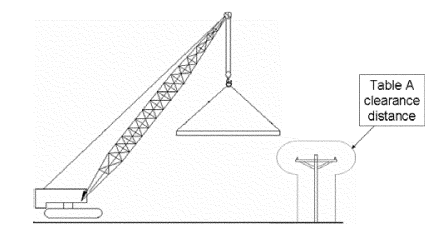
As discussed above in relation to §§1926.1407 through 1926.1411, equipment making electrical contact with power lines is one of the primary causes of equipment-related deaths on construction sites and, to prevent such contact, those sections would require equipment to maintain minimum distances from power lines.
In the proposed rule, OSHA determines that there are circumstances where neither the boom nor the load are directly over the power line or Table A clearance distance, but where the power line or the Table A clearance distance is within the fall path of the boom or load. This circumstance is depicted in the following illustrations:
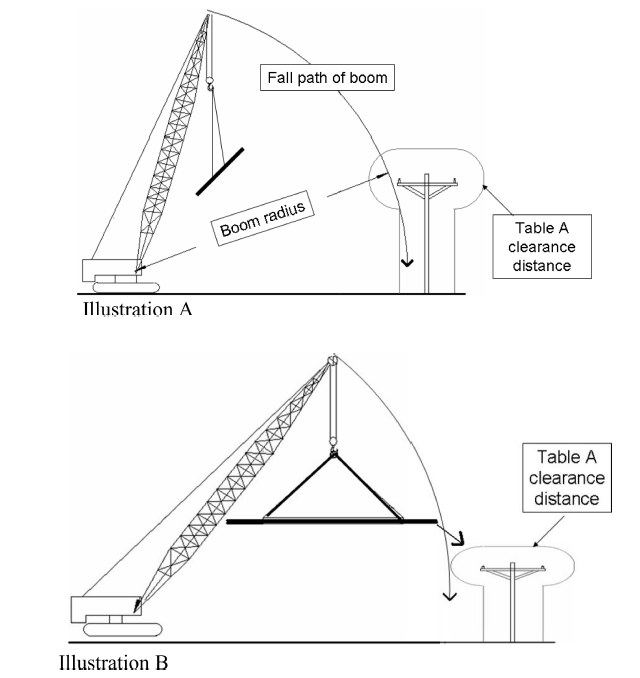
In Illustration A, neither the boom nor the load is above the power line or any part of the Table A zone. However, if the boom were to fall, the boom would cross into the Table A zone. In Illustration B, neither the boom nor load is above the power line or any part of the Table A zone. However, if the boom were to fall, the load would cross into the Table A zone.
OSHA requested comment in the proposed rule as to whether §1926.1426(a)(1)(iii) should be modified to also prohibit the equipment from being positioned such that the fall path of the boom or load would breach the Table A of §1926.1408 clearance distance. This requirement was proposed to prevent the boom, hoist line, or load from contacting an energized power line and carrying the electric current back through the equipment. One commenter, in two comments, agreed with the proposed change. (ID-0052.0;-0092.1.) No commenters disagreed.
Therefore, OSHA has modified §1926.1426(a)(1)(iii) to prohibit free fall (live boom) where the power line or the Table A clearance distance is within the fall path of the boom or the load.
Paragraph (a)(1)(iv) prohibits use of a live boom where the load is over a shaft. Employees in a shaft receiving a load are at high risk of death or injury from a free falling boom as the shaft severely limits the ability to avoid the falling boom. Because this hazard only exists when there is an employee in the shaft, OSHA has specified in §1926.1426(a)(1)(iv) of the final rule that the live boom prohibition only applies when at least one employee is in the shaft. This language is different from the language of §1926.1426(a)(1)(v), regarding cofferdams, because a shaft is typically a smaller work space than a cofferdam, thus, a shaft under a load is necessarily in the fall zone of the boom or the load.
Paragraph (a)(1)(v) prohibits free fall of a boom when the load is over a cofferdam, except where there are no employees in the fall zone of the boom or load. Much like employees who must receive a suspended load in a shaft, employees have limited ability to escape a free falling boom or load in a cofferdam. However, cofferdams are typically much larger work spaces than shafts, the fall zone of a falling boom or load may only affect one part of the cofferdam. Therefore, this provision only applies when employees are in the fall zone of the boom or load.
OSHA noted an ambiguity in proposed §1926.1426(a)(1)(v). The exception referred only to "the fall zone"; OSHA determines that-to make this provision consistent with §1926.1426(a)(1)(i) (prohibiting the use of live booms when an employee is in the fall zone of the boom or the load)- the words "of the boom or load" should be added to the language proposed for §1926.1426(a)(1)(v).
Paragraph (a)(1)(vi) prohibits use of a live boom for lifting operations in a refinery or tank farm. A free falling boom could strike pipes or a tank in a refinery or tank farm. Such accidental impact could cause a release of toxic materials or conflagration. No comments were received for this provision; it is promulgated as proposed.
Paragraph (a)(2) of this section is the exclusive list of conditions under which the use of cranes with live booms is permitted. C-DAC found that cranes with live booms can be used safely under some circumstances and did not determine that the cost of replacing or retrofitting all such equipment is justified as long as the use of live boom equipment is limited to these conditions. However, none of the conditions outlined in §1926.1426(a)(1) may be present.
Paragraph (a)(2)(i) allows the use of equipment with a live boom if that equipment was manufactured prior to October 31, 1984, and none of the circumstances listed in §1926.1426(a)(1) are present. ANSI B30.5 first prohibited live booms in the 1972 version and reiterated the prohibition in the 1982 edition, which was published on October 31, 1983, and became effective on October 31, 1984.
OSHA concludes that manufacturers would have begun to phase out live-boom equipment when ANSI first prohibited its use in 1972 and that few, if any, live boom equipment would have been manufactured after October 31, 1984. Moreover, during this period, hydraulic hoisting equipment, the design of which typically precluded boom free fall even in its early designs, became more prevalent.
In light of these factors, the Agency concludes that most equipment manufactured after October 31, 1984, would not have live booms. Section 1926.1426(a)(2) thus allows the older live boom equipment to be phased out safely by restricting its use to situations in which none of the circumstances listed in §1926.1426(a)(1) are present. However, OSHA added a new provision to this paragraph that considers live-boom equipment manufactured on or after October 31, 1984, and meeting the requirements of paragraph (b) of this section, not to be subject to the limitations of paragraph (a) of this section. OSHA considers such equipment, when so modified, to be as safe as any equipment modified under the requirements of paragraph (b).
Paragraph (a)(2)(ii) allows use of a live boom if the equipment is a floating crane/derrick or is a land crane/derrick on a vessel/flotation device and none of the circumstances listed in §1926.1426(a)(1) are present. The Committee found, and OSHA agrees, that equipment used on the water commonly has a live boom because the dynamics of load transfer while on water (from side to side), as well as unexpected wave action can cause rapid changes in list and trim, which sometimes necessitates that the operator have a free fall boom system to compensate for these effects. Non-live systems are not fast enough for this purpose. At the public hearing, a witness from the maritime industry said that the "unique tasks [associated with operating cranes on the water] have often required and will continue to require a modification of existing cranes and derricks so that they can safely accomplish these specialized applications." (ID-0345.41.)
As a result, the Agency concludes that there is no need to modify this provision; it is promulgated as proposed.
One commenter suggested there is a conflict between the §1926.1426(a) allowance for the limited use of free falling booms and §1926.1433(b)(4) incorporation of the ASME standard prohibition on the use of free falling booms. (ID-0053.1.)
Section 5-1.3.1 of ASME B30.5-2004 has a paragraph (b), which contains its own text, as well as two subsidiary paragraphs, enumerated (1) and (2), each of which also contains text. The ASME prohibition against live booms is in the text of paragraph (b) of ASME B30.5-2004 sec. 5-1.3.1. Free fall is not mentioned in subsidiary paragraphs (b)(1) or (b)(2) of ASME B30.5-2004 sec. 5-1.3.1.
Section 1926.1433 incorporates the concepts in only subsidiary paragraphs (b)(1) or (b)(2) of ASME B30.5-2004 sec. 5-1.3.1; it does not incorporate the portions of paragraph (b) of ASME B30.5-2004 sec. 5-1.3.1 that would conflict with §1926.1433. There is, therefore, no conflict between §§1926.1426(a) and 1926.1433(b)(4).
Paragraph §1926.1426(a)(2) is promulgated as proposed.
Paragraph (b) Preventing Boom Free Fall
Paragraph (b) of this section establishes criteria for the boom hoist on equipment with a boom designed to free fall. Paragraphs (b)(1) through (b)(4) specify the mechanisms or devices that a boom hoist can utilize as a secondary means to prevent boom free fall when the primary system fails. C-DAC determined that each of these were effective means of preventing boom free fall, and OSHA agrees. The addition of a listed secondary mechanism or device to prevent the fall of the boom changes the characteristics of equipment designed with a live boom, decreasing the risk of injury to employees. Therefore, if equipment has a boom hoist with a secondary mechanism or device listed in paragraphs (b)(1) through (4), it is not considered a live boom for purposes of the limitations of (a) of this section. No comments were received on these provisions; they are promulgated as proposed.
Paragraph (c) Preventing Uncontrolled Retraction
Paragraph (c) of this section requires hydraulic telescoping booms (which are also referred to as hydraulic extensible booms) to have an integrally mounted holding device to prevent the boom from retracting in the event of hydraulic failure.
The C-DAC draft of this provision stated that the purpose of this device was "to prevent boom movement in the event of hydraulic failure." OSHA determines that this language was unintentionally broad in that it refers to any "boom movement." In the proposed rule, OSHA modified the language to state that the purpose of the integrally mounted holding device is "to prevent the boom from retracting" in the event of hydraulic failure and requested public comment on this change.
Two commenters agreed with the modification and no commenters disagreed. (ID-0205.1;-0213.1.) The text of §1926.1426(c) is therefore promulgated as proposed.
Paragraph (d) Load Line Free Fall
Paragraph (d) of this section lists the circumstances under which free fall of the load line hoist is prohibited, and controlled load lowering must be used. "Free fall (of the load line)" is defined in §1926.1401 to mean "where only the brake is used to regulate the descent of the load line (the drive mechanism is not used to drive the load down faster or retard its lowering)." "Free fall" is contrasted with "controlled load lowering," which §1926.1401 defines as "lowering a load by means of a mechanical hoist drum device that allows a hoisted load to be lowered with maximum control using the gear train or hydraulic components of the hoist mechanism. Controlled load lowering requires the use of the hoist drive motor, rather than the load hoist brake, to lower the load."
As with free fall of the boom, free fall of the load line hoist presents a struck-by hazard to employees. One difference is that free fall of the load line endangers a smaller area than boom free fall. When a boom free falls, its tip (and any attached load) moves both downward and outward. Because the load will be moving in at least two directions simultaneously, the area that will be affected by the fall is larger than the affected area from a load line free fall.
In contrast, if a load line free falls, the load will tend to fall in a relatively straight path downward (as long as the boom is not being moved and the load is not significantly affected by winds). Thus the area affected will typically be smaller. As a result the prohibitions for load line free fall are less than those affiliated with boom free fall. No comments were received on paragraphs (d)(1) or (d)(2); they are promulgated as proposed.
Proposed paragraph (d)(3) stated that the use of load line hoist free fall is prohibited when the load is directly over a power line, or over any part of the area extending the Table A clearance distance to each side of the power line. OSHA requested comment on whether proposed §1926.1426(d)(3) should be modified to also prohibit the equipment from being positioned where the fall path of the load would breach the Table A clearance distance. One commenter, in two comments agreed with the change and no commenters disagreed. (ID-0052.0;-0092.1.)
Since this modification is consistent with the purpose of the provision, OSHA has included this revised language in the final rule; §1926.1426(d)(3) to prohibit load line free fall where the power line or the Table A clearance distance is within the fall path of the load.
Proposed paragraph (d)(4) stated that load line free fall is prohibited when the load is over a shaft or cofferdam. OSHA noted that, unlike the prohibition against live booms in §1926.1426(a)(1)(v), proposed paragraph (d)(4) contained no exception regarding cofferdams in which there are no employees in the fall zone. OSHA requested comment on whether proposed §1926.1426(d)(4) should include the same exception included in §1926.1426(a)(1)(v). Two commenters agreed with the modification and no commenters disagreed. (ID-0205;-0213.) Because the fall zone of a free falling load line is typically a smaller area than the fall zone of a free falling boom, the Agency is unaware of any reason to include the exception in §1926.1426(a)(1)(v) for live booms but omit it for load free fall. Therefore, in the final rule, OSHA has modified the language in proposed §1926.1426(d) by separately addressing shafts and cofferdams, and adding an exception for the latter.
Section 1926.1427 Operator Qualification and Certification Introduction
Section 1926.1427 addresses the safety problems that result if equipment operators lack the knowledge and skills necessary to perform their duties safely. In C-DAC's collective experience, operator error plays a role in a significant percentage of fatal and other serious crane accidents because operators are not familiar with the precautions needed to protect against hazards such as power line contact, crane overloading and collapse, and loss of control of the load. C-DAC concluded that a verified testing process is essential for ensuring that crane operators have the requisite knowledge and skills and that requiring crane operators to successfully complete such a process would be an effective and efficient way to reduce crane-related accidents.
In the proposed rule, OSHA noted that C-DAC's finding in this regard was supported by a study conducted over a 34-year period (1969-2002) by the Construction Safety Association of Ontario that showed a substantial decrease in crane and rigging fatalities in Ontario beginning in 1979, when mandatory training and certification requirements for Ontario crane operators went into effect. (ID-0009.) In the ten-year period from 1969 through 1978, before Ontario's requirements went into effect, 85 Ontario construction workers suffered crane and rigging fatalities, amounting to 8.5 per year, or 19.8% of all construction fatalities in Ontario. In the 24-year period from 1979 through 2002, there were 51 crane and rigging fatalities, or slightly more than two per year. For this period, crane and rigging fatalities equaled 9.6% of all Ontario construction fatalities. In the 12-year period from 1991 through 2002, the total number of crane and rigging fatalities was 9, or fewer than one per year. During this period, crane and rigging fatalities amounted to 4.1% of total construction fatalities. This study supports C-DAC's conclusion that third-party certification is an effective means of promoting safe crane operations.
The Ontario system requires prospective or current crane operators (referred to in Ontario as "hoisting engineers") to either successfully complete an apprenticeship program or demonstrate sufficient previous experience before seeking certification as a hoisting engineer. The apprenticeship program includes in-school training in a number of topics determined by the Ministry of Education, a practical examination administered at Ministry-designated sites, and a written examination administered by the Ministry. Upon passing this examination and proving completion of the requisite work hours, an apprentice receives a certificate of qualification as one of three types of hoisting engineer from the Ministry. (ID-0010.)
Hoisting engineers already qualified elsewhere must also obtain a certification from the Ministry to operate cranes in the province. These candidates must sit for the written examination and complete the practical skills assessment required for qualification of apprentices, but may demonstrate sufficient previous experience instead of completing the number of work/training hours required by the apprenticeship program, to receive a certificate of qualification from the Ministry in one of the three hoisting engineer categories. (ID-0011.)
The rulemaking record contains additional support for C-DAC's conclusion. A study of crane accidents in California both before and after that State adopted a mandatory certification requirement shows a significant drop in crane-related fatalities and injuries after the certification requirement went into effect on May 31, 2005. (ID-0205.1.) For the three years prior to that date, California experienced ten fatal accidents, while in the next three years, only two fatal accidents occurred. The number of injury cases declined from 30 to 13 over the same two periods. The California data supports that from Ontario and demonstrates that significant safety benefits can be expected from a requirement for thirdparty certification.
The rulemaking record also contains substantial evidence regarding the need for continued application of State and local laws. As several commenters explained, State and local licensing requirements are backed by the police power of that government. For example, New York law states that the operation of a crane without a valid license in New York City is a misdemeanor punishable by fines and imprisonment. (NYC Administrative Code §§28-405.1; 28-203.1.) Moreover, states have the power to revoke previously issued licenses under appropriate circumstances. (ID-0171.1.) In contrast, OSHA's enforcement of certification or other qualification requirements would be limited in most cases to a citation to an employer. Based on the record as a whole, the Agency concludes that cooperative Federal-State enforcement will increase the effectiveness of the new standard. See also discussion of federalism in section V.D of this preamble.
The certification requirements in the final rule are therefore designed to work in conjunction with State and local laws, and to afford employers several options for ensuring operator abilities in areas where there are no State or local operator licensing requirements. For operation of equipment within jurisdictions where a State or locality licenses crane operators, and the government entity's licensing program meets certain criteria, OSHA is requiring operators (with the exception of operators that are employees of and operating equipment for the U.S. military) to be licensed by that government entity. For operation in other areas, employers will have threeoptions for certification or qualification of their operators. Each of these options will be explained and discussed in detail below. They are:
1. Be certified by passing an examination administered by an accredited testing organization.
2. Be qualified through the employer's in-house, but independently audited, testing program.
3. Be qualified by the United States military.
While OSHA is requiring compliance with State and local licensing laws immediately upon the effective date of this standard in recognition of the existing force and effect of those laws, OSHA is not requiring certification or qualification under the three options listed above until four years from the effective date of this standard. Moreover, there are limited exceptions to all of the licensing and certification requirements, as specified in §1926.1427(a). Even after the four-year phase-in period of the general certification requirements, OSHA will continue to allow non-certified operators to operate the equipment as operators-in-training in accordance with §1926.1427(f), discussed below.
Of the three options available in the absence of State or local licensing laws, Option (3) of this section is available only to the United States military for qualification of its employees. Further, as discussed below, a number of commenters stated that Option (2) of this section was not viable for many employers. However, Option (1) of this section is available to all employers and will be the one that is most widely used. Therefore, most of the public comments and evidence presented at the hearing addressed Option (1).
At the hearing, a witness for an accredited testing organization testified that the certification process embodied in Option (1) originated in the 1990s when private industry groups began an effort to improve crane safety. The witness explained that the industry representatives involved with the organization are drawn from such groups as contractors, crane rental firms, labor unions, owners, steel erectors, manufacturers, construction firms, training consultants, and insurance companies. (ID-0343.) The witness also explained that exam management committees meet throughout the year to ensure the continuing fairness and integrity of the testing process. Finally, the witness explained that certification promotes safety by ensuring that the training an individual has received has succeeded in giving that individual the knowledge and skills to operate a crane safely. (ID-0343.)
Many commenters and witnesses at the public hearing expressed support for the proposed rule's approach of requiring third party verification of an operator's qualifications and for the range of options presented. A national safety organization expressed support for the provision to ensure qualification and certification of operators. (ID-0178.1.) A trade association stated that third party oversight was critical to create an effective and legitimate testing process and to ensure that the training portion did not have undue influence on the testing process. (ID-0205.1.)
Similarly, another commenter supported the proposed Q/C requirements, emphasizing the importance of independent certification of an operator's skill and knowledge by an accredited nationally recognized third-party entity or organization. (ID-0169.1.) Similar views were expressed by other commenters. (ID-0158.1;-0160.1;-0173.1;-0192.1;-0196.0;-0211.1;-0212.1;-0220.1;-0225.1;-0228.1;-0241.1.)
A number of witnesses at the public hearing also supported the proposed requirement for third-party verification. A representative from a crane rental company said that, although they incur additional cost to prove certification, they consider that cost an investment in the safety of their employees. (ID-0344.) A major crane user observed both certified and non-certified operators and found that the certified operators operated far more safely because of the more comprehensive training required to become certified. (ID-0344.)
An insurance company representative and former crane operator stated that his company believes that employers who certify their operators have fewer accidents and that, as a result, his firm offers companies it insures a ten percent discount if they have their operators certified. (ID-0343.) The representative believed that the cost of certification was modest when compared to the cost of accidents. (ID-0343.) A representative from a crane rental company testified that preparing for the certification process allowed his company to improve their operators' knowledge and ability to operate cranes safely. (ID-0343.) A representative from a steel erection company agreed that certification is important to both insurance companies and employers because certification gives employers peace of mind and reduces insurance costs. (ID-0344.)
Some commenters and witnesses opposed the proposed rule's requirement for qualification or certification of operators. A trade association commented that the requirements would not improve safety more than having trained, qualified operators because many of the operators in recent accidents were certified. (ID-0151.1.) The commenter also questioned whether sufficient analysis had been done to show that the proposed requirements would improve the safety of crane operations. This commenter believed that the current requirement (§1926.20(b)(4)) for equipment operators to be qualified by training or experience was sufficient. A witness from a similar trade association expressed a similar view, stating that training, not certification, is the answer to safe crane operations. (ID-0343.)
A representative of the building industry thought the requirements were too restrictive and stated that OSHA failed to show that the limited requirements would substantially reduces the risk of accidents while other alternatives would not. (ID-0232.1.) The commenter asked that its members have the option to self-evaluate their operators after they have gone through a specified training program in lieu of the third-party certification that would be required under proposed Option (1) of this section for cranes of less than 35 ton capacity with a boom length no greater than 120 feet. A witness who appeared on behalf of the commenter criticized the proposal for imposing the same requirements on employers engaged in residential construction as those in commercial construction and said training and certification requirements should be crane and industry specific. (ID-0341.)
Another trade association similarly recommended that its members be given the ability to self-certify their operators. (ID-0218.1.) A small business representative asked OSHA to assess whether it is feasible to allow small employers to "self-certify" that an operator is trained and competent to operate the equipment and perform the tasks being conducted. (ID-0147.1.) A trade association suggested that OSHA consider the feasibility of allowing small employers to "self-certify" that their operators are trained and competent to operate the equipment and perform their assigned tasks. (ID-0187.1.) Another trade association believed that mandatory self-certification was a feasible option for operators of what it characterized as "light-duty" cranes used by its members. (ID-0189.1.)
The commenter, however, also acknowledged that there are small businesses that are in favor of third-party certification. (ID-0147.1.)
An energy association argued that firms engaged in wind turbine construction should be permitted to self-certify their crane operators.-(ID-0329.1.) The commenter stated that construction of wind turbines requires the use of the largest and most complex cranes available, and that some of its members had found that some operators certified by NCCCO were not truly qualified to operate those cranes. It therefore believed that firms in its industry should be able to self-qualify their crane operators, but objected to the need for employers in its industry who use Option (2) of this section to be required to use the services of an auditor. The commenter said it did not believe that there would be properly trained and qualified people available to audit the wind industry. Instead of requiring auditors, the commenter suggested that OSHA add to the find rule additional, detailed criteria that an employer-sponsored program must contain to be acceptable.
OSHA rejects the suggestions of the commenters who argued that employers should have the option of determining that their operators are qualified without any form of third-party verification. Based on the rulemaking record, OSHA is persuaded that the third-party requirements in the proposed rule are an essential element in improving crane safety. The members of C-DAC, who had vast collective experience in all aspects of crane operations, reached a consensus (with two members dissenting) that third-party verification was needed to reduce the number of crane accidents and fatalities in the construction industry. Their consensus was supported by a number of commenters, including some employers who have already had their operators certified through a third-party process and have found certification to be a useful and cost-effective means of promoting safety. The reliance of the insurance industry on third-party verification as such an indicator of reduced risk that it warrants reduced premiums, is further evidence of its value. Moreover, the fact that safety-conscious members of private industry voluntarily helped to develop a third-party certification process before there was a government mandate to do so is further evidence that certification promotes safety.
As explained in the Introduction, under C-DAC ground rules, a "consensus" was reached on an issue if there were no more than two non-Federal dissenters.
It is also supported by the data from Ontario and California showing that third-party certification can significantly reduce crane-related fatalities and injuries, discussed below.
As discussed earlier, a number of commenters urged OSHA to require training rather than certification. But training alone is insufficient without a means of verifying that each operator understands the training well enough to operate safely and is sufficiently skilled to implement what he/she has been taught. As Graham Brent, Executive Director of NCCCO put it at the hearing, "[c]ertification * * * is an employer's, as well as the general public's, best assurance that the required training has not only been effective, but that learning has taken place during the training process." (ID-0343.) OSHA's current training standard has not prevented the high number of crane-related fatalities and serious injuries that have been occurring as a result of improper operation.
OSHA acknowledges that many employers have effective training programs and highly competent crane operators. However, the rulemaking record shows that a training requirement alone is insufficient to ensure that crane operators have the requisite level of competence. This was the opinion of the members of C-DAC and is shared by many of the members of the public who commented on the proposed rule and who testified at the public hearing.
A representative of the building industry objects to OSHA's reliance on the study by the Construction Safety Association of Ontario, saying that it does not meet statutory and regulatory information quality standards, including the Department of Labor's Information Quality Guidelines. (ID-0232.1.) First, OSHA notes that the Ontario study is only part of the record evidence on which the Agency relies in promulgating this standard. In the preamble to the proposed rule, OSHA stated that the Ontario study "buttressed" C-DAC's experience and conclusions regarding the need for independent testing of operator ability (see 73 FR 59810, Oct. 9, 2008). Second, OSHA's reliance on that study does comply with the Department's guidelines. Appendix II of the guidelines addresses the information quality principles on which OSHA relies in setting health and safety standards. For safety standards, such as this rule, OSHA must use "the best available statistical data from surveys of fatalities, injuries, and illnesses, and the best available peer-reviewed science and supporting studies that describe the nature of the safety risks being addressed." OSHA determines that the Ontario study, though not peer-reviewed, is the "best available statistical data" showing the efficacy of third-party operator certification. The California study is similarly supportive of the C-DAC conclusions.
"Guidelines for Ensuring and Maximizing the Quality, Objectivity, Utility, and Integrity of Information Disseminated by the Department of Labor," (Oct. 1, 2002), available on the Department of Labor's Web site.
In other respects as well, OSHA has complied with the Department of Labor's Information Quality Guidelines. The guidelines state that "[t]he goal of a safety risk analysis is to describe the numbers, rates, and causal nature of injuries related to the safety risks being addressed." To meet this goal, OSHA historically has "relied on injury and illness statistics from BLS, combined with incident or accident reports from enforcement activities, incident or accident reports submitted to the record from the private or public sectors, testimony of experts who have experience dealing with the safety risks being addressed, and information and data supplied by organizations that develop consensus safety standards."
In developing the proposed rule, and in issuing this final rule, OSHA has relied on these types of evidence, including studies based on BLS statistics and OSHA enforcement reports, as well as incident reports from specific enforcement cases. (See 73 FR 59719-59723, Oct. 9, 2008.) On the specific question of the need for third-party verification of a crane operator's qualifications, OSHA has relied primarily on the opinions of experts with vast experience in crane operations and the hazards presented by crane use, including the members of C-DAC and construction industry employers who appeared at the public hearing. OSHA is persuaded that third-party verification will significantly reduce the number of crane-related injuries and is confident that the information on which it relies to set this standard is reliable, the best available, and meets the Department's guidelines.
A trade association also questioned OSHA's reliance on the Ontario study, suggesting that Ontario's ability to issue citations to employees is the likely cause of Ontario's decrease in fatal crane accidents. (ID-0151.1.) OSHA notes, however, that the Construction Safety Association of Ontario attributed the decrease to increased operator skill, not employee citations. (ID-0009.) OSHA determines that the Construction Safety Association of Ontario was well-positioned to evaluate why Ontario was able to achieve a dramatic reduction in crane-related fatalities and accepts its opinion on the question. Moreover, the employee citations permitted under Section 66 of Ontario's Occupational Health and Safety Act did not take effect until 1990. These employee citations appear to function primarily as a deterrent to non-compliance with Ontario's construction safety standards, as opposed to the operator certification requirements that are intended to verify knowledge and skills necessary for safe operation. In that regard, the civil fine provisions are similar to the licensing requirements (separate from certification) that Ontario had required prior to 1979. There is no indication in the record that the fines provided a greater level of deterrence than the government's pre-existing authority to sanction an individual operator through the revocation of an operator's license.
The representative of the building industry claimed that the rate of accidents resulting from crane use in the residential construction industry is too low to justify requiring homebuilders to comply with the qualification/ certification requirement in the proposed rule. The commenter conducted a study, using fatality data from the Bureau of Labor Statistics, which, according to the commenter, showed that 13 out of 1385, or slightly less than 1%, of fatalities in the residential construction industry from 2003-2006 were crane-related. (ID-0232.1.) Because this percentage is substantially less than the more than 8% of all construction fatalities that were found to be crane-related in the Beavers study, the commenter suggests the risk of serious injury from the smaller truck mounted telescopic boom cranes used in residential construction is substantially less than the risk of injury from large lattice boom and tower cranes used in commercial/industrial construction. The commenter stated that a copy of its study was attached to its comment and is available on its Web site. (ID-0232.1.) In fact, a copy was not attached to its comment. OSHA has located a document on the commenter's Web site entitled "Residential Construction Fatalities, 2003-2006" that describes the causes of fatalities in residential construction, but has found nothing in that document to support the commenter's claim that only 13 of those fatalities were crane-related.
Nevertheless, even if the commenter could support its claim of 13 crane-related fatalities, its conclusion that cranes present little risk of serious injury in residential construction does not follow. First, OSHA determines that 13 crane-related fatalities in homebuilding in a four year period is significant and well worth trying to reduce. Moreover, the commenter's comparison of percentages is not persuasive. The fact that a smaller percentage of fatalities are crane-related in residential construction than in commercial/industrial construction may simply reflect lower crane usage in residential construction. A witness who appeared on behalf of the commenter at the public hearing, testified that cranes are typically used on a residential construction project between two and six hours to lift objects like roof and floor trusses. (ID-0341.) The witness noted that for commercial construction, a crane might be on the job from six months to two years. (ID-0341.) In light of the brief percentage of time cranes are used in residential construction compared to the percentage of time they are used in commercial construction, it would be expected that the percentage of accidents they cause will similarly be lower even if, while they are on the job, they present the same or even a higher degree of risk.
Mr. Behlman testified that overhead power lines are "very seldom" found on residential sites. (ID-0341.) However, the document on NAHB's Web site showing the causes of residential construction fatalities from 2003 to 2006 attributes 76 fatalities to "contact with overhead power lines."
OSHA also rejects the commenter's suggestion that homebuilders should be permitted to self-certify their crane operators. The commenter states that the vast majority of the building association's single-family home builders are very small, with 61% building ten homes or fewer. The witness stated at the hearing that the home building industry has many small operations and a few very large players. (ID-0341.) In OSHA's experience, most small construction firms would not have the expertise to develop or administer the types of tests necessary to reliably assess operator ability (see the discussion of the criteria applied by nationally recognized accrediting entities to accredit certification organizations).
OSHA also does not conclude that such companies typically possess the expertise to establish and implement the sophisticated type of training program that the commenter suggests should be required for employer self-certification. (ID-0232.1.) The same problem exists throughout the construction industry, which includes numerous small firms. Furthermore, as found by C-DAC, independent testing is essential to ensure that operators have in fact attained the knowledge and ability the training is supposed to impart.
A number of commenters suggested that the proposed requirements should be modified in various ways. Some suggested exempting certain equipment from the qualification/certification requirement or requiring a form of qualification/certification that the employer could implement without resort to third-party verification. Others suggested expanding the range of options available to the employer, in particular allowing accredited educational institutions to certify operators. These comments will be discussed below in the sections of the standard that address the issues raised by the commenters.
Paragraph (a)
In the final rule, paragraph (a) of this section specifies that the employer must ensure that the operator of any equipment covered under §1926.1400, with certain listed exceptions, is either qualified or certified to operate the equipment in accordance with the provisions of this section or is operating the equipment during a training period. Paragraph (a)(1) requires compliance with State and local operator licensing laws. For areas where State or local licensing is not required, paragraph (a)(2) requires employers to use one of the three options listed above to certify or qualify their operators. Paragraph (a)(3) provides exceptions from all of §1926.1427's certification and qualification requirements for operators of certain equipment, regardless of whether State or local governments have licensing requirements for operators of that equipment.
These State and local licensing requirements would remain in effect. See discussion of preemption of State and local law under federalism in section V.D of this preamble. OSHA is simply choosing not to require compliance with any such licensing requirements for that equipment.
Paragraph (a)(1) Compliance With State and Local Licensing Requirements
The proposed rule included a fourth option to satisfy the operator certification/qualification requirements of §1926.1427: qualification through a government entity with a licensing program meeting certain criteria. Several states submitted comments on the proposed rule urging the Agency to preserve State and local operator licensing laws. Some of these concerns are addressed in the discussion of preemption under federalism in section V.D of this preamble. Two of those commenters, each with its own statewide crane operator licensing requirements, specifically requested that OSHA mandate compliance with State requirements for crane operations within the jurisdiction of those states (with the exception of operators who are employees of the U.S. military). (ID-0171.1;-0237.) Three State governments argued persuasively that if government licensing was presented merely as an option, rather than required, many employers would simply by-pass these licensing requirements in favor of less stringent, portable private certification options. (ID-0171.1.) One State government also noted that some states have proven, reliable licensing procedures already in place. Where State and local licensing departments or offices are already well established and staffed, and are already preventing deaths or serious injuries through the use of effective licensing procedure, there is little support in the record for disturbing them.
In light of the commenter's compelling arguments and the policy considerations noted above, the Agency is convinced that the governmental licensing requirements should be mandatory, rather than optional. In response, the Agency is revising paragraphs (a) and (e) of §1926.1427 to mandate compliance with State and local operator licensing laws that meet a "Federal floor" established in paragraphs (e)(2) and (j) of this section.
This "Federal floor" refers to the minimum requirements for license tests in §1926.1427(e)(2), and the minimum knowledge and skills that must be tested as set forth in §1926.1427(j)(1) and (j)(2). Employers would not be required by OSHA to comply with State or local government entity licensing requirements that do not meet this "Federal floor," but States and local governments could still seek to enforce their own laws.
This mandatory compliance is set forth in the introductory text of §1926.1427(a)(1) and paragraph (a)(1)(i). OSHA has added §1926.1427(a)(1)(ii) to clarify that employees of the U.S. military who have been certified or qualified to operate equipment pursuant to §1926.1427(d) would not also be required to obtain an operator's license from a State or local government for construction work on behalf of the military employer. By requiring compliance with State and local laws, the Agency is also complying with Executive Order 13132, which urges agencies to preserve the full force and effect to State and local laws. (See 64 FR 43225, Aug. 10, 1999.)
This decision is a logical outgrowth of the proposal. The proposal identified a significant safety risk from improper operation of equipment and proposed certification requirements as a means of addressing that risk. Governmental licensing of crane operators has existed alongside OSHA's prior crane rules at former §1926.550 for many years, and C-DAC made them a significant component of the proposal without any indication that the new standard would exempt employers from compliance with those laws. The government licensing provision was the subject of a number of comments, and was discussed during the hearing in the context of comments requesting OSHA to make the government licensing mandatory.
The preamble to the proposed rule noted C-DAC's opinion that some States have "effective, reliable, licensing procedures" (73 FR 59814, Oct. 9, 2008). The preamble to the proposed rule also specifically cited the Department of Transportation's requirement that commercial drivers also carry State drivers licenses issued in accordance with Federal standards (73 FR 59810). The DOT licensing was provided as an example of how State licensing, when required as part of a general Federal compliance scheme, has been "used in the past to prevent fatal and other serious accidents that result when operators lack the knowledge and skills needed to operate safely." Id. The only other example of successful third-party certification provided as a basis for the certification requirement was another government licensing requirement: Ontario's licensing requirements for crane operators. Id. The combination of OSHA's exclusive reliance on these examples and the government licensing provision in proposed §1926.1427(e) provided clear notice that the government licensing provision might develop along the lines of the examples. While several commenters submitted comments supporting mandatory compliance with government licenses, thereby indicating that at least these parties viewed the mandatory compliance as a possible outcome of the rulemaking, none of the commenters objected to the government licensing provision or questioned the validity of their tests. The Agency's choice to make compliance with paragraph (e) mandatory, rather than optional, flows logically from the proposal, the comments, and the discussion at hearing. See National Mining Ass'n v. Mine Safety and Health Admin., 512 F.3d 696, 699 (DC Cir. 2008) (noting that the logical outgrowth test takes into account the comments, statements and proposals made during the notice-and-comment period).
The Agency's decision to mandate compliance with State and local laws is not new. OSHA already relies on State licensing requirements in its respirator standard when it provided for "a licensed health care professional" to perform a medical evaluation of an employee's ability to use a respiratory (see §1910.134(e)). This portion of the standard was challenged and upheld in American Iron Steel and Steel Institute v. OSHA, 182 F.3d 1261, 1278 (11th Cir. 1999). OSHA's choice to mandate compliance with State or local law is also consistent with the approach of other agencies. (See, e.g., Department of Transportation regulations requiring State licensing of commercial drivers, discussed in the preamble to the proposed rule at 73 FR 59810, Oct. 9, 2008.)
Paragraph (a)(2) Options for Certification or Qualification Where License Not Required by a Government Entity
As noted above, where a State or local license is not required, employers have three choices for certification of operators. Those choices are set out in paragraphs (b) through (d) of this section and discussed in detail below. It is important to note that these options will not satisfy the requirements of §1926.1427 for operation of equipment within a State or local government's jurisdiction when that government entity has it's own licensing requirements that satisfy the criteria in paragraphs (e) and (j) of this section.
Paragraph (a)(3) Exceptions
The exceptions in the proposed rule were for types of equipment that are specifically excluded from the qualification/certification requirement under sections of this standard that pertain to that equipment, including derricks (see §1926.1436), sideboom cranes (see §1926.1440), and equipment with a rated hoisting/lifting capacity of 2,000 pounds or less (see §1926.1441).
A labor representative pointed out that the exception in §1926.1441 applies to equipment with a "maximum manufacturer-rated" hoisting/lifting capacity of 2,000 pounds or less, and it asked that this same language be used in §1926.1427(a) to avoid suggesting that the exception might apply to larger equipment when it is configured to have a rated capacity of 2,000 pounds or less. (ID-0341.) OSHA agrees that the suggested change better reflects the intent of the provision and has modified the language of §1926.1427(a) in the final rule by replacing the word "rated" with "maximum rated." OSHA notes that this change does not change the substantive requirements of the rule in any manner.
A number of commenters asked that additional types of equipment or activities be exempted from §1926.1427's qualification/certification requirement.
A utility company recommended that cranes of 10,000 pound capacity or less be excluded on the basis that most uses of these cranes are highly repetitive and predictable. (ID-0144.1.) A trade association suggested exempting cranes rated at less than 10 or 15 tons from the requirement. (ID-0191.1.) It said that these types of cranes are often used to deliver products to a jobsite or to place small rooftop HVAC units on low rise buildings, and that they are used for simple lifts of relatively light loads. This commenter also requested that OSHA add a less restrictive certification level for cranes rated less than 30 tons, which it said are less complicated to assemble and set up and are used during "low risk" lifts.
Another trade association suggested that the threshold for requiring qualification/certification should exclude the 5,000 to 10,000 pound capacity cranes that its members typically use. (ID-0189.1.) It said that this equipment is relatively simple to operate, that the signs its members install rarely exceed 2,000 pounds, and that the equipment is used intermittently on the job and only for brief periods of time.
A third trade association believes that the size and scope of the lifts its members make do not justify the qualification/certification requirements in the proposed rule and suggested alternative requirements for its members when they operate cranes of less than 35 ton capacity with a boom length no greater than 120 feet. (ID-0218.1.) They ask that their members have the option to self-evaluate their operators after they have gone through a specified training program instead of the third-party certification that would be required under proposed Option (1). A representative of the building industry made a similar recommendation for cranes of less than 35 ton capacity with a boom length no greater than 120 feet. (ID-0232.1.) A small business representative suggested that OSHA consider exempting some small cranes (based on vehicle weight or boom length) or routine lifts. (ID-0147.1.)
A witness for a labor representative testified in opposition to excluding equipment rated over 2,000 pounds by the manufacturer. He stated that some low-capacity cranes have long booms and are used to lift loads to great heights, particularly when there is not sufficient space for a larger crane. (ID-0341.) According to the witness, safety concerns presented by low capacity cranes with a long boom are as serious as the concerns presented by high capacity cranes. (ID-0341.) He added that the danger of power line contact was present regardless of the capacity of the crane.
A representative from a crane rental company also testified against exempting low-capacity cranes from the qualification/certification requirement. His company had a fleet of cranes ranging from 4 to 600 ton capacity, and in his experience the majority of accidents that his customers experienced when they rented cranes but provided their own operators occurred with cranes rated 35 tons or less. (ID-0344.) He was aware of accidents on residential construction sites that resulted from operating on unsuitable ground, not setting the outriggers properly, and lifting too heavy a load for the crane's configuration, deficiencies that he attributed to operators who did not appreciate the hazards involved. (ID-0344.)
OSHA has carefully considered the comments asking for additional types of equipment to be exempted from the qualification/certification requirements of §1926.1427. For the following reasons, OSHA declines to add such exemptions to the final rule.
The members of C-DAC, who had vast collective experience in all aspects of crane operations, reached a consensus that third-party verification was needed to reduce the number of crane accidents and fatalities in the construction industry. They further determined that such a requirement should apply to virtually all hoisting equipment, with only the limited exceptions listed in the proposed rule. In proposing to exempt equipment with a rated capacity of 2,000 pounds or less, the Committee considered whether to establish a higher threshold for the requirement but concluded that the operators of higher-capacity cranes, including those in the 5,000-35,000 pound range that the commenters ask to be exempted, needed to be well-qualified to reduce the number of accidents involving such cranes. Ultimately, C-DAC included the 2,000 pound cutoff to parallel ANSI B30.5 in this regard (see 73 FR 59841, Oct. 9, 2008).
The rulemaking record shows that many of the same hazards presented by larger cranes are present for cranes in this capacity range, including operating in proximity to power lines, the potential for collapse if the crane is overloaded, and the need for adequate ground conditions to ensure the crane's stability during operation. As a labor representative testified, these smaller cranes may be used in tight spaces where larger cranes cannot be used. An operator's loss of control of the load in a tight space would present a serious safety hazard, and the potential for operating in tight spaces highlights the need for operators of even relatively low-capacity cranes to be highly skilled.
OSHA also rejects the suggestions by some commenters that exemptions should be created for cranes that are typically used for repetitive, predictable, intermittent, or light use.
The principal difficulty with this suggestion is that the underlying causes of crane-related fatalities and injuries are not necessarily diminished in such situations. For example, the presence of power lines presents an electrocution hazard in all situations, irrespective of how the equipment is used. Proper ground conditions, which can change during crane use, are also as necessary for those types of uses as others, and all cranes can be overloaded if operated improperly. The knowledge and skill needed for attaining operator qualification/certification under this section is a prerequisite for being able to successfully address these and other hazards.
Furthermore, while an employer may initially plan to use a crane in a repetitive or otherwise predictable manner, or to handle light loads, unforeseen circumstances can arise that can alter those plans. Wind, which can arise unexpectedly during a lift, can dramatically decrease the capacity of a crane and increase the difficulty in properly handling the load; a previously "repetitive" lift can change unexpectedly when rain causes the ground supporting the crane to become muddy and less able to support the crane; a rigging problem may arise during one of the "repetitive" lifts, which could cause unexpected load control problems during the lift; and hoisting a "light" load at a low boom angle can pose similar overturning hazards to hoisting a heavy load at a high boom angle. Nor are there fewer crane-related hazards when a worker operates a crane only intermittently. For example, that operator on one of those occasions may have to run the crane near power lines, in the blind, with uneven winds, or at a low boom angle; in such cases (as in many others) he/she needs to be as fully capable as an operator who runs the crane regularly.
Paragraph (a)(4)
The Agency is adding this paragraph to the final rule to clarify that operator certification or qualification as required under this section must be provided at no cost to employees who are already employed by the employer on November 8, 2010. This clarification is consistent with the Agency's revision of the training requirements throughout subpart CC to expressly state that employers must provide all training at no cost to employees. The clarification is consistent with the Agency's treatment of costs for operator qualification and certification in the preliminary economic analysis provided in the preamble of the proposed rule. (See, e.g., 73 FR 59895, Oct. 9, 2008 (operator certification training treated as cost to employer).)
Based on the testimony of several witnesses at the hearing, OSHA concludes that imposing the operator qualification and certification costs on the employer will not be overly burdensome to the employer. At the hearing, a representative from a crane rental company said that, although his company incurs additional cost to provide certification, his company considers that cost an investment in the safety of their employees. (ID-0344.) An insurance company representative and former crane operator stated that the cost of certification was modest when compared to the cost of accidents. (ID-0343.) This witness also stated that his company believes that employers who certify their operators have fewer accidents and that, as a result, his firm offers companies it insures a ten percent discount if they have their operators certified. (ID-0343.) A representative from a steel erection company agreed that certification is important to both insurance companies and employers because certification gives employers peace of mind and reduces insurance costs. (ID-0344.)
In light of the need for clarification and witness support at the hearing, OSHA is adding new paragraph (a)(4) to this section of the final rule.
Paragraph (b) Option (1): Certification by an Accredited Crane Operator Testing Organization
As noted above, the proposed rule provided four options for a crane operator to be qualified or certified. Option (1) of this section, in which the employee becomes certified to operate equipment of a certain type and capacity by passing an examination administered by an accredited testing organization, is the most broadly available option, and OSHA expects it to be the one that most employers use outside of jurisdictions with State or local licensing requirements.
Under Option (1), a crane operator becomes certified by a testing organization that has itself been accredited by a "nationally recognized accrediting agency." Section 1926.1401 defines "nationally recognized accrediting agency" as "an organization that, due to its independence and expertise, is widely recognized as competent to accredit testing organizations." The use of a nationally recognized accrediting agency to provide an independent, authoritative assurance of a testing organization's competence is a well-established practice. For example, for a number of years, the National Commission for Certifying Agencies (NCCA), the accreditation body of the National Organization for Competency Assurance (NOCA), has accredited testing organizations in a wide variety of fields, including those that provide crane operator certification. (ID-0021.) Also, in 2003, the American National Standards Institute began accrediting personnel certification entities. (ID-0022.)
Under §1926.1427(b)(1)(i), for a testing organization to become accredited, the accrediting agency must determine that the testing organization's written testing materials, practical examinations, test administration, grading, facilities/equipment and personnel meet industry recognized criteria. The accrediting agency must determine that the written testing materials and practical examinations are well designed and sufficiently comprehensive that an individual who achieves a passing grade has demonstrated the skills and knowledge needed to operate the equipment safely. The accrediting agency must also determine that the testing organization's administration and grading ensure the integrity of the test so that the individual's grade truly represents the knowledge and skill level of that individual.
A safety association believed that the criteria for accrediting agencies in proposed §1926.1427(b)(1)(i) were not sufficiently rigorous and suggested replacing that paragraph with a paragraph that required the nationally recognized accrediting agency to use certification criteria equal to or greater than that of the National Commission of Certifying Agencies (NCCA), the Council of Engineering and Scientific Specialty Boards (CESB), or ANSI/ISO/ IEC 17024, General Requirements for Bodies Operating Certification Systems of Persons. (ID-0178.1.) This commenter expressed concern that, without this more specific level of rigor, entities with little experience in professional certification will be able to establish accrediting bodies for certifications that do not adequately demonstrate professional crane operator competence.
An operator certification organization stated that NCCA and ANSI are nationally recognized accrediting agencies and that others should only be designated as such by OSHA after a comprehensive review of its accrediting protocols. (ID-0382.1.) It suggested changing the definition of "nationally recognized accrediting agency" in §1926.1401 to specify that the only accrediting agencies are ANSI, NCCA, and any other organization designated by OSHA as competent to accredit testing organizations.
These commenters are concerned that an organization that applies insufficiently stringent accrediting criteria might claim to be a "nationally recognized accrediting agency" and accredit testing organizations that are less competent than those accredited by NCCA and ANSI.
OSHA determines that the commenters are correct in suggesting that some additional specificity is needed in the definition to ensure that only entities using sufficiently stringent accrediting criteria are included. In the preamble to the proposed rule, OSHA identified two organizations that it determined were examples of a "nationally recognized accrediting agency"-the National Commission for Certifying Agencies (NCCA) and the American National Standards Institute (ANSI) (see 73 FR 59811, Oct. 9, 2008). No commenters have suggested that these are inappropriate examples of this term. Therefore, to provide greater specificity, OSHA has modified the language used in the proposed rule's definition to include references to NCCA and ANSI as examples of organizations that meet the final rule definition in §1926.1401.
Section 1926.1427(b)(1)(ii)(A) specifies that the written and practical tests administered by the testing organization must, at a minimum, assess the knowledge and skills listed in §§1926.1427(j)(1) and (2). Those subjects are discussed below under §1926.1427(j).
Paragraph (b)(1)(ii)(B) provides that the testing organization must provide different levels of certification based on equipment capacity and type. This requirement is designed to ensure that a certified operator has the knowledge and skill needed to safely operate equipment of the type and capacity the employee will actually be operating while avoiding the need for employees to know how to operate more complex equipment.
In the proposed rule, OSHA gave examples of what this provision means in practice. It stated, as one example, an employee who only operates a hydraulic truck crane would not need to also have the additional knowledge and skills necessary to operate a lattice boom crawler crane. As another, it said that an employee who operates only a 22 ton capacity hydraulic truck crane would not need to also have the additional knowledge and skills necessary to operate a 300 ton hydraulic truck crane. The Agency further stated that certification on a more complex type of equipment would typically qualify an operator to operate lower-capacity equipment of the same type, e.g., certification on a 300 ton hydraulic crane would qualify an operator to operate a 22 ton hydraulic crane.
None of the commenters opposed allowing operators certified to operate at a given capacity from also operating lower-capacity equipment of the same type. Two commenters recommended that "type," for purposes of paragraph (b)(1)(ii)(B), be defined for mobile cranes as they are defined in ASME B30.5. (ID-0205.1;-0213.1.) These commenters also stated that "qualifications (and certification) should be driven by the knowledge and skill required to operate a piece of equipment. When a body of knowledge or a particular skill set for a particular 'type' of crane changes, then so should the appropriate category of certification/ qualification."
The Agency concludes that a descriptive definition of "type" that addresses the point raised by these commenters would better accomplish the purpose of the term than tying it to specific examples of existing technology. Therefore, OSHA has added a definition of the word "type" to §1926.1401 of the final rule.
Examples of many of the various types of cranes currently in use are described in the ANSI B30 series (see, for example, ASME B30.5-2004 for mobile cranes and ASME B30.3-2004 for construction tower cranes). For example, in this context, truck-mounted telescoping boom cranes, truck-mounted non-telescoping boom cranes, and crawler cranes are three different "types," since the specific bodies of knowledge and skills needed for the safe operation of each category is different (although they are not completely distinct-the knowledge and skill sets overlap to some degree).
Commenters and witnesses from the railroad industry believed that certification based on "equipment capacity and type" did not address unique conditions in their industry because current certification examinations did not cover the types of cranes they use or the circumstances under which they use them. A railroad company stated that certification tests used by the two accredited testing organizations require knowledge of skills that do not apply in the railroad industry. (ID-0176.1.) A railroad association stated that railroads use cranes in fundamentally different ways than construction companies and that neither [currently] accredited testing organization has tests that address the use of cranes on railroads. (ID-0170.1.) A representative from another railroad company testified that some of the types of cranes his railroad uses are fundamentally different from the typical cranes used in the construction industry. Among the cranes that he said are unique to the railroad industry are locomotive cranes and rubber-tired cranes that can either run on the ground or travel on rails. (ID-0342.) The representative stated that certification tests on typical construction cranes were not suited to the types of cranes used in his industry and asked that the rule offer the latitude for the industry to train operators in a way that makes sense for railroads. (ID-0342.)
The comments and testimony by the railroad industry representatives suggest the need for some flexibility in the certification requirement to deal with specialized types of cranes or newly developed equipment for which certification examinations might not be available. Another aspect of this problem was raised by an energy association, which said that the cranes used in erecting wind turbines are the largest and most complex available, and that certification for such equipment is not currently available. (ID-0329.1.)
C-DAC addressed one example of a type of equipment-dedicated pile drivers-for which certification examinations were not available. Section 1926.1439(e) of the proposed rule accommodated this problem by providing that dedicated pile driver operators can be certified either for operation of dedicated pile drivers or for equipment that is most similar to dedicated pile drivers. OSHA concludes a similar approach is appropriate for any equipment for which a certification is not available. Accordingly, OSHA is adding §1926.1427(b)(2) to the final rule, which allows an operator to be certified to operate a crane if he or she is certified to operate a higher-capacity version of that type of crane or, if no accredited certification entities offer certification for that particular crane, if he or she is certified to operate the type of crane most similar to the equipment in question.
In light of this change, OSHA is deleting §1926.1439(e) from the final rule as it is no longer necessary. Paragraph (b)(2) will also facilitate employers' compliance with the requirements of §1926.1427 by making it clear that the operator's certificate must indicate the particular type and capacity of crane for which the operator was certified.
As discussed in the proposed rule, during the SBREFA process, several small entity representatives suggested that basing certification on the type of crane might result in some capable operators being denied certification. They described situations in which an operator is knowledgeable and skillful with respect to one particular model of crane but might be unable to obtain certification based on equipment capacity and type. In response to this concern, OSHA sought public comment on whether there should be a mechanism for an operator to become certified on a particular model of crane.
Some commenters supported such a mechanism. (ID-0145.1;-0151.1;-0194.1;-0214.1.) Several commenters who opposed the suggestion stated that such certification would likely not be available from testing organizations, that employers who use Option (2) would find it costly and impractical to develop tests for each model of crane, and that testing based on crane model was not appropriate because the skill set and knowledge required for safe operation are not model-dependent. (ID-0175.2;-0205.1;-0213.1.) Witnesses at the hearing also opposed model-specific certification. (ID-0341;-0343.)
OSHA has concluded that expansion of the options to include certification on a specific model of crane is not necessary. The body of knowledge and skills required to be qualified/certified on a particular model of crane is not less than that needed to be qualified/ certified for that model's type and capacity.
It may well be that an operator seeking certification is confident about operating the particular model of crane he/she has been operating but is concerned about being tested on another model of the same type of crane. To the extent this is a concern, OSHA notes that at least one accredited testing organization allows the practical test to be administered at the employer's worksite using the employer's own equipment. (ID-0343.) With this type of practical test available, operators who feel confident that they can become certified on a particular model can be tested on that model, and such certification will allow them to operate any model of the same type (as long as they also pass the written test). Therefore, certification on a specific model would be more restrictive than is necessary, and OSHA sees no benefit from providing for such a certification. OSHA has therefore retained the requirement that certification is based on the "type" of crane.
The SBREFA Panel also received comments from some SERs suggesting that the standard should accommodate crane operators who were fully capable of operating particular equipment in a limited set of circumstances but who would be unable to pass certification tests that required knowledge and abilities beyond those circumstances. The Panel recommended that OSHA consider and solicit public comment on expanding the levels of operator qualification/certification to allow such operators to be certified for a specific, limited type of circumstance defined by a set of parameters that, taken together, would describe an operation characterized by simplicity and relatively low risk. In response to the Panel's recommendation, OSHA requested public comment on whether such parameters could be identified in a way that would result in a clear, easily understood provision that could be effectively enforced.
A number of commenters were in favor of a provision that would allow certification in a limited set of circumstances. A labor organization supported certification limited to the use of rail-bound equipment used to install continuously welded rail and stick rail. (ID-0145.1.) This commenter said that such operations involved dragging, manipulating, and positioning rather than hoisting. Other commenters also supported such a limited certification provision but did not provide specific information about how to define those operations or what aspects of the operations made them less risky than other crane operations. (ID-0151.1;-0176.1;-0191.1;-0214.1.) Other commenters opposed this type of "restricted" certification. (ID-0175.2;-0205.1;-0213.1.) They said that the degree of risk in a given situation was difficult to assess and could change due to unforeseen circumstances arising on the job.
OSHA agrees with the commenters who opposed allowing a limited form of certification based on perceived risk levels. As explained earlier in the discussion of this section, the Agency found the argument that certification should not be required to operate cranes that are typically used for repetitive, predictable, intermittent, or light use to be unpersuasive. OSHA did so because such uses are likely to involve many if not all of the same hazards present in other situations.
Similar concerns apply to the concept of "low risk" operations. First, even if such operations could be effectively identified, the possibility of unforeseen events occurring during such a lift requires that the operator have sufficient ability to handle such complications.
Second, as noted above, apart from the suggestion regarding certain railroad operations, no commenter offered a means of setting the parameters for defining this concept. OSHA has therefore rejected the concept of a limited, "low risk" qualification/ certification.
A labor organization recommended that OSHA require that applicants for certification testing provide documentation that they have at least 1,000 hours of crane related on-the-job experience or training. (ID-0341.) Such experience was necessary, in this commenter's view, because neither the written nor practical exams tested an operator's ability to handle unusual worksite conditions, such as adverse weather or working on crowded jobsites, and did not test an operator's judgment.
As explained above, OSHA has included the qualification/certification requirement to serve as a mechanism to help ensure that operators have attained the level of knowledge and skill necessary to safely operate the equipment. The record amply demonstrates the sufficiency of the accreditation process that must be passed for a testing organization to become accredited. That process is designed to ensure that accredited testing organizations use a sufficiently reliable process for certifying operators. The record also shows that such a mechanism is an effective one for determining operator competence (the record includes the support of the commenter and its C-DAC nominee for that mechanism).
OSHA also notes that the this commenter is, in this regard, taking a position that is inconsistent with the one taken by its C-DAC nominee, who had agreed to the C-DAC version of §1926.1427, which had no experience/training prerequisite. Nor has this commenter explained why it has changed its position from that of its C-DAC nominee. Due to this inconsistency in position, OSHA accords reduced weight to this commenter's suggested change.
There is insufficient information in the record to include an additional requirement for 1,000 hours of "crane related experience or training." The commenter does not specify what should be included in "crane related experience," or why 1,000 hours would be the appropriate amount of such experience for this purpose. The commenter also does not specify if meeting the 1,000 hour prerequisite by "training" should mean hands-on (criteria for such training is delineated in §1926.1427(f)) or classroom type training. OSHA notes that the other commenters supporting this section have not recommended adding an experience or training prerequisite. The Agency has therefore declined to accept this suggested change.
OSHA also notes that the commenter is, in this regard, taking a position that is inconsistent with the one taken by its C-DAC nominee, who had agreed to the C-DAC version of §1926.1427, which had no experience/training prerequisite. Nor has the commenter explained why it has changed its position from that of its C-DAC nominee. Due to this inconsistency in position, OSHA accords reduced weight to the commenter's suggested change.
Section 1926.1427(b)(1)(iii) requires that the testing organization have procedures for operators to re-apply and be re-tested in the event an applicant fails a test. This would help ensure that if the employee initially failed to pass the test, the employee would be able to retake the test and still have the opportunity to obtain the certification. Section 1926.1427(b)(1)(iii) also requires that the testing organization have procedures for operators to re-apply and be re-tested in the event an operator is decertified.
Section 1926.1427(b)(1)(iv) specifies that the testing organization must have procedures for re-certifying operators designed to ensure that the operator continues to meet the requirements of §1926.1427(j). Under §1926.1427(b)(4), a certification is valid for five years, after which the operator must again pass a certification examination. Section 1926.1427(b)(1)(iv) is included so that recertification procedures appropriate for those who have already been certified will be available.
Under §1926.1427(b)(1)(v), the testing organization's accreditation must be renewed by the accrediting organization at least every three years to ensure continuing quality of testing materials and administration.
No comments were received on §§1926.1427(b)(1)(iii)-(v); those provisions are promulgated as proposed.
Under §1926.1427(b)(3) (previously designated §1926.1427(b)(2) in the proposed rule), a certification is "portable," which means that a certificate issued under Option (1) would meet the requirements of §1926.1427(a)(2) (when State or local jurisdiction does not require operator licensing) until the certificate expires. In the final rule, OSHA is specifying that meaning directly in §1926.1427(b)(3) rather than in a separate definition in §1926.1427(m), as proposed. C-DAC determined that certification under this option should be portable because the testing organization is fully independent of all employers who may employ a crane operator and there is no reason to limit the certification to a particular employer. OSHA agrees.
Section 1926.1427(b)(4) (previously designated §1926.1427(b)(3) in the proposed rule) provides that a certification under this paragraph is valid for exactly five years. The exact five year period is intended to strike the appropriate balance between ensuring that certified operators are re-evaluated regularly, while reducing the burden of recertification on operators.
No comments were received on the text that is now in paragraphs (b)(3) and (b)(4). As noted, the definition of "portable" has been moved from proposed (m)(1) to final (b)(3).
Paragraph (c) Option (2): Qualification by an Audited Employer Program
Paragraph (c) of this section sets out Option (2), in which the employer determines, through its own audited testing program, that its employee is qualified to operate the equipment. This option is designed to enable employers to meet the §1926.1427 requirements through their own in-house testing programs. As discussed above, however, C-DAC determined that independent, third-party involvement was needed to ensure the reliability and integrity of any testing program. Therefore, to ensure that testing under Option (2) of this section is accurate and reliable, §1926.1427(c)(1) requires that the tests must be developed by either an accredited crane operator testing organization (as described under Option (1)), or approved by an auditor who is certified by an accredited crane operator testing organization. In addition, the administration of the tests must be audited.
If the employer chooses to use tests approved by an auditor, the auditor must, under §1926.1427(c)(1)(ii)(A), be certified as a test evaluator by an accredited testing organization. To ensure that the auditor's evaluation is independent and impartial, §1926.1427(c)(1)(ii)(B) prohibits the auditor from being employed by the employer seeking evaluation of its qualification program. Also, §1926.1427(c)(1)(ii)(C) requires the auditor to determine that the program meets nationally recognized test development criteria and adequately assesses the criteria in §1926.1427(j).
The requirements for test administration that apply under Option (2) of this section are set forth in §1926.1427(c)(2). These requirements apply to both tests that have been developed by an accredited crane operator testing organization or to those that have been approved by an auditor. Section 1926.1427(c)(2)(i) requires that the auditor find that the procedures for administering the test meet nationally recognized test administration standards. This provision is designed to ensure that the test results accurately reflect the operator's performance on the test.
Under §1926.1427(c)(2)(ii), the auditor must be certified to evaluate the administration of the written and practical tests by an accredited crane operator testing organization. Section 1926.1427(c)(2)(iii) prohibits the auditor from being employed by the employer seeking the auditor's approval of its test administration procedures.
Proposed §1926.1427(c)(2)(iv) required that the audit be conducted in accordance with nationally recognized auditing standards. OSHA noted that the proposed rule, as drafted by C-DAC, required only that the administration of the tests, and not the audit of the tests themselves under paragraph (c)(1)(ii), would have to be conducted in accordance with nationally recognized auditing standards. OSHA determines that this was a drafting error and that the Committee intended that the entire audit be conducted in accordance with nationally recognized auditing standards. Therefore, the Agency solicited public comment on whether a new §1926.1427(c)(1)(ii)(D), reading as follows, should be added to §1926.1427(c)(1)(ii):
(D) The audit shall be conducted in accordance with nationally recognized auditing standards.
Several commenters stated that the regulatory text should remain unchanged because, the commenters believed, the nationally recognized accrediting agencies that accredit testing organizations do not review the examinations for content but only for examination design, administration, and maintenance. (ID-0175.1;-0205.1;-0211.1;-0213.1.)
The Agency concludes that the commenters have misunderstood OSHA's intent in this regard. Under Option (1) of this section, §1926.1427(b)(1), the accrediting agency must evaluate the "written testing materials" as well as the "practical examinations, test administration, grading, facilities/ equipment and personnel" to make sure they all meet "industry recognized criteria." The accrediting agency therefore must evaluate the tests as well as their administration to confirm that they meet industry recognized criteria.
Just as the accrediting agency under Option (1) of this section assesses written testing materials and the practical test for compliance with industry recognized criteria, under Option (2) of this section, as drafted by C-DAC and as written in the proposed rule, the auditor must determine "that the written and practical tests meet nationally recognized test development criteria and are valid and reliable in assessing the operator applicants ***." (see §1926.1427(c)(1)(ii)(C)). No comments were received objecting to those requirements.
OSHA determines that C-DAC's intent in designing Option (2) was, in essence, to have the auditor serve a role similar to that of the accreditor in Option (1). The accreditor in Option (1) assesses the tests as well as their administration to determine if they meet "industry recognized criteria." As drafted by C-DAC, the auditor does the same thing, both with respect to assessing the tests and their administration.
The problem identified by OSHA in the proposed rule relates to auditing procedure, not testing criteria. For example, the records that the auditor would generate and maintain, the procedures he/she would use for obtaining documents that need to be examined to conduct the audit, the thoroughness of the audit, and similar procedural matters regarding the conduct of the audit need to accord with nationally recognized auditing standards. Section 1926.1427(c)(1)(ii)(C) shows that C-DAC concluded that it was important that the audit meet nationally recognized auditing standards to help ensure the integrity of the audit of the administration of the tests. OSHA determines that it is equally important that the audit of the tests themselves meet those same procedural criteria. Therefore, the Agency has added new §1926.1427(c)(1)(ii)(D).
Paragraph (c)(3) requires that the program be audited within three months of its inception and every three years thereafter. The Agency has added "at least" to the final rule to clarify that the auditor has the flexibility to perform audits more regularly if it so chooses.
Paragraph (c)(4) of this section requires the employer's program to have testing procedures for re-qualification designed to ensure that the operator continues to meet the technical knowledge and skills requirement in §1926.1427(j). The re-qualification procedures must be audited in accordance with §§1926.1427(c)(1) and (c)(2).
In the event an auditor discovers a deficiency in an employer's operator qualification program, the employer must meet the requirements set forth in paragraph (c)(5) of this section. Under paragraph (c)(5)(i), no additional operators may be qualified until the auditor determines that the deficiency has been corrected. Under paragraph (c)(5)(ii), the program must be re-audited within 180 days of the confirmation that the deficiency was corrected. Paragraph (c)(5)(iii) requires the auditor to file a report of any such deficiency with the appropriate OSHA Regional Office within 15 days of discovery. In addition, paragraph (c)(5)(iv) requires that records of the audits must be maintained by the auditor for three years and must be made available by the auditor at the request of the Secretary of Labor or a designated representative. The auditor's maintenance of the records, and the reporting requirement, are intended to preserve the independent verification function of the auditor.
Paragraph (c)(6)(i) specifies that a qualification under Option (2) is not portable. As defined in §1926.1427(m)(2), "not portable" means that only the employer issuing the qualification may rely upon it. OSHA has added that statement of meaning directly in paragraph (c)(6)(i) in the final rule and has removed paragraph (m). C-DAC determined that portability should be limited to certification under Option (1) because the degree of consistency in adhering to the requirements of this section is likely to be highest among accredited crane operator testing organizations because they are fully independent and their business interest depends on their continued accreditation. Under paragraph (c)(6)(ii), a qualification under Option (2) is valid for exactly five years.
A trade association stated that qualification under Option (2) of this section (as well as Options (3) and (4)) should, like certification under Option (1), also be portable. (ID-0214.1.) The commenter stated that there was no rational reason to adopt a rule where portability is restricted to Option (1) certifications. However, OSHA concludes that C-DAC's decision to accord full portability only to a certification under Option (1) is sound. A certification issued under Option (1) is based on tests that are completely independent of any particular employer. Moreover, the commenter's nominee to C-DAC did not dissent on this issue and the commenter has not explained the reason for changing its position. OSHA gives reduced weight to comments by a nominating organization that are inconsistent with the position its nominee took on C-DAC.
A utility company suggested that electric utilities be able to use Option (2) without an independent auditor by allowing for an internal audit of the employee training program based on annual employee inspections, as allowed in §1910.269(a)(2). (ID-0342.) Granting this request would permit electric utilities to self-certify their operators. OSHA has rejected this option above and does so here for the same reasons given earlier.
Some commenters stated that Option (2) was impractical because there are currently no individuals who are accredited to carry out the duties of the auditor under the option (ID-0151.1;-0329.1.) OSHA notes, however, that employers have four years from the effective date of this standard to comply with §1926.1427, and the agency anticipates that, if the demand exists for the services of accredited auditors, they will become available during that time frame.
An operator certification company recommended eliminating Option (2) because, in the commenter's view, it lacks sufficient safeguards to ensure the integrity of the qualification process. (ID-0330.1.) The commenter views this Option as a form of self-certification that is generally inconsistent with the rule's principle of third-party verification. It suggests that this Option presents an inherent conflict of interest based on the incentive that employers have to pass their employee-operators and that the conflict is not cured by an auditor's oversight of the program. OSHA disagrees. Under this option, the auditor must be independent of the employer and certified by an accredited testing organization. In OSHA's view, these requirements provide adequate assurance that a testing program approved by the auditor is of high quality and reliability.
Paragraph (d) Option (3): Qualification by the U.S. Military
Proposed §1926.1427(d) provided that an operator who is an employee of the United States military would be deemed qualified if he/she had a current qualification issued by the U. S. military. The criteria for qualification under Option (3) would be left to the military to determine, including the length of time such a qualification would be valid. Qualification under this option would not be portable unless it meets the requirements of Option (1) of this section.
Unlike Options (1) and (2), Option (3) is available, in accordance with the requirements of paragraph (d), whether or not the equipment is operated within the jurisdiction of a State or local government that has its own operating licensing requirement. The Agency notes that in its comments requesting mandatory compliance with State licensing requirements, New York State noted that it did not intend to supplant Option (3). (ID-0171.1.) There is nothing in the record to indicate that employees of the U.S. military who are authorized by the U.S. military to operate equipment covered by this subpart are currently required to comply with State or local licensing requirements.
In the proposed rule, OSHA noted that OSHA standards did not apply to uniformed military personnel and to civilian employees of the military who are engaged in uniquely military equipment, systems, and operations. Accordingly, Option (3) would apply only to civilian employees of the Defense Department and Armed Forces who are engaged in work that is not uniquely military. It does not apply to employees of private contractors who are working under contract to the military. In the proposed rule, OSHA noted that the C-DAC document did not clearly exclude such employees even though that was C-DAC's intent.
To make this point clear, OSHA is adding the following clarification to §1926.1427(d)(1): An "employee of the U.S. military" is a Federal employee of the Department of Defense or Armed Forces and does not include employees of private contractors. This clarification was originally proposed in §1926.1427(m), which is removed from the final rule. Two commenters supported the clarification proposed by OSHA. (ID-0205.1;-0211.1.) Another said the provision should be clarified but did not express an opinion on whether OSHA's proposed clarification should be adopted. (ID-0122.) In the absence of any reasons presented in opposition to the proposed clarification, OSHA is retaining the clarification.
Paragraph (d)(2) specifies that qualification under Option (3) is not portable. Because this option is designed specifically to accommodate civilian employees of the U.S. military, and therefore is not based on the same criteria and independent third-party verification. However, if a U.S. military entity meets the requirements of Option (1), OSHA would consider the operator certification provided by that entity to be portable.
Paragraph (e) Option (4): Licensing by a Government Entity
Paragraph (e) of this section of the final rule addresses government licensing departments/offices that issue operating licenses for equipment covered by this standard. Paragraph (e)(1) makes it clear that OSHA is only requiring compliance with State or local operating licensing requirements when those licensing programs meet the requirements specified in paragraphs (e)(2). These requirements are commonly referred to as a "Federal floor," meaning that they are the minimum criteria necessary to trigger employer compliance with those licensing requirement under this standard. OSHA is including this "Federal floor" because it determines, as did C-DAC, that some, but potentially not all, State/local governments will have effective, reliable licensing procedures. If OSHA determines that a State or local licensing department/ office, or its testing, does not satisfy the minimum requirements set out in paragraphs (e) and (j), then employers would not be required by OSHA to comply with the licensing requirements of that government entity. In such cases, the employer would satisfy the requirements of this section by ensuring that their operators are certified or qualified in accordance with the options provided in paragraphs (b) through (d).
The requirement for the government licensing department/office to meet the criteria in §1926.1427(e)(2) ensures that operators who qualify under Option (4) have the requisite knowledge and skills to operate safely. Paragraph (e)(2)(i) requires that the criteria used by the licensing department/office address the knowledge and skill requirements listed in §1926.1427(j). Section 1926.1427(e)(2)(ii) requires that the government entity follow the same test content, test administration and related criteria as required under Option (1). Section 1926.427(e)(2)(iii) requires that the office with authority over the licensing department/office assess the tests and procedures used by the licensing office/department and determine that the requirements of §§1926.1427(e)(2)(ii) and 1926.1427(e)(2)(iii) have been met. Also, the government licensing office must have re-certification procedures in place as discussed in §§1926.1427(b)(1)(iv) and 1926.427(c)(4).
Under §1926.1427(e)(3)(i), a qualification under Option (4) is valid only within the geographic jurisdiction of the licensing entity. However, if the qualifications of Option (1) in §1926.1427(b) are met, OSHA would consider the operator certification provided by that entity to be portable. Under paragraph (e)(3)(ii), the qualification is valid for the time period specified by the licensing entity, but for no longer than five years.
Several commenters expressed the concern that OSHA's new standard would preempt existing State or local laws, particularly those relating to licensing of crane operators. Others encouraged the Agency to expressly preempt those laws. The preemption issue is discussed in full at the end of this preamble within section V.D addressing federalism.
Other Recommended Options
Commenters recommended that OSHA offer employers two additional options for qualifying or certifying operators. One is to allow employers to self-certify operators based on their own evaluation of the operator's ability. For the reasons discussed in the introduction to this section, OSHA rejects that suggestion.
A number of commenters recommended that OSHA expand the range of options by allowing an accredited educational institution to certify operators. (ID-0105.1;-0147.1;-0151.1;-0187.1;-0193.1.) At the public hearing, a witness for a trade association further recommended an option whereby operators could be trained and qualified through an employer program developed by an accredited educational institution. (ID-0343.)
Some commenters believed that additional options were needed because they believed that Option (1) was the only viable option for many employers and that an insufficient number of accredited testing organizations existed to meet the demand that an OSHA rule would create. (ID-0165.1;-0187.1;-0193.1.)
OSHA notes that an educational institution, like any other testing organization, may become an accredited testing organization under Option (1) by becoming accredited by a nationally recognized accrediting agency based on the criteria listed under that option and complying with the "firewall" requirements of §1926.1427(g). However, OSHA determines the comments favoring this concept were addressing OSHA's request for comment on whether to allow an educational institution to certify operators based solely on its accreditation by an organization recognized by the Department of Education (DoE) without the need to be accredited under Option (1) (see 73 FR 59812, Oct. 9, 2008).
OSHA concludes that accreditation of an educational institution under DoE criteria is insufficient to ensure that a certification issued by the institution would reliably demonstrate that the crane operator has the knowledge and skills needed for safe operation. The fundamental reason is that the accreditation process for educational institutions does not include an assessment of an institution's ability to assess personnel competency.
A representative from a consensus standard organization addressed this issue at the public hearing. The representative had experience both in accrediting educational institutions and personnel certification organizations. (ID-0344.) He testified that the accreditation of an educational institution under the DoE system is designed to assess the quality of the education an institution offers but does not determine whether the individuals who have attended that institution possess the specific skills or competencies required for particular jobs. Unlike an educational institution, which focuses on the number of graduates, attrition rates, and the percentage pass rate on any national certification or State licensure examinations, a personnel certification program is designed to address competency for job performance. Among the concerns cited by the representative were that the accreditation for an educational program does not assess competency, and that the tests administered by an educational program are not held to the same psychometric standards as those administered by an accredited personnel certification program. The commenter said higher education accreditation is concerned with the quality of education. Personnel certification accreditation, on the other hand, evaluates the quality of assessments to measure the acquisition and ongoing maintenance of valid job competencies. (ID-0344.) In addition, personnel certification is time-limited and certifying entities retain the ability to withdraw certification if the individual subsequently demonstrates a lack of competency. (ID-0344.) Institutions of higher education cannot revoke or repossess diplomas.
The representative explained that a key difference between educational accreditation and personnel accreditation is surveillance of the test administration process by the accrediting body to ensure that an individual's score is not tainted by prior knowledge of the examination or by lack of security during the test itself. Using the ANSI accreditation process as an example, he explained that a certification entity seeking accreditation will undergo annual surveillance- onsite during the first and third years, which can encompass multiple sites if the certification entity's structure merits such review. ANSI examines the controls over test items and the development of test items, to ensure that these items are not released to the public. ANSI also looks to ensure that the organizational structure of the certifying entity is reflective of the population it is intended to serve, and that the administration is fair and equitable among all the applicants.
These criteria are not required elements of accreditation for higher education institutions, according to both the representative and Department of Education materials (see 34 CFR part 602).
There is another reason why certification by an educational institution would, in most cases, not be suitable for crane operators: The need for personnel testing to be independent of the training that precedes the testing. As discussed below, §1926.1427(g) of this rule is designed to ensure that training is separate from testing to prevent an organization that offers both services from defeating the validity of the test by "teaching to the test." OSHA acknowledges that it might be possible for an educational institution to provide the necessary "firewalls" between its training and testing, and obtain the separate accreditation required under this section, such that it could comply with §1926.1427(g). However, educational institutions typically both teach and test, and may do so within their educational accreditation without any requirement that the testing process be insulated from the teaching process.
The purpose of a personnel certification test is different from a test offered by an educational institution, which is to determine whether the individual has mastered the material that was taught. As a labor representative stated at the hearing, personnel certification tests examine a random sampling of information that individuals must know to perform the function being tested. (ID-0341.) The labor representative pointed out that if the individual is tested only on the material he or she has been taught, the individual learns only the information needed to pass the test and the test is not a reliable measure of the person's depth of knowledge on the subject. Therefore, allowing educational institutions to certify crane operators based solely on their DoE accreditation would be inconsistent with the principle that testing for certification purposes should be independent of any training that the individual has received and would severely compromise the reliability of the certification process.
In sum, the DoE accreditation system for educational institutions is not designed to assess the capabilities that are needed for developing or administering personnel competency tests.
At least one other Federal agency has also taken this view of certification. The Department of Defense requires the certification of certain personnel performing Information Assurance functions within that organization. Appendix 2 to DoD 8570.01-M, the directive addressing such certifications, requires that the certifications must be accredited, and maintain accreditation, under ISO 17024. (ID-0346.1.)
Moreover, concerns about inadequate availability of certifying entities are unfounded. At the time of the proposed rule, two testing organizations, NCCCO and the Southern California Crane & Hoisting Association, had been accredited (see 73 FR 59812, Oct. 9, 2008). By the time of the hearing, four additional testing organizations had been accredited: The Operating Engineers Certification Program, Union Pacific Railroad, National Center for Construction Education and Research, and Crane Institute Certification. (ID-0343.) Although some of these are not available to all employers or crane operators, it does not appear that there will be a lack of availability of testing services under Option (1), particularly with the four-year phase-in period for §1926.1427.
In addition, the record shows that testing organizations arrange for testing to be available at convenient locations. For example, NCCCO offers the written test anywhere in the country where it receives adequate notice and an appropriate testing room is available. (ID-0343.) NCCCO also sends examiners to an employer's worksite to administer the practical tests. (ID-0343.) OSHA therefore concludes that the current four options afford crane operators and their employers sufficient opportunity to obtain qualification/certification and that additional options are not needed to make such services readily available.
Two building trade associations recommended that OSHA add an option that combines aspects of Option (2) of this section with tests developed by an accredited educational institution. (ID-0218.1;-0232.1.) Under their recommendation, the educational institution would develop written and practical tests, and the tests would be approved by an auditor who is certified by an accredited educational institution as qualified to evaluate such tests. The actual operator certification would be issued by the accredited educational institution.
OSHA determines that this recommended program is, in practical effect, not significantly different than the general recommendation for OSHA to allow certification by an accredited educational institution. First, it is likely that educational institutions would be administering tests to individuals who have taken their training courses without "firewall" separation between those functions, thereby giving rise to the problem addressed above that testing would not be independent of training and would therefore be of reduced reliability. Second, although the commenters would not permit the auditor to be employed by the employer, there is no prohibition against the auditor being employed by the accredited educational institution who certifies him/her. In OSHA's view, this creates the potential for a conflict of interest because the auditor would not be independent of the institution whose tests he or she is reviewing. OSHA finds that the recommendation by the commenters does not contain sufficient safeguards to ensure that the tests provide an indicator of operator competence that is comparable to the other options permitted under this rule.
One commenter asked OSHA to prohibit different organizations from administering the written and practical testing. (ID-0199.1.) The commenter stated that it is necessary for one organization to maintain oversight of the entire test process. The commenter did not provide any support for this assertion, nor has OSHA identified any other evidence in the record to support it. OSHA does not find the request persuasive and is instead relying on the accreditation requirements to ensure that the certifying entity administers all testing appropriately.
Paragraph (f) Pre-Qualification/Certification Training Period
Section 1926.1427(f) establishes a process by which operators who are not certified or qualified can get experience operating the equipment to help prepare for obtaining a certification/ qualification. Section 1926.1427(f) allows employees who are not yet qualified or certified to operate cranes provided that they qualify as "operators-in-training" in accordance with §§1926.1427(f)(1) through (5), which require appropriate monitoring of such operators-in-training to ensure worksite safety and places limitations on the tasks they can perform. OSHA revised proposed §1926.1427(f) to clarify that employees who do meet the requirements of an "operator-in-training," and who are not otherwise certified or qualified under this section, are prohibited from operating equipment (except for maintenance, as provided in §1926.1429 of this subpart). OSHA has removed the text that was in proposed paragraph (f)(2) as redundant, and has renumbered paragraph (f) of this section.
Proposed paragraph (f)(1) of this section had provided that "[a]n employee who is not qualified or certified under this section is permitted to operate equipment" by satisfying the requirements of proposed paragraph (f)." Proposed paragraph (f)(2), and an alternative also included in the proposed rule, had granted the same permission to any employee who had not passed the written exam or practical tests required under §1926.1427. While OSHA still intends that employees who have passed either the written exam or practical test be eligible to serve as an "operator-in-training," it is not including this text in the regulation because these employees are already addressed by the language that was in proposed paragraph (f)(1) ("an employee who is not qualified or certified under this section") and is included in the final rule as the introductory text for paragraph (f).
The proposed rule used the phrase "trainee/apprentice" to describe an operator-in-training, the word "supervisor" to describe the individual responsible for monitoring the operator-in-training, and the word "supervise" to describe that individual's oversight of the operator-in-training. Several commenters suggested that the terms "trainee," "apprentice," and "supervisor" could be construed to have labor/ management consequences under the National Labor Relations Act (NLRA). (ID-0182.1;-0199.1;-0341.0.) OSHA did not intend for these terms to be construed as they are used under the NLRA, and, to avoid any possible confusion on the subject, has changed "supervisor" to "trainer," "trainee/ apprentice" to "operator-in-training," and "supervise" to "monitor" in the final rule.
Paragraph (f)(1) requires that the operator-in-training be provided with sufficient training prior to operating the equipment to enable him/her to operate it safely under the limitations listed in this section and any additional limitations established by the employer. This ensures that, before beginning to operate the equipment at the site, the operator-in-training would have attained sufficient knowledge and skills to operate the equipment safely within the limitations and with the monitoring required by the remainder of §1926.1427.
Paragraph (f)(2) restricts the operator-in-training operation of the equipment to those tasks currently within his/her ability. As the operator-in-training gains experience and demonstrates increased skill, this provision allows him/her to perform progressively more complex tasks.
Paragraph (f)(3) sets forth the requirements that an employee would have to meet to be permitted to monitor the operator-in-training's operation of the crane. During the training period, the operator-in-training must be closely monitored to ensure that he/she is operating in accordance with the training he/she has received and is adhering to the limitation in paragraph (f)(2) that he/she only performs tasks currently within his/her ability.
Under paragraph (f)(3)(i) the operator-in-training's trainer has to be an employee or agent of the operator-in-training's employer. This ensures that the trainer has the authority to direct the actions of the operator-in-training.
Paragraph (f)(3)(ii) requires that the operator-in-training's trainer must be either a qualified/certified operator (in accordance with § 1926.1427), or to have passed the written portion of a qualification/certification test under one of the Options in § 1926.1427. In addition, the trainer must be familiar with the proper use of the equipment's controls. This provision is designed to ensure that the trainer has sufficient knowledge about the equipment to enable him/her to effectively oversee the safe operation of the crane.
Paragraph (f)(3)(iii) requires that the trainer perform no tasks that would detract from his/her ability to monitor the operator-in-training. This provision ensures that the trainer is able to devote sufficient attention what the operator-in-training is doing so that he/she can intervene to prevent the operator-in-training from doing anything unsafe.
Under paragraph (f)(3)(iv), for equipment other than tower cranes, the trainer and the operator-in-training must be in direct line of sight of each other and are required to communicate either verbally or by hand signals. This provision ensures that the trainer monitor can rapidly and effectively give instructions to the operator-in-training, especially for purposes of correcting anything that the operator-in-training may be doing incorrectly.
With respect to tower cranes, the height of the operator's station will often make it infeasible to maintain direct line of sight between the trainer and the operator-in-training. For the same reason, use of hand signals is also often not feasible. Therefore, the provision instead requires that they be in direct communication with each other. For example, direct communication could be achieved by radio or other instant electronic voice communication system.
Section 1926.1427(f)(4) permits the operator-in-training to continue operating the crane in the absence of the trainer for short breaks under criteria designed to result in safe operation. This provision recognizes that monitoring 100 percent of the time is neither practical nor is it necessary for safe operation if appropriate limitations are imposed. Those limitations are listed in paragraphs (f)(4)(i)-(iii):
Under paragraph (f)(4)(i), the break would be restricted to no more than 15 minutes, with no more than one break per hour.
Under paragraph (f)(4)(ii), immediately prior to the break, the trainer must inform the operator-in-training of the specific tasks that the operator-in-training is authorized to perform and the limitations that he/she must adhere to during the break.
Under paragraph (f)(4)(iii), the specific tasks that the operator-in-training would perform during the break must be within the operator-in-training's ability.
Proposed paragraph (f)(2)(v) stated that a ''* * * trainee/apprentice shall not operate the equipment in any of the following circumstances.'' This paragraph was followed by paragraphs (f)(2)(v)(A)-(E). Of these, paragraphs (f)(2)(v)(A)-(D) contained absolute prohibitions while paragraph (f)(2)(v)(E) contained a conditional prohibition. To avoid inconsistency between paragraph (f)(2)(v) and the paragraphs that followed, the paragraph, which is now at § 1926.1427(f)(5) has been modified to make clear that there is an exception at (f)(5)(v).
This requirement is now located at § 1926.1427(f)(5).
Paragraph (f)(5) recognizes that certain tasks are too complex or present such heightened risks that it would be unreasonably dangerous if a less than fully qualified operator were to operate the equipment. For the circumstances listed in §§1926.1427(f)(5)(i)-(v), the operator-in-training is prohibited from operating the equipment in all cases. With respect to operations involving multiple-lift rigging, the Committee determined that the difficulty and/or risk involved is not at the same level as the operations listed in §§1926.1427(f)(5)(i)-(iv). Consequently, while § 1926.1427(f)(5) contains a general prohibition against an operator-in-training operating the equipment during multiple-lift rigging operations, an exception would apply where the trainer determined that the operator-in-training's skills are sufficient for this high-skill work.
A utility company objected to the requirement in proposed § 1926.1427(f)(2)(v)(A) that operators-in- training who are performing subpart V work (construction and improvement of power lines) maintain at least a 20-foot distance from energized power lines, asking that operators-in-training only be required to maintain the same clearance from power lines (those listed in Table V-1 of subpart V) as certified operators. (ID-0144.1.) This commenter claimed that the prohibition would limit the ability of electric utility owners and operators to provide operators-in-training with hands on training.
Based on the record as a whole, OSHA is convinced that the risk of injury from contact with an energized power line is so great that it warrants extra precautions, particularly with respect to operators who are still learning how to operate their equipment. OSHA notes that the other electric utilities and representatives who submitted comments and appeared at the hearing did not voice a similar concern, nor did the industry's representatives on C-DAC. OSHA also notes that the exclusion of digger derricks from the scope of this subpart for pole work should largely alleviate this commenter's concern. Accordingly, OSHA is retaining paragraph (f)(5)(i) in the final rule.
Paragraph (g)
Paragraph (g) of this section provides that ''a testing entity is permitted to provide training as well as testing services as long as the criteria of the applicable accrediting agency (in the option selected) for an organization providing both services are met.'' This paragraph serves two purposes. First, it makes clear that an entity providing qualification/certification testing may also provide training to the individuals it tests, as well as others. Second, it establishes a condition such entities must satisfy: the testing agency must meet the criteria of its accrediting agency for an organization providing both services.
For example, an industry consensus standard, the International Organization for Standardization (''ISO'') 17024, requires that a certifying entity only offer training if it can demonstrate that the training is independent of both evaluation and certification. This is intended to prevent the entity's training arm from ''teaching to the test,'' which would detract from the test's ability to determine the individual's true knowledge of the subject matter needed for safe operation. It is also necessary to protect the integrity of the testing. Therefore, with respect to those accrediting agencies that apply the ISO standard, a testing entity may also conduct training as long as an adequate ''firewall'' exists between the two functions.
Paragraph (h)
Paragraph (h) of this section addresses C-DAC's concern that some competent crane operators may be hindered in obtaining qualification or certification under this section because they have difficulty with taking written tests even though they possess sufficient literacy for reading and understanding safety-related material such as the crane's operating manual and load chart. To avoid disqualifying individuals solely because they have this type of difficulty, paragraph (h) permits written tests under this section to be administered verbally, with answers given verbally, where the operator candidate (1) passes a written demonstration of literacy relevant to the work; and (2) demonstrates the ability to use the type of written manufacturer procedures applicable to the class/type of equipment for which the candidate is seeking certification. These would typically include, for example, the load chart and operator's manual for the crane the candidate would be operating. Thus, paragraph (h) only permits tests to be administered verbally where the individual demonstrates the literacy needed to read and understand written material needed for safe operation.
As explained in the proposed rule, neither of the demonstrations in paragraphs (h)(1) or (h)(2) would have to be made in English (see 73 FR 59816, Oct. 9, 2008). As an example, under these provisions, an employer could obtain a Spanish-language version of the load charts and operator's manual, and arrange to have the literacy test administered in Spanish. An operator able to meet the requirements of §1926.1427(h) using these Spanish language materials would have demonstrated adequate literacy under the rule.
A trade association supported the provision allowing examinations to be administered verbally. (ID-0151.1.) A testing organization opposed the provision, believing it adds an unnecessary and potentially harmful step in the qualification process. (ID-0343.) The testing organization was concerned that the rule does not identify standards or protocols by which the written demonstration of literacy relevant to the work and the ability to use written manufacturer procedures are to be made.
OSHA recognizes the testing organization's concern but concludes that the rule must allow sufficient flexibility in the testing process to enable individuals who have sufficient literacy skills and are demonstrably competent to operate a crane, but are deficient in written test-taking ability, to obtain qualification/certification under this rule. Accordingly, OSHA is retaining the provision allowing tests to be administered verbally if the specified demonstrations of literacy are made.
OSHA requested comment on several issues arising under paragraph (h), including (1) Whether, if an operator complies with paragraph (h) by demonstrating proficiency in a language other than English, the qualification/certification should be limited to the use of equipment that is equipped with materials in the operator's language; (2) whether the rule needs to incorporate safeguards to ensure that a translation of manufacturer-supplied materials conveys the same information as the original; (3) whether employers should be permitted to use manuals that have been re-written in simplified language to accommodate individuals whose literacy level does not permit them to understand the manufacturer-supplied materials.
One trade association commented that, in many regions of the United States, employers rely on non-English speakers to operate cranes and stated that OSHA should require testing organizations to offer crane operator certification in languages other than English. (ID-0231.1.) OSHA's longstanding position is that workers must be trained and provided with information in a language that they can understand. That is particularly important for crane operators, who will be in control of large pieces of equipment, with the potential to inflict major damage and injury.
It was C-DAC's intent in the proposed rule, and it is OSHA's intent in this final rule, that non-English speaking operators will have the ability to become certified using languages other than English. Paragraph (h)(2) of the rule, therefore, authorizes testing organizations to administer tests in any language that the operator candidate understands. Paragraph (h)(2) is intended to ensure that crane operators are certified in a language that they comprehend, and that the cranes they operate are equipped with the requisite materials in that language. OSHA intends to work with certifying organizations to ensure that examinations in appropriate languages are available within the four-year phase-in period under this section.
OSHA expects employers who perform their own testing under paragraph (c) to test candidates in the languages understood by their workers. OSHA concludes that accredited testing organizations providing certifications under paragraph (b) should likewise provide testing in major languages understood by the relevant worker population of the regions in which they do business. Doing so will maximize an organization's share of the testing market. Moreover, OSHA expects that employers who rely on testing organizations will demand testing in the languages understood by their workforces.
Paragraph (i) [Reserved.]
Paragraph (j) Certification Criteria
Paragraph (j) of this section sets out the qualification and certification criteria applicable to Options (1), (2), and (4) of this section. These criteria address the knowledge and skills that are fundamental to safe crane operation. As stated in the introductory language in §1926.1427(j), these would constitute ''minimum'' criteria; the accredited testing organizations, employers, or local or State licensing offices would not be precluded from adding additional requirements to their certification or qualification programs.
Paragraph (j)(1) describes the criteria that must be covered by the written examination portion of a qualification/certification program. As stated above in the discussion of examination administration, the written portion of the examination may be administered orally, so long as the candidate has demonstrated sufficient literacy relevant to the work (e.g., load charts and equipment manual).
Paragraph (j)(1)(i) states that the individual seeking qualification or certification must know ''the information necessary for safe operation of the specific type of equipment the individual will operate * * *'' Paragraph (j)(1)(i) goes on to list specific types of information the individual must know.
Paragraph (j)(1)(i)(A) requires that the written examination address the candidate's knowledge of the equipment controls and operational/performance characteristics of the specific type of equipment. Operational/performance characteristics would include, for example, the deflection characteristics of the boom, including how deflection affects the positioning of the load and the extent to which deflection varies with boom angle and length as well as load weight. Also, equipment with lattice/cable supported booms has different deflection characteristics than equipment with non-lattice booms (that is, hydraulic ram extensible booms).
Paragraph (j)(1)(i)(B) requires the candidate to know the use of, and be able to calculate (manually or with the use of a calculator), load/capacity information on a variety of configurations of the equipment. Such information is typically contained in load charts and manuals. This provision ensures that the operator is able to accurately determine, independently, the capacity of the equipment in each situation that he/she might encounter and thereby avoid overloading the equipment.
Paragraph (j)(1)(i)(C) requires the candidate to know procedures for preventing and responding to power line contact. As discussed above in relation to §§1926.1407-1926.1411, electrical contact with power lines is one of the principal causes of crane-related fatalities and injuries, and those sections contain detailed requirements for preventing such contact and for reducing the likelihood of death or injury should such contact occur. Knowing how to prevent and respond to power line contact is therefore critical knowledge for any crane operator.
As provided in §1926.1408(g)(1)(i)(A) on power line safety, operators must be aware of the danger of electrocution if they simultaneously touch energized equipment and the ground. They must also, pursuant to §1926.1408(g)(1)(i)(B), be trained to understand that when the equipment makes electrical contact with a power line, the operator's safety requires him or her to remain inside the cab except where there is an imminent danger of fire, explosion, or other emergency that necessitates their leaving the cab.
Paragraph (j)(1)(i)(D) addresses the need for crane operators to have technical knowledge similar to the subject matter listed in Appendix C applicable to the specific type of equipment the individual will operate. These criteria were selected by C-DAC because, in the experience of the committee's members, they are critical knowledge and skill areas for equipment operators. OSHA defers to C-DAC's experience on this issue and notes that the Agency did not receive any comments suggesting that a particular item be removed from this list. While testing based on the specific list provided in Appendix C is not the means of satisfying the requirements of §1926.1427(j)(1)(i)(D), alternative criteria must be ''similar to'' that of Appendix C. The appendix also serves as a ''safe harbor,'' meaning that testing on all of the criteria provided in Appendix C would satisfy the requirements of §1926.1427(j)(1)(i)(D).
In addition to the technical knowledge that is required under §1926.1427(j)(1)(i)(D), technical knowledge applicable to three specific subjects is required under §1926.1427(j)(1)(i)(E). Paragraph (j)(1)(i)(E)(1) requires that an operator have technical knowledge about the suitability of the supporting ground and surface to handle expected loads. Paragraph (j)(1)(i)(E)(2) requires operators to possess technical knowledge applicable to site hazards, such as hazards posed by excavations or vehicular traffic. Paragraph (j)(1)(i)(E)(3) requires operators to have technical knowledge about site access so that the operator can evaluate whether conditions at the point of access to the site enable the equipment to travel safely onto or off of the site. For example, where equipment must descend or ascend a dirt ramp, the operator needs to be able to assess the effect of the ramp's steepness and to detect signs of instability.
Paragraph (j)(1)(i)(F) requires operators to demonstrate a thorough knowledge of this subpart, including incorporated materials. Operators play a key role in the application of these requirements, and it is therefore essential that they understand them. Paragraph (j)(1)(ii) provides that the individual is able to read and locate relevant information in the equipment manual and other materials containing information referred to in paragraph (j)(1)(i) of this section. As discussed above in relation to paragraph (h), the written materials to which this paragraph refers must be in a language that the individual can read and in which the individual is tested.
Paragraph (j)(2) requires that the qualification/certification examination include a determination through a practical test that the individual has the skills necessary for the safe operation of the equipment. It also states criteria for such a test. Paragraph (j)(2)(i) requires that an individual demonstrate the ability to recognize, from visual and auditory observation, the items listed in proposed §1926.1412(d), which sets criteria for shift inspections. Paragraph (j)(2)(ii) requires the operator to demonstrate operational and maneuvering skills. Paragraph (j)(2)(iii) requires that the operator demonstrate the ability to apply load chart information. Paragraph (j)(2)(iv) requires that an operator be able to apply safe shut-down and securing procedures.
One commenter suggested incorporating standard verbal operation signals into the certification criteria. (ID-0110.1.) A different commenter asked OSHA to require knowledge of the ''dynamics of boom flex'' in its criteria for certification. (ID-0125.) To the extent that knowledge of such signals and the dynamics of boom flex are required for the safe operation of the type of equipment the individual will operate, they would be covered under §1926.1427(j)(1)(i). The examples of the types of information that would be required for certification are not all inclusive. OSHA defers to C-DAC's experience with respect to the determination of which examples should be highlighted in paragraph (j).
No other comments were received on §1926.1427(j); it is promulgated as proposed, except that OSHA has corrected ''audible observations'' to read ''auditory observations (observations through the use of the ear).
Paragraph (k) Phase-In
As discussed above, a number of commenters believe that Option (1) of this section (certification by an accredited testing organization) is the only viable option for many employers and expressed concern about the availability of sufficient accredited testing organizations to meet the demand that this rule would create. Therefore, in the final rule, OSHA has provided a four-year phase-in period for compliance with paragraph (a)(2), which requires employers to have their operators certified or qualified under Option (1) (independent certifying organization), Option (2) (audited employer certification), or Option (3) (U.S. military employees). Paragraph (k)(1) of this section of the final rule sets out different effective dates for the different provisions of §1926.1427: all provisions except paragraphs (a)(2) and (f) of this section are enforceable as of the effective date of new subpart CC, whereas the certification required under paragraph (a)(2) will not be required until the end of the phase-in period, which is four years after the effective date of subpart CC.
The phase-in period does not apply to compliance with licensing requirements of government entities. Those government entities already require compliance with their own licensing requirements, and OSHA sees no rationale for delaying compliance with existing law. Employers would be required to comply with State or local government entity licensing requirements only to the extent that State or local government entity licenses comply with the ''Federal floor'' established in paragraphs (e)(2) and (j) of this section. The options available under §1926.1427(a)(2) would remain available, and the four-year phase-in period would apply.
As already discussed, C-DAC determined that the market would respond to a qualification/certification requirement, and the increase in the number of accredited testing organizations since C-DAC completed its consensus document validates that view (OSHA notes that several more testing organizations have become accredited since the proposed rule was issued). There is no evidence in the record that the available testing organizations will be unable to meet the demand even if almost all employers choose that option. The four year period will provide time for additional testing organizations to become accredited for purposes of Option (1).
A labor organization suggested that the four-year phase-in period be reduced to two years. (ID-0409.1.) The commenter stated that C-DAC agreed to the four-year period when it issued its report in 2004 to allow sufficient time for additional certification services to become available. It noted that several additional testing organizations had become accredited since 2004 to meet the demand for certification under various State laws and suggested that the number of accredited testing organizations was now sufficient to meet the demand under this rule within two years. Another commenter also suggested that the phase-in period could be reduced to two or three years if sufficient certifying organizations are available when the final rule is issued. (ID-0104.1.)
OSHA concludes that the rulemaking record supports the proposed four-year phase-in period. While the availability of certification services has increased since C-DAC issued its report, four years is a reasonable amount of time to ensure that the supply of certification services will be sufficient to meet demand. It will also provide time for those operators who need additional training to pass qualification/certification tests to complete that training, and for accredited testing organizations to develop tests in languages other than English to accommodate crane operators for whom English is not their first language.
The four year period will also provide time for the market to also respond to demand for certification programs for certified auditors as described under Option (2) of this section (and for employers who so choose to develop audited programs for use under Option (2)). Some State and local government entities now offer licenses and, if those licensing organizations do not already meet the criteria under Option (4) of this section, the four-year phase-in period gives them time to do so if they so choose. C-DAC's determination that four years is a reasonable phase-in period was not based solely on the availability of testing services under Option (1) of this section, and OSHA continues to agree that period is appropriate.
Under paragraph (k)(1), during this four year period, §§1926.1427(k)(1)(i) and (ii) address the qualifications and training an operator must have before becoming qualified or certified under one of the four options. Section 1926.1427(k)(1)(i) requires that operators be competent for the purposes of operating the equipment safely. This means that the operator must have the requisite knowledge and skill to identify, anticipate, and avoid actions which could result in hazardous conditions related to the equipment and job site.
Paragraph (k)(1)(ii) requires that employers ensure that operators who do not already have sufficient knowledge or skill to operate the equipment safely undergo training prior to engaging in operations. In addition, the employer is required to ensure that the operator is evaluated to confirm that he/she understands the information provided in the training.
The interim measures in paragraph (k)(1) are not significantly different from requirements that were effective under subpart N of this part at former §1926.550, §1926.20(b)(4) (''the employer shall permit only those employees qualified by training or experience to operate equipment and machinery''), and §1926.21(b)(2)(''the employer shall instruct each employee in the recognition and avoidance of unsafe conditions . . .''). However, they are included in this final rule to ensure that there will not be a gap with respect to operator qualifications between the termination of the requirements under subpart N of this part at former §1926.550 and the effective date of §§1926.1427(a) through (j) and (m).
Paragraph (l) [Reserved.]
Definitions
The proposed rule contained definitions of ''portable'' and ''not portable'' in proposed §1926.1427(m). In addition, OSHA stated that it was considering adding a definition of ''employee of the U.S. military'' to paragraph (m). As noted above, OSHA has moved the definitions of ''portable'' and ''not portable'' to the provisions where those terms are used, and has added a definition of ''employee of the U.S. military'' to paragraph (d). As a result, proposed paragraph (m) is not needed and is removed.
Physical Qualifications and Substance Abuse Testing
Physical Qualifications
C-DAC considered whether to include in this standard provisions that would require equipment operators to meet particular physical qualifications. After considering various possible approaches, including those in industry consensus standards, the Committee decided that it would be very difficult, and likely unnecessary, to identify minimum physical requirements that would be appropriate.
First, the physical demands of equipment covered by this rule vary significantly depending on the type and, in some cases, age of the equipment. For example, some equipment is operated largely by electronic controls. In contrast, older ''friction cranes'' have pedal controls that can require significant strength and stamina to operate. Some equipment is air conditioned whereas other equipment is not. Tower cranes can require very long climbs to the operator station; small mobile hydraulic cranes typically have an operator's station that is much more easily accessible. A requirement regarding physical qualifications would have to account for these types of differences.
Second, establishing physical qualifications that would appropriately account for the effect of medical conditions would be a complex undertaking. The Committee ultimately determined that, in light of its members' experience that accidents caused by problems associated with the operator's physical/medical condition are rare, the issue of physical qualifications did not need to be addressed by this standard.
Several commenters suggested that OSHA should require operators to undergo and pass medical examinations. (ID-0104.1; -0143.1; -0151.1; -0152.1; -0187.1.) A trade association suggested that medical testing of vision, hearing, and potential for seizures, epilepsy, emotional instability, high blood pressure, and other physical impairments should be part of requirements for safe crane operation. (ID-0187.1.) A safety consultant stated that establishing physical qualifications that would appropriately account for the effects of medical conditions would not be a complex undertaking. (ID-0152.1.) This commenter suggested that a doctor who performs an operator's physical and medical examination could determine if an operator was medically qualified to operate a crane.
OSHA is not persuaded by these comments. First, OSHA concludes that it would not be reasonable to rely on the unguided discretion of examining physicians to determine whether an operator is medically qualified to operate a crane. Doing so would likely lead to a wide variation in the medical conditions that different physicians believe are either necessary or unnecessary for crane operation. Moreover, individual physicians are unlikely to be aware of the variety of conditions that may influence an individual's ability to operate a crane safely, such as the variation in strength needed to operate the controls on different types of cranes. Although physicians are able to determine if an individual has a particular medical condition, they are not well situated to determine if that condition should preclude the individual from operating a crane.
OSHA also finds the comment by the trade association to be unpersuasive. First, this commenter nominated a C-DAC member, who did not dissent on this issue. The commenter did not explain why it is deviating from the position its nominee took on C-DAC, and for that reason OSHA gives reduced weight to its comment. Moreover, OSHA notes that some of the criteria suggested by the commenter, particularly the phrase ''other physical impairments,'' are of questionable value in determining the physical qualifications of crane operators. Indeed, OSHA determines that the commenter's inclusion of such a catchall phrase highlights the difficulty of trying to list the medical conditions that should preclude a person from operating a crane.
In short, OSHA has not been given any persuasive reason to deviate from the considered judgment of C-DAC that this standard should not address the issue of physical qualifications of equipment operators.
Substance Abuse Testing
As explained in the proposed rule, C-DAC considered whether to include mandatory substance abuse testing for equipment operators and others, such as signal persons, whose jobs affect safety. It decided against doing so because of the procedural limitations such a requirement would impose on employers who have voluntarily instituted substance abuse programs; a government mandate for substance abuse testing would have to meet constitutional safeguards. For example, under a government-mandated testing program, an employer likely would not be permitted to ''stand down'' an operator based on an unconfirmed test result but would need to wait until a positive result is verified by a medical review officer. The Committee did not want to restrict an employer's ability to suspend an operator who tested positive pending confirmation of the result.
See Skinner v. Railway Labor Executives' Ass'n, 489 U.S. 602 (1989); International Brotherhood of Teamsters v. Department of Transportation, 932 F.2d 1292 (9th Cir. 1991).
In short, the Committee balanced the potential benefits from a requirement for substance abuse testing that would have more restrictive procedures against the fact that many employers already have their own programs in place that, in C-DAC's view, may be more protective than what could be enacted as an OSHA requirement. C-DAC concluded that it would be better not to include a substance abuse requirement.
Several commenters recommended that OSHA include substance abuse testing in the final rule. (ID-0104.1; -0105.1; -0151.1; -0152.1; -0187.1.) These commenters did not, however, address C-DAC's conclusion that an OSHA mandate for such testing could have the adverse consequence of limiting employers' ability to enforce their own substance abuse testing programs and could thereby detract from worksite safety. OSHA therefore defers to C-DAC's judgment and declines to include a substance abuse testing requirement in the final rule.
Section 1926.1428 Signal Person Qualifications
As discussed under §1926.1419, Signals-general requirements, the safety of equipment operations depends in many situations on signals given to the operator. It is critical that the operator understand the signals given, and the signal person must therefore be able to give clear, accurate and appropriate signals that unambiguously convey the needed information. The Committee, which included a number of members with significant experience with signal persons, was concerned that some signal persons are not able to recognize the hazards involved with certain crane operations, do not, in some cases, understand what it is that the crane needs to do to accomplish the task, and do not know how to give the appropriate signals. This poses hazards, such as struck-by and crushed-by hazards, due to either miscommunication or the communication of instructions that are inappropriate.
An example of the type of accident that can be caused by miscommunication from not knowing the appropriate signals is as follows: The signal person intends to indicate to the operator to hoist up, since the load needs to be raised straight up. However, the signal person uses the standard signal for booming up in the mistaken belief that this signal is for hoisting up. A struck-by or crushed-by incident could result because, when booming up, the load will move laterally as well as vertically.
A failure to understand what it is that the crane needs to do to accomplish a task can also lead to struck-by or crushed-by incidents. For example, as a crane booms down, boom deflection tends to increase, which has the effect of lowering the load more than if there were no boom deflection. If the signal person is unfamiliar with this boom characteristic, he or she may fail to signal in time for the load to stop at the correct point or may cause the load to descend too quickly.
The Committee concluded that to prevent such accidents it is necessary to establish qualification criteria that would have to be met for an individual to serve as a signal person (that criteria is set out in proposed §1926.1428(c), discussed below). The employer would have the option of using one of two methods for ensuring that these criteria were met. Under Option (1) of this section (§1926.1428(a)(1)), the signal person would have documentation from an independent ''qualified evaluator (third party),'' as defined in §1926.1401, showing that the evaluator had determined that the signal person meets the requirements of §1926.1428(c).
This qualification would be portable, that is, any employer could rely on such documentation to show that a signal person meets the criteria. C-DAC determined that such portability would be appropriate because of the independence and expertise of the third-party evaluator.
Under Option (2) of this section (§1926.1428(a)(2)), an employer's own qualified evaluator (not a third party) would determine that a signal person meets the qualification requirements. Since such a determination would not be done by an independent entity, other employers would not have a basis to assume that the assessment had been done correctly. Therefore, a qualification under this option would not be portable; other employers would not be permitted to rely upon it to show that the signal person meets these requirements.
One commenter argued for the deletion of Option (2) of this section (the employer option) altogether to ensure that an independent evaluator trains signalpersons according to the established best practices of the industry. (ID-0156.1.) The commenter did not explain why employer evaluations were less effective. To the contrary, the Agency notes that C-DAC experience indicated that employer evaluations of signal persons were effective. The employer evaluation may in some cases be even more effective and efficient than independent evaluations, such as for the evaluation of employer specific signals. Sections 1926.1428(a)(1) and (2) (Options (1) and (2)) are promulgated as proposed.
The term ''qualified evaluator'' used in proposed §1926.1428(a)(2) was defined in proposed §1926.1401 as ''a person employed by the signal person's employer who has demonstrated that he/she is competent in accurately assessing whether individuals meet the Qualification Requirements in this subpart for a signal person.'' In reviewing the C-DAC document, the Agency realized that the Committee had not provided a definition for the term ''third party qualified evaluator,'' which was used in proposed §1926.1428(a)(1). OSHA therefore added to the proposed rule a definition for this term.
The Agency requested public comment about whether this definition is appropriate, and two commenters indicated support for the definition. (ID-0187.1; -0205.1.) One commenter requested that, in the phrase, ''due to its independence and expertise,'' the Agency add ''history in providing training'' as an additional criterion and include labor-management joint apprenticeship training programs as an example of an entity that meets this definition. (ID-0191.1; -0194.1.)
The role of the third-party qualified evaluator in §1926.1428(a)(2) is to assess the individual's competence. The expertise needed for training is not the same as the expertise needed for evaluating competence (see the explanation of the distinction between training expertise and competence evaluation in the discussion of §1926.1427). Therefore, it would be inappropriate to require training expertise as a prerequisite for being considered a third-party qualified evaluator. Similarly, while labor-management joint apprenticeship training programs that train and assess signal persons would typically meet the definition for a third-party qualified evaluator, OSHA concludes that including them as an example in the definition could incorrectly imply that training expertise (as opposed to assessment expertise) is a prerequisite.
A third party evaluator that did not have signal person training expertise would nonetheless have to have substantive expertise in signaling and the other subjects referred to in §1926.1428, as well as expertise in assessment, to meet the ''expertise'' criterion in the definition.
Several other commenters expressed general support for the definition of a third-party qualified evaluator but requested clarifications. Two of these commenters proposed changing the definition to specify that an ''individual'' could also qualify as a third-party qualified evaluator. (ID-0205.1; -0222.1.) This is unnecessary because the word ''entity'' already encompasses an individual. The other commenters recommended that OSHA further clarify the definition by requiring an evaluating entity to ''demonstrate'' its competence through an independent body's audit, certification, or accreditation. (ID-0169.1; -0211.1.) OSHA agrees with C-DAC that competence can be demonstrated in a variety of ways and is not establishing an accreditation requirement as for evaluators of crane operators. The assessment of a signal person's qualifications is inherently less complex than the assessment of a crane operator's qualifications because the range of signals and their applications are more finite than the wide assortment of scenarios and skills for which a crane operator must be tested. As such, the need for independent assessment of the evaluator is diminished. Therefore, the Agency has not made the suggested changes; the definition is promulgated as proposed except that the defined term is ''qualified evaluator (not a third party)'' in the final rule.
Another commenter at the hearing, citing the availability of experienced, trained signal persons in his organization, requested a ''grandfather'' clause for signal persons so that previous training and proof of hands-on practical experience would qualify signal persons under this rule, citing the availability of experienced, trained signal persons in that organization. (ID-0345.17.) OSHA does not agree that a ''grandfather'' clause is necessary or appropriate. The experienced, trained workers to which the commenter refers should be able to pass the required assessment with little additional training.
In many cases the only additional training that likely will be needed for those experienced and trained workers will be to become familiar with the relevant requirements of §§1926.1419-1926.1422, and §1926.1428 (knowledge of that information is required under §1926.1428(c)(4)).
OSHA concurs with the C-DAC Committee's determination that it is important for employers to make the documentation of signal person qualifications readily available to employees and others who need to rely on those qualifications, such as crane operators who rely on signal persons provided by a different employer, or OSHA for compliance purposes. In proposed §1926.1428(a)(3), OSHA included C-DAC's language requiring that the documentation be ''available,'' rather than ''available at the site,'' but noted that C-DAC intended that the documentation be available at the site by, for example, the documentation being physically present at the site or through use of an on-site computer. OSHA asked for public comment on changing the term ''available'' to ''available at the site.''
Two commenters objected to the proposed change, indicating that it is not necessary to have the documentation on site so long as it can be readily produced. (ID-0205.1; -0222.1.) The commenters did not, however, provide further explanation or cite any examples of how the documentation would be ''readily produced'' quickly through means other than via computer. Moreover, the commenter's suggestion that documents be ''readily produced'' is vague and could encompass documents that might be ''produced'' offsite quickly but not transmitted in a timely manner to the work site. OSHA has decided to modify the language used in the proposed rule and require in the final rule that the documentation be available at the site, and is also adding language to make it clear that the employer is responsible for making that documentation available at the worksite.
In the proposed rule preamble, the Agency noted that the C-DAC draft of Option (2) of this section did not explicitly state that documentation of the signal person's qualification by this method is required. However, proposed §1926.1428(a)(3) stated that ''the documentation for whichever Option is used shall be available. * * *'' It was not clear to the Agency if C-DAC intended to require documentation under Option (2) of this section as it did for Option (1), or if it only intended that any documentation the employer chose to create under Option (2) would have to be made available.
One reason to require documentation under Option (2) of this section is the Committee's concern that, at present, the operator's employer has no ready means of determining if the signal person (who is typically a different employer's employee) has the necessary knowledge and skill for signaling until after hoisting operations have begun. In other words, a problem with the signal person's ability may not become evident to an operator until a hazardous situation has already arisen. Requiring documentation enables this determination to be made before hoisting operations begin.
Requiring documentation under Option (2) of this section addresses C-DAC's concern. Therefore, in the proposed rule, OSHA expanded the first sentence of the C-DAC version of §1926.1428(a)(2) to clarify that documentation is required under Option (2). The only comment received on OSHA's inclusion of an explicit requirement for documentation under Option (2) was from SC&RA, which supported its inclusion. (ID-0205.1.) Therefore, in the final rule, documentation is required under Option (2).
The Agency concludes that the rationale for including an explicit requirement for documentation under Option (2) of this section-the need for other affected employers at the site, such as the operator's employer, to have a ready means of determining if the signal person has the necessary knowledge and skill before beginning hoisting operations-also necessitates that the documentation be available at the site. OSHA is concerned that if it is not available at the site (either in paper form or electronically), it is less likely that the documentation will serve its intended purpose. Therefore, in the final rule, the documentation required under both Option (1) and Option (2) of this section must be available at the site.
OSHA is also adding a requirement in paragraph (a)(3) of this section of the final rule that the documentation must specify each type of signaling for which the signalperson has been tested and meets the requirements of §1926.1428(c). This requirement parallels the requirement in §1926.1427(b)(2) in which operator certification documents must specify the type and capacity of the equipment for which an operator is certified. This new provision fills a potential communication gap that would have existed in the implementation of the rule as proposed. As explained above, one of the main reasons that OSHA is requiring the documentation to be available at the site is so that the operator, or any person on the job site, who is unfamiliar with a signal person may review that documentation to ensure that the signal person is sufficiently qualified to provide the signals required for that job. Because many of the qualifications that must be tested under paragraph (c) of this section are conditional (e.g., if hand signals are to be used, the signal person must understand the Standard Method hand signals), and the proposed rule did not specify any content for the documentation, the documentation provided by a third-party qualified evaluator under Option (1) of this section might simply have generally noted the satisfactory completion of testing in accordance with §1926.1428(c). In that case, under the proposed rule, an operator preparing for a job requiring the use of hand signals would not have been able to use that documentation as intended to determine whether the signalperson knew and understood the Standard Method for hand signals. Under the final rule, the operator will be able to make that determination quickly because the documentation must specify whether the signalperson was examined on hand signals. This requirement is not intended to require significant detail, such as specifying that the signalperson knows the hand signals for ''hoist'' or ''stop.'' Rather, it is intended to identify satisfactory completion of testing on different categories of signals, such as hand signals, radio signals, or flag signals.
Paragraph (b) of this section addresses circumstances in which a signal person who had been qualified under §1926.1428(a) subsequently acts in a manner that indicates that he or she may not meet the qualification requirements. Such an indication would result, for example, where the use of Standard Method signals have been agreed to but the signal person does not give a Standard Method signal. Another example would be where the signal person gives inappropriate signals (such as indicating to the operator to boom up when the action that is needed is to hoist up).
In such circumstances the employer is prohibited from allowing the individual to continue working as a signal person until he or she is re-trained and has been requalified in accordance with §1926.1428(a). No comments were received on this provision; it is promulgated as proposed.
Paragraph (c) of this section sets forth the qualification requirements for signal persons. Paragraph (c)(1) requires that the signal person know and understand whatever signal method will be used for that particular job site.
In addition, if hand signals are used, the signal person must know and understand the Standard Method for hand signals. Hand signals are widely used in this industry. As discussed above with respect to §1926.1419(c), C-DAC determined that accidents due to miscommunication could be reduced if there were more widespread use of standardized hand signals. C-DAC concluded that this provision will promote greater use of standardized hand signals through the use of the Standard Method. No comments were received on this provision; it is promulgated as proposed.
As discussed above with respect to §1926.1419(c), there are circumstances when it would be permissible to use hand signals other than the Standard Method signals. Also, under §1926.1419, signals other than hand signals can be used.
Paragraph (c)(2) of this section will help prevent miscommunication between the signal person and the crane operator by requiring the signal person to be competent in the application of whatever signals are used. No comments were received on this provision; it is promulgated as proposed.
Paragraph (c)(3) of this section requires the signal person to have a basic understanding of crane operation and limitations, including crane dynamics involved in swinging and stopping loads and boom deflection from hoisting loads. As explained in the proposed rule preamble, it is critical that the signal person understand how the crane and load will move in response to the various signals he or she gives so that the signal person will give the most appropriate signals and reduce the occurrence of struck-by, crushed-by and other hazards (see 73 FR 59823, Oct. 9, 2008). No comments were received on this provision; it is promulgated as proposed.
Paragraph (c)(4) of this section specifies that signal persons must know and understand the relevant requirements in §§1926.1419-1926.1422, which address the types of signals that may be used and the circumstances surrounding their use, and the requirements of §1926.1428. C-DAC included the phrase ''relevant requirements'' to make clear that a signal person's qualification could be limited with regards to the use of a particular type of signal and associated information.
For example: A crane operation is going to use Standard Method hand signals. The signal person knows and understands all aspects of §1926.1419 that are relevant when using hand signals, as well as §1926.1422, Signals-hand signal chart. In addition, the signal person meets the requirements in §1926.1428(c)(1) and (2) with respect to the use of Standard Method hand signals. The signal person also has the knowledge necessary to meet the provision in §1926.1428(c)(3), and demonstrates through a verbal or written test, and through a practical test, that he/she has this knowledge and capabilities. However, the signal person is unfamiliar with the contents of §1926.1420, Signals-radio, telephone or other electronic transmission of signals, or of §1926.1421, Signals- voice signals-additional requirements.
In this example, it would be appropriate for the signal person to be qualified under either Option (1) or Option (2) of this section (see 1926.1428(a)) so long as that qualification was limited to signaling with Standard Method hand signals. Since the signal person would be qualified only for Standard Method signaling, there would be no need for that person to have the knowledge or capabilities associated with other types of signaling. In such a situation employers, though, would be precluded from using such a person if other types of signals were to be used. No comments were received on this provision; it is promulgated as proposed.
Paragraph (c)(5) of this section would require that the signal person pass knowledge and practical tests to demonstrate that he or she meets the qualification requirements. The knowledge test may be either oral or written. C-DAC noted that signal persons normally need not read or write to perform their jobs effectively. No comments were received on this provision. Therefore, OSHA agrees with C-DAC that administering the knowledge test orally, without a separate demonstration of literacy, should be permitted. The provision is promulgated as proposed, with one minor grammatical correction.
Section 1926.1429 Qualifications of Maintenance and Repair Workers
This section addresses the qualifications that the workers who maintain and repair cranes/derricks must possess. Subpart N of this part at former §1926.550 contained no provisions concerning the qualifications of maintenance and repair workers.
The Committee had two basic concerns regarding maintenance and repair work. First, it was aware of accidents that had occurred when the equipment that was being maintained or repaired was operated improperly. For example, a maintenance worker who booms down a mobile hydraulic crane to one side without following the manufacturer's instructions for deploying outriggers may overturn the equipment. C-DAC concluded that placing restrictions on equipment operations during such work would help prevent such accidents.
Second, the Committee sought to avoid hazards that can result from maintenance and repair work that is done improperly by ensuring that maintenance and repair workers are sufficiently qualified to perform their work. For example, if a load-bearing component is removed for maintenance or repair and re-installed incorrectly, unintended movement of the load or even a collapse could occur during operations.
Paragraph (a)
The Committee was aware that maintenance and repair workers sometimes need to operate equipment to perform maintenance, inspect the equipment, or verify the performance of the equipment. This work typically involves operating the equipment to get access to components, diagnose problems and check repairs.
C-DAC did not determine it necessary for maintenance, inspection and repair personnel to meet the requirements in proposed §1926.1427, Operator qualification and certification, when operating equipment for such purposes. The operations involved for these purposes are almost always done without a load on the hook. The only instance when there is a load on the hook is if the equipment is load tested. However, even when load testing, the operation is very limited, since the load is not moved about as it would be during normal crane operations.
While such limited operation does not, in C-DAC's view, necessitate the maintenance, inspection or repair personnel to meet the proposed §1926.1427 requirements, a failure to operate the equipment properly even in these limited circumstances can result in accidents from, for example, unintended movement or tip-over. OSHA agrees, and is therefore permitting maintenance and repair workers to operate equipment during their work only under specific restrictions designed to ensure safety.
Specifically, under paragraph (a)(1) of this section, maintenance and repair workers are permitted to operate the equipment only to the extent necessary to perform maintenance, inspect the equipment, or verify its performance. Under this provision, maintenance and repair workers are not permitted to operate the equipment during regular operations.
Paragraph (a)(2) of this section requires the maintenance and repair worker who operates equipment to either (i) do so under the direct supervision of an operator who meets the requirements of §1926.1427, Operator qualification and certification, or (ii) be familiar with the operation, limitations, characteristics and hazards associated with the type of equipment involved.
Paragraph (b)
In light of the safety hazards that could result from maintenance and repairs that are performed improperly, C-DAC determined that it was necessary for maintenance and repair workers to meet the ''qualified person'' criteria. OSHA agrees. Paragraph (b) of this section therefore provides that maintenance and repair personnel must meet the definition of a qualified person with respect to the equipment and maintenance/repair tasks they perform. As defined in §1926.1401, a ''qualified person'' is ''a person who, by possession of a recognized degree, certificate, or professional standing, or who by extensive knowledge, training, and experience, successfully demonstrated the ability to solve/resolve problems relating to the subject matter, the work, or the project.''
Two commenters requested that maintenance and repair workers be certified by a third party. (ID-0061; -0156.1.) As noted in the preamble to the proposed rule and again here, C-DAC considered the requirements for maintenance and repair workers and found that the term ''qualified person'' would adequately address these concerns. OSHA agrees, and is promulgating paragraph (b) without substantive change. OSHA is substituting the word ''must'' for ''shall'' in the last sentence of that paragraph to avoid any implication that a maintenance and repair worker is, by definition, a qualified person.
Section 1926.1430 Training
With a few exceptions, the requirements in this final rule for this section are the same as those in the proposed rule (see 73 FR 59939, Oct. 9, 2008). This section both references training criteria required by other sections of subpart CC and sets forth additional training criteria and requirements. Additionally, §1926.1430(h) requires employers to evaluate employees' understanding of the training.
The Agency determined that both training and testing of certain employees are critical to the safety of crane/derrick use in construction. The requirements of this section and subpart with respect to training do not replace those established by §1926.21, Safety training and education, which requires the employer to (1) ''establish and supervise programs for the education and training of employers and employees in the recognition, avoidance and prevention of unsafe conditions in employments covered by the [OSH] Act,'' and (2) ''instruct each employee in the recognition and avoidance of unsafe conditions and the regulations applicable to his work environment to control or eliminate any hazards or other exposure to illness or injury.'' Instead, they supplement and clarify the general training requirements for particular conditions and activities. These specific provisions ensure that employees have the necessary knowledge and skill to work safely with and around cranes. Greater specificity highlights the particular tasks (and the hazards associated with them) for which certain types of training are necessary.
With respect to operator testing, as discussed in connection with §1926.1427, Operator qualification and certification, this standard places special emphasis on ensuring that equipment operators have acquired the knowledge and skills necessary to operate their equipment safely. This standard also includes specific assessment requirements for signal persons (see §1926.1428(a)).
The Agency is also clarifying in §1926.1430 that employers have a duty to train each employee covered by subpart CC, and to provide that training at no cost to the employee. In the introductory text to proposed §1926.1430, the Agency specified that the employer ''shall provide'' all applicable training, which was included to indicate that the employer would bear the cost of training. This is consistent with the Agency's treatment of training costs in the preliminary economic analysis provided in the preamble for the proposed rule. (See, e.g., 73 FR 59895, Oct. 9, 2008 (operator certification training treated as cost to employer).) In the final rule, OSHA is rewording each of the training requirements to further clarify the employer's responsibilities with respect to all training requirements under subpart CC, and is adding new §1926.1430(g)(3) to expressly state that employers must provide all training at no cost to the employee.
Several commenters recommended that additional training be required. (ID-0126.1; -0156.1;-0182.1; -0209.1.) One suggested that maintenance and repair personnel be certified by either the manufacturer or an independent third party that they are trained in the maintenance and repair of the crane. (ID-0156.1.) However, under §1926.1429(b), maintenance and repair employees are required to be qualified persons. Those employees must be trained on the requirements of subpart CC as required by §1926.1430(d) and must have the education or experience to be considered a qualified person as defined in §1926.1401. This commenter has not presented evidence showing that manufacturer or third party certification would significantly improve the qualifications of maintenance and repair personnel who meet the test of ''qualified person.''
Another commenter felt additional hazard awareness training should be required for employees. (ID-0182.1.) OSHA determines that the training requirements of this and other sections of subpart CC, along with §1926.21, provide for adequate training of all employees and allow employers flexibility to provide training as needed for each employee at various worksites.
Proposed §1926.1430(a), Overhead powerlines, stated that employees listed in §1926.1408(g) must be trained accordance with the requirements of that paragraph. As discussed in §1926.1410, OSHA has added §1926.1410(m), which requires that operators and crew assigned to work with equipment that comes closer to power lines than the minimum clearance distance permitted under §§1926.1408 and 1926.1409, must also be trained in accordance with §1926.1408(g). To accommodate this change, §1926.1430(a) also includes a reference to §1926.1410(m).
Under paragraph (b) of this section, Signal persons, employees assigned to work as signal persons and need training to meet the requirements of §1926.1428(c) must be trained in the areas addressed in that paragraph. As discussed in §1926.1428(c), each employee who serves as a signal person must pass a verbal or written test, and a practical test demonstrating the required knowledge and skills. One commenter believes the training requirement outlined in this paragraph could be interpreted to mean that only training is required and the qualification requirements of §1926.1428 are not applicable. (ID-0292.1.) This is incorrect. This paragraph requires an employer to ensure the employee assigned as a signal person receives training, or re-training if needed, to be a signal person according to §1926.1428. This is not a replacement for the qualification requirements of §1926.1428. This provision is promulgated as proposed except for the clarification of the employer's duty to train each employee.
Proposed paragraph (c) of this section was entitled Operators, and set forth training requirements for operators of equipment covered by this subpart. Proposed §1926.1430(c)(1) stated that ''operators who are not qualified or certified under §1926.1427 shall be trained in the areas addressed in §1926.1427(j). * * *''
Several commenters believed that the language of proposed §1926.1430(c)(1) indicated that operators who have not been qualified or certified under §1926.1427 may nonetheless operate cranes. (ID-0156.1; -0182.1; -0208.1; -0292.1.) One commenter noted it could be interpreted to mean that certification was not required, only training. (ID-0182.1.)
Such interpretations are contrary to the Agency's intent. OSHA used the word ''operator'' in the proposed §1926.1427(c) to refer to any employee, with the exception of maintenance and repair workers, who operates equipment, whether or not that employee has completed all necessary training. It has the same meaning when used in final §1926.1427(c).
Proposed paragraph (c)(1) was intended to apply to operator trainees who must be qualified or certified under §1926.1427 to operate equipment, but are not yet qualified or certified. Also in this category are employees who need training to become re-qualified or re-certified, or who failed to pass a qualification or certification test and need additional training. Such employees are only permitted to operate cranes under the conditions specified in §1926.1427(f), and the proposed rule required them to be trained in the operator certification/qualification criteria provided in §1926.1427(j).
Because the certification and qualification requirements of §1926.1427 will not be phased in until four years after the effective date of the standard, see §1926.1427(k), OSHA specified in the preamble to proposed paragraph (c)(1) that operator training during this phase-in period would likewise be required to address the criteria in §1926.1427(j) (see 73 FR 59826, Oct. 9, 2008).
To clarify its intent in the final rule OSHA has split proposed paragraph (c)(1) of this section into three separate paragraphs, (c)(1) through (3), and renumbered proposed (c)(2) as (c)(4). Revised paragraph (c)(1) is intended to apply after the four-year phase in period to employees who must be certified, or qualified, under §1926.1427 and are training to do so for the first time, and to employees who are training for re-certification/re-qualification. These employees, who will only be permitted to operate the equipment as ''operators in training'' and subject to several conditions, must be trained in the areas addressed in §1926.1427(j) (criteria for operator certification testing).
Paragraph (c)(1) also requires employers to provide the necessary additional training if the operator-in-training does not pass a qualification or certification test. C-DAC determined, and OSHA agrees, that it is important for an employer to provide the training necessary for its operators to be qualified or certified as required by this subpart.
C-DAC selected the criteria in §1926.1427(j) as the minimum knowledge and skill requirements necessary for safe operation of equipment. OSHA is therefore requiring training in the same areas to ensure consistency with the certification/qualification process and to develop the trainee's knowledge and skills in the areas that the record reflects are critical to the safe operation of equipment.
New paragraph (c)(2) addresses training during the 4-year phase-in period in the same way for the same people as in paragraph (c)(1): Each must be trained in the areas addressed in §1926.1427(j). Although the certification/qualification requirements do not apply until four years after the effective date of this standard, OSHA concludes that it makes sense for two reasons to train employees in the same areas that they will need to master to pass the certification/qualification examinations: (1) It will facilitate their preparation for the examination, and (2) these areas have been identified in the record as the minimum knowledge and skill sets that all operators should possess.
Paragraph (c)(3) applies to operators of equipment covered by this subpart but are expressly excepted from the certification and qualification requirements of §1926.1427. This includes those operators for whom the qualification or certification requirements of §1926.1427 do not apply based on the type of equipment being operated. Section 1926.1427(a) provides: ''Exceptions: Operator qualification or certification under this section is not required for operators of derricks (see §1926.1436), sideboom cranes (see §1926.1440), and equipment with a maximum manufacturer-rated hoisting/lifting capacity of 2,000 pounds or less (see §1926.1441).'' For the same reasons that the Agency has concluded that the operator certification/qualification criteria in §1926.1427 are not appropriate for these operators, the Agency concludes that training on the same §1926.1427(j) criteria would also not be necessary. Instead, these operators, must be trained in the safe operation of the type of equipment they will be operating.
Proposed paragraph (c)(2) has been renumbered in the final rule as paragraph (c)(4). Final rule paragraph (c)(4) applies to all persons operating equipment under subpart CC, regardless of whether that person must be certified or qualified under §1926.1427, and regardless of whether it is during or after the four-year phase-in period, and requires operators to be trained in two practices that C-DAC deemed worthy of specific emphasis for the safe operation of any equipment. Paragraph (c)(4)(i) requires training in the testing of the boom hoist brake on friction equipment prior to moving a boom off a support to determine whether the brake requires adjustment or repair. The purpose of this procedure is to ensure that the brake is sufficient before the boom is at too great an angle or height. Using this procedure, if the brake is deficient, the boom will fall only a short distance. This provides an additional safety measure related to the hazards resulting from an uncontrolled boom. Moving the boom when the brake is not working properly can result in uncontrolled lowering of the boom, which can endanger workers in the proximity of the hoisting equipment. Paragraph (c)(4)(i) also requires similar training for testing the brake on all other equipment with a boom. Again, this procedure provides an additional safety measure related to the hazards resulting from an uncontrolled boom. For clarity, the Agency has added a reference to §§1926.1417(f) and (j) for additional requirements related to tag-out procedures and communication for any necessary repairs. See discussion of these requirements above at §§1926.1417(f) and (j).
Paragraph (c)(4)(ii) requires the operator to be trained in the manufacturer's emergency procedures, when available, for stopping unintended equipment movement. This provides another level of protection to minimize employee injury resulting from unintended equipment movement. OSHA recognizes that manufacturer's emergency procedures for halting unintended equipment movement may not always be available and therefore this training is required only when the procedures are available.
One commenter requested that more specialized training, such as model-specific training, should be required for newly hired operators or operators assigned to new or different models of equipment. (ID-0199.1.) OSHA determines that the rule addresses this commenter's concern. An operator qualified or certified under §1926.1427 has shown that he/she is qualified to operate any type of equipment covered by the qualification/certification. Others must be trained in the type of equipment they are operating under paragraph (c) of this section.
Paragraph (d) of this section, Competent persons and qualified persons, requires competent persons and qualified persons to be trained regarding the requirements of this subpart applicable to their respective roles.
A person assigned by an employer to be a ''competent person'' or ''qualified person'' under this rule must already have had a certain level of training (or, in the case of a competent person, either training or experience) to meet the criteria applicable to such a designation. This paragraph does not address such training-it does not require the employer to provide the training needed for an employee to meet the criteria to become a competent or qualified person. The sole purpose of this paragraph is to require the employer to ensure that both competent persons and qualified persons are trained on the requirements of this subpart applicable to the person's role and responsibility. For example, under §1926.1430(d), a ''competent person'' assigned to conduct shift inspections required in §1926.1412(d) must be trained in the required elements of a shift inspection. This training is necessary to ensure that the competent person or qualified person is aware of his/her role under this subpart regarding finding/correcting hazardous conditions.
Another example is maintenance and repair personnel, who may operate equipment under limited conditions necessary to perform the maintenance or repair (see §1926.1429(a)). Such an employee must be a ''qualified person,'' §1926.1429(b), and must be trained in accordance with §1926.1430(d) to operate the equipment as necessary to perform the maintenance or repair. The Agency notes, however, that maintenance and repair workers are not considered ''operators'' for the purposes of paragraph (c) of this section and are therefore not required to be trained in all of the areas addressed in §1926.1427(j), or as required under §1926.1427(c)(3).
No comments were received on this paragraph; it is promulgated without change from the proposed rule except for the clarification of the employer's duty to train each employee.
Paragraph (e) of this section, Crush/pinch points, provides that employees who work with equipment covered by this subpart must be instructed to stay clear of holes, crush/pinch points and the hazards that are addressed in §1926.1424, Work area control. See the discussion above of hazards and requirements addressed by §1926.1424. No comments were received on this provision, and it is promulgated as proposed except for the clarification of the employer's duty to train each employee.
Paragraph (f) of this section, Tag-out, states that operators and other employees authorized to start or energize equipment or operate equipment controls (such as maintenance and repair workers) must be trained according to the tag-out and start-up procedures in §1926.1417(f) and (g). See the discussion above of these procedures in §1926.1417.
On review of this paragraph, OSHA determines that a reference to the start-up procedures was inadvertently omitted in the text of the proposed rule since these employees are ''authorized to start/energize equipment.'' OSHA has corrected this omission in the final rule by adding a reference to start-up procedures in §1926.1417(g) in the regulatory text.
Paragraph (g) of this section requires employers to ensure that employees understand the required training and provide refresher training when necessary. Specifically, §1926.1430(g)(1) requires the employee to be evaluated to verify that he/she understands the information provided in training required by this subpart. The Agency determined that, to ensure that the training is effective, some means of assessment for understanding is needed.
One commenter believed this requirement was unclear and did not understand how an employer would determine if training was effective. (ID-0232.1.) This commenter also indicated that it could be interpreted that a test would always be required to determine whether training had been effective.
The Agency purposely does not use the term ''test'' in this paragraph. ''Test'' may be interpreted to mean a standardized written or a structured oral exam, which may not be appropriate for all situations. OSHA determines the method of evaluating an employee's training for effectiveness will vary by the subject matter of the training and the employee, and the Agency has therefore drafted this paragraph to provide sufficient flexibility for the employer to determine the most appropriate method of evaluation. Any number of methods could be used to determine if an employee has understood the training provided. For example, during assembly/disassembly a certain method of blocking may be needed. The supervisor trains and instructs the employee on the proper method. The supervisor can then evaluate the employee's comprehension of training in a number of ways. One way could be simply to ask the employee to orally describe how he/she would do this task, or to have the employee physically emulate the blocking method. Another would be to provide blocking to the employee and ask the employee to arrange the blocking in the proper manner. Either method can give the supervisor the necessary information to determine if the employee understood the proper method or if additional training is required.
Another commenter recommended the incorporation by reference of ANSI/ASSE Z490.1-2001 for how to test trainees. (ID-0178.1.) Much of sec. 6.2 of that standard reflects the same concepts referred to above and may be useful to employers. However, a ''Note'' to sec. E6.2.2 suggests that self-evaluations may be adequate. OSHA does not conclude that a self-evaluation is appropriate to meet the requirements of §1926.1430(g)(1). While other aspects of the ANSI/ASSE standard may be useful as a guide to employers, it is not drafted in a way that is suitable for enforcement of this provision. For these reasons, OSHA declines to incorporate it by reference as a requirement.
Paragraph (g)(2) of this section requires the employer to provide refresher training for an employee when, based on evaluation or employee conduct, it is indicated that retraining is needed.
One commenter recommended a requirement for a minimum number of continuing education courses each year for employees. (ID-0209.1.) Another commenter recommended that refresher training be done every 3 years or earlier when based on evaluation of employee conduct. (ID-0182.1.)
The Agency finds these comments to be unpersuasive. As proposed, the employer is required to retrain an employee based on the individual's conduct. OSHA determines this promotes a more effective retraining requirement than one based on time or type of coursework.
Therefore, paragraphs (g)(1) and (2) of this section are promulgated as set forth in the proposed rule. As noted above, the Agency is adding new paragraph (g)(3) to clarify that employers are responsible to provide the training required under subpart CC at no cost to employees.
The following chart summarizes the location of the training requirements in the final rule:
| Section | Training requirement |
| §§1926.1408(g) and 1926.1410(m) | Power line safety. |
| §1926.1424(a)(2) | Swing radius hazards. |
| §1926.1437(c)(2)(ii) | Swing radius hazards (floating cranes & land cranes on barges). |
| §1926.1430(e) | Crush/pinch points (Work Area Control). |
| §1926.1430(f) | Tag-out. |
| §1926.1430(f) | Start-up. |
| §1926.1430(d) | Competent and Qualified Persons. |
| §1926.1430(g)(2) | Refresher training (general). |
| §1926.1430(b) | Signal person training (equipment with greater than 2,000 pound maximum rated capacity). |
| §1926.1428(b) | Signal person re-training. |
| §1926.1427(f) | Operator-in-training. |
| §§1926.1427(k), 1926.1430(c)(2) and 1926.1430(c)(4) | Operator training during transitional period. |
| §1926.1430(c)(3) | Operator training for equipment where qualification or certification is not required by this subpart. |
| §1926.1430(c)(1) | Operator training for qualification or certification. |
| §1926.1430(c)(4)(i) | Operator training-boom hoist brake test. |
| §1926.1430(c)(4)(ii) | Operator training-emergency procedures (halting unintended movement). |
| §1926.1441(e) | Operator training (2,000 pound maximum rated capacity). |
| §1926.1441(f) | Signal person training (2,000 pound maximum rated capacity). |
| §1926.1423(k) | Fall protection training. |
Section 1926.1431 Hoisting Personnel
This section of the final rule sets forth additional requirements when equipment is used to hoist employees. Because equipment covered by this subpart is designed to move materials, not personnel, additional requirements are necessary for employee safety. This section replaces the requirements of subpart N, former §1926.550(g). Those requirements have been effective in reducing accidents and as a result most of the requirements have been continued in this rule. However, while continuing most of the hoisting personnel requirements that were in subpart N, subpart CC clarifies requirements where needed and has added requirements for certain activities, such as hoisting personnel in a drill shaft, as discussed below. With a few exceptions, the requirements in this final rule are the same as those found in the proposed rule (see 73 FR 59714, 59939-59943, Oct. 9, 2008). The following discussion will primarily focus on the differences between the proposed rule and this final rule.
OSHA stresses the provisions in this section are additional requirements that must be met when equipment is used to hoist personnel. During such use, all other applicable requirements of this subpart must be met.
Paragraph (a)
This paragraph states that equipment may be used to hoist personnel only when all other means of reaching the work area present a greater hazard or is not possible because of the project's structural design or worksite conditions. It reflects OSHA's longstanding recognition that using cranes and derricks to lift personnel is inherently hazardous and should only be done when it is either the least hazardous means or when, in light of the configuration of the worksite, it is the only means of performing required work.
This paragraph does not apply to work covered by 29 CFR part 1926 subpart R, Steel Erection. Subpart R, at §1926.753(c)(4), allows the use of equipment to hoist personnel in a platform that complies with subpart CC without the need for a showing that other means of reaching the work area would create a greater hazard or is impossible. OSHA's reasons for including this exception in subpart R are discussed in detail in the preamble to the steel erection standard (66 FR 5196, 5209, Jan. 18, 2001).
One commenter asserted that employers engaged in work covered by 29 CFR part 1926 subpart V, Power Transmission and Distribution, should be allowed to use equipment (with a boom attached platform) to hoist personnel without showing that other means of reaching the work area creates a greater hazard or is not possible. (ID-0144.1.) This commenter bases this assertion on the premise that many manufacturers offer a platform specifically designed to attach to the tip of the boom which may include platform mounted controls. The commenter believes that when using this type of platform, the equipment ''essentially transforms the crane into a large aerial lift.''
The Agency finds this comparison unpersuasive. As stated above, equipment covered by this section is primarily designed for hoisting materials, not people. C-DAC concluded that it was important to differentiate between equipment primarily designed for moving personnel, such as an aerial lift, as compared to equipment that is primarily designed to lift materials. In the judgment of the Committee, a personnel platform attached to equipment covered by this section presented a greater hazard than a machine that is designed for moving personnel. Therefore, the proposed rule would have required an employer to show that another means of reaching the work area presents a greater hazard or is not possible. OSHA agrees, and is retaining the same substantive requirement in the final rule.
Upon review of this provision, the Agency realized the use of the word ''worksite'' in the phrase, ''conventional means of reaching the worksite'' could be misleading. The Agency has changed the phrase to ''conventional means of reaching the work area.'' The term worksite could be interpreted to mean the entire construction worksite. This requirement is about an employee working in a particular area or place on a larger worksite. OSHA finds the use of the phrase ''work area'' to provide greater clarity. Therefore, the provision is promulgated as proposed incorporating this terminology change.
Paragraph (b) Use of Personnel Platform
Paragraph (b)(1) of this section generally requires the use of a personnel platform when hoisting employees and requires that criteria specified in §1926.1431(e) be met for such platforms. Paragraph (b)(2), Exceptions, sets forth the construction activities in which hoisting personnel without using a personnel platform is allowed. These activities are: hoisting employees into and out of drill shafts 8 feet and smaller in diameter, pile-driving operations, marine worksites, storage tanks (steel or concrete), shaft operations and chimney operations. OSHA considers the use of a personnel platform in these situations to be generally infeasible or more hazardous than other means. This section contains specific requirements for hoisting personnel during these operations at §§1926.1431(o), (p), (r), and (s), including alternatives to the use of a personnel platform. Each of the exceptions is discussed below under the particular paragraph related to that operation.
No comments were received on §1926.1431(b); it is promulgated as proposed except that ''must'' replaces ''shall'' to ensure that the sentence is imperative, not merely descriptive.
Paragraph (c) Equipment Set-Up
This paragraph sets forth the basic criteria for equipment set-up for personnel hoisting.
Paragraph (c)(1) of this section requires the equipment to be on level, firm and stable footing. A qualified person must determine if the footing is ''sufficiently firm and stable.'' Stable footing is essential to minimize the hazard of the equipment tipping while hoisting personnel. C-DAC determined that the danger of the equipment potentially tipping when hoisting personnel justifies the need for a qualified person to examine and approve the equipment's stability. OSHA agrees.
Paragraph (c)(2) specifies that each outrigger must be both extended and locked. The amount of extension must be the same for all outriggers and also be in accordance with the manufacturer's specifications. Proper placement and deployment of outriggers, C-DAC concluded, is essential to prevent the hazard of equipment tipping while hoisting personnel.
Equal extension of outriggers eliminates the hazard of the operator forgetting that one or more outriggers has a shorter extension and swinging into that area with a load that exceeds the crane's capacity. The essential factor is to have each outrigger extended equally within the manufacturer's specifications and procedures, whether it is a full or partial extension. No comments were received on §1926.1431(c); it is promulgated as proposed.
Paragraph (d) Equipment Criteria
This paragraph sets forth requirements for the equipment used to hoist personnel.
Paragraph (d)(1) of this section, Capacity: Use of suspended personnel platform, limits the total load to 50 percent of the equipment's rated capacity and specifies that the total load includes the hook, load line, and rigging. The 50 percent capacity limit does not apply during equipment proof testing.
The 50 percent limit reflects C-DAC's conclusion that using this equipment to hoist personnel requires a greater number of safety precautions than when lifting materials. The limit provides for an extra margin of safety to prevent overloading the equipment, which could cause tip-over or structural collapse.
One commenter asserted that a specific boom limit of not less than 65 degrees should be added to the requirements of this paragraph. (ID-0178.1.) The commenter did not provide any rationale for this recommendation. Therefore, OSHA defers to C-DAC's expertise in this area and is promulgating this provision as proposed.
Paragraph (d)(2), Capacity: Use of boom-attached personnel platforms, establishes the load limit at 50 percent of rated capacity for platforms that are attached to the boom. It also provides an exception to the 50 percent capacity limit during equipment proof testing. The same reasons for the 50 percent limit in §1926.1431(d)(1) apply here.
In the proposed rule, OSHA requested public comment on whether additional requirements (i.e., requirements other than those specified in the proposed rule for a suspended personnel platform) should apply when using boom-attached personnel platforms. No comments were received stating that this type of platform could present an additional hazard to employees. One commenter stated that this type of platform is safer than a suspended personnel platform. (ID-0144.1.) Since no comments or information were received demonstrating that precautions beyond those already proposed are needed for boom attached personnel platforms, OSHA has not added any further requirements for this type of platform in the final rule. Therefore, this paragraph is promulgated as proposed.
Paragraph (d)(3), Capacity: Hoisting personnel without a personnel platform, establishes the load limit at 50 percent of rated capacity. In calculating the load, the weight of the personnel, including the hook, load line, rigging and any other equipment that imposes a load must be included. No comments were received on this provision; it is promulgated as proposed.
Paragraph (d)(4) requires engaging all the equipment's locking or braking devices when the platform has reached its stationary work position. The purpose is to minimize sudden and unintended movement or tipping of the platform when employees have reached the work area. No comments were received on this provision; it is promulgated as proposed.
The provisions of paragraph (d)(5), Devices, require certain safety devices for equipment addressed by this section (see 73 FR 59829-59830, Oct. 9, 2008). OSHA received one comment on §1926.1431(d)(5)(i), which stated that a boom angle indicator would not provide useful information on an articulating crane because such cranes have up to three boom sections at various angles and numerous combinations of boom angles will achieve the same lifting capacities. (ID-0206.1.) OSHA agrees that essential design of the articulating crane precludes the use of a boom angle indicator. However, to provide some protection against falling and tipover hazards, OSHA has determined that an alternative device must be used on articulating cranes when they are used to hoist personnel. As discussed under §1926.1400, Scope, the record indicates that many articulating cranes are equipped with automatic overload-prevention devices. Such a device provides protection comparable to that provided by a boom angle indicator, which helps the operator prevent the crane from becoming overloaded by providing the boom angle information needed to apply the crane's load chart. Because overload protection is particularly vital when equipment is used to hoist personnel, OSHA is addressing the comment about articulating cranes by adding §1926.1431(d)(5)(ii), which specifies that articulating cranes must be equipped with a properly functioning automatic overload protection device.
No comments were received on the remaining provisions of paragraph (d)(5); they are promulgated as proposed, except that §§1926.1431(d)(5)(ii)-(vi) have been renumbered as §§1926.1431(d)(5)(iii)-(vii) because of the addition of new §1926.1431(d)(5)(ii). Additionally, with respect to paragraph (d)(5)(vii), the following has been added: ''(See §1926.1417 for tag-out and related requirements.)'' This sentence has been added to ensure the reader is aware of the applicable tag-out and related requirements of §1926.1417, Operation.
Paragraph (d)(6) prohibits the use of a personnel platform directly attached to a luffing jib. In the experience of C-DAC members, a complete prohibition of use of a boom-attached personnel platform to a luffing jib was necessary in light of the range of motion of a luffing jib and the fact that boom-attached personnel platforms are not designed for attachment to a luffing jib. Thus, only a suspended type personnel platform may be used on a luffing jib. OSHA defers to the expertise of the Committee. No comments were received on these provisions; they are promulgated as proposed.
Paragraph (e) Personnel Platform Criteria
This paragraph establishes the minimum criteria for a personnel platform. Paragraph (e)(1) of this section requires that both the platform and its attachment/suspension system be designed by a qualified person who understands structural design and be designed for the particular function of personnel hoisting. The purpose of this paragraph is to clearly stipulate that the platform must be designed for employee safety. This addresses the hazards of structural failure of the platform, failure of the attachment/suspension system, and precludes the use of designs that would be inappropriate for hoisting people.
Paragraph (e)(2) requires the system used to connect the personnel platform to the equipment to be within 10 degrees of level. This addresses the hazard of platform tipping by maintaining the platform close to level.
Paragraph (e)(3) requires the platform designer to consider the movement of employees on the platform and design the suspension system to minimize platform tipping from such movement. The purpose is to design the platform in such a way as to limit the likelihood of platform tipping while employees are working from the platform.
Paragraph (e)(4) requires the platform to support its own weight plus a minimum of five times the maximum intended load without failure. C-DAC selected this minimum limit because it would provide an adequate margin of safety for employee protection from structural failure of the platform. The guardrail system and personal fall arrest system anchorages are not subject to this requirement but instead are subject to §1926.1431(e)(6).
Paragraph (e)(5) requires that welding of any part of the platform or its component parts be performed by a welder who is certified and familiar with the weld grades, types and material specified in the particular platform's design. This requirement is designed to prevent structural failure of the platform due to improper welding.
Paragraph (e)(6) details the requirements of the platform for guardrails, fall arrest anchorage points and enclosure of the platform between the toeboard and mid-rail. Proper guardrails and fall arrest anchorage points are critical fall protection devices, and the required platform enclosure is needed to protect employees below from falling objects. In addition, points to which personal fall arrest systems are attached must meet the anchorage requirements in 29 CFR part 1926 subpart M.
Paragraph (e)(7) requires the placement of a grab rail within the entire perimeter of the personnel platform except for access gates/doors where a grab rail can be impractical. The grab rail provides a place for the employee to hold onto while in the platform instead of using a guardrail as a hand hold. Using a guardrail as a hand hold exposes the employee's hand to being smashed by external objects.
No comments were received on paragraphs (e)(1) through (e)(7); they are promulgated as proposed.
Paragraphs (e)(8)(i) and (ii), Access gates/doors, specifies that access gates/doors must be designed to not swing outward and must also have a mechanism that will keep the gate/door from being opened unintentionally.
One commenter, a platform manufacturer, stated that generally their platforms have doors that do not swing outward. (ID-0238.1.) However, for certain custom platforms, such as a one-person platform, the size and design of the platform makes it unsafe for a person to enter the platform and close the gate behind the occupant when it is an inward swinging gate. The commenter indicated that for this type of platform, the gates are designed to swing outward to provide safe access for the individual. To protect against accidental opening of the gate, a positive latching system is included with an outward swinging gate.
The Agency agrees that certain types of personnel platforms could be of a size or configuration that would necessitate an outward swinging access gate or door to allow for safe entry and egress of an occupant. Therefore, OSHA has revised this paragraph to include an exception for this type of platform. When it is infeasible to have an inward swinging gate due to the size or design of the platform, the gate can swing outward. However, the additional feature of a positive latching or similar system that prevents accidental opening must be included. This conforms with the intent of this requirement to prevent an occupant from falling from the platform due to an access gate or door opening unexpectedly.
Paragraph (e)(9) requires adequate headroom to allow employees to stand upright in the personnel platform. This provides adequate space for the employee to work from the platform while keeping his/her entire body within the platform, and contributes to greater stability during platform movement. No comments were received on this provision; it is promulgated as proposed.
Paragraph (e)(10) requires an overhead protective cover attached to the platform when an employee is exposed to falling objects. It mandates the overhead cover of the platform to be of such material and design to provide visibility for both the operator and the employees on the platform, while maintaining adequate protection from falling objects. The reference to a wire mesh with 1⁄2 inch openings is an example of a type of material and design that could be used for the platform cover. The nature of the worksite conditions and likely type of falling objects determines the type of material and design needed to protect the platform occupants. Full overhead protection (i.e., no visibility through the protective cover) is allowed when conditions are such that a full protective cover is necessary to protect employees from falling objects.
Paragraph (e)(10) explicitly states that the protection provided by the cover is supplemental to the protection provided by hard hats-the use of hard hats does not obviate the requirement for the platform cover.
One commenter noted that having overhead protection for employees in the power line industry interferes with the ability to work overhead, which is a routine occurrence. (ID-0144.) Additionally, at the public hearing, a representative from a labor union noted that typically an overhead cover would not be used on a personnel platform when they are working near power lines, as it is desirable to minimize the amount of conductive material. (ID-0344.) The Agency acknowledges that it is common for those in the power line industry to work overhead. However, the use of a personnel platform attached to a crane is not the only means of reaching this work location. As noted in §1926.1431(a), the use of a personnel platform attached to a crane is only permitted where the employer demonstrates that conventional means of reaching the worksite, such as an aerial lift, would be either more hazardous or impossible. OSHA notes that aerial lifts are commonly used in utility work, and it therefore determined that crane-suspended personnel platforms will be used rarely in such work. OSHA also notes that paragraph (e)(10) mandates overhead protection only when an employee is exposed to falling objects, and that should not be a common occurrence in utility work. Therefore, the Agency does not determine that this provision needs to make special accommodation for work near power lines. Paragraph (e)(10) is promulgated as proposed.
Paragraph (e)(11) requires that all edges of the platform be smooth enough to prevent injury. The purpose is to protect the employee from injuries such as lacerations and puncture wounds.
Paragraph (e)(12) requires conspicuous posting of a plate or other permanent written notice on the personnel platform listing the weight of the platform itself and the platform's rated capacity. The purpose of the provision is to make employees aware of the platform's limits to prevent overloading, which could result in structural failure of the platform or equipment, and to facilitate compliance with §1926.1431(f)(1), which prohibits loading the platform in excess of its rated capacity.
No comments were received on paragraphs (e)(11) or (e)(12); they are promulgated as proposed.
Paragraph (f) Personnel Platform Loading
Paragraph (f)(1) of this section prohibits loading the platform in excess of its rated capacity.
Paragraph (f)(2)(i) requires the platform to be used exclusively for personnel hoisting and not for hoisting materials. However, it does allow the necessary materials and tools for the work activity to be hoisted along with the employees. Using a personnel platform to hoist materials can lead to damage of the platform due to materials shifting or excessive loading. This can subject the platform to structural stresses that may not be visible and contribute to platform structural failure.
Paragraph (f)(2)(ii) provides an exception to paragraph (f)(2)(i) to allow materials and tools on the personnel platform during the trial lift as long as the materials/tools are properly secured and distributed as specified in §1926.1431(f)(3).
Paragraphs (f)(3)(i) and (ii) require that any materials and tools that are on the platform during the hoist be secured, and evenly distributed within the platform itself while the platform is suspended. These precautions are designed to prevent platform tipping and injury to employees due to movement of materials or tools during the hoist. OSHA concludes that the combination of paragraphs (f)(2)(ii) and (f)(3) strikes the appropriate balance by accommodating the practical requirements of the job while reducing the potential for overloading.
No comments were received on paragraphs (f)(1) through (f)(3); they are promulgated as proposed.
Paragraph (f)(4) limits the number of employees on a personnel platform to the lesser of either the number needed to perform the work or the maximum number for which the platform was designed. The purpose is to expose the fewest possible number of employees to the hazards presented when hoisting personnel and to minimize the load on the platform to the extent possible.
One commenter stated that boom attached personnel platforms should be limited to a maximum of 4 employees. (ID-0178.1.) Because no reason was provided to support this requirement, OSHA has not changed the requirement that the maximum number of employees on a platform is limited to the lesser of the number the platform was designed to hold or the number required to perform the work. Therefore, paragraph (f)(4) is promulgated as proposed.
Paragraph (g) Attachment and Rigging
Paragraph (g)(1) of this section establishes the requirements for the device used to connect the personnel platform to the hoist line.
The nature and type of connector used is critical to the overall safety of the suspended personnel platform. Under this paragraph, a hook used to connect the hoist line and personnel platform must be the type that can be closed/locked and must be closed/locked when attached to the platform. When a shackle is used in lieu of a hook, it must be of the alloy anchor type with either: A bolt, nut and retaining pin in place; or: The screw type with the screw pin secured against accidental removal. Any detachable device other than a shackle or hook that is used must be closable and lockable to the same extent a hook or shackle would be when in compliance with this section. When used to connect the personnel platform, such a device must be closed and locked to ensure that the platform is secured to the hoist line.
Paragraph (g)(2) requires that each bridle leg in a rope bridle be connected to the master link/shackle in a manner that allows the platform's load to be equally distributed among each bridle leg. The purpose of this type of attachment is to avoid platform tipping.
Paragraph (g)(3) requires that all hardware used for rigging must be able to support five times the maximum intended load applied to or transmitted to that component. Additionally, slings using rotation resistant rope must have a safety factor of ten. These measurements continue the requirements that were in former §1926.550(g)(4)(iv)(C).
Paragraph (g)(4) requires the eyes in wire rope slings to be fabricated with thimbles. The purpose of this requirement is to prevent excessive wear to the eyes and possible failure of the platform's rigging.
No comments were received on paragraphs (g)(1) through (g)(4); they are promulgated as proposed with minor grammatical clarifications.
Paragraph (g)(5) requires that bridles and rigging used to suspend the personnel platform be used exclusively for hoisting personnel operations. Rigging components must be dedicated for the sole use of personnel hoisting to help ensure that they are not damaged. Materials hoisting can lead to damage of the rigging components due to material shifting or excessive loading. This can make the rigging components susceptible to structural stress that may not be visible, yet contribute to failure. To clarify that the bridles and rigging used for hoisting personnel may only be used if they have not ever been used for other operations prior to being designated for the purpose of hoisting personnel, OSHA has modified the regulatory text from the proposed rule to state that the bridles and rigging ''must not have been used for any purpose other than hoisting personnel.''
Paragraph (h) Trial Lift and Inspection
Paragraph (h)(1) of this section requires a trial lift without occupants and with the platform loaded to at least the anticipated liftweight. The purpose of the trial lift is to confirm that: The lift set-up works properly; the lift route is free of obstacles; the work location is accessible; no work location will place the crane or derrick in such a configuration where the intended load would exceed 50 percent of the equipment's rated capacity; the soil or other supporting surface is stable; and that the lift route is suitable for the intended lift. The path of the trial lift must begin at the point the employees enter the platform and end at the ultimate location the platform is being hoisted to and positioned (end point). When there are multiple destination locations from a single set-up point, the trial lift must be conducted in one of two ways.
First, individual lifts may be conducted in which the platform is moved to one of the end points from the starting point, returned to the starting point, moved to a second end point, again returned to the starting point, and the process repeated until each end point has been reached. Alternatively, a single lift may be conducted from the starting point to all of the end points in sequence, without returning to the starting point until after the last end point has been reached.
OSHA determined that the phrase ''a single trial lift for all locations'' in the text of the proposed rule for §1926.1431(h)(1), based on C-DAC consensus language, was not sufficiently clear to describe the intended meaning of this requirement (see 73 FR 59714, 59940-59941, Oct. 9, 2008). In addition, OSHA was concerned that allowing the trial lift to be conducted in either of these two ways, irrespective of how the personnel will actually be hoisted, may result in the trial lift failing to reveal problems that would be encountered in the actual personnel lift.
To address these concerns, OSHA suggested language in the preamble to the proposed rule to clarify that the employer must use a lift path and sequence of stops in the trial lift that will match the lift path and sequence of stops when actually hoisting personnel. As noted above, the purpose is to detect any problems that could arise before personnel are hoisted. OSHA asked for public comment on these issues and the suggested language (73 FR 59714, 59833, Oct. 9, 2008).
Two commenters stated that the language in the proposed rule was sufficient and should not be changed (ID-0205.1; -0213.1); another commenter stated that the text suggested by OSHA in the preamble to the proposed rule should be used in the final rule (ID-0104.1). The Agency concludes this suggested text provides a better description of what needs to be done to ensure safety-i.e., that the trial lift method needs to match the actual hoist method. Therefore, the provision in the final rule includes this suggested language.
Paragraph (h)(2) requires the trial lift to take place immediately prior to each shift when hoisting personnel, and each time the equipment is moved and set up in a new location or a previously used location. This is to ensure that the conditions for the trial lift will be nearly identical to those of the actual personnel lift. Additionally, a trial lift must be done each time the lift route is changed, unless a competent person determines the new lift route does not present new factors affecting safety.
Paragraph (h)(3) requires a competent person to ensure that all required safety devices and operational aids required by this section are activated and properly functioning, that nothing interferes with the equipment or personnel platform during the trial lift, that the lift load does not exceed 50 percent of the equipment's rated capacity, and that the load radius used is accurately determined. These requirements ensure that necessary safety measures are in place and validated by a competent person for the trial lift. It is important for this to be the responsibility of a competent person because such a person not only has the knowledge necessary to make the determinations, but also has the authority to take any necessary corrective action.
Paragraph (h)(4) establishes the duties of the competent person immediately after the trial lift. It requires the competent person to conduct a visual inspection of the personnel platform and equipment to determine if there is any problem or defect resulting from the trial lift or if it produced any adverse effect. In addition, the competent person must ensure that the test weight used during the trial lift has been removed prior to personnel loading.
The purpose of these requirements is to ensure that any defects in the equipment, base support, or ground and personnel platform, revealed by the trial lift are seen by a competent person prior to hoisting personnel. (Note that, under §1926.1431(h)(6), any condition found during the trial lift that fails to meet a requirement of this standard or otherwise constitutes a safety hazard must be corrected before hoisting personnel.) Paragraph (h)(4) continues the requirements from former §1926.550(g)(5)(iv) while adding the requirement that the competent person ensure that the test weight is removed. This is needed because overloading the personnel platform can occur if the test weights are not removed and left on the platform when hoisting personnel.
No comments were received on §§1926.1431(h)(2) through (h)(4); they are promulgated as proposed.
Under paragraph (h)(5)(i), immediately prior to each personnel lift, the competent person must inspect the platform while it is lifted a few inches to ensure that the platform is secure and properly balanced.
The purpose of this procedure is to ensure that, with the occupants and materials/tools to be hoisted on the platform immediately before the hoist is to take place, the platform is secure and properly balanced. The purpose of having the occupants and materials/tools on board during this check is twofold. First, it ensures that the check takes place just before the personnel lift, which minimizes the chance that damage or other problems affecting the platform's security will occur after the check. In addition, it would be difficult to ensure that the platform will be properly balanced when in actual use without having the employees and materials/tools on board.
In the proposed rule, the text did not state that personnel and materials were to be on board during the trial lift (see 73 FR 59941, Oct. 9, 2008). In the preamble to the proposed rule, the Agency asked for comment on adding the phrase ''with the personnel and materials/tools on board'' to clarify the intent of this requirement (see 73 FR 59833, Oct. 9, 2008).
Three comments were received in response to the Agency's request for comment on this issue. (ID-0104.1; -0205.1; -0213.1.) All three commenters agreed with the Agency's suggested revision. Therefore, the final rule reflects this change in §1926.1431(h)(5)(i).
Paragraph (h)(5)(ii) requires a competent person to determine that hoist ropes are free of defects, that multiple part lines are not twisted around each other, and that the primary attachment is centered over the platform. If the load rope is slack, the competent person must inspect the hoisting system to ensure the rope lines are properly seated on drums and in sheaves. Paragraphs (i) and (ii) continue the requirements from former §1926.550(g)(5)(iii), with the additional clarification that hoist ropes must be free of deficiencies (that is, not just free of ''kinks,'' as was required in former §1926.550(g)(5)(iii)(A)). The purpose of these requirements is to mandate an additional final review by a competent person to evaluate the personnel platform, the balance of the load, and the lifting devices to ensure that necessary safety requirements are met.
No comments were received on §1926.1431(h)(5) (ii); it is promulgated as proposed.
Paragraph (h)(6) establishes that any condition that fails to meet the requirements of this standard or otherwise creates a safety hazard must be corrected before personnel are hoisted. This includes conditions found during the trial lift or in any inspection or subsequent review of the equipment, platform or rigging. No comments were received for this provision. However, the following reference has been added to this provision for clarification: ''(See §1926.1417 for tag-out and related requirements.).'' This sentence has been added to ensure the employer is aware of the applicable tag-out and related requirements of §1926.1417, Operation.
Paragraph (i) [Reserved.]
Paragraph (j) Proof Testing
This paragraph delineates the requirements of and method for proof testing the personnel platform and rigging. It requires the proof test to be done at each jobsite prior to hoisting personnel and after any repair or modification of the platform. The proof test must be at 125 percent of the platform's rated capacity with an evenly distributed test load. The platform must be lowered by controlled load lowering, braked, and held in a suspended position for at least five minutes. After this proof test, the competent person must inspect the platform and rigging to determine if it has passed the proof test. If not, all deficiencies that pose a safety hazard must be corrected and another proof test performed. The competent person must determine that the platform and rigging have successfully passed the proof test before any personnel hoisting begins.
The purpose of this paragraph is to determine if the structural integrity of the personnel platform is intact or if it has been affected by any condition, damage, repair or modification which could result in structural failure or other safety hazards from the platform or rigging. This ensures the load lowering and braking mechanisms are functioning properly before personnel are lifted. In addition, §1926.1431(j)(3) clarifies that only deficiencies that present a safety hazard need be corrected; minor deficiencies bearing no relation to safety do not need to be corrected.
In addition, the Agency is adding a reference to the requirements of §1926.1417, Operation, to ensure the reader is aware of the applicable tagout and startup requirements of §1926.1417, Operation. Paragraph (j)(3) of this section is otherwise promulgated as proposed.
One commenter stated that proof testing should not be required for boom attached personnel platforms, since there is no rigging and a simple visual inspection of the mounting hardware would be sufficient. (ID-0144.1.)
OSHA disagrees with this comment. The purpose of this proof test is to ensure the sufficiency and integrity of the system that will be hoisted by the crane/derrick. In the case of a suspended platform, that system consists of the platform and the rigging that attaches it to the crane/derrick. In the case of a boom-attached platform, that system consists of the platform with its boom-mounting hardware (in such cases OSHA considers the boom-mounting hardware part of the platform itself). Therefore, even when rigging is not used, the proof test still needs to be performed to help ensure the adequacy of the platform, including its attachment system.
Therefore, §§1926.1431(j)(1), (2) and (4) are promulgated as proposed.
Paragraph (k) Work practices
Paragraph (k)(1) of this section requires hoisting the personnel platform in a slow, controlled, cautious manner, with no sudden movements of the equipment or platform. This precaution minimizes the likelihood of platform tipping, loss of footing, and loss of control of the platform by the operator during hoisting.
Paragraph (k)(2)(i) requires that all occupants of the personnel platform keep all parts of the body inside the platform while it is being raised, lowered or moved horizontally. This does not apply when a platform occupant must position the platform. Additionally, this does not apply when a platform occupant is performing the duties of a signal person. The purpose of this requirement is to prevent an employee from having a body part struck by or caught in between the personnel platform and another object.
Paragraph (k)(2)(ii) prohibits platform occupants from standing on, sitting on, or working from any surface other than the floor of the personnel platform during hoisting or when working from the platform. It prohibits working from a railing or toeboard or the use of any means or device to raise the employee's working height. The purpose is to ensure that the occupants benefit from the protections of the guardrail system and do not destabilize the platform.
Paragraph (k)(2)(iii) prohibits platform occupants from pulling the platform out of plumb in relation to the hoisting equipment. The purpose is to prevent tipping of the platform with employees on board, which could exacerbate the fall hazard.
Paragraph (k)(3) requires a personnel platform that is not landed to be secured to the structure, before employees enter or exit the platform, to prevent dangerous movement of the platform at these times, which could exacerbate the fall hazard or cause an employee's body part to be struck by or caught in between the personnel platform and the structure. Paragraph (k)(3) allows an exception when a greater hazard is created by securing the platform to the structure.
Paragraph (k)(4) requires the operator to receive confirmation that the platform is no longer tied to the structure and is freely suspended before the operator moves the platform. This requirement prevents structural damage to the platform and/or rigging and prevents the fall hazard that could result from pulling the platform out of plumb if there were an attempt to move it while it is still attached.
Paragraph (k)(5) requires the use of tag lines when necessary to control the personnel platform. The purpose is to provide an additional way to control platform stability to decrease the risk of injury from loss of footing or from the platform striking an object.
Under paragraph (k)(6), where the platform is not equipped with any controls, the equipment operator is required to remain at the equipment controls at all times while the personnel platform is occupied. Because there are no controls in the personnel platform, the equipment operator must be available to make any necessary adjustments to protect the employees from injury from any condition arising after the platform is placed at the working location. Paragraph (k)(6) requires the operator to stay at the equipment controls, and on site and in view of the equipment, at all times the platform is occupied, whether or not the crane engine is running. Equipment controls, as discussed here and in §1926.1431(k)(7), include remote controls that are used to control the boom and swing functions of the equipment. This subpart does not prohibit the use of remote controls for equipment by an operator. See discussion of the use of remote controls at the preamble for §1926.1417(e)(1). The Agency has added the ''on site and in view of the equipment'' requirement in the final rule to address the situation where the operator uses a remote control to operate the equipment. The same requirement was included in proposed §1926.1431(k)(7) to address the same issue, and is included in final §1926.1431(k)(7), as discussed below.
No comments were received on paragraphs (k)(1) through (k)(6); they are promulgated as proposed with the exception of the addition noted for (k)(6).
Paragraph (k)(7), Platforms with controls, applies when a personnel platform has controls. Controls on certain personnel platforms enable a platform occupant to move both the platform and the boom. Other platform designs enable an occupant to control only the platform/basket itself, for example, to level the basket as it is boomed up or down.
Paragraph (k)(7)(i) requires the platform occupant using the platform's controls to be a qualified person with respect to their use, including the safe limitations of the equipment and hazards associated with its operation. Such knowledge and skill is essential for the safety of the platform occupants and employees in the surrounding area.
Proposed paragraph (k)(7)(ii) required the equipment operator to be at the equipment controls, in the personnel platform, or on site and in view of the equipment. In the proposed rule, the Agency requested public comment on whether this paragraph should be reworded to clarify the circumstances for selecting a location for the equipment operator (73 FR 59835, Oct. 9, 2008). Two commenters stated that, regardless of which option is chosen, the operator must be in a position that allows him to control the boom and swing functions of the equipment. (ID-0205.1; -0213.1.) However, these commenters also stated that the proposed regulatory text did not need to be revised. (ID-0205.1; -0213.1.)
Upon reviewing the paragraph as proposed and considering these comments, OSHA finds that the language used in proposed 1926.1431(k)(7)(ii) needs to be changed to clearly specify that an operator has to be able to control the boom and swing functions, wherever the operator is located. If the platform does not have controls for the boom and swing functions of the equipment, then it is essential that the operator be at the set of equipment controls which include these functions, because they are crucial for the safety of personnel being hoisted. These equipment controls may be on the platform, in the cab, or on a remote control. The operator must be able to take immediate action when necessary (such as, for example, when there is unexpected platform or equipment movement, a sudden change in wind conditions, or an injury to a platform occupant). In the final rule, OSHA has modified §1926.1431(k)(7)(ii) accordingly.
Paragraph (k)(7)(iii) requires the platform's operating manual to be on the platform or on the equipment while the platform is occupied. The purpose is to have ready access to manufacturer's operating information when employees are on the platform. No comments were received on this provision; it is promulgated as proposed.
Paragraph (k)(8)(i), Environmental conditions-Wind, requires a qualified person to determine if it is unsafe to hoist personnel when the wind speed (gust or sustained) exceeds 20 mph. C-DAC selected this triggering wind speed based in part on ASME B30.23-2005, which prohibits personnel hoisting operations when wind speed exceeds 20 mph. High winds increase the likelihood of platform tipping, sudden unexpected movement of the platform, or structural failure of the equipment. While OSHA is declining to set a specific wind speed threshold at which all hoisting operations must cease, it agrees that 20 mph is an appropriate point at which a safety determination be required. If the qualified person determines that hoisting personnel is unsafe, hoisting operations must not begin or, if already in progress, must be terminated.
One commenter questioned where and how the wind speed must be determined. (ID-0120.) With respect to where the measurement must be taken, the language of this provision refers to wind speed ''at the personnel platform.'' This means that a safety determination is required at any time at which the wind to which the platform is exposed exceeds 20 mph, whether the platform is on the ground or suspended.
The provision does not specify any particular type of device or protocol for taking the measurement. The Agency does not determine that such specificity is needed; any generally accepted method that accurately measures wind speed would suffice. Therefore, this paragraph is promulgated as proposed.
Paragraph (k)(8)(ii), Environmental conditions-Other weather and environmental conditions, requires a qualified person to determine if it is not safe to hoist personnel when there are indications of dangerous weather or any other impending/existing dangerous environmental condition. Upon determination that it is unsafe, personnel hoisting operations must not be started or must be terminated if already in progress.
Paragraph (k)(9) requires employees being hoisted to remain in direct communication with either the signal person (where used) or equipment operator at all times. In some instances the platform occupants are in a better position to see potential problems developing than the operator, or to recognize there is some other safety-related need for the operator to take action. In addition, there are instances when the operator becomes aware of a developing problem and needs to communicate that information to the employees being hoisted. This provision ensures that such information can be communicated quickly between the hoisted employees and operator.
No comments were received on paragraphs (k)(8)(ii) or (k)(9); they are promulgated as proposed.
Paragraphs (k)(10)(i) and (ii), Fall protection, require employees on the personnel platform to be provided with and use a personal fall arrest system attached to a structural member within the personnel platform. The fall arrest system (including the attachment point) must comply with §1926.502, Fall protection systems criteria and practices. When hoisting personnel over water, a personal fall arrest system would not be required since, in the event that an error or failure occurred resulting in the employees being in the water, being tied-off exacerbates the drowning hazard. However, the requirements of §1926.106, Working over or near water, do apply. Upon review of the rule, the Agency determined that it would provide greater clarity if the note referring to the requirements of §1926.106 was included in paragraph (k)(10)(ii), instead of at the end of this paragraph. The regulatory text of the final rule reflects this change.
The purpose of this requirement is to protect employees from a fall hazard while in the personnel platform in the event of sudden movement, tipping, or other circumstance in which a fall would not be prevented by the platform's guardrail system.
Paragraph (k)(11)(i), Other load lines, mandates that while hoisting personnel no other lifts may be made with any of the equipment's other load lines. This provision serves several purposes. First, it prevents platform tipping due to entanglement with other load lines or loads. Second, it reduces the chance that the equipment could be overloaded. Third, when hoisting personnel, it is essential that the operator's full attention be devoted to the hoisted personnel; use of another load line necessarily diverts his/her attention. An exception applies for pile driving operations, as the pile driver is always suspended on a load line and at times personnel have to be hoisted on another line to conduct work during the pile driving operation.
In the preamble to the proposed rule, OSHA explained that the C-DAC consensus language for this provision would have applied the requirement only when personnel were suspended on a personnel platform. However, the standard permits personnel to be hoisted without a personnel platform under certain circumstances. Since the requirement also needs to apply in those circumstances, OSHA expanded the language so that, in proposed paragraph (k)(11)(i), it also applied in those circumstances (see 73 FR 59836, Oct. 9, 2008). No comments were received on this issue; the provision is promulgated as proposed.
Paragraph (k)(11)(ii), Other load lines, allows the use of a winch line while hoisting personnel when all of the following factors are present: the personnel platform is a factory-produced boom-mounted personnel platform incorporating a winch as original equipment, the load on the winch line does not exceed 500 pounds, and the load on the winch line itself does not exceed the rated capacity of the winch and platform. C-DAC selected these factors based on the experience of its members, and determined that when all of these factors are present, there is little chance that the use of the winch line will compromise employee safety. OSHA agrees.
Paragraph (k)(12)(i), Traveling- equipment other than derricks, prohibits any traveling by equipment with hoisted employees except in two circumstances. The first is where the equipment is traveling on fixed rails. The second is where the employer demonstrates that there is no less hazardous way to perform the work than by traveling. However, this second exception does not apply to rubber-tired equipment, for which traveling is always prohibited. Traveling with hoisted employees is also always prohibited for derricks, as set forth under §1926.1431(k)(13). (See the discussion of these provisions in the preamble to the proposed rule, 73 FR at 59836-59837, Oct. 9, 2008.)
No comments were received on paragraphs (k)(10), (k)(11)(ii) or (k)(12)(i); they are promulgated as proposed. However, the note that appeared at the end of (k)(10) has been added to (k)(10)(i) as described above.
Paragraph (k)(12)(ii) (A)-(E), Traveling-equipment other than derricks, establishes certain criteria that must be met when traveling with employees in the situations permitted under paragraph (k)(12)(i).
One commenter stated the requirement to limit travel to the boom length was unclear. (ID-0053.1.) This commenter believed it could be interpreted to limit the length of the boom itself and not the distance the equipment can travel. The Agency concludes the requirement as written in the proposed rule, ''Travel shall be limited to boom length,'' is clear. However, in the interest of providing additional clarity, the Agency is adding the word ''equipment'' to the text of the final rule so that it will read, ''Equipment travel must be limited to boom length.'' The addition of this word makes it clear the focus of the requirement is the distance of travel for the equipment.
Paragraph (k)(13), Traveling-derricks, prohibits a derrick from traveling while it is hoisting personnel. In C-DAC's experience, hoisting employees on a traveling derrick is dangerous because derricks are not sufficiently stable when traveling. No comment was received on this provision; it is promulgated as proposed.
Paragraph (l) [Reserved.]
Paragraph (m) Pre-Lift Meeting
This paragraph requires a meeting prior to the trial lift at each new work location to review the requirements of this section and the procedures to be followed when hoisting personnel. The pre-lift meeting would be attended by the equipment operator, signal person (when one is used for the lift), employees to be hoisted, and the person responsible for the task to be performed.
Also, this paragraph requires this meeting to be repeated when an employee is newly assigned to the operation. The purpose of this requirement is to make all employees involved in the personnel hoisting operation aware of the requirements of this section and the plan for the personnel lift. This provides an opportunity for all employees involved to have a common and complete understanding of the hoisting operation and to give uniform information and instructions immediately prior to the lift. This addresses hazards which result from misunderstanding of the requirements, particular lift conditions or procedures. no comments were received on this provision; it is promulgated as proposed.
Paragraph (n) Hoisting Personnel Near Power Lines
This paragraph prohibits hoisting personnel within 20 feet of a power line 350 kV and below or within 50 feet of a power line over 350 kV, except for work that is covered by 29 CFR part 1926, subpart V, Power Transmission and Distribution.
The purpose of this requirement is to establish a safe clearance distance from power lines to protect employees from an electrocution hazard that could result if the personnel, a personnel platform, or equipment makes electrical contact with a power line. The clearance distances are similar to those in §§1926.1407 and 1926.1408 for equipment operating near power lines. However, under §§1926.1407 and 1926.1408, clearances less than 20 and 50 feet are permitted for certain voltage ranges. However, C-DAC determined that when personnel are hoisted near a power line it is necessary to require the minimum distances of 20 feet for lines 350 kV or less and 50 feet for lines over 350kV. Note that all other requirements in subpart CC regarding power line safety must also be met, including §§1926.1406-1409. No comments were received on this provision; it is promulgated as proposed.
Paragraph (o) Hoisting Personnel in Drill Shafts
This paragraph provides requirements when hoisting personnel in drill shafts that are 8 feet and smaller in diameter. Drill shafts of this size may be either too small to use a personnel platform, or use of a personnel platform might not allow the room needed to perform the necessary work. Therefore, due to the limitations of a drill shaft of this size, use of a personnel platform would typically be infeasible and a boatswain's chair may be the only practical means of hoisting personnel and performing the necessary work.
One commenter stated that personnel should not be hoisted into a drill shaft unless the employer determined that use of a video camera was both impractical and infeasible. (ID-0120.0.) However, this commenter did not provide any explanation or supporting documentation of how this would improve safety beyond what the proposed rule required. As discussed at paragraph (a) of this section, equipment may be used to hoist personnel only when all other means of reaching the work area presents a greater hazard or is not possible because of the project's structural design or worksite conditions.
Because no information was provided to justify an additional restriction on an employer, OSHA is promulgating this provision as proposed.
Section 1926.1431(o)(1) allows the employer to use either a personnel platform or a boatswain's chair for hoisting personnel. When an employer elects to use a boatswain's chair instead of a personnel platform, particular supplementary requirements in paragraph (o)(3) must be met. Those requirements address the heightened danger that the employee may fall from the chair or contact the wall of the drill shaft.
Note that, under §1926.1431(a), an employer may only use equipment to hoist personnel when other means of reaching the work area would present a greater hazard or would not be possible because of the project's structural design or worksite conditions. Therefore, before using either means to hoist personnel in drill shafts, the employer would need to determine and demonstrate that hoisting personnel instead of using other means of access to the work area is the least hazardous, or the only, means to gain access to the work area.
Paragraph (o)(2) requires the employer to follow requirements (a) through (n) of §1926.1431 when using a personnel platform to hoist employees.
Section 1926.1431(o)(3) sets out additional requirements that must be met when the employer elects to use a boatswain's chair instead of a personnel platform for hoisting personnel.
Paragraph (o)(3)(i) identifies which of the provisions in §1926.1431 (a)-(n) apply when using a boatswain's chair. For the applicable provisions, the phrase ''boatswain's chair'' is substituted for either ''personnel platform'' or ''platform.''
The §1926.1431 paragraphs not listed in §1926.1431(o)(3)(i) do not apply when a boatswain's chair is used. This is because those requirements are either specifically applicable to personnel platform design and use, or are otherwise not relevant when hoisting personnel in a drill shaft.
Paragraph (o)(3)(ii) requires a signal person to be stationed at the opening of the shaft during personnel hoisting. The purpose is to ensure that a signal person is used and stationed at the best position to watch the employee being hoisted, since the hoisted employee is out of the view of the operator.
Paragraph (o)(3)(iii) requires the employee to be hoisted in a slow, controlled descent and ascent. This is to limit swinging or sudden movement of the boatswain's chair to prevent a fall from the chair or impact with the walls of the drill shaft.
Paragraph (o)(3)(iv) requires the employee in the boatswain's chair to use personal fall arrest equipment, including a full body harness, that is attached independent of the crane/derrick. The purpose of requiring a tie off point independent of the equipment is to protect the employee from a sudden drop or fall due to equipment failure or other problem associated with the operation of the crane/derrick, and to protect the employee from falls when accessing and egressing the boatswain's chair.
Paragraph (o)(3)(v) requires fall protection equipment to comply with §1926.502, Fall protection systems criteria and practices.
Paragraph (o)(3)(vi) requires the boatswain's chair (excluding the personal fall arrest anchorages) to be capable of supporting, without failure, its own weight plus a minimum of five times the maximum intended load. This is similar to the requirement for personnel platforms at §1926.1431(e)(4). The strength requirement applicable to personal fall arrest anchorages is in §1926.502(d)(15).
Paragraph (o)(3)(vii) mandates that only one person can be hoisted at a time when using a boatswain's chair. No comments were received on paragraphs (o)(1)-(o)(3); they are promulgated as proposed.
Paragraph (p) Hoisting Personnel for Pile Driving Operations
This paragraph provides requirements for hoisting personnel in pile driving operations. Section 1926.1431(p)(1) requires the employer to use either a personnel platform or boatswain's chair when hoisting personnel in pile driving operations. As with drill shafts, use of a personnel platform will often be infeasible in this type of operation, and §1926.1431(p)(1) gives the employer the option of choosing which method to use. No comments were received on this provision; it is promulgated as proposed.
Section 1926.1431(p)(2) delineates the alternatives to using an anti two-blocking device during pile driving operations, since the heavy vibrations of the pile driver typically damage this device. (See §1926.1431(d)(45)(v), Anti two-block). The language C-DAC developed for this provision did not distinguish between lattice boom cranes and telescopic boom cranes. Its language would have required, for either type of equipment, that the cable used to hoist personnel be clearly marked so that they equipment operator would have sufficient time to stop hoisting to prevent two-blocking, or to use a spotter to warn the operator in time to prevent two-blocking. However, in reviewing the C-DAC language, OSHA realized that marking the cable is not a sufficient means of preventing two-blocking in telescopic boom cranes when extending the boom because extending the boom while the load hoist remains stationary can cause two-blocking. Instead, a spotter is always needed to warn against two-blocking for telescopic boom cranes.
Consequently, for the proposed rule, OSHA modified the language used by C-DAC and addressed lattice boom cranes and telescopic boom cranes separately. Proposed §1926.1431(p)(2) requires employers, when using lattice boom cranes, to clearly mark the cable used to hoist personnel at the point on the cable that allows the equipment operator to stop hoisting in time to prevent two-blocking, or to use a spotter to warn the operator in time to prevent two-blocking. When using lattice boom cranes, in addition to marking the cable as above, a spotter must also be used. (See the discussion of the proposed provision at 73 FR 59838, Oct. 9, 2008.)
In the preamble to the proposed rule, OSHA asked for public comment on this change to the C-DAC language, but no comments were received on this issue. Therefore, the provision is promulgated as proposed.
Section 1926.1431(p)(3) requires the employer to follow §§1926.1431(b) through (n) when using a personnel platform to hoist employees. Section 1926.1431(a) does not apply because the employer is not required to demonstrate that the other means of access listed in §1926.1431(a) are infeasible before being permitted to hoist personnel during pile driving operations. Demonstrating infeasibility prior to using a personnel platform is not required because in most instances another means of access is not feasible for this operation. No comments were received on this provision; it is promulgated as proposed.
Section 1926.1431(p)(4) establishes the requirements for use of a boatswain's chair instead of a personnel platform for hoisting personnel.
Section 1926.1431(p)(4)(i) identifies which of the provisions in §§1926.1431(a)-(o) apply when using a boatswain's chair in a pile driving operation. For the applicable provisions, the phrase ''boatswain's chair'' is substituted for either ''personnel platform'' or ''platform.''
The §1926.1431 paragraphs not listed in §1926.1431(p)(4)(i) do not apply when a boatswain's chair is used. This is because those requirements are either specifically applicable to personnel platform design and use, or are otherwise not relevant when hoisting personnel in a pile driving operation.
Section 1926.1431(p)(4)(ii) requires the employee to be hoisted in a slow, controlled descent and ascent. This is to limit swinging or sudden movement of the boatswain's chair to prevent a fall from the chair or impact with equipment or other structures.
Section 1926.1431(p)(4)(iii) specifies that the employee in the boatswain's chair use personal fall arrest equipment, including a full body harness. The fall arrest system must be attached to either the lower load block or the overhaul ball. The purpose of having the fall protection equipment and tie off point independent of the boatswain's chair and rigging used to hoist the employee is twofold: it protects the employee from a sudden drop or fall due to failure of that equipment and protects the employee when accessing and egressing the boatswain's chair.
Section 1926.1431(p)(4)(iv) requires fall protection equipment to comply with §1926.502, Fall protection systems criteria and practices. This ensures that the fall protection equipment is sufficient to safely arrest the employee's fall.
No comments were received on paragraphs (p)(4)(i)-(p)(4)(iv); they are promulgated as proposed.
The C-DAC consensus document did not include provisions to require a minimum strength for the boatswain's chair and to require that only one person be hoisted at a time, when using a boatswain's chair in pile driving operations. As explained in the preamble to the proposed rule, the Agency determined these were unintended omissions by the Committee. OSHA stated that it planned on including such provisions in the final rule, and asked for comment. No comments were received on this issue. Therefore, the final rule includes §1926.1431(p)(4)(v), which requires the boatswain's chair to be capable of supporting its own weight and at least five times the maximum intended load, and §1926.1431(p)(4)(vi), which states that only one person may be hoisted at a time.
Paragraph (q) [Reserved.]
Paragraph (r) Hoisting Personnel for Marine Transfer
This paragraph addresses the particular hazards related to hoisting personnel for transfer to or from a marine construction worksite. This paragraph applies when hoisting employees solely for such transfer.
Section 1926.1431(r)(1) requires the employer to use either a traditional personnel platform or a marine-hoisted personnel transfer device. This paragraph allows an employer to use a marine-hoisted personnel transfer device instead of a personnel platform for several reasons. Transferring personnel to or from a marine construction site poses special problems due to the effects of waves and gusting wind. These effects, which can be unpredictable, can result in a situation where the equipment operator will not be able to adequately control the equipment. In such a situation, the device used to transfer the employees may suddenly wind up in the water. Another situation is when employees may need to jump into the water to avoid a collision with the ship or an object on the construction site. A third situation is when the operator is unable to control the equipment while the employees are attempting to board or disembark. The longer it takes to get on or off, the greater this risk becomes. In all of these scenarios the employees need to be able to enter and exit the device being used to transfer them quickly and easily.
A personnel platform, which is designed, in part, to keep the employees inside, would, in most marine situations, compound the hazard faced by the employees, since they can be difficult to enter and exit quickly. In contrast, a marine-hoisted personnel transfer device is designed specifically to facilitate the employees' rapid entry and exit. The employer has the option of using such a device so that it may be used when the conditions are such that the risk of being prevented from entering or exiting quickly is greater than the risk of unintentionally falling.
In the proposed rule, OSHA requested public comment on whether paragraph (r)(1) should require the employer to first establish that use of a marine-hoisted personnel-transfer device was not less safe than a personnel platform. No comments were received on this issue.
Paragraph (r)(2) requires the employer to follow the requirements of paragraphs (a) through (n) of §1926.1431 when using a personnel platform to hoist employees. As discussed previously, these provisions are designed to ensure that hoisting personnel is the safest means of the employees gaining access to the work and that the personnel platform's design and use are adequate from a safety standpoint.
Paragraph (r)(3) establishes the requirements when the employer elects to use a marine-hoisted personnel-transfer device instead of a personnel platform for hoisting personnel.
Paragraph (r)(3)(i) identifies which of the provisions in §§1926.1431 (a) through (q) apply when using a marine-hoisted personnel-transfer device. For the applicable provisions, the phrase ''marine-hoisted personnel-transfer device'' is substituted for either ''personnel platform'' or ''platform.''
The §1926.1431 paragraphs not listed in §1926.1431 (r)(3)(i) do not apply when a marine-hoisted personnel-transfer device is used. This is because those requirements are either specifically applicable to personnel platform design and use, or are otherwise not relevant when hoisting personnel at a marine worksite.
Paragraph (r)(3)(ii) requires the marine-hoisted personnel-transfer device to be used exclusively for transferring employees. One purpose of this provision is to prevent the device from being used as a work platform. The device's design, which specifically facilitates easy and rapid entry and exit, is ill suited to providing a safe work platform. In particular, it is not designed to prevent a fall when an employee is using his or her hands for working rather than holding on to the device. Also, it is ill suited as a material transfer device because it is not designed to prevent materials from falling from it, and could be damaged by such use.
Paragraph(r)(3)(iii) limits the number of employees on the marine-hoisted personnel-transfer device to the maximum number the device is designed to hold. This prevents overloading, which can result in structural failure of the device. It also prevents overcrowding, which can cause an unintended fall or preclude a worker from entering or exiting as rapidly as when used properly.
Paragraph (r)(3)(iv) requires each employee being transferred on a marine-hoisted personnel-transfer device to wear a U.S. Coast Guard personal flotation device that is approved for industrial use. The purpose is to protect the employee from drowning if the device enters the water, or if the employee falls or needs to jump into the water.
No comments were received on paragraphs (r)(1)-(r)(3); they are promulgated as proposed.
Paragraph (s) Hoisting Personnel for Storage-Tank (Steel or Concrete), Shaft and Chimney Operations
This paragraph establishes requirements when hoisting personnel in storage-tanks (steel or concrete), shaft operations and chimney operations. Use of a personnel platform, while usually feasible, is infeasible in some circumstances involving these operations due to the nature of the work activity. Consequently, boatswain's chairs are allowed instead of a personnel platform in such instances, but only when the employer can demonstrate that use of a personnel platform is infeasible. For these reasons, §1926.1431(s)(1) allows the employer to use a boatswain's chair only when the employer has determined that use of a personnel platform is infeasible.
Section 1926.1431(s)(2) requires the employer to follow the requirements of paragraphs (a) through (n) of §1926.1431 when using a personnel platform to hoist employees. Under §1926.1431(a), an employer may only use equipment to hoist personnel when other means of reaching the work area presents a greater hazard or is not possible because of the project's structural design or worksite conditions. Therefore, before using a personnel platform to hoist personnel in storage tanks (steel or concrete), shaft operations and chimney operations, the employer must determine that hoisting personnel instead of using other means of access to the work area is the least hazardous, or the only, means to gain access to the work area.
Section 1926.1431(s)(3) establishes the requirements when the employer uses a boatswain's chair instead of a personnel platform for hoisting personnel.
Section 1926.1431(s)(3)(i) identifies which of the provisions in §§1926.1431(a) through (r) apply when using a boatswain's chair. For the applicable provisions, the phrase ''boatswain's chair'' is substituted for either ''personnel platform'' or ''platform.''
The §1926.1431 paragraphs not listed in §1926.1431(s)(3)(i) do not apply when a boatswain's chair is used. This is because those requirements are either specifically applicable to personnel platform design and use, or are otherwise not relevant when hoisting personnel on a boatswain's chair in storage tanks (steel or concrete), shaft operations and chimney operations.
Section 1926.1431(s)(3)(ii) requires the employee to be hoisted in a slow, controlled descent and ascent. This is to limit swinging or sudden movement of the boatswain's chair to prevent a fall from the chair or impact with the walls or other areas or structures involved in these operations.
No comments were received on paragraphs (s)(1) through (s)(3)(ii); they are promulgated as proposed.
Section 1926.1431(s)(3)(iii) requires the employee in the boatswain's chair to use personal fall arrest equipment, including a full body harness, that is attached independent of the crane/derrick. Having the tie off point independent of the equipment protects the employee from a sudden drop or fall due to equipment failure or other problems associated with the operation of the crane/derrick, and to protect the employee from falls when accessing and egressing the boatswain's chair.
One commenter noted that in certain construction projects there is no structure in place for independent attachment of personal fall arrest equipment. (ID-0130.l; -0343.1.) This commenter further requested that for activities related to construction of storage tanks, concrete shafts and chimneys, the requirement be changed to allow attachment to the lower load block or overhaul ball. The Agency found the information provided persuasive and has revised the regulatory language for the final rule. The Agency is limiting the change to those situations in which there is no adequate structure available for independent attachment. While there may be no available tie-off point during new construction, construction activities sometimes take place in storage tanks, concrete shafts and chimneys after the structure is in place. Therefore, the requirement has been changed to add a sentence specifying that when there is no adequate structure for attachment of personal fall arrest equipment as required in §1926.502(d)(15), the personal fall arrest equipment should be attached to the lower load block or to the overhaul ball.
Section 1926.1431(s)(3)(iv) requires fall protection equipment to comply with §1926.502, Fall protection systems criteria and practices. This ensures that the fall equipment is sufficient to safely arrest the employee's fall.
Section 1926.1431(s)(3)(v) requires the boatswain's chair to be capable of supporting, without failure, its own weight plus a minimum of five times the maximum intended load. This is consistent with the requirement for personnel platforms at §1926.1431(e)(4).
Section 1926.1431(s)(3)(vi) mandates that only one person be hoisted at a time when using a boatswain's chair. No comments were received on paragraphs (s)(3)(iv) through (s)(3)(vi); they are promulgated as proposed.
Section 1926.1432 Multiple-Crane/Derrick Lifts
Final §1926.1432 lists additional requirements for operations involving multiple cranes and derricks. As discussed in the proposed rule preamble, this section addresses hazards arising from operations that use more than one crane/derrick to lift a load (see 73 FR 59840-59841, Oct. 9, 2008). After reviewing comments on the proposed rule, the Agency is promulgating §§1926.1432(a) and 1926.1432(b)(1) as proposed. Section 1926.1432(b)(2) is nearly identical to the proposed text, but includes the following changes: the use of the terms ''directed'' and ''lift director'' instead of ''supervised'' and ''supervisor,'' respectively, and language to clarify that the lift director must review the multiple crane/derrick lift plan with all workers ''in a meeting.''
Several commenters expressed the view that OSHA should add specific requirements and procedures for the protection of employees engaged in ''critical lifts,'' which were not addressed separately in the proposed rules. (ID-0182.1; -0207.1.) One of these commenters requested that OSHA add ''critical lifts'' to the title of §1926.1432, and define ''critical lift'' to include any lift that exceeds 75 percent of the rated capacity of the crane or derrick, requires the use of more than one crane or derrick, involves hoisting personnel, or is otherwise determined by a qualified person to involve an exceptional level of risk. (ID-0182.1.) OSHA disagrees with these commenters for the reasons discussed below.
C-DAC specifically considered whether to use the term ''critical lift'' for triggering additional requirements, such as planning and oversight. (OSHA- S030-2006-0663-0485.) There are a variety of differing views as to what ought to be considered a critical lift in this regard. For example, the Army Corps of Engineers, in its 2008 U.S. Army Corps of Engineers Safety and Health Requirements Manual, defines ''critical lift'' as ''a non-routine crane lift requiring detailed planning and additional or unusual safety precautions.'' This manual describes critical lifts, in part, as lifts: (1) In which the load weighs 75% of the rated capacity of the crane; in which the load is out of the operator's view; involving more than one crane; involving non-routine or technically difficult rigging arrangement; hoisting personnel with a crane or derrick; or that the crane operator believes should be considered critical. EM 385-1-1, pg. 293. The National Aeronautics and Space Administration's definition is different:
Critical lifts are lifts where failure/loss of control could result in loss of life, loss of or damage to flight hardware, or a lift involving special high dollar items, such as spacecraft, one-of-a-kind articles, or major facility components, whose loss would have serious programmatic or institutional impact. Critical lifts also include the lifting of personnel with a crane, lifts where personnel are required to work under a suspended load, and operations with special personnel and equipment safety concerns beyond normal lifting hazards.
NASA Standard for Lifting Devices and Equipment, NASA STD-8719.9, pg. 5.
In OSHA's steel erection standard, 29 CFR 1926 subpart R, critical lift is defined as ''a lift that (1) exceeds 75 percent of the rated capacity of the crane or derrick, or (2) requires the use of more than one crane or derrick'' (See §1926.751). However, the steel erection standard does not require planning or other additional precautions whenever there is a critical lift. A critical lift plan is only required in subpart R when the employer elects to do a site-specific erection plan as an alternative to the requirements of §§1926.753(c)(5), 1926.757(a)(4), or 1926.757(e)(4).
C-DAC identified and addressed the particular situations that necessitate special planning and procedures rather than using a more generalized ''critical lift'' approach based on a percent of rated capacity. For example, the Committee developed specific requirements for hoisting personnel, operating equipment when power lines are present, and in §§1926.1417(o)(3)(ii) and 1926.1417(s), for hoisting loads that exceed 75 percent of rated capacity or are 90 percent or more of rated capacity. This enabled the Committee to separately address the specific hazards associated with each type of operation. The advantage of this approach is that the standard's requirements could be specifically tailored to each type of situation, promoting both effectiveness and clarity. Therefore, OSHA defers to the expertise of C-DAC and declines to adopt the commenters' suggestions.
Paragraph (a) Plan Development
Section 1926.1432(a) requires an employer to develop a plan before beginning a crane/derrick operation in which more than one crane/derrick will be supporting the load, the operation must be planned. The planning must meet the criteria set forth in §§1926.1432(a)(1) through (3). The purpose of the requirement for a plan is to help ensure that the hazards involved with a multiple lift are identified and eliminated. The Committee determined that a plan-based requirement would be the most appropriate and effective means of reducing the risks associated with these operations.
Section 1926.1432(a) does not, however, require the multiple crane/derrick lift plan to be documented. One commenter suggested that the final rule require the plan to be in writing to ensure that the plan would be well designed and could be clearly communicated to all affected personnel. (ID-0182.1.) C-DAC carefully considered where to recommend including documentation requirements throughout the standard, and did not recommend including one for this provision. The commenter did not provide any explanation of how a documentation requirement would enhance the review of the plan or the communication of the plan to the parties involved, and OSHA has decided to defer to the expertise of the Committee and declines to include a documentation requirement for §1926.1432.
Paragraph (a)(3)
Section 1926.1432(a)(3) requires engineering expertise to be provided by the employer whenever the qualified person determines that it is necessary. One commenter believed that all multiple-crane/derrick lifts should be planned by a licensed professional engineer due to the technical complexity of such lifts. (ID-0156.1.) As discussed in the preamble to the proposed rule, in the view of the Committee, some, but not all, multiple-crane/derrick lifts need to be planned with engineering expertise so that the lift can be performed safely (73 FR 59841, Oct. 9, 2008). Similarly, the Committee determined that it is not practical to set criteria in the rule for identifying which lifts need such expertise. OSHA defers to the expertise of the Committee on this issue and has decided not to adopt the commenter's suggestion.
Paragraph (b) Plan Implementation
Under this paragraph, the employer is required to take specific steps designed to ensure that the decisions and precautions built into the plan are effectively implemented.
Section 1926.1432(b)(1) requires direction of plan implementation by competent and qualified persons, or by one person who meets the definitions of both. OSHA has decided to replace the word ''supervised'' in this paragraph with the word ''directed.'' (For a detailed explanation of competent and qualified persons and the reason for replacing ''supervised,'' refer to the preamble discussion of §1926.1404(a), Supervision-competent-qualified person).
One commenter suggested that the final rule require a ''lift director'' for each multiple-crane/derrick lift and that the ''lift director must be present for each critical lift.'' (ID-0178.1.) OSHA agrees and, to also be consistent with the identification of the A/D director in §1926.1404(a), has denoted the person directing the multiple-crane/derrick lift as the ''lift director.''
Paragraph (b)(2)
OSHA has decided to replace the term ''supervisor'' in §1926.1432(b)(2) with the term ''lift director.'' This decision was made to be consistent with the similar change from ''A/D supervisor'' to ''A/D director'' in §1926.1404(a) and the change from ''lift supervisor'' to ''lift director'' in §§1926.1419(c)(2), 1926.1421(a), and 1926.1421(c). (For a detailed explanation of this change, refer to the preamble discussion of §1926.1404(a), Supervision-competent-qualified person).
Section 1926.1432(b)(2) mandates that the director review the plan with all employees who will be involved with the operation before lift operations begin. The Committee determined that it is important for employees to know how the plan will work, including their responsibilities and the responsibilities of others, to help ensure that the diverse aspects of the operation will be coordinated (see the more complete discussion of this provision in the proposed rule preamble at 73 FR 59841, Oct. 9, 2008).
One commenter suggested adding an additional provision to proposed §1926.1432(b) to enable the person directing the lift, or the operator, to halt operations if at any time the lift director determined the lift could not be safely executed pursuant to the lift plan. (ID-0182.1; -0357.1.) If such a halt to operations occurred, the suggested provision would require the lift director to modify the lift plan and review any such modifications with all workers involved with the operation. (ID-0182.1.)
Adding such a provision is unnecessary because §1926.1432 and other provisions in subpart CC already incorporate the commenter's suggestions. As discussed above, §1926.1432(b) requires the lift director to be a competent person. As defined in §1926.1401, a competent person ''is a person who is capable of identifying * * * hazards * * * and who has authorization to take prompt corrective measures to eliminate them.'' This ensures that the lift director has the authority to both halt operations and modify the plan if he or she determined the lift could not be executed safely according to the lift plan. Also, under §1926.1418, the equipment operator has the authority to stop operations whenever there is a concern as to safety. Thus, both the lift director and equipment operator have the authority to halt a multiple-crane/derrick lift if either determines the lift cannot be executed safely pursuant to the lift plan.
Furthermore, if the lift director modified the plan, a review of the modified plan with the workers is required under §1926.1432(b)(2) because it is a different plan from the one that had been used initially.
OSHA also received a comment suggesting that the plan-review requirement in proposed §1926.1432(b)(2) did not make clear the intention that the review take place in a meeting so that the plan could be reviewed collectively with the workers as a group. (ID-0182.1.) Because a collective review is more likely to be effective than separate, individual reviews, OSHA agrees with the commenter's clarification and has inserted the phrase ''in a meeting'' into final §1926.1432(b)(2).
Other than this additional language, the replacement of ''supervised'' with ''directed,'' and the inclusion of the term ''lift director,'' the Agency is promulgating this provision as proposed.
Section 1926.1433 Design, Construction and Testing
Previously, subpart N included design, construction, and testing requirements for specific types of equipment that either incorporate pre-1970 consensus standards or that require equipment to conform to manufacturer's specifications. The former category includes: crawler, locomotive, and truck cranes (ANSI B30.5-1968, incorporated by former §1926.550(b)(2)); overhead and gantry cranes (ANSI B30.2.0-1967, incorporated by former §1926.550(d)(4)); and derricks (ANSI B30.6-1969, incorporated by former §1926.550(e)). The latter includes hammerhead tower cranes (former §1926.550(c)(5)) and floating cranes and derricks (former §1926.550(f)(2)(iii)). Except for crawler, locomotive, and truck cranes, design, construction and/or testing requirements for each of these categories of equipment is addressed in a section of this standard that is dedicated to that type of equipment. This section contains certain requirements applicable only to crawler, locomotive, and truck cranes and, in addition, contains requirements that apply to all of the equipment covered by this subpart.
Paragraph (a)
Paragraph (a) of this section requires that crawler, truck and locomotive cranes manufactured prior to the effective date of this standard meet the applicable requirements for design, construction, and testing prescribed in ANSI B30.5-1968, safety code for ''Crawler, Locomotive, and Truck Cranes,'' PCSA Std. No. 2 (1968), the requirements in paragraph (b), or the applicable DIN (Deutsches Institut für Normung e.V., or German Institute for Standardization) standards that were in effect at the time of manufacture.
''PCSA'' is the acronym for the Power Crane Shovel Association.
This provision allows employers to continue to use equipment that complies with former §1926.550(b)(2) of subpart N and also gives them the flexibility to use equipment that was built to conform to applicable DIN standards.
One commenter objected to the inclusion of DIN standards, stating that those standards are less stringent than the ANSI standard. (ID-0178.1.) The commenter did not elaborate on this objection, and OSHA does not find merit in it. Many cranes currently in use in the United States were manufactured in Europe to DIN standards, and OSHA has no reason to conclude that these cranes are any less safe than those manufactured domestically. Accordingly, paragraph (a) is promulgated without substantive change. OSHA has clarified the paragraph by splitting the options for compliance into separate paragraphs (1) through (4), but has not changed any of the requirements.
Paragraph (b)
Paragraph (b) of this section uses the phrase ''mobile and locomotive cranes'' to reflect the current terminology used in ASME B30.5-2004. It specifies that such cranes must meet certain provisions of ASME B30.5-2004.
As drafted by C-DAC, paragraph (b) required that mobile (including crawler and truck) and locomotive cranes manufactured on or after the effective date of this standard meet certain provisions of ASME B30.5-2000 with addenda ASME B30.5a-2002, ''Safety Code for Mobile and Locomotive Cranes.'' Here, as elsewhere in the proposal, OSHA updated the provision to refer to the 2004 version of ASME B30.5, which was published after C-DAC completed its draft and was the most current ASME standard available at the time OSHA prepared the proposed rule for publication. For the proposed rule, OSHA compared the 2004 and earlier version and, as discussed below, requested public comment on whether certain changes in the 2004 version should be adopted. Two commenters objected to the revisions to incorporate the 2004 standards. (ID-0205.1; -0213.1.) Neither of these commenters provided specific reasoning or analysis for their positions beyond saying that the 2004 standard was not available at the time the consensus document was created. OSHA concludes that in the absence of any reason for not referring to the updated ASME standard, the most recent version of the standard available prior to the publication of the proposed rule should be used in this provision. Therefore, this provision is promulgated as proposed.
The incorporation by reference of the listed provisions of ASME B30.5-2004 in paragraph (b) of this section does not mean that other provisions found in ASME B30.5-2004 do not apply to equipment under this subpart. Some other provisions of ASME B30.5-2004 are not incorporated into this section because they deal with issues addressed elsewhere in this standard. For example, two-block protection, which is required by sec. 5-1.9.9.1 of the ASME standard, is addressed in §1926.1416 of this proposed standard. In addition, the issues addressed in paragraph (e) below are addressed in ASME B30.5-2004 but, instead of making those provisions applicable solely to mobile and locomotive cranes, C-DAC drafted corresponding provisions that would be applied to all of the equipment subject to this proposed standard.
The sections of ASME B30.5 referenced in §§1926.1433(b)(1) and (b)(13) contain requirements for equipment with outriggers partially extended that are not found in the earlier version of the ASME standard. In the discussion of §1926.1433(b) of the proposed rule, OSHA noted that §1926.1404(q)(1) permits partial deployment of outriggers when manufacturer procedures permit, and expressed its conclusion that incorporating the provisions on partially deployed outriggers in the 2004 version of ASME B30.5 would be consistent with §1926.1404(q)(1). OSHA requested public comment on this issue. In response, one commenter recommended requiring a system or device that would sense the positions of the outriggers and interact with the crane's onboard computer system (LMI, RCL, etc.) to automatically reduce the crane's capacity based on the outrigger positions. (ID-0131.1.) Although this might well be a desirable addition, OSHA cannot find evidence in this rulemaking record to indicate that such a system/device is currently available and feasible. The Agency therefore declines to add such a requirement.
Paragraph (c)
Proposed paragraph (c) of this section, Prototype testing, required that mobile (including crawler and truck) and locomotive cranes manufactured on or after the effective date of this standard meet the prototype testing requirements in §1926.1433(c)(1), Test Option A or §1926.1433(c)(2), Test Option B of this section. Test Option A continues the prototype testing methodology that was previously required under subpart N for crawler, locomotive, and truck cranes through the incorporation of ANSI B30.5-1968. Test Option B permits, as an alternative, the use of computer modeling technology for prototype evaluation. C-DAC agreed to allow computer modeling testing under the European CEN standard only on the condition that the requirements of proposed §1926.1433(c)(2), discussed below, are met to ensure the reliability of the computer modeling. OSHA is incorporating this option into the final rule with the same condition. OSHA has updated the reference to the CEN standard to BS EN 13000:2004. This change was made because for purposes of incorporation by reference OSHA must point to a specific document and OSHA has selected the English language version of EN 13000. In addition, for clarity, a note to paragraph (c) states that prototype testing of crawler, locomotive and truck cranes manufactured prior to the effective date of the standard must conform to paragraph (a). No comments were received on the provisions of paragraph (c) that apply to mobile cranes.
OSHA noted in the proposal that neither proposed §1926.1433(c) nor any other proposed provisions would apply prototype testing requirements to tower cranes. It appeared to the Agency that this was an oversight on the part of C-DAC. OSHA requested public comment on whether there should be prototype testing requirements for tower cranes, and, if so, what requirements should apply. All four commenters on this issue recommended inclusion of computer modeling and/or verification for tower crane prototypes in accordance with BS EN 14439:2006. (ID-0156.1; -0180.1; -0205.1; -0213.1.) OSHA agrees with these comments and has added these requirements to the final version of §1926.1433(c).
Another commenter suggested that the standard require equipment manufacturers to obtain independent verification that the prototype testing was performed. (ID-0156.1.) C-DAC addressed the prototype issues directly and did not recommend this approach. Based on the evidence in the record, the Agency is not convinced that placing this burden on the manufacturer is warranted.
Paragraph (d)
Paragraph (d) of this section mandates that all equipment covered by this subpart meet the requirements listed in §§1926.1433(d)(1) through (d)(13) of this section. The issues listed in paragraph (d) are addressed by ASME B30.5-2004. However, as explained in the proposed rule, C-DAC determined that these requirements were also appropriate for other equipment, and the proposed rule applied them to all equipment (see 73 FR 59843-59845, Oct. 9, 2008). The Agency did not receive any comments opposing this approach. Therefore, instead of applying these requirements solely to mobile and locomotive cranes, paragraph (d) applies them to all equipment covered by this subpart.
Section 1926.1433(d)(1), Load capacity/ratings and related information, requires the employer to ensure that the information available in the cab (see §1926.1417(c)) regarding load capacity/ratings and related information include the data listed in §§1926.1433(d)(1)(i) through (d)(1)(xvi). These equipment specifications need to be made available for the operator to reference in the cab so that the operator has immediate access to information needed to ensure safe operation.
Section 1926.1433(d)(2) requires that load hooks (including latched and unlatched types), ball assemblies and load blocks be of sufficient weight to overhaul the line from the highest hook position for boom, or boom and jib lengths, and the number of parts of the line in use. This requirement is necessary to prevent any incidents that could occur when ball assemblies, load blocks, and load hooks are of insufficient weight to keep the load line from being unintentionally pulled up the boom due to the weight of the load line itself.
Section 1926.1433(d)(3) requires that hook and ball assemblies and load blocks be marked with their rated capacity and weight. Marking this equipment with their rated capacities and weights is needed to help ensure that they are not overloaded and is necessary to help enable employers to comply with proposed §1926.1433(d)(2).
Section 1926.1433(d)(4), Latching hooks, requires that hooks meet the requirements in §§1926.1433(d)(4)(i)-(ii) of this section. Section 1926.1433(d)(4)(i) requires that hooks be equipped with latches, except where the requirements of §1926.1433(d)(4)(ii) are met. It also requires that latches close the throat openings of hooks and that they be designed to retain slings or other lifting devices/accessories in the hooks when the rigging apparatus is slack. This requirement is included to ensure that the rigging will not be unintentionally dislodged from the hook when the rigging apparatus is slack.
Pursuant to a commenter's suggestion on the structure of this section as proposed (ID-0172.1), this section was reorganized in the final rule for clarity but was not changed substantively.
Section 1926.1433(d)(4)(ii) prohibits hooks without latches, or with latches removed or disabled, from being used unless two criteria are met. First, to ensure that the hazards are weighed appropriately, a qualified person must determine that it is safer to hoist and place the load without latches (or with the latches removed/tied-back). Second, routes for the loads must be pre-planned to ensure that no employee is required to work in the fall zone except for employees necessary for the hooking or unhooking of the load. The reason for generally requiring hooks to be equipped with latches is to prevent the load from accidentally disengaging from the hook. C-DAC determined that the use of hooks with latches is an industry recognized practice, but also recognized that there are some circumstances where the use of a hook with a latch presents a greater hazard. The exceptions in §1926.1433(d)(4)(ii) are included to address the latter circumstances. For example, if an employee would have to climb up or out onto an unsecured, elevated member to unhook the load after its placement, the employee would be exposed to a fall hazard. The criteria in §1926.1433(d)(4)(ii) for permitting a hook to be used without a latch are designed to ensure that the operation can still be conducted safely.
Section 1926.1433(d)(5), Posted warnings, states that posted warnings required by this subpart, as well as those originally supplied with the equipment by the manufacturer, must be maintained in legible condition. Compliance with this requirement will increase the likelihood that employees will recognize the hazard identified on the posted warning and avoid or protect themselves from that hazard.
Two commenters stated that posted warnings originally supplied with the equipment by the manufacturer should not be included in this provision and were not agreed to by C-DAC; they believed that C-DAC required only original posted warnings related to electrical hazards. (ID-0205.1; -0222.1.) These commenters are mistaken; the proposed language is unchanged from the C-DAC consensus document. In any event, OSHA believes that maintenance of manufacturers' original posted warnings is critical to safe operation of equipment and is promulgating this provision as proposed.
Section 1926.1433(d)(6) requires that an accessible fire extinguisher be on the equipment to eliminate small fires quickly. This provision continues a similar requirement that was in the former §1926.550(a)(14)(i).
Section 1926.1433(d)(7), Cabs, states that equipment with cabs must meet the requirements listed in §1926.1433(d)(7)(i) through (v) of this section. These provisions ensure that the crane operator is provided with a safe work station that has adequate ventilation, safe means of access and egress, good visibility, protection against window breakage, and sufficient roof strength. Most of these requirements continue the protections provided under OSHA's prior rules for crawler, locomotive, and truck cranes, which incorporated by reference various sections of ANSI B30.5-1968.
Section 1926.1433(d)(7)(i) requires that cabs be designed with a form of adjustable ventilation and method for clearing the windshield for maintaining visibility and air circulation. Examples of means for adjustable ventilation include an air conditioner or window that can be opened (for ventilation and air circulation); examples of means for maintaining visibility include heater (for preventing windshield icing), defroster, fan, and windshield wiper. This provision ensures adequate air circulation, both for the operator's health and for good visibility.
Under §1926.1433(d)(7)(ii), cab doors (whether swinging or sliding) must be designed to prevent inadvertent opening or closing while traveling or operating the machine. Swinging doors adjacent to the operator must open outward. Sliding operator doors must open rearward. Standardization of the direction for opening doors helps ensure that an operator will be able to exit the cab quickly in an emergency.
Section 1926.1433(d)(7)(iii), Windows, requires that cab windows meet the requirements listed in §§1926.1433(d)(7)(iii)(A) through (C).
Section 1926.1433(d)(7)(iii)(A) requires that the cab have windows in front and on both sides of the operator. Forward vertical visibility must be sufficient to give the operator a view of the boom point at all times.
Section 1926.1433(d)(7)(iii)(B) allows windows to have sections designed to be opened or readily removed. Windows with sections designed to be opened must be designed so that they can be secured to prevent inadvertent closure. Compliance with this provision ensures that the operator can adequately ventilate the cab should conditions within the cab affect the safe operation of the crane.
Section 1926.1433(d)(7)(iii)(C) specifies that windows be constructed of safety glass, or material with similar optical and safety properties, that introduces no visible distortion or otherwise obscures visibility. In the final rule, OSHA has deleted the phrase ''that interferes with the safe operation of the crane'' from the end of this paragraph as proposed to eliminate an ambiguity that might arise in interpreting this provision.
Section 1926.1433(d)(7)(iv) requires that a clear passageway be provided from the operator's station to an exit door on the operator's side. This provision will enable the operator to enter and exit the equipment safely and will enable the operator to escape from the cab quickly in the event of an emergency.
Section 1926.1433(d)(7)(v) states that areas of the cab roof that serve as a workstation for rigging, maintenance or other crane-related tasks must be capable of supporting 250 pounds without permanent distortion.
Section 1926.1433(d)(8) requires that belts, gears, shafts, pulleys, sprockets, spindles, drums, fly wheels, chains, and other parts or components that reciprocate, rotate or otherwise move be guarded where contact by employees (except for maintenance and repair workers) is possible in the performance of normal duties. The exception permits maintenance and repair workers to remove the guards when their work requires access to the parts being guarded.
Section 1926.1433(d)(9) requires that all exhaust pipes, turbochargers, and charge air coolers be insulated or guarded where contact by employees is possible in the performance of normal duties. As with §1926.1433(d)(8), an exception is provided when maintenance and repair workers need to remove the guards to perform their work. This provision is included to protect workers against injuries that can occur if they contact components that are hot enough to cause burns.
Section 1926.1433(d)(10) requires that hydraulic and pneumatic lines be protected from damage to the extent feasible. For example, where hydraulic or pneumatic lines are subject to chafing from vibration or movement of the equipment, they must be secured, protected with anti-chafing gear, or otherwise protected from chafing damage. Denting, crushing, puncturing, or nicking a hydraulic or pneumatic line could adversely affect the structural integrity of the line and compromise the safe operation of the affected systems and the crane as a whole.
Section 1926.1433(d)(11) requires that equipment be designed so that exhaust fumes are not discharged in the cab and are discharged in a direction away from the operator. This provision ensures that exhaust gases that are likely to adversely affect or incapacitate the operator will not accumulate in the cab because of the design of the equipment. For the same reason, OSHA is amending the final rule to clarify that the exhaust fumes must also be discharged away from any air intake source for the cab.
Section 1926.1433(d)(12), Friction mechanisms, states that where friction mechanisms (such as brakes and clutches) are used to control the boom hoist or load line hoist, they must be: of a size and thermal capacity sufficient to control all rated loads with the minimum recommended reeving; and adjustable to permit compensation for lining wear to maintain proper operation. The words ''all rated'' have been added back into paragraph (d)(12)(i) of this section in response to several comments who correctly pointed out that the phrase was included in the C-DAC consensus document. (ID-0180.1; -0205.1; -0213.1.) This phrase was inadvertently deleted from the proposal and is needed to clarify the requirement.
Section 1926.1433(d)(13), Hydraulic load hoists, specifies that hydraulic drums have an integrally mounted holding device or internal static brake to prevent load hoist movement in the event of hydraulic failure. This requirement will protect employees against unintended movement of the load hoist caused by a hydraulic failure.
As noted above, §§1926.1433(d)(7)(iii)(C) and 1926.1433(d)(11) were amended to clarify those provisions, and §1926.1433(d)(12)(i) was amended to address comments received. All other provisions of paragraph (d) are promulgated as proposed with minor grammatical corrections and changes in numbering.
Paragraph (e)
Section 1926.1433(e) permits employers to rely on documentation from manufacturers to show that they are in compliance with §§1926.1433(a)-(c) and 1926.1433(d)(7)-(d)(13) where the equipment has not been modified since it was manufactured, except in accordance with §1926.1434, Equipment modifications. Sections 1926.1433(d)(1)-(d)(6) are excluded from this provision because the employer can easily verify compliance with them without recourse to documentation provided by the manufacturer. An employer's failure to have such documentation in its possession would not, in itself, constitute a violation of these provisions. Rather, §1926.1433(e) is intended to make clear that crane users need not independently determine whether their equipment meets certain provisions of this section but may rely on manufacturer documentation for that purpose. No comments were received on this paragraph, and it is promulgated as proposed.
For clarification, the phrase in the final standard: ''where the equipment has not been modified'' replaces the phrase in the proposed standard: ''where the equipment has not changed.''
Section 1926.1434 Equipment modifications
This section addresses the procedures an employer must follow when equipment is modified in a way that affects its capacity or safe operation. Its purpose is to safeguard against unsafe modifications and to ensure that the equipment's instructions and specifications are updated to reflect the modifications so that the equipment may be used safely.
This section uses the term ''modification/addition'' to refer to ''modification or addition'' to clarify that an addition to the equipment is a type of modification and needs to be subject to the same approval procedures as other types of modifications. For example, the addition of a generator to the back of the cab of a crane needs to be subject to the approval procedures because it will alter the crane's backward stability.
Paragraph (a)
Paragraph (a) of this section prohibits modifications or additions to equipment which affect the capacity or safe operation of the equipment except where any of five options set out in §§1926.1434(a)(1), (2), (3), (4), and (5) are met. Options outlined in (a)(4) and (a)(5) were not in the proposed rule; see discussion below.
Option (1)-Manufacturer Review and Approval
Under paragraph (a)(1)(i), the employer must get the manufacturer of the equipment to approve the modifications/additions in writing. Paragraph (a)(1)(ii) requires that load charts, procedures, instruction manuals, and instruction plates/tags/decals be modified in accordance with the modification/addition. Under (a)(1)(iii), the original safety factor of the equipment must not be reduced. Meeting the requirements of this paragraph ensures that the original safety factor is not reduced and that all affiliated materials related to safe operation of the equipment (instructions, charts) are updated to reflect the changes made. Paragraph (a)(1) is promulgated as proposed.
Option (2)-Manufacturer Refusal To Review Request
Under paragraph (a)(2), the employer must provide a detailed description of the proposed modification to the manufacturer and ask it to approve the modification/addition. If the manufacturer declines to review the technical merits of the proposal or fails, within 30 days, to acknowledge the request or initiate the review, the employer may proceed with the modification/addition if it complies with the other requirements in paragraph (a)(2). In these conditions, the employer may utilize a registered professional engineer who is a qualified person with respect to the equipment to approve the modification/addition in lieu of the manufacturer. See §1926.1401 for the definition of qualified person. C-DAC found it important to clarify that this individual needs to be a qualified person ''with respect to the equipment involved,'' since specialized knowledge beyond that of a general registered professional engineer is needed to make the required assessments regarding the particular equipment that is being modified.
The Committee recommended this option because it determined that the refusal of a manufacturer to review a request, or a manufacturer's failure to act on the request within a reasonable time, would not preclude an employer from making a modification if adequate precautions are followed. The Committee concluded that 30 days would give the manufacturer a reasonable amount of time to decide whether to simply decline to review the request or to proceed with evaluating it. Also, the Committee concluded that a failure to respond at all in this period would fairly reflect an intention not to act on the request in a timely manner.
Under paragraph (a)(2)(i)(A) OSHA requires that the approval by the registered professional engineer specify the equipment configurations to which it applies. Cranes typically can be configured in a variety of ways. Modifications may have different effects depending on the configuration. C-DAC determined that it was essential for purposes of ensuring safe operation that the approval specify the configurations to which it applies. An example of an approval satisfying this would be the following: ''This is an approval to add an additional boom section of the above-described design for a brand K lattice boom crane, model 1. This approval applies only when the crane is configured without a jib.''
Paragraph (a)(2)(i)(B) requires that the registered professional engineer modify load charts, procedures, instruction manuals, and instruction plates/tags/decals as necessary to accord with the modification/addition. Under paragraph (a)(2)(ii), the original safety factor of the equipment must not be reduced.
One local jurisdiction commented that local governments should have the option of reviewing and approving cranes that are not modified in conjunction with the manufacturer. (ID-0156.1.) The commenter did not explain how such a requirement would work in practice or how it would enhance employee safety. OSHA defers to C-DAC's judgment that having a registered professional engineer (who is a qualified person with respect to the equipment involved) approve the modification in accordance with the requirements of paragraph (a)(2) will provide adequate protection. See, e.g., Building & Constr. Trades Dep't, AFL-CIO v. Brock, 838 F.2d 1258, 1271 (DC Cir. 1988) (''[A] party challenging an OSHA standard must bear the burden of demonstrating that the variations it advocates will * * * provide more than a de minimis benefit. * * *''). Paragraph (a)(2) is adopted without change from the proposal.
Option (3)-Unavailable Manufacturer
Paragraph (a)(3) addresses a scenario in which the manufacturer of equipment is unavailable to review proposed modifications/additions because, for example, it has gone out of business (and has not been taken over by a successor company). In this situation, if the employer wishes to modify its equipment in a way that affects its capacity or safe operation, it can get approval from a registered professional engineer in accordance with the requirements of (a)(2)(i) and (ii) above. This paragraph is adopted as proposed.
Option (4)-Manufacturer Does Not Complete the Review Within 120 Days of the Request
Paragraph (a)(4) has been added to this section of the final rule based on a particular scenario raised by a commenter where a manufacturer agrees to review a proposed modification/addition, but fails to complete that review within 120 days of the date on which it was provided with a detailed description of the proposed modification/addition. (ID-0187.1.) OSHA agrees with the commenter that in that scenario the employer should have the option of seeking approval from a registered professional engineer in accordance with the requirements of (a)(2)(i) and (ii) above. OSHA concludes that 120 days will generally be sufficient for manufacturers to complete reviews; for proposed modifications/additions that are particularly extensive or complex, OSHA assumes that the length of time needed to review the proposal will be longer and will be addressed as a contractual matter between the parties.
Option (5)-Multiple Manufacturers of Equipment Designed for Use on Marine Work Sites
Paragraph (a)(5) has been added to this final rule in response to a comment regarding equipment used on marine work sites. (ID-0187.1.) According to this commenter, in the marine construction industry, contractors routinely hire shipyards to build specialized barges or modify existing barges used as floating platforms for hoisting equipment. Custom-made hoisting equipment for such operations is frequently assembled using component parts manufactured by multiple manufacturers and then installed on the floating platform. In such cases, it is impossible to identify a single ''manufacturer'' from which to seek approval for a modification/addition; therefore OSHA concludes that it was reasonable to provide employers in these instances with the ability to seek approval for a proposed modification/addition from a registered professional engineer in accordance with paragraphs (a)(2)(i) and (ii) above. The term marine worksite is defined in §1926.1401 as ''a construction worksite located in, on, or above the water.''
Paragraph (b)
Paragraph (b) of this section prohibits modifications or additions which affect the capacity or safe operation of the equipment where the manufacturer, after a review of the technical safety merits of the proposed modification/addition, rejects the proposal and explains the reasons for the rejection in a written response.
OSHA concludes, as did C-DAC, that it was important to expressly state the need for the manufacturer to explain why it rejected the employer's proposed modification. Such an explanation both demonstrates that the manufacturer reviewed the technical safety merits of the request and gives the employer the opportunity to modify the proposal to address the manufacturer's objections. If the manufacturer does not provide the reasons for its rejection in writing, the employer may consider this a refusal to review a request under paragraph (a)(2) above.
No comments were received for this paragraph; it is promulgated as proposed.
Paragraph (c)
Paragraph (c) of this section states that the provisions in §§1926.1434(a) and (b) do not apply to modifications made or approved by the U.S. military. During C-DAC negotiations, a representative of the U.S. Navy indicated to C-DAC that such an exception is needed in the event of military exigencies. OSHA defers to the Committee's expertise on this issue. No comments were received for this paragraph; it is promulgated as proposed.
Section 1926.1435 Tower Cranes
Definition of Tower Crane
OSHA's proposed definition reflected three changes from the Committee draft. First, a characteristic of tower cranes that was missing from the C-DAC definition was that the working boom is in an elevated position above the ground. Second, the working boom on some tower cranes, even of the non-luffing type, may not be at a 90 degree angle to the tower, and so the term ''fixed horizontally'' may not always be appropriate for a non-luffing jib. Third, tower cranes do not always rotate about the tower center to swing loads. There are ''top slewing'' tower cranes-those in which the working boom rotates on the top of a fixed tower, and ''bottom slewing'' tower cranes-those in which the tower itself (with the working boom fixed to it) rotates on its base, and for the latter, the boom does not rotate about the tower center. OSHA requested public comment on the changes it made to the Committee draft definition.
One commenter agreed with the proposed definition of ''tower crane,'' saying that OSHA's changes removed any ambiguity in the definition. (ID-0187.1.) Three commenters suggested adding the words ''or near vertical'' to the first sentence of the definition so that it would say, ''a type of lifting structure which utilizes a vertical, or near vertical, mast or tower. * * *'' (ID-0180.1; -0205.1; -0213.1.) These commenters were evidently concerned that a tower crane could, under §1926.1435(b)(5), Plumb tolerance, permissibly deviate from being perfectly vertical by a slight amount. As explained below in the discussion of §1926.1435(b)(5), the crane's tower must be plumb to the manufacturer's tolerance or, where the manufacturer does not specify the plumb tolerance, plumbed to a tolerance of at least 1:500.
OSHA concludes that adding the words ''or near vertical'' to the definition of tower crane is not necessary. Although a tower crane may deviate from being perfectly vertical by the amount of the manufacturer's tolerance or, where the manufacturer does not specify a tolerance, at least 1:500, the tower crane would still be ''vertical'' within the ordinary meaning of that word. Adding the words ''or near vertical'' could create additional ambiguity and is not necessary to avoid misleading tower crane users into thinking that their equipment does not fall within OSHA's definition if the tower deviates from perfect vertical by the amount permitted by the rule.
Two commenters suggested adding the following sentence at the end of the definition:
Mobile cranes that are configured with luffing jib and/or tower attachments are not considered tower cranes under this section.
(ID-0205.1; -0213.1.)
The provisions in this section for tower cranes are not appropriate for application to a mobile crane configured with a luffing jib. This conclusion is equally applicable to mobile cranes used with tower attachments. Such attachments typically consist of devices that fix the mobile crane's main boom at a near-vertical position and use of a luffing jib. OSHA therefore agrees that a mobile crane configured in either manner should not be treated as a tower crane, since the supplemental provision for tower cranes in this section are not designed for such applications. Therefore, the Agency has added the language suggested by the commenters to the definition.
Note, however, that some tower cranes are mobile, i.e., truck-mounted (such as truck-mounted self-erecting tower cranes). These are considered tower cranes under this standard.
Paragraph (a)
Section 1926.1435(a) states that §1926.1435 contains supplemental requirements for tower cranes and that all other sections of this standard apply to tower cranes unless specified otherwise. This paragraph makes clear that all provisions of this subpart apply to tower cranes unless a specific provision states that they are inapplicable. As discussed below, two sections of this standard that do not apply to tower cranes are §§1926.1415 (safety devices) and 1926.1416 (operational aids). Instead, this section lists the safety devices and operational aids that are required for tower cranes. In addition, this section contains additional requirements for erecting, climbing, dismantling, and inspections that are specific to tower cranes. No comments were received on this paragraph, and it is promulgated as proposed.
Paragraph (b) Erecting, Climbing and Dismantling
Section 1926.1435(b)(1) requires the employer to comply with the assembly and disassembly requirements set out in §§1926.1403-1926.1406, except as otherwise specified in this section. Section 1926.1435(b)(1) notes that the industry generally refers to the assembly and disassembly of tower cranes as erecting, climbing and dismantling. Therefore, when the term ''assembly'' is used in §§1926.1403 through §1926.1405, it is replaced with ''erecting and climbing'' when referring to tower cranes. Similarly, where the term ''disassembly'' is used, it is replaced with ''dismantling'' when referring to tower cranes.
Section 1926.1435(b)(2), Dangerous areas (self-erecting tower cranes), addresses the hazards associated with crew members located in certain areas. Employees must not be in or under the tower, jib, or rotating portion of the crane during erecting, climbing and dismantling operations until the crane is secured in a locked position and the competent person indicates it is safe to enter these areas. The only exception to this is where the manufacturer's instructions direct otherwise and the employer limits access to necessary employees only.
These areas are hazardous because, in the event of unintended movement of components, there is a heightened chance that an employee could be struck or crushed. The exception accounts for those situations in which, due to the design of the equipment, it is infeasible for all employees to be out of these areas during erecting, climbing and dismantling operations. No commenters addressed §1926.1435(b)(2). It is promulgated without change.
Proposed paragraph (b)(3), Foundations and structural supports, provided: ''Tower crane foundations and structural supports shall be designed by the manufacturer or a registered professional engineer.''
When a tower crane is mounted to portions of a structure, it is vital for safe operation that the structure be able to withstand the forces imposed by both the crane and the loads the crane will handle throughout the job. Accordingly, when portions of a structure are used to support a tower crane, the manufacturer or registered professional engineer who designs the crane's structural supports must ensure not only that the structure is adequate to support the crane when it is mounted but that it will continue to support the crane under all anticipated conditions of use.
In the proposal, OSHA noted that it interpreted ''structural supports'' in this provision to include both the portions of the structure used for support and the means of attaching the tower to the structure, and requested public comment on whether proposed §1926.1435(b)(3) stated this intent with sufficient clarity.
Five commenters recommended that OSHA clarify that ''structural supports'' means both the portions of the structure used for support and the means of attachment. (ID-0120.0; -0156.1; -0180.1; -0205.1; -0213.1.) OSHA has modified paragraph (b)(3) of this section of the final rule accordingly.
Section 1926.1435(b)(4), Addressing specific hazards, requires the employer to comply with §§1926.1404(h)(1) through (9), which pertain to erecting, climbing and dismantling. In particular, §1926.1404(h) requires that the A/D Director address certain hazards, which are discussed above in the discussion of §1926.1404. Section 1926.1435(b)(4) lists additional hazards, specific to tower cranes, that the A/D Director also must address. These additional hazards are those associated with (i) the foundations and structural supports for tower cranes, (ii) the loss of backward stability, and (iii) wind speed.
Proposed §1926.1435(b)(4)(i) required the A/D Director to ''verify'' that the foundation and structural supports are installed in accordance with their design. This paragraph is designed to ensure that the design of these components by the manufacturer or registered professional engineer is followed when they are installed.
Three commenters stated that the A/D Director is not qualified to perform this function and that the registered professional engineer who designed the support should verify that the foundation and structural supports are properly installed. (ID-0180.1; -0205.1; -0213.1.)
OSHA determines that the commenters are assuming that, by the use of the term ''verify,'' the proposed provision meant that the A/D Director would have to independently assess the foundation and supports to determine if they were installed in accordance with their design. OSHA is not, however, requiring the A/D Director to make such an independent assessment. For example, the intent of the provision is met when the A/D Director determines from the engineer of record that the installation was done correctly. To make this clear, OSHA has, in the final rule, changed the word ''verify'' to ''determine.''
Paragraph (b)(4)(ii) requires that the A/D Director address the backward stability of the crane before self erecting tower cranes or cranes on traveling or stationary undercarriages are swung. OSHA has removed the words ''must be considered'' that were in the proposed paragraph to avoid ambiguity. Paragraph (b)(4) requires the A/D Director to ''address'' certain issues, including the stability issue in paragraph (b)(4)(ii), and the words ''must be considered'' could be read as limiting or modifying that duty. This provision is similar to the assembly/disassembly requirement in §1926.1404(h)(11) except that it applies only to self erecting tower cranes and cranes that are on traveling or static (stationary) undercarriages. It applies to these types of tower cranes to highlight the fact that, because they do not have a base that is fixed to the ground, the backwards stability safety issue needs to be addressed. No comments were received on this provision, and it is promulgated with only the one revision.
Proposed §1926.1435(b)(4)(iii) provided that erecting, climbing, and dismantling not take place when the wind speed recommended by the manufacturer is exceeded. Where the manufacturer does not recommend a maximum wind speed, a qualified person is required to establish the maximum wind speed that must not be exceeded. This provision was included because the horizontal force caused by wind during erecting and dismantling can have a substantial effect on the stability of a tower crane.
One commenter suggested that climbing should not be allowed if the wind speed perpendicular to the jib is in excess of 20 miles per hour. (ID-0137.1.) This commenter stated that most manufacturers will allow climbing in winds up to 40 miles per hour but are not specific on winds that are perpendicular to the jib. OSHA concludes that any manufacturer who specifies wind speed will assume that the wind might be blowing in any direction, including perpendicular to the jib, and take that into account in the recommendation. OSHA further concludes that manufacturers (and qualified persons) are well qualified to determine the maximum wind speed and finds no basis in the record to set a maximum wind speed during erection of 20 miles per hour. Accordingly, OSHA is promulgating §1926.1435(b)(4)(iii) as proposed.
Paragraph (b)(5) of this section, Plumb tolerance, requires that the crane's tower be plumb to the manufacturer's tolerance and verified by a qualified person. Where the manufacturer does not specify the plumb tolerance, this provision requires that the tower be plumb to a tolerance of at least 1:500. The tower needs to be plumb within the manufacturer's tolerance to ensure the crane's stability and prevent it from collapsing. The Committee noted that a tolerance of at least 1:500 is generally what manufacturers specify and that for any type of vertical structure this generally is the accepted plumb tolerance in the engineering and construction industries. No comments were received on this provision; it is promulgated as proposed.
Paragraph (b)(6), Multiple tower crane jobsites, requires construction jobsites with more than one fixed jib (hammerhead) tower crane installed to be located so that no crane can contact the structure of another crane. However, the jibs of multiple hammerhead tower cranes are permitted to pass over/under one another. This provision is designed to ensure that multiple tower cranes on a construction site do not collide with each other. No comments were received on this paragraph. OSHA has replaced the word ''may'' with ''can'' in the final rule to clarify that it must be physically impossible for the structure of one crane to contact the structure of another. The text is otherwise unchanged in the final rule.
Paragraph (b)(7), Climbing procedures, contains special requirements that have to be followed during the climbing process. Climbing is defined in §1926.1401. Paragraph (b)(7) requires that prior to, and during, all climbing procedures the employer (i) Comply with all manufacturer prohibitions; (ii) have a registered professional engineer verify that the host structure is strong enough to sustain the forces imposed through the braces, brace anchorages and supporting floors; and (iii) ensure that no part of the climbing procedure takes place when wind exceeds the speed recommended by the manufacturer or, where the manufacture does not specify the wind speed, the speed determined by a qualified person. No comments were received on this paragraph; it is unchanged in the final rule. The Agency notes that several commenters did object generally to the mandatory compliance with manufacturer requirements. These arguments are addressed in the discussion of §1926.1417.
Paragraph (b)(7)(ii) requires the employer to have a registered professional engineer verify that the host structure is strong enough to sustain the forces imposed through the braces, brace anchorages and supporting floors. Examples of typical host structures include a building, parking garage, bridge or pier. If the host structure is not strong enough, the host structure could collapse and cause the tower crane to collapse as well. No comments were received on this paragraph; it is unchanged in the final rule.
Proposed paragraph (b)(7)(iii) required the employer to ensure that no part of the climbing procedure takes place when wind exceeds the speed recommended by the manufacturer or by a qualified person if the manufacturer does not specify this information. The Agency noted that §1926.1435(b)(4)(iii) requires wind speed to be addressed during erecting, climbing and dismantling in the same manner as §1926.1435(b)(7)(iii) and requested public comment on whether §1926.1435(b)(7)(iii) should be omitted as redundant. Three commenters agreed that §1926.1435(b)(7)(iii) was redundant and should be deleted. (ID-0180.1; -0205.1; -0213.1.) OSHA agrees and has deleted §1926.1435(b)(7)(iii) from the final rule.
One commenter suggested that all rigging used during the climbing process should follow the rules provided in §1926.1431 (Hoisting personnel), and in particular the requirement that the lift not exceed 50% of the equipment's rated capacity. (ID-0137.1.) This commenter said that such a requirement is appropriate because climbing frames are often hoisted or lowered by the crane while workers are on them. OSHA is aware of no reason why workers need to be on a climbing frame while it is being hoisted and it notes that such a practice would violate a number of provisions of §1926.1431. As discussed in §1926.1431, cranes are designed to hoist material, not personnel, and may only be used to hoist personnel when stringent requirements to ensure safety are followed, including the requirement that the lift not exceed 50% of the equipment's rated capacity. OSHA is not requiring that all rigging used in climbing a tower crane meet this requirement because it does not determine that workers should be, or commonly are, hoisted while on the climbing frame.
The same commenter stated that the swing should be disabled during climbing and that a pre-test of the hydraulic system should be performed when the upper structure is initially raised. This commenter did not offer any rationale in support of these suggestions, and OSHA does not conclude they are needed to ensure the safety of the climbing process.
Section 1926.1435(b)(8), Counterweight/ballast, addresses the hazard of instability that can result from improper installation or removal of counterweight/ballast, which can cause a collapse. Sections 1926.1435(b)(8)(i) and (ii) require that tower cranes not be erected, dismantled or operated without the amount and position of counterweight or ballast in place as specified by the manufacturer or a registered professional engineer familiar with the equipment and that the maximum amount of counterweight or ballast not be exceeded. No comments addressed this paragraph, and it is promulgated as proposed.
Paragraph (c) Signs
Section 1926.1435(c) requires employers to comply with the manufacturer's specifications regarding the size and location of signs. This requirement addresses the hazards that can result from attaching signs (such as signs with the company's name) to tower cranes. The force of the wind bearing against a large sign can significantly increase the horizontal force the wind exerts on the crane. According to the Committee, most manufacturers specify the maximum size and permissible location of signs so that the stability of the tower crane is not compromised. Where the manufacturer does not specify this information or where such information is unavailable, this provision requires a registered professional engineer who is familiar with the specific type of tower crane involved to give written approval of the size and location of any signs. The provision applies irrespective of whether the sign was installed during or after erecting/climbing. No comments were received on this provision, and it is promulgated as proposed.
Paragraphs (d) Safety Devices and (e) Operational Aids
These paragraphs set out the safety devices and operational aids that are required on tower cranes. Sections 1926.1415 and 1926.1416, which require safety devices and operational aids on other types of cranes, are not applicable to tower cranes. Instead, §§1926.1435(d) and (e) apply. Although some of the safety devices and operational aids for tower cranes are the same as those that §§1926.1415 and 1926.1416 require for other equipment, others are unique to tower cranes. C-DAC determined it would promote clarity to list all the devices and aids for tower cranes in this section.
Safety devices must be in proper working order. Where a safety device is not in proper working order, the crane must be taken out of service until it is again functioning properly. The Committee determined that the protection offered by safety devices is critical to safe operation and that there is no alternative way to achieve the same level of safety that the safety devices provide. By contrast, if an operational aid is malfunctioning, operations may continue where the employer implements specified temporary alternative measures. Where the tower crane manufacturer specifies more protective alternative measures than those specified in this section, the employer is required to follow those more protective alternative measures.
Safety Devices: Paragraph (d)(2) requires the safety devices on tower cranes discussed below.
Boom stops on luffing boom type tower cranes (§1926.1435(d)(2)(i)) and jib stops on luffing boom type tower cranes if equipped with a jib attachment (§1926.1435(d)(2)(ii)) are required. These are comparable to the boom and jib stops required for other cranes under §1926.1415 (discussed above) and are intended to prevent the boom and jib from being raised to too high an angle and toppling over backwards.
Paragraph (d)(2)(iii) requires travel end rail stops at both ends of the travel rail. These are comparable to the rail stops required for equipment on rails under §1926.1415 and are designed to keep the crane from overshooting the boundaries on the rail within which it is supposed to operate, which could cause the crane to collapse.
Paragraph (d)(2)(iv) requires travel rail clamps on all travel bogies. A ''travel bogie (tower cranes)'' is defined in §1926.1401 as ''an assembly of two or more axles arranged to permit vertical wheel displacement and equalize the loading on the wheels.'' When tower cranes travel on rails, they are mounted on travel bogies. The rail clamps that are required by this paragraph enable the bogies to be clamped to the rail to prevent the crane from lifting off the rail.
Paragraph (d)(2)(v) requires integrally mounted check valves on all load supporting hydraulic cylinders. A check valve permits fluid to flow in one direction only. When installed on load supporting hydraulic cylinders, such as the cylinders used to climb the crane, they protect against the loss of load support in the event of a hydraulic pressure failure by preventing the reverse flow of the hydraulic fluid supporting the cylinder.
Paragraph (d)(2)(vi) requires a hydraulic system pressure limiting device.
A pressure limiting device, such as a relief valve, would prevent the pressure in a hydraulic system from exceeding its design limit, which can cause the system to fail.
Paragraph (d)(2)(vii) requires the following brakes, which must automatically set in the event of pressure loss or power failure: A hoist brake on all hoists; a swing brake; a trolley brake; and a rail travel brake. These types of brakes are needed to enable the motion of the crane and load to be controlled safely. Under this paragraph, they must set automatically to avoid uncontrolled movement of the crane or load in the event of pressure loss or power failure that prevents their operation.
Paragraph (d)(2)(viii) requires a ''deadman'' control or forced neutral return control (hand) levers. These devices ensure that the crane does not move unless the movement is being controlled by the operator. In the case of a deadman control, the motion being controlled, such as hoisting or trolleying, ceases when the operator releases the control. Forced neutral return control levers automatically return to the neutral position when they are released.
Paragraph (d)(2)(ix) requires an emergency stop switch at the operator's station. This safety device is needed to enable the operator to immediately stop all crane functions in the event of an emergency.
Paragraph (d)(2)(x) requires trolley end stops as safety devices because trolley travel limiting devices, which are required by §1926.1435(e)(5)(i), will not work without trolley end stops.
Paragraph (d)(3) requires that all of the safety devices listed in §1926.1435(d)(2) be in proper working order for the crane to be operated. Where a device stops working properly during operations, the operator would have to safely stop operations, and operations are prohibited from resuming until the device is once again in proper working order. In the final rule, OSHA is adding text and a cross-reference to §1926.1417 to make it clear that the equipment must be taken out of service, and tagged as such, when a safety device is not operational.
Three commenters stated that several of the proposed safety devices-the hydraulic system pressure limiting device required by §1926.1435(d)(2)(vi), the brakes required by §1926.1435(d)(2)(vii), and the deadman control required by §1926.1435(d)(2)(viii), should be listed as design features rather than safety devices because they cannot be checked every shift, as safety devices must under §1926.1412(d)(1)(xiv). (ID-0180.1; -0205.1; -0213.1.) OSHA declines to adopt this suggestion because it agrees with C-DAC's determination that these devices must be working properly for the crane to operate safely, and they therefore need to be listed as safety devices under the standard. Moreover, the commenters who said these devices cannot be checked every shift did not explain why they believed this was so, and C-DAC's inclusion of them as safety devices shows that C-DAC determined that checking these devices for proper operation, as §1926.1412(d)(1)(xiv) requires, is feasible.
The three commenters included one C-DAC member and two organizations that nominated members who served on C-DAC. As discussed above, OSHA gives reduces weight to comments offered by C-DAC members and organizations that nominated C-DAC members when those comments oppose the position those members took in C-DAC deliberations.
Operational aids: Like §1926.1416 for other equipment, §1926.1435(e) divides operational aids for tower cranes into Category I aids and Category II aids, with the two categories differing in the amount of time that temporary alternative measures can be used until the aids are repaired. For Category I aids that period is seven days, and for Category II it is 30 days. Also like §1926.1416, if a required part is ordered within seven days of the occurrence of the deficiency and not received in time to complete the repair in seven and thirty days, respectively, the employer would have seven days from receiving the part to complete the repair. The rationale for these time periods is discussed under §1926.1416. For purposes of clarification, the Agency has added a reference to §1926.1435(e)(3) noting that the requirements of §1926.1417(j) are applicable. See further discussion at §1926.1417(j).
Section 1926.1435(e)(4) specifies that operational aids must work properly during operations and, if an aid stops working, the operator is required to safely stop operations until the aid is working properly again or until the temporary alternative measures specified in this section are implemented. Where a replacement part for an operational aid is not available, the substitution of a device that performs the same function would not be considered a modification subject to §1926.1434, i.e., it would not need to be approved by the manufacturer or a registered professional engineer. (See the discussion above regarding §1926.1416 for an explanation of the Committee's rationale for this approach to operational aids.)
Three of the operational aids discussed below are required on tower cranes manufactured more than one year after the effective date of the standard. The remainder are required on all cranes. It was C-DAC's understanding that the three aids not required on existing cranes represent technology only recently available to the industry, while the aids that are required on all cranes have routinely been used in the industry for some time.
Paragraph (e)(5) requires the Category I operational aids discussed below and specifies the alternative measures that would have to be followed if they are not working properly. If these operational aids are not working properly, they must be repaired no later than 7 days after the deficiency occurs. However, if the employer documents that it has ordered the necessary parts within 7 days of the occurrence of the deficiency, the repair must be completed within 7 days of receipt of the parts.
OSHA noted in the proposed rule preamble that the term ''days'' could mean either business days or calendar days. For the reasons outlined in the discussion of §1926.1416 above, in the final rule OSHA has changed ''days'' to ''calendar days'' to reflect the Committee's intent.
Paragraph (e)(5)(i) requires trolley travel limiting devices. These devices are required at both ends of the jib to prevent the trolley from running into the end stops. If the trolley were to run into an end stop, injuries or fatalities could result in a variety of ways. For example, the sudden stopping of the trolley at the outward end stop could cause the load to swing significantly past the crane's maximum working radius, causing a collapse. Another example is where the load swing from the sudden stopping of the trolley could cause the load to fall and strike employees.
If this operational aid were not working properly, the employer would have to use one of two temporary alternative measures: (A) Mark the trolley rope so it can be seen by the operator at a point that will give the operator sufficient time to stop the trolley prior to the end stops, or (B) use a spotter who is in direct communication with the operator when operations are conducted within 10 feet of either end of the travel rail end stops; the spotter must inform the operator of the distance of the travel bogies from the end stops or buffers.
Proposed §1926.1435(e)(5)(i)(B) did not explicitly require the spotter to be in direct communication with the operator. The Agency proposed adding this language as necessary to make the provision work effectively and as the Committee intended and requested public comment on whether to add specific language to that effect. Five commenters supported the addition of an explicit requirement that the spotter be in direct communication with the operator; no commenters opposed the change. (ID-0069.1; -0156.1; -0180.1; -0205.1; -0213.1.) OSHA has amended §1926.1435(e)(5)(i)(B) accordingly.
A similar change has been made to §§1926.1435(e)(5)(ii), (e)(5)(iii), (e)(5)(iv), and (e)(5)(vii) discussed below, which also provide for the use of a spotter as a temporary alternative measure when certain operational aids are not functioning.
In addition, one commenter suggested there should be visual acuity requirements for spotters. (ID-0069.1.) For the reasons discussed earlier under §1926.1408(b)(4)(ii), OSHA is not specifying such a requirement in this rule.
Paragraph (e)(5)(ii) requires a boom hoist limiting device. As defined in §1926.1401, the word ''boom'' used in reference to tower cranes refers to a luffing boom. Therefore, under this paragraph, a boom hoist limiting device would only be required on cranes with luffing booms. A boom hoist limiting device automatically prevents the boom hoist from pulling the boom past the minimum allowable radius (maximum boom angle), which can result in boom failure (see the discussion above of boom hoist limiting device with respect to §1926.1416(d)(1)). The temporary alternative measures for this operational aid are similar to the ones for the trolley travel limiting device and the boom hoist limiting device in §1926.1416(d)(1): the employer has the option of clearly marking the cable at a point that would give the operator sufficient time to stop the boom hoist within the minimum and maximum boom radius or use a spotter who is in direct communication with the operator to inform the operator when this point is reached.
Paragraph (e)(5)(iii) requires an anti two-blocking device. This is comparable to the requirement for anti two-blocking devices for other cranes required by §1926.1416. This operational aid is required on tower cranes to prevent damage from contact between the load block, overhaul ball, or similar component, and the boom tip (or fixed upper block or similar component). Where the operational aid is not working properly, the employer has the option of clearly marking the cable at a point that would give the operator sufficient time to stop the hoist to prevent two-blocking, or use a spotter who is in direct communication with the operator to inform the operator when this point is reached. (See the discussion of the need for this type of device, and rationale for including it as an operational aid, above with respect to §1926.1416(d)(3)).
Paragraph (e)(5)(iv) requires a hoist drum lower limiting device. This paragraph requires that tower cranes manufactured more than one year after the effective date of this standard be equipped with a device that prevents the last two wraps of hoist cable from being spooled off the drum. Such a device prevents the entire rope from being spooled off the drum, which can cause the rope to separate (and the load to fall) from the drum due to the shock from the load suddenly stopping.
Paragraph (e)(5)(v) requires a load moment limiting device. ''Load moment (or rated capacity) limiter'' is defined in §1926.1401. This type of device detects and prevents a potential overload condition which could cause the load to fall, the crane to collapse or other failure of the crane.
Where the load moment limiting device is not in proper working condition, two types of measures are required. The first type of measure is designed to ensure that the operator determines the radius. If the crane is equipped with a radius indicating device, it is required to be used. If the crane is not so equipped, the radius is required to be measured (such as with a tape measure) to ensure that the load is within the rated capacity of the crane.
The second type of measure is designed to ensure that the operator accurately determines the weight of the load. The load weight is required to be determined from a source recognized by the industry (such as the load's manufacturer), or by a calculation method recognized by the industry (such as calculating a steel beam from measured dimensions and a known per foot weight). This information must be provided to the operator prior to the lift. The proposed rule had provided for calculations based on a ''reliable'' source or calculation method, or ''by other equally reliable means.'' To avoid potentially subjective interpretations of ''reliable,'' OSHA is instead requiring that the measurements be from a source typically relied on in the industry.
Paragraph (e)(5)(vi) requires a hoist line pull limiting device so that the load applied to the hoist drum will not exceed the hoist's capacity. If the hoist is equipped with a multiple speed hoist transmission, the device would have to limit the hoist's lifting capacity in each individual gear ratio. If the hoist line pull were to exceed the hoist's capacity, the hoist could fail and unspool the line, causing the load to drop suddenly.
The temporary alternative measure for this operational aid is that the operator ensure that the weight of the load does not exceed the capacity of the hoist, taking into account each individual gear ratio if the crane is equipped with a multiple speed hoist transmission. For example, this could be done by the operator checking the hoist capacity in the equipment manual and verifying that the load will not exceed that capacity.
Paragraph (e)(5)(vii) requires a rail travel limiting device in each direction to prevent the travel bogies from running into the end stops or buffers. As noted above, rail stops that keep the crane from overshooting the section of rail within which it is supposed to operate is one of the safety devices required for tower cranes that travel on rails. A rail travel limiting device is a device that limits the crane's travel to keep a travel bogie from running into a rail stop. C-DAC determined that rail stops should not be the exclusive means of ensuring that the crane stays within its intended limits because the travel bogie could jump the tracks if it were to strike the rail stops at a high enough speed. The temporary alternative to a rail travel limiting device that is not in proper working order is to use a spotter who is in direct communication with the operator when operations are conducted within 10 feet of either end of the travel rail end stops; the spotter must inform the operator of the distance of the travel bogies from the end stops or buffers.
Proposed paragraph (e)(5)(viii) required the boom hoist drum to be equipped with a device that would positively lock the boom hoist drum. One example of such a device is a ratchet and pawl mechanism. The purpose of the device is to prevent the boom hoist (and therefore the load as well) from inadvertently lowering. The temporary alternative measure that was proposed was to require the device to be set manually if an electric, hydraulic, or automatic device is not working.
In the proposed rule, OSHA noted that the temporary alternative proposed in paragraph (e)(5)(viii) addressed the situation where the mechanism to automatically set the locking device was malfunctioning but did not address the situation where the locking device itself was not working properly. The Agency requested public comment on whether this provision should include a temporary measure that would be required if the positive locking device is not working properly (regardless of whether it is attempted to be set automatically or manually) and, if so, what temporary measure is available in such a situation.
Several commenters responded that boom hoist drum should have either a positive locking device, an integrally mounted holding device, a secondary braking device, or an internal static brake to prevent boom hoist movement in the event of hydraulic or main brake failure. (ID-0180.1; -0205.1; -0213.1.) According to these commenters, any of these devices would prevent the boom hoist drum from spinning freely and allowing the boom to free fall in the event the main boom hoist brake (required by §1926.1435(d)(vii)(A)) fails.
OSHA concludes that any of the devices mentioned by these commenters, if working properly, would comply with this provision. However, the commenters did not address the question posed in the proposal as to whether there is a temporary measure that should be required if the device is not working properly. If the drum was, for example, equipped with a ratchet and pawl locking device, the record does not show that it would be practical to install another type of device in the event the ratchet and pawl device is not working properly.
Upon further reviewing proposed paragraph (e)(5)(viii), OSHA determines it was C-DAC's intent to require a positive locking mechanism that could be set from a control at the operator's station and to require, as a temporary alternative measure if the control is not working, that the device be set manually. Moreover, OSHA concludes that such an alternative would provide an adequate temporary alternative. Such a device would be analogous to the parking brake of a car, which can normally be actuated from the driver's seat but, in the event that control fails, the car can be kept from moving by chocking the wheels. To express this intent more clearly, OSHA is modifying paragraph (e)(5)(viii) accordingly.
Paragraph (e)(6) requires the category II operational aids discussed below and specifies the alternative measures that would have to be followed if they are not working properly. If these operational aids are not working properly, they must be repaired no later than 30 days after the deficiency occurs. However, if the employer documents that it has ordered the necessary parts within 7 days of the occurrence of the deficiency, and the part is not received in time to complete the repair in 30 days, the repair must be completed within 7 days of receipt of the parts. As noted above, the word ''days'' in the proposed rule has been changed to ''calendar days'' in the final rule.
Paragraph (e)(6)(i) requires a boom angle or hook radius indicator as specified in §§1926.1435(e)(6)(i)(A) and (B). Under these provisions, luffing boom tower cranes are required to have a boom angle indicator readable from the operator's station. Hammerhead tower cranes manufactured more than one year after the effective date of this standard are required to have a hook radius indicator readable from the operator's station. These devices are needed because the information they provide is necessary for the operator to determine the crane's capacity under its load chart. As with the similar devices required under §1926.1416, the temporary alternative is to measure the boom angle or hook radius with a measuring device (§1926.1435(e)(6)(i)(C)).
Section 1926.1435(e)(6)(ii) requires tower cranes to have a trolley travel deceleration device that would automatically reduce the trolley speed before the trolley reaches the end limit in both directions. Section 1926.1435(e)(6)(iii) requires tower cranes to have a boom hoist deceleration device, which would automatically reduce the boom speed before a luffing boom reaches the minimum or maximum radius limit. Section 1926.1435(e)(6)(iv) requires tower cranes to have a load hoist deceleration device, which would automatically limit the load speed before the load hoist reaches the upper limit. In the proposed rule, the temporary alternative measure for each of these operational aids was for the operator to reduce the speed when approaching the limits.
In specifying temporary alternative measures generally for operational aids, C-DAC sought to identify some measure in each instance that would assist the operator in performing the necessary task (in this case, slowing the action of a crane component before it reaches a limiting point). However, in the case of these deceleration devices, the Committee was unable to identify or develop that type of alternative measure. The temporary alternatives listed in the proposed rule instruct the operator to do manually what the operational aids are supposed to do automatically but do not assist the operator in carrying out this function. Because the temporary alternatives specified in the proposed rule did not meet the usual criteria for temporary alternative measures, the Agency requested public comment on whether there are any alternative measures that could be used to assist the operators if these deceleration devices malfunction.
Four commenters stated there are no temporary alternative measures for these devices. (ID-0172.1; -0180.1; -0205.1; -0213.1.) No commenters suggested that there are available measures.
As neither C-DAC nor public commenters have been able to identify appropriate temporary alternative measures, OSHA has considered whether to continue to characterize these devices as operational aids or to treat them as safety devices and prohibit operation of the equipment unless they are working properly. OSHA has also considered whether to retain them as Category II operational aids, which must be repaired within 30 days, or to change them to Category I operational aids, which must be repaired within 7 days. OSHA has decided to retain them as Category II operational aids but to modify the temporary alternative from that in the proposed rule to ensure that the operator is able to operate the crane safely even if a deceleration device is not working.
As noted above, the proposed rule specified as a ''temporary alternative measure'' that the operator reduce speed when approaching a limit (such as a trolley's end limit) if a deceleration device is not working properly. In fact, reducing the speed near a limit is a work practice that crane operators generally follow even if the deceleration devices are working properly because serious damage, such as the load falling, can result if a deceleration device should fail suddenly while the component is moving too fast at the end of its travel. The deceleration devices serve as backup devices that slow down the components in the event the operator fails to do so properly, but operator control is the primary means of slowing the trolley, boom hoist, and load hoist before they reach the end of their travel.
As noted above, OSHA is retaining C-DAC's characterization of these deceleration devices as Category II operational aids. C-DAC determined that the crane could be operated safely if the deceleration devices were malfunctioning as long as the operator follows the normal practice of manually slowing the trolley, boom hoist, and load hoist when they are near the end of their travel. No commenter or witness suggested that a different characterization was proper.
To address operations when the deceleration device is malfunctioning, OSHA is requiring the employer to make sure that the operator is aware of the malfunctioning deceleration device and of the need to take extra care when the component is near the end of its travel, instead of requiring the temporary alternative measures listed in the proposed rule. OSHA is therefore specifying, in the final rule, that as a temporary alternative measure for each deceleration device, the employer must post a notice in the cab of the crane notifying the operator that the device in question is malfunctioning and instructing the operator to reduce speed when approaching a limit corresponding to the malfunctioning device. OSHA concludes that an operator who knows that the deceleration device is not working properly will take the extra care needed to ensure that the component is moving at a safe speed. OSHA modified paragraphs (e)(6)(ii)-(iv) in the final rule accordingly.
Paragraph (e)(6)(v) requires tower cranes to have a device that displays the wind speed, mounted above the upper rotating structure. On self erecting tower cranes, which typically rotate at the tower base and do not have an ''upper rotating superstructure,'' it would have to be mounted at or above the jib level to be in a position to give a useful reading. The temporary alternative measure is for the wind speed to be obtained from a properly functioning device on another tower crane on the same site or to be estimated by a qualified person.
One commenter suggested that paragraph (e)(6)(v) be modified to make it clear that the qualified person performing the estimate of the wind speed must be located at the same height as the operator of the crane. (ID-0199.1.) OSHA does not determine such a change is needed. First, the operator's station is not always at the level of the jib; in some cranes the operator cab is well below the jib, and in others the operator may even be at ground level. Second, a qualified person is expected to use his or her judgment and expertise to perform numerous functions throughout this rule, and OSHA concludes that the qualified person at the site is best able to determine how best to estimate the wind speed if called upon to do so under this paragraph.
Section 1926.1435(e)(6)(vi) requires tower cranes manufactured more than one year after the effective date of this standard to have a device that displays the magnitude of the load on the hook. This could be either a separate device or one that is part of the load moment limiting device (discussed above) that displays magnitude of the load on the hook. By informing the operator of the weight of the load, this device helps the operator ensure that the crane is operated within its rated capacity. The temporary alternative is for the weight of the load to be determined from a source recognized by the industry (such as the load's manufacturer), by a calculation method recognized by the industry (such as calculating the weight a steel beam from measured dimensions and a known per foot weight), or by other equally reliable means. This information must be provided to the operator prior to the lift. The proposed rule had provided that the weight of the load and calculations be based on a ''reliable source.'' To avoid the potentially subjective interpretations of ''reliable,'' OSHA is instead requiring in the final rule that these be from a source typically relied on in the industry.
One commenter believed that most of the operational aids listed in this section are so vital to safe operation that the crane should not be operated if they are not functioning properly. (ID-0172.1.) In effect, this commenter would convert these devices from operational aids to safety devices. This commenter also believed the time period for other operational aids to be repaired should be shortened.
It was C-DAC's considered judgment that safety would not be compromised if the employer follows the temporary alternative measures specified for the various operational aids and that the time periods for getting malfunctioning devices repaired was reasonable. This commenter has offered no basis for OSHA to override C-DAC's judgment on these issues.
Paragraph (f) Inspections
Proposed paragraph (f)(1) of this section did not state that §1926.1413 (Wire rope-inspection) applies to tower cranes. OSHA notes that the wire rope inspections required under §1926.1413 must also be conducted for tower cranes and determines it is useful to reference all tower crane inspection requirements in §1926.1435(f). Therefore, OSHA modified §1926.1435(f)(1) of the final rule to specify that 1926.1413 applies to tower cranes.
Under paragraph (f)(1), the post-erection, shift, monthly, and annual inspections required under §§1926.1412 and 1926.1413 must be conducted for tower cranes.
Proposed paragraphs (f)(2) and (f)(3) specified additional requirements for the post-erection and monthly inspections for tower cranes beyond those required under §1926.1412. OSHA received no comments objecting to those requirements but did receive comments suggesting that a pre-erection inspection should be required and recommending that additional items be included in the monthly inspection. OSHA will first address the pre-erection inspection issue.
Two commenters and witnesses at the hearing urged OSHA to add a requirement for a pre-erection inspection of the crane's component parts. (ID-0182.1; -0199.1.) One of the commenters reasoned that a thorough inspection of a tower crane's component parts is more difficult once the crane is erected because the inspector would have to be jacked or hoisted into place and access to the parts would be more restricted. (ID-0199.1.) A witness testified that shift inspections are not adequate to detect damage from previous use, dismantling, handling, or shipping, and such damage could remain undetected until the next comprehensive inspection unless a pre-erection inspection is conducted. (ID-0341.)
Several witnesses who use tower cranes also testified in favor of pre-erection inspections and said that they routinely conduct such inspections. (ID-0344.) For example, a representative from a steel erection contractor and crane vendor was asked by a public participant if there is a benefit to require a pre-erection inspection of all component parts by a qualified person. In response, he testified that a pre-erection inspection is done routinely anyway because his company is required to inspect the crane components before erection to make sure the components were not damaged during shipping. (ID-0344.)
In addition, one commenter noted that ASME B30.3 (2003), Construction Tower Cranes, includes a provision on pre-erection inspections, which suggests that such inspections are routinely conducted in the industry. (ID-0405.1.) The ASME B30.3 provision reads:
3-1.1.2(g). Before crane components are erected, they shall be visually inspected for damage from shipping and handling. Dented, bent, torn, gouged, or otherwise damaged structural members shall not be erected until repaired in accordance with the manufacturer's or a qualified person's instructions, or replaced.
Although the record contains substantial support for pre-erection inspections, it also reflects different views regarding the appropriate scope of such an inspection. One commenter recommended an inspection of ''the tower crane's component parts.'' (ID- 0182.1.) As noted above, the ASME B30.3 standard similarly refers to ''crane components.'' Another commenter listed the turntable, jib, and boom as items to be inspected. (ID-0199.1.) One witness at the hearing stated that the pre-erection inspection should include the tower, turntable, jib, counterjib, machinery, masts, boom, and pendants. (ID-0341.) However, the organization represented by that witness submitted a considerably longer list of items it believed should be inspected. (ID-0333.) Another witness favored pre-erection inspections of ''major components'' but could not offer a more specific definition than ''components that, if they failed, would have a catastrophic result.'' (ID-0344.)
In light of the record, OSHA concludes that pre-erection inspections should be required for tower cranes, with such inspections focused on discovering defects that would be difficult to detect during the shift inspections that will be conducted regularly after the crane is put in service. By focusing the inspection on such components, the pre-erection inspection will address the concern expressed by commenters that some defects will be difficult to detect during shift inspections after the crane is erected.
OSHA is requiring the pre-erection inspection to be conducted by a ''qualified person.'' The final rule requires that certain other inspections be conducted by a qualified person, including the post-erection inspection required by §1926.1412(c) and the annual/comprehensive inspection required by §1926.1412(f). As discussed below, under the pre-erection inspection required by this final rule, the individual conducting the inspection must make decisions similar to those that must be made during the annual/comprehensive inspection, i.e., deciding whether a deficiency would be an immediate safety hazard or whether it requires scrutiny during the monthly inspections. Since the pre-erection inspection requires the same degree of expertise as the annual/comprehensive inspections, paragraph (f)(2) is similarly requiring the pre-erection inspection to be conducted by a qualified person.
Paragraph (f)(2)(i) requires the qualified person to pay particular attention to components that will be difficult to inspect thoroughly during shift inspections. As noted above, inspection of such components was a special concern of commenters who believed that pre-erection inspections should be required.
The shift, monthly, and annual inspections required under §1926.1412 leave it up to the individual conducting the inspection to determine if a deficiency revealed by an inspection constitutes a safety hazard that requires either immediate correction or further scrutiny. In particular, §§1926.1412(f)(4)-(6) on annual inspections require the qualified person who conducts the inspection to determine whether a deficiency is a safety hazard that requires immediate correction or whether it is not yet a safety hazard but is of sufficient concern to be monitored in the monthly inspections.
OSHA determines that a similar approach is appropriate here because a deficiency revealed in a pre-erection inspection may be sufficiently serious that a component should not be used at all, or it may not presently be a safety hazard but may be a matter of concern to the inspector so as to require periodic scrutiny. Accordingly, paragraph (f)(2)(ii) requires the qualified person who conducts the inspection to determine, before a component is erected, whether the component would create a safety hazard if used on the crane. If so, the component cannot be used unless it is repaired and upon re-inspection is found not to constitute a safety hazard.
Paragraph (f)(2)(iii) specifies that, if the qualified person determines that, though not presently a safety hazard, the component needs to be monitored, the employer must ensure that the component is checked in the monthly inspections. To ensure that any individual who conducts a monthly inspection knows that the component must be monitored during that inspection, paragraph (f)(2)(iii) requires that any such determination be documented and the documentation made available to any person who conducts a monthly inspection.
Proposed paragraph (f)(2) specified two additional post-erection inspection requirements in addition to those required under §1926.1412(c). It required a load test using certified weights, or scaled weights using a certified scale with a current certificate of calibration, after each erection. It also specified that the load test be conducted in accordance with the manufacturer's instructions, or if no instructions are available, in accordance with written load test procedures developed by a registered professional engineer. No adverse comment was received on these provisions, and proposed paragraph (f)(2) is promulgated as proposed but renumbered as paragraph (f)(3).
Proposed paragraph (f)(3) required that additional items be included in the monthly inspections of tower cranes. These include tower (mast) bolts and other structural bolts (for loose or dislodged condition) from the base of the tower up or, if the crane is tied to or braced by the structure, those above the upper-most brace support (§1926.1435(f)(3)(i)). The monthly inspection must also include the upper-most tie-in, braces, floor supports, and floor wedges where the tower crane is supported by the structure (§1926.1435(f)(3)(i)), for loose or dislodged components.
One commenter's suggestion addressed the suitability of the bolts used to erect the tower and to support the turntable. (ID-0172.1.) Although OSHA agrees with the commenter that these bolts serve an important safety function, the commenter did not provide any supporting information that would enable OSHA to evaluate whether the detailed requirements proposed by the commenter are needed to improve tower crane safety. However, OSHA does determine that the bolts should be included as components to be inspected and is adding paragraph (f)(5) requiring them to be inspected for proper condition and torque as part of the annual inspection.
Accordingly, OSHA is promulgating proposed paragraph (f)(3) but renumbering it as paragraph (f)(4).
A commenter suggested that the upper rotation structure should undergo a special, thorough inspection before climbing. (ID-0137.1.) This commenter did not state why it believed such an inspection was needed. Accordingly, OSHA has no basis in the record to conclude that the additional inspection requested by this commenter would improve the safety of the climbing operation.
Proposal for Tower Crane Tracking System
A witness at the hearing suggested that OSHA adopt a tracking system whereby any major part of a tower crane that suffered a structural failure would be able to be identified even if that part was moved to another jurisdiction. (ID-0342.) The witness explained that the proposed system would require the serial number of parts that failed to be reported to the manufacturer so that localities such as New York City could contact the manufacturer to determine whether a particular crane was safe to operate within that jurisdiction.
This commenter also called for prototype testing of tower cranes. (ID-0156.1.) As explained in §1926.1433, OSHA has added such a requirement to §1926.1433(c).
OSHA is not promulgating requirements to implement the system proposed by this witness. Such a scheme is complex, and appears to require the development of new tracking systems and required reporting to manufacturers that might be beyond the scope of OSHA's authority. It also goes far beyond any provisions of the proposed standard, and its adoption would require OSHA to reopen the rulemaking record to allow other interested persons to comment on it. OSHA does not conclude that such a reopening is justified on the basis of the witness's testimony. The Agency notes, however, that it is not preempting a locality's authority to establish such a scheme within its jurisdiction. (See discussion of preemption under federalism in section V.D of this preamble.)
Section 1926.1436 Derricks
This section contains requirements for derricks that supplement the other requirements of this standard. Subpart N, at former §1926.550(e), required derricks to comply with applicable provisions for design, construction, installation, inspection, testing, maintenance, and operation in ANSI B30.6-1969, safety code for ''Derricks,'' as well as the general provisions of subpart N that applied to all equipment.
C-DAC's experience, and its review of injury and fatality statistics, did not indicate a need to deviate significantly from the requirements of subpart N. For the most part, the most recent version of the ANSI standard, ASME B30.6-2003, does not differ substantively from the 1969 version, so the requirements of this new section differ substantively in only limited respects from previous subpart N. Where substantive differences exist, they are discussed in the context of that requirement.
Paragraph (a)
Section 1926.1436 contains supplemental requirements for derricks, whether temporarily or permanently mounted; all sections of this subpart apply to derricks unless specified otherwise. Section 1926.1436(a) defines a derrick as powered equipment consisting of a mast or equivalent member that is held at or near the end by guys or braces, with or without a boom, and its hoisting mechanism. The mast/equivalent member and/or the load is moved by the hoisting mechanism (typically base-mounted) and operating ropes. Derricks include: A-frame, basket, breast, Chicago boom, gin pole (except gin poles used for erection of communication towers), guy, shearleg, stiffleg, and variations of such equipment.
Paragraph (a) excludes the gin poles when used for the erection of communication towers. This mirrors the exclusion of such equipment from the scope of the standard under §1926.1400(c)(12). See discussion of this exclusion in §1926.1400(c)(12). No comments were received; therefore this provision is promulgated as proposed.
Paragraph (b) Operation-Procedures
Paragraph (b)(1) of this section states that §1926.1417 (Operation) of this standard applies to derricks except for §1926.1417(c) (Accessibility of procedures). C-DAC concluded and OSHA agreed that it was appropriate to keep the operation requirements for derricks consistent with those of cranes as much as possible because they both present many of the same hazards and operational issues. However, §1926.1417(c) requires the operating procedures, including load charts, to be located in ''the cab'' of the equipment and derricks often do not have a cab. Therefore, it was not appropriate to require that §1926.1417(c) apply to derricks. The discussion of §1926.1436(b)(3) sets forth the requirements for the accessibility of the load chart for derricks.
Paragraph (b)(2) of this section, Load chart contents, lists the information that must be included on load charts. Subpart N incorporated similar load chart requirements via sec. 6-1.1.2 in ANSI B30.6-1969, which remains the same in the 2003 version of the consensus standard.
Paragraph (b)(2)(i) requires the load chart contain the rated capacity at corresponding ranges of boom angle or operating radii. This information is necessary to prevent overloading of the derrick.
Paragraph (b)(2)(ii) requires the load chart to list the specific lengths of components to which the rated capacities apply. This information is necessary because the derrick's load capacity varies with different component lengths.
Paragraph (b)(2)(iii) requires the load chart to list required parts for hoist reeving. By listing the reeving parts considered during the tabulation of available load charts, the derrick operator can determine if available load charts are applicable to the configuration of the derrick at the work site. As with paragraphs (b)(2)(i) and (ii), meeting the requirement of paragraph (b)(2)(iii) will help prevent accidents that could occur as a result of errors in determining the equipment's rated capacity.
Paragraph (b)(2)(iv) requires the size and construction of rope to be included on the load chart or in the operating manual. This requirement prevents hoisting accidents that might occur if a rope fails because it was the wrong size or construction for the load being lifted.
Paragraph (b)(3) of this section, Load chart location, sets forth the requirement for the location of load charts. Section 1926.1436(b)(3)(i), Permanent installations, requires permanently installed derricks with fixed lengths of boom, guy, and mast, to have a load chart posted where it is visible to personnel responsible for the operation of the equipment. Section 1926.1436(b)(3)(ii), Non-permanent installations, requires derricks that are not permanently installed to have the load chart readily available at the job site to personnel responsible for the operation of the equipment. These requirements ensure the critical information contained on these charts is readily available on the worksite enabling the calculation of the parameters for a safe lift. No comments were received for §1926.1436(b); it is promulgated as proposed.
Paragraph (c)-Construction
Paragraph (c) of this section contains supplemental engineering and fabrication requirements that address hazards specific to derricks. Paragraph (c)(1), General requirements, lists general construction requirements that apply to the use of all types of derricks. These requirements are similar to sec. 6-1.2.1 of ANSI B30.6-1969 and ASME B30.6-2003 and would help the employer prevent accidents caused by inadequate structural design and fabrication.
Paragraph (c)(1)(i) states that derricks must be constructed to meet all stresses imposed on members and components when installed and operated in accordance with the manufacturer's/builder's procedures and within its rated capacity. ''Builder'' is defined in §1926.1401 as ''the builder/constructor of equipment.'' This definition distinguishes a ''builder'' of equipment (a derrick that is erected at the worksite by an employer) from a manufacturer, who sells products that may be used at any worksite. Section 1926.1436(c)(1)(i) uses the word ''builder'' in addition to ''manufacturer'' because it will often be the builder's procedures, rather than the manufacturer's, that must be followed to ensure that derricks are constructed properly. In the proposed rule, the definition of builder included the word employer. Upon review of the definition proposed, OSHA determines that the word employer did not enhance the definition and could possibly lead to confusion. Therefore, OSHA has modified the definition in the final rule.
Paragraph (c)(1)(ii) specifies that the welding of load sustaining members must conform to recommended practices in ANSI/AWS D14.3-94 or AWS D1.1/D1.1M:2002. This is similar to sec. 6-1.2.1(b) of ASME B30.6-2003 which relies on newer welding standards than ANSI B30.6-1969. Paragraph (c)(1)(ii) will prevent structural failures when the derrick is used within its rated capacity.
One commenter wanted the referenced consensus standards to be included as an appendix for ease of compliance. (ID-0214.1.) Including all the consensus standards relevant to this final rule would make the regulatory text or an appendix cumbersome. Moreover, OSHA determines that employers using this equipment are likely to have ready access to the pertinent standards referenced in paragraph (c)(1)(ii). For these reasons, OSHA is not adding the full text of referenced consensus standards to the regulatory text or an appendix. This paragraph is promulgated as proposed.
Paragraph (c)(2) of this section, Guy derricks, lists the additional requirements applicable to the construction of guy derricks. (See the preamble to the proposed rule for a short description of guy derricks, 73 FR 59853, Oct. 9, 2008.)
Paragraph (c)(2)(i) specifies the minimum number of guys to be six, with equal spacing, except where a qualified person or derrick manufacturer approves variations from these requirements and revises the rated capacity to compensate for such variations. This requirement is comparable to sec. 6-1.2.2 of ANSI B30.6-1969 and ASME B30.6-2003. This paragraph is adopted as proposed.
Paragraph (c)(2)(ii) states that guy derricks must not be used unless the employer has the following guy information from a manufacturer or from a qualified person when not available from the manufacturer: (A) The number of guys; (B) the spacing around the mast; and (C) the size, grade, and construction of rope to be used for each guy. Paragraph (c)(2)(iii) requires that for guy derricks manufactured after December 18, 1970, in addition to the information required by §1926.1436(c)(2)(ii), the employer must have the following guy information from a manufacturer or from a qualified person when not available from the manufacturer: (A) The amount of initial sag or tension; and (B) the amount of tension in guy line rope at anchor.
These provisions are substantially different from requirements in the relevant ANSI/ASME standards. The corresponding ANSI/ASME provisions are sec. 6-1.2.2 of ANSI B30.6-1969 and ASME B30.6-2003. The ANSI/ASME standards require the derrick manufacturer to furnish complete information recommending the guy specifications listed in §§1926.1436(c)(2)(ii) and (c)(2)(iii). The OSHA standard, by contrast, imposes an obligation on derrick users to possess the necessary information. No comments were received on this deviation from the consensus standard and OSHA has deferred to C-DAC's judgment that it is better to place this responsibility on the derrick user rather than the manufacturer.
The 1969 version of the ANSI standard does not include the pieces of information described in §1926.1436(c)(2)(iii), but later versions of the B30.6 standard, including the 2003 version, list those items.
Paragraphs (c)(2)(ii) and (c)(2)(iii) have been revised from the proposal. As proposed, these paragraphs simply required the employer to have the listed pieces of information before using the guy derrick. OSHA requested comments on whether the standard should require guy specifications to be developed by a qualified person if they are not available from the manufacturer. Several comments were received supporting the proposed revision. (ID-0180.1; -0205.1; -0213.1.) No comments were received that opposed this proposed revision. In the final rule the regulatory text in both paragraphs has been updated to clarify that the required information must come from the manufacturer or from a qualified person when that information is not available from a manufacturer.
Paragraph (c)(2)(iv) states that the mast base must permit the mast to rotate freely with allowance for slight tilting of the mast caused by guy slack. No comments were received for this provision; it is promulgated as proposed.
Paragraph (c)(2)(v) requires that the mast cap must: (A) permit the mast to rotate freely; (B) withstand tilting and cramping caused by the guy loads; (C) be secured to the mast to prevent disengagement during erection; and (D) be provided with means for attaching guy ropes. Paragraphs (c)(2)(iv) and (v) track similar provisions in secs. 6- 1.2.2(c) and (d) of ANSI B30.6-1969 and ASME B30.6-2003. No comments were received on (c)(2)(v); it is promulgated as proposed
Additional installation requirements for guy derricks that are specific to the anchoring of its guys are addressed in §1926.1436(d).
In the proposed rule, §§1926.1436(c) and 1926.1436(d) both contained requirements related to guy derricks. OSHA asked for public comment as to whether having specifications for guy derricks in both paragraphs (c) and (d) of this section could lead to confusion or impede compliance with its provisions. Several commenters believed that the two sets of proposed requirements for guy derricks should be combined. (ID-0180.1; -0205.1; -0213.1.) However, the commenters did not offer an explanation for how this would prevent confusion or enhance compliance. Upon consideration, OSHA disagrees with the commenters and therefore, requirements for guy derricks will be found in both paragraphs (c) and (d) of this section, just as in the proposed rule.
Paragraph (c)(3), Stiffleg derricks, provides additional requirements specific to stiffleg derricks to help ensure their safe use. These requirements which have not been changed from the proposal are similar to those in secs. 6-1.2.2(c) and (d) of ANSI B30.6-1969 and ASME B30.6-2003.
Paragraph (c)(3)(i) requires the mast to be supported in the vertical position by at least two stifflegs; one end of each must be connected to the top of the mast and the other end securely anchored.
Paragraph (c)(3)(ii) specifies that stifflegs must be capable of withstanding the loads imposed at any point of operation within the rated load chart range.
Paragraph (c)(3)(iii) specifies that the mast base must: (A) permit the mast to rotate freely (when necessary); and (B) permit deflection of the mast without binding.
Paragraph (c)(3)(iv) states that the mast must be prevented from lifting out of its socket when the mast is in tension.
Paragraph (c)(3)(v) requires the stiffleg connecting member at the top of the mast to: (A) permit the mast to rotate freely (when necessary); (B) withstand the loads imposed by the action of the stifflegs; and (C) be secured so as to oppose separating forces.
OSHA requested public comment on whether the provisions in paragraphs (c)(3) and (d)(3), which both contained requirements for stiffleg derricks, needed to be changed or modified to avoid potential confusion. As discussed above, with respect to the requirements for guy derricks in both paragraphs (c) and (d), OSHA has decided to adhere to the proposal; requirements for stiffleg derricks will be found in both paragraphs (c) and (d) of this section.
Paragraph (c)(4) of this section, Gin pole derricks, contains additional requirements specific to gin pole derricks to help ensure their safe use. Similar requirements are found in sec. 6-1.2.4 of ASME B30.6-2003. No comments were received for paragraph (c)(4); it is promulgated as proposed.
Under paragraph (c)(4)(i), guy lines must be sized and spaced so as to make the gin pole stable in both boomed and vertical positions. If the size and/or spacing of guy lines does not result in the gin pole being stable in both boomed and vertical positions, the employer must ensure that the derrick is not used in an unstable position.
Paragraph (c)(4)(ii) requires that the base of the gin pole permit movement of the pole (when necessary).
Under paragraph (c)(4)(iii), the gin pole must be anchored at the base against horizontal forces (when such forces are present).
Paragraph (c)(5) of this section, Chicago boom derricks, states that the fittings for stepping the boom and for attaching the topping lift must be arranged to: (i) Permit the derrick to swing at all permitted operating radii and mounting heights between fittings; (ii) accommodate attachment to the upright member of the host structure; (iii) withstand the forces applied when configured and operated in accordance with the manufacturer's/builder's procedures and within its rated capacity; and (iv) prevent the boom or topping lift from lifting out under tensile forces. Similar requirements, which will help ensure that such derricks are used safely, are found in sec. 6-1.2.5 of ASME B30.6-2003. No comments were received for paragraph (c)(5); it is promulgated as proposed.
Paragraph (d) Anchoring and Guying
Paragraph (d) of this section lists requirements for anchoring and guying derricks to the surfaces that support them.
Paragraph (d)(1) requires the use of load anchoring data developed by the manufacturer or a qualified person. Subpart N, via sec. 6-1.4.3 of ANSI B30.6-1969, required load anchoring data for non-permanent installations, which include most derricks used for construction work, to be determined by the user. The 2003 version of ASME B30.6 requires the data to be determined by a qualified person. C-DAC concluded that, to better ensure safety, a qualified person (as defined in §1926.1401) is needed to develop such data. The final rule affords the employer the additional flexibility of relying on data provided by the derrick manufacturer rather than relying exclusively on a qualified person to develop such data. No comments were received for this provision; it is promulgated as proposed.
C-DAC believed that derrick users should be able to rely on data developed by the manufacturer or a qualified person for any type of installation and therefore did not distinguish between fixed and temporary installations for this purpose.
Paragraph (d)(2) of this section, Guy derricks, lists additional requirements, for anchoring and guying, that are specific to the use of guy derricks. These provisions are similar to sec. 6-1.4.1 of ANSI B30.6-1969 and ASME B30.6- 2003. Under paragraph (d)(2)(i) the mast based must be anchored. Paragraph (d)(2)(ii) provides that the guys must be secured to the ground or another firm anchorage. And under paragraph (d)(2)(iii) the anchorage and guying must be designed to withstand maximum horizontal and vertical forces encountered when operating within rated capacity with the particular guy slope and spacing specified for the application. No comments were received for paragraph (d)(2); it is promulgated as proposed.
Paragraph (d)(3) of this section, Stiffleg derricks, lists anchoring and guying requirements that are specific to the use of stiffleg derricks. This paragraph is similar to sec. 6-1.4.2 in ANSI B30.6-1969 and ASME B30.6-2003.
Under paragraph (d)(3)(i) the mast base and stifflegs must be anchored. Additionally, (d)(3)(ii) provides that the mast base and stifflegs must be designed to withstand maximum horizontal and vertical forces encountered when operating within rated capacity with the particular stiffleg spacing and slope specified for the application. Paragraph (d)(3) had no comments and is promulgated as proposed.
Paragraph (e) Swingers and Hoists
Paragraph (e) of this section lists requirements for swinger mechanisms and hoists that are used as part of a derrick. Paragraph (e)(1) requires that the boom, swinger mechanisms, and hoists be suitable for the derrick work intended and be anchored to prevent displacement from the imposed loads. This provision is similar to sec. 6-1.5.1 of ANSI B30.6-1969 and sec. 6-1.5 of ASME B30.6-2003. No comments were received for paragraph (e)(1); it is promulgated as proposed.
Paragraph (e)(2) of this section, Hoists, specifies the minimum requirements for hoists used for derricks. This paragraph of the proposed rule was originally titled and related to base-mounted drum hoists. However, a tank building institute whose members use derricks routinely commented that confusion will result in their industry from the use of the term ''Base-Mounted Drum Hoists,'' in this context. (ID-0130.1.) Hoists used are not limited to the base-mounted type. The commenter requested that the regulatory text of §1926.1436(e)(2) be revised to replace the words ''base mounted drum hoists'' with the word ''hoist'' to eliminate ambiguity.
OSHA determines that it is appropriate to revise §1926.1436(e)(2) to replace the reference to ''base-mounted drum hoist'' with the term ''hoist.'' This revision recognizes that there may be designs of hoists, other than base-mounted drum, that are used with derricks.
Additionally, the commenter suggested that §1926.553 be revised in conjunction with this final rule. (ID-0130.1.) See discussion in the preamble explanation of the amendment to subpart M.
Paragraphs (e)(2)(i)(A) through (D) require base-mounted drum hoists to meet requirements in specified sections of ASME B30.7-2001. Paragraph (e)(2)(i) does not apply to other types of hoists. No comments were received on these provisions and the provisions are adopted as proposed.
Paragraph (e)(2)(ii), Load tests for new hoists, outlines the requirements for load testing new hoists used with a derrick. The employer must ensure that new hoists are load tested to a minimum of 110% of rated capacity, but not more than 125% of rated capacity, unless otherwise recommended by the manufacturer. This requirement is met where the manufacturer has conducted this testing. ASME B30.7-2001, in section 7-2.2.2(a), requires similar testing but requires the test to be conducted by the manufacturer. OSHA recognizes that the manufacturer will usually be the party who conducts the test and allows the manufacturer to do so, but paragraph (e)(2)(ii) permits the test to be conducted by any party as long as it is performed correctly. This paragraph received no comments and it is adopted as proposed.
Paragraph (e)(2)(iii), Repaired or modified hoists, outlines the requirements for use of a hoist that has been repaired or modified. If a hoist has had repairs, modifications or additions that affect its capacity or safe operation it must be evaluated by a qualified person to determine if a load test is necessary If a load test is necessary, load testing must be conducted in accordance with paragraphs (e)(2)(ii) and (iv). This requirement parallels section 7-2.2.2(b)(1) of ASME B30.7-2001. OSHA received no comments on this provision and it is adopted as proposed.
Paragraph (e)(2)(iv), Load test procedure, outlines how tests required by paragraphs (e)(2)(ii) or (iii) must be conducted. Under paragraph (e)(2)(iv)(A) the test load must be hoisted a vertical distance to assure the load is supported by the hoist and held by the hoist brakes. Paragraph (e)(2)(iv)(B) requires the test load to be lowered, stopped and held with the brake(s). These provisions are comparable to section 7-2.2.2(b)(2) of ASME B30.7-2001.
Paragraph (e)(2)(iv)(C) states that the hoist must not be used unless a competent person determines that the test has been passed. ASME B30.7-2001 does not specify who must determine if a hoist passes its load test. C-DAC concluded, however, that to ensure the load test is properly assessed, this determination needs to be made by a competent person. The requirement that a competent person determine whether the hoist has passed a load test is consistent with the requirement, discussed below under §1926.1436(g), that a competent person determine whether a derrick has passed a load test.
A commenter recommended that §1926.1436(e)(2)(iv) be revised to add a paragraph requiring derrick users to simulate test/trial lifts in similar working cycle durations for actual field work cycles. (ID-0120.1.) The commenter provided no explanation for this suggestion nor any information on how the practice would improve safety beyond the requirements proposed. OSHA defers to C-DAC's judgment that the load test procedures specified in paragraph (e)(2)(iv) of this section will provide the necessary level of safety to employees.
For these reasons, OSHA did not modify the proposed text of §1926.1436(e)(2)(iv) to add a paragraph (D). No other comments were received on paragraph (e)(2)(iv); it is promulgated as proposed.
Paragraph (f) Operational Aids
Paragraph (f) of this section specifies the types of operational aids that must be used on derricks during construction activities.
Paragraph (f)(1) is adopted as proposed and states that §1926.1416 (Operational aids) applies, except for §§1926.1416(d)(1), (e)(1) and (e)(4). Under §1926.1436(f)(1), two operational aids-an anti two-block device and a hoist drum rotation indicator (if the drum is not visible from the operator's station)-are required on a derrick manufactured more than one year after the effective date of this subpart. See discussion of §1926.1416 for information about the safety functions served by these operational aids.
Proposed paragraph (f)(2) of this section, Boom angle aid, provided that the employer had to ensure that either: (i) the boom hoist cable is marked with caution and stop marks, corresponding to maximum and minimum allowable boom angles, that are within view of the operator or a spotter who is in direct communication with the operator, or (ii) an electronic or other device that signals the operator in time to prevent the boom from moving past its maximum and minimum angles, or automatically prevents such movement, is used.
C-DAC intended these precautions to be taken in lieu of requiring boom angle indicators and that they are unnecessary if the derrick has such a device. Therefore, OSHA requested public comment on whether proposed §1926.1436(f)(2) should be modified by adding the words, ''If the derrick is not equipped with a functioning boom angle indicator.''
Several commenters supported OSHA's recommended revision of §1926.1436(f)(2) but noted that the language should be more explicit in stating that a boom angle indicator is not required. (ID-0180.1; -0213.1; -0205.1.) They also asked OSHA to clarify that the options provided in paragraphs (e)(2)(i) and (ii) of this section are not required when boom angle indicators are used. To address these concerns, OSHA has modified the language of §1926.1436(f)(2) to clarify that while a boom angle indicator is not required, if the derrick has a boom angle indicator, the employer need not use the options provided in paragraphs (e)(2)(i) and (ii) unless the boom angle indicator is not functioning.
Paragraph (f)(3) of this section, Load weight/capacity devices, requires that derricks manufactured more than November 8, 2011 with a maximum rated capacity over 6,000 pounds have at least one of the following: load weighing device, load moment indicator, rated capacity indicator, or rated capacity limiter. This paragraph adopts, for derricks, a requirement comparable to that required for cranes under §1926.1416(e)(4). Because this paragraph imposes a requirement not previously applied to derricks by an industry standard, OSHA concludes, as did C-DAC, that it is appropriate to allow one year after this standard becomes effective for new derricks to be equipped with such devices.
Paragraph (f)(3) sets temporary alternative measures that must be used when the load weight/capacity device is not working properly. In that case the weight of the load must be determined from a source recognized by the industry (e.g., the load's manufacturer), or by a calculation method recognized by the industry (e.g., calculating a steel beam from measured dimensions and a known per foot weight). This information must be provided to the operator before the lift. These temporary alternatives are the same as those required by §1926.1416(e)(5) for equipment generally and under §1926.1435(e)(6)(vi) for tower cranes specifically. For purposes of clarification, the Agency has added a reference to §1926.1436(f)(3)(i) noting that the requirements of §1926.1417(j) are applicable. (See further discussion at §1926.1417(j).)
Under §§1926.1416(e) and 1926.1435(e)(6), a load weight/capacity device is a category II operational aid and, as such, it must be repaired within 30 days if it is not working properly.
OSHA requested comment on whether to apply that same 30-day requirement, along with the exception for a situation in which a part is ordered within 7 days of the malfunction but is not received in time to complete the repair within 30 days.
Several commenters supported a revision of paragraph (f)(3) of this section to include the recommended time limits. (ID-0205.1; -0213.1; -0343.) OSHA concludes it is reasonable to make this revision for consistency with alternatives that are available to crane users during the repair of similar operational aids. Section 1926.1436(f)(3) has been revised to reflect this modification.
Paragraph (g) Post-Assembly Approval and Testing-New or Reinstalled Derricks
Paragraph (g) of this section lists the minimum testing and approval requirements that an employer must meet to assure that its derrick will be structurally and functionally able to perform within the manufacturer's specifications and recommendations. C-DAC determined that by meeting these minimum requirements, the employer would provide its workers with a safe derrick that will not endanger the workers during hoisting operations.
Paragraph (g)(1), Anchorages, lists minimum requirements for an anchor used to support a derrick. Section 1926.1436(g)(1)(i) requires that the anchorages, including the structure to which the derrick is attached (if applicable), be approved by a qualified person.
A commenter recommended that §1926.1436(g)(1)(i) be revised to require design inspection by a registered professional engineer instead of a qualified person as proposed. (ID-0120.1.) However, the commenter submitted no explanation for the recommendation nor any information as to why the use of a registered professional engineer would result in a higher level of safety than the use of a qualified person. Since no information supporting this position was presented, OSHA finds no reason to modify the provision based on this comment; it is promulgated as proposed.
Paragraph (g)(1)(ii) requires the qualified person to determine whether any special testing of the anchorage is needed when rock or hairpin anchorages are used. If so, it must be tested accordingly.
The provisions of paragraph (g)(1) are similar to what was required by subpart N through its incorporation of section 6-2.2.1b in ANSI B30.6-1969 and also what is currently in section 6-2.2.1(b) in its newest revision, ASME B30.6- 2003. These requirements will help the employer ensure that the derrick does not collapse due to insufficient anchoring and injure or kill workers who must use or be in the vicinity of the derrick. Paragraph (g)(1) is adopted without change from the proposal.
The OSHA standard differs from ASME B30.6-2003 in the following respect: The ASME section states that rock or hairpin anchorages ''may require'' special testing. C-DAC believed that it is necessary to explicitly require that a qualified person determine whether such testing is needed.
OSHA received no comments on paragraph (g)(2), Functional test, and it is adopted as proposed. The provision requires that, prior to initial use, new or reinstalled derricks must be tested by a competent person with no hook load to verify proper operation as outlined in paragraphs (g)(2)(i) through (v). The test must include (i) lifting and lowering the hook(s) through the full range of hook travel; (ii) raising and lowering the boom through the full range of boom travel; (iii) swinging in each direction through the full range of swing; (iv) actuating the anti two-block and boom hoist limit devices (if provided); and (v) actuating locking, limiting and indicating devices (if provided). These provisions are similar to section 6-2.2.1 of ASME B30.6-2003.
OSHA received no comments on paragraph (g)(3), Load test, and it is adopted as proposed. The provision requires that, prior to initial use, new or reinstalled derricks must be load tested by a competent person. Subpart N required operational tests prior to initial use of all new and altered derricks through the incorporation of section 6-2.2.1 of ANSI B30.6-1969, but a load test was not explicitly required. C-DAC recommended that OSHA adopt the revised guidance provided in section 6-2.2.2 of ASME B30.6-2003, which includes a requirement to load test all new and reinstalled derricks prior to initial use and specifies the elements such a test should include. OSHA determines, as did C-DAC, that compliance with the load test requirements listed in paragraph (g)(3) will help the employer identify defects in the derrick prior to its actual use. The requirements for the load test are outlined in paragraphs (g)(3)(i) through (g)(3)(iii).
Under paragraph (g)(3)(i) test loads must be at least 100% and no more than 110% of the rated capacity, unless otherwise recommended by the manufacturer or qualified person, but in no event must the test load be less than the maximum anticipated load. Under paragraph (g)(3)(ii) the test must consist of (A) hoisting the test load a few inches and holding to verify that the load is supported by the derrick and held by the hoist brake(s); (B) swinging the derrick, if applicable, the full range of its swing, at the maximum allowable working radius for the test load; (C) booming the derrick up and down within the allowable working radius for the test load; and (D) lowering, stopping and holding the load with the brake(s). Paragraph (g)(3)(iii) provides that the derrick must not be used unless the competent person determines that the test has been passed.
Paragraph (g)(4), Documentation, requires that tests conducted under this paragraph must be documented. The document must contain the date, test results, and the name of the tester. The document must be retained until the derrick is re-tested or dismantled, whichever occurs first. Because a load test meeting the criteria listed in the standard is so important to the safe use of the derrick, C-DAC determined that documentation of the test was needed to show that the test had been conducted properly. Section 6-2.2.2(a)(1) of ASME B30.6-2003 similarly requires that a written report of the load test be prepared and maintained. OSHA received no comments on this paragraph. OSHA is adding language to clarify that all inspection documentation must be available to inspectors in accordance with §1926.1412(k).
Paragraph (h) Load Testing Repaired or Modified Derricks
Paragraph (h) of this section requires that derricks that have had repairs, modifications, or additions affecting the derrick's capacity or safe operation be evaluated by a qualified person to determine if a load test is necessary. If so, load testing must be conducted and documented in accordance with §1926.1436(g). Subpart N, through incorporation of section 6-2.3.3 of ANSI B30.6-1969, required all replaced and repaired parts to have at least the original safety factor. However, there was no explicit requirement to load test the derricks after parts were repaired or replaced. ASME B30.6-2003 does address load testing of repaired, altered or modified derricks in section 6-2.2.2(b), specifying that the need for such a test be determined by a qualified person. Paragraph (h) is consistent with the ASME requirement. Such testing will help the employer identify safety defects in a repaired or modified derrick prior to its actual use. No comments were received for (h); it is promulgated as proposed.
Paragraph (i) [Reserved.]
Paragraph (j) Power Failure Procedures
Paragraph (j) of this section requires the derrick operator to safely stop operation if the power fails during operations and lists additional steps that must be taken. Section 1926.1436(j)(1) requires setting all brakes or locking devices. Section 1926.1436(j)(2) requires moving all clutch and other power controls to the off position. These steps will prevent inadvertent movement of the load during the power outage or upon restoration of power. These precautions are found in section 6-3.2.3(h) of ANSI B30.6-1969 and are reiterated in ASME B30.6-2003. No comments were received for (j); it is promulgated as proposed.
Paragraph (k) Use of Winch Heads
Paragraph (k) of this section specifies minimum requirements for the safe use of a winch during hoisting operations. Paragraph (k)(1) requires that ropes not be handled on a winch head without the knowledge of the operator. Section 1926.1436(k)(2) requires the operator to be within reach of the power unit control while a winch head is being used. These requirements are in sec. 6-3.3.5 of ANSI B30.6-1969 and are continued in sec. 6-3.3.6 of ASME B30.6-2003. No comments were received for (k); it is promulgated as proposed.
Paragraph (l) [Reserved.]
Paragraph (m) Securing the Boom
Paragraph (m) of this section lists minimum requirements for ensuring the stability of a derrick's boom when at rest to prevent injuries and deaths that could occur if it inadvertently shifted or fell.
Paragraph (m)(1) requires that when the boom is being held in a fixed position, dogs, pawls, or other positive holding mechanisms on the boom hoist be engaged. Section 1926.1436(m)(2) requires that when taken out of service for 30 days or more, the boom be secured by one of the following methods: (i) By laying down the boom; (ii) by securing the boom to a stationary member, as nearly under the head as possible, by attachment of a sling to the load block; (iii) for guy derricks, by lifting the boom to a vertical position and securing it to the mast; or (iv) for stiffleg derricks, by securing the boom against the stiffleg.
The comparable ASME B30.6-2003 provision (sec. 6-3.3.7) would require the boom to be secured when the derrick is ''not in use.'' C-DAC concluded the intent of the ANSI provision was to require the boom to be secured when the derrick was not in service but concluded that the ASME wording could be misconstrued to mean that the boom had to be secured whenever the derrick was not in the process of lifting a load. To avoid misunderstanding and establish an objective requirement for when the boom had to be secured, C-DAC proposed that the boom be secured whenever the derrick is taken out of service for 30 days or more. No comments were received for paragraph (m); it is promulgated as proposed.
Paragraph (n)
''Jumping the derrick'' is the practice of moving structural components of the derrick to different locations, such as to the upper floors as a building is constructed, and is essential to some construction activities. Section 1926.1436(n) requires that the process of jumping the derrick be supervised by the A/D (assembly/disassembly) director. As defined in §1926.1401, the A/D director must either be a person who meets the criteria for both a competent person and a qualified person, or a competent person who is assisted by one or more qualified persons.
As discussed above, paragraph (g) of this section requires a derrick to be load tested to confirm that the derrick and its support can withstand rated loads. C-DAC discussed whether load testing should be required when a derrick is jumped, but ultimately concluded that a jumped derrick need not be load tested and determined that the A/D director could be relied upon to see that the jumped derrick is properly erected and anchored and complies with the applicable requirements of this standard. OSHA is satisfied with C-DAC's rationale and agrees that giving the A/D director the responsibility for supervising the jumping of a derrick will ensure that the jumped derrick is safe to use.
Several labor representatives objected to the use of the word ''supervisor'' in the term ''A/D supervisor'' used in proposed §1926.1404(a). (ID-0182.1; -0199.1; -0172.1.) As explained in the discussion of assembly/disassembly, OSHA has decided to replace the term A/D supervisor with ''A/D director'' in §1926.1404(a). Accordingly, OSHA has revised this paragraph to replace the term A/D supervisor with the term A/D director.
A commenter recommended that §1926.1436(n) be revised to add a requirement to include a ''site-specific jumping plan approved by a registered professional engineer.'' (ID-0120.1.) However, the commenter provided no explanation for this recommendation, nor did the commenter provide any information to establish how this would be an improvement over the rule's requirement to have the jumping process directed by an A/D director. Since no information supporting this revision was presented, OSHA finds no persuasive reason to modify the provision based on this comment; it is promulgated as proposed.
Paragraph (o)
Paragraph (o) of this section requires that derrick operations be supervised by a competent person. No comments were received for this provision; it is promulgated as proposed. Subpart N incorporated sec. 6.3.1.1 of ANSI B30.6-1969, which requires derrick operations to be directed by a designated individual. ASME B30.6-2003 contains a similar requirement, and both consensus standards specify the requirements and practices of that designated individual. OSHA concludes, as did C-DAC, that the definition of competent person meets the objectives of the ANSI/ASME designated individual requirements to competently perform the specific duties involved in supervising derrick operations. The experience and knowledge possessed by the competent person and his/her ability to recognize and correct potential hazardous conditions will help ensure the safety of derrick operations.
Paragraph (p) Inspections
Under paragraph (p) of this section, the inspection requirements of §1926.1412 apply to derricks. In addition to the items that must be inspected under §1926.1412, this paragraph requires certain additional items to be inspected. These additional items, when combined with the items that must be inspected under §1926.1412, are consistent with ANSI B30.6-1969 and ASME B30.6-2003.
Paragraph (p)(1), Daily, requires the inspection of guys for proper tension. Guy wires are critical elements of the support system for derricks.
Paragraph (p)(2), Annual, contains two requirements. Paragraph (p)(2)(i) requires inspection of the gudgeon pin for cracks, wear, and distortion. Paragraph (p)(2)(ii) requires inspection of the foundation supports for continued ability to sustain the imposed loads. Since a derrick is more likely to remain stationary and supported by the same foundation throughout the duration of its use than the majority of the equipment covered by this standard, C-DAC determined it was necessary to require the foundation to be inspected annually in addition to the items specified in §1926.1412. No comments were received for this paragraph; it is promulgated as proposed.
Paragraph (q) Operator Qualification and Training
Paragraph (q) of this section, Qualification and Training, requires that derrick operators be trained in the safe operation of the specific type of equipment that operator will be using. Section 1926.1427 does not apply.
C-DAC discussed whether there should be a certification requirement for derrick operators, but decided against recommending such a provision. The Committee noted that there are no accredited testing criteria to use for testing derrick operators. Nor are there nationally recognized accredited testing facilities readily available. C-DAC questioned whether testing providers would find it cost-effective to establish accredited testing programs for derrick operators, noting that most training for derricks must be site specific because the types of derricks used, their support structures, and the hazards associated with specific projects vary from company to company. Moreover, the accident investigation data reviewed by C-DAC did not indicate that there was a need to require derrick operators to meet certification requirements similar to those proposed for crane operators.
One commenter opposed excluding derrick operators from the certification requirements of §1926.1427 of this subpart because derrick operations require similar skills to make a safe pick as those required for cranes. (ID-0172.1.) Testimony from hearing participants confirmed that the industry was unable to accommodate a need for accredited testing facilities or applicable testing criteria for derrick operators. (ID-0343.) A commenter asserted there were no organizations that provided accredited testing for derrick operators in the industry. (ID-0130.1.) Overall OSHA did not find sufficient evidence in the record to support a requirement for derrick operators to meet the certification requirements of §1926.1427. More general discussion of this topic is provided in §1926.1427.
In reviewing the C-DAC language of §§1926.1430 and 1926.1436, OSHA realized that the Committee did not specify any training requirements for derrick operators, which OSHA concludes was an inadvertent omission.
The Agency noted in the preamble to the proposed rule that it was planning to add a training requirement to §1926.1436 and requested public comment on the addition of such a provision.
Commenters supported OSHA's recommended addition, so this section now includes a requirement that derrick operators be trained on the specific type of equipment being used. (ID-0130.1; -0205.1; -0213.1.) This provision has been modified from the proposed rule to specifically address the training that is required for derrick operators.
A commenter asked that employers be allowed to train and qualify their operators and that the qualification be valid for a limit of five years. (ID-0130.1.) Since this final rule does not require qualification for derrick operators beyond that of the training requirement, OSHA disagrees with this proposition. For additional information on comments received about training to particular types of equipment, see the discussion at §1926.1427(j)(1)(i).
Section 1926.1437 Floating Cranes/Derricks and Land Cranes/Derricks on Barges
Section 1926.1437 covers two types of equipment in a marine environment. The first type is referred to as ''floating cranes/derricks,'' defined in §1926.1401, Definitions, as ''equipment designed by the manufacturer (or employer) for marine use by permanent attachment to a barge, pontoons, vessel, or other means of flotation.'' The second type, ''Land cranes/derrick'' is defined in §1926.1401 as ''equipment not originally designed by the manufacturer for marine use by permanent attachment to barges, pontoons, vessels, or other means of flotation. Section 1926.1437(m) applies only to floating cranes/derricks, and §1926.1437(n) applies only to land cranes/derricks used on barges, pontoons, vessels or other means of flotation.
Paragraph (a)
Paragraph (a) of this section specifies that the requirements of §1926.1437 are supplemental requirements; therefore, all other requirements of this subpart apply unless specifically noted otherwise. Section 1926.1437(a) exempts equipment operating on jacked barges from the requirements of §1926.1437 when the jacks are deployed to the river, lake, or sea bed and the barge is fully supported by the jacks.
A jacked barge deployed in this manner has four ''spuds'' on its corners that are grounded into the sea-bottom, providing a level and stable platform on which employees work. This configuration results in work conditions similar to a crane working on land, unlike the work conditions pertinent to equipment covered by this section. Therefore, equipment used on a jacked barge deployed in this manner is subject to all other applicable requirements of this proposed subpart but not to the requirements of this section.
One commenter raised a question as to whether the exclusion of jacked barges would apply when the barge is supported by jacks anchored to the river, lake, or sea bed, but not fully supported ''in a more permanent condition.'' (ID-0172.1.) However, the commenter does not explain what is meant by ''a more permanent condition.'' The test for whether the jacks, on deployment in the river, lake, or sea bed, fully support the barge.
OSHA received no substantive comments or information indicating that the exception for jacked barges is unsafe for employees. Therefore, OSHA is retaining the exception in the final rule because it determines that employees on jacked barges will be protected by the other provisions of this subpart. OSHA also is retaining the language explaining the application of the section because it provides useful explanatory information to the regulated community regarding compliance obligations.
Paragraph (b) General Requirements
Paragraph (b) of this section specifies that paragraphs (c)-(k) of this section apply to both floating cranes/derricks and land cranes/derricks. As noted above and discussed below, §1926.1437(m) applies only to floating cranes/derricks, and §1926.1437(n) applies only to land cranes/derricks mounted on vessels/flotation devices. OSHA received no comments on the proposed paragraph. OSHA is retaining the paragraph as proposed because it provides useful explanatory information to the regulated community regarding compliance obligations.
Paragraph (c) Work Area Control
Paragraph (c) of this section provides that the requirements of §1926.1424, Work area control, apply to equipment covered by this section, except for the requirements of §1926.1424(a)(2)(ii). Paragraph (c)(2) of this section closely parallels §1926.1424(a)(2)(ii) but omits the requirement that employers demonstrate infeasibility before using a combination of warning signs and high visibility markings in place of erecting and maintaining control lines, warning lines, railings, or similar boundaries of hazard areas. Because equipment covered by this section typically operates within a very limited physical work space, employers often need increased flexibility in determining which work area control method is most appropriate in light of special site-specific circumstances. To help ensure that employees are adequately protected if the employer uses high visibility markings to supplement warning signs, this paragraph requires the employer to train employees to understand the meaning of the markings.
OSHA received no comments on this provision as proposed. Upon review of this provision, the Agency determined the two examples provided in the regulatory text were redundant. Therefore, except for the removal of one of the examples, OSHA is retaining the provision as proposed, because it will ensure maximum worker safety under the limited space available on many of these vessels.
Paragraph (d) Keeping Clear of the Load
Paragraph (d) of this section states that the requirements of §1926.1425, Keeping clear of the load, do not apply to the equipment covered by §1926.1437. Due to the limited space available for equipment on worksites covered by this section (i.e., the decks of barges and other vessels), the requirements of §1926.1425 are infeasible under these worksite conditions, in the experience of C-DAC. OSHA received no comments on this provision, and, therefore, is promulgating it in the final rule as proposed because it strikes a balance between the practicalities of the worksite and safety for employees. Other provisions within this section provide other means of protecting employees in the unique worksites covered by this section.
Paragraph (e) Additional Safety Devices
Paragraph (e) of this section lists additional safety devices required for equipment covered by this section. Equipment covered by §1926.1437 is required to have the safety devices listed in §1926.1415, Safety devices, unless otherwise noted in §1926.1415. The additional safety devices required by §1926.1437(e) address the special conditions of a marine worksite, especially with respect to vessel stability, inadvertent movement due to water conditions, and the greater effect of wind and other environmental conditions on equipment operating at these sites. However, note that §1926.1415 excepts floating cranes/derricks and land cranes/derricks on barges, pontoons, vessels, or other means of flotation from having crane level indicators and floating cranes from having foot pedal brake locks. (See the discussion above under §§1926.1415(a)(1)(iii) and 1926.1415(a)(4) for an explanation of these exceptions.)
Paragraph (e)(1) requires equipment covered by this section to have a list and trim device. It is necessary to have this device since the degrees of list and trim are directly related to the stability of the vessel/flotation device and therefore to the stability of the equipment and its safe operation.
Proposed paragraph (e)(2) required equipment covered in this section to have a horn. In the experience of C-DAC, the sounding of the equipment's horn is commonly understood in the marine industry as a way to warn employees about the presence of or movement of the equipment or its load. In the final rule, OSHA has added the requirement of a horn to the general list of safety devices required in §1926.1415. See §1926.1415(a)(7). As noted above, the requirements of §1926.1415 apply to floating cranes/derricks, so restating the requirement in §1926.1437(e)(2) would be redundant. OSHA is therefore removing the horn requirement from this section and renumbering the remainder of §1926.1437(e).
Paragraph (e)(2), as renumbered in the final rule, now requires that all equipment with a rotating superstructure have a positive crane house lock. This device is necessary for equipment covered within this section because it positively locks the rotating superstructure. The lock provides additional protection from the superstructure's accidental movement that can result due to the action of wind, waves, or current.
Because the speed and direction of the wind can directly affect equipment operations, such as by diminishing equipment capacity and inducing unintended movement of the load, §1926.1437(e)(3) requires equipment covered by this section to have and use a wind speed and direction indicator when a competent person determines that wind is a factor that needs to be considered during operations.
OSHA received no comments on proposed paragraphs (e)(1)-(e)(4), and is retaining all of these provisions in the final rule, except for the requirement of a horn and with renumbering, because they improve the safety of the vessels, and, therefore, the safety of the employee involved in crane/derrick operations onboard the vessel.
Paragraph (f) Operational Aids
Paragraph (f) of this section modifies the application of some of the requirements in proposed §1926.1416, Operational aids, for equipment covered by this section. Apart from these differences, §1926.1416 applies to equipment covered by this section.
Paragraph (f)(1) requires that equipment covered by this section to be equipped with an anti-two-block device when hoisting personnel or when hoisting over an occupied cofferdam or shaft. As discussed at §1926.1416(d)(3), two-blocking can result in a sudden drop of the load on the line. Anti-two-block devices protect against this danger. However, anti-two-blocking devices have a high rate of failure in a marine environment due to wind and other environmental factors. Also, the equipment covered by this section is often performing live boom/fast-moving functions, causing an anti-two-block device to consistently malfunction. Therefore, an anti-two-block device is only required when hoisting personnel or hoisting over an occupied cofferdam or shaft due to the additional risk to employees during these operations.
Paragraph (f)(2) specifies that employers using equipment to perform dragline, clamshell (grapple), magnet, drop ball, container handling, concrete bucket, and pile driving work covered by this section, are exempt from the requirements of §1926.1416(e)(4), Load weighing and similar devices. These operations add heavy loads and repetitive motion to the marine characteristics described above. As a result, load weighing devices used during these operations consistently malfunction. Additionally, the listing and tilting that is typical in marine worksites often prevents these devices from providing accurate load readings.
OSHA received no comments on these provisions as proposed. However, OSHA is retaining these provisions in the final rule because the provisions afford protection to workers involved in personnel lifting operations or exposed to a load failure while working in cofferdams or shafts. The provisions also prevent employers from relying on malfunctioning equipment to the detriment of employees using or exposed to the equipment.
Paragraph (g) Accessibility of Procedures Applicable to Equipment Operation
Paragraph (g) of this section sets forth requirements regarding accessibility of equipment operation procedures. The provision requires equipment with a cab to comply with the requirements of §1926.1417(c), Operation-accessibility of procedures. If the equipment does not have a cab then the requirements of this paragraph apply.
The Agency determined that it is necessary to have the load chart located where the operator is stationed. Under §1926.1437(g)(1), if the operator's station is movable, such as with pendant-controlled equipment, the load chart must be posted on the equipment. Under §1926.1437(g)(2), the remaining procedures (other than load charts) must be readily available on board the vessel/flotation device. Where there is no cab for the equipment, it is impractical to require these other procedures to be next to the operator; however, it is still necessary for the operator to have easy access to these procedures for reference during operations.
While OSHA received no comments on the proposed provisions, it is retaining the provisions in the final rule because, as explained elsewhere in this preamble, having this procedural information as readily available as possible is critical to operating cranes/derricks safely, thereby ensuring the protection of the workers involved in the crane/derrick operations.
Paragraph (h) Inspections
Paragraph (h) of this section sets forth additional inspection requirements applicable to equipment covered by this section. The introductory sentence to this paragraph states that §1926.1412, Inspections, applies to the inspection of the crane/derrick, and that the additional inspection requirements in this paragraph apply to the vessel/flotation device that supports the crane/derrick.
In the proposed rule, the Agency modified the language of the C-DAC consensus document for this introductory sentence by including coverage for floating cranes/derricks and requested comment on this modification. Two commenters responded and both agreed with the modified language as used in the proposed rule. (ID-0205.1; -0213.1.) OSHA is retaining this language in the final rule because the increased coverage enhances employee protection, and the introductory language provides useful explanatory information to the regulated community regarding compliance obligations.
With respect to the requirements of §1926.1437(h)(2)(ii), a commenter expressed concern that the Agency expected an employer to physically open the hatch on a barge to inspect for ''taking on water.'' (ID-0345.26.) The commenter further explained that hatch covers are usually sealed, and generally are removed only if there is suspected damage to the hull. (ID-0345.26.) Another commenter confirmed that most non-freshwater vessels have permanently sealed hatches. (ID-0344.1.)
Under this provision, as proposed, a competent person must inspect the vessel for ''taking on water'' and does not specify any particular method for making this determination. As one commenter suggested, measuring freeboards is a way to determine if a vessel is listing more than a couple of degrees and, therefore, possibly taking on water. (ID-0344.1.) The requirement here is for the competent person to use an effective means of determining if the vessel is taking on water, which can vary depending on the type of vessel.
With respect to §1926.1437(h)(2)(iv), a commenter was concerned that the requirement to check the ''fuel compartments * * * for serviceability as a water-tight appliance'' included an expectation that the hatch cover would be removed to inspect the fuel compartment. (ID-0345.26.) The commenter further stated the usual means of checking for water in a fuel tank is by using a plumb bob and clear coat that changes color if water is present. The proposed provision requires a competent person to inspect the fuel compartments, among other areas, for ''serviceability as a water-tight appliance.'' The provision does not specify any particular method for making this determination, provided the competent person uses an effective method for doing so.
Based on the need to ensure the integrity of the vessel/flotation device for employee safety, and the availability of nonintrusive means of determining this integrity, OSHA is retaining §§1926.1437(h)(2)(ii) and 1926.1437(h)(2)(iv) in the final rule. OSHA received no comments on the remaining provisions proposed for paragraphs (h)(2) and (h)(3) and OSHA is retaining these provisions to ensure that vessels/flotation devices used for crane/derrick operations remain safe for employees, and that the employer corrects deficiencies in the vessels/flotation devices that are hazardous to employees.
Under §1926.1437(h), inspections are required at four distinct times: Each shift, each month, annually, and every four years. As specified in paragraph (h)(3), a competent person must conduct the shift and monthly inspections. If the competent person identifies a deficiency, an immediate determination by a qualified person is then required to ascertain if the deficiency constitutes a hazard. If the deficiency constitutes a hazard, the vessel must be removed from service until the deficiency is corrected.
These requirements differ from the shift and monthly general inspection requirements of §1926.1412, in which the competent person who identifies a deficiency then determines whether the deficiency is a safety hazard requiring immediate correction. The reason for this difference is that the equipment covered under this section is highly specialized and therefore requires a high level of knowledge.
With respect to the annual inspections, §1926.1437(h)(4) requires the equipment and vessel/flotation device to be inspected by a qualified person with expertise with respect to vessels/flotation devices. The Agency concludes it is important to state explicitly that the qualified person conducting these inspections must have the necessary expertise for the items listed for the annual inspection with respect to barges, pontoons, vessels or other means of flotation. Accordingly, OSHA is retaining the provision in the final rule.
The qualified person required for the shift and monthly inspections must have expertise with respect to the work conditions, the crane/derrick, and the vessel/flotation device. However, the annual inspection is more extensive than the shift or monthly inspections. The qualified person for the annual inspection must have a greater level of expertise than the qualified person required for determining whether deficiencies identified in shift and monthly inspections constitute hazards. The qualified person for the annual inspection must have expertise in all the areas covered by the annual inspection, in addition to general expertise regarding the equipment and vessel/flotation device. This expertise will ensure that the operational conditions are safe for employees, and, therefore, OSHA is retaining these requirements in the final rule.
Section 1926.1437(h)(4)(i)(C) requires an inspection of various component parts of the vessel to determine if there is significant corrosion, wear, deterioration or deformation. The use of the word significant is to indicate that the functionality of these components is not impaired in any way due to exposure to the elements or use. The Committee determined, and OSHA agrees, that these components are essential to safe operation of the vessel and therefore critical to employee safety.
A commenter indicated that the requirement to check for ''external evidence of leaks and structural damage'' in §1926.1437(h)(4)(i)(C) should not apply below the waterline of the hull. (ID-0345.26.) That commenter suggested that applying the requirement below the waterline would be unduly burdensome because it would require dry-docking the vessel. Another commenter, indicated that dry-docking a vessel is expensive-between $20,000 and $60,000 per dry-docking, depending on the type of vessel. (ID-0344.1.) This cost estimate was supported by another commenter, who noted the average cost for its fleet was $50,000 to dry-dock a vessel. (ID-0383.1.) A commenter indicated that industry practice is to conduct the routine annual inspection from the waterline up, and that inspecting below the waterline would not enhance safety. (ID-0344.1.)
The Agency agrees that it is not necessary to require dry-docking on an annual basis. Instead, OSHA modified the language used in the proposed rule to allow employers to check for leaks and damage below the waterline inside the vessel/flotation device, by, for example, opening hatches and access/inspection ports, but not by opening sealed compartments or cutting openings.
Paragraph (h)(4)(iii)(A) requires the removal from service of any vessel/flotation device when a qualified person determines a deficiency in the equipment constitutes a immediate hazard. As with other removal from service requirements, OSHA is including a cross-reference to the tag-out requirement in §1926.1417(f), which is triggered when equipment is removed from service.
Paragraph (h)(5) requires an inspection every four years of the internal portion of the barge, pontoons, vessel, or other means of flotation by a marine engineer, marine architect, licensed surveyor, or other qualified person who has expertise with respect to vessels/flotation devices. A higher level of expertise is necessary for performing the four-year inspection than the annual inspection. By listing ''other qualified person'' together with ''marine engineer,'' ''marine architect,'' and ''licensed surveyor,'' the Agency clarifies that the expertise of the ''other qualified person'' must be equivalent to that of a marine engineer, marine architect, or licensed surveyor. In this regard, the proposal did not list inspection items for the four-year inspection. Instead, OSHA determines (based on C-DAC's recommendation) that a better approach is to rely on the expert knowledge of the marine engineer, marine architect, licensed surveyor, or other qualified person who has expertise with respect to vessels/flotation devices.
OSHA received two comments regarding the use of the term ''quadrennial'' in the proposed rule. (ID-0343; -0344.1.) Both recommended using the term ''four-year'' because it is consistent with current terminology used by the marine industry. In light of this information OSHA revised the term ''quadrennial'' to ''four-year'' in the final rule in paragraphs (h)(5) and (h)(6) of §1926.1437.
Paragraph (h)(6) sets forth the documentation requirements for the monthly, annual, and four-year inspections, which follow those in §1926.1412, Inspections, at §§1926.1412(e)(3) and 1926.1412(f)(7). However, with respect to four-year inspections the written documentation of the inspection must be maintained for four years. This provision enables the employer to track changes in the condition of the vessel from the previous inspection, thereby correcting hazards in a timely manner. Therefore, OSHA is retaining this provision in the final rule. The Agency is adding language to paragraph (h)(6) to clarify that all of the inspection documentation (including the four year inspection documentation) must be made available, for the duration of the document retention period, to persons performing inspections, in accordance with §1926.1412(k).
Paragraph (i) [Reserved.]
Paragraph (j) Working With a Diver
Paragraph (j) of this section sets forth supplemental requirements designed to ensure that a diver is hoisted safely from the vessel and back onto the vessel when equipment covered by this section is used for this purpose. Extra precautions and measures are needed when engaged in this activity due to the drowning, struck-by, crushed-by, and other hazards involved.
Marine environments and the condition of a diver can change quickly and unexpectedly; the crane/derrick operator must be constantly aware of the diving operation and in position to take immediate action when necessary. Therefore, under proposed §1926.1437(j)(1), when one or more divers are being hoisted into and out of the water, the employer is prohibited from using the equipment for any other purpose until all divers have returned back on board. This requirement ensures the operator's attention is not diverted from the welfare of the divers. Paragraph (j)(2) of this section requires the equipment operator to remain at the equipment controls during the entire diving operation. This provision ensures that the operator is able to respond when necessary.
Paragraph (j)(3) requires that, in addition to the signal requirements in §§1926.1419-1926.1422, the diver tender must be in direct communication with the equipment operator. This communication must be done either through maintaining a clear line of sight between the operator and tender or by electronic transmission between the operator and tender. The tender is the individual responsible for monitoring and communicating with the diver. In this section, the diver tender is required to maintain effective communication with the equipment operator when the equipment is used to get the diver in and out of the water. The tender is the member of the dive team who closely monitors the diver's condition during the dive and checks the equipment prior to the dive. Therefore, the tender is able to let the operator know when a diver needs to be lifted out of the water or when other action by the equipment operator is needed.
Paragraph (j)(4) specifies that when using a crane/derrick to hoist a diver, the crane/derrick must be secured in such a way that there is no amount of shifting in any direction. A small shift of a crane/derrick on a barge can result in movement that can injure the diver.
OSHA notes that §1926.1431, Hoisting personnel, applies when a crane/derrick is used to hoist personnel. In most instances when personnel are hoisted, they must be located in a personnel platform that meets criteria specified in §1926.1431. However, §1926.1431(b)(2) contains exceptions to the use a personnel platform and one such exception, specified by §1926.1431(b)(2)(iii), applies when an employer transfers an employee to or from a marine worksite in a marine-hoisted personnel-transfer device. Under the definition in §1926.1401, ''marine worksite'' includes a worksite in the water; therefore, the exception specified by §1926.1431(b)(2)(iii) to the requirement to use a personnel platform applies when a diver is hoisted into or out of the water in a marine-hoisted personnel-transfer device.
OSHA received no comments on any of the provisions in proposed paragraph (j). Accordingly, OSHA is retaining these provisions in the final rule because, in the Committee's view, use of a personnel platform could be infeasible or more hazardous to employees than an alternative means of hoisting personnel such as marine-hoisted personnel-transfer devices (see the discussion above in this preamble for §1926.1431(b)(2)(iii)).
Paragraph (k)
Paragraph (k) of this section requires the employer to adhere to the specifications and limitations established by the manufacturer of the barge, pontoon, vessel, or other means of flotation with respect to imposed environmental, operational, and in-transit loads. The purpose of this provision is to ensure that the equipment can operate safely under the forces imposed on it. In its deliberations, the Committee noted that the manufacturer is in the best position to determine the maximum external loads the vessel/flotation device can withstand while maintaining necessary stability and buoyancy, and that requiring employers to adhere to the manufacturer's specifications and limitations would provide employees with the requisite level of protection.
The language of the proposed rule varied from the text in the C-DAC consensus document. OSHA made this revision to clarify that it was an employer's responsibility to follow the manufacturer's specifications and limitations. OSHA requested public comment on this revision. OSHA received two comments in response to this request. (ID-0205.1; -0213.1.) Both commenters stated the C-DAC language showed the Committee's ''original intent of this paragraph was a design specification,'' and further stated that the revision as proposed by OSHA did not consider the Committee's language was addressing design specifications.
On reviewing these comments, the C-DAC consensus document, and OSHA's proposed text, OSHA determines that paragraph (k) needs to address both the commenters' position that there is a need for a design specification, and OSHA's position in the proposed rule that employers must comply to the manufacturer's specifications and limitations. OSHA revised proposed paragraph (k) accordingly.
In addition, another commenter raised the issue that, for many vessels covered by this section, the manufacturer no longer exists, or that the vessel has been modified and an expert has established the appropriate specifications and limitations for the vessel. (ID-0345.26.) One commenter noted the company's fleet had vessels that were 60 years old and the manufacturers of some of these vessels were no longer in business. (ID-0344.1.) OSHA finds these comments persuasive, and is adding a provision to paragraph (k) to require the employer to follow specifications and limitations established by a qualified person in such instances.
Paragraph (l) [Reserved.]
Paragraph (m) Floating Cranes/Derricks
Paragraph (m) of this section sets forth requirements with respect to load charts, rated capacity, allowable list, allowable trim, wind speed and related measures for floating cranes/derricks. The requirements in §§1926.1437(m)(1) through (5) address the various hazards that contribute to instability of the vessel/flotation device and the effect of marine conditions that can lead to boom/equipment failure.
As defined in §1926.1401, a floating crane/derrick includes equipment built either by a manufacturer or by the employer using the equipment. Both types must meet the criteria in §§1926.1437(m)(1) through (m)(3). These provisions are designed to prevent the crane/derrick portion of the equipment from failure due to overloading, thereby, preventing the vessel/flotation device from capsizing.
Paragraph (m)(1) requires that load charts applicable to operations on water not be exceeded. Paragraph (m)(2) establishes criteria (in Table M1) for maximum allowable list and trim relative to the rated capacity of the equipment. Section 1926.1437(m)(3) provides two charts that set the stability criteria for specific conditions. The first of these charts (Table M2) contains the minimum requirements to maintain stability with respect to wind speed and freeboard distance of the vessel/flotation device. The second chart (Table M3) addresses the backward stability of the boom.
The Agency requested public comment on a definition of freeboard as it is used in Table M2. In response, a commenter offered this definition: ''Freeboard is the vertical distance between the water line and the main deck of the vessel.'' (ID-0383.1.) This definition is consistent with OSHA's review of the definition of freeboard; therefore, OSHA is adding this definition to the regulatory text of §1926.1437(m)(2) in the final rule and is including it in §1926.1401,
Definitions.
Under paragraph (m)(4), employer-made equipment must meet the same criteria specified by §§1926.1437(m)(1)-(m)(3) for manufacturer-made equipment. In addition, an employer using equipment it builds is required to have documents demonstrating that these criteria have been met. Such documents must be signed by a registered professional engineer who is a qualified person with respect to the design of the type of equipment involved.
Manufacturers have sufficient expertise with respect to the development of load charts, rated capacities, and related operational limitations, so there is no need for a documentation requirement for manufacturer-built floating cranes/derricks. However, given the variety of employer-made equipment, the Agency included this documentation requirement to ensure that employer-made equipment has the same level of safety as manufactured equipment.
Paragraph (m)(5) addresses structural and access requirements for the barge, pontoon, vessel, or other means of flotation. These requirements are related to the stability of the vessel, including minimizing movement while operating equipment, thereby increasing employee safety by reducing the likelihood of capsizing.
Paragraph (m)(5)(i) requires the vessel to be structurally sufficient to withstand the stress of both static and dynamic loads of the crane/derrick when operating at the crane/derrick's maximum rated capacity with all planned deck loads and ballasted compartments. This provision is necessary to minimize the likelihood of the vessel's structure failing, which would expose employees to a drowning hazard, or endanger them because of inadvertent movement during equipment operations.
Paragraph (m)(5)(ii) requires a subdivided hull with at least one longitudinal watertight bulkhead to reduce the free surface effect on the vessel. Subdividing the hull limits the effects of liquid movement on vessel stability, thereby, reducing the risk of the vessel capsizing.
Paragraph (m)(5)(iii) requires void compartments to be accessible for inspection and pumping. This requirement ensures that the employer evaluates the amount of water in the compartments to determine the potential free surface effect on vessel stability, and then to initiate pumping when necessary to avoid capsizing.
OSHA received no comments were received on paragraphs (m)(3) through (m)(5). OSHA is retaining these provisions in the final rule to ensure the stability of vessels/flotation devices during crane/derrick operations, thereby preventing employee exposure to drowning, impact, and other hazards associated with crane/derrick operations onboard vessels/flotation devices.
Paragraph (n) Land Cranes/Derricks
Paragraph (n) of this section sets forth the requirements for land cranes/derricks when used on a barge, pontoons, vessel or other means of flotation. As noted above, land cranes/derricks are not originally designed for marine use but are covered by this section when they are mounted on a vessel/flotation device and used on water. The Agency determined that special requirements are needed to address the distinctive safety issues presented when using such equipment.
The stability of the vessel/flotation device is affected by the use of a land crane/derrick on board. Implementing a system that keeps the equipment properly located on the vessel is essential for maintaining stability. In addition, land cranes/derricks have less capacity when on a vessel/flotation device than when on land, due to the fact that the crane/derrick is not originally designed for the special conditions on a vessel/flotation device. Consequently, the employer must adjust the rated capacity of the crane/derrick when used on the vessel/flotation device. If not properly determined, the land crane/derrick may be overloaded, which can cause loss of stability (including tip-over) and boom/equipment failure, thereby endangering employees.
Paragraph (n)(1) sets forth the requirements for determining the rated capacity for land cranes/derricks used on a vessel/flotation device. Load charts for this equipment developed for use on land do not address the use of the equipment on a flotation device or the environmental conditions of a marine worksite. Therefore, under §1926.1437(n)(1)(i), the rated capacity (as depicted in the load charts) must be reduced for list, trim, wave action, and wind.
In establishing the rated capacity for use on the vessel/flotation device, the capacity of the vessel/flotation device also must be considered. Since some locations on the vessel/flotation device will have less ability to support the crane/derrick than others, under §1926.1437(n)(1)(ii), the rated capacity must be applicable to a specified location(s) on the vessel/flotation device. This assessment must be made considering the expected and encountered environmental conditions.
Paragraph (n)(2) specifies that the modification to rated capacity required by §1926.1437(n)(1) of this section must be performed either by the manufacturer of the equipment or by a qualified person with expertise in both land crane/derrick capacity and the stability of vessels/flotation devices. Performance by a qualified person will achieve equivalent operational safety conditions as for the modified floating cranes/derricks. In the proposed rule, OSHA (at the request of the SBREFA Panel) requested public comment as to whether qualified persons are available in the industry with expertise in both land crane/derrick capacity and the stability of vessels/flotation devices with respect to equipment performing duty-cycle work (73 FR 59864, Oct. 9, 2008). Two commenters responded to this inquiry by stating that qualified persons are available in the industry with expertise in both land crane/derrick capacity and stability of vessels with respect to equipment performing duty-cycle work. (ID-0205.1; -0213.1.)
OSHA also requested comment from the public on whether the requirements of (n)(2) are necessary for the safety of employees when equipment is engaged in duty cycle work. Two commenters found that these requirements are necessary for safety when equipment is engaged in duty cycle work. (ID-0205.1; -0213.1.) Another commenter supported this position by noting instances when the input of a qualified person is needed since the list and trim of the vessel can affect the rated capacity of the equipment. (ID-0345.26.) Based on these comments, and the employee protection afforded by the requirements of paragraph (n)(2), OSHA is including these requirements in the final rule as proposed.
Paragraph (n)(3) sets parameters for the maximum allowable list and trim for the vessel/flotation device and the land crane/derrick to ensure vessel and crane/derrick stability and to prevent the crane/derrick from exceeding its rated capacity. Under paragraph (n)(4), when a land crane/derrick is used on a flotation device, all deck surfaces must be above water and the entire bottom area must be submerged. This provision is necessary to ensure a stable platform when operating the land crane/derrick, to protect against loads that would cause the system used to secure the land crane/derrick (see §1926.1437(n)(5)) to fail, and to protect against overloading the vessel/flotation device land/crane derrick.
Even though OSHA received no comments on these two paragraphs, it is retaining the paragraphs in the final rule because maintaining proper list and trim, as well as buoyancy, is critical to the stability of the vessel/flotation device, which will prevent the vessel/flotation device from capsizing and endangering employees.
Paragraph (n)(5) sets forth four options for securing the land crane/derrick on the vessel/flotation device. Providing several options to employers addresses the various of work scenarios found in the industry. Each option is effective in preventing the land crane/derrick from rolling, sliding, or in any way shifting away from its proper location. These horizontal movements can cause the vessel/flotation device to become unstable, or the land crane/derrick to slide or fall into the water. Additionally, OSHA determines that an exception is appropriate for use of mobile auxiliary cranes on a vessel. The requirements for this type of equipment are specified by §1926.1437(n)(5)(vi).
In this preamble the Agency uses the term ''securing'' and ''secured'' to refer collectively to the systems described in Options (1)-(4) in §§1926.1437(n)(5)(i) through (iv). The Agency notes that this definition differs from the term ''positively secured'' in subpart N in former §1926.550(f)(1)(iv), which required that ''mobile cranes on barges shall be positively secured.'' As OSHA stated in a letter of interpretation, the term ''positively secured'' in the subpart N means ''physically attached''-similar to the type of system described in Option (1) of paragraph (n)(5)(i). (See OSHA's interpretation letter to Mr. Gary C. Hay, October 12, 2004 (ID-0014).)
Paragraphs (n)(5)(i) through (iv) provide the four options for securing the land crane/derrick to the vessel/flotation device. The options for preventing equipment shifting include direct physical attachment, corralling, a rail system or a centerline cable system. These options serve to prevent inadvertent movement of the equipment away from its proper location on the vessel/flotation device, which can harm employees working nearby, or such movement can endanger employees by capsizing the vessel. However, it is not the purpose of these options to prevent any portion of the land crane/derrick from pulling vertically up from the deck when handling loads beyond the land crane/derrick's rated capacity. Rather, these options will prevent horizontal rolling or shifting away from the land crane/derrick's proper location.
Paragraph (n)(5)(v) requires that the option selected for securing the equipment on the vessel be designed by a marine engineer, a registered professional engineer familiar with floating crane/derrick design, or a qualified person familiar with floating crane/derrick design. The Agency determined that expertise in floating crane/derrick design is necessary to design a securing system that meets the selected option's requirements and to prevent inadvertent movement of the equipment on the vessel/flotation device.
OSHA received no comments on any of the requirements in proposed paragraph (n)(5). Consequently, OSHA is retaining this paragraph in the final rule because properly securing land crane/derrick on the vessel/flotation device will maintain the stability of the vessel/flotation device, thereby preventing the vessel/flotation device from capsizing and endangering employees.
Paragraph (n)(6) provides an exception stating that an employer does not have to secure mobile auxiliary cranes as required by paragraph (n)(5) when the employer demonstrates that specific conditions have been met. Typically, the movement of the mobile crane on these vessels does not adversely affect the stability of the floating crane/derrick because of the large size, displacement and design of the floating crane/derrick. The size and design of the floating crane/derrick also makes it less susceptible than other vessels to the effects of wind, waves, and other environmental conditions. OSHA finds that when the employer demonstrates meeting the criteria specified by §§1926.1437(n)(6)(v) and (vi), employees will receive adequate protection from inadvertent horizontal movement of a mobile crane located on the deck of a floating crane/derrick.
Formerly paragraph (n)(5)(vi) in the proposed rule
Under paragraph (n)(6)(i), a written plan that is developed and signed by a marine engineer, or a registered professional engineer familiar with floating crane/derrick design, is required. OSHA finds that developing a written plan for the use of these cranes requires specialized knowledge and skill because of the catastrophic consequences to employees that could result if the task is not performed correctly.
Paragraph (n)(6)(ii), requires that the written plan be developed so that the applicable requirements of §1926.1437 are met despite the position, travel, operation, and lack of physical attachment, corralling, use of rails, or use of cable system of the mobile auxiliary crane. For example, a section of the plan could address a vessel's stability while it is operating within specified dynamic and environmental conditions (see §§1926.1437(n)(6)(v) and (vi)), i.e., that the movement of the vessel under these conditions does not cause the mobile crane to shift horizontally, or that the maximum list and trim specified for vessel and mobile crane are not exceeded.
Under paragraph (n)(6)(iii), the plan must specify the areas of the deck where the mobile auxiliary crane is permitted to be positioned, travel, and operate. It must also specify the parameters (that is, limitations) of such movements and operation. For example, a section of the plan could limit movement of the mobile crane to a specified area without a load, and to another specified area while handling a load.
Under paragraph (n)(6)(iv), the employer must mark the deck to identify the permitted areas for positioning, traveling, and operating the mobile crane. This provision is necessary so that the operator maneuvers and operates the crane within the permitted areas specified by the plan, thereby ensuring the stability of the vessel/flotation device and the safety of employees.
Under paragraph (n)(6)(v), the plan must specify the dynamic and environmental conditions that have to be present for the mobile auxiliary crane to move and operate on the vessel. Under §1926.1437(n)(6)(v), if the specific dynamic and environmental conditions are not present, the mobile auxiliary crane must be secured according to one of the four options outlined in §§1926.1437(n)(5)(i) through (iv). For example, the plan must address environmental conditions, such as the maximum amount of wind and wave action permitted; if these conditions are exceeded, the mobile crane must be secured using one of the four options specified by §1926.1437(n)(5). While OSHA received no comments on the requirements of this paragraph in the proposal, it is retaining this paragraph in the final standard as proposed because a properly prepared plan will ensure the structural integrity and stability of the vessel/flotation device, thereby protecting employees from drowning, impact, and other hazards.
Paragraph (n)(7) contains requirements regarding the barge, pontoon, vessel or other means of flotation on which the land crane/derrick is located. The requirements §1926.1437(n)(7) are identical to those listed at paragraph (m)(5) of this section. These requirements ensure the structural capacity of the vessel/flotation device to support the land crane/derrick and the loads handled by this equipment, as well as the stability of the vessel/flotation device. These provisions are designed to help prevent unintended movement while operating equipment and to prevent capsizing. OSHA finds these requirements necessary to provide a safe, stable work environment. OSHA received no comments on this paragraph in the proposed rule. However, as with paragraph (m)(5), OSHA is retaining this paragraph in the final rule to ensure the stability of vessels/flotation devices during crane/derrick operations, thereby preventing employee exposure to drowning, impact, and other hazards associated with crane/derrick operations onboard vessels/flotation devices.
Formerly paragraph (n)(6) in the proposal.
Section 1926.1438 Overhead and Gantry Cranes
As defined in §1926.1401, overhead and gantry cranes include overhead/bridge cranes, semigantry cranes, cantilever gantry cranes, wall cranes, storage bridge cranes, launching gantry cranes, and similar equipment, irrespective of whether it travels on tracks, wheels, or other means. The Committee developed this definition to reflect the wide range of this type of equipment.
Overhead and gantry cranes are commonly found on general industry as well as construction worksites. Sometimes overhead and gantry cranes installed in general industry facilities are used for construction purposes (for example, the overhead/gantry crane in a factory is sometimes used when a part of the factory is being renovated). The Committee determined that applying the general industry standard for overhead and gantry cranes, §1910.179, to the use of those cranes for construction work, rather than the requirements of new subpart CC, would reduce compliance burdens without jeopardizing employee protection. All comments received agreed it is reasonable to require cranes fitting this particular description to comply with §1910.179 in lieu of requirements imposed under this subpart.
The rule therefore distinguishes between permanently installed overhead and gantry cranes and those that are not permanently installed. Overhead and gantry cranes permanently installed in a facility are considered an irremovable part of the property and are primarily used in general industry but may, on rare occasions, be used for construction activities. Generally, these cranes are installed in facilities and are not easily assembled or disassembled. They are typically physically fastened to a building and enhance the utility of the property. The requirements of §1910.179, the general industry standard, and not subpart CC, apply to these permanently installed overhead and gantry cranes.
In contrast, overhead and gantry cranes used frequently for construction activities are generally not permanently installed in a facility. They tend to be more easily assembled or disassembled than their permanently installed counterparts. The determining factor of whether an overhead or gantry crane is or is not permanently installed is whether or not it is regarded as a permanent part of the facility. If it is intended as a temporary installation or meant to be removed from the property, then the overhead or gantry crane is not considered permanently installed, and subpart CC applies. For example, if an employer attaches the base of a gantry crane to a concrete slab at a building construction site for use in constructing the building, that gantry crane would be covered by the provisions in subpart CC.
Paragraph (a) Permanently Installed Overhead and Gantry Cranes
Section 1926.1438(a) applies the requirements of §1910.179, with the exception of §1910.179(b)(1), to six listed types of cranes and ''others with fundamentally similar characteristics,'' when they are used in construction and are permanently installed in a facility. The requirements in subpart CC do not apply to these cranes. Section 1910.179(b)(1) sets forth the scope of the general industry standard as defined under 29 CFR part 1910. It is excluded to avoid any confusion that might arise from having two separate scope provisions applicable to §1926.1438(a). Nonetheless, the types of overhead and gantry cranes covered under §§1926.1438(a) and 1910.179(b)(1) are the same, in that they all share fundamental characteristics. These cranes are grouped because they all have trolleys and similar travel characteristics.
Paragraph (b) Overhead and Gantry Cranes That Are Not Permanently Installed in a Facility
Paragraph (b)(1) of this section provides the scope of §1926.1438(b). By its terms, §1926.1438(b) pertains to overhead and gantry cranes, overhead/bridge cranes, semigantry cranes, cantilever gantry cranes, wall cranes, storage bridge cranes, launching gantry cranes, and similar equipment having the same fundamental characteristics, when they are used in construction and are not permanently installed in a facility. The words ''having the same fundamental characteristics'' have been added to be consistent with the language in §1926.1438(a).
Paragraph (b)(2) specifies which requirements apply to the equipment identified in §1926.1438(b)(1).
Paragraph (b)(2)(i) requires overhead and gantry cranes not permanently installed in a facility to comply with §§1926.1400 through 1926.1414; §§1926.1417 through 1926.1425; §1926.1426(d); §§1926.1427 through 1926.1434; §§1926.1437, 1926.1439, and 1926.1441 of subpart CC. Sections 1926.1435, 1926.1436 and 1926.1440, entitled Tower cranes, Derricks, and Sideboom cranes, respectively, are not applicable because they pertain to different kinds of equipment. Sections 1926.1415, 1926.1416 and 1926.1426(a)-(c) do not apply because they refer to devices not used on overhead and gantry cranes.
Paragraph (b)(2)(ii) requires employers to comply with the requirements of §1910.179.
Paragraph (b)(2)(ii)(A) specifies the portions of §1910.179 that are applicable to the equipment identified in §1926.1438(b)(1). The Committee selected these requirements because each is a safety requirement that applies to this type of crane regardless of whether it is used in construction or general industry. Other than certain definitions (described below), these are the only provisions of §1910.179 that apply to the equipment identified in §1926.1438(b)(1). These requirements are:
§1910.179(b)(5)-Rated load marking
§1910.179(b)(6)-Clearance from obstruction
§1910.179(b)(7)-Clearance between parallel cranes
§1910.179(e)(1)-Trolley stops
§1910.179(e)(3)-Trolley bumpers
§1910.179(e)(5)-Guards for hoisting ropes
§1910.179(e)(6)-Guards for moving parts
§1910.179(f)(1)-Brakes for hoists
§1910.179(f)(4)-Brakes for trolleys and bridges
§1910.179(g)-Electric equipment
§1910.179(h)(1)-Sheaves
§1910.179(h)(3)-Equalizers
§1910.179(k)-Testing
§1910.179(n)-Handling the load
Section 1926.1438(b)(2)(ii)(B) states that the definitions in §1910.179(a), except for ''hoist'' and ''load,'' apply to equipment covered by §1926.1438(b). For those words, the definitions in §1926.1401 apply. Only three terms are defined in both §1926.1401 and §1910.179: ''hoist,'' ''load,'' and ''runway.''
With respect to ''hoist'' and ''load,'' the definitions in §§1926.1401 and 1910.179(a) are similar but worded differently. ''Hoist'' is defined in §1926.1401 as ''a mechanical device for lifting and lowering loads by winding rope onto or off a drum.'' In §1910.179, ''hoist'' is defined as ''an apparatus which may be part of a crane, exerting a force for lifting and lowering.'' ''Load'' is defined in §1926.1401 as ''the object to be hoisted and the weight of the object being lifted or lowered, including the weight of the load-attaching equipment such as the load block, ropes, slings, shackles, and any other ancillary equipment.'' Section 1910.179 defines ''load'' as ''the total superimposed weight on the load block or hook.'' In both cases, the §1926.1401 definition is clearer and more precise.
With respect to ''runway,'' the §1926.1401 and §1910.179 definitions address different subject matter. The definition in §1926.1401 addresses the criteria for a ground surface used as a path of travel for a mobile crane traveling with a suspended personnel platform. The definition in §1910.179 refers to the rails, beams, and other structural components along which an overhead or gantry crane travels. Because the §1926.1401 definition of ''runway'' does not pertain to overhead and gantry cranes, the §1910.179 definition applies under this section.
Paragraph (b)(2)(ii)(C) limits the application of §1910.179(b)(2) to equipment identified in §1926.1438(b)(1) that was manufactured before September 19, 2001. Section 1910.179(b)(2) requires cranes manufactured after August 31, 1971, to comply with the design specifications in American National Standard Safety Code for Overhead and Gantry Cranes, ANSI B30.2.0-1967. As discussed below, equipment manufactured after September 19, 2001, must comply with the updated provisions of ASME B30.2- 2001. Section 1926.1438(b)(2)(ii)(C) is a transitional provision covering equipment manufactured between August 31, 1971 and September 19, 2001. OSHA has made minor grammatical revisions to (b)(2)(ii)(C) for clarity.
Paragraph (b)(2)(iii) incorporates several sections of the 2001 version of ASME B30.2 into this section. Previously, ANSI B30.2.0-1967 applied through subpart N's former §1926.550(d). The Committee agreed that the 2001 version should be used because it is more comprehensive than the 1967 version and thus more conducive to safety. The following sections are incorporated by reference: 2-1.3.1-Foundations and Anchorages; 2-1.3.2-Crane Runways; 2-1.4.1-Welded Construction; 2-1.6-Lubrication; 2-1.7.2-Ladders and Stairways; 2-1.8.2-Bridge Bumpers; 2- 1.9.1-Bridge Rail Sweeps; 2-1.9.2-Trolley Rail Sweeps; 2-1.11-Truck Frame Drop; 2-1.12.2-Hoist Control Braking Means; 2-1.13.7-Lifting Magnets; 2-1.14.2-Drums; 2-1.14.3-Ropes; 2-1.14.5-Hooks; 2-1.15-Warning Devices or Means for a Crane with a Power-Traveling Mechanism; 2- 2.2.2-Load Test; 2-3.2.1.1-Planned Engineered Lifts; and 2-3.5-Crane Lockout/Tagout, except that in 2- 3.5.1(b), ''29 CFR 1910.147,'' the OSHA general industry Lockout/Tagout standard, is substituted for ''ANSI Z244.1.''
When C-DAC drafted §1926.1438(b)(2)(ii)(C), the current version of ASME B30.2 was the 2001 edition. That has since been superseded by a 2005 edition. OSHA notes that, in all material respects, the 2001 and 2005 versions of the provisions listed in §1926.1438(b)(2)(iii) are the same. Except for sec. 2-1.8.2, the 2001 and 2005 provisions are identical.
Section 2-1.8.2 contains a wording change that does not substantively alter that provision. The 2001 version of sec. 2-1.8.2 contains the following requirement, among others, for bridge bumpers: ''energy-absorbing (or -dissipating) capacity to stop the bridge when traveling with power off in either direction at a speed of at least 40% of rated load speed.'' In the 2005 version ''(or -dissipating)'' is changed to ''(or energy-dissipating).'' This is clearly a clarification rather than a substantive change. Accordingly, OSHA has changed §1926.1438(b)(2)(iii) to refer to the 2005 version of ASME B30.2.
When employers engaged in construction work must lock or tag components of overhead and gantry cranes during maintenance and repair work, §1926.1438(b)(2)(iii) requires them to comply with OSHA's general industry lockout/tagout standard at §1910.147 instead of the ANSI lockout/tagout standard (ANSI Z244.1) referenced in sec. 2-3.5.1(b) of ASME B30.2-2005. The Committee determined that the OSHA general industry lockout/tagout standard would be more accessible and familiar to employers in the construction industry than the ANSI standard. Therefore, requiring compliance with the OSHA standard will promote compliance and, as a result, improve worker protection.
One commenter suggested exempting all overhead and gantry cranes from the scope of subpart CC because they are rarely used in construction. (ID-0178.1.) While OSHA understands they are rarely used in construction, these cranes are at least occasionally used in construction. Were the Agency to delete this section entirely, these cranes (overhead and gantry cranes used in construction) would not be explicitly covered by any OSHA standard.
The same commenter reasoned that, because overhead cranes are primarily used in general industry and §1910.179 does not require operator certification, an overhead crane operator who performs construction work only occasionally would need to be certified for the occasional construction-related pick, but not for any other part of the job. As explained above, the rule distinguishes between permanently installed overhead and gantry cranes, which are primarily used in general industry, and those that are not permanently installed, which are primarily used in construction work.
The Committee determined that applying the general industry standard (§1910.179) to overhead and gantry cranes that are permanently installed in a facility and used for construction would reduce compliance burdens without jeopardizing employee protection. However, the use of overhead and gantry cranes that are not permanently installed in a facility, which are more frequently used for construction, presents concerns about employee safety that are particular to the construction environment. For these overhead and gantry cranes, the Committee applied the safety requirements in §1910.179, which apply whether the crane is used in general industry or construction, along with portions of subpart CC to address the specific concerns about cranes used in construction. OSHA agrees.
The commenter recognized the Committee's concern when he stated that, unlike operators of rented or subcontracted mobile cranes, employers that deal with overhead cranes are very aware of the qualifications of their operators. (ID-0178.1.) OSHA determines that non-permanently installed overhead and gantry cranes used in construction present the same concerns as rented or subcontracted mobile cranes.
Finally, the commenter suggests that §1926.1438 requires operator certification for certain classes of lifting equipment-pile drivers, derricks, and service trucks with hoisting devices- for which no certification programs currently exist. These three types of lifting equipment are not covered by §1926.1438: Dedicated pile drivers are covered by §1926.1439, which requires qualification or certification; operators of cranes used with a pile-driving attachment must be qualified or certified under §1926.1427, and derricks are covered by §1926.1436, which specifically states that §1926.1427, Operator qualification and certification, does not apply. See the discussion above of §1926.1400 regarding service trucks with hoisting devices. As noted in the explanation of §1926.1427, OSHA has modified its operator certification requirements from the proposed rule to address certification of operators of equipment for which no certification program currently exists.
Another commenter sought clarification on whether §1926.1438 applies to permanently installed overhead and gantry cranes located in facilities that may also involve construction related activities. (ID-0162.1.) As explained above, this section applies to permanently installed overhead and gantry cranes that are used in construction. Section 1926.1438(a) clearly states that the requirements of §1910.179, except for §1910.179(b)(1), apply to these cranes; in these instances, the requirements of subpart CC would not apply. Section 1926.1438 does not apply to permanently installed overhead and gantry cranes that are merely located in a facility that may also be involved in construction activities. The crane itself must be used in construction activities to trigger §1926.1438.
Except as explained above, the Agency has therefore promulgated this provision as proposed.
Section 1926.1439 Dedicated Pile Drivers
This section covers equipment that is designed to function exclusively as a pile driver, as defined in §1926.1401. Unlike the other equipment covered by this subpart, dedicated pile drivers are not designed primarily to hoist, lower, and horizontally move suspended loads. However, the Committee decided that the scope of this standard should cover dedicated pile drivers because their functions, and related hazards, are similar to those of cranes. For a complete discussion of the rationale for the coverage of dedicated pile drivers by this standard, see the discussion in the proposed rule at §1926.1400, Scope (73 FR 59714, 59727-59728, Oct. 9, 2008).
As discussed below, most of the provisions of this subpart apply to dedicated pile drivers; however, this section includes provisions that address the unique characteristics of such equipment. In addition to the requirements of this subpart, pile driving equipment continues to be covered by §1926.603, Pile driving equipment.
One commenter expressed support for the inclusion of §1926.1439. (ID-0158.1.) OSHA received no public comment in opposition.
Paragraph (a)
This paragraph provides that the requirements of subpart CC apply to dedicated pile drivers except as noted elsewhere in this section. The Agency changed the words ''this standard'' to ''Subpart CC'' in the final rule. With the exception of the clarification, this provision is promulgated as proposed.
Paragraph (b)
Paragraph (b) of this section provides that the requirements of §1926.1416(d)(3) do not apply to dedicated pile drivers. Section 1926.1416(d)(3) requires that cranes manufactured after February 28, 1992, be equipped with anti-two-blocking devices. This does not apply to dedicated pile drivers. As explained in the discussion of §1926.1416(d)(3), anti- two-block devices are not required during pile driving operations because the heavy repetitive forces imposed on such devices during pile driving cause the devices to malfunction.
For discussion of alternative requirements to anti-two-blocking devices when hoisting an employee during pile driving operations, see §1926.1431(p)(2). No comments were received for this paragraph; it is promulgated as proposed.
Paragraph (c)
Paragraph (c) of this section provides that the requirements of §1926.1416(e)(4) (load weighing and similar devices) are applicable only to dedicated pile drivers manufactured more than one year after the effective date of this final rule. A load weighing and rated capacity device provides the operator of a dedicated pile driver with a reliable load weight prior to each lift to prevent equipment overload. C-DAC found that a phase-in period was necessary because of the technical challenges in designing this device to work consistently and reliably on a dedicated pile driver.
OSHA solicited public comment on the availability of load-weighing or rated capacity devices for dedicated pile drivers and the related issue of whether a date other than one year after the effective date of this standard would be an appropriate date for application of this requirement. OSHA received no public comment regarding the phase-in requirements. The Agency changed the words ''this standard'' to ''Subpart CC'' in the final rule. With the exception of the clarification, this provision is promulgated as proposed.
Paragraph (d)
Paragraph (d) of this section provides that for §1926.1433, only paragraphs (d) and (e) of §1926.1433 apply to dedicated pile drivers. Paragraphs (d) and (e) of §1926.1433, Design, construction and testing, are applicable to all equipment covered by this subpart, whereas the other provisions are applicable to specific types of equipment and are not relevant to dedicated pile drivers. (See discussion in §1926.1433 for further explanation.)
In the proposed rule this paragraph referred to §§1926.1433(e) and (f); this was a clerical error. For the proposed rule, §1926.1433 had been renumbered from what was in the C-DAC consensus document, but paragraph (d) did not get updated accordingly. OSHA has made this correction in the final rule. With the exception of the corrected referencing, this provision is promulgated as proposed.
Deletion of Proposed Paragraph (e)
The Committee concluded that there was no reason to exclude dedicated pile drivers from the requirements of §1926.1427, Operator qualification and certification. The Committee was concerned, however, that because of the relatively few dedicated pile drivers in use, there would not be adequate market demand to support the availability of certification testing specific to such equipment. For the same reasons, the Committee was concerned about the availability of auditors for auditing employer qualification programs for dedicated pile driver operators. C-DAC concluded that any lack of qualification or certification services specific to dedicated pile drivers would be alleviated by allowing qualification or certification on similar equipment, so proposed paragraph (e) of this section read:
Section 1926.1427 (Operator qualification and certification) applies, except that the qualification or certification shall be for operation of either dedicated pile drivers or equipment that is the most similar to dedicated pile drivers.
After reviewing comments regarding §1926.1427, OSHA decided to add language similar to proposed §1926.1439(e) to §1926.1427. See discussion of §1926.1427(b)(2). In light of that change, OSHA has decided that it is not necessary to include proposed §1926.1439(e) in the dedicated pile driver section of the final rule. The concerns addressed by that paragraph, as proposed, are now dealt with in §1926.1427(b)(2), which covers dedicated pile drivers as well as other types of equipment covered by subpart CC.
Section 1926.1440 Requirements for Sideboom Cranes
''Sideboom crane'' is defined in §1926.1401 as ''a track-type or wheel-type tractor having a boom mounted on the side of the tractor, used for lifting, lowering or transporting a load suspended on the load hook. The boom or hook can be lifted or lowered in a vertical direction only.'' No comments were submitted on this definition; it is promulgated as proposed. (See the discussion in the proposed rule explaining this definition at 73 FR 59868, Oct. 9, 2008.)
This section identifies which of the other sections of the final rule apply to this equipment and sets additional requirements. The limited requirements for sideboom cranes, compared to the requirements for other types of cranes, reflect the particular construction and limited functions of sideboom cranes. Sideboom cranes are of a limited capacity and require a relatively simple operation.
Paragraph (a)
Section 1926.1440(a) of the final rule states that the provisions of this standard apply with the exception of §§1926.1402, Ground conditions, 1926.1415, Safety devices, 1926.1416, Operational aids, and 1926.1427, Operator qualification and certification. As noted in the preamble to the proposed rule, the Committee exempted sideboom cranes from the requirements of these four sections because the Committee determined that, in light of the limited capacity and relative simplicity of operation of sideboom cranes, these requirements would be unnecessary (73 FR 59868, Oct. 9, 2008).
During the SBREFA process, one Small Entity Representative (SER) raised a question as to whether small sideboom cranes incapable of lifting above the height of a truck bed and with a capacity of not more than 6,000 pounds should be covered by the proposed rule. This SER recommended that these small sideboom cranes be exempted from the scope of subpart CC. Accordingly, OSHA asked for public comment about the appropriateness of such an exemption (see 73 FR 59868, Oct. 9, 2008). Two commenters responded to this issue. (ID-0205; -0213.) Both commenters expressed their belief that such equipment should be exempted from the final rule unless the equipment is being used outside the parameters of the equipment's design, but neither commenter provided any explanation as to why the final rule should exempt such equipment. (ID-0205; -0213.) As discussed above, OSHA decided to exempt sideboom cranes from several provisions of the final rule. Absent any justification to provide additional relief for small-capacity sideboom cranes, OSHA concludes that the exemptions already provided in the final rule are appropriate, and will ensure the safety of workers who operate these cranes.
Paragraph (b)
This paragraph addresses the hazards posed by boom free fall (that is, ''live'' booms). As noted above in the discussion of §1926.1426 (Free fall and controlled load lowering), in general, the use of equipment with live booms is prohibited. However, equipment manufactured before the ANSI B30.5 series prohibited live booms may use live booms under conditions specified in §1926.1426(a)(2). The prohibition in §1926.1426 applies to equipment manufactured on or after October 31, 1984. Equipment manufactured before that date may only use live booms when none of the free fall prohibitions outlined in §1926.1426(a)(1) are present.
OSHA received no comments on proposed §1926.1440(b). Therefore, in the final rule, this paragraph will retain the approach to live booms described in the proposal. Accordingly, final paragraph (b) of this section applies an approach to live booms used with sideboom cranes that is similar to the approach discussed above for §1926.1426. The only difference is the cut-off date of manufacture for sideboom cranes with live booms. As explained above in the discussion of §1926.1426(a)(2), in light of the history of the ANSI B30.5 prohibition against live booms, most equipment covered by this standard manufactured after October 31, 1984, does not have live booms. In contrast, the ANSI/ASME standards applicable to sideboom cranes (ANSI/ASME B30.14) have never prohibited live booms. As a result, sideboom cranes with live booms continued to be manufactured after 1984. Consequently, under §1926.1440(b), to avoid undue burden on employers, OSHA is designating the cut-off date of manufacture for sideboom cranes with live booms as the effective date of this final standard. Therefore, employers may continue to use sideboom cranes manufactured prior to this date in which the boom is designed to free fall, except under the conditions specified in §1926.1426(a)(1). OSHA determines that these conditions will increase employee safety compared to current practices. No comments were submitted on this paragraph; it is promulgated as proposed.
Paragraph (c)
As drafted by C-DAC, this paragraph would have required that sideboom cranes meet specific requirements of ASME B30.14-1996 (''Side Boom Tractors''), as amended by ASME B30.14a-1997, B30.14b-1999, and B30.14c-2001. After the Committee completed its work, ASME consolidated the requirements of the 1996 standard and the amendments into ASME B30.14-2004. Final §1926.1440(c) incorporates by reference several sections of ASME B30.14-2004 into the same 12 subparagraphs described in the proposed rule. While OSHA received no comments to proposed §1926.1440(c), it decided to retain these 12 subparagraphs in the final rule because the Committee determined that these ASME requirements are necessary and appropriate for sideboom cranes, and represent current best practices for the industry.
The 12 subparagraphs retained in §1926.1440(c) of the final rule refer to the following sections of ASME B30.14-2004: 14-1.1 (''Load Ratings''); 14-1.3 (''Side Boom Tractor Travel''); 14-1.5 (''Ropes and Reeving Accessories''); 14-1.7.1 (''Booms''); 14-1.7.2 (''General Requirements-Exhaust Gases''); 14-1.7.3 (''General Requirements- Stabilizers (Wheel-Type Side Boom Tractors)''); 14-1.7.4 (''General Requirements-Welded Construction''); 14-1.7.6 (''General requirements-Clutch and Brake Protection''); 14-2.2.2 (''Testing-Rated Load Test''), except that it applies only to equipment that has been altered or modified; paragraph (a) of 14-3.1.2 (''Operator Qualifications'') except that the phrase ''when required by law'' is omitted; paragraphs (e), (f)(1)-(f)(4), (f)(6), (f)(7), (h), and (i) of 14-3.1.3 (''Operating Practices''), and paragraphs (j), (l), and (m) of §1926.14-3.2.3 (''Moving the Load''). Regarding the last four of these sections, OSHA is stipulating exceptions, or requiring employers to comply with only specified provisions. OSHA wanted to avoid any duplication, conflicts or possible confusion, so the final rule does not incorporate provisions of the ASME standard that deal with issues addressed by other provisions of this standard. The incorporated provisions consist of requirements that are specific to sideboom cranes.
Section 1926.1441 ''Requirements for Equipment With a Rated Hoisting/Lifting Capacity of 2,000 Pounds or Less
Section 1926.1441 establishes the requirements applicable for equipment with a maximum-rated hoisting/lifting capacity of 2,000 pounds. The section covers equipment designed and built at the jobsite, as well as manufactured equipment. In the proposal, the introductory paragraph used the term ''manufacturer-rated'' that appeared in the C-DAC Document. OSHA requested public comment on this whether to use the term ''rated'' instead of ''manufacturer-rated'' to clarify that the section applied to both jobsite-built and manufactured equipment. OSHA received only two comments, and both commenters supported this revision because it would clarify application of the section. (ID-0205.1; -0213.1.) Therefore, OSHA made the proposed revision in the final rule.
OSHA also solicited public comment on whether the maximum rated capacity for application of this section should be revised because of crane-technology advancements or other considerations. Two commenters, one from the sign-installation industry and the other from the utilities industry, commented that OSHA should increase the maximum rated capacity cut-off for application of this section to not more than 10,000 pounds. (ID-0162.1; -0189.1.) The sign-installation representative commented that the operator-qualification requirements of §1926.1441 would encourage employers to use smaller cranes at or near their maximum rated capacity. This commenter indicated that using 2,000-pound rated-capacity equipment in such a way is less safe than using higher capacity equipment, which would be operated below its rated capacity, and at a more optimum boom angle. The utilities-industry commenter suggested coupling the 10,000 pound cut-off with a boom length of 25 feet. A representative from the materials-delivery industry testified during the hearing of the proposed rule that OSHA should exempt truck-mounted articulated-boom loaders of 10,000 pounds or less, stating that the State of California has such an exemption. (ID-0343.)
Another commenter, from the home-building industry, believed that OSHA should raise the capacity cut-off to 70,000 pounds and 120 feet of boom because this industry frequently performs light load lifts such as hoisting roofing and framing materials. (ID-0232.) OSHA notes that the ground conditions at residential construction sites are often hazardous to crane operation because the soil at new-home construction sites is often disturbed. In addition, there may be voids, such as conduits and sewers, underneath the soil around existing homes. Power lines also are common at these sites. Furthermore, cranes used in residential construction not only hoist loads to structures, but also hold loads in position during installation activities, often with significant boom extension. A representative from a major crane-rental company shared similar concerns during the public hearing about the hazards of boom trucks used to perform relatively light lifts in support of residential-construction activities. (ID-0344.) This witness stated that boom-truck cranes present greater risk of tip over than larger cranes with wider outrigger bases and greater stability, and that an inexperienced operator with a rented crane (i.e., bare rental) may not have this knowledge. This witness believed that the operators of bare rental cranes do not completely understand how much the capacity of the equipment decreases as the boom extends further. The witness described crane incidents in which operators of small cranes tipped equipment or dropped bundles of roofing materials at residential-construction sites, and provided numerous photographs of crane failures at these sites. (ID-0345.7.)
Two commenters stated that they believe the 2,000-pound limit is appropriate. (ID-0205.1; -0213.1.) Discussion at the hearing also addressed the appropriateness of the 2,000 pound capacity limitation. For example, a representative of a major local government testified about the city's experiences with smaller cranes, and explained that smaller cranes, like some knuckle-boom cranes, lift heavier loads and extend their booms further than older cranes, allowing materials-delivery personnel at construction sites to position and hold materials for contractors during installation and erection activities. (ID-0342.) The city representative stated that, when employers perform these activities with greater capacity equipment, employers typically plan for those operations; however, the same planning is not necessarily done by employers when using smaller capacity equipment for the same activities (i.e., lifting, moving, and landing materials).
After reviewing the comments and testimony received on this issue, OSHA finds no persuasive evidence that justifies revising the capacity cut-off for the application of the requirements §1926.1441. The record provides no evidence that the hazards are different for equipment in the rated capacity range from 2,000 to 10,000 pounds than the hazards associated with equipment not covered by §1926.1441. The myriad hazards addressed by this standard, including, for example, inadequate ground conditions, power lines, ineffective signal communications, overloading, and inadequate operator knowledge/ability, also are applicable to equipment in this capacity range. As noted in the discussion of §1926.1427, some hazards may be increased because these cranes are often used in tight spaces. Therefore, OSHA determines that the cut-off point of 2,000 pounds or less as proposed is appropriate. This conclusion is consistent with the judgment of the Committee as described in the proposal (73 FR 59869, Oct. 9, 2008).
Paragraph (a) of this section lists the provisions of this subpart that apply to equipment covered by this section. OSHA did not receive any comments on proposed paragraph (a) and is deferring to the Committee's determination that the hazards addressed by these provisions apply irrespective of the equipment's rated capacity. For example, the dangers associated with making electrical contact with a power line do not depend on the lifting capacity of the equipment, so C-DAC determined that §§1926.1407- 1926.1411 on power line safety should apply to all equipment regardless of rated capacity. Similarly, the other provisions listed in this paragraph apply to equipment with a rated capacity of 2,000 pounds or less to the same extent that those sections apply to that type of equipment with a rated capacity in excess of 2,000 pounds. To avoid confusion, OSHA is including references in this final paragraph (a) to provisions located and required in other paragraphs of proposed §1926.1441. Therefore, paragraph (a) now also references §§1926.1403, 1926.1406, 1926.1412(c), and 1926.1425 (except 1926.1425(c)(3)).
Paragraph (b) of this section sets forth requirements for the assembly/disassembly of cranes covered by this section, and duplicates requirements specified elsewhere in this subpart. In this regard, paragraph (b)(1) requires that equipment covered by this section meet the requirements of §§1926.1403 and 1926.1406 for assembly/disassembly, while paragraph (b)(2) consists of requirements for the components and configuration of equipment covered by this section. OSHA received no comments on these two paragraphs. Paragraph (b)(1) refers to §§1926.1403 and 1926.1406 of this subpart, and the preamble discussion above provides an explanation of these sections, and OSHA's rationale for including them in the final rule. Because §§1926.1403 and 1926.1406 are included in paragraph (a), OSHA has modified the language in paragraph (b)(1) for clarity. The requirements set forth under paragraph (b)(2) duplicate the requirements specified by §§1926.1404(m)(1), (m)(1)(i), (m)(1)(ii), (m)(2), and (n) of this subpart; see the discussion under §1926.1404(m) and (n) of this preamble for an explanation of these provisions, and OSHA's rationale for adopting them in the final rule.
Paragraph (b)(3) requires employers to comply with manufacturer prohibitions for equipment covered by this section. The same requirement applies to higher-capacity equipment under §1926.1404(n). OSHA received no comments on the proposed paragraph and is including the provision in the final rule as proposed because the Committee agreed that manufacturers' prohibitions are designed to prevent hazards that can arise with the use of their products.
Paragraph (c) of this section specifies procedural requirements for operating the equipment. Paragraph (c)(1) requires the employer to comply with all manufacturer procedures applicable to equipment operation, including equipment operation with attachments. The same requirement applies to higher-capacity equipment under §1926.1417(a). OSHA received no comments on the proposed paragraph and is including the provision in the final rule as proposed because the Committee agreed that manufacturer procedures are designed to prevent hazards that can arise with the use of their products.
The requirements in paragraph (c)(2) apply to equipment for which manufacturer operating procedures are unavailable. Under these conditions, paragraph (c)(2)(i) requires the employer to develop, and ensure compliance with, the procedures necessary for the safe operation of the equipment and its attachments.
Paragraph (c)(2)(ii) specifies that the employer must ensure that a qualified person develops the procedures for operational controls. The Committee concluded that, because these procedures are highly complex and critical to operational control of the equipment, a qualified person has the high degree of expertise necessary to ensure proper development of the control procedures.
When the employer develops the operating procedures for this equipment, paragraph (c)(2)(iii) requires that procedures related to the capacity of the equipment be developed and signed by a professional engineer familiar with the equipment. The Committee concluded that, because the type and complexity of engineering analysis needed to develop safe procedures related to capacity, a registered professional engineer who is familiar with the equipment must perform this task. The Committee also agreed that signing the procedures was necessary to ensure that the engineer performed the task with the requisite level of care.
No commenters responded to the provisions of proposed paragraph (c). OSHA is adopting these provisions in the final rule as proposed because (1) the provisions are consistent with the consensus reached by the Committee, and (2) will ensure that, absent manufacturer procedures, employers develop procedures that will protect workers as effectively as operating procedures developed by the equipment manufacturer when implemented as required.
Paragraph (c)(3) of the final rule addresses the provision of operating information to the equipment operator. Equipment covered by this section may not have an operator's cab; therefore, paragraph (c)(3)(i) requires that the load chart be made available to the operator at the control station rather than in the cab. The Committee developed this provision to prevent cranes from being used to perform operations beyond their rated capacities. The Committee determined that the load chart must be readily available to crane operators since capacity varies according to a variety of factors addressed in such charts, including, for example, boom length, radius, boom angle, and equipment configuration. OSHA received no comments on the proposed paragraph and is including the provision in the final rule as proposed based on the rationale provided by the Committee
Under paragraph (c)(3)(ii), employers must ensure that required procedures, recommendations, warnings, instructions, and operator's manual be readily available for use by the operator. Again, this provision covers equipment with and without a cab. The consensus of the Committee was that operators must have easy access to the information in these materials to operate the equipment safely. No comments were received on this provision and OSHA is including this provision in the final rule as proposed.
When rated capacities are available at the control station only in electronic form and a failure occurs that makes the rated capacities inaccessible, paragraph (c)(3)(iii) requires employers to ensure that the crane operator immediately ceases operations or follows safe shut-down procedures until the rated capacities become available again. The Committee agreed that it is unsafe to continue to operate the equipment if the rated capacities are inaccessible to the operator. No comments were received on this provision and OSHA is adopting this requirement in the final rule as proposed.
Paragraph (d) of this section specifies requirements for safety devices and operational aids for the equipment. In this regard, paragraph (d)(1) requires that employers maintain safety devices and operational aids that are part of the original equipment in accordance with manufacturer procedures. (Note: This requirement applies to anti two-block devices used on equipment covered by this section manufactured before the effective date of this final standard; see discussion of anti two-block device under paragraph (d)(3) below.) The Committee determined that the full range of safety devices and operational aids required by §§1926.1415 and 1926.1416 of this subpart were not generally needed for the safe operation of this low-capacity equipment. However, the Committee also concluded that, if the manufacturer included such devices or aids, it is probable that the manufacturer's design relies on them working properly for the equipment to operate safely. Therefore, it is appropriate for the standard to require them to be maintained in accordance with the manufacturer's procedures. No comments were received on this provision and OSHA is retaining this paragraph in the final standard as proposed.
Under paragraph (d)(2), employers must ensure that the equipment covered by this section and manufactured more than one year after the effective date of this final standard be equipped either with an anti-two block device that meets the requirements of §1926.1416(d)(3), or be designed so that no damage or load failure occurs in the event of a two-block situation. The provision also identifies an example of equipment designed to prevent equipment damage load failure, i.e., when the power unit of the machine stalls in the event of a two-block situation. In such a case, the power unit does not have sufficient power to cause the load to fail or to damage the equipment. Instead, when the two-block situation occurs, the power unit stalls, which prevents the load from falling. The purpose of this paragraph is to prevent equipment damage or failure stemming from contact between a component on the hoist line and the boom tip, which occurs during a two-block situation. Such contact can lead to a damaged or severed load line, as well as other types of equipment failure.
The Committee agreed to provide employers with discretion to choose between two options for eliminating two-block hazards. The first option prevents a two-block situation from occurring, while the second option prevents equipment damage and load failure if a two-block situation occurs. The Committee determined that, for the equipment cover by this section, each option protects employees equally well. Regarding the first option, the anti two-block device used must meet the requirements for such devices specified by §1926.1416(d)(3). Paragraph (d)(3) of §1926,1416 addresses two types of anti two-block devices: the warning type, and the automatic-prevention type (see the discussion of these devices above under §1926.1416(d)(3) of this preamble). The type required depends on the type of crane and the date of manufacture. However, §1926.1416(d)(3) requires that employers use the automatic-prevention type on equipment manufactured more than one year after the effective date of this final standard. Therefore, since the requirement in §1926.1441(d)(2) only applies to equipment manufactured more than one year after the effective date of this final standard, and to remain consistent with §1926.1416(d)(3), the anti two-block device used on equipment covered by this section must be the automatic-prevention type. The Committee concluded that it would be inappropriate to apply this requirement to equipment manufactured before either a voluntary consensus standard or Federal requirement is in place. Therefore, this paragraph applies to equipment manufactured more than one year after the effective date of this final standard.
OSHA received no comments on any provision of proposed paragraph (c). Based on the Committee's rationale for these provisions, and the increased safety afforded to employees, OSHA is adopting these provisions in the final rule as proposed.
Paragraph (e) of this section requires that, before operating equipment, employers train operators on the safe operation of the type of equipment the operator will be using. OSHA received two comments on the proposed paragraph. The first commenter believed the 2,000 pound cut-off was too low and, because the operators would not have to be certified, employers will use lower-capacity cranes to perform construction jobs that require higher-capacity equipment. (ID-0189.) The second commenter stated that certification of the operators of low-capacity cranes is unnecessary in the home-building industry, but offered no rationale for this position. (ID-0232.)
OSHA notes that the problem of overloading equipment would exist even at a higher cut-off point. The only way to eliminate this problem would be to require operator qualification/certification pursuant to §1926.1427 for all equipment, including equipment covered by this section. The Committee concluded that it is appropriate to exempt lower-capacity equipment from the operator qualification/certification requirements of §1926.1427. Consistent with the Committee's consensus, OSHA finds that training operators in the safe operation of the equipment as required by this final standard reduces the likelihood of accidents and injuries by minimizing operator error; therefore, the operator certification/qualification procedures required for higher-capacity equipment under §1926.1427 are not necessary for this lower-capacity equipment.
Under paragraph (f) of this section, employers must ensure that signal persons are trained in the proper use of signals applicable to the use of equipment covered by this section. Although the equipment covered by this section has a low capacity, in some circumstances its safe operation depends on signals given by a signal person. Accordingly, this paragraph ensures that communication between the crane operator and the signal person is clear and effective. However, the Committee concluded that the comprehensive signal-person qualification procedures required for higher-capacity equipment under §1926.1428, Signal person qualifications, are not needed for this equipment. OSHA received no comments on proposed paragraph (f) and is including the provision in the final rule as proposed based on the rationale provided by the Committee.
Proposed paragraph (g) of this section required that equipment covered by this section comply with §1926.1425, Keeping clear of the load, except for §1926.1425(c)(3); §1926.1425(c)(3) specifies that materials be rigged by a qualified rigger. The Committee determined that, in light of the limited capacity of this equipment, it was unnecessary to require a qualified rigger. OSHA received no comments on the proposed provision and is deferring to the Committee's determination. As noted in the discussion of paragraph (a) above, the requirement for the employer to comply with §1926.1425 (except for §1926.1425(c)(3)) has been added to the provisions listed in paragraph (a). Therefore, OSHA is removing and reserving paragraph (g) in this final rule because the requirements proposed in paragraph (g) are now required in final paragraph (a).
According to paragraph (h) of this section, employers must ensure that equipment covered by this section is inspected pursuant to the manufacturer's procedures. The Committee concluded that these inspections are sufficient to detect conditions that could lead to equipment failure because manufacturers typically recommend procedures designed to prevent hazards that can arise during equipment operation. The Committee concluded that the comprehensive inspection procedures required for higher-capacity equipment under §1926.1412 are not needed for lighter, less complicated, equipment. OSHA received no comments on the proposed paragraph and is adopting this paragraph in the final rule as proposed based on the rationale provided by the Committee.
Paragraph (j) of this section prohibits using equipment covered by this section to hoist personnel. OSHA received no comments on the proposed paragraph and is including it in the final rule as proposed because the Committee determined that the low capacity and light construction of this equipment makes it unsuited for lifting personnel safely.
Under paragraph (k) of this section, employers must ensure that a qualified engineer designs the equipment. The Committee noted that some employers may design and construct this type of equipment themselves, rather than using equipment built by a manufacturer. The Committee developed this provision to ensure that, in such cases, the design of such equipment is sufficient to protect employees exposed to it. OSHA received no comments on the proposed paragraph and is retaining it in the final standard as proposed based on the Committee's rationale.
Section 1926.1442 Severability
The Agency is including a standard severability clause to express the Agency's intent that if any court of competent jurisdiction renders any provision in subpart CC unenforceable, the remaining provisions of the subpart would remain in effect.
See Part 1 for sections I-III.
See Part 2 for section IV, Authority Citations to Subpart CC, §1926.1417.
See Part 4 for section V to end.
['Cranes, Lifts, and Scaffolding']
['Derricks', 'Cranes, Lifts, and Scaffolding']
UPGRADE TO CONTINUE READING