['Air Programs']
['Mobile Emission Sources']
12/22/2025

Copyright 2026 J. J. Keller & Associate, Inc. For re-use options please contact copyright@jjkeller.com or call 800-558-5011.
...
1. The standard bench aging durability procedures [Ref. §86.1823-08(d)] consist of aging a catalyst-oxygen-sensor system on an aging bench which follows the standard bench cycle (SBC) described in this appendix.
2. The SBC requires use of an aging bench with an engine as the source of feed gas for the catalyst.
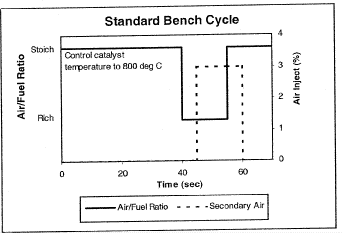
3. The SBC is a 60-second cycle which is repeated as necessary on the aging bench to conduct aging for the required period of time. The SBC is defined based on the catalyst temperature, engine air/fuel (A/F) ratio, and the amount of secondary air injection which is added in front of the first catalyst.
Catalyst Temperature Control
1. Catalyst temperature shall be measured in the catalyst bed at the location where the highest temperature occurs in the hottest catalyst. Alternatively, the feed gas temperature may be measured and converted to catalyst bed temperature using a linear transform calculated from correlation data collected on the catalyst design and aging bench to be used in the aging process.
2. Control the catalyst temperature at stoichiometric operation (01 to 40 seconds on the cycle) to a minimum of 800°C (±10°C) by selecting the appropriate Engine speed, load, and spark timing for the engine. Control the maximum catalyst temperature that occurs during the cycle to 890°C (±10°C) by selecting the appropriate A/F ratio of the engine during the “rich” phase described in the table below.
3. If a low control temperature other than 800°C is utilized, the high control temperature shall be 90°C higher than the low control temperature.
| Time
(seconds) | Engine air/fuel ratio | Secondary air injection |
|---|---|---|
| 01-40 | 14.7 (stoichiometric, with load, spark timing, and engine speed controlled to achieve a minimum catalyst temperature of 800°C) | None |
| 41-45 | “Rich” (A/F ratio selected to achieve a maximum catalyst temperature over the entire cycle of 890°C, or 90° higher than low control temperature) | None |
| 46-55 | “Rich” (A/F ratio selected to achieve a maximum catalyst temperature over the entire cycle of 890°C, or 90° higher than low control temperature) | 3% (±0.1%) |
| 56-60 | 14.7 (stoichiometric, same load, spark timing, and engine speed as used in the 01-40 sec period of the cycle) | 3% (±0.1%) |
[71 FR 2837, Jan. 17, 2006]
['Air Programs']
['Mobile Emission Sources']
UPGRADE TO CONTINUE READING