['Air Programs']
['Mobile Emission Sources']
12/22/2025

Copyright 2026 J. J. Keller & Associate, Inc. For re-use options please contact copyright@jjkeller.com or call 800-558-5011.
...
The R-Factor is the catalyst thermal reactivity coefficient used in the bench aging time (BAT) equation [Ref. §86.1826-08(d)(3)]. Manufacturers may determine the value of R experimentally using the following procedures.
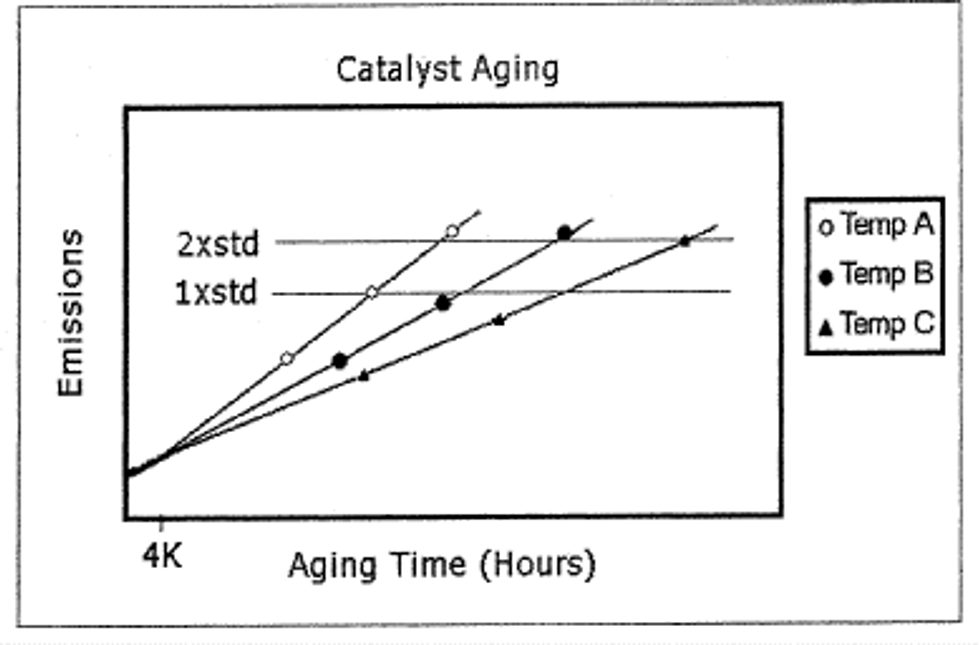
1. Using the applicable bench cycle and aging bench hardware, age several catalysts (minimum of 3 of the same catalyst design) at different control temperatures between the normal operating temperature and the damage limit temperature. Measure emissions (or catalyst inefficiency (1-catalyst efficiency)) for each constituent. Assure that the final testing yields data between one- and two-times the standard.
2. Estimate the value of R and calculate the effective reference temperature (Tr) for the bench aging cycle for each control temperature according to the procedure described in §86.1826-08(d)(4).
3. Plot emissions (or catalyst inefficiency) versus aging time for each catalyst. Calculate the least-squared best-fit line through the data. For the data set to be useful for this purpose the data should have an approximately common intercept between 0 and 4000 miles. See the following graph for an example.
4. Calculate the slope of the best-fit line for each aging temperature.
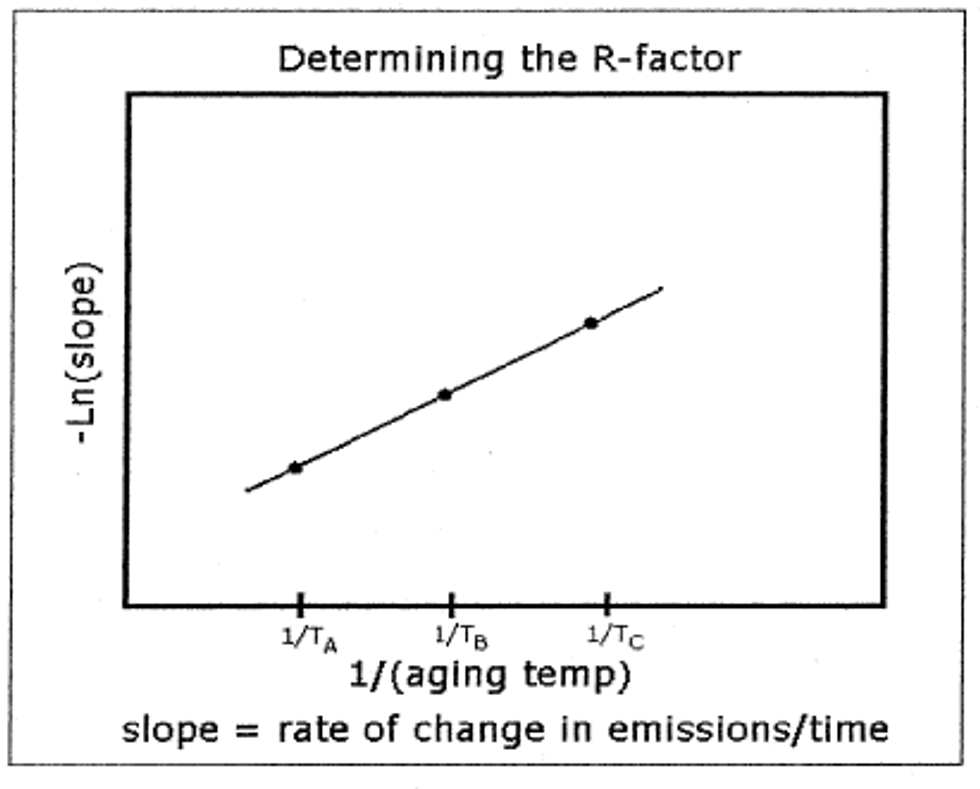
5. Plot the natural log (ln) of the slope of each best-fit line (determined in step 4) along the vertical axis, versus the inverse of aging temperature (1/(aging temperature, deg K)) along the horizontal axis, Calculate the least-squared best-fit lines through the data. The slope of the line is the R-factor. See the following graph for an example.
6. Compare the R-factor to the initial value that was used in Step 2. If the calculated R-factor differs from the initial value by more than 5%, choose a new R-factor that is between the initial and calculated values, then repeat Steps 2-6 to derive a new R-factor. Repeat this process until the calculated R-factor is within 5% of the initially assumed R-factor.
7. Compare the R-factor determined separately for each constituent. Use the lowest R-factor (worst case) for the BAT equation.
[71 FR 2837, Jan. 17, 2006]
['Air Programs']
['Mobile Emission Sources']
UPGRADE TO CONTINUE READING