Compliance Just Got Easier: Stay ahead of regulatory changes with instant notifications on updates that matter.
['Hazmat markings, Placards, and Labels']
['Orange panel - Hazmat', 'Hazmat markings']
01/21/2026

Copyright 2026 J. J. Keller & Associate, Inc. For re-use options please contact copyright@jjkeller.com or call 800-558-5011.
(a) General. When required by §172.301, §172.302, §172.313, §172.326, §172.328, §172.330, or §172.331, identification number markings must be displayed on orange panels or placards as specified in this section, or on white square-on-point configurations as prescribed in §172.336(b).
(b) Orange panels. Display of an identification number on an orange panel shall be in conformance with the following:
(1) The orange panel must be 160 mm (6.3 inches) high by 400 mm (15.7 inches) wide with a 15 mm (0.6 inches) black outer border. The identification number shall be displayed in 100 mm (3.9 inches) black Helvetica Medium numerals on the orange panel. Measurements may vary from those specified plus or minus 5 mm (0.2 inches).
(2) The orange panel may be made of any durable material prescribed for placards in §172.519, and shall be of the orange color specified for labels or placards in appendix A to this part.
(3) The name and hazard class of a material may be shown in the upper left border of the orange panel in letters not more than 18 points (0.25 inches) high.
(4) Except for size and color, the orange panel and identification numbers shall be as illustrated for Liquefied petroleum gas:
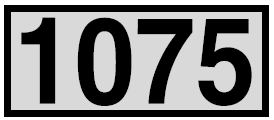
(c) Placards: Display of an identification number on a hazard warning placard shall be in conformance with the following:
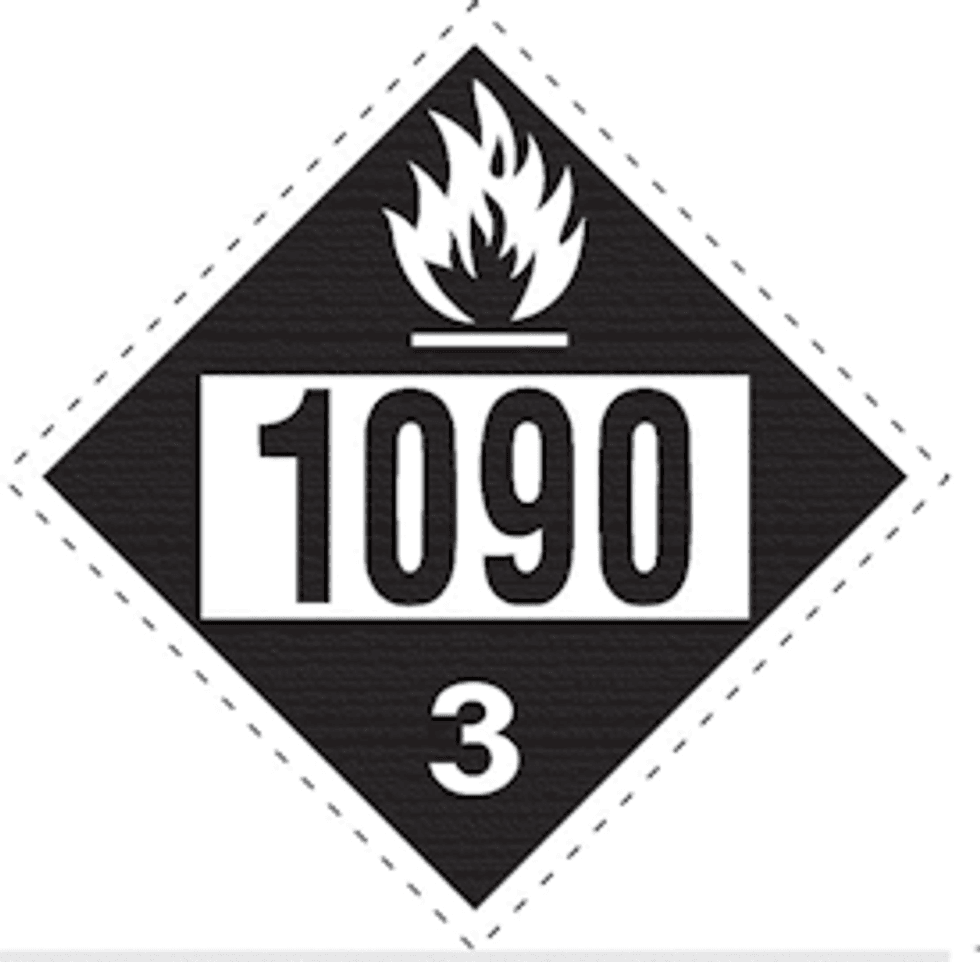
(1) The identification number shall be displayed across the center area of the placard in 88 mm (3.5 inches) black Alpine Gothic or Alternate Gothic No. 3 numerals on a white background 100 mm (3.9 inches) high and approximately 215 mm (8.5 inches) wide and may be outlined with a solid or dotted line border.
(2) The top of the 100 mm (3.9 inches) high white background shall be approximately 40 mm (1.6 inches) above the placard horizontal centerline.
(3) An identification number may be displayed only on a placard corresponding to the primary hazard class of the hazardous material.
(4) For a COMBUSTIBLE placard used to display an identification number, the entire background below the white background for the identification number must be white during transportation by rail and may be white during transportation by highway.
(5) The name of the hazardous material and the hazard class may be shown in letters not more than 18 points high immediately within the upper border of the space on the placard bearing the identification number of the material.
(6) If an identification number is placed over the word(s) on a placard, the word(s) should be substantially covered to maximize the effectiveness of the identification number.
(d) Example. Except for size and color, the display of an identification number on a placard shall be as illustrated for Acetone:
[Amdt. 172–101, 45 FR 74667, Nov. 10, 1980, as amended by Amdt. 172–81, 48 FR 28099, June 20, 1983; Amdt. 172–110, 52 FR 29527, Aug. 10, 1987; Amdt. 172–123, 55 FR 52593, Dec. 21, 1990; 56 FR 66255, Dec. 20, 1991; Amdt. 172–151, 62 FR 1228, Jan. 8, 1997; 65 FR 50459, Aug. 18, 2000; 68 FR 57632, Oct. 6, 2003; 87 FR 79772, Dec. 27, 2022]
['Hazmat markings, Placards, and Labels']
['Orange panel - Hazmat', 'Hazmat markings']
UPGRADE TO CONTINUE READING
ezExplanations
Results Aided by AI