Compliance Just Got Easier: Stay ahead of regulatory changes with instant notifications on updates that matter.
['Air Programs']
['Air Emissions']
07/11/2024

Copyright 2026 J. J. Keller & Associate, Inc. For re-use options please contact copyright@jjkeller.com or call 800-558-5011.
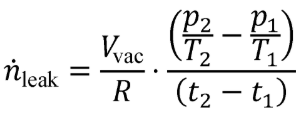
This section describes how to calculate the leak rate of a vacuum-decay leak verification, which is described in §1065.345(e). Use the following equation to calculate the leak rate, , and compare it to the criterion specified in §1065.345(e):
Eq. 1065.644-1
Where:
Vvac = geometric volume of the vacuum-side of the sampling system.
R = molar gas constant.
p2 = vacuum-side absolute pressure at time t 2.
T2 = vacuum-side absolute temperature at time t 2.
p1 = vacuum-side absolute pressure at time t 1.
T1 = vacuum-side absolute temperature at time t 1.
t2 = time at completion of vacuum-decay leak verification test.
t1 = time at start of vacuum-decay leak verification test.
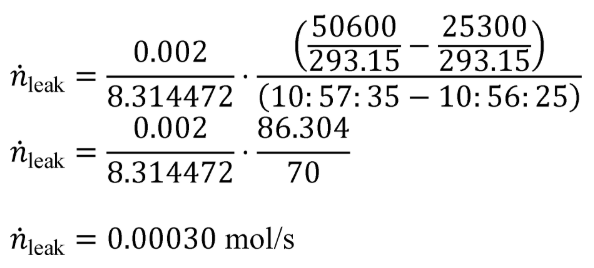
Example:
Vvac = 2.0000 L = 0.00200 m 3
R = 8.314472 J/(mol·K) = 8.314472 (m 2 ·kg)/(s 2 ·mol·K)
p2 = 50.600 kPa = 50600 Pa = 50600 kg/(m·s 2)
T2 = 293.15 K
p1 = 25.300 kPa = 25300 Pa = 25300 kg/(m·s 2)
T1 = 293.15 K
t2 = 10:57:35 a.m.
t1 = 10:56:25 a.m.
[79 FR 23795, Apr. 28, 2014; 89 FR 29808, Apr. 22, 2024]
['Air Programs']
['Air Emissions']
UPGRADE TO CONTINUE READING
ezExplanations
Results Aided by AI