Compliance Just Got Easier: Stay ahead of regulatory changes with instant notifications on updates that matter.
['Fuel Management']
['Fuel management']
12/01/2023

Copyright 2026 J. J. Keller & Associate, Inc. For re-use options please contact copyright@jjkeller.com or call 800-558-5011.
:
|
InstituteEnglishTransportationUSAFleet OperationsFuel managementFuel ManagementAnalysisFocus AreaIn Depth (Level 3)
Gear fast and run slow
['Fuel Management']
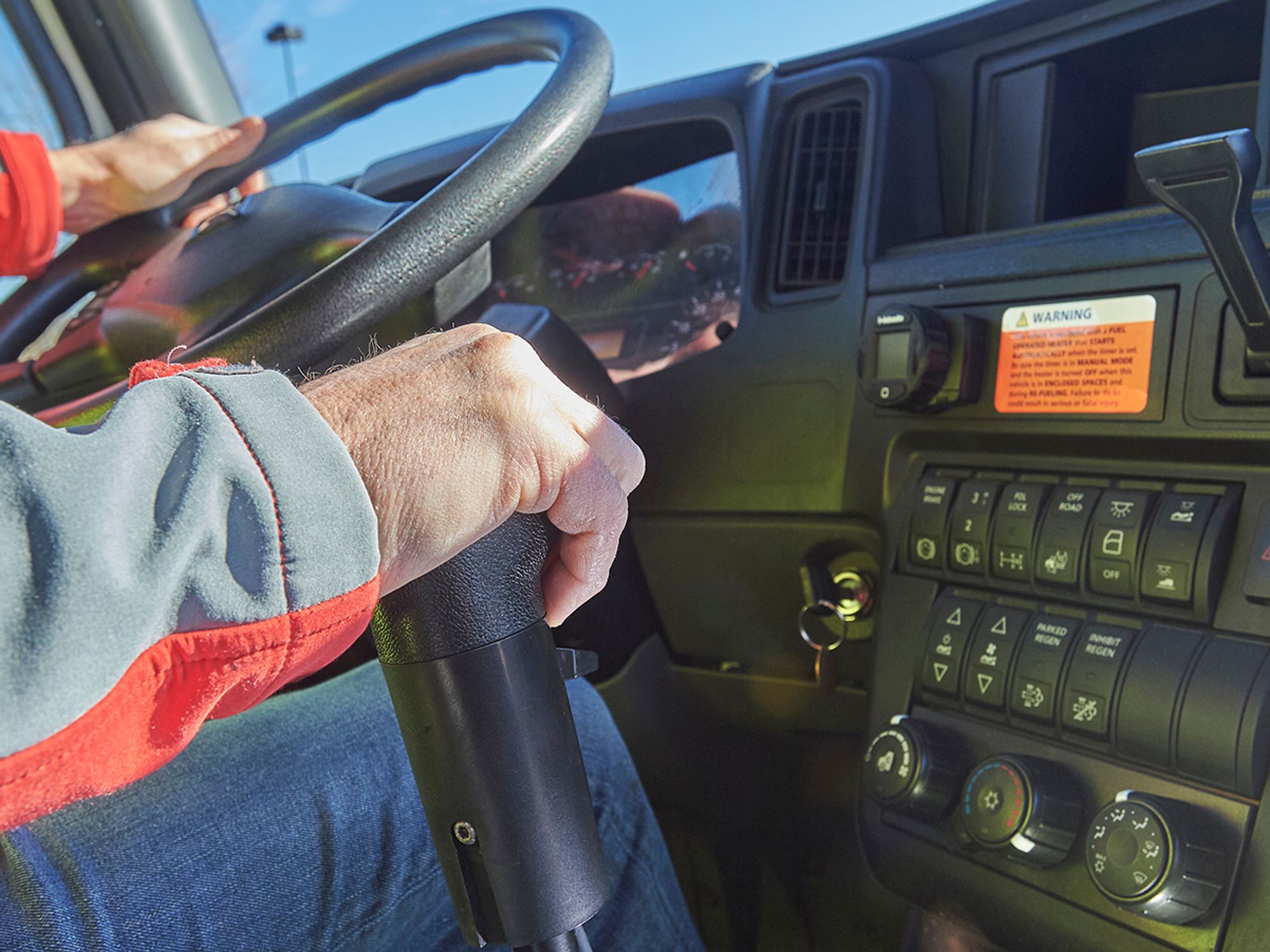
- Motor carriers should be sure drivers are operating vehicles at slower than their optimum speed to prevent wear and tear.
Gear ratios in the transmission and rear axle(s) determine how fast the engine spins (in revolutions per mile [RPM]) at any given road speed. When spec’ing for fuel economy, each must be selected with the other in mind. The best way to use gearing for fuel economy is to “gear fast/run slow.”
Motor carriers should spec their vehicles so that they could run fast but set the vehicle software to cruise at a slower speed than they are capable of. This lower cruising speed will also mean a lower cruising RPM. The lower the engine RPM during cruising, the less fuel consumed.
Vehicle owners should be careful to not overdo it. The goal is to make sure that the engine is operating at the lower end of its power band when cruising, rather than the upper end. If the vehicle is geared too fast, the engine will be below its power band when cruising, which can create wear and performance problems (the driver or the vehicle must do a lot of downshifting to maintain speed/power during normal driving).
Most trucks, tractors, and large buses are geared for a top speed of 75-80 miles per hour (mph) at 1800 to 2100 RPMs. With this engine/gear package, they cruise efficiently at 65 mph with the engine operating at between 1300-1500 RPM (when equipped with engines with a power band of 1200 RPMs to 1800 RPMs). At this operating range the vehicle uses the least amount of fuel possible.
:
fuel-management
FOUNDATIONAL LEARNING
Gear fast and run slow
InstituteEnglishTransportationUSAFleet OperationsFuel managementFuel ManagementAnalysisFocus AreaIn Depth (Level 3)
['Fuel Management']
- Motor carriers should be sure drivers are operating vehicles at slower than their optimum speed to prevent wear and tear.
Gear ratios in the transmission and rear axle(s) determine how fast the engine spins (in revolutions per mile [RPM]) at any given road speed. When spec’ing for fuel economy, each must be selected with the other in mind. The best way to use gearing for fuel economy is to “gear fast/run slow.”
Motor carriers should spec their vehicles so that they could run fast but set the vehicle software to cruise at a slower speed than they are capable of. This lower cruising speed will also mean a lower cruising RPM. The lower the engine RPM during cruising, the less fuel consumed.
Vehicle owners should be careful to not overdo it. The goal is to make sure that the engine is operating at the lower end of its power band when cruising, rather than the upper end. If the vehicle is geared too fast, the engine will be below its power band when cruising, which can create wear and performance problems (the driver or the vehicle must do a lot of downshifting to maintain speed/power during normal driving).
Most trucks, tractors, and large buses are geared for a top speed of 75-80 miles per hour (mph) at 1800 to 2100 RPMs. With this engine/gear package, they cruise efficiently at 65 mph with the engine operating at between 1300-1500 RPM (when equipped with engines with a power band of 1200 RPMs to 1800 RPMs). At this operating range the vehicle uses the least amount of fuel possible.
2656869290
2656869042
UPGRADE TO CONTINUE READING
RELATED TOPICS
J. J. Keller is the trusted source for DOT / Transportation, OSHA / Workplace Safety, Human Resources, Construction Safety and Hazmat / Hazardous Materials regulation compliance products and services. J. J. Keller helps you increase safety awareness, reduce risk, follow best practices, improve safety training, and stay current with changing regulations.
Copyright 2026 J. J. Keller & Associate, Inc. For re-use options please contact copyright@jjkeller.com or call 800-558-5011.