Compliance Just Got Easier: Stay ahead of regulatory changes with instant notifications on updates that matter.
['Whistleblower Protection Program']
['Whistleblower Protection Program', 'Whistleblower Complaint Filing']
04/25/2026

Copyright 2026 J. J. Keller & Associate, Inc. For re-use options please contact copyright@jjkeller.com or call 800-558-5011.
:
|
InstituteWhistleblower Protection ProgramWhistleblower Protection ProgramSafety & HealthWhistleblower Complaint FilingGeneral Industry SafetyEnglishAnalysisFocus AreaCompliance and Exceptions (Level 2)USA
Filing a complaint
['Whistleblower Protection Program']
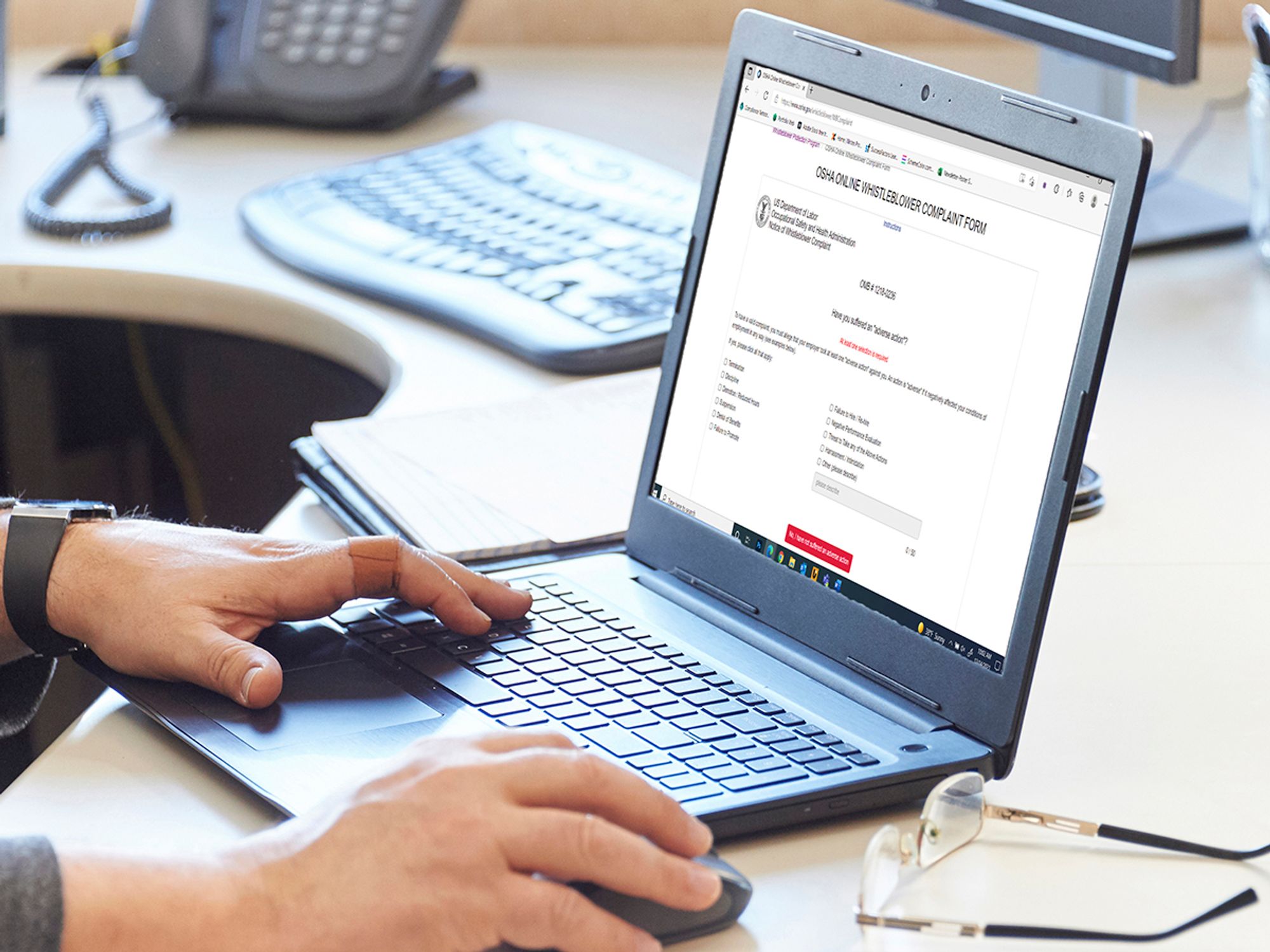
- Employees who believe they have been retaliated against by their employers for reporting hazards should file a complaint with OSHA as soon as possible.
- Private-sector and USPS employees are covered under the OSH Act and in some cases, state law. Other federal employees are covered by their agencies’ procedures.
Employees who believe that their employers retaliated against them because they engaged in protected activity may contact the Occupational Safety and Health Administration (OSHA). Complaints can be filed verbally in any language by visiting the nearest OSHA office, calling 1-800-321-6742, mailing a written complaint to the closest OSHA office, or by filing a complaint online at www.osha.gov/whistleblower/WBComplaint. Learn more about how to file a complaint at www.whistleblowers.gov/complaint_page.
However, they must file any complaint within the legal time limits, and each statute may have a different time limit. The date of the postmark, fax, electronic communication, telephone call, hand delivery, delivery to a third-party commercial carrier, or in-person filing at an OSHA office is considered the date filed.
Note that whistleblower complaints under section 11(c) of the Occupational Safety and Health Act, for example, must be filed within 30 days after the alleged retaliation occurs (when the employee is notified of the retaliatory action). Complaints filed with OSHA after 30 days may be referred to the National Labor Relations Board (NLRB) for possible further action. Complaints regarding retaliation for reporting an injury or illness to an employer may also be considered for OSHA safety and health enforcement action.
When OSHA receives a complaint, the agency will first review it to determine whether certain basic requirements are met, such as whether the complaint was filed on time. If so, the complaint will be investigated in order to determine whether the employer retaliated against the employee for engaging in activity protected under one of OSHA’s whistleblower laws. The agency may also attempt to assist the employer and employee in reaching a settlement of the case.
Publication OSHA 4487, "Elements of a Whistleblower Complaint," explains that OSHA investigates complaints sharing four elements:
- Protected activity — Actions by an employee that are statutorily protected, such as reporting a potential violation, hazard, or work-related injury or illness; cooperating with a government agency; filing a complaint; or refusing to perform unsafe or illegal work.
- Employer knowledge — This exists when a person involved in or influencing the adverse action decision knows or suspects the employee engaged in protected activity, and in some cases, this can be inferred.
- Adverse action — An employer’s action that would discourage a reasonable employee from engaging in protected activity, including but not limited to: termination, lay off, demotion, overtime denial, discipline, reassignment, pay or hour reduction, and blacklisting.
- Nexus — The connection between the protected activity and adverse action.
Publication OSHA 4488, "OSHA Explains: How We Investigate Whistleblower Complaints under the OSH Act," offers a flowchart for the investigative process.
Private-sector and USPS employees
Private-sector employees throughout the United States and its territories and employees of the United States Postal Service (USPS) who suffer retaliation because of occupational safety or health activity are covered by section 11(c) of the OSH Act. In addition, private-sector employees are covered by laws in states which operate their own comprehensive occupational safety and health programs approved by federal OSHA (“state plans”). For information on the whistleblower provisions of the 29 state-plan states that cover private-sector employees, employees should visit www.osha.gov/stateplans.
Public-sector employees
With the exception of employees of the USPS, public-sector employees (those employed as municipal, county, state, territorial, or federal workers) are not covered by the OSH Act. State and local government employees are covered by the whistleblower provisions of all the states with state plans, including seven states which cover only state and local government employees.
A federal employee who is not a USPS employee and who wishes to file a complaint alleging retaliation due to disclosure of a substantial and specific danger to public health or safety or involving a violation of an occupational safety or health standard or regulation should contact the Office of Special Counsel (www.osc.gov). Such federal employees are also covered by their own agency’s procedures for remedying such retaliation.
Public-sector employees who are unsure whether they are covered under a whistleblower law should call (800) 321-6742 for assistance, or visit www.whistleblowers.gov.
:
whistleblower-protection-program
whistleblower-protection-program
FOUNDATIONAL LEARNING
Filing a complaint
InstituteWhistleblower Protection ProgramWhistleblower Protection ProgramSafety & HealthWhistleblower Complaint FilingGeneral Industry SafetyEnglishAnalysisFocus AreaCompliance and Exceptions (Level 2)USA
['Whistleblower Protection Program']
- Employees who believe they have been retaliated against by their employers for reporting hazards should file a complaint with OSHA as soon as possible.
- Private-sector and USPS employees are covered under the OSH Act and in some cases, state law. Other federal employees are covered by their agencies’ procedures.
Employees who believe that their employers retaliated against them because they engaged in protected activity may contact the Occupational Safety and Health Administration (OSHA). Complaints can be filed verbally in any language by visiting the nearest OSHA office, calling 1-800-321-6742, mailing a written complaint to the closest OSHA office, or by filing a complaint online at www.osha.gov/whistleblower/WBComplaint. Learn more about how to file a complaint at www.whistleblowers.gov/complaint_page.
However, they must file any complaint within the legal time limits, and each statute may have a different time limit. The date of the postmark, fax, electronic communication, telephone call, hand delivery, delivery to a third-party commercial carrier, or in-person filing at an OSHA office is considered the date filed.
Note that whistleblower complaints under section 11(c) of the Occupational Safety and Health Act, for example, must be filed within 30 days after the alleged retaliation occurs (when the employee is notified of the retaliatory action). Complaints filed with OSHA after 30 days may be referred to the National Labor Relations Board (NLRB) for possible further action. Complaints regarding retaliation for reporting an injury or illness to an employer may also be considered for OSHA safety and health enforcement action.
When OSHA receives a complaint, the agency will first review it to determine whether certain basic requirements are met, such as whether the complaint was filed on time. If so, the complaint will be investigated in order to determine whether the employer retaliated against the employee for engaging in activity protected under one of OSHA’s whistleblower laws. The agency may also attempt to assist the employer and employee in reaching a settlement of the case.
Publication OSHA 4487, "Elements of a Whistleblower Complaint," explains that OSHA investigates complaints sharing four elements:
- Protected activity — Actions by an employee that are statutorily protected, such as reporting a potential violation, hazard, or work-related injury or illness; cooperating with a government agency; filing a complaint; or refusing to perform unsafe or illegal work.
- Employer knowledge — This exists when a person involved in or influencing the adverse action decision knows or suspects the employee engaged in protected activity, and in some cases, this can be inferred.
- Adverse action — An employer’s action that would discourage a reasonable employee from engaging in protected activity, including but not limited to: termination, lay off, demotion, overtime denial, discipline, reassignment, pay or hour reduction, and blacklisting.
- Nexus — The connection between the protected activity and adverse action.
Publication OSHA 4488, "OSHA Explains: How We Investigate Whistleblower Complaints under the OSH Act," offers a flowchart for the investigative process.
Private-sector and USPS employees
Private-sector employees throughout the United States and its territories and employees of the United States Postal Service (USPS) who suffer retaliation because of occupational safety or health activity are covered by section 11(c) of the OSH Act. In addition, private-sector employees are covered by laws in states which operate their own comprehensive occupational safety and health programs approved by federal OSHA (“state plans”). For information on the whistleblower provisions of the 29 state-plan states that cover private-sector employees, employees should visit www.osha.gov/stateplans.
Public-sector employees
With the exception of employees of the USPS, public-sector employees (those employed as municipal, county, state, territorial, or federal workers) are not covered by the OSH Act. State and local government employees are covered by the whistleblower provisions of all the states with state plans, including seven states which cover only state and local government employees.
A federal employee who is not a USPS employee and who wishes to file a complaint alleging retaliation due to disclosure of a substantial and specific danger to public health or safety or involving a violation of an occupational safety or health standard or regulation should contact the Office of Special Counsel (www.osc.gov). Such federal employees are also covered by their own agency’s procedures for remedying such retaliation.
Public-sector employees who are unsure whether they are covered under a whistleblower law should call (800) 321-6742 for assistance, or visit www.whistleblowers.gov.
2656869280
2656871372
UPGRADE TO CONTINUE READING
RELATED TOPICS
J. J. Keller is the trusted source for DOT / Transportation, OSHA / Workplace Safety, Human Resources, Construction Safety and Hazmat / Hazardous Materials regulation compliance products and services. J. J. Keller helps you increase safety awareness, reduce risk, follow best practices, improve safety training, and stay current with changing regulations.
Copyright 2026 J. J. Keller & Associate, Inc. For re-use options please contact copyright@jjkeller.com or call 800-558-5011.