
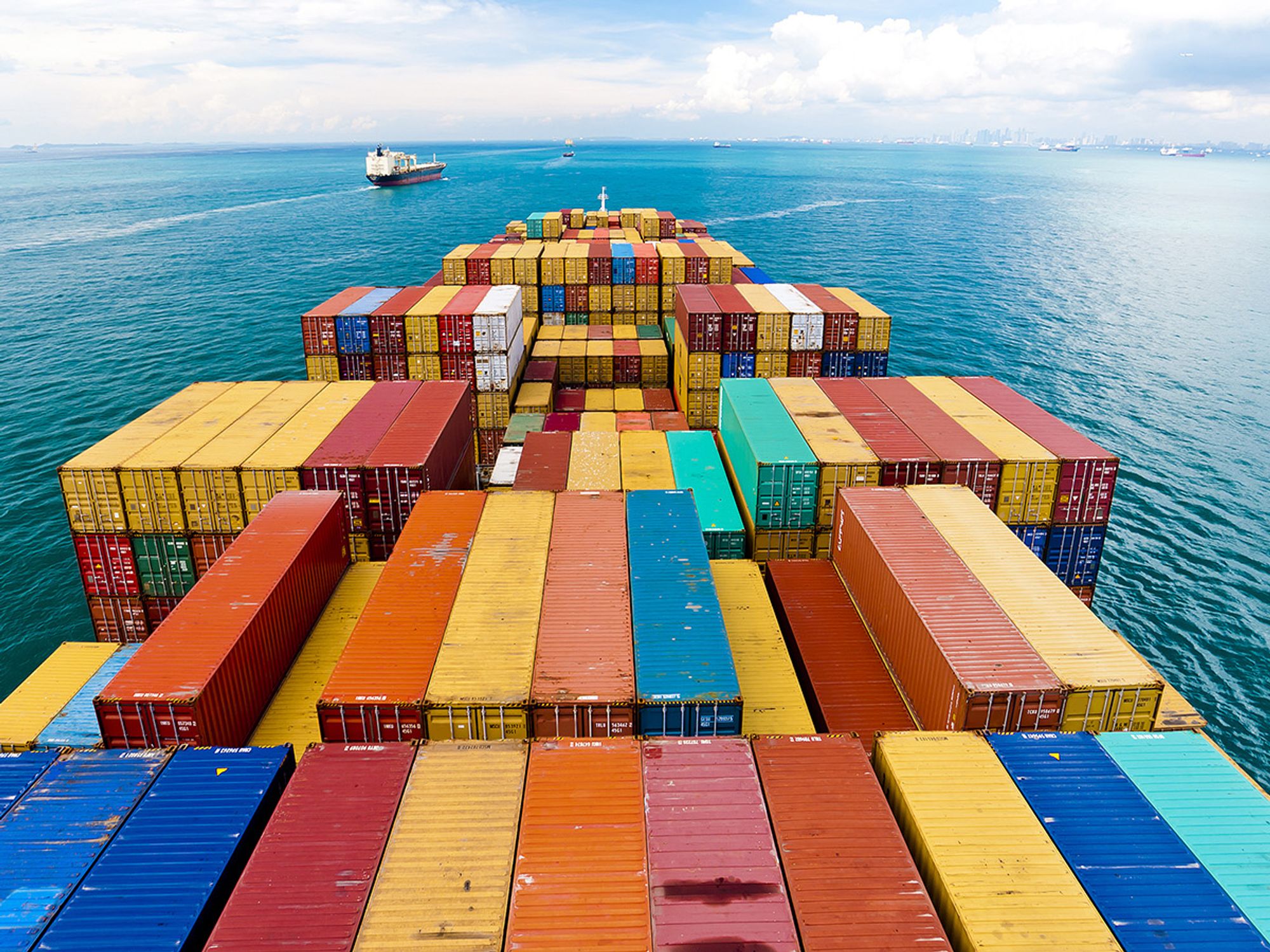
- PHMSA and the USCG regulate the transport of hazmat by vessel in the U.S.
- The HMR provide guidance for transporting hazardous materials by water, as well as other the modes of transport.
Hazardous materials (hazmat) aren’t just transported by road, rail, or air—they’re also shipped by vessel. In the U.S., the Pipeline and Hazardous Materials Safety Administration (PHMSA) works with the U.S. Coast Guard (USCG) to oversee hazmat transport by water.
The Hazardous Materials Regulations (HMR) provide guidance for all modes of transportation. However, each mode has its own unique requirements that you must account for when transporting hazmat. When you're shipping hazmat by vessel, there are some important differences to be aware of, especially in areas like:
- Training
- Documentation
- General handling and stowage
- General segregation requirements
- Emergency situations
- Ferry vessels and barges
- All shipments of hazardous material by vessel must be accompanied by the following documents: Shipping papers; certification; a dangerous cargo manifest, list or stowage plan; and a special permit (if applicable).
Unless there's an exception, carriers cannot transport a hazardous material by vessel without the following documents:
- Shipping papers
- Certification
- Dangerous cargo manifest, list, or stowage plan
- Special permit (if applicable)
Shipping papers
Section 176.24 requires shippers to provide a shipping paper that is prepared in accordance with Part 172 of the Hazardous Materials Regulations (HMR). The shipping paper, including emergency response information, must accompany the hazardous materials, unless the material is excepted from shipping paper requirements under the HMR.
Certification
Section 176.27 requires that, at the time a freight container or transport vehicle containing hazardous materials is offered for transportation by vessel, the person responsible for packing or loading it must give the vessel operator a signed container packing certificate stating:
- The container or transport unit is serviceable for the material loaded within.
- It contains no incompatible goods.
- The container and its contents have been properly marked, labeled, and placarded.
- Packages within the container have been inspected, secured, and are not damaged.
The signed certification may appear on a shipping paper or on a separate document. Below are two examples of the certification statement:
“This is to certify that the above-named materials are properly classified, described, packaged, marked and labeled, and are in proper condition for transportation according to the applicable regulations of the Department of Transportation.”
“It is declared that the packing of the container has been carried out in accordance with the applicable provisions of 49 CFR.”
Dangerous cargo manifest, list, or stowage plan
The carrier, its agents, or any person designated by the carrier must prepare a dangerous cargo manifest, list, or stowage plan. The document must include all hazardous materials subject to the requirements of the HMR or the International Maritime Dangerous Goods (IMDG) Code, and must include:
- Name, official number, and nationality of vessel;
- Shipping name and identification number of each hazardous material on board;
- The number and description of each type of package;
- Classification of the hazardous material;
- Any additional description required by section 172.203;
- Stowage location of hazardous material; and
- Additional information in case the vessel is used for storage of explosives or other hazardous materials.
The Dangerous Cargo Manifest must be kept on or near the vessel’s bridge, except when the vessel is docked in a U.S. port.
When docked at a U.S. port, this document may be kept in the vessel’s cargo office or another location designated by the master of the vessel, provided that a sign is placed beside the designated holder on or near the vessel’s bridge indicating the location of the dangerous cargo manifest, list, or stowage plan.
This document must always be in a location that is readily accessible to emergency response and enforcement personnel.
Special permit
If a hazardous material is being transported by vessel under the authority of an exemption or special permit, then a copy of the exemption or special permit is required to be on board the vessel and must be kept with the dangerous cargo manifest.
- Hazardous materials may only be handled or stowed under the direction and observation of a responsible person.
- Each hold or compartment of a vessel must be inspected before hazmat can be loaded on board.
- Authorized storage locations are listed in Column 10 of the Hazardous Materials Table (HMT).
Hazardous materials may only be handled or stowed on board a vessel under the direction and observation of a responsible person who has been assigned this duty. A responsible person is considered:
- For a vessel engaged in coastwise voyages, or on rivers, bays, sounds or lakes, including the Great Lakes when the voyage is not foreign going, the responsible person may be an employee of the carrier and assigned this duty by the carrier, or a licensed officer attached to the vessel and assigned by the master of the vessel.
- For a domestic vessel engaged in a foreign-going or intercoastal voyage, the responsible person must be an officer possessing an unexpired license issued by the U.S. Coast Guard (USCG) and assigned this duty by the master of the vessel.
- For a foreign vessel, the responsible person must be an officer of the vessel assigned this duty by the master of the vessel.
Before hazardous materials can be loaded or stored on board a vessel, each hold or compartment must be free of debris. This requires examination of the bilges to ensure that residue from previous cargo has been removed.
The carrier and the master of the vessel are jointly responsible for posting “NO SMOKING” signs in locations when smoking is prohibited by the Hazardous Materials Regulations (HMR) during the loading, stowing, storing, transportation, or unloading of hazardous materials.
Inspection
After stowage, the carrier must inspect each hold or compartment containing hazardous materials to ensure that stowage has been accomplished properly and that there are no visible signs of damage to any packages or evidence of heating, leaking, or sifting.
For manned vessels, an inspection of the cargo must be made after stowage has been completed and at least once every 24 hours thereafter (weather permitting). However, freight containers or individual barges do not need to be opened.
Vessels equipped with smoke or fire detecting systems with an automatic monitoring capability need to be inspected only after stowage is completed and after periods of heavy weather. Each inspection of the stowage of hazardous materials must be recorded in the vessel’s deck logbook. For unmanned and magazine vessels, an inspection of the cargo must be made only after stowage has been completed.
This inspection must be made by the individual who is responsible to the carrier and who is in charge of loading and stowing the cargo on the unmanned vessels or the individual in charge in the case of a magazine vessel.
Stowage locations
Authorized vessel stowage locations can be found in Column 10 of the Hazardous Materials Table (HMT) in Part 172.101.
Column 10A contains alpha and numeric categories that specify the authorized stowage locations on board cargo and passenger vessels. The categories can be found in section 172.101(k). There are three physical locations given:
- “On Deck” means located on the weather deck.
- “Under the deck” means located in a hold or compartment below the weather deck.
- “Under deck away from heat” means located under deck and with built-in means of ventilation.
Hazardous materials offered for transport as limited quantities are allocated stowage category A and are not subject to any of the stowage requirements indicated in Column 10B of the HMT.
Column 10B specifies codes for vessel stowage requirements for specific hazardous materials. The meaning of each code found in Column 10B is defined in section 176.84(b) and section176.84(c) for explosives.
- Different types of hazardous materials must be stored separately from each other according to the General Segregation Table.
- Segregation requirements for subsidiary hazards take priority when the segregation is more restrictive than segregation requirements for the primary hazard.
The segregation requirements in 176.83 apply to all cargo spaces on deck or under deck for vessels. The requirements also apply to hazardous materials in cargo transport units.
Segregation can be obtained by:
- Maintaining certain distances between incompatible hazardous materials,
- Requiring the presence of steel bulkheads (an upright wall),
- Having decks between hazards or a combination of an upright wall and a deck.
Spaces between hazardous materials that must be separated may be filled with other cargo that is compatible with the hazardous materials. The segregation of hazardous materials stowed together must always be in accordance with the most restrictive requirements for any of the hazardous materials concerned.
Segregation requirements for subsidiary hazards take priority when the segregation is more restrictive than segregation requirements for the primary hazard. In addition, two hazardous materials for which any segregation is required may not be stowed in the same cargo transport unit. The general requirements for segregation between the various classes of dangerous goods are shown in the segregation table.
Segregation table
To use the General Segregation Table in section 176.83(b), find one class of material in the vertical column, and then find another class in the horizontal row. The intersection of the vertical column and the horizontal row contains a number or symbol that represents the method of segregation that you must use between the two classes.
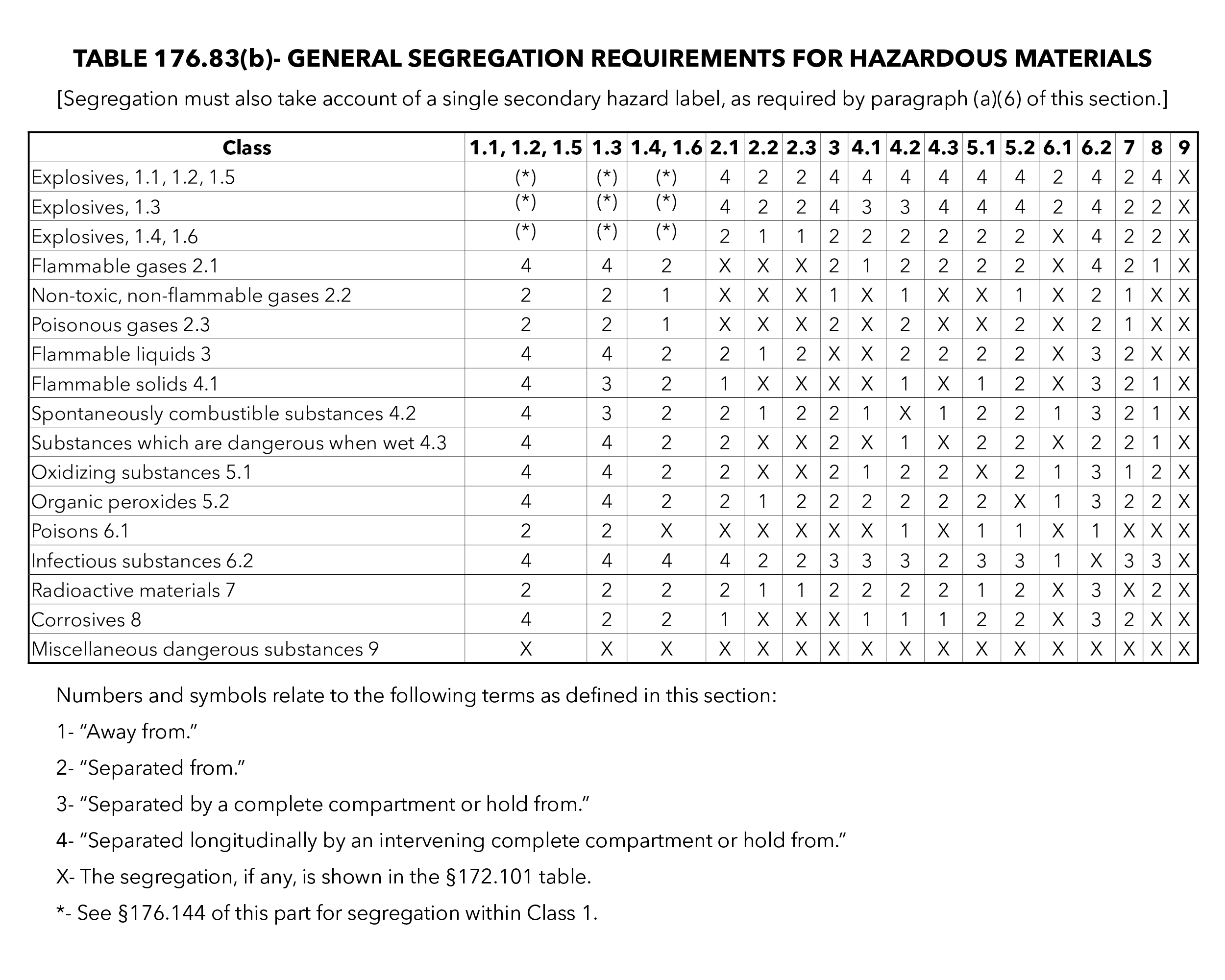
The meaning of the entry in the cell where the materials intersect is:
Away from - means that incompatible hazardous materials may be carried in the same compartment, hold, or deck provided they are horizontally separated by three meters (10 feet).
Separated from - means packages must be carried in different compartments or holds if “under deck,” and separated horizontally by six meters (20 feet) if “on deck.” Separated by a complete compartment or hold from - means packages may be separated between decks if one of the decks is resistant to fire and liquid or, if “on deck,” horizontally separated by 12 meters (39 feet).
Separated longitudinally by an intervening complete compartment or hold from - means for packages separated between “under deck” and “on deck,” a complete compartment must separate them, as well as a longitudinal distance of 24 meters (79 feet).
For “on deck” stowage, a separation of at least 24 meters (79 feet) longitudinally must be maintained.
X – means as shown in column 10 of the hazmat table in section 172.101.
Asterisk – means as stated in section 176.144.