
Portable fire extinguishers
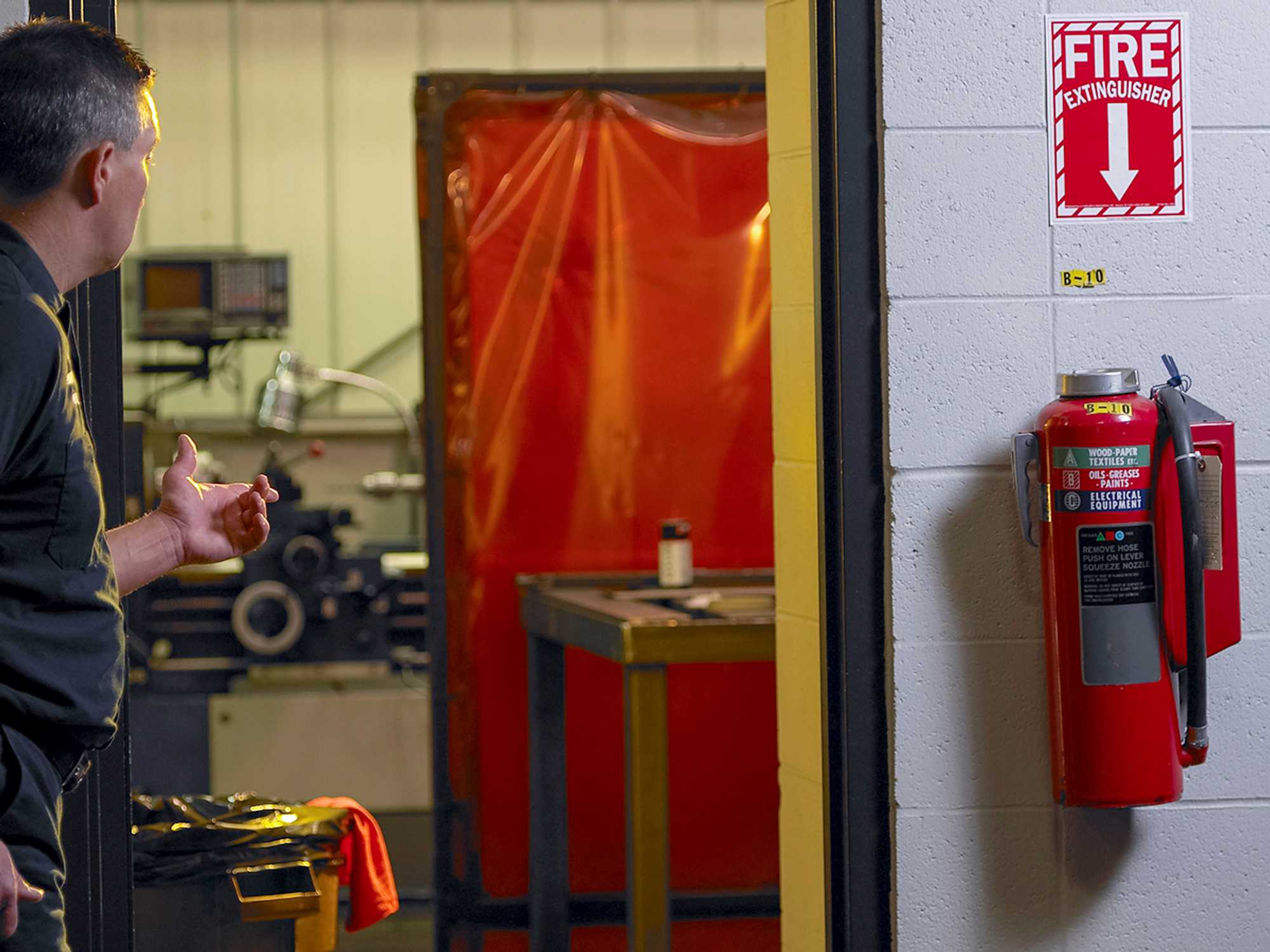
Portable fire extinguishers are designed to be used by employees during the beginning stages of a fire. They contain an extinguishing agent which eliminates one of the vital elements of fire (heat, fuel, or oxygen). If used properly, fire extinguishers can save both lives and property.
Section 1910.157 covers the placement, use, maintenance, and testing of portable fire extinguishers that are provided for employee use. However, the regulation does not apply if you, as an employer:
- Have an established and implemented written fire safety policy. This policy requires the immediate and total evacuation of employees from the facility when the fire alarm signal is sounded; AND
- Have an emergency action plan (EAP) and a fire prevention plan (FPP) that meet the requirements of 29 CFR 1910.38 and 1910.39, respectively; AND
- Do not have fire extinguishers available in the facility.
If 1910.157 applies, your facility’s fire extinguishers must be accepted, certified, listed, or labeled by a nationally recognized testing laboratory. The types of extinguishers in your facility should be determined by the classes of anticipated workplace fires and the size and degree of hazard which would affect their use. Here are some rules of thumb:
| Fire class: | Materials burned in fire: | Extinguishing agent: |
| A | Wood, paper, cloth, rubber, plastic | Water, dry chemical |
| B | Flammable liquids, gases, greases | Dry chemical, carbon dioxide, foam |
| C | Electrical equipment, wiring, machinery | Dry chemical, carbon dioxide |
| D | Combustible metals | Special techniques, dry powder specific for metal |
| K | Cooking oils and fats | Special extinguishers |
Multi-purpose extinguishers (ABC) will handle all A, B, and C fires.
Storage and location
Mount, locate, and identify your fire extinguishers so that they are readily accessible to employees without subjecting themselves to possible injury. Do not put an extinguisher where employees cannot reach it or wherever other equipment is in the way. Make sure the storage location is not in an area where the extinguisher could be damaged. For example, placing an extinguisher in a heavily traveled forklift aisle might need to be reconsidered.
Keep extinguishers in their designated places at all times, except during use. They should be fully charged and in operable condition.
The location of portable fire extinguishers depends on the fire hazards present:
- Storage location for Class A fires: If a class A fire can occur, locate extinguishers so that employees travel no more than 75 feet or less to reach it. You can use standpipe systems or hose stations connected to a sprinkler system instead of class A portable fire extinguishers, if they:
- Meet the respective requirements of 29 CFR 1910.158 or 1910.159,
- Provide total coverage of the area to be protected, and
- Receive annual employee training on their use.
- Storage location for Class B fires: Locate fire extinguishers so that the level distance is 50 feet or less from the hazard area.
- Storage location for Class C fires: Locate extinguishers for Class C fires close to Class A or B extinguishers for the same area.
- Storage location for Class D fires: Locate extinguishers or other extinguishing agents for Class D fires so the travel distance from the combustible metal working area to any extinguishing agent is 75 feet or less.
- Storage location for Class K fires: Locate extinguishers near the cooking area. (OSHA does not have a specific location provision for these types of fires.)
Reading fire extinguisher labels
All fire extinguishers should be marked with a symbol indicating the type of fire class on which it should be used. Review Appendix B to NFPA 10, Standard for Portable Fire Extinguishers, to see the types of labels that are on portable fire extinguishers. NFPA offers free access to NFPA 10 at www.nfpa.org/freeaccess.
Employee training
If you provide portable fire extinguishers for employees to use, you must also provide them an educational program to teach them the general principles of fire extinguisher use and the hazards involved with the incipient stage of firefighting. Provide this training when employees are first hired and then at least once a year thereafter.
Training can include information on:
- How to distinguish between different fires and different fire extinguishers,
- How to operate portable fire extinguishers,
- The capabilities of portable fire extinguishers,
- When to use and when not to use portable fires extinguishers, and
- General fire safety and prevention.
Employees who have been designated to use firefighting equipment as part of the EAP must be trained in the use of the appropriate equipment. This training must be provided upon initial assignment to the designated group and then at least once a year.
How to use fire extinguishers
Allow only a properly trained employee to use an extinguisher if a fire occurs. When using a typical extinguisher, follow the “PASS” method. This method includes holding the extinguisher upright and:
- Pulling the pin, standing back eight or ten feet,
- Aiming at the base of the fire,
- Squeezing the handle to release the extinguishing agent, and
- Sweeping at the base of the fire with the extinguishing agent.
Do not aim high at the flames — the fire won’t be put out. Act fast and spray quickly at the base of the fire, not at the smoke or flames because most extinguishers have a very limited operation time (only eight to 10 seconds).
When to use a portable fire extinguisher
Because fires are dangerous, it’s critical to know when it’s “safe” to attempt to fight a fire with a portable fire extinguisher. Meet all of the following before attempting to fight a fire:
- The building is completely evacuated.
- Someone is calling the Fire Department.
- The fire is small and confined (a wastebasket fire is considered small and confined).
- You can fight the fire with your back toward a non-threatened escape.
- The extinguisher’s class (A, B, C, D, or K) matches the type of fire involved.
- The extinguisher works effectively.
- You’re trained and confident in extinguisher use.
When NOT to use a portable fire extinguisher
It’s just as important to know when you should evacuate. Don’t attempt to fight a fire if any of these conditions exist:
- The fire is already large or has grown beyond its original confined space.
- The path of escape is threatened.
- You aren’t sure how to use the extinguisher.
- You aren’t sure if the extinguisher is the right type for the fire.
Inspection, maintenance, and testing
As an employer, you are responsible for inspecting, maintaining, and testing the fire extinguishers at your facility. The person within the company responsible for these processes must be trained to do the work and to recognize problem areas that could cause an extinguisher to be inoperable.
Testing of fire extinguishers is done in intervals:
- Once a month: Visually inspect extinguishers.
- Every 12 months: Perform a maintenance check:
- Record the date of this inspection and retain this record for one year after the last entry or the life of the shell, whichever is less.
- A stored pressure extinguisher does not require internal examination.
- Every six months: Empty and perform applicable maintenance on stored pressure dry chemical extinguishers that require a 12-year hydrostatic test:
- Dry chemical extinguishers having non-refillable disposable containers are exempt from this requirement.
- When recharging or hydrostatic testing is performed, the six-year requirement begins from that date.
Alternate equivalent protection must be provided when extinguishers are removed from service for testing. Options for this protection include:
- Replacing the extinguisher,
- Restricting the unprotected area from employee exposure,
- Providing a hose system that’s ready to operate, or
- Posting a fire watch.
What to look for during a visual inspection
During the monthly visual inspection, make sure the extinguishers are:
- Mounted properly in their designated location;
- Fully charged and ready for use;
- Sealed;
- Free from defects like rust, scratches, dents, missing pins, cracked hoses, broken nozzles, and gauges that don’t measure pressure;
- Appropriately initialed and dated on an inspection tag attached to the extinguisher;
- Labeled with the proper six-year or hydrotest label; and
- Labeled with the original manufacturer’s label or band.
Hydrostatic testing of extinguishers
Hydrostatic testing uses special equipment and precise water pressure to test portable extinguishers. Use only trained workers with suitable testing equipment and facilities to perform this test. This testing must be performed in intervals according to the type of extinguisher. Exceptions to this requirement are when:
- The extinguisher has been repaired by soldering, welding, brazing, or use of patching compound;
- The cylinder or shell threads are damaged;
- There is corrosion that has caused pitting, including corrosion under removable name plate assemblies;
- The extinguisher has been burned in a fire; or
- A calcium chloride extinguishing agent has been used in a stainless steel shell.
Review the table below from 29 CFR 1910.157(f) to determine when extinguishers in your facility must be hydrostatically tested:
| Type of extinguishers | Test interval (years) |
| Soda acid (soldered brass shells) (until 1/1/82) | ( 1) |
| Soda acid (stainless steel shell) | 5 |
| Cartridge operated water and/or antifreeze | 5 |
| Stored pressure water and/or antifreeze | 5 |
| Wetting agent | 5 |
| Foam (soldered brass shells) (until 1/1/82) | ( 1) |
| Foam (stainless steel shell) | 5 |
| Aqueous Film Forming foam (AFFF) | 5 |
| Loaded stream | 5 |
| Dry chemical with stainless steel | 5 |
| Carbon dioxide | 5 |
| Dry chemical, stored pressure, with mild steel, brazed brass or aluminum shells | 12 |
| Dry chemical, cartridge or cylinder operated, with mild steel shells | 12 |
| Halon 1211 | 12 |
| Halon 1301 | 12 |
| Dry powder, cartridge or cylinder operated with mild steel shells | 12 |
| (1) Extinguishers having shells constructed of copper or brass joined by soft solder or rivets shall not be hydrostatically tested and shall be removed from service by January 1, 1982. (Not permitted) | |