Compliance Just Got Easier: Stay ahead of regulatory changes with instant notifications on updates that matter.
['Walking Working Surfaces']
['Ladders', 'Walking Working Surfaces']
04/22/2026

Copyright 2026 J. J. Keller & Associate, Inc. For re-use options please contact copyright@jjkeller.com or call 800-558-5011.
:
|
InstituteSafety & HealthGeneral Industry SafetyWalking Working SurfacesWalking Working SurfacesUSALaddersEnglishAnalysisFocus AreaIn Depth (Level 3)
Mobile ladder stands
['Walking Working Surfaces']
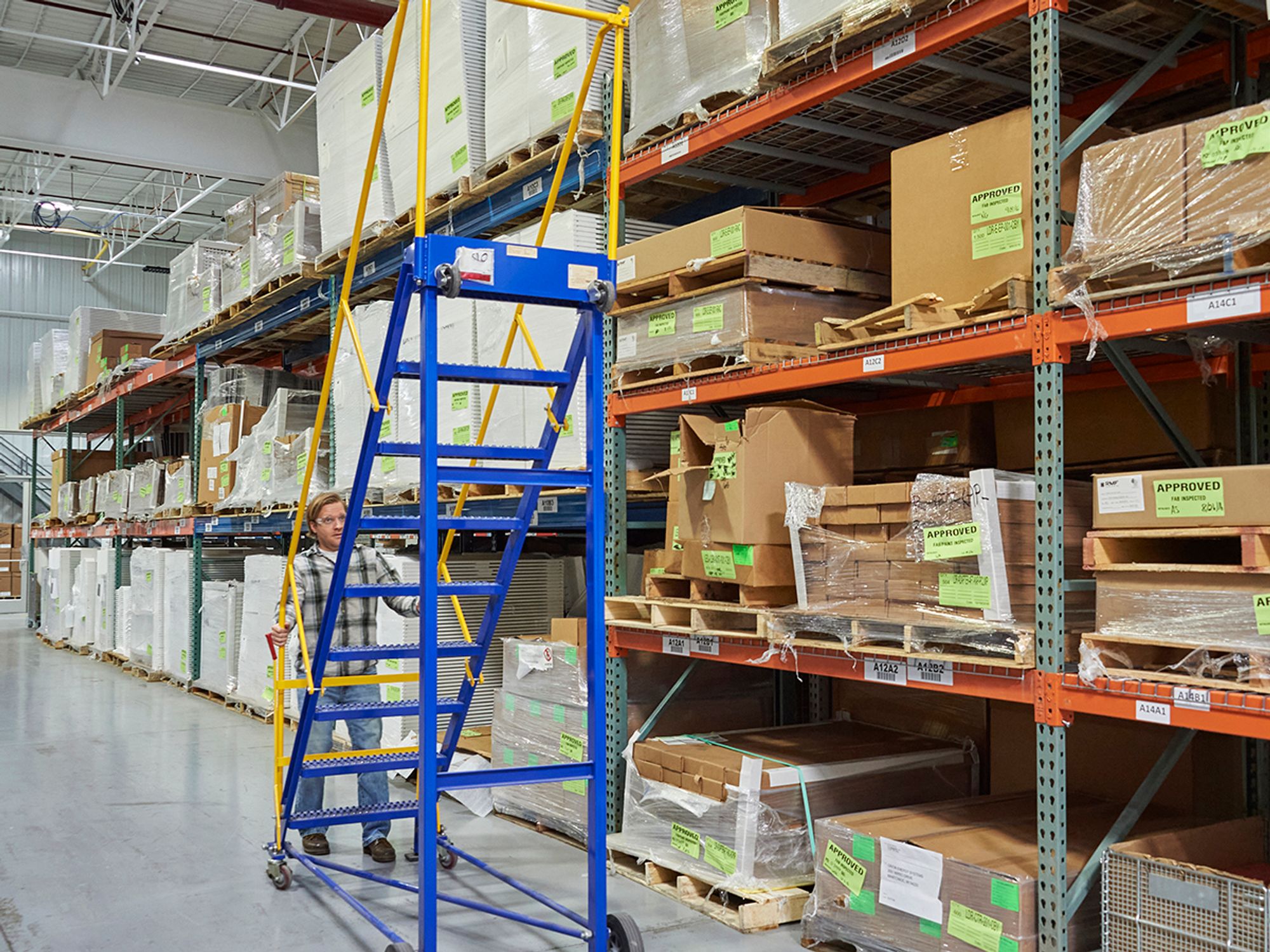
- OSHA’s mobile ladder stand and mobile ladder stand platform requirements are in addition to requirements that apply to all ladders.
- Employers must ensure that mobile ladder stands and platforms are slip resistant and unable to tip over.
The mobile ladder stand and mobile ladder stand platform requirements are in addition to the requirements for all ladders. The Occupational Safety and Health Administration (OSHA) also uses performance-based requirements for these units.
As defined in 1910.21, mobile ladder stands and mobile ladder platforms are ladders that are mobile, have a fixed height, and are self-supporting.
A “mobile ladder stand platform” is a mobile ladder stand with treads leading to one or more platforms. One difference is that a mobile ladder stand is designed for use by one worker at a time, and a mobile ladder platform has one or more platforms and more than one worker can use the platform or platforms at the same time.
The steps and platforms must be slip resistant. Slip-resistant surfaces must be either part of the design and construction, or provided as a secondary process, such as dimpling, knurling, shotblasting, coating, spraying, or applying durable slip-resistant tape.
OSHA says that employers have both an initial and continuing obligation to ensure that steps and platforms remain slip resistant. If the slip resistance applied by the manufacturer wears down or needs repair, employers must take steps to restore the slip resistance. For example, if slip-resistant tape comes off, the employer must replace it. Problems with slip resistance may be noticed during inspections.
Mobile ladder stands and platforms that have wheels or casters must be equipped with a system to impede horizontal movement when an employee is on the stand or platform. Stands or platforms must not move (or be moved) when an employee is on the unit.
The height of a mobile ladder stand or platform must not exceed four times the shortest base dimension. If the height does exceed the shortest base dimension, additional support is required and can include:
- Outriggers,
- Counterweights, or
- Other ways that stabilize the mobile ladder stand or platform.
Employers need to determine the best way to prevent a stand or platform from tipping over.
:
walking-working-surfaces
walking-working-surfaces
FOUNDATIONAL LEARNING
Mobile ladder stands
InstituteSafety & HealthGeneral Industry SafetyWalking Working SurfacesWalking Working SurfacesUSALaddersEnglishAnalysisFocus AreaIn Depth (Level 3)
['Walking Working Surfaces']
- OSHA’s mobile ladder stand and mobile ladder stand platform requirements are in addition to requirements that apply to all ladders.
- Employers must ensure that mobile ladder stands and platforms are slip resistant and unable to tip over.
The mobile ladder stand and mobile ladder stand platform requirements are in addition to the requirements for all ladders. The Occupational Safety and Health Administration (OSHA) also uses performance-based requirements for these units.
As defined in 1910.21, mobile ladder stands and mobile ladder platforms are ladders that are mobile, have a fixed height, and are self-supporting.
A “mobile ladder stand platform” is a mobile ladder stand with treads leading to one or more platforms. One difference is that a mobile ladder stand is designed for use by one worker at a time, and a mobile ladder platform has one or more platforms and more than one worker can use the platform or platforms at the same time.
The steps and platforms must be slip resistant. Slip-resistant surfaces must be either part of the design and construction, or provided as a secondary process, such as dimpling, knurling, shotblasting, coating, spraying, or applying durable slip-resistant tape.
OSHA says that employers have both an initial and continuing obligation to ensure that steps and platforms remain slip resistant. If the slip resistance applied by the manufacturer wears down or needs repair, employers must take steps to restore the slip resistance. For example, if slip-resistant tape comes off, the employer must replace it. Problems with slip resistance may be noticed during inspections.
Mobile ladder stands and platforms that have wheels or casters must be equipped with a system to impede horizontal movement when an employee is on the stand or platform. Stands or platforms must not move (or be moved) when an employee is on the unit.
The height of a mobile ladder stand or platform must not exceed four times the shortest base dimension. If the height does exceed the shortest base dimension, additional support is required and can include:
- Outriggers,
- Counterweights, or
- Other ways that stabilize the mobile ladder stand or platform.
Employers need to determine the best way to prevent a stand or platform from tipping over.
2656871110
2656950080
UPGRADE TO CONTINUE READING
RELATED TOPICS
J. J. Keller is the trusted source for DOT / Transportation, OSHA / Workplace Safety, Human Resources, Construction Safety and Hazmat / Hazardous Materials regulation compliance products and services. J. J. Keller helps you increase safety awareness, reduce risk, follow best practices, improve safety training, and stay current with changing regulations.
Copyright 2026 J. J. Keller & Associate, Inc. For re-use options please contact copyright@jjkeller.com or call 800-558-5011.